Japanese people are overjoyed that Tokyo is going to get the Olympic Games in 2020. This reminds me of the announcement in 1993. We stayed up all night and then we heard that the Games for 2000 were going to be in “Syddeney”. What immense joy! We celebrated by going to a joyful parade in Sydney. Our granddaughter Natasha turned two at this time of the year. Our daughter Monika was happy to let us take little Tashi along on the train to Sydney to watch the parade. Our daughter Caroline came along too with us. This week Natasha is going to be 22! Last year she had a big party for her 21st birthday.
Peter with Natasha in Sydney in 1993Tashi contemplates whether to sit at the edge of the street too to watch the parade.She found a spot next to some kids.
Maybe she did not like so much to have her photo taken.Here is another photo from 1993: Tashi and Caroline.Here is Tashi with her twin brothers and her new born sister Roxy. Why is Roxy crying?The twins near Shellharbour Beach with Tashi and CarolinePeter with the twins, Caroline and Uta near Moss Vale Railway Station. 1993Our son Martin with his daughter Justine.February 1993 The twins with Tristan and Justine, the children of our son Martin.
Two years ago when I had not been blogging for very long yet, I wrote the following about my parents:
‘Your father has always been a selfish person. He doesn’t send any money for you but I bet he sits down for breakfast with a soft boiled egg in front of him. He knows how to look after himself and doesn’t care whether his children have anything to eat.’
The voice of my mother still rings in my ears. When years later I talked to my father about his so called selfishness, he justified himself with a lot of words and by producing the Post Office receipts which proved that he had constantly sent money for us children. True, he never could send much, however Mum’s claim that he didn’t send any money at all was totally wrong, according to Dad. He made sure that I looked at all the relevant slips. It seemed very important to him that I should believe him.
I felt sorry for Dad and I felt sorry for Mum. I used to feel that I could not take sides for either of them: I was totally torn between them. My loyalty belonged to both in equal proportions, that means, I could never decide on who’s side I should be. Mum of course accused me constantly of siding with my father and rejecting her. She probably did not feel supported by me. She just could not stand it when I tried to defend Dad.
Dad was the opposite. No matter how much he complained about Mum and let it be known how frustated he was about Mum’s behaviour, he was never angry with me when I tried to defend Mum. He always listened patiently to what I had to say. On the contrary, he liked it when I pointed out how much Mum meant to me and the boys.
‘You are right, Uta,’ he would say, ‘it is very important for you and the boys that you have a good relationship with your Mum. After all she is your Mum. I certainly would not like you rejecting her. In her own way she loves all three of you. You should never forget this.’ Then he would continue to complain about it that Mum was not willing to leave Berlin and live together with him and us children as one family. He also had some gripes about Aunty Ilse. According to him it was she who had wrecked their marriage.
I loved Aunty Ilse. For me it was very hard to listen to Dad’s accusations about her. Dad claimed in a very angry voice that Ilse had lived a ‘Lotter-Leben’ (bad life) when she was younger. He said that she had now a very good marriage. He was of the opinion that marrying HL was the best thing that could have happened to her. Dad regarded HL as being of very good character. I could only agree. In my experience, this Uncle spoke of Dad always in a respectful way too, that is, I never heard him say anything bad about him. Come to think of it, neither did Aunty Ilse. The way I saw it, only Mum would talk about Dad in a very nasty kind of way. It shows that to her mind he must have been a great disappointment to her. Even as a child I tried to see both sides. This was mind boggling for me. A lot of the issues were about what normally only grown-ups would be concerned about. On the other hand – even though I had no way of being able to tell what for instance the sexual difficulties may have been – I none the less felt those vibes which told me, my parents had these very strong love/hate feelings towards each other. I also sensed Mum’s absolute disgust about the way Dad’s life had turned out to be. Yes, I can imagine what immense disappointment this was for her!
Some time after Dad had managed to set himself up in a secure position again he talked to me about how it would be best for all of us if he remarried Mum. I told him that I could not imagine this happening. And sure enough, when he asked Mum to live with him again, she refused.
In 1959 Peter and I migrated to Australia with our two baby-girls. The following year Dad married G. Peter and I were under the impression that the new wife was right for Dad in every way, I am sure, Dad had a very good marriage with G. They had only a short time together: At age sixty-two Dad died of prostate cancer. After having stayed in hospital for a while Dad pleaded with G to take him home. She did this and nursed him for the last six months of his life. It so happened, that G received Dad’s pension after he died. This upset my Mum and my brothers immensely! They thought, G had no right to receive all the benefits. They told me that the first wife should get more consideration for having had a much longer marriage as well as children. I felt awful when my family talked badly about G. I know that she had always been very welcoming, kind and supportive towards my brothers.
G is ninety-two now. Over the distance I still have some occasional contact with her. I am never going to forget, how, during the last years of his life, she gave Dad so much of herself. When I received her letter six months before he died, telling me about the seriousness of Dad’s illness, I cried and cried.
This was the end of my post. What follows are some replies I wrote to comments from some bloggers.
I must have been a sensitive child. It is interesting to observe how marriage break-ups effect children in different ways. I always say I had four mothers: My birth-mother, my aunt, who was my mother’s sister and throughout her life treated me very much as though I was her own daughter (maybe because she never had a child of her own), then the third very much loved mother was my mother-in-law and finally my father’s second wife, whom I knew only through correspondence and photos. Later on, many years after my father’s death, I did get to know her personally on a few visits to Germany. It was so good to be able to talk to her about my father!
Some children grow up not knowing anything about their father. I for one feel blessed that I knew my parents, who both loved me, each in their own way. And I was also very much loved by many people in the large extended family. It is of course very sad, that my parents could not live a happy life together. – – – Yes, it saddened me, but I think it also matured me in my early teenage years. I always had a feeling wanting to understand the different characters. Maybe this brought on a longing in me to write about my feelings and the way I saw different people.
The way I see it, it was really my father who was bitter about the separation. My mother did not want to move to where my father was. My father was quite bitter about this. He was fighting sickness and not being able to get a proper job in the postwar years.
I reckon my teenage years were not as good as they could have been, but I’m not bitter about this Everything turned out all right for me in the end. I was the first born one and used to be a good student. Everyone always thought I’d make it to university. However this did not eventuate. To be honest, I really was not unhappy about this, not at all. I was overjoyed when among dozens of applicants I landed a job in an office at the age of 18. I did office work for five years. In the meantime I had married and started a family. When I was approaching 25 we moved to Australia under a migration program. We had two children under two and soon there followed a third one! We did not have much money, but we thought we were doing all right.
Uta with her children at Fairy Meadow Beach, NSW, Australia, June 1960
This is a reflectionon my parents. Their marriage their frequent separations, their divorce, how they related to us children, their interests, their friends or partners, Dad’s second marriage.
When I was about fifteen, Mum introduced ‘Bambi’ into our lives. ‘Bambi’ was Herr Burghoff aka Tomscick. Of course only Mum called him ‘Bambi’. To us children he was ‘Herr Burghoff’. We did not have any problem with this. Later on I found out that Dad had a problem with calling him by his adopted new name. Dad insisted on calling him ‘Tomscick’.
Here is a conversation I had with Dad when I was about eighteen:
It was June 1953. I was on a one week leave from FLEUROP and had used this, my very first vacation, to visit Dad in Düsseldorf.
‘The boys told me that Tomscik never shared his supper with you children,’ said Dad.
‘Don’t worry, Dad,’ was my response. ‘We never wanted Herr Burghoff to act as our Dad. I thought it was perfectly all right that he bought “Abendbrot” only for himself and Mum. At the time he was still studying and didn’t have much money. Maybe it would have been different had he already been employed in the Public Service.’
‘And what is this, that he wants to marry Mum?’ asked Dad.
‘Well, it’s true, he wanted to marry her. You know, that as a Catholic he was not allowed to marry a divorced woman. That’s why they asked the Pope for special permission. It took a while, but they did get it in the end.’
‘Yea, by declaring the marriage invalid and my children bastards,’ screamed Dad.
‘I know, they established that she married under pressure of her mother and sister Ilse. They claim, she didn’t really know what she was getting into when she married you.’
Dad looked extremely upset. ‘That’s absolute nonsense!’ he shouted.
I felt very sorry for Dad. ‘Anyway, Dad, it seems Mum’s not going to marry him after all. Tante Ilse says so.’
‘And why would that be? What could possibly be a reason for not marrying him now?’
‘The reason? According to Tante Ilse there are several reasons. You know, Herr Burghoff is now employed here in a town in the Rheinland. That is Mum would have to move away from Berlin, if she wanted to live with him. And you know what Mum’s like: She just does not want to leave Berlin!’
Dad nodded. He knew all about this: Mum had always refused to leave Berlin to live with him.
‘ And Tante Ilse told me something else. She said when Mum went to his new place for a visit, she noticed him praying a lot. At least twice a day he would fall on his knees praying in front of a statue. It was kind of acceptable for Mum to go with him to Sunday Mass in Berlin. But apparently she can’t stand all this praying at home. Tante Ilse thinks it was just too much for her to see him do this. Indeed, it must have been the straw that broke the camel’s back!’
Mum actually never re-married. An acquaintance of Mum’s helped her to acquire a permanent job in the Berlin Rathaus (Council Building). She worked there till she turned 65. She could have stopped working earlier, however she knew her pension would increase if she worked to age 65. She lived for her twice yearly vacations. She always saved up for these vacations to go on wonderful holiday trips. On one of these trips she met a widower who was keen on marrying her. Years later she once told me, she chose not to marry him. He was elderly and she was too scared he might eventually need nursing care. The thought of having to nurse someone in old age just didn’t appeal to her. She thought she deserved to have the opportunity to still have a bit of fun in life. On each holiday she took lots of photos and meticulously preserved them in photo albums. She also wrote a few comments for every trip. There are some records in her recollections about two very elegant men who invited her for dinner. These men turned out to be homosexuals who greatly enjoyed the company of a well groomed presentable lady. And apparently she enjoyed being invited and appreciated. She told me she was glad that none of them expected any sexual favours from her.
Dad was actually thinking of re-marrying Mum once he was back in secure employment. As far as I know he did ask her and she refused. Apparently she had no desire at all to get back together with him. I remember Dad did ask me at the time whether I thought it would be better for us children if he re-married our mother. Well, I must admit, I did not think so at the time. I just could not imagine the two of them being civil to each other after all the hostilities that had been going on between them for many years. I think I was eighteen when this question came up. When I was younger I would so much have loved to be living with two parents under the one roof. At eighteen I had overcome these feelings of deprivation of not having two parents around all the time. Should I have thought more about my two younger brothers? Maybe Mum would have mellowed and been able to put up with Dad for the sake of the boys who definitely would have needed a father – – – –
Mum with her three children: Uta, Bodo and Peter-Uwe. 1948 in Berlin
I don’t know whether Mum would have paid any attention to what I could have been saying. I always had the feeling I could not talk to Mum about these feelings. It was very different with Dad. He always wanted to hear my opinion on everything.
Anyhow as it turned out I left old Germany a few years later with my husband and two young children. Dad was quite devastated to see us leaving. He had become so attached to his first born granddaughter Gaby. She gave him such great joy! We were soon well and truly settled in Australia. We felt Australia was for our young family much better than Germany. We never regretted having left Germany behind.
Dad’s secretary, Frau Kusche, was a war-widow. She came from Lodz in Poland the same as my Dad. She had raised a son and a daughter as a war-widow. I had seen Frau Kusche only once briefly at the office. I later heard her 28 year old son who was married and also had a little son, this 28 year old was suffering from terminal cancer. Before he died he was witness at the marriage of his sister who had been an air-hostess and was marrying an American. My father, who had married Frau Kusche in the meantime, was also present at the wedding, together with his new wife of course.
Frau Kusche’s first name starts with G. Dad had a few good years with her towards the end of his life. He too, sadly died of cancer when he was only 62. He and G made a few visits to America to see G’s daughter there. They had also planned to come and visit us in Australia. Sadly, this never eventuated. G. was looking after Dad when he was terminally ill. It took a lot out of her. But she recovered eventually. She’s still alive and well now, being in her nineties, her daughter-in-law keeping an eye on her.
Today I happened to read what I published nearly two years ago about feeling hot after my morning walk with Irene. Apparently feeling hot like this reminded me of a character in one of Lily Brett’s books. Here is what I wrote about it:
‘You gotta have Balls’
“This is the title of a book by Lily Brett. This very funny novel was first published in Australia in 2005. One character in the book is a buxom sixty-something woman who came from Poland to New York and loves to cook meat-balls. She tends to feel hot while she’s doing the cooking. This is why she stands in her kitchen in her beautiful, elegant bra with just an apron on top of it.
After my morning walk I felt hot again and had to strip down to my bra. I helped hubby in the kitchen with the breakfast dishes and didn’t even wear an apron on top of it! When I do this sort of thing, I’m always reminded of that buxom woman in the book.
Lily Brett is an Australian writer and lives with her Australian painter husband, David Rankin, in New York.”
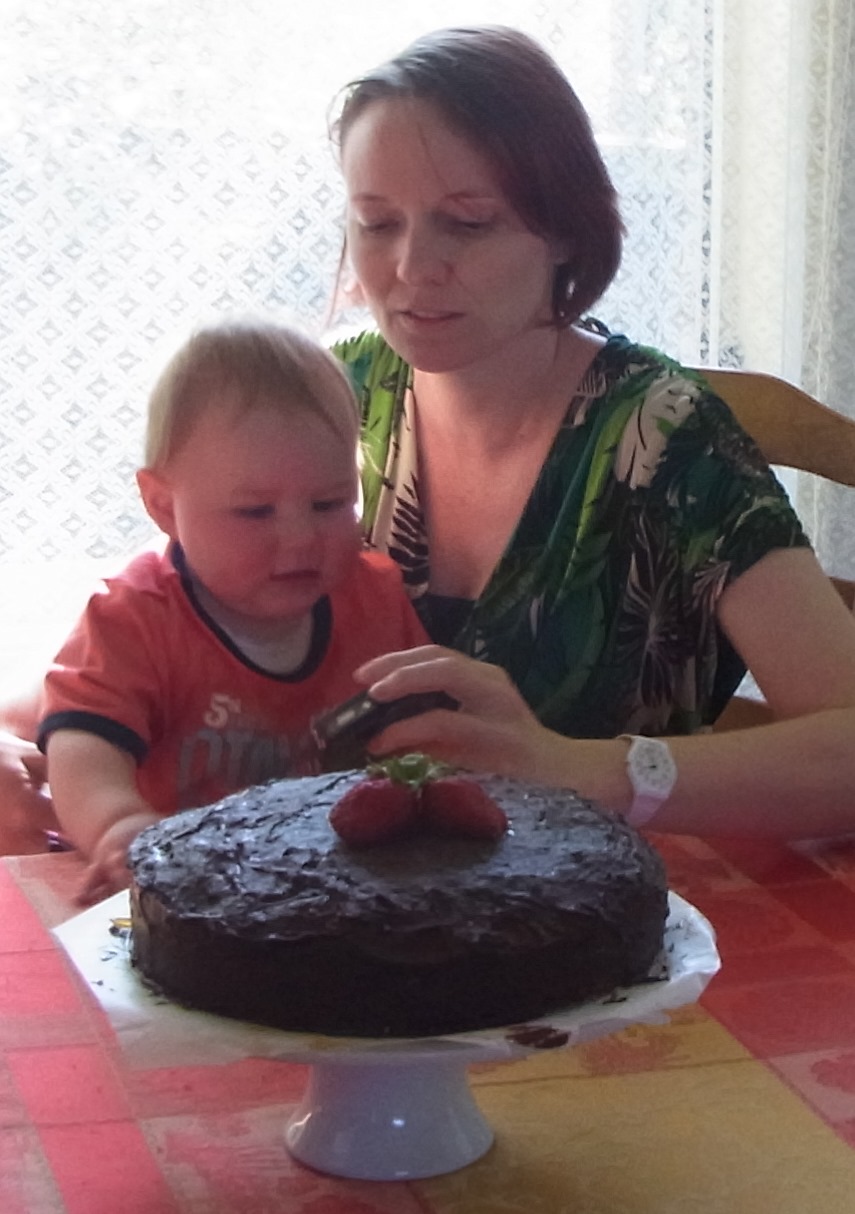
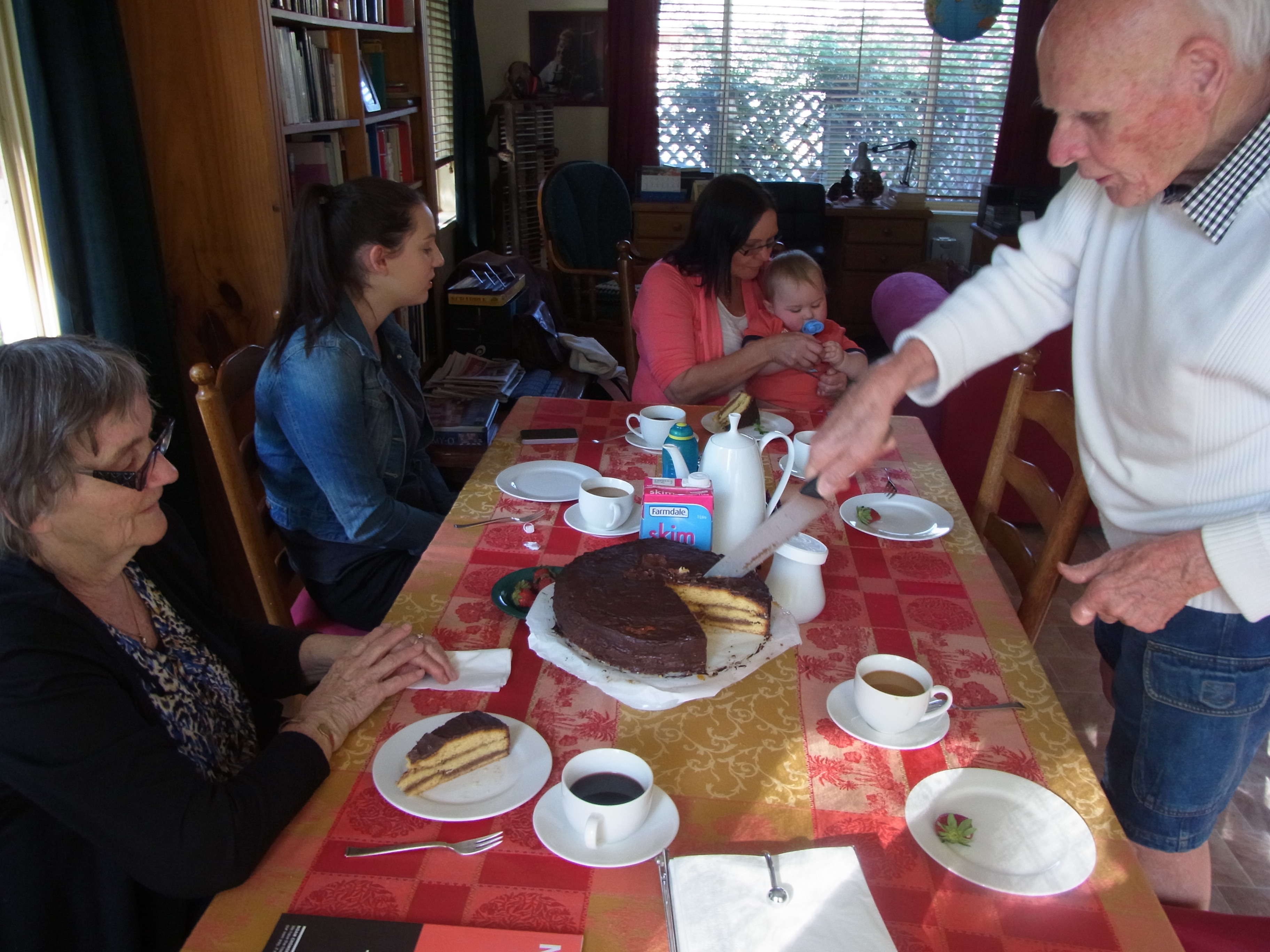
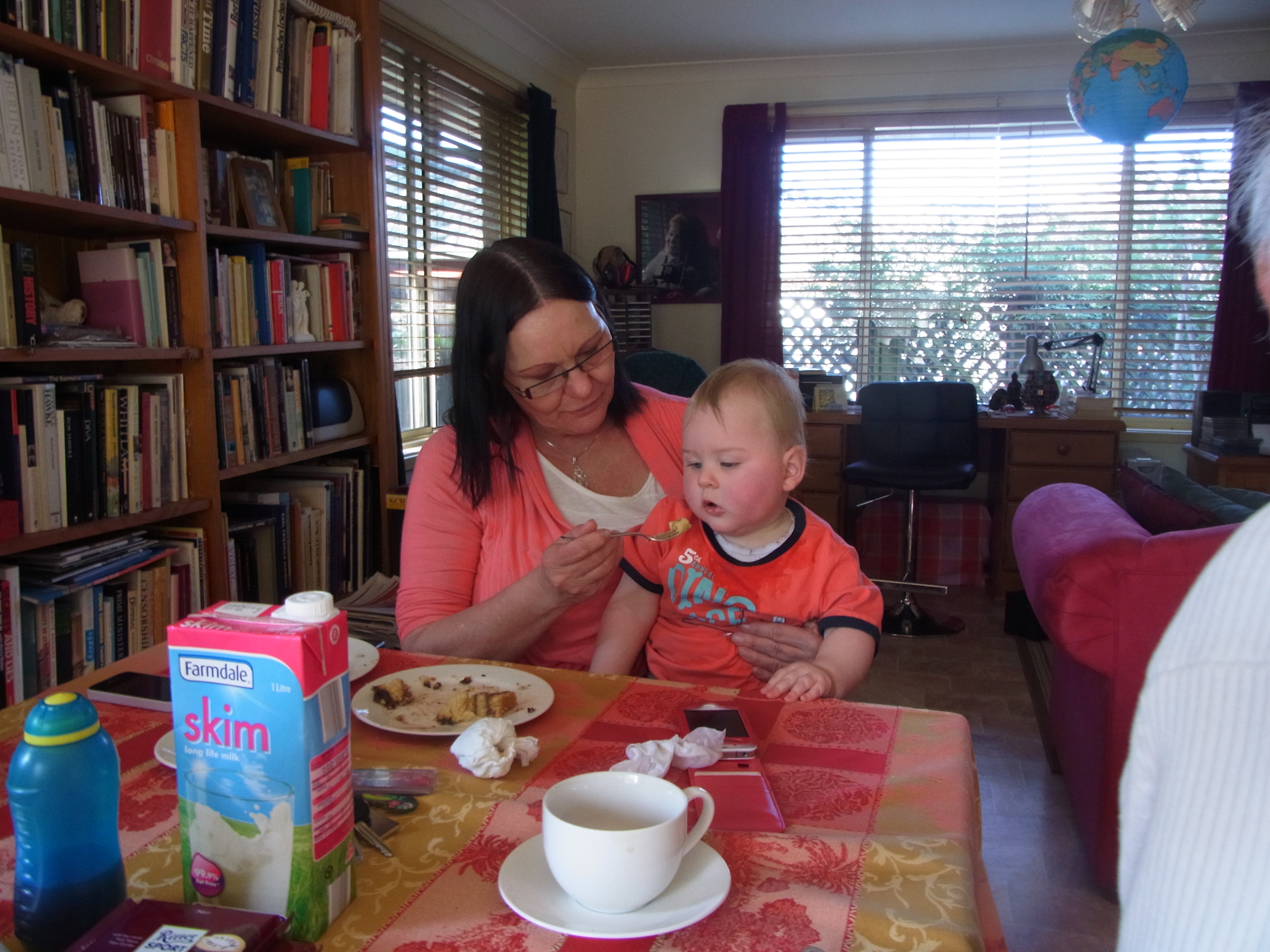
UR -OPA PETER WITH GREAT-GRANDSON LUCASFather’s Day CakeLucas with Aunt Caroline admiring the cakePeter spoils us on Father’s Day.Monika gives her grandson some cake.
Lucas likes the cake very much and just wants more and more. When there’s no more cake left on Monika’s plate he moves over to his Mum who gives him more cake from her plate. Peter tells Lucas to remember that his Opi baked the cake! Opi is a cake lover too. So Lucas has this in common with his Great-Granddad.
Peter loves baking cakes. This cake was made with almond-meal and semolina and lots of eggs. The filling was fresh cream (with some chocolate spread in the cream) and also some apricot jam. As topping Peter used dark cooking chocolate.
Lucas is now 13 months and a bit and loves to walk. He walked tirelessly round and round in our place, from the dining room to the kitchen, to the hallway and back to the dining room. While he was eating his cake he made noises of pleasure that sounded like singing.



 AuntyUta