What’s on the ABC?

https://www.netflix.com/tudum/articles/byron-baes-fights-drama-sound-bath-art-therapy

Byron Baes has us thinking about ‘sound healing’. But what is it?

ABC Everyday

 / By Yasmin Jeffery

Hannah Brauer sits with her legs crossed and holds hands above her head while another woman does "sound healing" next to her
Byron Baes’ Hannah (left) invites Ruby (right) to do some “sound healing” at a party in the show’s first episode.(Supplied: Netflix/ABC Everyday: Luke Tribe)

Share

I’m only a few episodes deep into Byron Baes and I already have so many questions. 

For starters, what is a “ceremonial cacao”? And why does everyone hate the Gold Coast so much?

But of all the questions I’m dying to ask Byron Bay’s “tight-knit inspirers”, I’m most curious about the “sound healing” Hannah books for the party at her parents’ bougie house in the first ep.

“I’m having my beautiful sound healing lady play a little,” Hannah announces at the event, trailing off as she gestures into the air.

“It’s about music as it changes the molecular cellular levels.”

A few reality-TV minutes later, Ruby the sound healer arrives.

Then she begins using what look like singing bowls to create “meditative vibrations“.

Some people at the party take it seriously, but there’s also plenty of laughter and shared confused glances. If I were there (a gal can dream) I probably would’ve raised an eyebrow.

Your shortcut guide to new Netflix show Byron Baes

Netflix divided Byron Bay locals when it announced last year it was filming a reality TV show in the town.

A group of young fashion-conscious people stand together outdoors holding drinks

Read more

Because … what is sound healing?

Psychologist Mary Hoang tells me sound healing is an ancient practice that uses different instruments including singing bowls and tuning forks to give people “an experience of their mind and body state”.

“Sound healing has been used for quite a long time to help people connect to their emotions, remember past experiences, and it’s an opportunity to just relax and get a sense of wellbeing,” Ms Hoang continues.

“It’s [based on] the idea that the music will have a direct effect on the body and brain and that it will be able to bring about some kind of healing,” adds Professor Katrina McFerran, head of music therapy at the University of Melbourne.

Professor McFerran says this is very different to music therapy, which is a research-based profession that involves music therapists working with people “to achieve their goals using music”.

Some examples of this include using music to help improve pain relief, for help with rehabilitation goals, or to develop insight into personal issues.

This is not to say the contemporary practice of music therapy in Western culture, which sits within a medical model, is “better” than sound healing, or that there’s no point to it.

“There are longstanding cultural traditions of using music within all kinds of rituals which might be described as forms of healing. It’s really important to be respectful of that, and not to disregard what may be thousands of years of beliefs and practices using music,” Professor McFerran adds.

Be a part of the ABC Everyday community by joining our Facebook group.

What the experts do know about the impact sounds can have on us

There’s plenty of research that supports the fact that making and listening to music is beneficial to our social and emotional wellbeing.

“I don’t know if [sound healing] ‘changes the molecular structure of the cells’ [like Hannah claims], but music can help trigger different emotions and memories and help reduce stress by reducing the heart rate [and] decreasing cortisol in the body,” Ms Hoang says.

The ingredients that make Byron Baes compelling reality television

Netflix’s first ever Australian reality docu-soap series Byron Baes is proving popular. 

To women take a selfie on an iphone. One is holding crystals.

Read more

And Amanda Krause, a lecturer in psychology at James Cook University, says “there are cognitive, spiritual and physical benefits” to hearing music and sounds, too. 

“But it’s really important to note that peoples’ preferences play a role [in the level of benefit that comes from listening to them],” she adds. 

If you like what you’re listening to and you’ve chosen to listen to it, she says that’s when you’d start to see some of the positive benefits we just touched on.

But if you don’t respond well to a particular song or sound — say the chiming vibe at Hannah’s party grates on you — you won’t.

Professor McFerran says this is why music therapists and music psychology researchers veer away from “generalisations about the reactions and responses people have to music emotionally, let alone at what you might call a level of ‘healing’.”

How to start meditating

Seven tips to help you start meditating, no matter where you are.

Zohab Zee Khan sitting in meditation on top of a large rock depicting our 7 easy ways to start meditating.

Read more

Want to experience it for yourself? Here’s what to look for

If you decide to see a sound healer, Ms Hoang recommends considering your expectations and what you want from it beforehand.

“Some sound-healing claims can be quite far-reaching of what the effects might be,” she says.

“When choosing a sound healing experience, find out if the person has experience working with what you’re coming to work through. 

“And if you’re working on more acute mental health issues, you probably want to see someone who’s trained in psychology or a music therapist.”

She also suggests opting for a tailored experience that takes the sounds you find pleasing into account, whether that’s ambient beats, guitar or rock.

This is general information only. For personal advice, you should see a qualified medical practitioner.

ABC Everyday in your inbox

Get our newsletter for the best of ABC Everyday each week

Your information is being handled in accordance with the ABC Privacy Collection Statement.Email addressSUBSCRIBE

Posted Yesterday at 6:00amFri 18 Mar 2022 at 6:00am, updated Yesterday at 8:10amFri 18 Mar 2022 at 8:10am

Share

Related Stories

These are the shows Australians are ashamed to watchShows we are hanging out for in 2022Here’s your guide on how to get the most out of meditationThree quick exercises to help you through anxious moments

Entertainment, Mental Health, Spirituality

Back to top

More from ABC Everyday

RECIPE

Hetty McKinnon recommends making fried rice on a tray

Vegetarian fried rice that's baked on a tray with eggs, peas, beans, sugar snap peas, leek and asparagus, an easy family dinner.

Three easy dinners that freeze well too

A large tray of beef cottage pie fresh from the oven, ready to be served for a family dinner.

Why some people in a household get COVID, but others don’t

Amanda Tye husband

Dinner in under 25 minutes? Try these recipes

A pan of one pot spaghetti with parsley, capers, tuna, lemon, peas and asparagus.

How much superannuation should you really have at your age?

Man checking his super balance on paperwork and looking thoughtful, in a story about how much superannuation should you have.

Edwina took cold showers every day for a month. Here’s what happened

A woman stands in a garden smiling, in a story about trying cold showers for its benefits.

Cooked rice can make you sick if you don’t store it like this

An illustration of a skull and cross bone next to a bowl of rice photographed from above.

Found something fungi at home? Here’s some tips to remove that mould

Woman covering her mouth and nose with her hands as she looks at mould on a wall in a home.

ABC Everyday

ABC Everyday helps you navigate life’s challenges and choices so you can stay on top of the things that matter to you.

Opinion: Volodymyr Zelensky – the modern warrior-artist

https://www.washingtonpost.com/opinions/2022/03/15/volodymyr-zelensky-modern-warrior-artist/

By Kathleen ParkerColumnist

Listen to article

3 min

Ukrainian President Volodymyr Zelensky addresses the nation in Kyiv on Feb. 25. (Handout/AFP/Getty Images)

video of a duo singing “Endless Love,” the 1981 song by Lionel Richie and Diana Ross, identified the singers as Ukrainian President Volodymyr Zelensky and his wife, Olena Zelenska. It immediately went viral.

Sign up for a weekly roundup of thought-provoking ideas and debates

If something seems too good to be true, it probably is. PolitiFact correctly identified the singers as Alejandro Manzano of the band Boyce Avenue and Connie Talbot, an English singer.

On the phone with my sister, who had sent me the link, we both admitted we wanted it to be real, if only because it fit the narrative that Zelensky, an entertainer before becoming a politician, could do anything. To a world long starved of a hero, the Ukrainian president reminded us of the power of unyielding courage in the face of overwhelming odds.

Maybe part of our infatuation is that so few expected so much from Zelensky. Before becoming akin to Superman, he was a television personality and comedian — a funny guy. But signs of backbone were also plain to see: Zelensky had already proved himself to be a stand-up guy when then-President Donald Trump asked him to investigate Joe Biden, and his son Hunter, as the 2020 campaign approached.

A week before the call, Trump had frozen almost $400 million in military aid for Ukraine. Trump was running a squeeze play: Get me some dirt on Biden, he told Zelensky, and Ukraine can have its weapons. This improper hostage-taking of funds for personal political gain resulted in Trump’s first impeachment trial.

Note: Zelensky never did investigate the Bidens, a decision that must seem providential in retrospect.

In the present context, such gambits now seem almost quaint. Nearly three weeks into Russia’s invasion of Ukraine, the 44-year-old Zelensky is Russia’s No. 1 target. Tuesday, as Zelensky likely was preparing for a scheduled virtual address to a joint session of Congress on Wednesday, Olena Zelenska posted online: “Like all wives in Ukraine, I’m afraid for my husband’s life.”

Zelensky long ago mastered the art of simultaneously taunting Putin and inspiring the world. In one recent gibe, Zelensky showcased a photo of an apparent Russian missile fragment, found near his residence in Kyiv. “Missed,” Zelensky said to Moscow.

https://5fba6c40b38118e5b9c8f8acaf4906f9.safeframe.googlesyndication.com/safeframe/1-0-38/html/container.html

While requesting a meeting with Putin on March 3, Zelensky said, “I don’t bite. What are you afraid of?”

Citing Putin’s curious habit of sitting at the end of extremely long tables during meetings with aides, Zelensky said, “Sit down with me to negotiate, just not at 30 meters.”

Nina Khrushcheva, great-granddaughter of former Soviet premier Nikita Khrushchev and a professor of foreign affairs at Manhattan’s New School, told me recently that she believes Putin puts himself at the end of long conference tables to avoid being physically compared with other men. She also briefly considered the possibility that Zelensky had hired a public relations firm to help sharpen his mordant trolling of the Russian president.

“I thought he had hired a PR agent because it was so well choreographed,” she said.

But then, Zelensky is a comedic actor, an art that is serving him well. If he’s fearful, he doesn’t show it as he walks the shell-shocked streets of Kyiv. He has made clear he won’t leave Ukraine, inspiring his fellow Ukrainians to stand and fight. Equal parts Sam Elliott, Stephen Colbert and, in the romantic fantasies of at least two gullible sisters, a crooner, Zelensky has gone a long way toward redefining manhood in a time of gender muddle and animus toward men.

He is the modern-day warrior-artist — political and presidential, fearless and faithful, humble yet cocky, beautiful in his ordinariness. An Everyman in his trademark T-shirt and half-zip, Zelensky is David against Goliath, shouting to the world that he’s not afraid. We are riveted because this bird is so seldom seen.

Art and war have been companions through the centuries, but it’s rare to discover someone who combines the spirit of both disciplines. Zelensky has reminded us that a warrior’s strength isn’t measured in missiles; and that an artist’s soul (along with sharp wit) guards freedom as much as the point of a spear.

The best men in history have understood these imperatives and rallied others as their time commanded. Zelensky was made for this role in this moment. Bravo.

War in Ukraine: What you need to know

The latest: Fierce fighting continues across Ukraine, with Russian shells bombarding an apartment building in the capital, Kyiv, on Monday. Here’s the latest status of Ukrainian cities under Russian attack.

Oil prices: Sanctions on Russia are helping gas prices hit new highs. Here’s why — and how long the surge could last.

The fight: Casualties are mounting in Ukraine — including civilians, while Moscow is facing allegations that it has used cluster and vacuum weapons. Russia’s assault on Ukraine has been extensive with strikes and attacks across the entire country.

The response: Russia’s war could be a global economic “game changer,” with rising gas prices and shifting trade decisions suggesting change that will be felt for years. Meanwhile, in Russia, online access has been significantly curtailed by censors at home and businesses abroad. Boycotts of Russia and campaigns in support of Ukraine have been launched from a range of industries.

How you can help: Here are ways those in the U.S. can help support the Ukrainian people as well as what people around the world have been donating.

Read our full coverage of the Russia-Ukraine crisis.

Show less

199 Comments

Gift Article

Image without a caption

Opinion by Kathleen ParkerKathleen Parker writes a twice-weekly column on politics and culture. She received the Pulitzer Prize for Commentary in 2010.  Twitter

War in Ukraine: What you need to know

https://www.washingtonpost.com/opinions/2022/03/15/volodymyr-zelensky-modern-warrior-artist/

The latest: Fierce fighting continues across Ukraine, with Russian shells bombarding an apartment building in the capital, Kyiv, on Monday. Here’s the latest status of Ukrainian cities under Russian attack.

Oil prices: Sanctions on Russia are helping gas prices hit new highs. Here’s why — and how long the surge could last.

. . . . .

Is it time to rethink the traditional IQ test?

ABC Radio National

By Fiona Pepper and Bec Zajac for Life Matters

 Posted Tue 5 Feb 2019 at 6:00amTuesday 5 Feb 2019 at 6:00am, updated Wed 6 Feb 2019 at 12:44pmWednesday 6 Feb 2019 at 12:44pm

 5 Feb 2019 at 6:00amTuesday 5 Feb 2019 at 6:00am, updated Wed 6 Feb 2019 at 12:44pmWednesday 6 Feb 2019 at 12:44pm

Aerial view of students completing an exam.
The IQ test is held in high regard — but is it a genuine measure of intelligence?(Getty Images: Chris Ryan)

Help keep family & friends informed by sharing this article

For over 100 years, the intelligence quotient (IQ) test has been considered the quintessential marker of who is “smart” and who is not.

But a dip in IQ scores worldwide has researchers questioning if it’s time to broaden how we understand intelligence.

“My particular theory is that scores really haven’t gone backwards, but the IQ test hasn’t kept up with the way we’re using our brains,” says Tony Florio, a clinical psychologist and senior lecturer at the University of NSW.

He argues the test measures only a certain kind of intelligence, and is therefore of limited use.

Tony sits on a bench under a tree looking at the sky.
Tony Florio is a clinical psychologist who specialises in IQ, but he believes the test doesn’t measure everything.(ABC RN: Farz Edraki)

Dr Florio suggests that the IQ test might help us see who will be successful in a traditional school system, which was its original purpose, but that it is not the be all and end all about who’s smart and who isn’t.

Dr Florio has studied the test for decades and says a typical IQ test is divided into ten subsets including vocabulary, general knowledge and problem solving.

In Australia, he says, these tests are conducted by psychologists either clinically, in schools or very occassionally for organisational psychology testing — for example when selecting members for executive committees.

An IQ score of a 100 is considered a score of average intelligence, 130 and above is defined as gifted, and a person scoring below 70 is interpreted as having an intellectual disability.

Not the first time the test has been criticised

Dr Florio has several criticisms about the breadth of the IQ test, which, he says, measures linguistic and logical-mathematical abilities and not motivation, personality or creativity.

“It’s gone down a narrow pathway,” he says.

He’s not alone in criticising the test.

He says there has been a perennial debate about whether there is one general intelligence.

Is there more to being smart than IQ?

Dr Florio argues that the IQ test doesn’t necessarily accommodate that “individuals are complicated with many aspects to them” — pointing to similar concerns raised by the test’s very founder.

He explains that French psychologist Alfred Binet, who developed the IQ test over 100 years ago, feared the test — initially designed to help measure the ‘mental age’ of a child — could be too limited.

Binet stressed that intelligence was far too broad a concept to quantify with a single number; however, he designed the test as a way to help identify children with learning difficulties.

France was the first country to introduce universal education and needed to work out who would struggle with learning and might need extra help, Dr Florio explains.

He says it’s much easier to compare people as children because there are different educational milestones that they reach at different ages.

If children were reaching them at a younger age they were seen as gifted and if they were reaching them later they were seen as delayed.

In 1916, Dr Florio highlights, an American psychologist adapted the IQ test for use in the US Army and since then the test has been adopted by many institutions other than schools.

The impact of the ‘Google effect’

Since the test first began in 1906 there has been, until recently, a steady increase in IQ score test results worldwide, a trend dubbed ‘the Flynn Effect’.

Dr Florio says factors that led to the Flynn Effect were improved nutrition and maternal health, and increasing access to education.

Even the reduction in the average size of families was a contributing factor, says Dr Florio, as “there’s less children per family so more attention per child”.

Now, however, Dr Florio says research shows a decline in scores occurring specifically throughout Europe where most of the relevant research has been conducted, and this is being branded the ‘reverse Flynn Effect’.

Research seems to suggest that worldwide our IQ scores in developed countries have been dropping over the last decade, Dr Florio says.

Davina Bell standing in hallway.
Davina Bell is a children’s author whose most recent book is called ‘All the Ways to be Smart’.(ABC RN: Fiona Pepper)

“You’d think logically that it should’ve just plateaued but it seems to have in fact gone backwards.”

According to Dr Florio, there are several theories to explain this.

“There’s a theory that’s been dubbed the ‘Google effect’,” he says.

“Because we now outsource a lot of things like our memory and doing cognitive tasks to machines, we don’t develop general knowledge retention which is something that is measured on IQ tests.”

Dr Florio says another explanation could be “that we can’t improve forever”.

But do the decreasing results point to a decreasing intelligence?

Dr Florio isn’t convinced.

He says it may be that it’s not useful to have that kind of general knowledge memory any more, which means that the IQ test as we understand it may need to change.

More than one way to be ‘smart’

Children’s book author Davina Bell, who has researched alternative approaches to intelligence, sits firmly in the camp that argues there is more than one way to be intelligent.

She says she has long felt that creative pursuits were undervalued in traditional intelligence tests, an idea she’s explored in her latest children’s book, All the Ways to be Smart.

An illustration of students sitting in a classroom
Davina aimed to create a children’s book that celebrates all the many ways someone can be ‘smart’.(Supplied: Allison Colpoys)

While researching for this book, Bell discovered the work of Harvard psychologist Howard Gardener and his theory of Multiple Intelligences.

“Gardener said that rather than seeing intelligence as dominated by a single general ability we should see it as a series of modalities or abilities,” Bell says.

Listen to the podcast

Life Matters is here to help you get a handle on all the important stuff: love, sex, health, fitness, parenting, career, finances and family.

Read more

Gardener describes nine categories to measure intelligence, including bodily-kinesthetic intelligence, such as good hand-eye coordination, interpersonal intelligence, such as the ability to effectively communicate, and musical intelligence.

Bell wanted to create a book that honoured all nine ‘ways of being smart’, for example being ‘smart’ at drawing, interacting with others or being physically coordinated.

“The book offers a kind of validation,” Bell says.

“If you weren’t a traditionally smart person or if you had intelligence in other areas that perhaps weren’t recognised, maybe it provides a validation of your identity outside those traditional intelligences,” she says.

Dr Florio supports Gardener’s broader approach to intelligence, but says the academic community’s response to Gardener’s theory is mixed.

Illustration of two children doing craft at a desk.
Bell’s book highlights creativity as one of the nine ways of being smart.(Supplied: Allison Colpoys)

“I think Gardener’s theories are valid, there are lots and lots of other abilities,” Dr Florio says.

Although Dr Florio explains Gardener’s critics say his definition cannot be quantified and in the academic community some say it is not backed up by enough data.

Dr Florio believes there still is a place for the traditional IQ test when it comes to diagnosing conditions like autism, dyslexia and intellectual disabilities.

But, like Bell, he sees approaches like Gardener’s as offering a broader and more modern understanding of intelligence.

“Gardener was pointing out the limitations of the IQ test and the problems of focusing on one aspect. We are complex individuals,” he says.

Posted 5 Feb 20195 Feb 2019, updated 6 Feb 2019

Monday Afternoon/14/03/2022

It was such a nice sunny day, today! 🙂

I enjoyed this easy to breathe air without any moisture in it! 🙂

A bit before 2 PM a walked over to the Club. I spent there about 

an hour sitting in nice surroundings. It was a quiet day at the Club. 

Not many people go to the Club on Monday or Tuesday, for these are the days when the Bistro stays closed: So, no food is available on these days.

I liked to sit there for two hours in the afternoon with only a couple of drinks: First I had some cappuccino, and after about one hour I had a glass of chilled Riesling. 🙂

As a member of the Club, I paid only 4 Dollars for each drink! 🙂

While sitting there, I looked into one of my books from the Dapto Library:

A cute little book about Paris with beautiful photos on every page! 🙂

This booklet is called “Quiet Paris” and has 142 pages. 🙂

So that you may get an idea, what these pages are about, I copy, what it says about the content:

(Introduction, with no pictures, starts on page 6)

Museums starts on page 10

Libraries starts on page 22

Parks and Gardens starts on page 32

Places to relax 52

Places of Worship 62

Shops 72

Restaurants 88

Cafes 100

Bookshops 110

Galleries 122

Cultural Centres 130

Places to stay 136

Paris is such a beautiful city! 🙂

I have been there for a week in 1954 as a 19-year-old, and

absolutely loved then my time in Paris! 🤩

I loved it again 36 years later in 1990, when I was there with

Peter and 11 year old daughter Caroline! 🙂

I may sing now this German song about travelling:

“Wenn ich ein Vöglein wär

Und auch zwei Flügel hätt

Flög ich dort hin!

Weils aber nicht kann sein,

Weils aber nicht kann sein,

Bleib ich all hier! “

Ja, ich bleibe hier . . . .

Still, I do enjoy very, very much

looking at all these great photos 

about Paris! 😍

This afternoon, soon after 4 PM, 

I walked home with my rollator in

glorious sunshine!

Environmental Risks And Opportunities

Thank you, dear Lew, for another extremely well researched post on an a very important subject!

lewbornmann's avatarLew Bornmann's Blog

It seems to me….

We owe it to ourselves and to the next generation to conserve the environment so that we can bequeath our children a sustainable world that benefits all.”  ~ Wangari Maathai[1].

COVID-19 has presented an opportunity for a positive response to the environmental challenge we are facing.  The recovery effort will necessitate considerable stimulus investment.  If that investment is made in an environmentally friendly manner, such as sustainable solar and wind power generation rather than in bailing out carbon-based corporations, it can be a win for everyone.  Otherwise, it will set us on a pathway to environmental catastrophe.

Unfortunately, Donald Trump saw it differently voicing his “1,000 percent” support of the oil and gas industry[2] setting the U.S. back by considerably more than just his four years in office. Historically, recessions are typically followed by sharp rebounds in emissions, hopefully, this time…

View original post 1,979 more words

What I wrote as a comment to a blog by Dawn Pisturino on Feb. 27th/2022

Dawn Pisturino

Dawn Pisturino

I think, it is not hard to understand, that from the Russians point of view, it is of the utmost importance, that they create all around Russia sufficient buffer zones in order to secure Russian borders as much as possible.

They are very powerful country now! This gives them the means for securing all their borders!

I think they are not out for any wars: They just want to b e able to keep securing all their borders!

All people, that study history objectively, should find it obvious, why the Russians, with Putin as their leader, right now act the way they do!

Hasn’t the West fed them lie upon lie? I don’t see, why they should have any reason to trust us!

The Funny Man Volodymyr Zelensky

Navigate to News section

Ukraine’s Hero President Z.

The funnyman who became a warrior and founded a new Europe

BY

BERNARD-HENRI LÉVY

MARCH 01, 2022

Courtesy the author

Volodymyr Zelensky meets with Bernard-Henri Levy, 2019COURTESY THE AUTHOR

Idon’t know if, by the time this article appears, Volodymyr Zelensky will still be alive.

We do know that he is in Kyiv, surrounded by his generals, in a bunker that the Sukhoi fighter jets seek.

And we have just seen him in a video where he appears helmetless, outside, like a young Churchill walking in the poor neighborhoods of London during the Nazi Blitz of September 1940.

But I also know that he is at the top of the Kremlin’s kill list, according to the English-language press.

His recent farewells come to mind—on Friday, Feb. 25, to his counterparts over Zoom during a special meeting of the European Union: “This is maybe the last time that you will see me alive.”

What is greatness?

True greatness, as taught by European chivalry?

Perhaps it is that.

That heroism, calm and proud.

A touch of Allende the night before the assault of the Moneda by Pinochet’s death squads.

The way he told President Biden, who offered up an exfiltration—“I need weapons, not a taxi”—and Putin, today’s Pinochet: “You can try to kill me, I am ready for it, since I know that the idea lives in me and will survive me.”

The first time I met him was on March 30, 2019, the night before the first round of his stunning election, in a seafood restaurant near the Maidan.

I had just performed, at the Taras Shevchenko National University of Kyiv, Looking for Europe, the theatrical monologue that I was bringing then to the European capitals. My friend Vladislav Davidzon, one of the last American journalists still in Ukraine—reporting for Tablet—had arranged the meeting.

FROM THE ARCHIVES

Getty Images
Getty Images

News section icon

Ukraine’s New President Is a Jewish ComedianTablet’s Vladislav Davidzon gained special access to Volodymyr Zelensky, Ukraine’s enigmatic new leader who once played the president on TV. Here, Davidzon shares his impressions of Zelensky and his predictions for Ukraine’s political future.

BYVLADISLAV DAVIDZON

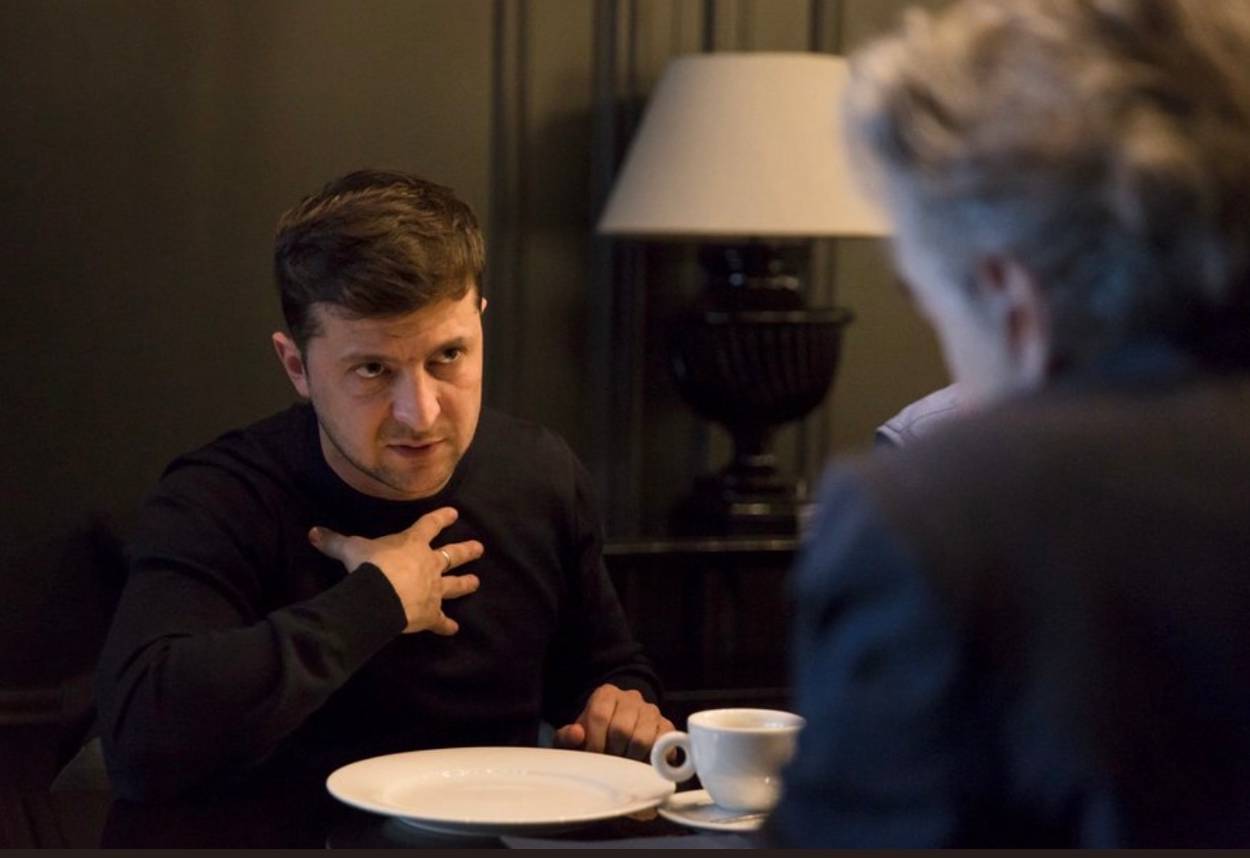
Volodymyr Zelensky was, at the time, a very young man. Looking like a paper boy in jeans, old sneakers, and a black T-shirt with a worn neckline, he had spent the night celebrating the final performance, in an old Kyiv skating rink turned café-theater, of “Servant of the People,” the one-man show that had made him famous.

We talked about Beppe Grillo, that other cabaret actor, and founder of the Five Star movement in Italy, whom Zelensky hated being compared to.

About French Coluche, whose story he didn’t know well and whose final pirouette, a decision to retire from the presidential election, he did not quite understand: “Maybe because there was now a great man in France, François Mitterrand, so his service was no longer needed?”

About Ronald Reagan, by contrast, he knew everything; hadn’t he just done—for the Ukrainian TV channel 1+1, which belongs to the Israeli-Ukrainian Igor Kolomoyskyi, Zelensky’s sponsor—the voice-over for a docudrama on the destiny of this actor in bad Westerns who became a great president?

We also spoke about Putin, the other Vladimir, about whom he had no doubt: If he would come face to face, he would make Putin laugh, just as he had made all Russians laugh. “I act in the Russian language, you know; the kids love me, in Moscow; they double over with laughter at my sketches; the only thing is …”

He hesitated …

Then, over the table, in a low voice: “There is one thing … this man does not see; he has eyes, but does not see; or, if he does look, it’s with an icy stare, devoid of all expression.”

The other subject of our conversation was his Judaism.

How could a young Jew, born into a family decimated by the Shoah, in the oblast of Dnipropetrovsk, become president of the country of Babi Yar?

It’s simple, he answered, with a hoarse laugh: “There is less antisemitism in Ukraine than in France; and, above all, less than in Russia where, hunting for the Nazi mote in thy brother’s eye, they end up missing the beam in thine own eye; wasn’t it Ukrainian units of the Red Army that liberated Auschwitz, after all?”

Our second meeting took place at the annual Yalta European Strategy conference, the Ukrainian mini-Davos created by the philanthropist Victor Pinchuk.

Like every year, there were distinguished geopoliticians, American officials, NATO representatives, acting or former European heads of state, and intellectuals.

Zelensky, now president, gave a strong speech in which he laid out his plan for combatting corruption, the scourge of his country’s economy.

The time came for the traditional closing dinner, where the host would, over pears and cheese, offer a “surprise” to anchor the event: one year, Donald Trump, candidate … another, Elton John or Stephen Hawking …

This time the surprise, arriving on the stage, in front of the tables, is the troupe of actors who had performed with the new head of state, up to his election.

One does an impersonation of Angela Merkel.

Another plays a supposed WhatsApp exchange, hilarious and salacious, between Trump and Hillary Clinton.

And here was a third, made up like Zelensky, playing a rustic Ukrainian who speaks poor English searching for someone to interpret for him and pointing, as if by chance, at the real Zelensky, who without being asked twice, bounds out of his chair to join his comrades on stage.

That was the situation.

A fake Zelensky, playing the real one.

The real Zelensky, playing the interpreter of the fake.

The fake, translated by the real, offers up howlers that the other is forced to translate, which make fun of him.

In short, an incredible show.

The room, faced with this quid pro quo, this joyful blurring of original and copy, faced with the self-effacement of a president swallowed by his avatar, hesitates among laughter, uneasiness, and amazement.

That night, Zelensky was Woody Allen inviting us, like in The Purple Rose of Cairo, into his film, or, better, into his TV series.

When the show was over, I went to ask him what Putin, in Moscow, might think of this enemy disappearing behind his mask and allowing himself to be silent within his simulacrum. He told me this: “It’s true! The attitude is surely unheard of in the main repertoire of the FSB! But laughter is a weapon that is fatal to men of marble! You shall see.”

We met again, once more, last year.

I was coming back from reporting in the Donbas, where I had run the front lines from Mariupol to Luhansk, with elite troops of the new Ukrainian army. And while my photographers, Marc Roussel and Gilles Hertzog, had laid out some of their best shots on the coffee table in the room where we were being received, a whole other Zelensky revealed himself.

In one of the photos, taken at Novotroitske, Zelensky recognized Major General Viktor Ganushchak, the leader of the 10th Battalion of the Alpine Chasers brigade, mildly paunchy in a chicane jacket straight out of frozen Verdun.

About another photo, taken in the Myroliubovka zone, near Donetsk, he commented to Andriy Yermak, his close adviser, to his right, on the vulnerability of three 155 mm cannons, positioned like prehistoric iron monsters in the middle of a field.

About a third, taken near Donetsk, on a gutted road in the ghost town Pisky, he knew the exact number of brave souls who, dug into the mud and snow, held the line.

And then, in Zolote, not far from Luhansk, in a maze of trenches made from an assembly of planks planted in the black earth, he knew by name, having just inspected them, most of the overequipped Rambos, their faces muddy or hooded, who stood guard every 30 feet and seemed hypnotized by the no man’s land before them.

Did Volodymyr Zelensky already know, on that day, that Putin had decided he’d had enough of the Ukrainian democratic exception, and of his clowning?

Did he understand that he would never, after all, laugh with the cold-eyed man with an assassin’s soul?

At that moment, things became clear.

I understood that this former artist of the LOL and the stand-up, whose true nature I thought I had found at the gala dinner in Kyiv, had transformed himself into a warrior.

I saw him join the exemplary company of the men and women that I’d revered my whole life—from republican Spain to Sarajevo and Kurdistan—who are not made for the part that befalls them, but who take it up with panache and learn to make war without loving it.

And in his silhouette grown heavier, on his features once young like French republican drummer boy Francois Joseph Bara, now resembling the French revolutionary Georges Danton, I saw the resistance fighter whose courage amazes the world today.

This man prefers to die fighting than to suffer the dishonor of forced surrender.

Young Global Leaders

https://en.wikipedia.org/wiki/Young_Global_Leaders#:~:text=The%20program%20was%20founded%20by,class%20comprised%20237%20young%20leaders.

From Wikipedia, the free encyclopedia

Jump to navigation

Jump to search

The Forum of Young Global Leaders, or Young Global Leaders (YGL), was created by Klaus Schwab, Founder and Executive Chairman of the World Economic Forum. It is a non-profit organization managed from GenevaSwitzerland, under the supervision of the Swiss government.

The program was founded by Klaus Schwab of the World Economic Forum in 1993 under the name “Global Leaders for Tomorrow” and was renamed to Young Global Leaders in 2004.[1]

Schwab created the group with $1 million won from the Dan David Prize,[2] and the inaugural 2005 class comprised 237 young leaders.

People recognized as a Young Global Leader are allowed to attend one meeting of the World Economic Forum for free.[3]

Reception

BusinessWeeks Bruce Nussbaum describes the Young Global Leaders as “the most exclusive private social network in the world”,[4] while the organization itself describes the selected leaders as representing “the voice for the future and the hopes of the next generation”.

. . . . .