Naomi Klein: This Changes Everything

https://thischangeseverything.org/book/

I copied the following for I think it makes for very interesting reading

HIS CHANGES EVERYTHING: THE BOOK

Hilary Weston Writers’ Trust Prize for Nonfiction
Observer Book of the Year
New York Times Book Review 100 Notable Books of the Year

Forget everything you think you know about global warming. The really inconvenient truth is that it’s not about carbon—it’s about capitalism. The convenient truth is that we can seize this existential crisis to transform our failed economic system and build something radically better.

In her most provocative book yet, Naomi Klein, author of the global bestsellers The Shock Doctrine and No Logo, tackles the most profound threat humanity has ever faced: the war our economic model is waging against life on earth.

Klein exposes the myths that are clouding the climate debate.

We have been told the market will save us, when in fact the addiction to profit and growth is digging us in deeper every day. We have been told it’s impossible to get off fossil fuels when in fact we know exactly how to do it—it just requires breaking every rule in the “free-market” playbook: reining in corporate power, rebuilding local economies, and reclaiming our democracies.

We have also been told that humanity is too greedy and selfish to rise to this challenge. In fact, all around the world, the fight for the next economy and against reckless extraction is already succeeding in ways both surprising and inspiring.

Climate change, Klein argues, is a civilizational wake-up call, a powerful message delivered in the language of fires, floods, storms, and droughts. Confronting it is no longer about changing the light bulbs. It’s about changing the world—before the world changes so drastically that no one is safe. 

Either we leap—or we sink.

Once a decade, Naomi Klein writes a book that redefines its era. No Logo did so for globalization. The Shock Doctrine changed the way we think about austerity. This Changes Everything is about to upend the debate about the stormy era already upon us.

WHAT PEOPLE ARE SAYING

“A book of such ambition and consequence that it is almost unreviewable … the most momentous and contentious environmental book since “Silent Spring.”

— New York Times Book Review

“Written with an elegant blend of science, statistics, field reports and personal insight, it does not paralyze but buoys the reader. The book’s exploration of climate change from the perspective of how capitalism functions produces fresh insights and its examination of the interconnectedness between our relationship with nature and the creation of better, fairer societies presents a radical proposal. Klein’s urgency and outrage is balanced by meticulous documentation and passionate argument. Heart and mind go hand in hand in this magisterial response to a present crisis.”

— Jury citation: Hilary Weston Writers’ Trust Prize for Nonfiction

“Few journalists today take on the big issues as comprehensively and fearlessly as Naomi Klein. She combines rigorous reporting, analysis, history and global scope into a package that not only identifies problems, but also illuminates successful activism and solutions. That goes for her groundbreaking book on climate change and for columns that brilliantly connect the dots – such as the intersection of climate justice and racial justice.”

— Jury citation: The Izzy Award

“This is the best book about climate change in a very long time— reminding us just how much the powers-that-be depend on the power of coal, gas and oil. And that in turn should give us hope, because it means the fight for a just world is the same as the fight for a liveable one.”

— Bill McKibben, author of The End of Nature and co-founder of 350.org

“An enormous, complex, compelling and, by turns, distressing and rallying analysis of the dysfunctional symbiotic relationships between free-market capitalism, the fossil fuel industry and global warming”

— Booklist Review

“Naomi Klein applies her fine, fierce, and meticulous mind to the greatest, most urgent questions of our times. Her work has changed the terms of the debate. I count her among the most inspirational political thinkers in the world today.”

— Arundhati Roy, author of The God of Small Things and Capitalism: A Ghost Story

“Without a doubt one of the most important books of the decade.”

— Amitav Ghosh, author of The Hungry Tide: A Novel

“A work of startling force, exhaustive reporting, and telling anecdote … makes a muscular case for global warming as the defining, cross-sectional issue of our era.”

— Globe & Mail Review

“Naomi Klein has done for politics what Jared Diamond did for the study of human history. She skillfully blends politics, economics and history and distills out simple and powerful truths with universal applicability.”

— Robert F. Kennedy, Jr.

Naomi Klein’s “words and knowledge run deep, inspiring change and the need for immediate action.”

— Charlize Theron

“This Changes Everything gets the science right, but it’s about much more than facts and figures. This is a deeply insightful exploration of the ideology and interests that have systematically blocked climate action and have undercut even good faith efforts. Klein gives no one a free pass. A rousing must-read!”

— Michael E. Mann, director of the Earth System Science Center at Pennsylvania State University and author of The Hockey Stick and the Climate Wars
“Good vs Evil”

Reducing Foreign Policy to Good vs Evil

Last year in March Dr. Stuart Bramhall published a Film Review by Adam Curtis (BBC).

At the moment I was mostly interest in what it said about Good vs Evil. I copy it here:

“Reducing Foreign Policy to Good vs Evil

Like Ronald Reagan, George W Bush attempted to reduce the US role in Afghanistan to a simple battle of good vs evil. The political reality was far more complex. US and Saudi intervention during the Soviet occupation brought corrupt warlords to power who supported their fiefdoms through Afghanistan’s heroin trade.

The Taliban, consisting mainly of Afghan orphans raised in Pakistani Madrassa, were primarily driven by a desire to end the heroin trade and this endemic corruption, which they (rightly) blamed on the interference of western imperialists in their country’s domestic affairs.”

A simple battle of good vs evil? Certainly not. I think it still has not become clear to us what is at spiel. It still is not simple, on the contrary, it seems to become more and more complicated. See here:

Brexit,Trump, Syria and the Fabricated War on Terror

I reblogged the avove!

A sustainable urbanised World?

https://theconversation.com/habitat-iii-the-biggest-conference-youve-probably-never-heard-of-63499?utm_medium=email&utm_campaign=Latest%20from%20The%20Conversation%20for%20September%205%202016%20-%205547&utm_content=Latest%20from%20The%20Conversation%20for%20September%205%202016%20-%205547+CID_3ff983a54929ca2b3404d8bc530ad836&utm_source=campaign_monitor&utm_term=Habitat%20III%20the%20biggest%20conference%20youve%20probably%20never%20heard%20of

The Conversation says:

“Habitat III: the biggest conference you’ve probably never heard of”


I ask myself why on earth have we not heard of this big conference?

The last paragraph in The Conversations’ write-up is as follows:

“Fulfilling our UN member state role in Habitat III is an opportunity not to be missed. Through Quito, we can reinvigorate our national urban policy, build our regional profile and leverage and export our urban expertise. But, more importantly, by taking our seat at the table we will be playing our part in the transition of humanity into a sustainable, urbanised world.”

So,

What is Habitat III?

“Habitat III” is shorthand for a major global summit, formally known as the United Nations Conference on Housing and Sustainable Urban Development, to be held in Quito, Ecuador, on 17-20 October 2016.

http://citiscope.org/habitatIII/explainer/what-habitat-iii


Uta’s Diary, 2nd of September 2016

DSCN2120This morning I am trying to read the verses in yesterday’s post: 
Passion(which was the last one in yesterday’s post): Nothing (unfortunately totally blurred)

DSCN2124

Change: Nothing (also very blurred)


DSCN2125

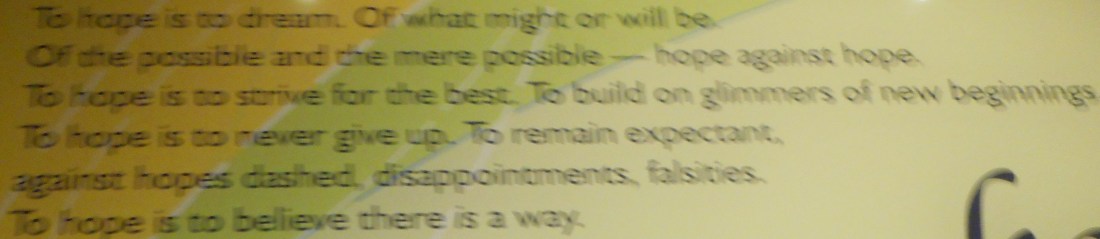
“Hope: To hope is to dream of what might or will be
of the possible and the mere possible – hope against hope
To hope is to strive for the best, To build on glimmers of new beginnings
To hope is never to give up. To remain expectant
against hopes dashed, disappointments, falsities.
To hope is to believe there is a way.”

—————————————-
 The following is a reflection by me on that verse about hope:
Do I hope?
What does a woman in her eighties hope for?
Do I dream of what might or will be, of the possible and the mere possible?
I am contemplating for how long I might or will be still alive. Right, it is possible or mere possible that I’m going to live for another twenty years. But I do not think, it is very likely. To expect five to ten more years is probably more likely.
Now, I want to go to the last line of the above verse: “To hope is to believe there is a way.”
Well, I hope there is a way to stay healthy enough so I’ll never need to go into a Nursing Home.
However, no matter how much I’ll try to look after my health to the best of my ability, I do not believe that there is always a way to avoid a Nursing Home.
In case I cannot avoid going into a Nursing Home I do hope that I’ll be able:
” . . . .  to strive for the best, to build on glimmers of new beginnings,
to . . .   never give up. To remain expectant
against hopes dashed, disappointments, falsities . . . “
——————————————-
Now to JOY:
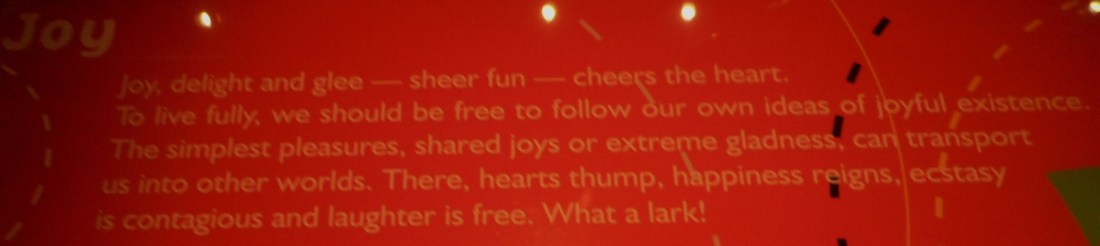
“Joy delight and glee – sheer fun – cheers the heart.

To live fully, we should be free to follow our own ideas of joyful existence.
The simplest pleasures, shared joys or extreme gladness can transport us
into other worlds. There, hearts thump, happiness reigns, ecstasy
is contagious and laughter is free. What a lark!”

DSCN2126

————————————-
Following is my comment!
I agree with everything that is said in this verse about joy. 
I feel blessed for I still have a lot of joy in my life. My joyful  existence
does not include gambling, drinking alcohol to excess, smoking, drug taking,
shopping for things I cannot afford. I feel free to  follow my own ideas of a joyful existence.
I tend to enjoy simple pleasures. When I am in the company of joyful family and friends, ‘my heart thumps’.
The best company is when I can laugh a lot. How  wonderful, that laughter is being had for free!
—————————————–
I was able to retrieve a bit about Loneliness:
 
” , , , You can experience the emptiness of being alone,

sense the vastness of this land, feel the solitude:
Loneliness drives people apart or it draws them together in surprising ways.”

DSCN2127

————————————————–
Devotion, Fear, Thrill and Mystery as well as Eternity,
I’ll come back to these in another post.
I very much like the following words that were printed on a wall in the National Museum:

“The past is never fully gone. It is absorbed into the present and the future. It stays to shape what we are and what we do.”

How the entire nation of Nauru almost moved to Queensland

How the entire nation of Nauru almost moved to Queensland

August 15, 2016 6.16am AEST

Nauru’s parliament would have been rebuilt in Queensland, but with less power. CdaMVvWgS/Wikimedia Commons

Nauru is best known to most Australians as the remote Pacific island where asylum seekers who arrive by boat are sent. What is less well known is that in the 1960s, the Australian government planned to relocate the entire population of Nauru to an island off the Queensland coast.

The irony of this is striking, especially in light of continuing revelations that highlight the non-suitability of Nauru as a host country for refugees. It also provides a cautionary tale for those considering wholesale population relocation as a “solution” for Pacific island communities threatened by the impacts of climate change.

Extensive phosphate mining on Nauru by Australia, Britain and New Zealand during the 20th century devastated much of the country. The landscape was so damaged that scientists considered it would be uninhabitable by the mid-1990s. With the exorbitant cost of rehabilitating the island, relocation was considered the only option.

In 1962, Australia’s prime minister Robert Menzies acknowledged that the three nations had a “clear obligation … to provide a satisfactory future for the Nauruans”, given the large commercial and agricultural benefits they had derived from Nauru’s phosphate. This meant “either finding an island for the Nauruans or receiving them into one of the three countries, or all of the three countries”.

That same year, Australia appointed a Director of Nauruan Resettlement to comb the South Pacific looking for “spare islands offering a fair prospect”. Possible relocation sites in and around Fiji, Papua New Guinea, the Solomon Islands, and Australia’s Northern Territory were explored, but were ultimately deemed inappropriate. There weren’t enough job opportunities and there were tensions with the locals.

Fraser Island in Queensland was also considered, but the Australian government decided it didn’t offer sufficiently strong economic prospects to support the population. The Nauruans thought this was a convenient excuse (and archival materials show that the timber industry was fiercely opposed).

The Curtis solution

In 1963, Curtis Island near Gladstone was offered as an alternative. Land there was privately held, but the Australian government planned to acquire it and grant the Nauruans the freehold title. Pastoral, agricultural, fishing and commercial activities were to be established, and all the costs of resettlement, including housing and infrastructure, were to be met by the partner governments at an estimated cost of 10 million pounds – around A$274 million in today’s terms.

But the Nauruans refused to go. They did not want to be assimilated into White Australia and lose their distinctive identity as a people. Many also saw resettlement as a quick-fix solution by the governments that had devastated their homeland, and a cheap option compared with full rehabilitation of the island.

Australia also refused to relinquish sovereignty over Curtis Island. While the Nauruans could become Australian citizens, and would have the right to “manage their own local administration” through a council “with wide powers of local government”, the island would officially remain part of Australia.

Frustrated by what it perceived as a genuine and generous attempt to meet the wishes of the Nauruan people, the Menzies government insisted it wouldn’t change its mind.

So the Nauruans stayed put.

Nauru’s phosphate industry has left the landscape scarred and useless for agriculture. CdaMVvWgS/Wikimedia Commons

The issue briefly resurfaced in 2003 when Australia’s foreign minister Alexander Downer once again suggested wholesale relocation as a possible strategy, given that Nauru was “bankrupt and widely regarded as having no viable future”. Nauru’s president dismissed the proposal, reiterating that relocating the population to Australia would undermine the country’s identity and culture.

Planned relocations in the Pacific

Today, “planned relocation” is touted as a possible solution for low-lying Pacific island countries, such as Kiribati and Tuvalu, which are threatened by sea-level rise and other long-term climate impacts.

But past experiences in the Pacific, such as the relocation of the Banabans in 1945 from present-day Kiribati to Fiji, show the potentially deep, intergenerational psychological consequences of planned relocation. This is why most Pacific islanders see it as an option of last resort. Unless relocation plans result from a respectful, considered and consultative process, in which different options and views are seriously considered, they will always be highly fraught.

Nauru today is at the highest level of vulnerability on the Environmental Vulnerability Index. The past destruction wrought by phosphate mining has rendered the island incapable of supporting any local agriculture or industry, with 90% of the land covered by limestone pinnacles.

It has a very high unemployment rate, scarce labour opportunities, and virtually no private sector – hence why the millions of dollars on offer to operate Australia’s offshore processing centres was so attractive. These factors also illustrate why the permanent resettlement of refugees on Nauru is unrealistic and unsustainable.

Nauru’s future seems sadly rooted in an unhealthy relationship of co-dependency with Australia, as its territory is once again exploited, at the expense of the vulnerable. And as the story of Curtis Island shows, there are no simple solutions, whether well-intentioned or not.


This is an overview of a longer article published in Australian Geographer.

Qantas Flight Singapore to Sydney

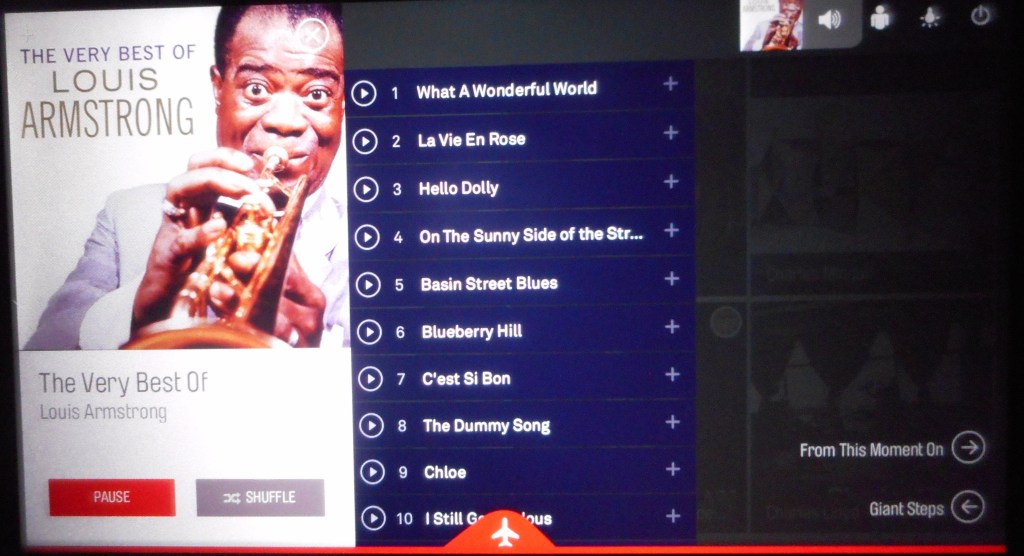
There were Touch Screens on the last leg of our flight back home to Sydney.  For instance I very much enjoyed the Louis Armstrong music.

DSCN1730

I listened to the whole tape twice in a row, even though there was plenty of other music available that I could have listened to.

DSCN1733

Also,  bottles of water were frequently passed around for whoever wanted them. We did fly right through the night till we arrived in Sydney at 6 am. Some people slept most of the time, but others had their screens turned on in front of them. I very much liked these easy to handle touch screens. I ended up getting very interested  into an American TV series called ‘The 100’ and copy here some information about it from Wikipedia.

“From Wikipedia, the free encyclopedia:

The 100 (pronounced The Hundred is an American post-apocalyptic science fiction drama television series that premiered on March 19, 2014. The series, developed by Jason Rothenberg, is loosely based on a book of the same name, the first in a trilogy by Kass Morgan.”

I do find the plot very interesting. Here I copy again from encyclopedia something about the plot:

“The series is set 97 years after a devastating nuclear apocalypse wiped out almost all life on Earth. The only known survivors lived on 12 space stations in Earth’s orbit prior to the apocalyptic event. The space stations banded together to form a single massive station named “The Ark”, where about 2,400 people live under the leadership of Chancellor Jaha.[1] Resources are scarce, so all crimes – regardless of their nature or severity – are punishable by ejection into space (“floating”) unless the perpetrator is under 18 years of age. After the Ark’s life-support systems are found to be critically failing, 100 juvenile prisoners are declared “expendable” and sent to the surface – near former Washington, D.C.[7] – in a last ditch attempt to determine whether Earth is habitable again, in a program called “The 100”. The teens arrive on a seemingly pristine planet they have only seen from space. They attempt to find refuge and supplies at an old military installation, Mount Weather Emergency Operations Center, located in the foothills of the Blue Ridge Mountains. However, they land some distance from the intended target and soon face other problems. Confronting both the wonders and the dangers of this rugged new world, they struggle to form a tentative community. They soon discover that not all humanity was wiped out – some survived the war: the grounders who live in clans locked in a permanent power struggle, another group of grounders who have become cannibals are known as Reapers, and Mountain Men, who live in Mount Weather, who locked themselves away before the apocalypse and are killed by the residual radiation outside.
In the second season, the remaining 48 of the 100 are taken to Mount Weather, where they discover a community of survivors. It is eventually revealed that the medical staff are extracting bone marrow from the 100 and the grounders so they will finally be able to survive on the outside. Meanwhile, the inhabitants of the Ark have successfully crash-landed various stations on Earth and begun an alliance with the grounders to save groups of people, naming the main settlement at Alpha Station “Camp Jaha”.”

Australian Federal Election, July 2016

Here is a copy of an article by the AIM Network on the above subject. I was especially interested in finding out a bit more about the senators who have been elected or are predicted to get into the senate. Towards the end of the article it says that Senator Xenophon does not like offshore processing of refugees.

http://theaimn.com/road-to-nowhere/

On a Road to Nowhere?
July 4, 2016 Written by: The Weasel 17 Replies
Category: News and Politics
permalink
Tagged under:

2013 Federal Election, ABC, AEC, ALP, asylum seekers, Australian election, Australian Labor Party, Bill Shorten, Climate change, Constitutional Recognition, Double dissolution, Education, Federal ICAC, Gonsky, Greens, Hanson, House of Representatives, Katter, Liberal, LNP, Malcolm Turnbull, marriage equality, Mcgowan, Medicare, National, NBN, News and Politics, One Nation, Parliament, rageVote, Refugees, Renewable energy, Royal commission into Banking, Senate, stabilityMal, Treaty, Wilkie, xenophon

The Weasel
weasel-theResults-
As we all wake up today from our election hangovers, and stagger bleary eyed to work, many are considering the real implication of living in interesting times… and the real possibility that the Governor General may be forced to call a second election. The double dissolution election brought on by #stabilityMal has surprised everyone, not least the Australian voter; who, after casting their #rageVote now wonders what they were drinking, and who it was they spent those huddled, sweaty moments with in that election booth. Therefore, in another empty attempt to make sense of it all, it’s time for more analysis and conjecture!

Battle of the Bastards
The current count on the AEC website has the ALP leading in 69 seats, and the LNP with 64. The ALP is trending in a further three seats, and the LNP in two, though all five are too close to call… which should probably be the subtitle for this election. The AEC has six seats undetermined, though this includes Cowper where the nationals have suffered a 9.5 swing against, but will likely defeat Rob Oakeshott to retain the seat.

**updated 1800hrs 4 July** The ABC (i.e. Antony Green) has a slightly different tally, with ALP at 67, LNP at 68 **up from 64**. Out of the 10 ‘seats in doubt’ the LNP is ahead on slender margins in four seats, the ALP on a similar knife-edge in five, and Xenophon party fairly comfortable in one. Giving us a House looking like this:
TABLES-house

One of the key factors in this election is that traditional conservative voters have felt betrayed by the Liberal and National parties. Mining, CSG, the NBN, foreign ownership, constant cuts and privatisation have been a catalyst for conservative voters to look at what else is on offer. Some have realised that the ALP has policies they support; others have turned even further right. As a result, immigration is likely to be a continuing flashpoint, though this time around even Pauline Hanson supports socialised healthcare and the NBN.

Greens and Andrew Wilkie have a record of voting with the ALP, though Wilkie has stated he will not enter into any deals. Cathy McGowan tends to vote with the Coalition. Previously Katter aligned with the LNP, though this time there’s no carbon tax on the table this time. Key issues for Katter are CSG, energy privatisation and land sales, all of which the ALP have made murmurs about, while the LNP are unwilling/unable to move on either. If that will shift the pragmatic Katter away from traditional alliances remains to be seen. Xenophon has already said he will take the number of seats either party wins into account when negotiating agreements, so if that second seat in Grey comes to Team X then he will truly be the kingmaker.

Stiff Upper Lip
The new senate is going to be a mixed bag. Media and politicians alike may decry the election results as a circus as much as they like; but the people have spoken, just not coherently.

There are two truths in democracy: The voter is always right… and you get the government you deserve… and based on ABC.net.au and the AEC website, the senate is currently looking like this:

TABLES-senate

The trend for seats in doubt generally toward the right wing parties such as Katter, Shooters, Fishers, and Farmers, One Nation, and the various Christian groups. As per predictions, the lions’ share will likely go to the major parties; though there is a chance that either Katter or One Nation will get across the line.

Given the wide range of voices represented in the senate, we need to ask the question: Where do the new senators stand on legislation?

The Sydney Morning Herald published this rough breakdown of each parties’ focus. The Weasel takes a next step and looks at how the senators will likely vote on current key issues.

Positions garnered from official policy statements, news reports, and interest group websites.
Where there is no clear position, it can be assumed that senators will use the issue as a bargaining chip to further their own agenda.

Marriage Equality
Derryn Hinch: Pro equality, parliamentary vote
Fred Nile: Anti equality, pro plebiscite
Jacqui Lambie: Anti equality, pro plebiscite, conscience vote for party.
Katter: Anti equality
Lib Democrats: Pro equality, parliamentary vote
One Nation: Anti equality, pro plebiscite
Xenophon: Pro equality, parliamentary vote
see also Aus Marriage Equality site

Climate Change / Renewable Energy
Derryn Hinch: No clear position
Fred Nile: Sceptic, pro nuclear
Jacqui Lambie: Supports action (in statements), pro nuclear, voting record unclear
Katter: Pro Action, stop CSG, extend emission target, boost ethanol production
Lib Democrats: Sceptics, support mitigation, pro nuclear
One Nation: Wants a Royal commission into climate science “corruption”
Xenophon: Pro Action, 50% reduction target by 2030

Recognition or Treaty with Aboriginal and Torres Strait Islander peoples
Derryn Hinch: No clear position
Fred Nile: Opposes Constitutional recognition, supports increased engagement
Jacqui Lambie: Constitutional recognition, plus dedicated indigenous seats in parliament
Katter: Wants action, possibly prefers treaty
Lib Democrats: Opposes Constitutional recognition
One Nation: Opposes Constitutional recognition and treaty
Xenophon: Supports Constitutional recognition

Education
Derryn Hinch: No clear position
Fred Nile: Improve education by adding bible study, and cutting Safe Schools
Jacqui Lambie: Boost TAFE, introduce national-service style apprenticeship scheme
Katter: Pro funding boosts, also wants systematic education reform
Lib Democrats: Stop Federal funding, pro deregulation, cut Austudy
One Nation: Government subsidised apprenticeship scheme
Xenophon: Pro Gonski, anti university deregulation

Royal Commission into Banking
Derryn Hinch: No clear position, may support
Fred Nile: No clear position
Jacqui Lambie: Supports
Katter: Supports
Lib Democrats: No clear position, unlikely to support
One Nation: No clear position, may support
Xenophon: Supports

NBN
Derryn Hinch: No clear position
Fred Nile: No clear position, wants more infrastructure
Jacqui Lambie: Supports FTTP
Katter: Supports FTTP
Lib Democrats: Prefers private competitive roll out instead of government
One Nation: Wants high speed broadband, proposes wireless hubs for regions
Xenophon: Supports FTTP

Federal ICAC
Derryn Hinch: Probably Pro ICAC
Fred Nile: No clear position
Jacqui Lambie: Pro ICAC
Katter: No clear position
Lib Democrats: No clear position
One Nation: Probably Pro ICAC
Xenophon: Pro ICAC

Refugees
Derryn Hinch: No clear position
Fred Nile: Mandatory detention, prefers Christian refugees,
Jacqui Lambie: Wants children out of detention, strict monitoring & quotas
Katter: Turnbacks, faster assessment, and supply work while on TPVs
Lib Democrats: Mandatory detention, on/off shore processing, strict entry requirements
One Nation: Turnbacks
Xenophon: Dislikes offshore processing, increase intake, speed up processing

Healthcare
Derryn Hinch: No clear position
Fred Nile: Better spending, especially in aged care
Jacqui Lambie: Supports socialised medicine, especially for combat veterans
Katter: Supports socialised medicine, wants more services for regions
Lib Democrats: Abolish Medicare, privatise, The Market will provide… apparently
One Nation: Supports socialised medicine
Xenophon: Supports socialised medicine, focus on prevention

On the question of which senators get a six-year stint, and which three… well that is up to the senate. There are two options:
1. Order-of-election; Out of the 12 state senators, whoever crossed the line first gets six years.
2. Recount; Votes are recounted treating the vote as a normal three-year cycle. Whoever would have been elected on that basis gets six years.
Which one the senate uses will likely depend on the three major parties, with Xenophon once again in position as king-maker. The inestimable Antony Green, of course, covers this question in more detail.

The anti-Islam voting block of Fred Nile, One Nation, and Lambie will bring up issues surrounding Muslim Australians and immigration generally; and likely to include senate inquiries into banning burkas or halal certification and labelling. The LNP could use this flashpoint as a major negotiating chip to pass other legislation; though that is unlikely to be the ABCC bill.

On practical and ideological matters of investing in education, healthcare, and infrastructure such as the NBN, the balance is definitely leaning toward the ALP. Lambie, Katter and Xenophon have shifted to the centre on these issues, and the LNP can no longer rely on social policies to wedge support for their neo-liberal economic programme. Accepting a Federal ICAC may present the ALP with a ticket to govern, but marriage equality is unlikely to get anywhere unless the ALP can push an open vote. Action on climate will be problematic, expect another senate inquiry into nuclear power.

As predicted Derryn Hinch picked up the PUP and Ricky Muir vote, though really has very little to offer beyond his pet name-and-shame project, and animal justice. Populist by nature, he could decide or shift his vote if a concerted push came from his electorate…

…and that is important to remember. You can write to your MP and your Senator to express your preference. This parliament is an opportunity for voters and community to have a real impact on the nature of the parliament, and what agenda the parliament pursues. Given that the independent parties may decide who gets to form government, the time to start writing is now.

An Amazon Book: Ritual and its Consequences

Ritual and Its Consequences: An Essay on the Limits of Sincerity 1st Edition
by Adam B. Seligman (Author), Robert P. Weller (Author), Michael J. Puett (Author), Simon (Author)

Going to the above link I found this interesting write-up:

“This pioneering, interdisciplinary work shows how rituals allow us to live in a perennially imperfect world. Drawing on a variety of cultural settings, the authors utilize psychoanalytic and anthropological perspectives to describe how ritual–like play–creates “as if” worlds, rooted in the imaginative capacity of the human mind to create a subjunctive universe. The ability to cross between imagined worlds is central to the human capacity for empathy. Ritual, they claim, defines the boundaries of these imagined worlds, including those of empathy and other realms of human creativity, such as music, architecture and literature.

The authors juxtapose this ritual orientation to a “sincere” search for unity and wholeness. The sincere world sees fragmentation and incoherence as signs of inauthenticity that must be overcome. Our modern world has accepted the sincere viewpoint at the expense of ritual, dismissing ritual as mere convention. In response, the authors show how the conventions of ritual allow us to live together in a broken world. Ritual is work, endless work. But it is among the most important things that we humans do.”

Here are some more editorial Reviews:

“In this whirligig world we do not know what to do apart from the done thing. Ritual and courtesy are, in contemporary parlance, suspect activities surplus to requirements. Like conformity, ritual attracts the adjectives ‘mere,’ ‘meaningless,’ ‘external,’ ’empty’ and ‘inauthentic.’ This book brilliantly expounds the creative potential and the necessity of ritual, and exposes the destructive possibilities of sincerity. It could be seen as part of a Jewish riposte to Christianity or a Confucian one to the Enlightenment, but Catholics and members of enclosed orders will like it too. Everybody should read it, especially American Protestants and post-Protestant secularists who suffer more than most from the ills of sincerity.” –David Martin, Emeritus Professor of Sociology, London School of Economics

“In this whirligig world we do not know what to do apart from the done thing. Ritual and courtesy are, in contemporary parlance, suspect activities surplus to requirements. Like conformity, ritual attracts the adjectives ‘mere,’ ‘meaningless,’ ‘external,’ ’empty’ and ‘inauthentic.’ This book brilliantly expounds the creative potential and the necessity of ritual, and exposes the destructive possibilities of sincerity. It could be seen as part of a Jewish riposte to Christianity or a Confucian one to the Enlightenment, but Catholics and members of enclosed orders will like it too. Everybody should read it, especially American Protestants and post-Protestant secularists who suffer more than most from the ills of sincerity.” –David Martin, Emeritus Professor of Sociology, London School of Economics

“An enormously important and paradigm-changing book. The audacity of its scope is refreshing–a turn to grand theory in an academic culture whose trend is to say more and more and less and less.”Common Knowledge

“…A new, interesting, and very fruitful approach towards understanding and using the concept of ‘ritual.'”–Religion

About the Authors
Adam B. Seligman is Professor of Religion and Research Associate at the Institute for Culture, Religion, and World Affairs at Boston University. Robert P. Weller is Professor and Chair of the Department of Anthropology and Research Associate at the Institute for Culture, Religion, and World Affairs at Boston University. Michael J. Puett is Professor of Chinese History at Harvard University. Bennett Simon is Professor of Psychiatry at Harvard Medical School and Training and Supervising Analyst at Boston Psychoanalytic Society and Institute

Customers Who Bought This Item Also Bought

Ritual Theory, Ritual Practice
Catherine Bell

The Sacred and The Profane: The Nature of Religion
Mircea Eliade

Ritual: Perspectives and Dimensions–Revised Edition
Catherine Bell

Rethinking Pluralism: Ritual, Experience, and Ambiguity
Adam B. Seligman

The Path: What Chinese Philosophers Can Teach Us About the Good Life
Michael Puett

History and Presence
Robert A. Orsi

On July 25, 2014 John Lord published a Post about whether Grammar matters

The heading of this post by John Lord from 2014 was:


My Last Post?

The post started as follows:

“In the everyday context of reading and interpreting the written word. Does grammar matter? Should those who have good grammatical skills refrain from criticism?

Should those lacking good English desist from airing a view even though the value of their contribution is unquestioned? Or in the broader context should those of little formal educational merit abstain from expressing an opinion?  . . . . ”

To read on please go to:

http://theaimn.com/last-post/


John Lord said in his post:

“. . . .  This blog does not employ a proof reader. It relies on its writers to get it right. Unfortunately this writer who is almost entirely self-educated is the biggest culprit. Inevitably everything I write comes under criticism for one grammatical error or another. And rightly so I might add. So much so that, sometimes, there are more comments about my grammar than the subject of my writing. . . . ”

Towards the end of the blog John Lord wrote as follows:

” So I finish where I started.

“Should those lacking good English skills desist from airing a view even though the value of their contribution is unquestioned. Or in the broader context should those of little formal educational merit abstain from expressing an opinion?”
The answer is of course an empathetic NO.

Undoubtedly there will be some who will find fault with this piece. You can email any corrections to me and I will correct them. You can as a lot of people choose to do, tell me in the comments. However, I defy any reader to say they cannot comprehend the meaning of my language.

johnlord@wideband.net.au


Finally I’d like to make a comment on the subject. I did not finish high-school and have never been to university. English is my second language. I have been blogging since July 2011. I very much enjoy the contact with other bloggers. I am aware that university educated people do find that there is a lot wrong with the way I write. I know that my daughters as well as my son may point to quite a few errors in any of my writing that I have published. 

Free Trade Agreements

Here is an article by Kaye Lee in The AIMN  –  The Australian Independent Media Network:

http://theaimn.com/andrew-robb-naive-just-photo-shoot/

I started reading this article and soon found out that Australia’s steel industry as well as the car industry is as good as finished. What good can it be for Australia to have no such industry of our own anymore? 

” . . .  As thousands of people stand to lose their jobs in the steel industry, we are informed by our Prime Minister and Treasurer that Bill Shorten is endangering our free trade agreements by suggesting we use Australian steel in public works. . . ”

” . . . .  For the car industry, the free trade agreements were yet another nail in the coffin with cheap cars from South Korea, Japan and China about to flood the market.  Support for transitioning the industry to innovative manufacture of clean cars or superior quality parts evaporated.  Had they had some assistance during the period when mining had forced the Aussie dollar to record highs, this industry may have survived along with the hundreds of thousands of jobs and the skills training it provided, but with no time to transition, they couldn’t survive the FTAs. . . . . ”

“An analysis by the World Bank shows that the Trans Pacific Partnership would grow Australia’s GDP by just 0.7% by 2030.”

And on it goes:

“Little has been said about the 15,000 jobs in Australia’s pulp, paper and fibre packaging industry that are now at risk.”

“The Ai Group estimates that the local industry can expect to face almost $1billion of Chinese imports over the next four years, warning that Australian paper and packaging companies could “make the strategic decision to move manufacturing to China, as this is the business model currently being rewarded under ChAFTA.”

“Even the much vaunted deal on beef exports is not as good as they would have us believe.”

“The Chinese deal on beef is only for an extra 10% exports before a trigger where tariffs will be charged again, and the proposed tariff reduction will not fully take place for nine years.”

Well, I copied here bits and pieces of Kaye Lee’s article. These bits and pieces are sufficient to make me most upset. How can the majority of Australian voters believe that our government acts in the interest of Australians?