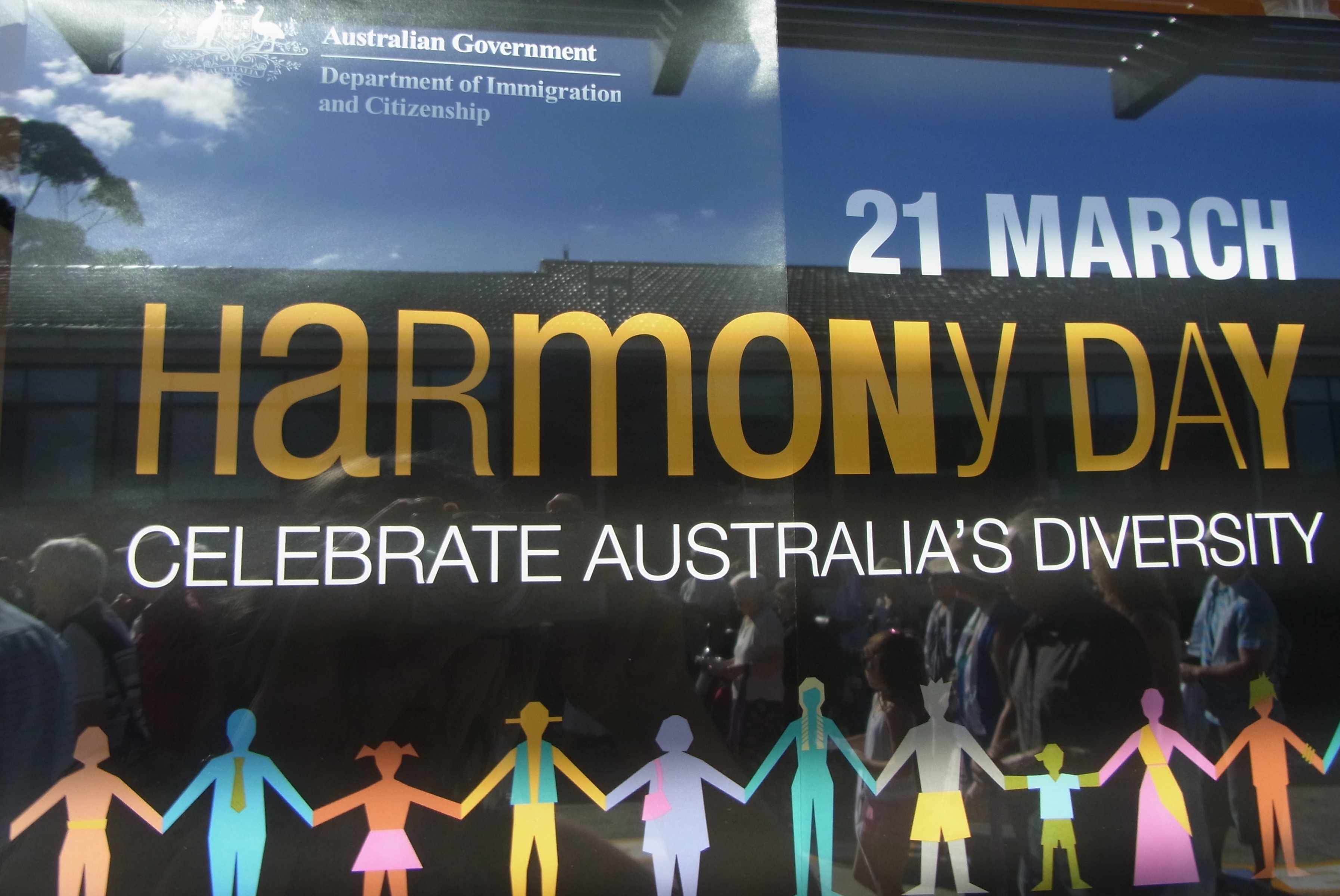
Uta’s Diary, 6th November 2014

RIMG0121

RIMG0874

I found these two posters in my media library. They are from 2013.
My thoughts today are still very much with everything about yesterday’s Memorial Service for Gough Whitlam. Gough was 98 when he died.
He had chosen the music and I think also the speakers for this service. He could not have chosen any better. The music was the best and so were the speakera.

The service concludes with the Sydney Philharmonia Choir and Sydney Symphony Orchestra performing Hubert Parry’s Jerusalem by Hubert Parry

Read more: http://www.smh.com.au/federal-politics/political-news/live-gough-whitlam-farewelled-at-state-memorial-service-20141105-3jmf6.html#ixzz3IEgVvfJ5

About the ‘Clash of Civilisations’

http://www.abc.net.au/news/2014-10-31/dal-santo-are-we-creating-the-clash-of-civilizations/5856832


Matthew Dal Santo writes in the DRUM:


Are we creating the ‘clash of civilisations’?


In his famous and controversial Clash of Civilizations, Harvard political scientist Samuel Huntington argued that the 21st century would be the era not of the nation-state but civilisations, transcending state borders and uniting in a common culture and shared values the energies and aspirations of diverse peoples and polities.


. . . . . . . .


Dal Santo argues that language matters.  And Huntington wrote:

“The security of the world requires acceptance of global multi-culturality,”


I reckon the above article is worth reading and trying to think about what  we want to accomplish with our “Western” values.

John Pilger writes about the forgotten Coup

The forgotten coup – how America and Britain crushed the government of their ‘ally’, Australia

23 October 2014

whitlam1.jpg

Across the political and media elite in Australia, a silence has descended on the memory of the great, reforming prime minister Gough Whitlam, who has died. His achievements are recognised, if grudgingly, his mistakes noted in false sorrow. But a critical reason for his extraordinary political demise will, they hope, be buried with him.


Australia briefly became an independent state during the Whitlam years, 1972-75. An American commentator wrote that no country had “reversed its posture in international affairs so totally without going through a domestic revolution”. Whitlam ended his nation’s colonial servility. He abolished Royal patronage, moved Australia towards the Non-Aligned Movement, supported “zones of peace” and opposed nuclear weapons testing.


Although not regarded as on the left of the Labor Party, Whitlam was a maverick social democrat of principle, pride and propriety. He believed that a foreign power should not control his country’s resources and dictate its economic and foreign policies. He proposed to “buy back the farm”. In drafting the first Aboriginal lands rights legislation, his government raised the ghost of the greatest land grab in human history, Britain’s colonisation of Australia, and the question of who owned the island-continent’s vast natural wealth.


Latin Americans will recognise the audacity and danger of this “breaking free” in a country whose establishment was welded to great, external power. Australians had served every British imperial adventure since the Boxer rebellion was crushed in China. In the 1960s, Australia pleaded to join the US in its invasion of Vietnam, then provided “black teams” to be run by the CIA. US diplomatic cables published last year by WikiLeaks disclose the names of leading figures in both main parties, including a future prime minister and foreign minister, as Washington’s informants during the Whitlam years.


Whitlam knew the risk he was taking. The day after his election, he ordered that his staff should not be “vetted or harassed” by the Australian security organisation, ASIO – then, as now, tied to Anglo-American intelligence. When his ministers publicly condemned the US bombing of Vietnam as “corrupt and barbaric”, a CIA station officer in Saigon said: “We were told the Australians might as well be regarded as North Vietnamese collaborators.”


Whitlam demanded to know if and why the CIA was running a spy base at Pine Gap near Alice Springs, a giant vacuum cleaner which, as Edward Snowden revealed recently, allows the US to spy on everyone. “Try to screw us or bounce us,” the prime minister warned the US ambassador, “[and Pine Gap] will become a matter of contention”.


Victor Marchetti, the CIA officer who had helped set up Pine Gap, later told me, “This threat to close Pine Gap caused apoplexy in the White House… a kind of Chile [coup] was set in motion.”


Pine Gap’s top-secret messages were de-coded by a CIA contractor, TRW. One of the de-coders was Christopher Boyce, a young man troubled by the “deception and betrayal of an ally”. Boyce revealed that the CIA had infiltrated the Australian political and trade union elite and referred to the Governor-General of Australia, Sir John Kerr, as “our man Kerr”.


Kerr was not only the Queen’s man, he had long-standing ties to Anglo-American intelligence. He was an enthusiastic member of the Australian Association for Cultural Freedom, described by Jonathan Kwitny of the Wall Street Journal in his book, ‘The Crimes of Patriots’, as, “an elite, invitation-only group… exposed in Congress as being founded, funded and generally run by the CIA”. The CIA “paid for Kerr’s travel, built his prestige… Kerr continued to go to the CIA for money”.


When Whitlam was re-elected for a second term, in 1974, the White House sent Marshall Green to Canberra as ambassador. Green was an imperious, sinister figure who worked in the shadows of America’s “deep state”. Known as the “coupmaster”, he had played a central role in the 1965 coup against President Sukarno in Indonesia – which cost up to a million lives. One of his first speeches in Australia was to the Australian Institute of Directors – described by an alarmed member of the audience as “an incitement to the country’s business leaders to rise against the government”.


The Americans and British worked together. In 1975, Whitlam discovered that Britain’s MI6 was operating against his government. “The Brits were actually decoding secret messages coming into my foreign affairs office,” he said later. One of his ministers, Clyde Cameron, told me, “We knew MI6 was bugging Cabinet meetings for the Americans.” In the 1980s, senior CIA officers revealed that the “Whitlam problem” had been discussed “with urgency” by the CIA’s director, William Colby, and the head of MI6, Sir Maurice Oldfield. A deputy director of the CIA said: “Kerr did what he was told to do.”


On 10 November, 1975, Whitlam was shown a top secret telex message sourced to Theodore Shackley, the notorious head of the CIA’s East Asia Division, who had helped run the coup against Salvador Allende in Chile two years earlier.


Shackley’s message was read to Whitlam. It said that the prime minister of Australia was a security risk in his own country. The day before, Kerr had visited the headquarters of the Defence Signals Directorate, Australia’s NSA where he was briefed on the “security crisis”.


On 11 November – the day Whitlam was to inform Parliament about the secret CIA presence in Australia – he was summoned by Kerr. Invoking archaic vice-regal “reserve powers”, Kerr sacked the democratically elected prime minister. The “Whitlam problem” was solved, and Australian politics never recovered, nor the nation its true independence.


Follow John Pilger on Twitter @johnpilger and Facebook – www.facebook.com/pilgerwebsite

What IAN VERRENDER says in the Drum about the Economy under Whitlam

Think Whitlam ruined our economy? Think again

Posted Mon at 8:30amMon 27 Oct 2014, 8:30am

What is never recognised is the Australian economy under Gough Whitlam outperformed its peers, most of which floundered during one of the most turbulent periods of modern economic history, writes Ian Verrender.

Time. It tends to blunt the edges, soften the memories and, for most of us, perhaps even heal some old wounds.

The generous and genuine outpouring of admiration and emotion following Gough’s second Dismissal last week, much of it from unexpected quarters and old political adversaries, touched on an element of the national psyche that illustrates everything that is good about Australia.

As expected, not everyone could bring themselves to be magnanimous, to acknowledge the achievements, to recognise the profound impact of a man who forever removed us from a cloistered, claustrophobic and conformist era for which some conservatives still pine.

But as Winston Churchill once observed: “You have enemies? Good. That means you have stood up for something in your life.”

The achievements of the nation’s 21st prime minister were thrust to the fore all week; universal healthcare, education, law reform, women’s rights and indigenous rights on the domestic front, on the global stage, his recognition of China.

But if there is one vulnerability, one chink in the Whitlam legacy and legend – apart from the shambolic ill-discipline within cabinet – it is in his government’s handling of the economy.

And so began the venomous sniping, within hours of his passing, from a joyless handful forever confined to the shadows and whose anger and bitterness festers and feeds upon itself.

The conventional wisdom is that, from an economic perspective, the Whitlam government was an unmitigated disaster.

Certainly, the raw numbers bear that out. And there is plenty of evidence to support the notion that the new government believed economic management was a secondary consideration to its social agenda.

What is never recognised, however, is that the Australian economy under Whitlam outperformed its peers, most of which floundered during one of the most turbulent periods of modern economic history.

Former treasury secretary John Stone left no doubt about his sentiments – if doubt existed – in his Australian Financial Review piece last Thursday.

As Stone tells it, the economy only grew “superficially” between 1972 and 1975. Given the National Accounts do not record a measure of “superficial growth”, presumably Stone means the economy did not experience a recession.

On every other measure, however, Stone claims the economy was in crisis. Private investment in dwelling and non-dwelling construction slumped, wages growth was out of control, peaking at 30.5 per cent in 1974-75, there was a rapid expansion of the public service and personal income tax grew 34.3 per cent in 1973-74.

Interest rates rose alarmingly, Stone recalls, while inflation peaked at 16.7 per cent in 1974-75. Investor confidence evaporated, he argues, with the All Ordinaries Index “tumbling 39 per cent between June 1972 and June 1975”.

It is a damning assessment on any measure, given particular credence by his position at the time front and centre of the action.

Except … there are a vast number of monumental omissions in Stone’s piece, which a cynic may deduce was specifically designed to give the impression that the economic malaise of the time was a purely Australian experience, that we alone were on the slide due to the incompetence of the incumbent government.

As Stone rightly points out, Australia did not go into recession. What he fails to mention is that America did. So did the UK. And they were no ordinary recessions.

Both our northern hemisphere allies endured long and painful slumps, the chaotic fallout from which reverberated through the global economy, including Australia.

Not only that, inflation ran wild in both the northern hemisphere economic superpowers and throughout the developed world. It was a global recession that marked the dramatic end of the post-war boom.

This was the time of rampant stagflation, a rare phenomenon in economics where inflation and unemployment rise simultaneously. It’s a nightmare scenario for policymakers. Raise rates to dampen inflation and you exacerbate unemployment. Try to fix the jobs crisis and you fuel inflation.

There were a number of factors behind the global recession.

The Bretton-Woods financial system – instituted after the war that tied the US dollar to the price of gold – collapsed in the early ’70s, itself enough to engineer a significant slump in global activity. This followed attacks on the currency as the US ran up a constant series of balance of payments deficits.

The sudden collapse of the system and the immediate devaluation of the US dollar, which from then on became a fiat currency valued against other currencies, created havoc on trade and current account balances throughout the developed world.

Add to this that the Arab world had formed the Organisation of Petroleum Exporting Countries and in 1973 deliberately squeezed supplies.

The price of oil quadrupled between October 1973 and the following January. That’s correct, energy prices rose 400 per cent in four months, sending shockwaves through developed world economies, underscoring the dramatic price rises that, in turn, fed through to wage demands.

Between 1973 and 1975, the Whitlam era, inflation in the UK grew from 7.4 per cent to 24.89 per cent – vastly higher than anything experienced in Australia.

Great Britain was wracked by industrial disputes. Miners walked off the job, coal supplies dwindled. So dire was the energy situation, UK prime minister Edward Heath instituted the three day week as commercial electricity users were restricted. Food queues formed.

America, meanwhile, endured its worst recession since the Great Depression between November 1973 and March 1975. While the unemployment spike was relatively short-lived inflation soared from a relatively modest 3.65 per cent in early 1973 to a 12.34 per cent peak at the end of 1974 before tapering off during 1975.

Stone’s contention that the collapse in Australian share prices was an indictment of Australia’s economic management may hold some merit. But again, we weren’t alone. In fact the Australian decline in share prices was modest compared with those on Wall Street and London.

Described as the seventh worst crash on record, between January 1973 and December 1974, Wall Street lost 45.1 per cent of its value. In London, meanwhile, the FT 30 declined a massive 73 per cent.

Gough Whitlam’s first two treasurers, Frank Crean and Jim Cairns, were widely criticised for their performances. Cairns, especially, appeared to be distracted by assets of another kind, and spending during his reign blew out spectacularly.

But Bill Hayden’s budget, delivered shortly before The Dismissal, had many in the Opposition worried. It was a responsible document designed to bring inflation and unemployment under control.

Whitlam is not the first to be lashed by Stone. He quit as treasury secretary days before Paul Keating’s 1984 budget and Peter Costello was lambasted for introducing the GST.

A close ally and informal advisor to Joh Bjelke-Petersen, Stone railed against Asian immigration and eventually joined the National Party, a party that until recent times strongly espoused protectionism.

Despite Stone’s towering intellect and formidable qualifications, perhaps Whitlam’s greatest mistake on the economy was to not recognise the failings of one of his senior bureaucrats, an insular man who, four decades after the events, still fails to grasp the impact the global economic upheaval had on Australia.

Ian Verrender is the ABC’s business editor. View his full profile here.

Topics: government-and-politics, business-economics-and-finance, budget

About Capitalism

From the International Spiegel:

The Zombie System: How Capitalism Has Gone Off the Rails

By Michael Sauga

Photo Gallery: The Deline of Capitalism?Photos
REUTERS/ Metropolitan Police

Six years after the Lehman disaster, the industrialized world is suffering from Japan Syndrome. Growth is minimal, another crash may be brewing and the gulf between rich and poor continues to widen. Can the global economy reinvent itself?

A new buzzword is circulating in the world’s convention centers and auditoriums. It can be heard at the World Economic Forum in Davos, Switzerland, and at the annual meeting of the International Monetary Fund. Bankers sprinkle it into the presentations; politicians use it leave an impression on discussion panels.

The buzzword is “inclusion” and it refers to a trait that Western industrialized nations seem to be on the verge of losing: the ability to allow as many layers of society as possible to benefit from economic advancement and participate in political life.The term is now even being used at meetings of a more exclusive character, as was the case in London in May. Some 250 wealthy and extremely wealthy individuals, from Google Chairman Eric Schmidt to Unilever CEO Paul Polman, gathered in a venerable castle on the Thames River to lament the fact that in today’s capitalism, there is too little left over for the lower income classes. Former US President Bill Clinton found fault with the “uneven distribution of opportunity,” while IMF Managing Director Christine Lagarde was critical of the numerous financial scandals. The hostess of the meeting, investor and bank heir Lynn Forester de Rothschild, said she was concerned about social cohesion, noting that citizens had “lost confidence in their governments.”

It isn’t necessary, of course, to attend the London conference on “inclusive capitalism” to realize that industrialized countries have a problem. When the Berlin Wall came down 25 years ago, the West’s liberal economic and social order seemed on the verge of an unstoppable march of triumph. Communism had failed, politicians worldwide were singing the praises of deregulated markets and US political scientist Francis Fukuyama was invoking the “end of history.”

Today, no one talks anymore about the beneficial effects of unimpeded capital movement. Today’s issue is “secular stagnation,” as former US Treasury Secretary Larry Summers puts it. The American economy isn’t growing even half as quickly as did in the 1990s. Japan has become the sick man of Asia. And Europe is sinking into a recession that has begun to slow down the German export machine and threaten prosperity.

Capitalism in the 21st century is a capitalism of uncertainty, as became evident once again last week. All it took were a few disappointing US trade figures and suddenly markets plunged worldwide, from the American bond market to crude oil trading. It seemed only fitting that the turbulence also affected the bonds of the country that has long been seen as an indicator of jitters: Greece. The financial papers called it a “flash crash.”

Running Out of Ammunition

Politicians and business leaders everywhere are now calling for new growth initiatives, but the governments’ arsenals are empty. The billions spent on economic stimulus packages following the financial crisis have created mountains of debt in most industrialized countries and they now lack funds for new spending programs.

Central banks are also running out of ammunition. They have pushed interest rates close to zero and have spent hundreds of billions to buy government bonds. Yet the vast amounts of money they are pumping into the financial sector isn’t making its way into the economy.

Be it in Japan, Europe or the United States, companies are hardly investing in new machinery or factories anymore. Instead, prices are exploding on the global stock, real estate and bond markets, a dangerous boom driven by cheap money, not by sustainable growth. Experts with the Bank for International Settlements have already identified “worrisome signs” of an impending crash in many areas. In addition to creating new risks, the West’s crisis policy is also exacerbating conflicts in the industrialized nations themselves. While workers’ wages are stagnating and traditional savings accounts are yielding almost nothing, the wealthier classes — those that derive most of their income by allowing their money to work for them — are profiting handsomely.

According to the latest Global Wealth Report by the Boston Consulting Group, worldwide private wealth grew by about 15 percent last year, almost twice as fast as in the 12 months previous.

The data expose a dangerous malfunction in capitalism’s engine room. Banks, mutual funds and investment firms used to ensure that citizens’ savings were transformed into technical advances, growth and new jobs. Today they organize the redistribution of social wealth from the bottom to the top. The middle class has also been negatively affected: For years, many average earners have seen their prosperity shrinking instead of growing.

Harvard economist Larry Katz rails that US society has come to resemble a deformed and unstable apartment building: The penthouse at the top is getting bigger and bigger, the lower levels are overcrowded, the middle levels are full of empty apartments and the elevator has stopped working.

‘Wider and Wider’

It’s no wonder, then, that people can no longer get much out of the system. According to polls by the Allensbach Institute, only one in five Germans believes economic conditions in Germany are “fair.” Almost 90 percent feel that the gap between rich and poor is “getting wider and wider.”

In this sense, the crisis of capitalism has turned into a crisis of democracy. Many feel that their countries are no longer being governed by parliaments and legislatures, but by bank lobbyists, which apply the logic of suicide bombers to secure their privileges: Either they are rescued or they drag the entire sector to its death.

It isn’t surprising that this situation reinforces the arguments of leftist economists like distribution critic Thomas Piketty. But even market liberals have begun using terms like the “one-percent society” and “plutocracy.” The chief commentator of the Financial Times, Martin Wolf, calls the unleashing of the capital markets a “pact with the devil.”

They aren’t alone. Even the system’s insiders are filled with doubt. There is the bank analyst in New York who has become exasperated with banks; the business owner in Switzerland who is calling for higher taxes; the conservative Washington politician who has lost faith in the conservatives; and the private banker in Frankfurt who is at odds with Europe’s supreme monetary authority.

They all convey a deep sense of unease, and some even show a touch of rebellion.


If there is a rock star among global bank analysts, it’s Mike Mayo. The wiry financial expert loves loud ties and tightly cut suits, he can do 35 pull-ups at a time, and he likes it when people call him the “CEO killer.”

The weapons Mayo takes into battle are neatly lined up in his small office on the 15th floor of a New York skyscraper: number-heavy studies about the US banking industry, some as thick as a shoebox and often so revealing that they have enraged industry giants like former Citigroup CEO Sandy Weill, or Stan O’Neal in his days as the head of Merrill Lynch. Words of praise from Mayo are met with cheers on the exchanges, but when he says sell, it can send prices tumbling.

Mayo isn’t interested in a particular sector but rather the core of the Western economic system. Karl Marx called banks “the most artificial and most developed product turned out by the capitalist mode of production.” For Austrian economist Joseph Schumpeter, they were guarantors of progress, which he described as “creative destruction.”

But financial institutions haven’t performed this function in a long time. Before the financial crisis, they were the drivers of the untenable expansion of debt that caused the crash. Now, focused as they are on repairing the damage done, they are inhibiting the recovery. The amount of credit ought to be “six times faster than it has been,” says Mayo. “Banks now aren’t the engines of growth anymore.”Mayo’s words reflect the experience of his 25 years in the industry, a career that sometimes sounds like a plot thought up by John Grisham: the young hero faces off against a mafia-like system.

He was in his late 20s when he arrived on Wall Street, a place he saw as symbolic of both the economic and the moral superiority of capitalism. “I always had this impression,” says Mayo, “that the head of a bank would be the most ethical person and upstanding citizen possible.”

A New Party for Australia

Disillusioned with both Labor and Liberal. I am sure this applies to many Australian voters. I hope the “Progressives” are going to become a viable alternative.

The Australian Progressives Team

Meet the Australian Progressives team. As we annouce more team members on our Facebook page we will update our list below.

Tim Jones

Tim Jones

Party President

I am a ‘career tradesman’ who has worked as an underground fitter, on power stations, ships and factories around Australia.

I did my degree in psychology and linguistics in the 90s and worked as a nurse for a few years after.

I have two grown sons and a grandson who deserve a country which celebrates them and the future they will share.

As a co-founder of ‘March in March’ I wanted to fight for that future and co-founding The Australian Progressives is my natural next step.

Progress is what we do with hope. Without hope we are lost.

Fariza Fatima

Fariza Fatima

I am a student of Law and Media at Macquarie University. I am currently a project officer at a grass roots community organization. I believe in working towards justice by empowering people – in pursuit of this I have dabbled in volunteering at five different non-government organizations and 3 university societies.

I am a founder and deputy editor of Youthink a Youth magazine. I live by two maxims “You must be the change you wish to see” and “let yourself be silently drawn by what you really love”.

I’m part of the Australian Progressives because we are part of a global system, with global economies – global measures of efficiency. I believe that this process needs global empathy. The current discourse allows great debate but on a very narrow spectrum – this stagnation needs to be resolved. We need new policies and structures in light of our globalized world. We need compassionate policies that connect us to other people. We need Change.

Brenden Prazner

Brenden Prazner

I’m a self-confessed geek at heart. I embrace technology, what it can do and how it can make life better (and more fun!).

I’ve worked for the past 17 years in the decorated apparel industry (11 of which in software development), and have enjoyed a variety of technical and commercial roles in a range of businesses from small owner-operators to large national leading apparel suppliers.

I’m a father of two and hope for a future where our nation is governed by logic and reason, and policies created around facts and not fiction.

I’ve joined the Australian Progressives because I believe in a nation that embraces positive change, and realises the possibilities that an informed and science-literate nation can deliver.

Emma Watt

Emma Watt

I am studying Law and International Relations at UNSW. I’m passionate about social justice, and politics, and in the past two years I have been the community director of the UNSW United Nations Society and the Co-Deputy Convenor for the Amnesty International Australia NSW Student’s Conference.

I’m in the Australian Progressives because I don’t want to wait to be a ‘leader of tomorrow’. It’s time to act now – raw and uninhibited.

I am deeply passionate about youth voices and I want to see more youth participating in and contributing to the political agenda.

Candy Lawrence

Candy Lawrence

Facebook administrator

I am a retired educator with nearly 30 years’ experience teaching and caring for children from birth to 18 years. My passion for teaching is based on respect for children’s individuality, competence and potential. I have expertise and experience in gifted education and hope to see a day when ‘tall poppy syndrome’ is recognised as an impediment to our progress as a nation.

As a writer in my spare time, I strive to improve children’s welfare through my blog ‘Aunt Annie’s Childcare’ which has a world-wide following. I have also been active locally in the fight against unconventional gas mining on the Far North Coast as an advocate for children’s rights.

I joined the Australian Progressives because they have given me hope. The lack of personal respect exhibited by our current politicians in question time dismays me. The lack of human decency, particularly with respect to children’s welfare and rights, disgusts me. The destruction of our planet due to human greed frightens me. As a member of the Australian Progressives I will fight to build a society where our politicians behave with dignity and a high standard of ethics, and where our children inherit a living planet.

Whitlam played by the Rules . . . .

Whitlam: a loyal servant of a system which failed him

Posted Mon at 3:08pmMon 27 Oct 2014, 3:08pm

Gough Whitlam played by the rules and was smashed – leaving his office to his enemies, but with his consistency, conviction and integrity untarnished, writes Mungo MacCallum.

As numerous eye-glazing speeches could attest, Gough Whitlam had a great love for the constitution and the Parliament. Like his friend and sparring partner James Killen, Whitlam had a respect bordering on reverence for the forms and practices of the Australian version of Westminster.

This did not mean that he believed them to be unchangeable, set in stone; indeed, much of his working life was spent in trying to modify and reform them when he felt it necessary.

But he always did so within the accepted boundaries: Whitlam, while he could be a radical when it came to policy, was always a gradualist – a Fabian – when it came to process. He believed in referendum, not revolution. He assiduously followed the rules, both in the letter and the spirit.

But his opponents were not so scrupulous, and that was what ultimately destroyed him and his government. From the moment the Labor administration was elected, the conservatives determined to do whatever it would take to bring it down. After 23 years, they regarded their rejection as an affront, an aberration; the natural law – their law – must be restored.

And any excuse would do; if Whitlam employed tactics and strategy to achieve his aims, the coalition leaders cried foul and went feral. Thus in 1974, Whitlam and his colleagues devised a scheme to take control of the Senate by persuading a sitting DLP senator, Vince Gair, to resign and take up a diplomatic post.

This was certainly unusual, even sneaky, but it was entirely legitimate. However, the then Liberal leader Billy Snedden took the unprecedented step of forcing an election by using his Senate numbers to block the budget. Of course, budget measures were and are regularly postponed and rejected, as the current administration knows all too well. But this was not a routine measure: the coalition withheld what is known as the supply bills, the money appropriated for the day-to-day working of government especially in paying the public service.

This was seen an outrageous breach of convention, never before seriously contemplated, let alone implemented. In 1967, the Labor Senate leader Lionel Murphy had mooted the idea to Whitlam, who summarily dismissed it as unthinkable. But the coalition took the plunge not once but twice: in 1975 Malcolm Fraser devised an encore.

He was only able to do so by another egregious breach. When the Queensland Labor senator Bert Millner died in office, testate premier Joh Bjelke-Petersen replaced him not with another Labor nominee, but with an opponent, the risible Patrick Albert Field. Once again, this had not happened since Federation; replacements within the same party had always been automatic, and indeed have now become so by law.

But Field, with instructions to oppose Labor without question or hesitation, gave Fraser the numbers he needed. His trigger was the sacking of a senior minister, Rex Connor, over what was known as the Loans Affair. This had entailed an attempt to build massive infrastructure by securing petro dollar funds from the Arabs through unconventional sources.

Once again, this was unusual, and in the end reckless, even foolhardy; but in spite of what was later alleged, it was in no sense illegitimate. The relevant decisions, albeit in secret, were signed through the Executive Council of Cabinet. But the whole thing went wrong, and eventually Whitlam removed the commission of Connor, as Minister for Minerals and Energy, to end negotiations.

However, Connor persisted, still searching for the fairy tale millions. The Australian’s foreign editor, Greg Sheridan, in a series of graceless articles immediately after Whitlam’s death, suggested that Whitlam had in fact given Connor a wink: if the money could still be secured, all would be forgiven. At the time Sheridan was fomenting DLD conspiracies in student politics. I was on the spot in Canberra and from my first-hand knowledge can testify that this was not true: when Whitlam found out he was incandescent.

But in any case, Sheridan’s fantasy misses the point: Connor was dismissed, not for pursuing the loan, but for misleading Parliament – the same crime that had undone the hapless Jim Cairns. For Whitlam, this was the unforgiveable sin: he knew sacking Connor would bring dire political consequences, but he felt he had no choice: Parliament was supreme. To a normal observer Whitlam deserved praise for his adherence to principle, but for Fraser it was what he called an extraordinary and reprehensible circumstance, and pulled the trigger: which brings us to the governor-general, Sir John Kerr.

Whitlam was confident that Kerr would remain on side not because he was weak (which he was, as Fraser has since confirmed) but because he was bound to follow the advice of his ministers. This, after all, was the convention observed by the British monarch – Kerr’s superior — for centuries. But Kerr had already broken ranks: he had taken counsel and encouragement from the Chief Justice and former Liberal attorney-general Garfield Barwick, who was also the cousin of Fraser’s own shadow attorney, Robert Ellicott.

So Fraser was prepared: Fraser was lurking when Whitlam saw Kerr to tender his advice to call a half-Senate election, and when Kerr refused and Whitlam indignantly knocked back Kerr’s demand for an election for the House of Representatives, Kerr dismissed him. Whitlam’s immediate (and conventional) response was that he would go to the Queen: Kerr replied that he had already terminated his commission and produced the document. Rather than throw it in his face, as his feisty wife Margaret later suggested, he meekly concurred: to the last he followed the rules.

Kerr did not: when later the Speaker of the House, Gordon Scholes, went to inform him that the Parliament had voted confidence in Whitlam, Kerr refused to see him, an act of authoritarianism not seen since the days of King Charles I. This was indeed, as Whitlam called it, a coup, a putsch. But maintaining his loyalty to the system that had failed him, he stood stony faced as the viceroy’s aide-de-camp shut down Parliament and set him up for an election he knew he was doomed to lose: if Kerr, the Governor-General he had appointed, had dismissed him, the voters would believe he had done something unforgivable. They didn’t know what it was, but that didn’t matter. It was all over.

So Whitlam played by the rules and was smashed – leaving his office to his enemies, but with his consistency, conviction and integrity untarnished. They don’t make them like that any more.

Mungo Wentworth MacCallum is a political journalist and commentator. View his full profile here.

Topics: federal-government

A Columnist’s analysing the peddling of Fear

Are we peddling fear just for the sake of it?

Posted about 4 hours agoFri 24 Oct 2014, 6:46am

As disturbing as the events in Ottawa were we are entitled to ask whether the political response here in Australia, on the other side of the world, was helpful or merely exploitative, writes Barrie Cassidy.

The threat of terrorism is real, but is it exaggerated?

The need to be vigilant is obvious, but do we have to live in fear?

Every time someone goes berserk overseas, do we have to behave as if it happened around the corner?

Why in 2014 is every act by a crazed gunman immediately interpreted as an act of terrorism?

And when does the rhetoric of politicians cross the boundaries from sensible public safety and security warnings to fear for the sake of it?

As disturbing as the events in Ottawa were, they could have been the actions of a “lone wolf” with a criminal history. Even if it turns out he was part of some sort of organised global terror attack – what the Prime Minister, Tony Abbott, described in the Parliament as part of Islamic State’s “war on the world” – we are still entitled to ask whether the response here in Australia, on the other side of the world, was helpful or merely exploitative.

The politicians rushed to the microphones to draw the links with Australia, to underline the similarities between the two countries, and to emphasise how the same thing could so easily happen here.

The presiding officers of almost every parliament in the country put out statements on security. Tony Abbott gave an interview and followed up with a statement to the Parliament. The Opposition Leader Bill Shorten fell in behind. There was a minute’s silence. How often does that happen when a soldier in another country dies at the hands of a gunman?

Of course Australian authorities charged with the safety of the public should be impacted and instructed by the shootings in Ottawa. Of course everybody is disturbed and alarmed when these shootings happen.

But even so, why did the politicians on both sides of the aisle feel the need to see to it that every Australian shared the fear that they were so ready to express? What are we supposed to do?

Why did the politicians tell us that threats of a 17-year-old Year 10 student should leave us “chilled?” The Courier Mail, by contrast, ran a headline: “ISIS Aussie terror threat backfires. He’s just a very naughty boy.” A “naughty boy” that one senator – David Leyonhjelm – dismissed as “an absolute dickhead.”

Eminent social researcher Hugh Mackay in a 2007 speech entitled “Be Afraid” said:

Fear is a complex emotion but it comes in two main forms. There’s anticipatory fear where we perceive a threat, know what to do about it, and take the necessary evasive action.

That happens when you see a dangerous situation looming on the road, or someone threatens you with violence.

Then there’s inhibitory fear, where the threat is too great, too amorphous or too appalling for us to know how to deal with it. Because there’s no way to discharge the fear through action, we are inhibited rather than energised. The term ‘paralysed by fear’ is a good description of inhibitory fear at work.

Terrorism is an inhibitory fear, and yet that never seems to guide the rhetoric of the politicians.

Mackay went on:

It’s no wonder we are afraid and unfocused in our fear. We’re jumpy about everything because we can’t quite get a handle on what is going on, what will happen next, or even what should happen next.

And that’s the point. The politicians ram this home to the public at every opportunity, and yet the safety mechanisms, the essential responses, are not a matter for them. Indeed, quite often after they’ve been told how serious is the risk, they are then told to go about their lives as normal.

Fear sells, and certainly anxiety wins support for anti-terrorism laws no matter how much they infringe on civil liberties.

Fear is the currency of both sides of politics, and not just fear of terrorism.

Labor for years exploited the fear of WorkChoices. They still do. Tony Abbott was elected off the back of a fear campaign over the carbon tax.

One day though – who knows when – terrorism and the fear of it won’t be the central issue. The Abbott Government needs to be better prepared for when that day arrives.

For example, just this week the ABS announced what the Environment Minister Greg Hunt described as “the largest quarterly fall in electricity prices in Australian history”.

“It’s likely,” he said, “that it stretches back to the Second World War, maybe stretches back further.”

In fact, prices dropped by 5 per cent between July and September. That’s a fact. And yet the perception in an Essential Poll coincidentally released this week showed that just 7 per cent of Australians believe electricity is getting cheaper.

Perhaps worse than that, only 6 per cent believe the cost of living is improving and just 6 per cent believe their jobs are more secure than they were 12 months ago.

There is a gulf between reality and perception that at some stage the government will have to tackle.

In opposition Tony Abbott skilfully stoked anxiety about power prices. He’ll find it much harder to persuade the electorate that their bills are coming down – and by extension – their cost of living is improving.

Australians might fear terrorism, but worryingly for the government, they are at the same time – in the words of Sydney Morning Herald columnist Peter Hartcher – stuck in a “pessimism trap”.

Hartcher drew on Ipsos research based on 12 discussion groups to observe that the electorate acknowledges the Abbott Government is trying to address a serious problem with debt and deficit.

But he then quotes the research director of the forthcoming Mind and Mood Report, Laura Demasi:

The government’s rhetoric that we’re living beyond our means, that we have to make cuts … doesn’t inspire confidence.

Coupled with that, we have the government saying “we have to make young people pay tens and tens of thousands of dollars for a degree, and to wait for unemployment benefits, and we need you to work until you’re 70. It’s that bad that we have to hit young people and old people.”

That doesn’t make people feel confident about the future.

Clearly, behind the clouds of terrorism, the government has some work to do.

Hugh Mackay’s 2007 speech ended with this advice to voters:

Above all, be afraid of the corrosive and paralysing effect of fear itself. If we allow it to dull the clarity of our focus on the local issues facing us in this election campaign, that will be a huge victory for terrorism.

John Howard lost that election. Perhaps Mackay’s words should be heeded by both the electorate – and Tony Abbott.

Barrie Cassidy is the presenter of the ABC program Insiders. View his full profile here.

Lola Wright, a living Treasure

http://www.illawarramercury.com.au/story/2600053/the-ballad-of-living-treasure-lola-wright/

The Illawarra Mercury published the above story about Lola Wright, written

The following is part of the article which I copied:

“Nothing went to waste in the Queensland bush tent where Lola lived for two years of her transient childhood.

Lola, still smoking away, living in a tiny community in central-western NSW.

Lola, still smoking away, living in a tiny community in central-western NSW.

Each day, her mother would sprinkle the dirt floor with water then sweep it, until the surface underfoot felt as solid as concrete.

The drawers and the kitchen sink were made of split kerosene tins and the legs of the cupboards were cotton reels, stood inside old condensed milk cans filled with kerosene, to deter ants.

Lola slept in a bush bunk made from a chaff bag suspended between two forked tree branches.

The hammock-style arrangement was a marvel of 1930s bush ingenuity, though its frailties were exposed on stormy nights when the family’s frightened collie dog would take refuge underneath, only to later stand up and butt against the bag’s underside, expelling the sleeping child.

The tent had only two real pieces of furniture – a double bed for Lola’s mother and father and a wind-up, Gramophone-style record player. Whatever would come, with Lola there would always be music.

Lola was taught to play the piano by nuns at her school but taught herself the accordion she played in the bush band.

Lola was taught to play the piano by nuns at her school but taught herself the accordion she played in the bush band.

‘‘When [the record player] ran out of needles, you’d use a straw out of the broom,’’ Lola remembers.

From her current home in tiny Morundah, a town near Narrandera consisting of little more than a hotel, some silos and houses for 22 residents, Lola looks back on the bush tent as the last real home of her childhood. She, her mother and little brother Billy had long followed her father from job to job, arriving at the camp in Dotswood Station, where the family’s ‘‘gypsy’’ patriarch cut timber for the railway, in 1934. But her parents soon divorced, and life became more uncertain. Lola was sent to boarding school and never knew where she would spend her holidays, or with which relative. Looking back, she attributes her decision to marry young – at 21, to a man she would later divorce (‘‘a good choice who just went bad as he got older’’) – to a want for stability. ‘‘I lived in a suitcase until I was married,’’ she said. ‘‘Then I had my own flat, my own things in my place – and it was very important to me.’’

Billy had been unwell for much of his childhood and was in care when Lola went to boarding school. Unbeknown to the family then, the eight-year-old had Hunter Syndrome, a rare and serious genetic disorder that mostly affects boys. The condition is caused by a lack of the enzyme iduronate sulfatase. Without this enzyme, compounds build up in various body tissues, causing damage. Lola’s father came to collect her one day, telling her: ‘‘we’ve got to go and bury Billy, he died’’. ‘‘I was a little bit sad but he had nothing to live for, poor little fellow,’’ Lola said.

Tragedy arrived again in 1942 when Lola’s father, Harvey Cowling, became a prisoner of war during the Japanese invasion of Ambon, in Indonesia. Cowling went to Ambon as part of the field ambulance and was captured almost immediately. He remained a prisoner for three years before he emerged weighing about 40kgs, with a pot belly from beriberi. Lola was there to greet him when he stepped off a ship onto Australian soil again, in 1946.

‘‘I couldn’t feel the sad things about him, I just knew it was my father,’’ she said. ‘‘It was just overwhelming to even think about meeting him when he got off the ship. All the love I had for him just flowed out, I couldn’t think about anything else. We were really good mates.’’

Nuns had taught Lola to play piano at boarding school and she later taught herself to play the accordion. She could often play a song after a single listen and had an uncanny ability to remember songs, from the very old songs her grandmother passed down, to the traditional Australian folk songs she picked up around the campfires of her family’s transient days in the 1920s and 1930s. During the 1950s and 1960s, when she campaigned for women’s rights and aligned herself with Communism, she favoured anthems about solidarity and women’s rights.

Her incredible internal archive – estimated to include 600 songs – brought her to the attention of the National Library, whose recordings were discovered by Randwick producer and musical director Christina Mimmocchi. Mimmocchi was struck by the story ‘‘of a very resilient woman’’ and the ‘‘great character’’ that started to emerge alongside the music-focused recordings. The resulting play, Lola’s Keg Night, is a musical memoir adapted by Mimmocchi and Sutherland playwright Pat Cranney, who recognised in Lola a role model and early feminist. In the 1950s nad 1960s she had helped popularise a song called The Equal Pay Song, written to support the campaign for female teachers to be paid the same as their male colleagues. ‘‘She didn’t take being treated badly by husbands,’’ Cranny said. ‘‘She left them if the relationship wasn’t working – she was quite a strong women.’’

Mimmocchi and Cranney drew directly from the library recordings, and Lola’s unpublished autobiography, to develop a verbatim play that will premiere at the Illawarra Performing Arts Centre on October 9. They named it after the keg nights Lola and her long-term escort, Bill, would host in their Horsley Road, Oak Flats home in the late 1970s. Lola’s teaching friends, Bill’s fellow wharfies and various Labor Party mates had a tradition of meeting in an area pub on Fridays. But the gatherings were moved to Lola’s when the group’s relationship with the publican broke down. Bill would procure the kegs and Lola would take her piano accordion out on the front porch and oversee rousing sing-alongs. She was encouraging, with a schoolteacher’s authority and a knack for getting everyone involved. ‘‘People follow her instructions, so if she said ‘you’re not to touch that keg until you’ve sung Solidarity Forever’, they’d listen,’’ Mimmocchi said. To the bad singers she gave a set of spoons to play, or a lagerphone.

They were instruments she was well familiar with by then. In 1958, inspired by an appearance by Australia’s first bush band in the musical Reedy River, she formed the South Coast Bush Band with a group of friends and her second husband, Coledale Labor Union icon Jack Wright.

The South Coast Bush Band  was in demand for union demos, fund-raisers and dances.

The South Coast Bush Band was in demand for union demos, fund-raisers and dances.

Lola was the only one with any musical knowledge, but the band was in demand at local dances and miners’ strikes, school fundraisers and trade union functions. In 1959 they played in Petersham Town Hall to celebrate Dame Mary Gilmore’s 90th birthday. In her autobiography, Lola describes how the others compensated for their lack of musical training. ‘‘The blokes were all extroverts with good voices, good presentation and a sense of rhythm,’’ she wrote. ‘‘Normal Mitchell, Winifred’s better half, played the lagerphone – better than any I had heard before or since. Jack Wright played bones that he rattled like a professional. Merv Haberly played mouth organ and Johnny Chalmers played bass – bush bass, that is. That needed no expertise, but his voice was as magnificent as his huge frame.Our band was formed, not to make money, but to spread Australian folk songs. At the time we were being inundated with Yankie Folk Songs and ours, which are equally as good, were being ignored.’’

Lola was a champion for Australian culture and carried this into the classroom over a 40-year teaching career that took her to about 10 Illawarra primary schools. In a submission to a book published in March 2012 to mark the Centenary of Coledale Public school, former student Michelle Harvey recalled her ‘‘incredible teacher’’ from the 1950s. ‘‘She introduced us to a love of learning. We learnt much of our own country and some of its culture. She became an inspiration to me for the way she radiated warmth and responsiveness to us kids.’’ She liked to get kids singing and playing percussion instruments, and led giant sing-alongs in the schoolyard. She was always looking out for the underdog and ‘‘the child who needed extra love’’, said colleague and friend Lenore Armour.

Lola Troy (later Wright) and her first daughter Denise.

Lola Troy (later Wright) and her first daughter Denise.

‘‘But she didn’t muck around. She wasn’t soft, she was absolutly respected’’.

‘‘She was a risk taker, she would bend the rules a bit. She cared about the learner, not the subject, and she had results.’’

Lola had two daughters (her son, Peter, died in infancy), and had two marriages behind he when she started seeing Bill Everill.

Their attraction sparked at a progressive bush dance in Wollongong.

‘‘How are you?’’ asked Lola.

‘‘Any better and I’d be dangerous,’’ Bill replied.

‘‘That’s how I like my men.’’

The dance separated them, but Bill arranged a later introduction. It was love.

‘‘The first thing that struck me was the way his blue eyes could twinkle,’’ Lola said.

‘‘He was a man who was well read, loved music, was gentle and understanding.’’

Bill was married to a Catholic woman who wouldn’t give him a divorce, so he and Lola weren’t married until 1986, 13 years into their courtship. They moved together to an acre of land in little Morundah and had 14 good years together before Bill’s heath started to fail.

Lola nursed him through a suite of illnesses for the last six years of his life, including dementia towards then end.

Bill stayed at home until seven days before he died. At the hospital, a nurse told Lola she had performed the work of five nurses in caring for him.

Lola sat quietly at Bill’s bedside and stroked his hand until he died.

‘‘There was no drama about it except I had a friend with me who was a clairvoyant,’’ Lola said.

‘‘We were in a hospital room and of course it was air conditioned, but she went and opened the window. I asked her why, and she said, ‘to let the spirits in to take Bill’s soul away’.

‘‘A week later she walked in and saw a photo on the table and said: ‘who are they?’. I said, they’re Bill’s maternal grandparents. She said ‘oh my goodness, they’re the ones that came to take him away’.’’

Lola looks back on her bush upbringing and thinks it taught her to be friendly. There weren’t many people around, so was important to get along. ‘‘Often you need things and you can share things – your life and our time and your abilities. I think that it’s the sharing and caring that I got from living in the bush.’’ In Morundah, Lola was still mowing her own lawn until six months ago, when she started making socks for the younger residents, so they will do it for her. She buys her bread from the pub, which doubles as a corner store. On Friday nights you may find her there.

‘‘There’s a good crowd,’’ she said.

‘‘There’s only 22 of us but we’re all good mates.’’

An Article in The Washington Post from January 27, 2013

By Bob Woodward January 27, 2013
Bob Woodward is an associate editor of The Post. His latest book is “The Price of Politics.” Evelyn M. Duffy contributed to this column.
In the first months of the Obama presidency in 2009, Chuck Hagel, who had just finished two terms as a U.S. senator, went to the White House to visit with the friend he had made during the four years they overlapped in the Senate.

So, President Obama asked, what do you think about foreign policy and defense issues?

According to an account that Hagel later gave, and is reported here for the first time, he told Obama: “We are at a time where there is a new world order. We don’t control it. You must question everything, every assumption, everything they” — the military and diplomats — “tell you. Any assumption 10 years old is out of date. You need to question our role. You need to question the military. You need to question what are we using the military for.

“Afghanistan will be defining for your presidency in the first term,” Hagel also said, according to his own account, “perhaps even for a second term.” The key was not to get “bogged down.”

Obama did not say much but listened. At the time, Hagel considered Obama a “loner,” inclined to keep a distance and his own counsel. But Hagel’s comments help explain why Obama nominated his former Senate colleague to be his next secretary of defense. The two share similar views and philosophies as the Obama administration attempts to define the role of the United States in the transition to a post-superpower world.

This worldview is part hawk and part dove. It amounts, in part, to a challenge to the wars of President George W. Bush. It holds that the Afghanistan war has been mismanaged and the Iraq war unnecessary. War is an option, but very much a last resort.

So, this thinking goes, the U.S. role in the world must be carefully scaled back — this is not a matter of choice but of facing reality; the military needs to be treated with deep skepticism; lots of strategic military and foreign policy thinking is out of date; and quagmires like Afghanistan should be avoided.

The bottom line: The United States must get out of these massive land wars — Iraq and Afghanistan — and, if possible, avoid future large-scale war.

Although much discussion of the Hagel nomination has centered on his attitudes about Iran, Israel and the defense budget, Hagel’s broader agreement with Obama on overall philosophy is probably more consequential.

Hagel has also said he believes it is important that a defense secretary should not dictate foreign policy and that policy should be made in the White House.

He privately voiced reservations about Obama’s decision in late 2009 to add 51,000 troops to Afghanistan. “The president has not had commander-in-chief control of the Pentagon since Bush senior was president,” Hagel said privately in 2011.

If Hagel is confirmed, as appears likely, he and the president will have a large task in navigating this new world order. Avoiding war is tied directly to the credibility of the threat to go to war.

Hagel’s experience provides two unusual perspectives. The first is as a former E-5 Army sergeant in 1968, which he has described as “the worst year of the Vietnam War.” In summation, another Vietnam must be avoided.

The second is the Georgetown University class that he taught called “Redefining Geopolitical Relationships.” He asks the class the basic question: Where is all this going?

For example, he has said that one result of the Iraq war has been to make Iran the most important country in the Middle East, and he worried that Iraq could become an Iranian satellite.

When I interviewed President Obama in the summer of 2010 for my book “Obama’s Wars,” his deeply rooted aversion to war was evident. As I reported in the book, I handed Obama a copy of a quotation from Rick Atkinson’s World War II history, “The Day of Battle,” and asked him to read it. Obama stood and read:

“And then there was the saddest lesson, to be learned again and again . . . that war is corrupting, that it corrodes the soul and tarnishes the spirit, that even the excellent and the superior can be defiled, and that no heart would remain unstained.”

“I sympathize with this view,” Obama told me. “See my Nobel Prize acceptance speech.”

I had listened to the speech when he gave it, Dec. 10, 2009, and later read it, but I dug it out again. And there it was:

“The instruments of war do have a role to play in preserving the peace. And yet this truth must coexist with another — that no matter how justified, war promises human tragedy. The soldier’s courage and sacrifice is full of glory, expressing devotion to country, to cause, to comrades in arms. But war itself is never glorious” — Churchill had called it that — “and we must never trumpet it as such. So part of our challenge is reconciling these two seemingly irreconcilable truths — that war is sometimes necessary and war at some level is an expression of human folly.”

That is probably the best definition of the Obama doctrine on war. Applying such a doctrine in today’s dangerous and unpredictable world will be daunting — but on these issues Obama seems to have found a soul mate.

Read more on this debate:

Robert Satloff: The message Hagel carries on Iran

Jim Inhofe: The wrong man to be defense secretary

David Ignatius: Hagel and the revival of Eisenhower’s doctrine