There is a proverbial shit storm brewing in Washington D.C. right now and it is separate from the one created by President Donald Trump. Since Trump took office, his executive orders have enraged Americans from coast to coast. While some of them were beneficial like ending the US involvement in TPP, others, like the travel ban, have caused unnecessary turmoil for innocent people. However, all those orders were conducted in the open and for all Americans to see — unlike the soft coup being carried out against Trump in secret by the deep state.
As Jay Syrmopolous pointed out last week, giving a clear admission of a soft coup in progress, John Schindler, a former professor of national security affairs at the U.S. Naval War College, who spent nearly a decade with the super-secret National Security Agency as an intelligence analyst and counterintelligence officer —…
Three women struck by lightning in Bowral during Saturday’s storms
Phoebe Moloney
Three women, all sisters aged in their 60s, have been hit by lightning in Bowral in the New South Wales Southern Highlands.
The women were sitting together on a bench in Corbett Gardens, a park just off Bowral’s main street, when they were struck by lightning on Saturday afternoon.
NSW storms: 3 struck by lightning, towns battered by hail
Three women were struck by lightning in the NSW southern highlands during the second day of severe storms across the state on Saturday. Vision courtesy ABC News 24.
Two of the women have been treated for shock while the third, 61, was hospitalised for major injuries.
She has been airlifted to a Sydney hospital to be treated for severe burns, police said.
Severe thunderstorms over Bowral at 4.10pm on Saturday. Photo: Bureau of Meteorology
The unstable weather conditions stretched to Sydney, with severe thunderstorms hitting Sydney’s northern suburbs on Saturday afternoon.
“There have been really strong steering winds pushing the storm in, quit deep easterly winds have stretch it out all the way to the coast in some form,” Jordan Notara of the Bureau of Meteorology said. “Although we haven’t seen reports of large hailstones on Sydney’s coastal fringe.”
Climate change doubled the likelihood of the New South Wales heatwave
February 16, 2017 6.10am AEDT •Updated February 17, 2017 1.29pm AE
The heatwave that engulfed southeastern Australia at the end of last week has seen heat records continue to tumble like Jenga blocks.
On Saturday February 11, as New South Wales suffered through the heatwave’s peak, temperatures soared to 47℃ in Richmond, 50km northwest of Sydney, while 87 fires raged across the state amid catastrophic fire conditions.
On that day, most of NSW experienced temperatures at least 12℃ above normal for this time of year. In White Cliffs, the overnight minimum was 34.2℃, a new record for the state’s highest observed minimum temperature.
On Friday, the average maximum temperature right across NSW hit 42.4℃, beating the previous February record of 42.0℃. The new record stood for all of 24 hours before it was smashed again on Saturday, as the whole state averaged 44.0℃ at its peak. At this time, NSW was the hottest place on Earth.
A degree or two here or there might not sound like much, but to put it in cricketing parlance, those temperature records are the equivalent of a modern test batsman retiring with an average of over 100 – the feat of outdoing Don Bradman’s fabled 99.94 would undoubtedly be front-page news.
And still the records continue to fall. Mungindi, on the border with Queensland, broke the NSW record of 50 days in a row above 35℃, set just four years ago at Bourke Airport, with the new record now at 52 days.
Maximum temperature anomalies across NSW on February 11, the peak of the heatwave.Bureau of Meteorology, Author provided
This is all the more noteworthy when we consider that the El Niño of 2015-16 is long gone and the conditions that ordinarily influence our weather are firmly in neutral. This means we should expect average, not sweltering, temperatures.
Since Christmas, much of eastern Australia has been in a flux of extreme temperatures. This increased frequency of heatwaves shows a strong trend in observations, which is set to continue as the human influence on the climate deepens.
It is all part of a rapid warming trend that over the past decade has seen new heat records in Australia outnumber new cold records by 12 to 1.
Let’s be clear, this is not natural. Climate scientists have long been saying that we would feel the impacts of human-caused climate change in heat records first, before noticing the upward swing in average temperatures (although that is happening too). This heatwave is simply the latest example.
The useful thing scientifically about heatwaves is that we can estimate the role that climate change plays in these individual events. This is a relatively new field known as “event attribution”, which has grown and improved significantly over the past decade.
We compared the likelihood of such a heatwave in model simulations that factor in human greenhouse gas emissions, compared with simulations in which there is no such human influence. Since 2017 has only just begun, we used model runs representing 2014, which was similarly an El Niño-neutral year, while also experiencing similar levels of human influence on the climate.
Based on this analysis, we found that heatwaves at least as hot as this one are now twice as likely to occur. In the current climate, a heatwave of this severity and extent occurs, on average, once every 120 years, so is still quite rare. However, without human-induced climate change, this heatwave would only occur once every 240 years.
In other words, the waiting time for the recent east Australian heatwave has halved. As climate change worsens in the coming decades, the waiting time will reduce even further.
Our results show very clearly the influence of climate change on this heatwave event. They tell us that what we saw last weekend is a taste of what our future will bring, unless humans can rapidly and deeply cut our greenhouse emissions.
Our increasingly fragile electricity networks will struggle to cope, as the threat of rolling blackouts across NSW showed. It is worth noting that the large number of rooftop solar panels in NSW may have helped to avert such a crisis this time around.
These impacts have led state governments and other bodies to investigate heatwave management strategies, while our colleagues at the Bureau of Meteorology have developed a heatwave forecast service for Australia.
These are likely to be just the beginning of strategies needed to combat heatwaves, with conditions currently regarded as extreme set to be the “new normal” by the 2030s. With the ramifications of extreme weather clear to everyone who experienced this heatwave, there is no better time to talk about how we can ready ourselves.
We urgently need to discuss the health and economic impacts of heatwaves, and how we are going to cope with more of them in the future.
We would like to acknowledge Robert Smalley, Andrew Watkins and Karl Braganza of the Australian Bureau of Meteorology for providing observations included in this article. This article was amended on February 16, 2017, to include updated weather observations.
This morning I cooked some spaghetti with some sea salt. I added a bit of butter, one whole red chilli and some Spanish onion as well as a tiny bit of fresh ginger. It made a delicious meal!
I spent about an hour outside cleaning bits and pieces in the garden area at the back of our house. Also, taking some photos, actually lots of photos!
This is where our chillis grow.
Peter joined me for a while outside. We were sitting at the table in the shade, talking about this and that.
This is the other table at the north side where it soon got too sunny and hot.This Jasmine bush is growing out of a pot and has a tremendous amount of buds at the moment.
Some of the buds opened up already. They have a beautiful, very strong scent!
Bob Altemeyer is a retired professor of psychology at the University of Manitoba in Canada. He studied authoritarianism for over forty years during his academic career. His research on authoritarian aggression won the Prize for Behavioral Science Research awarded by the American Association for the Advancement of Science. An accessible, non-technical presentation of his findings on authoritarian followers and leaders is available in The Authoritarians, a free online book available at home.cc.umanitoba.ca/~altemey/
“It’s open warfare in Washington, D.C. with the latest casualty being President Trump’s National Security Advisor, Gen. Michael Flynn. Was it his discussion with the Russian Ambassador or something else that was his undoing. Who benefits?”
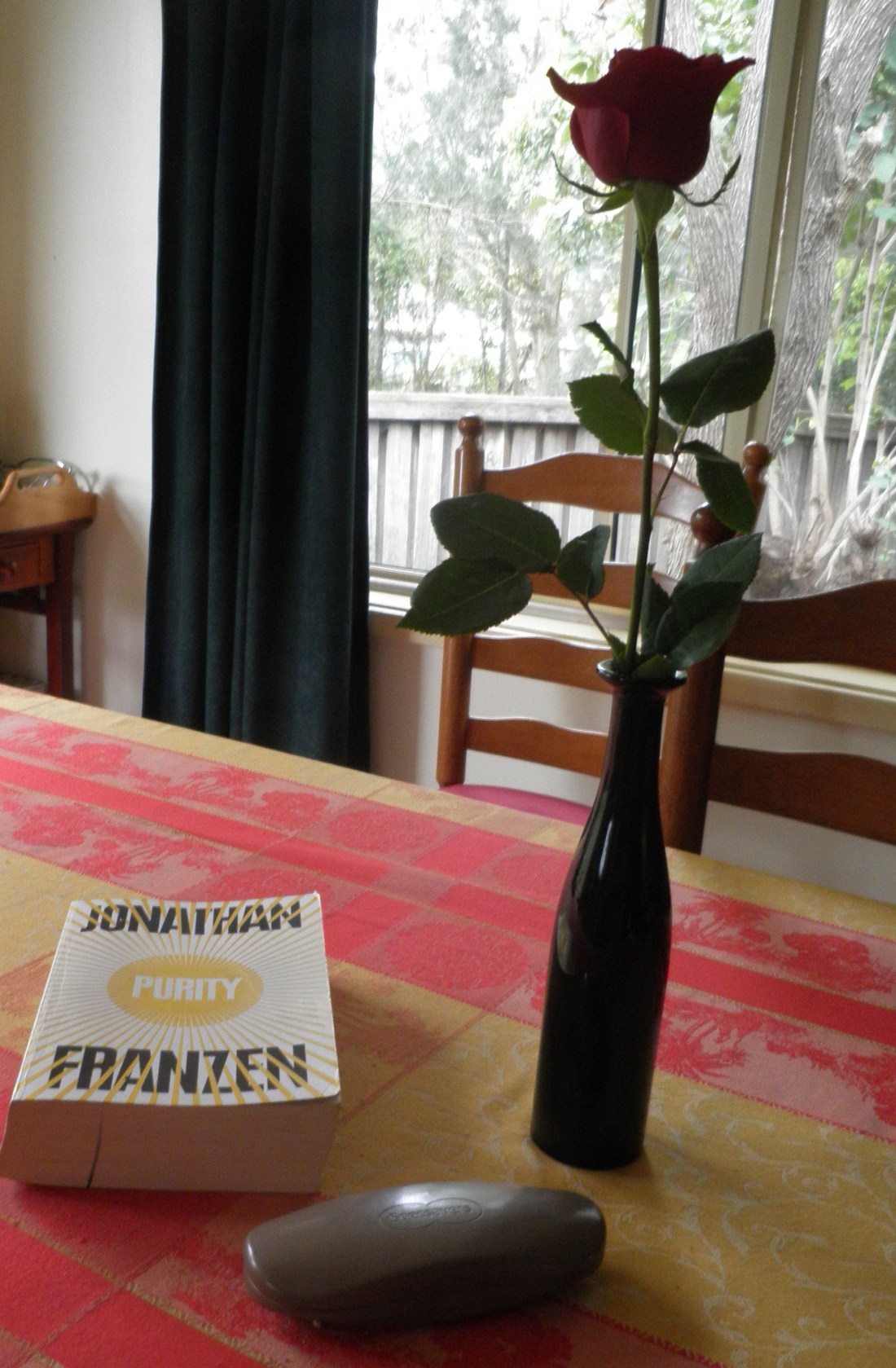
This is the morning of the 15th of February in Australia. We’ve just have had breakfast. I am very much looking forward to continue reading Jonathan Franzen’s ‘Purity’. I have only a few more pages to read.
Last night we watched ‘The End is my Beginning’. This was a very thought provoking film about the end of life. It was filmed like a documentary and based on the life of an Italian journalist and his family.
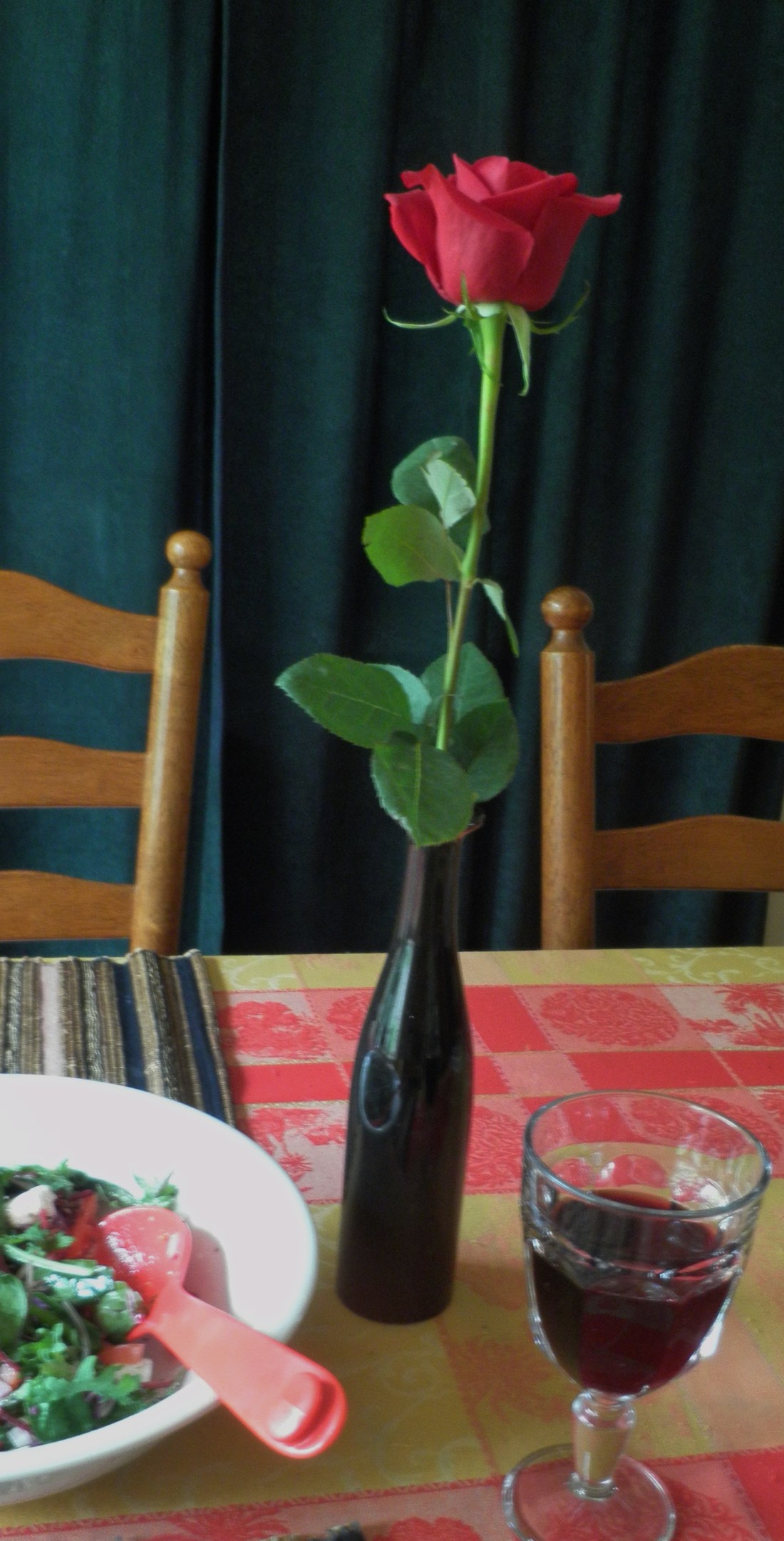
A Rose for Valentines’s Day 2017 and a lot more novel reading is still waiting for me.This pizza we were looking forward to eat on Valentine’s Day unfortunately turned out to be not to our taste.Luckily though we had wine and a delicious salad.
A man on his deathbed recounts his life and experiences to his son in what should be a film teeming with flashbacks, seeing as how the man is Tiziano Terzani and the theatre of his adventures are Vietnam and its devastating war, Mao’s China, Ghandi’s India and the Himalayas.
Instead, The End Is My Beginning[+], an adaptation of the bestseller by the great Italian writer and journalist, directed by Jo Baier, is a long dialogue between father and son, noteworthy performances from the leads (Bruno Ganz and Elio Germano), a theatrical film shot in one setting: Terzani’s real house in Tuscany, where he spent his last days among the pristine countryside and mountains, talking to his son Folco about life, disease and death.
Adapted for the big screen by Folco Terzani and the film’s German producer, Ulrich Limmer, the memories of the unforgettable Asian correspondent for Der Spiegel and Corriere della Sera, who passed away in 2004, are presented directly and simply: “We wondered whether or not to use flashbacks,” said Limmer, “but then decided to show something increasingly more rare: one man speaking, and another listening”.
The choice was a decidedly courageous one, and it paid off thanks to the intensity of the cast, the quality of the dialogue, and viewers’ awareness that they are watching an authentic and in some way illuminating adventure. “More than a film, it’s a unique experience,” said Germano, who to portray Folco spent two months at the Terzani’s house “in contact with the stars, mountains and wind, and collecting chestnuts”.
The challenge pays off also thanks to the total lack of melodrama. Everything is measured, restrained, like Germano’s emotions. Though his gazes and silences, the actor expresses the undeniable conflict of a son towards a larger-than-life father, as well as his curiosity and the desire to understand his parent.
This is early morning Monday, the 13th of February. I just had a look at what the Sydney Morning Herald published last night about the weather and I put this in another post this morning:
Just now all this feels quite unbelievable to me. I do not say that it is not true, it’s just that where I am it feels right now more like a cool winter’s morning: The outside temperature is a cool 15 C. What a change from two days ago!
“The coast and parts of the ranges were the only areas in NSW to escape high-30s or 40s on Saturday.” This is what it says in Peter Hannam’s article in the SMH.
Further it says:”NSW and other parts of south-eastern Australia were the hottest in the world on Saturday, according to the Climate Reanalyzer website.”
Here is what was said about fire conditions a couple of days ago:
“Soaring temperatures across much of the state have led to warnings of catastrophic fire conditions. In Walgett, the temperature has hit 46 degrees.
As NSW faces the “worst possible fire conditions” in its history with ‘extreme’ and catastrophic’ warnings in place across large slabs of the state, RFS Commissioner Shane Fitzsimmons said the situation was as “bad as it gets” and warned it was set to get worse on Sunday when winds are expected to sweep through scorched parts of mid to northern NSW.
“To put it simply [the conditions] are off the old scale,” he said. “It is without precedent in NSW”.
As of 11am, the RFS reported 76 bush and grass fires across NSW with 26 not yet contained. Deputy Commission Rob Rogers told ABC news: “It’s going to be a really tough day.”
I am sure a lot of fires in rural NSW are still burning now. It is a huge task for fire crews to keep them away from homes as much as possible.
Here is a comment I made yesterday: “We were quite lucky today. we had an overcast sky, all day and a bit of wind and the temperature went no higher than 28 Celsius which I find very pleasant. The rest of NSW still has sweltering conditions and severe fire alert. Today, I was able to do a lot of reading in the Novel “Purity” by Jonathan Franzen.”
Red hot: NSW smashes February statewide heat records two days in a row
Peter Hannam
CONTACT VIA EMAIL
FOLLOW ON FACEBOOK
FOLLOW ON GOOGLE PLUS
TWITTER TWEET
EMAIL
Meteorologists were predicting NSW would set a state-wide record for February warmth during the current heatwave but few would have tipped the mark would be broken two days in a row.
The blast of summer heat has placed south-eastern Australia on the map as the hottest place on the planet.



 AuntyUta