Berlin – Paris Return

Memories from EASTER 1954.
I was nineteen and a half!

Mum belonged to a theatre subscription group. The members were mainly elderly. For Easter 1954 this group had organised a bus-tour to Paris. Mum did not want to go and asked me, could I go instead. I agreed.

The distance Berlin – Paris is about the same as Sydney – Melbourne. However we did not drive straight through to Paris but had an overnight stop on the way, even though there were two busdrivers. On the way back, which was Easter Monday, the busdrivers had to go straight through, arriving in Berlin late at night.

The Paris accomodation for two nights was at Montmartre. I had to share the room with three elderly ladies. Not only that, I had to share a double bed with one of the women! The organisers apologised because of this. For the following night they had found another room for me: I was shifted to a different hotel to share a twin bedroom with our travel-hostess from Berlin who was an attractive woman in her twenties.

During the day a young French guide had shown us around. There was also a young woman who acted as interpreter. I saw a lot of Paris in the company of the two French guides and our two busdrivers.On top of this there was a young man from Berlin who had come on the bus with us. We called him ‘Bubie’. He was twenty and about to be apprenticed with a company in London. So he was quite an interesting young guy. However, I thought he was a bit full of himself. Typical of me to be so critical! In Paris and on the bus though he was good company for me. The old people soon started making comments such as: ‘Oh, quite soon an engagement might be taking place.’

On the night when I was supposed to share the room with our young tour-guide from Berlin, we had all been out dancing until the early morning hours. When I arrived at the door to my room, the door was locked. I knocked and knocked. Nobody opened. One of the busdrivers, who had been out with all of us, suggested to come to the busdrivers’ room which happened to be in the same hotel. I said this was out of the question. I wanted to be let into my room!! Busdriver-boy said: ‘She may have somebody with her in the room!’ I said I didn’t care if she had a lover-boy in there or not. I wanted to get into my bed!! After more and more knocking and a long, long wait in front of the room the door opened. Yes, indeed a lover-boy had been in the room with my room-mate. Lover-boy disappeared then. I was finally let into the room and into my untouched bed.

As a matter of fact only one of the busdrivers had been out dancing with our party. The other, a bit older one, had dutifully gone to bed quite early and was fit the next morning for the long busdrive back to Berlin. He wouldn’t let the younger one drive much. He must have been under the impression that the guy hadn’t had enough rest and was feeling rather tired!

Karl, my friend, had remembered the day and time when I would arrive back in Berlin. It was after 10 pm and he was waiting at the bus-stop with his bike ready to take me home. My little suitcase fitted on the back of his bike. I fitted at the front. Off we went. He was a smoker. The best thing he could think of to give me before we parted was one of his cigarettes. This was when we were not in front of my house but just around the corner. I smoked a bit of the cigarette telling him that I had had a good time in Paris. Then I left him. He had been surprised that my mum had not thought of meeting me at the bus-stop. As it turned out, Mum was not even there when I arrived home: She was at her friend’s place. I went back to work the following morning.

When I was Fourteen

Das Mädchen mit der schönen Figur
(The Girl with the Beautiful Figure)

Mum liked to see the woman doctor who had her consulting rooms a few blocks down the road from where we lived. The woman doctor was always duely concerned about Mum’s heart condition. Mum used to praise her a lot for saying kind words to her whenever she visited. Naturally Frau Doktor would prescribe the right kind of medicine too. In other words she was a very praiseworthy doctor. Her waiting room was never short of patients.

Once Mum sent me to see Frau Doktor. I think it had something to do with my irregular periods. The doctor’s sister lived with the doctor on the premises. She was the one who always received the patients. She liked to talk and was friendly with everyone.

While I was waiting my turn, the doctor’s sister started to talk to me. It did not take her long before she told me, that she had been watching me walking along the street. She said I had caught her eye because of my very erect posture. She also mentioned that she always thought of me as ‘The Girl with the Beautiful Figure’. Was I, a fourteen year old, embarrassed by all this talk? – – –
My word I was!

Memories from August 2010

Sunday, 1stAugust 2010

Today I had the feeling that spring was just around the corner. I walked to church and enjoyed the warmth of the sun. Soon I took off my cardigan and let the sunshine touch my bare arms. This is good for replenishing Vitamin D and for absorbing more Calcium, I told myself.

I was amazed how healthy I felt on a day like today. Last month I had persevered with several more tooth-extractions, There were some five teeth that had very old and quite large amalgam-fillings. I had made up my mind that it was time to get rid off these teeth. So now there aren’t anymore amalgam fillings left in my mouth. I wonder whether this is why I feel much healthier? Soon after all those extractions I had started a detoxing program. Kate, the naturopath at the Dental Centre, gave me four different supplements, which I keep taking as prescribed. In about six weeks I’ll go for another check-up to find out whether the detoxing of the various metals in my blood has been successful.

Most days I feel that walking for thirty minutes or so is no problem. I usually don’t get pains anymore and I hardly ever seem to run out of breath while walking. Besides, I used to wobble a bit to one side quite frequently. This seems to be better now. Come to think of it, I have been keeping quite well over the last few months. Didn’t I undertake an exhausting overseas trip from the end of May to the beginning of July this year, and didn’t I cope with the stress of travelling remarkably well? Who would have thought that I was capable of travelling for so long without a problem?

The last time I had travelled overseas had been in 1994. That year I had gone with Peter and daughter Caroline to Berlin. In 1997 and 2004 Peter travelled to Berlin by himself. So I had not been to Berlin for a long time. I felt very much like a stranger there during our recent visit in contrast to Peter who straight away felt at home again. He’s extremely familiar with this city. I think the biggest difference, compared to my previous visits, was the experience of feeling so much more elderly. I was for instance always grateful when younger people offered me their seat on the underground train or on the bus. Being elderly gave me the feeling that I could go slowly. I did not have to hurry as the younger people did. Whenever I felt a bit tired I could sit down and rest for a while.

We arrived in Berlin on the 31st of May. We had expected warm weather, but it was still very, very chilly and often extremely windy. Consequently I soon developed a terrible cold. However with adequate rest I quickly recovered from this attack of flu. When it had become a bit warmer, Peter and I enjoyed what nature had to offer, especially further up north in Mecklenburg/Vorpommern where we stayed for ten days with my brother Peter and his wife Astrid.

Mecklenburg/Vorpommern has forests and many, many lakes as well as canals connecting these lakes. The small towns in the area all cater for tourists. Very old houses have been lovingly restored. Some new developments include expensive marinas. Peter and Astrid showed us historical sites and castles where previously kings and queens liked to relax with their families, away from the hussle and bussle of Berlin.

The last few days of our stay in Germany we were back in Berlin. Day-temperatures had risen to well above thirty degrees by then. It did not cool down very much during the nights either. Daylight lasted till about ten at night. At four in the morning it was quite light again. Sometimes it seemed to be a bit light the whole night through!

Peter’s sister, who lives in Berlin, went on a lot of outings with us. Sometimes we were driven around in a car by friends or family members. However most of the time we used public transport – and very efficient transport at that. When you want to catch an underground train, you hardly ever have to wait for more than five minutes for the train to arrive!

Most people probably do not know that Berlin has many lakes, rivers and canals with hundreds of bridges. I do not know the exact number of bridges, however, I was told Berlin has more bridges than Venice! We saw quite a few of these Berlin waterways. Once we were taken on a boat- excursion that took us right through the city centre! On the boat we were served beer. frankfurts and potato salad. A few times we went on ‘book hunting’ excursions. Visiting friends and family in different parts of the city kept us busy as well.

On Friday, 2nd of July, was departure day. We left from Tegel Airport . This Airport is rather small and totally inadequate for a city like Berlin. Because of a lack of space very few big machines can fly in or out of Berlin. However, a much larger airport is to be opened in Berlin in about two years. If all goes well, Peter and I may then be able to go on a direct flight from Sydney to Berlin which would probably cut travelling time by a few hours.

This time we had a return flight from Sydney to Berlin via Kuala Lumpur and Amsterdam. We travelled KLM. To our great relief our luggage could be booked through to Berlin and later back to Sydney.

I was a bit apprehensive about our return flight since the schedule included a five hour stay at Kuala Lumpur. To my surprise I rather liked this stay at Kuala Lumpur Airport. The airport is huge. Internet connections are provided without charge. There is also no charge for drinking water! In the midst of the airport is a rainforest enclosure for travellers to enjoy. And of course there are shops, shops, shops! Also facilities for showers, massages, reflexology treatments and more. In the sitting area you can find stretch-out seats for tired travellers!

We did not want to go for dinner at one of the restaurants. We rightly assumed we would get dinner on the flight from Kuala Lumpur to Sydney. However we decided to go for coffee and cake at the Airport’s Deli France. And we enjoyed this! For a little while I also made use of one of the stretch-out seats. Why doesn’t every airport have those seats for sleepy travellers?

Memories 1955 to 1959

In January 1956 I left Berlin to stay with my father. I stayed with him in Düsseldorf for three months only.

In April I returned to Berlin. Peter was unemployed at the time. I went to see the boss at FLEUROP to ask him for my job back. I felt great relief when he agreed to employ me once more.

From then on Peter and I saw each other on a daily basis. He usually waited for me outside FLEUROP at a quarter to five when my working day finished. Then we walked together all the way to where he lived, which took the best part of an hour. We had worked out, that we could have a meal together for five Marks and a bit. People told us a meal for two cost much more than this. We proved them wrong. We ate well and stayed within our budget. Amazing!

It did not take us long to come up with the idea to live together. We thought it would be terrific, if we could rent a room for the two of us. So we looked at rooms for rent. Disaster! Whatever made us think, anybody would take us in as a couple unless we were married? Like it or not, I had to stay at my Mum’s place in that tiny room which used to be the maid’s room; and Peter had to stay on his mother’s sofa.

In the summer of 1956 I looked for a place of my own again. Peter had gone to West-Germany to take up work in a coalmine. The previous year, when I had left home for the first time, I had rented a very tiny room. I had been nearly twenty-one then A year later, I ventured into the suburbs close to where my place of work was. The room for rent was a very large one in a single story house. The land-lady was very welcoming. She asked me, would I mind if her other lodger, who was a music student, was practicing her singing. I said, I wouldn’t mind that at all. This made the landlady happy, because she sponsored this student girl, who was only about seventeen and was happy to sleep on a small sofa in the kitchen. However, in the large living-rooms there was a grand piano which the girl could make use of. The landlady said to me, that there was a garden with a gazebo at the back and I could reach it from my room since my room had French doors to the garden. I said I liked this very much. Soon I felt quite at home in my new surroundings. But I missed Peter. Sometimes I sat in the gazebo reading his letters. He still worked in the coalmines of Meiderich, from where he wrote me daily . I tried to answer his letters promptly for I knew he was always waiting for an answer.

Peter returned to Berlin in November and we got married in December. Eight months later Gabriele was born. When she was born, we lived at Tante Ilse’s place. I got several weeks paid maternity leave. When I had to go back to work, Tante Ilse looked after our baby girl. Tante Ilse called her ‘Princess’ and looked after her as a mother would. When the sun was out, she liked to push Gaby’s cot out onto the balcony. She found it hard, to let me and Peter take over when we came home from work. To her Gaby must have been the baby she was never able to have herself. I remembered, how she loved to spend time with me when I was little. She tought me how to tie my shoe-laces. A lot of my toys were gifts from her. She felt like a mother to me.

Since the day we were married, Peter had employment in the dispatching department of a magazine. When it got very busy and certain deadlines were approaching, he was required to stay longer, sometimes even right through the night. I think, Peter did not mind that very much because he found the job interesting and challenging. Once he had to work continuously for twenty-four hours! That was at a time, when we had just been married and I had no idea, he might have to work longer. When he did not come home, I got very worried. I waited and waited. After a few hours I went down to a phone-booth and rang the office. I think the boss himself answered the phone. He told me about the overtime. Later on the whole office kept joking about it, how Peter’s newly married wife had to ring to find out about the overtime. Peter did then get explicit instructions to always ring me when he had to work longer. And the boss then got into the habit of asking him: ‘Did you ring your wife? Sorry, just wanted to make sure!’ Actually Peter had to remember to ring me at FLEUROP during office hours. There was no phone where we lived.

On the day we married we had moved to a room which was just a bedroom and extremely cold. There was a tall ‘Kachelofen” (tiled stove), which could be heated with wood and coal. The problem for us was, to buy coal you had to be registered, and we had not been registered long enough! For buying wood, you didn’t have to be registered. So we bought some of that. And the very kind store-owner, who sensed our plight, let us have a few ‘Briquettes’ of coal.

That winter the outside temperature dropped to minus fourteen Celsius or thereabouts. In our bedroom it must often have been close to freezing point. It was really, really cold! No wonder we longed to go to a warmer country such as Australia!

In Februar 1957 Tante Ilse became aware of our plight and invited us to stay with her in her apartment. Onkel Peter had left for the USA to get some military training in Florida. Tante Ilse said, she would be glad of our company and we would be very welcome to stay with her. I think, Tante Ilse was the first person, apart from Peter, who suspected that I might be pregnant. My father inquired about a possible pregnancy when we visited him over Easter.

After his training in Florida, Onkel Peter was received into the German Bundeswehr. He had to move to a Northern town of Western Germany. By the end of the year, Tante Ilse wanted to move there as well. Unfortunately we could not afford to take over her apartment in Berlin: It was too expensive for us! If you wanted to take over an apartment, you had to show, that you could afford the rent. Once you have won the rights to rent a certain place, you were allowed to sublet. It was such a pity that we could not afford the apartment!

My father wrote us, we could all stay with him, because his lodger was about to move out anyway, which made a room free for us. We were grateful for my father’s offer. In November, Peter left for Düsseldorf, where he found himself a job, which he started in January the following year.

Beginning of December 1957

Moving from Berlin to Düsseldorf

and sixteen months later to Australia

The train took us through the German Democratic Republic and then all the way to Düsseldorf. At the border our passports were inspected by the Volks-Polizei (People’s police). There were a lot of East-German people on board, because the train was an East-German ‘Interzonenzug’.

We were able to buy food and drinks in the dining-car. However we had to pay with West-Marks. If you were able to proof, that you were a GDR citizen, they let you do purchases with East-Marks. There was an East-German family in the compartment with us. The husband went to buy beer with East-Marks. When he came back, he offered to buy beer for us with his East-Marks. He said, he was willing to sell it to us for half the price of West-Marks that we would otherwise have to pay for it. Peter took up the offer. Luckily the VOPOs did not catch up on to that, otherwise we could have ended up in jail!

Peter had come back to Berlin to say goodbye to the family and to take me and Gaby to Düsseldorf. We boarded the overnight train. As far as I remember, Gaby was a very good baby and settled in well for the night. We even coped with the nappy business rather well. In those days disposible nappies were unheard of.

When, sixteen months later, we were on the boat to Australia with twenty months old Gaby and five months old Monika, we gave all the cotton nappies to our steward to take them to the laundry service. We were barely able to afford this nappy service. Yet we were not allowed to wash the nappies ourselves, even though there was a laundry provided for general use. Anyhow, the nappy service worked well for us. Luckily everything else on the voyage was free for us!

 Our Life in Düsseldorf

 In Düsseldorf Peter worked in a dispatching job once more. As a dispatcher he was on a monthly salary. The government provided two different medical insurances: One was for people on monthly salaries, the other one for people on weekly wages. Since Peter belonged to the insurance for salaried people, I, as his wife, could see with my second pregnancy a gynocologist, wo would not have accepted me as a patient, had I been in the other insurance. This gynocologist had very posh offices and I never had to pay for anything. Everything was paid for by the insurance. After the delivery they made me stay in hospital for nearly a week. This did not cost anything either.

For the time I was in hospital some very kind nuns looked after Gaby. They charged very little for that. When the weekend came and Peter was off work, he took Gaby home. I think he took a few days off after the weekend, so he could help me with the babies when I came home from hospital. I did not stay in hospital for a whole week. I insisted they let me go home early, since I felt all right to do so. The previous year, when I had Gaby, the policy of the hospital in Berlin had been to let mothers stay in hospital for ten days after a delivery.

Peter’s work was extremely low paid work. But we did not mind that. We lived rentfree and did not need to spend much on clothes. Food we could buy at a discount price just around the corner. My father loved to spend time with Gaby who became a very lively little girl. On Saturdays, when the babies were already asleep, Peter and I would go to a movie session. And Vati (my father) stayed behind, wishing us a good night. When we were very careful with the grocery purchases, we usually had enough money left for the movies, also to buy films for our camera, get them developed and pictures printed.

Easter Photos from 1935


Apparently Mum’s mother came from Leipzig to Berlin for a visit  around Eastertime, when I would have been about six months. I think the dress I wear may have been knitted by Mum. Grandma volunteers to hold me up so I can show myself properly to the camera!

In the photo with Mum we see some Fruit, Easter-Eggs and Toys on the table.

The photo with Dad was also taken on Easter Sunday.


Memories

Peter’s Family during the Year after I first met Peter

When I visited Peter’s family they were always very welcoming. They lived in a small apartment on the fifth floor. There was no lift!

Peter’s mother had only one room to herself. The second room in the apartment was occupied by Peter’s older sister, brother-in-law, as well as their baby daughter. In the third room lived Peter’s Great-Aunt .

Peter slept sometimes on the sofa in his mother’s room. Every room in the apartment was used as a bedroom! However during the day, these rooms were made into cosy living-rooms. I do not know, how people managed this kind of comfort under such crowded conditions. Sundays I was often invited for a tasty hot meal at lunchtime. We were usually six people around the table in Mama’s room. Sunday afternoons there was coffee and cake for the family, often including another sister of Peter as well as her husband and baby son. I felt very much at home with Peter’s family. Another family-member was a little dog called Tussy: Every day, after its morning walk, this dog enjoyed a cup of cocoa and a dog biscuit. A very special treat indeed.

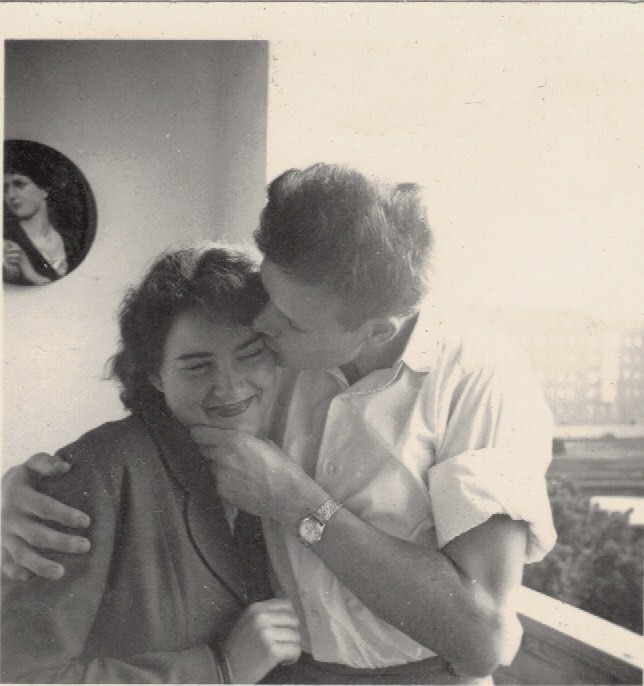
Peter’s mother had a small balcony attached to her room. The following picture of Peter and me was taken on this balcony.

A Challenging Teacher


Dr. Petzel, our seventy year old German teacher, fled from East-Prussia, when the Russians approached. Dr. Petzel seemed ancient to us girls. Instead of teaching German, he would often tell us about his experiences on the road from East Prussia to Berlin in the bitter cold of winter. I was amazed to hear, that people were able to continue walking even after their toes were frozen! How did they do it? How could they walk for hundreds of kilometers with frozen toes or worse? I really felt sorry for all the refugees. The sub-zero temperatures affected just about every one of them, especially babies, whose nappies all too often froze onto their bodies. I don’t know, whether under those circumstances any baby really had a chance to survive. Often babies were just left at some Red Cross station, either dead or dying.

But back to Dr. Petzel. He was of very small stature and had hair like a hedgehog. What little hair could be seen, looked grey. He often made remarks, how important it was to get a good education. ‘Look at me’, he would say, ‘I lost everything because of the war. But one thing no-one can take away from me, is, what is in my head.’ Another one of his favourite sayings was, that he studied German at university, that is he studied ‘Germanic Languages’, but still cannot say, that he knows German . ‘There is so much to know about the German language’, he said, ‘no-one can really know it perfectly.’ Before he started on this elaboration, he went around the class, stopped in front of one student, then another one, and another one. He asked each of them, whether they knew German. Of course every-one answered with ‘yes’. Finally Dr. Petzel informed us quite gleefully, they were all wrong, since we did not know very much German at all, neither did he, even though he studied it.

 At High School all the teachers in those days, rightly or wrongly, had the habit of looking up in the files, what profession the students’ parents had. Then they picked on those students, whose father or mother had acquired a doctorate. One girl, Irene Flemming, had a mother, who was a medical doctor. Other than that there were only two girls in our class, whose father had the title of ‘doctor’. I was one of them, the other one was Franziska von Kopp. Irene, Franziska and I were often singled out by Dr. Petzel (and other teachers as well) as being the daughters of academics and therefore, naturally, we had to be smarter than the rest of the girls!

It so happened that I found it relatively easy, to understand grammar as well as punctuation. Needless to say, that was something for Dr. Petzel. One day he asked a difficult question about grammar, that none of the girls were able to find an answer for. Then he said to me: ‘Frl. Spickermann, can you give me an answer to my question?’ I stood up in order to say, what I had to say. Dr. Petzel walked very close up to me. He looked me straight in the face, standing on tip-toe to make himself as tall as I was. And believe it or not, I was able to provide the right answer!

When the lesson was finished, some of my friends came up to me, saying: ‘Gee, how come, you stayed so calm, when Hedgehog came right up to you trying to look into your blouse?’ I was surprised, that they thought, this had been going on. I think I was only thirteen and had hardly any bosom to speak of yet. And honestly, I had not felt threatened at all. I think my friends admired me for my so called ‘coolness’. To me it felt great, that my friends thought my behaviour was admirable.

Memories from my Teenage-Years

I was seventeen, when a nineteen year old guy, who was in his final year of schooling, showed an interest in me. The way he talked and looked at me, I could not help but fall in love with him! We were friends for a few weeks, when my mother found out, his father owned a small flower-shop. In my mother’s eyes this made him some-one of very low standing and definitely not suited for me as a companion. My mother decided, she wanted to see the father in his flower-shop and made me go along with her.

The flower-shop turned out to be very small indeed. The whole family was gathered in the shop, when we arrived. There was the congenial looking father, who was of small stature. The mother was a tallish woman. I imagined her to be very resolute and practical in every way. I knew, that she was my friend’s step-mother. His mother had died, when he had been at a very young age. He had shown me a picture of her. He did remember her quite well and missed her very much! The photo showed a young, extremely friendly and beautiful looking woman. I could understand, how a boy would be fascinated by those soft features. The step-mother turned out to have rather harsh features. There was also a step-sister, a spindly looking girl of about ten. When she heard, what was going on, she said full of ‘Schadenfreude’: ‘Ah. so W . . . .    has been telling fibs again!’

Then W was called out. When he appeared from behind the shop, he looked small and embarassed, letting his head hang from having a bad conscience. I felt very embarrassed for him. Talking to the father, my mother made sure, that we two young people were never allowed to see each other again. The father said a few soothing words to me, trying to comfort me. He urged me, that it was for the best, if I listened to my mother.

I trotted back home with Mum, feeling very, very sad indeed. For the next few months my only friend remained my schoolfriend E H. Her father was Dr. H. He was a boss at TELEFUNKEN, E lived around the corner and I was allowed to visit her at night-time, whenever I felt like it. I also went on a few outings with her.

 A few months later, aged eighteen, I started work. Then in the spring of 1953 I met another guy, who I thought was very likeable indeed. When a year had passed, since I had seen W, I met him once more. He had done his ‘Abitur’ in the meantime and found employment in some office near Kurfürstendamm. He was telling me about Fax- machines, which he had to use.

When I told him about my new friend, he must have sensed, that I was not really interested in a friendship with him anymore, feeling already too attached to the other guy. We parted as good friends. However we agreed, it would be interesting to see each other again at the same place, which was the Bayrischer Platz, exactly ten years later, on the 30th June 1963. But by that time I was already married with three children and living in Australia. Needless to say, I never saw him again.

                                                        ———————–

I left high-school at intermediate level in the summer of 1950. Thereafter I lost contact with all my girl-friends, who went on to high-school to the end of year thirteen to get the ‘Abitur’, which would qualify them for university entrance. My choice was to continue higher education at a commercial school, which hopefully would qualify me for a secretarial position.

The best thing at that school was, that we read Goethe’s Faust. I was therefore able to get good marks in German. English was a good subject for me too. However in all the commercial subjects I was extremely unsatisfactory.

One day our class-teacher, Herr Gluschke, had had enough and talked to me under four eyes. ‘How come ‘, he said, ‘that you are good in all subjects, the other teachers teach, and in all the subjects that I teach, you’re far from good?’

What did I answer? Did I say, that the other subjects interested me more? Did I tell him, I found it hard to work anything out on a counting machine because I felt I needed a lot more practice on it? Or that I had problems remembering the required wording in answer to a set question, when we were not allowed to take notes in his classes and when we had no books whatsoever on the subjects he was teaching? I don’t know, what I answered him.

No wonder I was dead scared of the final exams. Rather than finish the second year of commercial schooling, I applied for a job which would enable me to get familiar with secretarial work. I looked up advertised jobs. In one of the ads they offered two beginners’ jobs for office work. Later I found out, that there were ninety-five applicants for these two very lowly paid jobs! And I was the extremely lucky person, who ended up with one of the two jobs!

Herr Gluschke, on hearing that I wanted to leave school and start working, happily wished me all the best for the future! I started work in the clearing house of FLEUROP/INTERFLORA on the second of January 1953 and stayed with that company for the best part of five years.

At the commercial school I had made only one close friendl: E H. And E did not finish school either. Her father, who was an executive at TELEFUNKEN, had seen to it, that she could start work for TELEFUNKEN in Spain.

Apart from some commercial English, we had also learned a bit of commercial Spanish at school, which came in handy for E. Of course in Spain it did not take her long to speak and write Spanish fluently. She became friends with a Spanish guy called Jesus. So E stayed on in Spain and I missed her. We kept writing each other for a while. I also saw her, when she came back to Berlin to visit her parents.

I also missed that guy, who’s father owned a small flower-shop. He had been telling me such wonderful stories! He also played songs on the piano. I loved it when he played the song about the lonely soldier at the river Wolga. He also knew some naughty songs. But I told him, I wasn’t so keen on those. He accepted that gracefully.

His name was W .  . .. I called him ‘Wölfi’: he called me ‘Schäfchen’. Schäfchen means ‘little sheep’. Of course, he only called me that, when no-one else was around. ‘Schäfchen’, he said it lovingly and understandingly, and I didn’t object! I must say, as compared to him, I really felt like a ‘Schäfchen’. He told me, he earned some pocket money as a piano-player in night-bars. So he must have been well aware of what was going on at night-time in a big city.

 Students in their final year of high-school, that is the thirteenth year of schooling (after having started at around six), those students in their final year were called ‘Abiturienten’. So W was an ‘Abiturient’, when I met him at a Spanish evening class. I had joined that class of the Workers’ Education to catch up on Spanish, for I felt the few hours of schooling at my school were not sufficent to get a proper footing in the language. Come to think of it, there would not have been a reason for W to join that class, for Spanish was not required at his school. He was interested in travel though. Maybe that is why he wanted to learn some Spanish.

It was the spring of 1952 I was seventeen and a half at the time and W was nineteen. When I told him, I had already learned a bit of Spanish at school, he asked me, could I help him with his Spanish. This showed me, that he was interested in getting to know me. He was allowed to visit me at my home. We still had a piano at the time. I loved it, when he played the piano.

Sunday nights I was supposed to sell news-papers. One Sunday night I skipped it, because I wanted to stay with W. That was a mistake, because Mum found out about it. She was outraged about my behaviour and started making inquiries about him. Something did not seem right to her. She had begun to smell a rat! And yes, she was right. W had been telling me and Mum quite a lot of fibs, For one, he did not want to admit, that his father was only a small shopkeeper. He thought, if Frau Dr. Spickermann knew about that, she would never agree to her daughter going out with him! So he told us stories about a rich aunt, who was his patron and who took him on travels to Italy and America. It was of course all phantasy! Naturally Mum thought, he could not be trusted anymore. There was not a thing in the world I could have done to change her mind. I still had feelings for him, but I had to suppress them.

I had started selling Sunday night newspapers at age fifteen. I needed a special permission from the police to do it, since fifteen year olds were not supposed to work late at night. But since I was nearly sixteen and looked much older anyway, I had no problem in getting permission to do it. I had to sell ‘Die Nachtausgabe des Montags-Echos’ (the night-edition of the Monday-Echo). It earned me a bit of pocket-money. Occasionally people would think I was a university student who was badly in need of money. These people would give me a generous tip, sometimes a five Mark note! Once a class-mate saw me selling papers in front of a cinema. I felt extremely embarassed that my class-mate had seen me selling papers. It was not the done thing for school-students to sell papers. University-students did it all the time, but not school-students.

When I started office work later on, I was paid an extremely low salary, Never the less, from then on I quit selling papers.

Pictures from 1938

My brother Bodo was born on the 9th of June 1938. I remember waking up in the morning and being told by Auntie Elsa that I have a little brother –  ‘ein Brüderchen’. He was beautiful! I saw him lying in his cot in my parents’ bedroom.I was overjoyed that this was my brother!

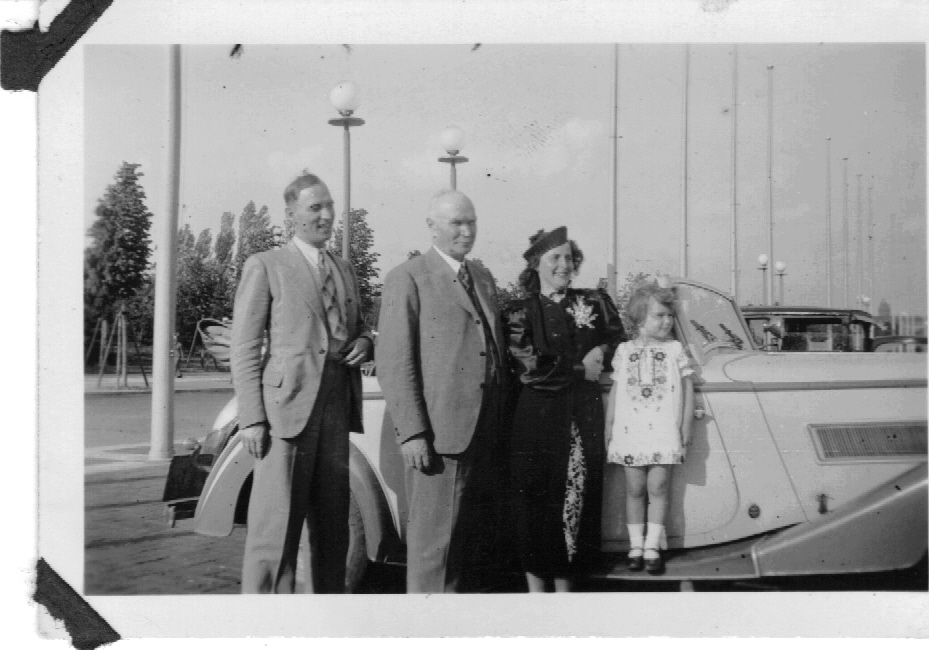
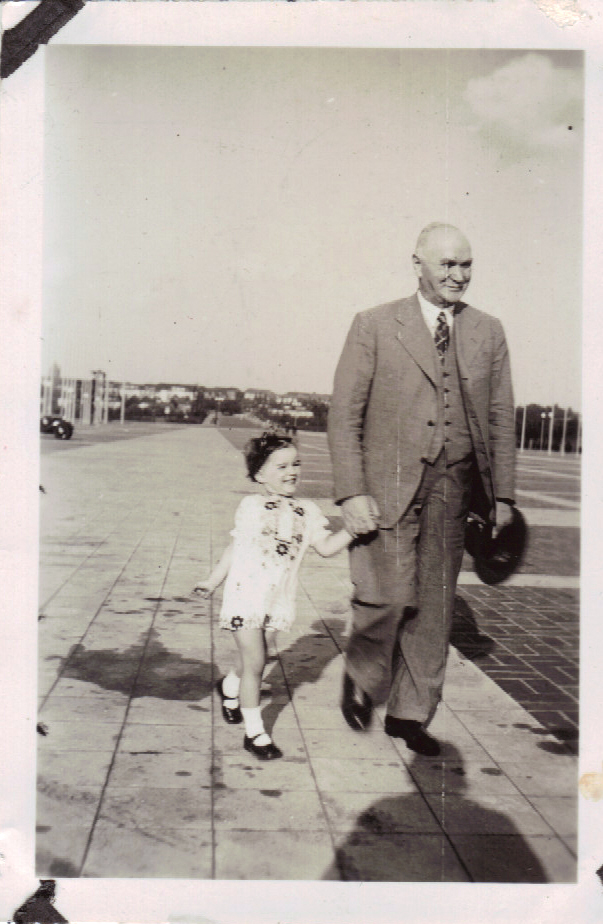
That same month my Dad’s father came to visit. Uncle Adi and Aunty Elsa drove Grandad, Dad and me to the Olympic Stadium  in their huge car. There were some pictures taken in the big square in front of the stadium. I look so very happy walking along with Grandad. Mum didn’t come along with us on that day because she had to stay with little Bodo. I think she kept still to her bed at the time. So it must have been soon after Bodo’s birth which was a planned home-birth. For years to come Aunty Elsa would talk a lot about it how it eventuated. She said coming home from seeing a movie at the cinema she noticed a hanky that had been placed on our balcony so it could be seen from the street. This was the sign, that the delivery of the baby had started and Aunty Elsa got very excited and rushed up to be with her sister. Apparently a midwife had been on call all the time and the delivery went on very smoothly. I never did get disturbed by it and must have been sleeping right through the night in the neighbouring room!

We already had a telephone at the time. To this day I remember our number! I was allowed to answer the phone. I was told to say: ‘Hier bei Dr. Spickermann!’ when answering the phone.

The picture with me beside Mum’s bed looking at Bodo in Mum’s arms shows that my parents’ beds had been seperated for the delivery of the baby. Normally these two beds would have been close together.

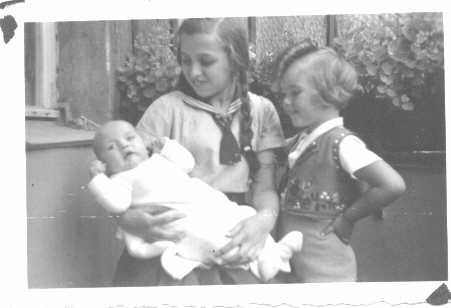
A few months later we had another visitor to Berlin: My cousin Ursula. The picture which was taken on our balcony shows Ursula holding little Bodo and me looking on.

And for good measure I’m going to add a picture of Grandfather and Grandmother from 1934 when I was a little baby.

OUR LUCKY ESCAPE


Some of my children know a bit about our lucky escape in 1945. In case they want to find out a bit more about it, I am now trying to write down whatever I do remember.

During the last war years we had stayed away from Berlin, living east of Berlin in a desolate country area. With the Russians fast approaching at the beginning of 1945, my mother decided, we would move to grandmother’s place in Leipzig, rather than go back to Berlin to our apartment which we still rented. We children were never allowed to visit Berlin during the years of the bomb raids.

From the beginning of February 1945 my mother, my two brothers and I stayed in Leipzig with grandmother and cousin Renata. As I remember it, there were frequent bomb raids. We were used to the sound of the sirens and having to stay in the cellar for hours at a time.

After Christmas, schools had not opened any more. We played a lot in the surrounding streets with other children. But we were never allowed to stroll very far. In case of an alarm , we had to be within the vicinity of our cellar. For us children this was just part of every day life. My brothers were three and six years, I was ten years old. The winter was very cold, but we still had enough to eat, were dressed warmly. In the kitchen there was always a fire going in the oven for cooking and for hot water. In the bedrooms we had enormous feather-beds to keep us warm.

There was talking about that this bloody war was soon to end. We sure were looking forward to this! I cannot remember ever having been scared or thinking that anything bad could happen to me. Or to my family. To us children it seemed rather entertaining to be sitting in the air-raid shelter. Many people congregating as soon as the sirens went off, was extremely exciting! We did get to know everyone, who lived in that tall five story building. The adults would talk to us children, asking us questions, just being friendly.

And we would listen to the adults talking to each other. I remember that I always found it interesting to listen to adult conversations. And sometimes all of us would sing a few songs. I loved the singing of songs! When we could hear bombs hitting somewhere in the neighbourhood, it never seemed very close to us. This meant we were all right. Often my three year old brother entertained everyone by singing solo. They were cute little children’s songs. People always encouraged him to sing more songs because they loved his singing.

In April there was another bomb-raid. We had a relaxing time with everybody in the cellar. It was a long lasting alarm, went on for hours. Since it was in the middle of the night, mum wanted us to go to sleep. We were able to stretch out a bit on our makeshift beds. But I don’t think we were able to go to sleep that night. My brother Peter was still singing his songs when several bombs hit us. This time there could be no doubt that the bombs had fallen right on top of us since the noise was absolutely deafening! My six year old brother Bodo started crying. I felt so sorry for him. It was terrible seeing him being so horribly scared. I said to him he needn’t be afraid. Soon everything would be over.

I was right. It did not take long at all. All of a sudden, it was very quiet. Then some people started moving, investigating, whether we could still get out. Our main exit was full of debris. Impossible to get out there. There was a bricked-in escape to the cellar of the next door building. To make use of this escape, quite a few bricks would have to be dislodged. Then someone shouted that the window, that led from the cellar to the footpath in one of the adjoining cellar-rooms, was not blocked. It was easy, to get out through there!

A sigh of relief went through the crowd. My brother Bodo was not scared any more either. My brother Peter had never been scared at all. People said, this was because he had still been too little to understand. Later on, we found, that the building had been hit by up to five bombs. Right to the ground-floor,  everything had been torn away. Miraculously, a lot of the ground-floor was still standing. This was my grandmother’s apartment! My grandmother was able to save some of her furniture together with all our belongings. A lucky escape indeed.