Aboriginal heritage site damaged at BHP Pilbara iron ore mine

https://www.smh.com.au/national/western-australia/aboriginal-heritage-site-damaged-at-bhp-pilbara-iron-ore-mine-20210222-p574uf.html

By Tess Ingram and Marta Pascual Juanola

February 23, 2021 — 4.19pm Larger text size

A registered Aboriginal heritage site has been damaged at one of BHP’s Pilbara iron ore mines, despite the major miner pledging in June to consult with traditional owners before disturbing sites in the area.

In late January, a culturally significant rock shelter was impacted at BHP’s Mining Area C project in the Pilbara, causing a rockfall at the site. It is understood neither BHP or the Banjima people are clear on what caused the damage.
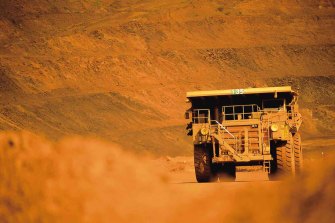
The blast happened at the company’s South Flank iron ore mine.
The blast happened at the company’s South Flank iron ore mine.CREDIT:AP

Mining Area C is adjacent to BHP’s $US3.06 billion ($4 billion) South Flank project, which is under construction and will be the largest iron ore mining and processing facility ever built in Western Australia. It is located on Banjima’s traditional lands in Western Australia’s Pilbara region, 130 kilometres north-west of Newman.

The news comes almost a year after fellow Pilbara miner Rio Tinto drew international condemnation when it destroyed 46,000-year-old Aboriginal rock shelters while blasting at Juukan Gorge in the same region.

T

he destruction of Juukan went against the wishes of the traditional owners, the Puutu Kunti Kurrama and Pinikura people, shocked investors, forced the resignations of former chief executive Jean-Sebastian Jacques and two of his deputies, and sparked a federal parliamentary inquiry.

On May 29 2020, just five days after Rio’s blast at Juukan, WA Treasurer and Aboriginal Affairs Minister Ben Wyatt gave BHP approval to proceed with work at South Flank that would result in the destruction of 40 Banjima heritage sites. That approval was provided under the controversial section 18 of WA’s Aboriginal Heritage Act, which the WA government is in the process of reforming.

In a statement in June, BHP said it would “not disturb the sites identified without further extensive consultation with the Banjima people. That consultation will be based on our commitment to understanding the cultural significance of the region and on the deep respect we have for the Banjima people and their heritage.”

It is understood that commitment extends to all sites identified within Section 18 approvals, however, while the rock shelter was approved under a Section 18 application, BHP did not deliberately proceed with work that could affect the site.

BHP President Minerals Australia, Edgar Basto, said the rock fall at the site was identified as part of monitoring on January 29.

“This site is not part of current mining operations. The cause of the rock fall is not known,” Mr Basto said in a statement.

“The heritage site was first recorded in 2005 with the Traditional Owners of the land, the Banjima. The site does not contain rock art or archaeological deposits, and could not be dated. Section 18 approval was subsequently obtained following consultation with the Banjima and with their support.

“We notified the Banjima Traditional Owners of the rock fall, and I and Western Australia Iron Ore President Brandon Craig subsequently met with Banjima Elders as part of the Banjima Heritage Advisory Council, and agreed to a joint investigation with the Banjima to determine the cause of the rock fall. We are committed to learning from the outcomes of the joint investigation.

“The relationships we hold with the traditional custodians of the land on which we operate are critically important to BHP. Over many years, we have built a strong relationship with the Banjima people based on deep respect for their heritage and their connection to country. This includes the establishment of the Banjima Heritage Advisory Council last year. We will continue to work with the Banjima in a spirit of respect and cooperation.”

A spokesman for the Banjima Native Title Aboriginal Corporation confirmed an investigation had been launched into the incident.

RELATED ARTICLE
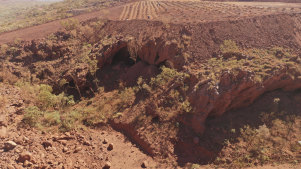
The site at Juukan Gorge that was reduced to rubble to extend one of Rio Tinto's iron ore mines.
Indigenous

Juukan Gorge destruction shines light on Aboriginal group ‘gags’

“In late January 2021, BHP submitted a report to Banjima Native Title Aboriginal Corporation RNTBC (BNTAC) outlining rockfall impact to a registered Banjima site, located within BHP’s Mining Area C,” the BNTAC spokesperson said.

“Following the initial report, Banjima’s newly established South Flank Heritage Advisory Council — together with BNTAC and BHP — launched an investigation into the cause of the rockfall.

Banjima’s South Flank Heritage committee met with BHP executives on 11 February to clarify the initial report’s details and progress of the investigation.”

The Banjima People told the Juukan inquiry they “have a long and sometimes difficult relationship with mining companies” and the “cumulative destruction of our country is something which sits uneasily with our people”.

“We are resolute in our position that the events at Juukan Gorge, the subject of this inquiry,
and the destruction of Aboriginal heritage generally — without due regard to the cultural
custodians of that heritage — must not be repeated, nor should it continue,” Senior Banjima elder and BNTAC chairman Maitland Parker told the inquiry.

RELATED ARTICLE
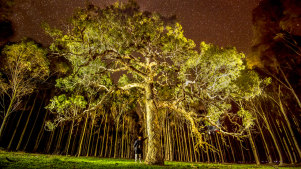
The yellow box tree, widely referred to as the directions tree or fiddleback, has been cut down.
Explainer
Indigenous culture

What do these sacred trees tell us about Aboriginal heritage in Australia?

In the wake of the Juukan disaster, BHP and BNTAC established the Heritage Advisory Council in September to provide input into mine planning at South Flank.

The council comprises of Banjima elders and senior BHP representatives.

Mr Basto said in September the council would “ensure on-going high level dialogue between us on important cultural heritage and other matters”.

Sydney Metro in meltdown

Hundreds of Sydney Metro passengers were ordered off trains during the height of Thursday morning’s peak hour services after mechanical problems on a train at North Ryde caused serious delays.

Commuters reported being left stuck for up to 20 minutes on stationary trains after 8am and being told to disembark and wait for buses.

Sydney Metro commuters face delays

Sydney Metro commuters face delays

Port Augusta woman charged with murder

Sydney Metro commuters face delays

Tania Matin said she was told via an announcement to get off the train at Macquarie University and catch a bus, but nobody was there to direct passengers and she returned to the station after waiting 15 minutes.

She was then able to board a train, but ordered off again at Macquarie Park, where she was greeted by a line of “thousands” waiting for buses. After another 20 minutes, she gave up and took a metro train back to Epping.

Ms Matin said she was angry “not at the mechanical failure… but lack of communication, mismanagement and lack of skill to control the huge crowd [at peak hour]”.

Services on the network returned to normal about 11am.

It’s been a poor week for the Sydney Metro, which also had a train break down at Chatswood on Wednesday. On Tuesday, a fire alarm prompted services to skip Macquarie Park.

The network has faced frequent technical problems since its opening in May.

Jenny Noyes

Jenny Noyes is a journalist at the Sydney Morning Herald. She was previously a writer and editor at Daily Life.


Two Articles in the Sydney Morning Herald about the Value of Human Life

All Israel wants is to live in peace with its neighbours

Read more: http://www.smh.com.au/comment/all-israel-wants-is-to-live-in-peace-with-its-neighbours-20140729-zy5jn.html#ixzz392M0QFvW


Yair Miller is president of the NSW Jewish Board of Deputies.

Read more: http://www.smh.com.au/comment/all-israel-wants-is-to-live-in-peace-with-its-neighbours-20140729-zy5jn.html#ixzz392MIL5AW


MH17, Gaza and the value of human life

Read more: http://www.smh.com.au/comment/mh17-gaza-and-the-value-of-human-life-20140724-zw8jn.html#ixzz392MhnNGX


Waleed Aly is a Fairfax columnist. He hosts Drive on ABC Radio National and is a lecturer in politics at Monash University.

Read more: http://www.smh.com.au/comment/mh17-gaza-and-the-value-of-human-life-20140724-zw8jn.html#ixzz392Mp5dxZ

Are we Equals?

http://www.smh.com.au/lifestyle/no-sex-please-were-equals-20140217-32umo.html


I just read the above article in the Sydney Morning Herald. It is an edited version of an article first published in The New York Magazine.

Read more: http://www.smh.com.au/lifestyle/no-sex-please-were-equals-20140217-32umo.html#ixzz2u0QEdkBK


So I am asking myself now can married couples be equals? The answer is of course, sure, they can be equals. However in a sexual way they definitely cannot be equals unless they are happy to live more or less in a kind of sibling relationship.

I think the French did get it right a long time ago: Viva la difference!

Mike Carlton in the Sydney Morning Herald on Tony Abbott

‘Any government which makes it harder to manufacture cars is making it harder for us to continue to be a first world economy because without cars, without steel, without aluminium, without cement, we don’t have these manufacturers in Australia, we are not really a sophisticated economy any more.”

These thoughtful words, taken from the Liberal Party website, were uttered by none other than Tony Abbott after one of his fancy dress tours of the Ford production line at Geelong in 2011.

My, how things change. In his few short months in government, Abbott has seen off the entire Australian car making industry, with the loss of who knows how many tens of thousands of jobs and an even chance of plunging Victoria and South Australia into at least a local recession. There goes his sophisticated economy. It’s a unique achievement, unmatched by any incoming government.

Advertisement

Given that the usual claque of chattering economists is now saying that this was inevitable – they’d all foreseen it years ago, etc, and no bad thing, blah blah – you’d think this is something Abbott might have touched on during the election campaign. But no, not a hint. You might also think that he and his Industry Minister, Ian ”Chainsaw” Macfarlane, would have had some policy or plan in place for dealing with this tectonic shift.

No to that, too. They haven’t a clue. As so often happens, the best the Prime Minister could do was to heap platitude upon banality. The Toyota workers would go ”from good jobs to better jobs”, he intoned glibly, as if that would fix everything. Chainsaw blathered on about creating ”a framework”.

When in doubt, blame the trade unions. This is a habit so deeply ingrained in the Liberal DNA that facts are irrelevant. Abbott first tried it on after the troubles at SPC Ardmona, making such extravagant claims about the supposedly feather bed working conditions at its factory in Shepparton that the local MP, Sharman Stone, one of his own backbenchers, publicly called him a liar. You don’t see that happen a lot with prime ministers.

But with that Bourbon talent he has for learning nothing and forgetting nothing, Abbott was at it again when Toyota pulled the pin. Union intransigence had driven the company to the wall, a refrain taken up by Joe Hockey, who claimed Toyota executives had privately told him that very thing last year. That, too, fell in a heap when the company issued a statement to say that: ”Toyota Australia has never blamed the union for its decision to close its manufacturing operations by the end of 2017, neither publicly or in private discussions with any stakeholders.” Oops.

Ah, but the age of entitlement is over, we’re told. Unless you happen to be a needy football club, that is. During the election campaign, Abbott promised $5 million to the Brisbane Broncos – owned by Rupert Murdoch’s News Corp, no less – to ”kick-start the revitalisation” of their ”sporting precinct at Red Hill”. The Manly Sea Eagles were offered $10 million to renovate Brookvale Oval, which just happens to be in Abbott’s electorate of Warringah and where he’s the number one ticket holder. We shall see if those juicy bits of pork-barrelling make it through the coming federal budget.


There are few sights more ridiculous than a media pack howling in a hot but futile pursuit of a reluctant celebrity.

So it was with the release of Wotzername from Bali’s Kerobokan prison on Monday. Chaotic scenes! Grunting and shouting, heaving and pushing, sweaty and dishevelled, Australia’s finest hacks – trained to the peak of ruthless efficiency – battled to bring us their fascinating pictures and reports of a fleeing tartan hat.

The wonderful thing about a media scrum, as these things are invariably called, is that the participants each and individually pretend, po-faced, that it’s nothing to do with them. They remain aloof from the vulgar fray. It’s their rivals and competitors battling in the gutter. But all in vain. To the fury of the pack, the tartan hat was spirited away in a motorcade thoughtfully provided by Channel Seven’s Sunday Night program. Why, the grand old man of TV journalism, Mike Willesee himself, had been glimpsed chomping on a fat Cohiba in the back of one of the speeding limos.

Deprived of their prey by this piece of treacherous one-upmanship, the scrum immediately began speculating on what enormous sum Seven had forked out to snare the interview. The biggest guess I saw was $3 million, a towering absurdity. My sources at Seven assure me it was ”well, well south” of $1 million.

As ancient tradition dictates, the losers then put up a self-righteous fuss about the wickedness of cheque-book journalism. As I write, I understand they are now doing their best to torpedo the whole show by convincing the Indonesian authorities that an interview would be a shocking breach of the tartan hat’s parole conditions.

Then there’s the small matter of whether the hat’s owner should be permitted to profit from the proceeds of crime. There is a law against this but, happily for the public interest, we have in Attorney-General George ” Soapy” Brandis the nation’s great champion of free speech. We can be sure that Soapy and his newly appointed Freedom Commissioner, Tim Wilson, will be stout in their defence of Wotzername’s right to tell all.

For me, the most enjoyable thing was hearing the hacks bulldozing their way through the pronunciation of Indonesian place names.

I flicked around the radio and TV dials. No one came within a bull’s roar of getting Kerobokan right, let alone the Balinese capital, Denpasar, or the resort precinct of Seminyak. For the record, it’s not Ker-Robber-kan. It’s Kra-BOKE-un, a light accent on the second syllable, as it generally is with Bahasa Indonesia. D’n-PAHS-ar, not DEN-pasar. I don’t expect the commercial lot to get it right but you’d think the ABC might give it a go.

Nitpicking, perhaps. Yet the same reporters are aware they’d be laughed off the air if they pronounced, say, Illinois or Arkansas or Connecticut phonetically. Because it’s only Indonesia, developing nation and all that, near enough is good enough. We Australians are hopelessly bad at our neighbours’ languages.

smhcarlton@gmail.com

Read more: http://www.smh.com.au/comment/tony-abbott-opposition-leader-bites-tony-abbott-pm-20140214-32r1i.html#ixzz2tL36vBjt