Peter wrote in 2014: My Granddad and World War I

One hundred years ago the most terrible of wars began. Up to that time there had been no war like this. I blame the industrial societies for it. In their search for growth potential they did not allow any restrictions; “markets, customers and resources,” was the cry for the “promised land”.

My Granddad, Otto Hannemann, was a carpenter foreman in the growing city of Berlin. Born in the small town of Lukenwalde, south of Berlin, he looked for work in the big city to support his growing family. In the first picture we see him with one of his two daughters and my dad. It seems they are all dressed up for  a Sunday outing. In July 1907 my father was six years old.

July 1907

July 1907

These were the years of peace and  future  well being. I don’t know much about my Granddad. My father seemed to be proud of him and proclaimed that “he built all the bridges” over the railway lines out of Berlin to the South. In the next picture we see him with some workers on a building site. I have been assured that he is in the picture. I think it is him on the far left with his hat on. The occasion is most likely a “Richtfest”,  the celebration of the erection  of the roof supports.

IMG_20141103_0001

When the war started he was not called up straight away. Only later, in the beginning of 1916, he was called upon as he was a reservist (Landjäger). In the picture he looks rather serious, probably anticipating what lay ahead of him.

Early 1916, it is still Winter

Early 1916, it is still Winter

It is the same picture my Grandmother had in a large frame on the wall of her bedroom. It seems he had his training in Schwerin, the capital of Mecklenburg.

The next picture was taken on the 15th February 1916. He was sending the card as a birthday gift. For whom, I don’t know. You can see him on the left in the back row.with the arrow pointing at him.

15.2.1916

15.2.1916

In the next picture you can see him second from the left in the centre row. On the back he wrote that those are the men from room 13 and he added, which mystifies me,  “the ‘washer children’ are not in the picture”. Whatever this means?

14.4.1916

14.4.1916

The next picture could be from the same period. The soldiers in “drill uniforms” usually worn on work duties. It looks to me they are waiting to be issued with food. He is in the centre and is marked with a red cross.

IMG_20141103_0005

I have no idea when he was sent to the Western Front. Perhaps he was even opposite Australian forces.

The following photo was made on Sunday 14th May 1916. It tells on the sign  “Rat-Goulash on the menu for the day”.

14 th of May 1916

14 th of May 1916

On the 15th of July 1916 he wrote at the back of the photo that he sent to his loved ones, that really they don’t have to eat rat-goulash yet. The picture has been staged he assured the readers, but still there are lots of rats to be seen. And they say Germans have no sense of humour.

I don’t know what happened to him after his arrival at the front. We know from the war reports and history books that it was hell. On the 2. 12. 1916 he fell. Some reports tell of cold and frosty days. He is buried in a war cemetery just  outside Lille.#

Granddad's final resting place.

Granddad’s final resting place.

When the fighting stopped all soldiers hoped they saw the last of it. But the struggle was not over. World War Two, the next conflict, was even worse.
Diary

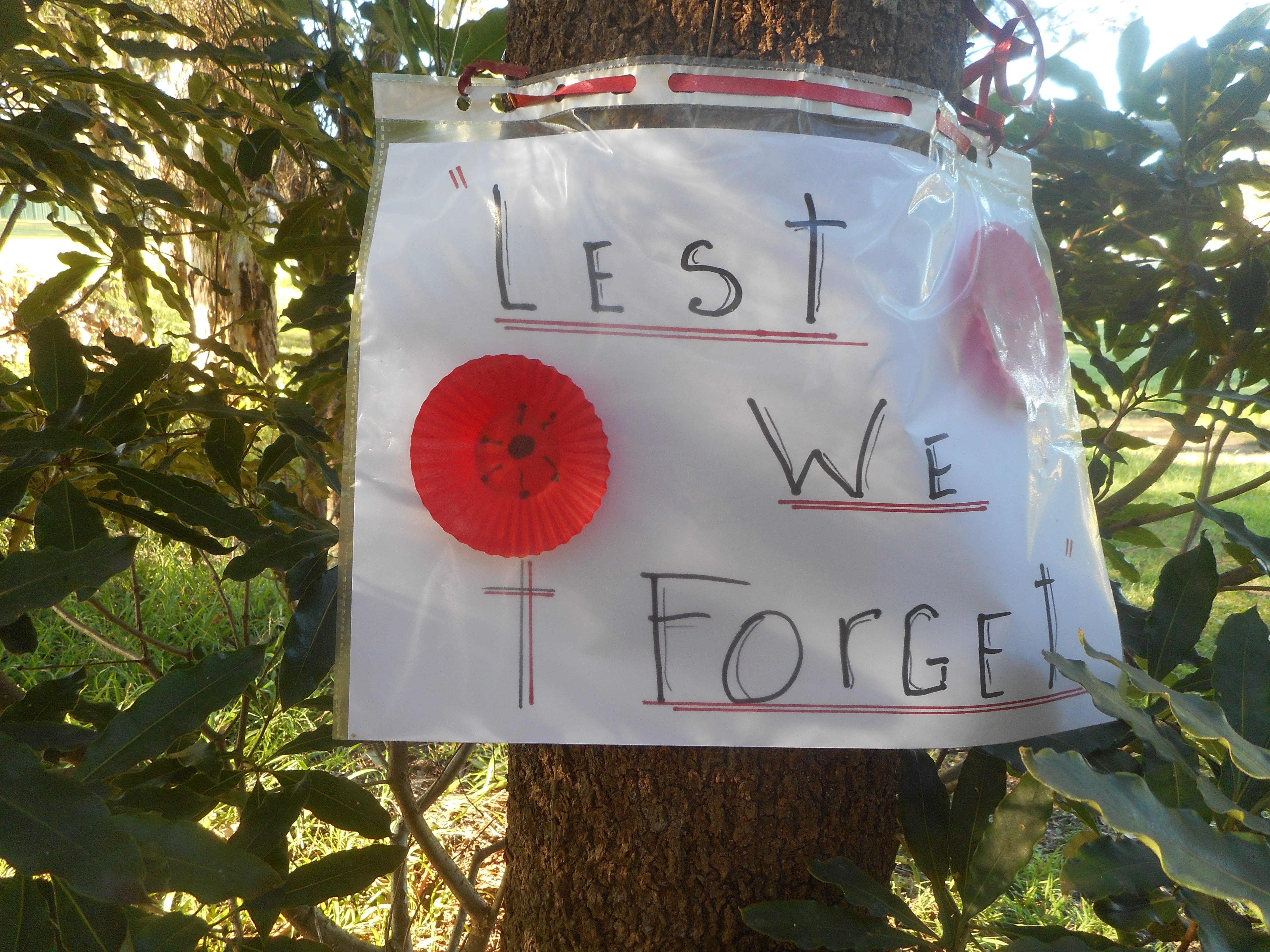
Pictures from Anzac Day 2021 among the trees in Lakelands Park, Dapto, NSW, Australia.

Remembering how the poppies grow row on row between the crosses in Flanders Fields.

Remembering Peter’s grandfather, Otto Hannemann, who died in 1916 in Flanders. His grave is near Lille in France.

https://berlioz1935.wordpress.com/tag/ww-1/

This is what Peter published about his grandfather Otto HANNEMANN:

One hundred years ago the most terrible of wars began. Up to that time there had been no war like this. I blame the industrial societies for it. In their search for growth potential they did not allow any restrictions; “markets, customers and resources,” was the cry for the “promised land”.

My Granddad, Otto Hannemann, was a carpenter foreman in the growing city of Berlin. Born in the small town of Lukenwalde, south of Berlin, he looked for work in the big city to support his growing family. In the first picture we see him with one of his two daughters and my dad. It seems they are all dressed up for  a Sunday outing. In July 1907 my father was six years old.

July 1907

These were the years of peace and  future  well being. I don’t know much about my Granddad. My father seemed to be proud of him and proclaimed that “he built all the bridges” over the railway lines out of Berlin to the South. In the next picture we see him with some workers on a building site. I have been assured that he is in the picture. I think it is him on the far left with his hat on. The occasion is most likely a “Richtfest”,  the celebration of the erection  of the roof supports.

IMG_20141103_0001

When the war started he was not called up straight away. Only later, in the beginning of 1916, he was called upon as he was a reservist (Landjäger). In the picture he looks rather serious, probably anticipating what lay ahead of him.

Early 1916, it is still Winter

It is the same picture my Grandmother had in a large frame on the wall of her bedroom. It seems he had his training in Schwerin, the capital of Mecklenburg.

The next picture was taken on the 15th February 1916. He was sending the card as a birthday gift. For whom, I don’t know. You can see him on the left in the back row.with the arrow pointing at him.

15.2.1916

In the next picture you can see him second from the left in the centre row. On the back he wrote that those are the men from room 13 and he added, which mystifies me,  “the ‘washer children’ are not in the picture”. Whatever this means?

14.4.1916

The next picture could be from the same period. The soldiers in “drill uniforms” usually worn on work duties. It looks to me they are waiting to be issued with food. He is in the centre and is marked with a red cross.

IMG_20141103_0005

I have no idea when he was sent to the Western Front. Perhaps he was even opposite Australian forces.

The following photo was made on Sunday 14th May 1916. It tells on the sign  “Rat-Goulash on the menu for the day”.

On the 15th of July 1916 he wrote at the back of the photo that he sent to his loved ones, that really they don’t have to eat rat-goulash yet. The picture has been staged he assured the readers, but still there are lots of rats to be seen. And they say Germans have no sense of humour.

July 1907

On the 2. 12. 1916 he fell. Some reports tell of cold and frosty days. He is buried in a war cemetery just  outside Lille.

A pictures of his grave can be viewed here just towards the end of Peter’s post:

https://berlioz1935.wordpress.com/tag/ww-1/

Father, Mother and Grandfather

https://berlioz1935.wordpress.com/2013/10/28/october-27th/

Peter’s father, Richar Hannemann, was born on the 28th of October 1900.

Seventeen of his descendents live in Australia and nine in Germany . Two of his grandchildren have passed away.

https://berlioz1935.wordpress.com/2013/11/16/6-november/

Peter’s mother, Frieda Hannemann, nee Müller, was born on the 16th of November 1900.

“She was always a rather physically weak child, did not like any strenuous activity. On Sundays her father liked to walk with the family across the Tempelhofer Field (later Airport Tempelhof) where the walk over the sandy ground drove her to tears. But her father wanted to have his beer on the other side of the large field.

After school and training to be an “early childhood carer” she worked for a little while as a nanny, but later, during the Big War, she joined the Post Office and became a telephone operator in the new technology of telephony. She had a beautiful, clear voice right to the end of her life. In old age she still sounded like a forty year old on the phone.

Peter’s parents got engaged in 1922
and married in 1929.

https://berlioz1935.wordpress.com/2014/11/03/my-granddad-and-world-war-i/

This blog is about Peter’s grandfather, Otto Hannemann, father of Richard Hannemann.

“Otto Hannemann, was a carpenter foreman in the growing city of Berlin. Born in the small town of Lukenwalde, south of Berlin, he looked for work in the big city to support his growing family.

When the war started he was not called up straight away. Only later, in the beginning of 1916, he was called upon as he was a reservist (Landjäger).
It seems he had his training in Schwerin, the capital of Mecklenburg

He was sent to the Western Front. (Perhaps he was even opposite Australian forces.) We know from the war reports and history books that it was hell. On the 2. 12. 1916 he fell. Some reports tell of cold and frosty days. He is buried in a war cemetery just outside Lille: https://en.wikipedia.org/wiki/Lille”

Uta’s October Diary continued

Over the weekend Peter and I talked and talked about two different movies that we saw a few days ago. The first movie was DAS WEISSE BAND (The White Ribbon). This one we watched online. The other movie was BEFORE I GO TO SLEEP. Both movies were very thought provoking. After we saw BEFORE I GO TO SLEEP on Saturday morning at the GALA Cinema in Warrawong we had lunch – (not just desert!) – in this Cafe which used to be a book shop previously.

IMG_0129

DAS WEISSE BAND is set in a village in northern Germany before World War One. To me the way religion was regarded in this village looked very much like fundamentalism. Normal village life suffered because of this. Built up frustrations among adults as well as children resulted in evil deeds. Significantly nobody wanted the culprits to be found. Really strange behaviour! The Authority of the baron, the doctor, the pastor was accepted as a God given by the farmers and village workers. Nobody ever questioned the authority of these people.

The village teacher and the 17 year old nanny of the baron’s children were from the city, meaning they were outsiders and being treated as such. The midwife, who acted as housekeeper to the widowed doctor, suffered terrible abuse from him. The baroness was an altogether different person. She spent most of her time living in great style in Italy with her two children and a lot of servants, having a great time there. Once she returned to the baron’s manor with all her servants. This is when she employed the 17 year old nanny. However the baroness did not stay for very long. She asked the baron for a divorce for she had met someone in Italy and wanted to go back to Italy.

The pastor made his two eldest pubescent children wear a white band to remind them that they had to stay pure. The boy’s hands were tied to the bed at night so he would not be able to touch himself! All the poor families in the village (including the pastor) had too many children and were constantly in fear they would not be able to feed that many children.

Then World War One started.

See more here: http://en.wikipedia.org/wiki/The_White_Ribbon

http://en.wikipedia.org/wiki/Before_I_Go_to_Sleep_(film)

Before I go to sleep: “This psychological thriller is based on the worldwide best-selling novel about a woman who wakes up every day remembering nothing – the result of a traumatic accident in her past – until one day, new terrifying truths emerge that force her to question everyone around her…”

As I said we watched this movie in the GALA Cinema. So many things in the plot we did not quite understand at first. I read up a bit now about it, also about the plot in the novel. In the movie the woman, Christine, speaks every day onto a camera as opposed to keeping a journal as in the novel. Christine is played by Nicole Kidman . Mark Strong plays Dr. Nash. Colin Firth plays Ben Lucas, the husband of Christine. Anne-Marie Duff plays Claire, a good friend of Christine’s. Can Christine trust her? She admits to having had a brief affair with Ben and that she then stayed away from Ben and his son for she did not want to upset her friend Christine.

Christine decides to trust Claire. She also wants to trust, Ben, her husband. Then it becomes doubtful that she can trust him. There were some scenes when Christine had reason not to completely trust Dr Nash. In the end she is very confused and does not know whom to trust.

Presumably, Christine was for a number of years in hospital after her traumatic accident. When the movie starts, she was at home with her husband Ben, but maybe only for about the last four months or so. Living with Christine becomes quite frustrating for Ben for every morning Christine has forgotten everything that went on the day before. After sleeping she does not know that Ben is her husband.

Dr. Nash gets in touch with her. He rings her every morning telling her where she has hidden her camera. Christine meets Dr. Nash but is not allowed to tell her husband about it. It is a suspense drama all right.

And how the story ends is really mind boggling. There are a lot of contradictory things that Ben tells Christine. What sort of accident has she actually been in and what or who caused it? I ask the question, why has this horrific “accident” not been conclusively investigated? Who is telling the truth? If Christine’s son is alive (according to Claire), why is she being told by her husband that he is dead?

Both movies had to do with human relationships and they raise for me the question why act people in a certain way? I tend to contemplate about what influences play a part in their lives? The photography, directing and acting in both movies was outstanding.