UTA’S DIARY

RIMG0038

I copied the following from this website:   http://www.illawarrafolkfestival.com.au/lola-wrights-keg-night  and  http://bushmusicclub.blogspot.com.au/2014/07/lolas-keg-night-story-of-lola-wright.html

“Lola Wright’s Keg Night” is a musical memoir adapted by PP Cranney & Christina Mimmocchi from the autobiography of Lola Wright. It’s a new verbatim play with music based on the passionate life and times of former Illawarra resident, Lola Wright – teacher, activist, performer, wife, mother, lover. For over forty years, from the 1940s to the 1980s, Lola contributed to the Illawarra’s vibrant social history. Whether teaching nursery rhymes to primary students, establishing the South Coast’s first bush band, playing piano at local dances, singing The Red Flag at miners’ strikes, or leading a sing-along of The Internationale at one of her infamous Oak Flats Keg Nights, Lola’s passion for music, and social justice, left its mark on all who knew her. This is her story in her own words and the music that she loved – an entertaining, audience-participation reading-in-progress performed by Vashti Hughes, Laura Bishop and others.

With thanks to the Alistair Hulett Memorial Fund, the NSW Teachers’ Federation, the National Library of Australia, the Bush Music Club, the Illawarra Folk Club and Merrigong Theatre.

Lola’s keg night? Well, Lola was famous for her parties, where the keg was not broached until sufficient songs were sung! And no one could say they didn’t know the songs as the words were projected onto a screen. After all, she was a teacher.”


Mrs. Wright (Lola Wright)  was principal of Oak Flats Primary School in the 1960s. This is how our children know and remember her. She is 88 now and lives in Morundah, a small town in the South West of NSW with 22 dwellings, a pub and an Opera Centre. (See: http://www.morundahopera.com.au/contacts.html) In April 2013 we stayed in Fig Tree Motel in Narrandera for one night. It’s a pity we did not know then that Mrs. Wright lives in Morundah very close to Narrandera! https://auntyuta.com/2013/04/page/3/

Christina Mimmocchi, the producer of Lola’s Keg Night, says that she had the pleasure of delving into the National Library of Australia’s oral history and folklore archive to seek out old songs . . . . Christina listened to all fourteen hours of Lola’s interviews and recordings for the NLA. So everything in the play has been either said by Lola in her National Library interviews or has been written by her in her unpublished autobiography. http://trove.nla.gov.au/work/22720011?selectedversion=NBD24494996

  • Folkloric recording.
  • Lola Wright was born in Childers, Queensland. She recalls her childhood years frequently moving around the country because of her father’s work as a sleeper cutter &​ bushman; graduating from Armidale Teacher’s College, N.S.W, rising to the position of School Principal for Oaks Flats.; settling in the Illawarra, N.S.W. &​ becoming involved with the Communist and Union movement; the local communist party branch’s involvement in local folklore; working conditions for women in the 1950s; her actions as a feminist fighting for equal pay in the education system. She recalls forming &​ running the South Coast Bush Band in the mid-1950s after a visist from the original Bushwhackers to Wollongong; life during mining strikes.


Our family was very interested to see Lola’s Keg Night.  Caroline booked tickets online for six of us  for Saturday night, 11th of October 2014,  at the Merrigong Studio in Wollongong.

http://bushmusicclub.blogspot.com.au/2014/07/lolas-keg-night-story-of-lola-wright.html

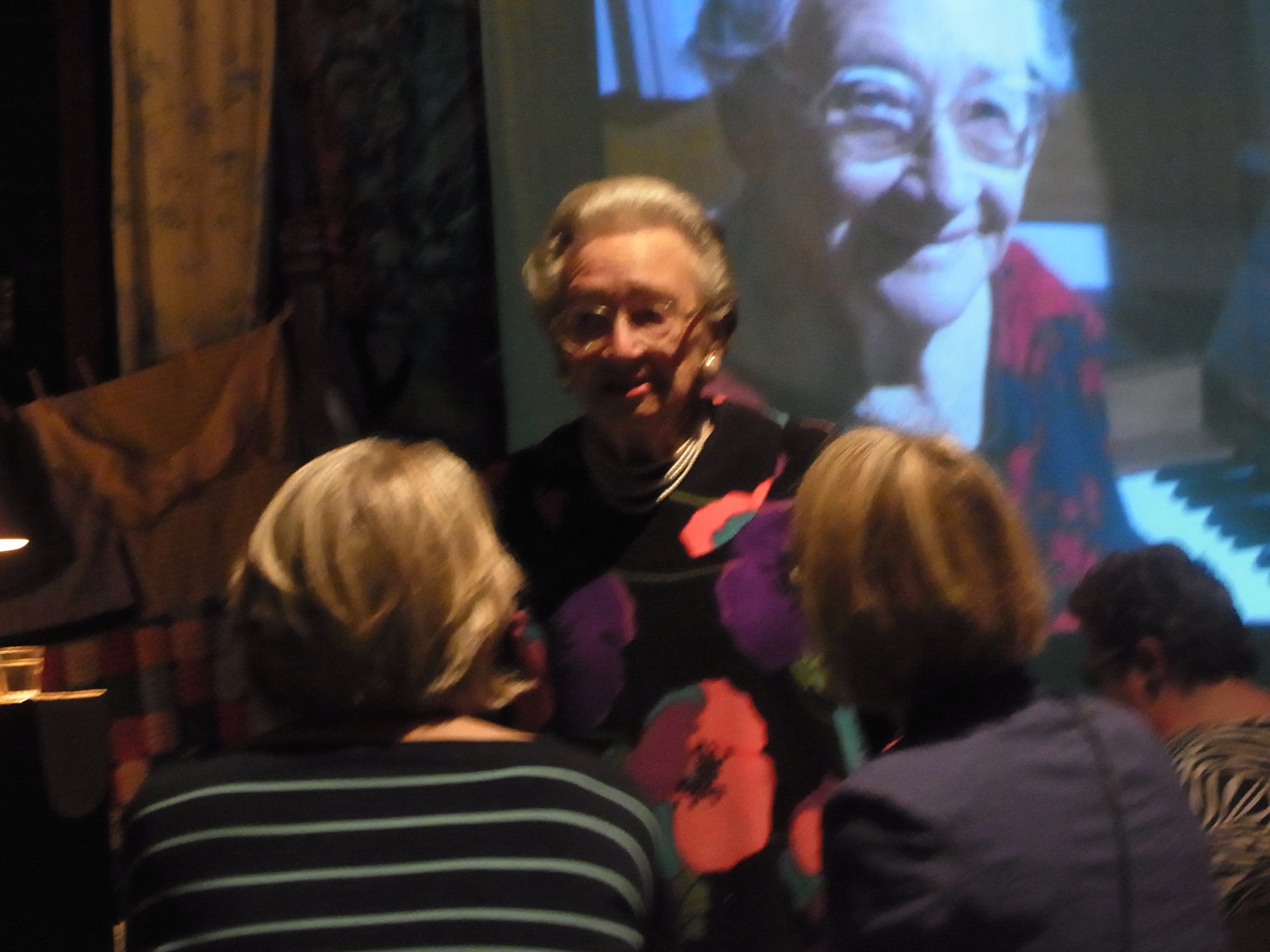
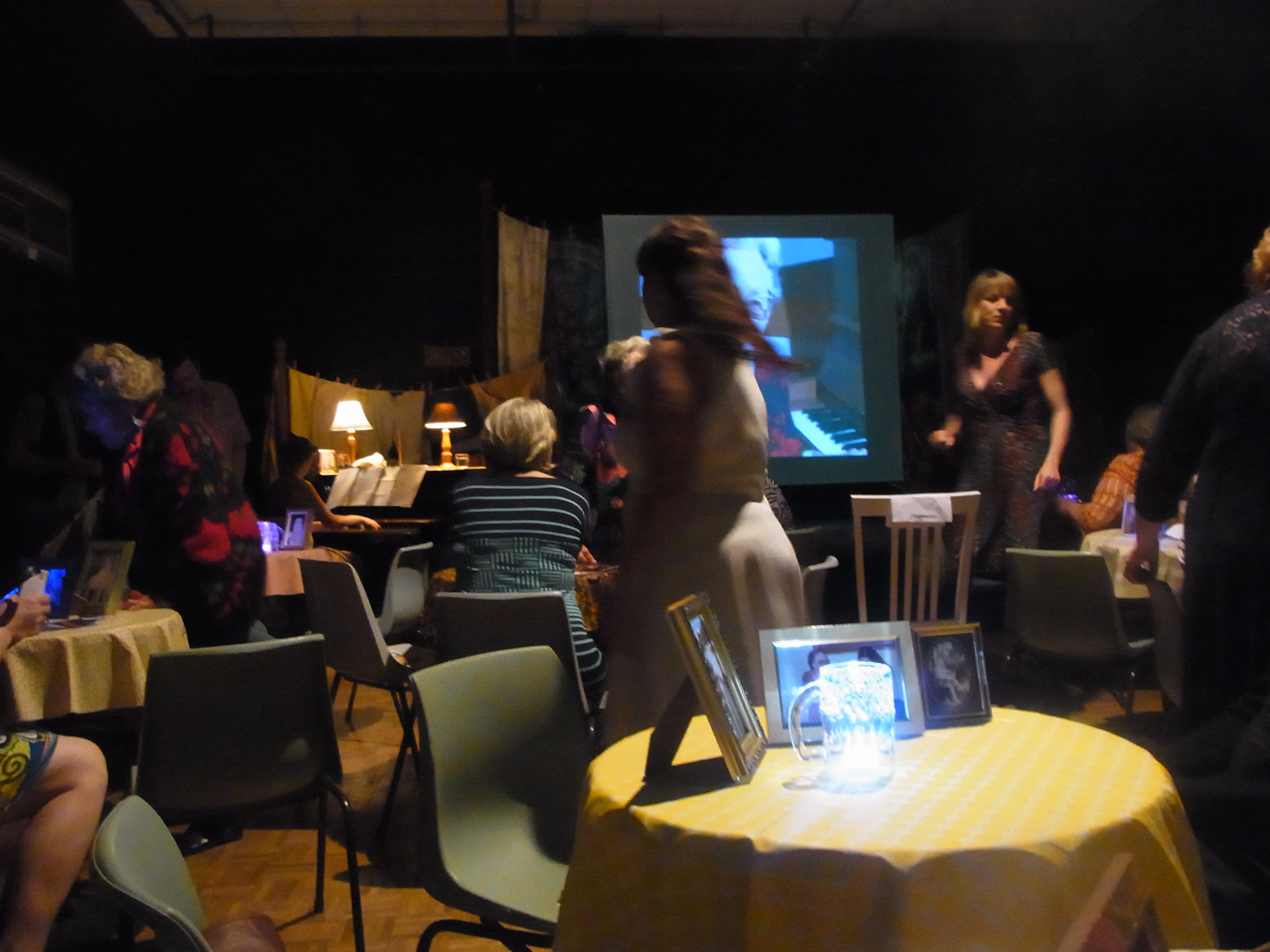
The above website shows pictures from the Merrigong Studio. There were individual small tables for the theater goers. There were candles and pictures on each table. Matthew organised the pushing together of some tables for our family group: There were Monika and Mark, Caroline and Matthew as well as Peter and myself. All of us had a terrific evening. In time I warmed up enough to join in the singing of some of the bushsongs. The texts were always displayed on the screen above the stage. Our group took to drinking beer. During intermission I felt that I’d rather have some hot tea to drink.  Matthew soon arrived with a lovely wooden tray with an old fashioned tea-pot on it plus a beautiful cup and a creamer and sugar. I enjoyed this tea very much.

IMG_0119.JPG (2)

RIMG0296

RIMG0295

RIMG0300

RIMG0299

An Article in The Washington Post from January 27, 2013

By Bob Woodward January 27, 2013
Bob Woodward is an associate editor of The Post. His latest book is “The Price of Politics.” Evelyn M. Duffy contributed to this column.
In the first months of the Obama presidency in 2009, Chuck Hagel, who had just finished two terms as a U.S. senator, went to the White House to visit with the friend he had made during the four years they overlapped in the Senate.

So, President Obama asked, what do you think about foreign policy and defense issues?

According to an account that Hagel later gave, and is reported here for the first time, he told Obama: “We are at a time where there is a new world order. We don’t control it. You must question everything, every assumption, everything they” — the military and diplomats — “tell you. Any assumption 10 years old is out of date. You need to question our role. You need to question the military. You need to question what are we using the military for.

“Afghanistan will be defining for your presidency in the first term,” Hagel also said, according to his own account, “perhaps even for a second term.” The key was not to get “bogged down.”

Obama did not say much but listened. At the time, Hagel considered Obama a “loner,” inclined to keep a distance and his own counsel. But Hagel’s comments help explain why Obama nominated his former Senate colleague to be his next secretary of defense. The two share similar views and philosophies as the Obama administration attempts to define the role of the United States in the transition to a post-superpower world.

This worldview is part hawk and part dove. It amounts, in part, to a challenge to the wars of President George W. Bush. It holds that the Afghanistan war has been mismanaged and the Iraq war unnecessary. War is an option, but very much a last resort.

So, this thinking goes, the U.S. role in the world must be carefully scaled back — this is not a matter of choice but of facing reality; the military needs to be treated with deep skepticism; lots of strategic military and foreign policy thinking is out of date; and quagmires like Afghanistan should be avoided.

The bottom line: The United States must get out of these massive land wars — Iraq and Afghanistan — and, if possible, avoid future large-scale war.

Although much discussion of the Hagel nomination has centered on his attitudes about Iran, Israel and the defense budget, Hagel’s broader agreement with Obama on overall philosophy is probably more consequential.

Hagel has also said he believes it is important that a defense secretary should not dictate foreign policy and that policy should be made in the White House.

He privately voiced reservations about Obama’s decision in late 2009 to add 51,000 troops to Afghanistan. “The president has not had commander-in-chief control of the Pentagon since Bush senior was president,” Hagel said privately in 2011.

If Hagel is confirmed, as appears likely, he and the president will have a large task in navigating this new world order. Avoiding war is tied directly to the credibility of the threat to go to war.

Hagel’s experience provides two unusual perspectives. The first is as a former E-5 Army sergeant in 1968, which he has described as “the worst year of the Vietnam War.” In summation, another Vietnam must be avoided.

The second is the Georgetown University class that he taught called “Redefining Geopolitical Relationships.” He asks the class the basic question: Where is all this going?

For example, he has said that one result of the Iraq war has been to make Iran the most important country in the Middle East, and he worried that Iraq could become an Iranian satellite.

When I interviewed President Obama in the summer of 2010 for my book “Obama’s Wars,” his deeply rooted aversion to war was evident. As I reported in the book, I handed Obama a copy of a quotation from Rick Atkinson’s World War II history, “The Day of Battle,” and asked him to read it. Obama stood and read:

“And then there was the saddest lesson, to be learned again and again . . . that war is corrupting, that it corrodes the soul and tarnishes the spirit, that even the excellent and the superior can be defiled, and that no heart would remain unstained.”

“I sympathize with this view,” Obama told me. “See my Nobel Prize acceptance speech.”

I had listened to the speech when he gave it, Dec. 10, 2009, and later read it, but I dug it out again. And there it was:

“The instruments of war do have a role to play in preserving the peace. And yet this truth must coexist with another — that no matter how justified, war promises human tragedy. The soldier’s courage and sacrifice is full of glory, expressing devotion to country, to cause, to comrades in arms. But war itself is never glorious” — Churchill had called it that — “and we must never trumpet it as such. So part of our challenge is reconciling these two seemingly irreconcilable truths — that war is sometimes necessary and war at some level is an expression of human folly.”

That is probably the best definition of the Obama doctrine on war. Applying such a doctrine in today’s dangerous and unpredictable world will be daunting — but on these issues Obama seems to have found a soul mate.

Read more on this debate:

Robert Satloff: The message Hagel carries on Iran

Jim Inhofe: The wrong man to be defense secretary

David Ignatius: Hagel and the revival of Eisenhower’s doctrine

Childhood Memories

I publish here a copy of something I had published already in May 2013. I did get some very interesting comments to this post at the time. So I copied all the comments and my replies as well. Some of my new blogger friends might want to have a look at it and maybe some of my older blogger friends also would like to have another look. 🙂

This now is what I published in May 2013:

‘I have now two pages about my childhood. One is just “Uta’s Early Childhood”, the other one is “Uta’s Early Childhood, Part II”. In the Part II I inserted today some pictures about my sixth birthday in 1940 plus one picture from summer of 1942. All these pictures were taken during the war, World War II that is, when we lived in Berlin, Germany.

Did we suffer during the first years of war? I don’t think so. Except that my father had moved away from Berlin. He became the manager in grandfather’s furniture factory in Lodz, Poland, which since the German occupation in 1939 was called Litzmannstadt. My father had grown up in Lodz. His family had lived in Lodz since the early 1800s, when this part of Poland belonged to Russia.

My father had studied in Leipzig, Germany. In 1930 he had married my mother in Leipzig. During the early years of their marriage they had for the most part lived in Berlin. Sometime during the early war years my father had some disagreements with some Nazi people he worked with in Berlin. I think he didn’t voice his disagreements publicly. Had he done so, he may have ended up in a concentration camp!

In the end he was allowed to remove himself from Berlin. As I said he became then the manager in grandfather’s factory. My mother typically chose to stay with us children in Berlin. We only went for some visits to “Litzmannstadt”.’

Submitted on 2014/10/15 at 9:49 am | In reply to auntyuta.
Just now I did re-read this whole post and all the comments. As Peter says, between “Will” and “Reason”, “Will” will always win. I think this is because most people will their emotions let their thinking rule. Well, this is the way it is, this is what humans are like.

To come back to how children experienced the Nazi area in Germany, one book, that deals with this, comes to mind. I read it only recently. It is set in a small place near Munich in southern Germany. I lived near Berlin and in Leipzig during the last years of the war. So I have no experience what life was like for children in Bavaria during these war years in Nazi time. However what Markus Zusak tells us in his historical novel THE BOOK THIEF sounds absolutely believable to me.

In the next comment section I post some details about the book from Wikipedia.

auntyuta
auntyuta.wordpress.com
utahannemann@hotmail.com
14.200.207.145
Submitted on 2014/10/15 at 9:30 am
THE BOOK THIEF

From Wikipedia, the free encyclopedia
This article is about the novel. For the film adaptation, see The Book Thief (film).
The Book Thief
The Book Thief by Markus Zusak book cover.jpg
1st Edition front cover
Illustrator Trudy White
Cover artist Colin Anderson/Brand X Pictures/Getty Images
Country Germany
Language English, German
Genre Novel-Historical Fiction
Publisher Picador, Australia; Knopf, US
Publication date
2005(Australia); 14 March 2006 (worldwide)
Media type Print (Hardback & Paperback)
Pages 550

The Book Thief is a novel by Australian author Markus Zusak.[1] Narrated by Death, the book is set in Nazi Germany, a place and time when the narrator notes he was extremely busy. It describes a young girl’s relationship with her foster parents, the other residents of their neighborhood, and a young Jewish man who hides in her home during the escalation of World War II. First published in 2005, the book has won numerous awards and was listed on The New York Times Best Seller list for over 230 weeks.[2]

berlioz1935
berlioz1935.wordpress.com
berlioz1935@gmail.com
14.200.207.145
Submitted on 2013/05/21 at 11:05 am | In reply to Robert M. Weiss.
Robert, you are spot on with your overall view of history. I always say, that the 2. WW was a continuation of WW I as it was finished in an unsatisfactory way. Meaning, nobody was thinking about the future. Versailles was a disaster. A much better solution was found at the end of WW II. The Germans, at the end of WW I, were hoping that Wilson’s 14 Points would be adhered to.

http://en.wikipedia.org/wiki/Fourteen_Points

As a result “The humiliation of the Treaty of Versailles”, as you say, let to the rise of Hitler.

You say further “By borrowing heavily from German mythology, Wagner, the concept of the ubermensch, Hitler instilled in the young a burning pride in Germany’s future. Hitler was also influenced by Schopenhauer’s “Will to Power”. This idea is the subject of a book. “The Jew of Linz” by Australian writer Kimberly Cornish

http://en.wikipedia.org/wiki/The_Jew_of_Linz.

Cornish has been criticised too, but I found it an interesting read on a certain view point of history. Schopenhauer stipulates, that in a contest between “Will” and “Reason”, “Will” will always win.

berlioz1935
berlioz1935.wordpress.com
berlioz1935@gmail.com
14.200.207.145
Submitted on 2013/05/21 at 10:27 am | In reply to The Emu.
The disagreement with the Nazis was on two levels: personal and about the conduct of war.

Personal: When Hitler came to power he joined the party as a “good” public servant would. Later the life style of his wife could have headed for divorce. This was intolerable for the Nazis and they asked him to discipline his wife or he could not remain a member of the party.

Contact of War: After the Sportpalast Speech

http://en.wikipedia.org/wiki/Sportpalast_speech

in which Goebels called for “Total War” to be waged. Uta’s father was of the opinion that it was pure propaganda. As an economist he could see that many mistakes were made and the German industry and population were not put on a war footing. He criticised the use of forced labour and called for the utilisation of German women in industry. Only 33% of women were working. Working women was an anathema for Hitler.

He wrote a Memorandum to Hitler and for his effort was hauled in front of Martin Bormann, secretary of Hitler, who advised him not to insist on sending the Memorandum to Hitler. Instead they sent him to the “Ostfront” because he was a Russian speaker.

This is the stuff novels are written about. A lot of what we know is only bits and pieces. Adults did not talk to children about it. Later, yes, but not all came to light.

auntyuta
auntyuta.wordpress.com
utahannemann@hotmail.com
14.200.207.145
Submitted on 2013/05/21 at 7:59 am
Thanks for this very insightful reply, Robert.

” . . . . nationalism has been responsible for many wars.” This is a known fact. Still, leaders don’t want to learn from this and continue to promote it.
Will there ever be a time when mankind can live in peace without any wars?
Maybe if there’s an outside threat we’ll then be acknowledging our common humanity.

So he marched to the death camp with his children . . . . . I wonder how many children were with him.

Is it that the Nazis rigorously went to eliminate everything that seemed foreign to them?Do a lot of people to this day have an innate fear about this what doesn’t fit into their view of the world?

I think not many people are interested in understanding the historical process. They are just interested in how they see their own little world, which is an island surrounded by things that frighten them. Does this lead to fundamentalism? Can fundamentalists live peacefully together with non-fundamentalists or other fundamentalists? If they don’t want peace, what do you do? Eliminate them? Every religion teaches you not to kill unless you are attacked. So for instance Talibans want to kill us. So we are allowed to kill them. Aren’t we? No objections to killing Talibans. Too bad if a few other people get killed along the way. And so it goes. No wonder I need prayers to stay sane. Because the historical process goes on whether I like it or not.

Robert M. Weiss
river4827.wordpress.com
forestbreeze40@earthlink.net
70.197.68.149
Submitted on 2013/05/21 at 3:00 am
Janusz Korczak was offered an opportunity to escape from Poland, but he did not take it. Instead, in 1942, he marched with his orphan children to the death camp of Treblinka…. No doubt people in great psychological need follow cults, and often utilize unhealthy coping mechanisms. What happens with countries brings matters to a larger scale, and nationalism has been responsible for many wars. The humiliation of the Treaty of Versailles, the rampant unemployment, and other factors went into the cauldron of Nazi Germany. Hitler’s genius was to work with the young people, and gain their support in actively supporting the Third Reich and its goals. By borrowing heavily from German mythology, Wagner, the concept of the ubermensch, Hitler instilled in the young a burning pride in Germany’s future. Hitler was also influenced by Schopenhauer’s “Will to Power”, the incendiary speeches of Bismarck, and the methods of American advertising… History is composed of a series of reactions and counter reactions. Perhaps one day we will succeed in isolating the variables responsible for the vagaries of history, and gain a more precise understanding of the historical process.

catterel
catterel.wordpress.com
catherine.sommer@bluewin.ch
86.168.203.38
Submitted on 2013/05/20 at 9:02 pm | In reply to auntyuta.
HiI Uta – yes, no, yes. I’m writing a memoir that gets added to sporadically, but haven’t published many old photos from that time. Maybe I should!

auntyuta
auntyuta.wordpress.com
utahannemann@hotmail.com
14.200.207.145
Submitted on 2013/05/20 at 3:10 pm | In reply to The Emu.
“The Marshall Plan (officially the European Recovery Program, ERP) was the American program to aid Europe, in which the United States gave economic support to help rebuild European economies after the end of World War II in order to prevent the spread of Soviet Communism. . . .”
Ian, this recovery program helped Germany enormously after WW II. Whereas what happened after WW I was a terrible disaster for Germany. The result was that the Nazis came to power!
The disagreements my father had with the Nazis had to do with the war. But sorry, I cannot recall properly what my father said about it. Anyhow the way I remember it, my father was objecting to the way the war was conducted. I think he moved to “Litzmannstadt” towards the end of 1940. This for instance would have been long before Pearl Harbour!
For a great part of 1941 we stayed with the grandparents in Poland.
By August 1941 we were back in our apartment in Berlin (without my father of course). In September 1941 I started school. I was then aged seven already! My second brother was born in October 1941.
My first school reports say my father’s occupation was “Betriebsführer” (Manager).
He was born in 1904. During the first war years he was regarded as being too old to be conscripted. But by 1943 his year, that is men having been born in 1904, were being called up for military duties. After some training my father was made straight away to be an officer. He was sent to the Eastern front.
He came back from the war with his health ruined. For many years after the war he suffered from these health problems without getting any support from my mother I might say. But his sisters and the sisters families as well as his mother who were all refugees from Poland, well everyone in his extended family supported him to the best of their ability. Eventually he did recover and was able to get full employment. At about 1949 my mother got a divorce from him. In the 1950s when he was gainfully employed again and his health had improved a lot, he asked my mother to marry him again. She refused.
He married his secretary in 1959. In 1966 he died of prostate cancer.

The Emu
aussieemu.wordpress.com
ian.anafelton@gmail.com
121.219.179.19
Submitted on 2013/05/20 at 11:37 am
Very interesting Auntyuta, to read of your background in those years, virtually a first hand account and must be recorded and handed down into your family and put into book form.
It intrigues me as to the disagreement your father had with the Nazi;s, maybe you could elaborate on this Auntyuta.
A great historical reading.
Emu aka Ian

auntyuta
auntyuta.wordpress.com
utahannemann@hotmail.com
14.200.207.145
Submitted on 2013/05/20 at 7:58 am | In reply to catterel.
Hi Cat, do you write a lot about your early childhood and do you have pictures of that time published? Do you find you cannot disclose too much about people who are still alive? It’s great for your kids to be told by you what life was like in the 1940’s and 50’s.

auntyuta
auntyuta.wordpress.com
utahannemann@hotmail.com
14.200.207.145
Submitted on 2013/05/20 at 7:46 am | In reply to Robert M. Weiss.
Hi, Robert, I have the feeling what you say about Hitler may be absolutely right. My generation (after all I was only a child during the Hitler years) on the whole has learned not to trust people like this.
Aren’t there certain people around in certain countries who somehow are able to get followers when clearly if they only started thinking a bit for themselves maybe they couldn’t be followers? Sadly people in general go more by their feelings and what’s in it for them rather than thinking about the consequences of their support. Aren’t most people selfish? If something is promised that advances them they go for it, don’t they?
I guess Janusz Korczak was a remarkable educator, right? I think you mentioned him in one of your blogs. But I can’t recall any details. Did he for instance survive the war years? Did he have family? It is of course admirable if people stand up for what they believe in.
The best example where protests by a lot of people resulted in an immense change happened in the Eastern part of Germany. The fall of the Iron Curtain, which for years and years looked rather impossible, all of a sudden was possible in a rather peaceful way. That it went ahead peacefully was thanks to some noble people who restrained themselves from interfering.
War and Peace, War and Peace, maybe this is the fate of mankind for ever and ever. Didn’t Orwell say, some people when they say peace mean war? Our previous Primeminister Keating here in Australia used to fight a lot in parliament. His attitude was it was better to fight in parliament rather than attack each other in the street.

Robert M. Weiss
river4827.wordpress.com
forestbreeze40@earthlink.net
70.197.70.2
Submitted on 2013/05/20 at 2:24 am
Many people at that time didn’t voice their opinions openly. Janusz Korczak, the Polish educator, did. He walked through the streets of Warsaw wearing his Polish army uniform, and was put in jail for his efforts… I continue to be amazed how the Germans could have supported such a madman as Adolf Hitler, which he clearly was. He misused Darwinism, Nietzsche, and never followed his main tenet: to produce children for the Fatherland. Perhaps he knew that that he was the most misbegotten cross and handicapped person of them all.

catterel
catterel.wordpress.com
catherine.sommer@bluewin.ch
86.166.198.202
Submitted on 2013/05/20 at 12:10 am
Yes, do please write about your childhood. It was so different then, and personal memories make it come alive for our children and grandchildren. My early life in England (1940’s and 50’s) seems like tales from a distant planet when I reminisce to the kids!

auntyuta
auntyuta.wordpress.com
utahannemann@hotmail.com
14.200.207.145
Submitted on 2013/05/19 at 4:36 pm
Hi Diana, thanks for the comment and welcome to my blogging. I read your about page and am interested in what happened to you when you turned forty. I remember, a long time ago when I turned forty my life seems to have undergone some kind of a change.
A lot of the subjects you write about look very interesting to me. I want to do some reading of your blogs pretty soon.
Cheerio, Aunty Uta.

Holistic Wayfarer
aholisticjourney.wordpress.com
dipumpkin@gmail.com
76.232.196.192
Submitted on 2013/05/19 at 1:51 pm
Keep writing. That was a fascinating era — and we are just so comfortable these days. We don’t appreciate what our parents and grandparents endured to sustain the basic things we take for granted.

Political Realism according to George F. Kennan

http://www.tagesspiegel.de/meinung/die-linke-und-der-krieg-gegen-den-globalen-interventionismus-von-usa-und-nato/10822178.html

Berlioz gave me the above link to an article in DER TAGESSPIEGEL:

Die Linke und der Krieg
Gegen den globalen Interventionismus von USA und Nato!

10.10.2014 17:18 Uhr
von Oskar Lafontaine

Oskar Lafontaine, the author of this article, quotes something that George F. Kennan said in 1948. I felt straight away that I would like to find out more about this George F. Kennan. And sure enough there was a tremendous amount about George Kennan to be found in Wikipedia.

I copied here just a few things about Kennan’s life and political views. In my opinion it would really be most interesting to study a bit more about his life and career!

http://en.wikipedia.org/wiki/George_F._Kennan#Early_life_and_career

Realism and the Life and Career of George F. Kennan
Political realism formed the basis of Kennan’s work as a diplomat and diplomatic historian and remains relevant to the debate over American foreign policy, which since the 19th century has been characterized by a shift from the Founding Fathers’ realist school to the idealistic or Wilsonian school of international relations. In the realist tradition, security is based on the principle of a balance of power, whereas the Wilsonian view (considered impractical by realists) relies on morality as the sole determining factor in statecraft. According to the Wilsonian approach the spread of democracy abroad as a foreign policy is key and morals are universally valid. During the Presidency of Bill Clinton, American diplomacy reflected the Wilsonian school to such a degree that those in favor of the realist approach likened President Clinton’s policies to social work. According to Kennan, whose concept of American diplomacy was based on the realist approach, such moralism without regard to the realities of power and the national interest is self-defeating and will lead to the erosion of American power.[76]
In his historical writings and memoirs, Kennan laments in great detail the failings of democratic foreign policy makers and those of the United States in particular. According to Kennan, when American policymakers suddenly confronted the Cold War, they had inherited little more than rationale and rhetoric “utopian in expectations, legalistic in concept, moralistic in [the] demand it seemed to place on others, and self-righteous in the degree of high-mindedness and rectitude … to ourselves”.[77] The source of the problem is the force of public opinion, a force that is inevitably unstable, unserious, subjective, emotional, and simplistic. Kennan has insisted that the U.S. public can only be united behind a foreign policy goal on the “primitive level of slogans and jingoistic ideological inspiration”.[78]
Containment in 1967, when he published the first volume of his memoirs, involved something other than the use of military “counterforce”. He was never pleased that the policy he influenced was associated with the arms build-up of the Cold War. In his memoirs, Kennan argued that containment did not demand a militarized U.S. foreign policy. “Counterforce” implied the political and economic defense of Western Europe against the disruptive effect of the war on European society.[79] Exhausted by war, the Soviet Union posed no serious military threat to the United States or its allies at the beginning of the Cold War but rather an ideological and political rival.[80]
In the 1960s, Kennan criticized U.S. involvement in Vietnam, arguing that the United States had little vital interest in the region.[81] In Kennan’s view, the Soviet Union, Britain, Germany, Japan, and North America remained the arenas of vital U.S. interests. In the 1970s and 1980s, he emerged as a leading critic of the renewed arms race as détente was scrapped.[82]
In 1989 President George H. W. Bush awarded Kennan the Medal of Freedom, the nation’s highest civilian honor. Yet he remained a realist critic of recent U.S. presidents, urging the U.S. government to “withdraw from its public advocacy of democracy and human rights”, saying that the “tendency to see ourselves as the center of political enlightenment and as teachers to a great part of the rest of the world strikes me as unthought-through, vainglorious and undesirable”.[52][83] These ideas were particularly applicable to U.S. relations with China and Russia. Kennan opposed the Clinton administration’s war in Kosovo and its expansion of NATO (the establishment of which he had also opposed half a century earlier), expressing fears that both policies would worsen relations with Russia.[84] He described NATO enlargement as a “strategic blunder of potentially epic proportions”.[85]
Kennan remained vigorous and alert in the last years of his life, although arthritis had him using a wheelchair. In his later years, Kennan concluded that “the general effect of Cold War extremism was to delay rather than hasten the great change that overtook the Soviet Union”.[86] At 98 he warned of the unforeseen consequences of waging war against Iraq. He warned that launching an attack on Iraq would amount to waging a second war that “bears no relation to the first war against terrorism” and declared efforts by the Bush administration to link al Qaeda with Saddam Hussein “pathetically unsupportive and unreliable”. Kennan went on to warn:
Anyone who has ever studied the history of American diplomacy, especially military diplomacy, knows that you might start in a war with certain things on your mind as a purpose of what you are doing, but in the end, you found yourself fighting for entirely different things that you had never thought of before … In other words, war has a momentum of its own and it carries you away from all thoughtful intentions when you get into it. Today, if we went into Iraq, like the president would like us to do, you know where you begin. You never know where you are going to end.[87]
In February 2004 scholars, diplomats, and Princeton alumni gathered at the university’s campus to celebrate Kennan’s 100th birthday. Among those in attendance were Secretary of State Colin Powell, international relations theorist John Mearsheimer, journalist Chris Hedges, former ambassador and career Foreign Service officer Jack F. Matlock, Jr., and Kennan’s biographer, John Lewis Gaddis.[88]
Use of institutions[edit]
Kennan was critical of the United States’ attempt to extend its influence abroad through the use of institutions. From his perspective, attempting to extrapolate US domestic politics to other nations through international regimes was a dangerous proposition. Kennan states, “In the first place, the idea of the subordination of a large number of states to an international juridical regime, limiting their possibilities for aggression and injury to other states, implies that these are all states like our own, reasonably content with their international borders and status, at least to the extent that they would be willing to refrain from pressing for change without international agreement.”[89] Rather than tying their hands to other states by investing our power in institutions, he advocated keeping power on the national level and focusing on maintaining the balance of power abroad to protect the United States’ domestic security interests.
Death and legacy[edit]
Kennan died on March 17, 2005, at age 101 at his home in Princeton, New Jersey. He was survived by his wife Annelise, whom he married in 1931, and his four children, eight grandchildren, and six great-grandchildren.[8] Annelise died in 2008 at the age of 98.[90]
In an obituary in the New York Times, Kennan was described as “the American diplomat who did more than any other envoy of his generation to shape United States policy during the cold war” to whom “the White House and the Pentagon turned when they sought to understand the Soviet Union after World War II”.[8] Of Kennan, historian Wilson D. Miscamble remarked that “[o]ne can only hope that present and future makers of foreign policy might share something of his integrity and intelligence”.[84] Foreign Policy described Kennan as “the most influential diplomat of the 20th century”. Henry Kissinger said that Kennan “came as close to authoring the diplomatic doctrine of his era as any diplomat in our history”, while Colin Powell called Kennan “our best tutor” in dealing with the foreign policy issues of the 21st century.[91]
During his career, Kennan received a number of awards and honors. As a scholar and writer, Kennan was a two-time recipient of both the Pulitzer Prizes and the National Book Award, and had also received the Francis Parkman Prize, the Ambassador Book Award and the Bancroft Prize. Among Kennan’s numerous other awards and distinctions were the Testimonial of Loyal and Meritorious Service from the Department of State (1953), Princeton’s Woodrow Wilson Award for Distinguished Achievement in the Nation’s Service (1976), the Order of the Pour le Mérite (1976), the Albert Einstein Peace Prize (1981), the Peace Prize of the German Book Trade (1982), the American Academy of Arts and Letters Gold Medal (1984), the American Whig-Cliosophic Society’s James Madison Award for Distinguished Public Service (1985), the Franklin D. Roosevelt Foundation Freedom from Fear Medal (1987), the Presidential Medal of Freedom (1989), the Distinguished Service Award from the Department of State (1994), and the Library of Congress Living Legend (2000). Kennan had also received 29 honorary degrees and was honored in his name with the George F. Kennan Chair in National Security Strategy at the National War College and the George F. Kennan Professorship at the Institute for Advanced Study.[92][93][94]
Historian Wilson D. Miscamble argues that Kennan played a critical role in shaping the foreign policies of the Truman administration. He also states that Kennan did not hold a vision for either global or strongpoint containment; he simply wanted to restore the balance of power between the United States and the Soviet Union.[95] Like historian John Lewis Gaddis, Miscamble concedes that although Kennan personally preferred political containment, his recommendations ultimately resulted in a policy directed more toward strongpoint than to global containment.[96]
Immigration[edit]
Noting the large-scale Mexican immigration in the Southwest, Kennan in 2002 saw “unmistakable evidences of a growing differentiation between the cultures, respectively, of large southern and southwestern regions of this country, on the one hand”, and those of “some northern regions”. In the former, “the very culture of the bulk of the population of these regions will tend to be primarily Latin-American in nature rather than what is inherited from earlier American traditions … Could it really be that there was so little of merit [in America] that it deserves to be recklessly trashed in favor of a polyglot mix-mash?”[97]Realism[edit]
Political realism formed the basis of Kennan’s work as a diplomat and diplomatic historian and remains relevant to the debate over American foreign policy, which since the 19th century has been characterized by a shift from the Founding Fathers’ realist school to the idealistic or Wilsonian school of international relations. In the realist tradition, security is based on the principle of a balance of power, whereas the Wilsonian view (considered impractical by realists) relies on morality as the sole determining factor in statecraft. According to the Wilsonian approach the spread of democracy abroad as a foreign policy is key and morals are universally valid. During the Presidency of Bill Clinton, American diplomacy reflected the Wilsonian school to such a degree that those in favor of the realist approach likened President Clinton’s policies to social work. According to Kennan, whose concept of American diplomacy was based on the realist approach, such moralism without regard to the realities of power and the national interest is self-defeating and will lead to the erosion of American power.[76]
In his historical writings and memoirs, Kennan laments in great detail the failings of democratic foreign policy makers and those of the United States in particular. According to Kennan, when American policymakers suddenly confronted the Cold War, they had inherited little more than rationale and rhetoric “utopian in expectations, legalistic in concept, moralistic in [the] demand it seemed to place on others, and self-righteous in the degree of high-mindedness and rectitude … to ourselves”.[77] The source of the problem is the force of public opinion, a force that is inevitably unstable, unserious, subjective, emotional, and simplistic. Kennan has insisted that the U.S. public can only be united behind a foreign policy goal on the “primitive level of slogans and jingoistic ideological inspiration”.[78]
Containment in 1967, when he published the first volume of his memoirs, involved something other than the use of military “counterforce”. He was never pleased that the policy he influenced was associated with the arms build-up of the Cold War. In his memoirs, Kennan argued that containment did not demand a militarized U.S. foreign policy. “Counterforce” implied the political and economic defense of Western Europe against the disruptive effect of the war on European society.[79] Exhausted by war, the Soviet Union posed no serious military threat to the United States or its allies at the beginning of the Cold War but rather an ideological and political rival.[80]
In the 1960s, Kennan criticized U.S. involvement in Vietnam, arguing that the United States had little vital interest in the region.[81] In Kennan’s view, the Soviet Union, Britain, Germany, Japan, and North America remained the arenas of vital U.S. interests. In the 1970s and 1980s, he emerged as a leading critic of the renewed arms race as détente was scrapped.[82]
In 1989 President George H. W. Bush awarded Kennan the Medal of Freedom, the nation’s highest civilian honor. Yet he remained a realist critic of recent U.S. presidents, urging the U.S. government to “withdraw from its public advocacy of democracy and human rights”, saying that the “tendency to see ourselves as the center of political enlightenment and as teachers to a great part of the rest of the world strikes me as unthought-through, vainglorious and undesirable”.[52][83] These ideas were particularly applicable to U.S. relations with China and Russia. Kennan opposed the Clinton administration’s war in Kosovo and its expansion of NATO (the establishment of which he had also opposed half a century earlier), expressing fears that both policies would worsen relations with Russia.[84] He described NATO enlargement as a “strategic blunder of potentially epic proportions”.[85]
Kennan remained vigorous and alert in the last years of his life, although arthritis had him using a wheelchair. In his later years, Kennan concluded that “the general effect of Cold War extremism was to delay rather than hasten the great change that overtook the Soviet Union”.[86] At 98 he warned of the unforeseen consequences of waging war against Iraq. He warned that launching an attack on Iraq would amount to waging a second war that “bears no relation to the first war against terrorism” and declared efforts by the Bush administration to link al Qaeda with Saddam Hussein “pathetically unsupportive and unreliable”. Kennan went on to warn:
Anyone who has ever studied the history of American diplomacy, especially military diplomacy, knows that you might start in a war with certain things on your mind as a purpose of what you are doing, but in the end, you found yourself fighting for entirely different things that you had never thought of before … In other words, war has a momentum of its own and it carries you away from all thoughtful intentions when you get into it. Today, if we went into Iraq, like the president would like us to do, you know where you begin. You never know where you are going to end.[87]
In February 2004 scholars, diplomats, and Princeton alumni gathered at the university’s campus to celebrate Kennan’s 100th birthday. Among those in attendance were Secretary of State Colin Powell, international relations theorist John Mearsheimer, journalist Chris Hedges, former ambassador and career Foreign Service officer Jack F. Matlock, Jr., and Kennan’s biographer, John Lewis Gaddis.[88]
Use of institutions[edit]
Kennan was critical of the United States’ attempt to extend its influence abroad through the use of institutions. From his perspective, attempting to extrapolate US domestic politics to other nations through international regimes was a dangerous proposition. Kennan states, “In the first place, the idea of the subordination of a large number of states to an international juridical regime, limiting their possibilities for aggression and injury to other states, implies that these are all states like our own, reasonably content with their international borders and status, at least to the extent that they would be willing to refrain from pressing for change without international agreement.”[89] Rather than tying their hands to other states by investing our power in institutions, he advocated keeping power on the national level and focusing on maintaining the balance of power abroad to protect the United States’ domestic security interests.
Death and legacy[edit]
Kennan died on March 17, 2005, at age 101 at his home in Princeton, New Jersey. He was survived by his wife Annelise, whom he married in 1931, and his four children, eight grandchildren, and six great-grandchildren.[8] Annelise died in 2008 at the age of 98.[90]
In an obituary in the New York Times, Kennan was described as “the American diplomat who did more than any other envoy of his generation to shape United States policy during the cold war” to whom “the White House and the Pentagon turned when they sought to understand the Soviet Union after World War II”.[8] Of Kennan, historian Wilson D. Miscamble remarked that “[o]ne can only hope that present and future makers of foreign policy might share something of his integrity and intelligence”.[84] Foreign Policy described Kennan as “the most influential diplomat of the 20th century”. Henry Kissinger said that Kennan “came as close to authoring the diplomatic doctrine of his era as any diplomat in our history”, while Colin Powell called Kennan “our best tutor” in dealing with the foreign policy issues of the 21st century.[91]
During his career, Kennan received a number of awards and honors. As a scholar and writer, Kennan was a two-time recipient of both the Pulitzer Prizes and the National Book Award, and had also received the Francis Parkman Prize, the Ambassador Book Award and the Bancroft Prize. Among Kennan’s numerous other awards and distinctions were the Testimonial of Loyal and Meritorious Service from the Department of State (1953), Princeton’s Woodrow Wilson Award for Distinguished Achievement in the Nation’s Service (1976), the Order of the Pour le Mérite (1976), the Albert Einstein Peace Prize (1981), the Peace Prize of the German Book Trade (1982), the American Academy of Arts and Letters Gold Medal (1984), the American Whig-Cliosophic Society’s James Madison Award for Distinguished Public Service (1985), the Franklin D. Roosevelt Foundation Freedom from Fear Medal (1987), the Presidential Medal of Freedom (1989), the Distinguished Service Award from the Department of State (1994), and the Library of Congress Living Legend (2000). Kennan had also received 29 honorary degrees and was honored in his name with the George F. Kennan Chair in National Security Strategy at the National War College and the George F. Kennan Professorship at the Institute for Advanced Study.[92][93][94]
Historian Wilson D. Miscamble argues that Kennan played a critical role in shaping the foreign policies of the Truman administration. He also states that Kennan did not hold a vision for either global or strongpoint containment; he simply wanted to restore the balance of power between the United States and the Soviet Union.[95] Like historian John Lewis Gaddis, Miscamble concedes that although Kennan personally preferred political containment, his recommendations ultimately resulted in a policy directed more toward strongpoint than to global containment.[96]
Immigration[edit]
Noting the large-scale Mexican immigration in the Southwest, Kennan in 2002 saw “unmistakable evidences of a growing differentiation between the cultures, respectively, of large southern and southwestern regions of this country, on the one hand”, and those of “some northern regions”. In the former, “the very culture of the bulk of the population of these regions will tend to be primarily Latin-American in nature rather than what is inherited from earlier American traditions … Could it really be that there was so little of merit [in America] that it deserves to be recklessly trashed in favor of a polyglot mix-mash?”[97]Realism
Political realism formed the basis of Kennan’s work as a diplomat and diplomatic historian and remains relevant to the debate over American foreign policy, which since the 19th century has been characterized by a shift from the Founding Fathers’ realist school to the idealistic or Wilsonian school of international relations. In the realist tradition, security is based on the principle of a balance of power, whereas the Wilsonian view (considered impractical by realists) relies on morality as the sole determining factor in statecraft. According to the Wilsonian approach the spread of democracy abroad as a foreign policy is key and morals are universally valid. During the Presidency of Bill Clinton, American diplomacy reflected the Wilsonian school to such a degree that those in favor of the realist approach likened President Clinton’s policies to social work. According to Kennan, whose concept of American diplomacy was based on the realist approach, such moralism without regard to the realities of power and the national interest is self-defeating and will lead to the erosion of American power.[76]
In his historical writings and memoirs, Kennan laments in great detail the failings of democratic foreign policy makers and those of the United States in particular. According to Kennan, when American policymakers suddenly confronted the Cold War, they had inherited little more than rationale and rhetoric “utopian in expectations, legalistic in concept, moralistic in [the] demand it seemed to place on others, and self-righteous in the degree of high-mindedness and rectitude … to ourselves”.[77] The source of the problem is the force of public opinion, a force that is inevitably unstable, unserious, subjective, emotional, and simplistic. Kennan has insisted that the U.S. public can only be united behind a foreign policy goal on the “primitive level of slogans and jingoistic ideological inspiration”.[78]
Containment in 1967, when he published the first volume of his memoirs, involved something other than the use of military “counterforce”. He was never pleased that the policy he influenced was associated with the arms build-up of the Cold War. In his memoirs, Kennan argued that containment did not demand a militarized U.S. foreign policy. “Counterforce” implied the political and economic defense of Western Europe against the disruptive effect of the war on European society.[79] Exhausted by war, the Soviet Union posed no serious military threat to the United States or its allies at the beginning of the Cold War but rather an ideological and political rival.[80]
In the 1960s, Kennan criticized U.S. involvement in Vietnam, arguing that the United States had little vital interest in the region.[81] In Kennan’s view, the Soviet Union, Britain, Germany, Japan, and North America remained the arenas of vital U.S. interests. In the 1970s and 1980s, he emerged as a leading critic of the renewed arms race as détente was scrapped.[82]
In 1989 President George H. W. Bush awarded Kennan the Medal of Freedom, the nation’s highest civilian honor. Yet he remained a realist critic of recent U.S. presidents, urging the U.S. government to “withdraw from its public advocacy of democracy and human rights”, saying that the “tendency to see ourselves as the center of political enlightenment and as teachers to a great part of the rest of the world strikes me as unthought-through, vainglorious and undesirable”.[52][83] These ideas were particularly applicable to U.S. relations with China and Russia. Kennan opposed the Clinton administration’s war in Kosovo and its expansion of NATO (the establishment of which he had also opposed half a century earlier), expressing fears that both policies would worsen relations with Russia.[84] He described NATO enlargement as a “strategic blunder of potentially epic proportions”.[85]
Kennan remained vigorous and alert in the last years of his life, although arthritis had him using a wheelchair. In his later years, Kennan concluded that “the general effect of Cold War extremism was to delay rather than hasten the great change that overtook the Soviet Union”.[86] At 98 he warned of the unforeseen consequences of waging war against Iraq. He warned that launching an attack on Iraq would amount to waging a second war that “bears no relation to the first war against terrorism” and declared efforts by the Bush administration to link al Qaeda with Saddam Hussein “pathetically unsupportive and unreliable”. Kennan went on to warn:
Anyone who has ever studied the history of American diplomacy, especially military diplomacy, knows that you might start in a war with certain things on your mind as a purpose of what you are doing, but in the end, you found yourself fighting for entirely different things that you had never thought of before … In other words, war has a momentum of its own and it carries you away from all thoughtful intentions when you get into it. Today, if we went into Iraq, like the president would like us to do, you know where you begin. You never know where you are going to end.[87]
In February 2004 scholars, diplomats, and Princeton alumni gathered at the university’s campus to celebrate Kennan’s 100th birthday. Among those in attendance were Secretary of State Colin Powell, international relations theorist John Mearsheimer, journalist Chris Hedges, former ambassador and career Foreign Service officer Jack F. Matlock, Jr., and Kennan’s biographer, John Lewis Gaddis.[88]
Use of institutions[edit]
Kennan was critical of the United States’ attempt to extend its influence abroad through the use of institutions. From his perspective, attempting to extrapolate US domestic politics to other nations through international regimes was a dangerous proposition. Kennan states, “In the first place, the idea of the subordination of a large number of states to an international juridical regime, limiting their possibilities for aggression and injury to other states, implies that these are all states like our own, reasonably content with their international borders and status, at least to the extent that they would be willing to refrain from pressing for change without international agreement.”[89] Rather than tying their hands to other states by investing our power in institutions, he advocated keeping power on the national level and focusing on maintaining the balance of power abroad to protect the United States’ domestic security interests.
Death and legacy[edit]
Kennan died on March 17, 2005, at age 101 at his home in Princeton, New Jersey. He was survived by his wife Annelise, whom he married in 1931, and his four children, eight grandchildren, and six great-grandchildren.[8] Annelise died in 2008 at the age of 98.[90]
In an obituary in the New York Times, Kennan was described as “the American diplomat who did more than any other envoy of his generation to shape United States policy during the cold war” to whom “the White House and the Pentagon turned when they sought to understand the Soviet Union after World War II”.[8] Of Kennan, historian Wilson D. Miscamble remarked that “[o]ne can only hope that present and future makers of foreign policy might share something of his integrity and intelligence”.[84] Foreign Policy described Kennan as “the most influential diplomat of the 20th century”. Henry Kissinger said that Kennan “came as close to authoring the diplomatic doctrine of his era as any diplomat in our history”, while Colin Powell called Kennan “our best tutor” in dealing with the foreign policy issues of the 21st century.[91]
During his career, Kennan received a number of awards and honors. As a scholar and writer, Kennan was a two-time recipient of both the Pulitzer Prizes and the National Book Award, and had also received the Francis Parkman Prize, the Ambassador Book Award and the Bancroft Prize. Among Kennan’s numerous other awards and distinctions were the Testimonial of Loyal and Meritorious Service from the Department of State (1953), Princeton’s Woodrow Wilson Award for Distinguished Achievement in the Nation’s Service (1976), the Order of the Pour le Mérite (1976), the Albert Einstein Peace Prize (1981), the Peace Prize of the German Book Trade (1982), the American Academy of Arts and Letters Gold Medal (1984), the American Whig-Cliosophic Society’s James Madison Award for Distinguished Public Service (1985), the Franklin D. Roosevelt Foundation Freedom from Fear Medal (1987), the Presidential Medal of Freedom (1989), the Distinguished Service Award from the Department of State (1994), and the Library of Congress Living Legend (2000). Kennan had also received 29 honorary degrees and was honored in his name with the George F. Kennan Chair in National Security Strategy at the National War College and the George F. Kennan Professorship at the Institute for Advanced Study.[92][93][94]
Historian Wilson D. Miscamble argues that Kennan played a critical role in shaping the foreign policies of the Truman administration. He also states that Kennan did not hold a vision for either global or strongpoint containment; he simply wanted to restore the balance of power between the United States and the Soviet Union.[95] Like historian John Lewis Gaddis, Miscamble concedes that although Kennan personally preferred political containment, his recommendations ultimately resulted in a policy directed more toward strongpoint than to global containment.[96]
Immigration[edit]
Noting the large-scale Mexican immigration in the Southwest, Kennan in 2002 saw “unmistakable evidences of a growing differentiation between the cultures, respectively, of large southern and southwestern regions of this country, on the one hand”, and those of “some northern regions”. In the former, “the very culture of the bulk of the population of these regions will tend to be primarily Latin-American in nature rather than what is inherited from earlier American traditions … Could it really be that there was so little of merit [in America] that it deserves to be recklessly trashed in favor of a polyglot mix-mash?”[97]

A Review by Thomas M. Troy, Jr.

https://www.cia.gov/library/center-for-the-study-of-intelligence/csi-publications/csi-studies/studies/vol46no1/article08.html

The Cultural Cold War: The CIA and the World of Arts and Letters

Intelligence in Recent Public Literature
By Frances Stonor Saunders. New York: The New Press, 2000. 509 pages.

Reviewed by Thomas M. Troy, Jr.

If The Cultural Cold War had been published in the 1960s or 1970s, it most likely would have caused a sensation and been a best seller. It would have provoked anguished editorials in major Western newspapers and a barrage of “we-told-you-so” items in the communist-controlled media. Published at the turn of the century, however, the book is something of a curiosity.1 It contains a long cry of moral outrage over the fact that the CIA committed “vast resources to a secret program of cultural propaganda in western Europe.”2 At the same time, the author, an independent filmmaker and novelist, has produced a well-written account of a basically unfamiliar story with a cast of many larger-than-life characters who played roles in the Cold War.

To over-simplify the historical background: In the late 1940s, Washington did not take it for granted that the people in Western Europe would support democratic governments and that their states would effectively oppose the Soviet Union and support the United States. To help promote democracy and to oppose the Soviet Union and West European communist parties, the CIA supported members of the non-communist left, including many intellectuals. Because the CIA’s activities were clandestine, only a few of the beneficiaries were witting of the Agency’s support, although a large number suspected Agency involvement.

Frances Saunders evidently was dismayed and shocked! shocked! to learn there was gambling in the back room of Rick’s café. She finds the Agency’s activities to be reprehensible and morally repugnant and believes that the CIA’s “deception” actually undermined intellectual freedom. She rejects the “blank check” line of defense offered by some people that the Agency “simply helped people to say what they would have said anyway.”3 She reminds readers that the CIA overthrew governments, was responsible for the Bay of Pigs operation and the Phoenix Program, spied on American citizens, harassed democratically elected foreign leaders, and plotted assassinations. The CIA denied these activities before Congress and, “in the process, elevated the art of lying to new heights.”4 Ms. Saunders vents her spleen mainly in her introduction, but in the text she repeatedly returns to the theme that the CIA injured the cause of intellectual freedom by clandestinely supporting (oh, irony of ironies!) champions of intellectual freedom. Not adverse to using clichés, Saunders refers to the CIA at various times as a “wilderness of mirrors,” an “invisible government,” and a “rogue elephant.”

Please go to

https://www.cia.gov/library/center-for-the-study-of-intelligence/csi-publications/csi-studies/studies/vol46no1/article08.html

for the continuation of the review.

And please go to

The History of CIA-Funded Foundations

for an interesting history of CIA funded foundations.

George Orwell’s Nineteen Eighty-Four

George Orwell’s Nineteen Eighty-Four

I still did not finish reading the whole novel on ‘kindle’. Today I thought about it that we once watched a film version of the book. I wanted to see, whether wikipedia said something about the movie. I did find quite a bit about different movie versions. I also found the following entry about the book in wikipedia.

http://en.wikipedia.org/wiki/Nations_of_Nineteen_Eighty-Four#Airstrip_One

Here is a bit of what it says on the above page of wikipedia:

Ambiguity
Almost all of the information about the world beyond London is given to the reader through government or Party sources, which by the very premise of the novel are unreliable. Specifically, in one episode Julia brings up the idea that the war is fictional and that the rocket bombs falling from time to time on London are fired by the government of Oceania itself, in order to maintain the war atmosphere among the population (better known as a false flag operation). The protagonists have no means of proving or disproving this theory. However, during preparations for Hate Week, rocket bombs fell at an increasing rate, hitting places such as playgrounds and crowded theatres, causing mass casualties and increased hysteria and hatred for the party’s enemies. War is also a convenient pretext for maintaining a huge military–industrial complex in which the state is committed to developing and acquiring large and expensive weapons systems which almost immediately become obsolete and require replacement.
Because of this ambiguity, it is entirely possible that the geopolitical situation described in Goldstein’s book is entirely fictitious; perhaps The Party controls the whole world, or perhaps its power is limited to just Great Britain as a lone and desperate rogue nation using fanaticism and hatred of the outside world to compensate for political impotence. It’s also possible that a genuine resistance movement exists, or that Oceania is indeed under attack by outside forces.”

I say all this sounds pretty ambiguous. But what I remember about the novel and the film and what I’ve re-read this far this is the sort of picture I do get from this novel. All in all some pretty scary ideas about an imagined world. Sometimes these things do sound a little bit too true for comfort!!

Four Things the Left Should Learn from Kobane

historythree's avatarThe Disorder Of Things

The Kurdish town of Kobanê has recently become the centre of a geopolitical conflagration that may well change the course of Middle Eastern politics. After months of silence over the threat faced by Kurds from ISIS, the world is now finally watching, even if the ‘international community’ remains conspicuously quiet. However, many Western responses, be it from scholars, journos or activists, have somewhat predictably retracted into recycled critiques of US and UK imperialism, often at the expense of missing what is truly exceptional and noteworthy in recent developments. So, in the style of contemporary leftist listicles, here are four things we can and should learn from events in and around Kobanê.

1. It’s Time to Question the West’s Fixation on ISIS

If Barack Obama, David Cameron and Recep Tayyip Erdogan are to be believed, the ‘savagery’ of ‘fundamentalism’ is the primary focus of NATO involvement in Syria. Notably, many left…

View original post 1,066 more words

The Nuclear Waste Scandal

What can be done with nuclear waste? Please, think about it!

stuartbramhall's avatarThe Most Revolutionary Act

Nightmare Nuclear Waste
(2009)

Film Review

In the face of growing international concern over the ongoing nuclear disaster at Fukushima,  an excellent 2009 French/German film (with English subtitles) about nuclear waste has been re-released and is making the rounds of cyberspace. This is truly a life and death issue, owing to the research evidence linking high environmental radiation levels (from the 1986 Chernobyl meltdown) to a big spike in European cancer levels. Important facts come out in this film that the nuclear industry and government are doing their best to conceal:

1. The whole issue of nuclear waste is characterized by secrecy, cover-up, lies and deception by the nuclear industry and pro-nuclear governments (including the extremely pro-nuclear Obama administration).

2. As the world waits with baited breath for the nuclear industry to come up with a permanent solution for deadly waste that will take 100,000 years to decontaminate, massive amounts…

View original post 706 more words

This was published in the Guardian 2014, September 26

Please go to the link below if you want to see and read about these 10 objects that Neil MacGregor chose:

http://www.theguardian.com/books/2014/sep/26/10-objects-made-modern-germany

Ten objects that made modern Germany
To mark the 25th anniversary of the fall of the Berlin Wall and ahead of a British Museum exhibition, Neil MacGregor chooses the icons that shaped the memories of the new nation

It is 25 years since the Berlin Wall fell and a new Germany was born. In the last quarter of a century the country has seen an unprecedented opening up of archives and a programme of national education and much public debate about the different inheritances of East and West Germany. There has also been an unprecedented building of monuments marking the horrors of the recent past. But what are the memories that German citizens bring to their new state? What, in short, does the world look like if you are German?

At the forefront of that memory is the Third Reich and the Holocaust.

But there is more than that, and one of the ways that German history is not like other European histories is that Germans consciously use it as a warning to act differently in the future. As the historian Michael Stürmer says, “for a long time in Germany, history was what must not be allowed to happen again”. This is very different from Britain or France, where most public engagement with history, in terms of monuments and memorials, is to honour valour and heroism, with little public recognition of any wrongdoing, or of follies that might have led to the wars in which the valour had to be demonstrated. What is striking about German war memorials is that they look forward not back – a characteristic clearly visible in their parliament building.

The historic Reichstag was burnt out in 1933, with the fire blamed on the communists and used to advantage by the Nazis. During the war it was badly damaged, then occupied by the Russians. After reunification the decision was made to restore it, but the marks of the 1933 fire, as well as graffiti made by Soviet soldiers, were left untouched, as a reminder to legislators that if you get things as wrong as Germany did then the consequences are unimaginably terrible. An MP travelling to the Reichstag today will pass not only the Holocaust memorial but also memorials to the killing of homosexuals, disabled people and Roma. When they get to the building, they find it topped by a huge glass dome, to which the public have access. So not only do you have an emblem of a transparent legislature, but the public can literally exercise oversight over their government – a direct reversal of the situation under both the Nazis and the Stasi.

In effect the building is a meditation on different aspects of history. I can’t think of another country in the world that lives so closely with the acutely uncomfortable reminders of its past in order to help it act more wisely in future.

In making our radio series, British Museum exhibition and book we have tried to look at objects that evoke memories of which pretty well all Germans can say “this is part of me”. Some are obvious, such as the Gutenberg Bible. Every German knows that Germany invented printing and, in that sense, made the modern world. But we have also tried to focus on elements that the British public might not be so familiar with, as well as areas of German history about which there is still a reticence in Germany. People talk about the Holocaust very honestly and fully, but subjects such as the huge civilian losses from allied bombing raids are little discussed, unlike in this country. Yet it remains a potent memory.

It has always been the British Museum’s job to present the history we need in order to make sense of now. Germany is the European state we most need to understand if we are going to comprehend both Europe, and the world.

• Germany: Memories of a Nation is on BBC Radio 4, Monday to Friday at 9.45am, for six weeks from 29 September. The exhibition opens at the British Museum on 16 October, britishmuseum.org. Germany: Memories of a Nation by Neil MacGregor is published by Allen Lane on 6 November (£25).

Weekend Diary

Saturday, 4th of October 2014

Peter is busily turning all our clocks one hour ahead right now. This means, we lose one hour during the night and from tomorrow on we are going to be on daylight saving (summer) time already!

It is 9 pm now. With the clock going on daylight saving during the night I tell myself it is really like 10 o’clock. I might soon get ready for bed and do a bit of reading in my kindle before I go to sleep.
I am about to start the fifth chapter in “1984”. Reading Orwell’s book a second time I find quite a challenge. I did read this book once before, as long ago as the 1960s. At the time 1984 seemed a long time away. I think I kind of could not believe that changes in society could become as extreme as what Orwell predicted. But of course we started to make plenty of jokes about it all the time when some changes seemed to become slightly Orwellian.
It seems to me changes are getting now actually more and more Orwellian. If for instance people do not blindly believe everything the government tells them and voice their opinion about it, people fear this may result in some kind of surveillance. And people realise how electronic surveillance is possible and more and more being made use of without people’s knowledge even. Just reading on the internet certain blogs that criticise the government could perhaps have consequences. This is what people think.
Anyhow, one gets the feeling some governments do not welcome a proper debate on issues that are controversial. More and more governments wants to hide things from their population. I think it is hard to trust a government that becomes very, very secretive; never wanting to tell people the truth. WAR IS PEACE. This is Orwellian!

Sunday, 5th of October 2014

Notes from Chapter Five of Orwell’s 1984

“Freedom is Slavery”

Orthodoxy means not thinking – not needing to think.
Orthodoxy is unconsciousness

thought-criminals and saboteurs

DUCKSPEAK, to quack like a duck
Applied to an opponent, it is abuse,
applied to someone you agree with, it is praise.

Syme. There was something that he lacked: Discretion, aloofness, a sort of saving stupidity. He said things that would have been better unsaid, he read too many books . . . .

About a quarter of one’s salary had to be earmarked for voluntary subscriptions, which were so numerous that it was difficult to keep track of them. For Hate Week the house-by-house fund. . . . .

Thought Police – to wear an improper expression on your face (to look incredulous when a victory was announced, for example) was itself a punishable offence. There was even a word for it in Newspeak: FACECRIME, it was called.

Sunday, 5th of October 2014

Notes from Orwell’s 1984, Chapter 6

Winston was writing in his diary about a woman with a young face painted very thick. The whiteness of it, like a mask, and the bright red lips appealed to him.

But then he could not go on writing. “He wanted to do any violent or noisy or painful thing that might black out the memory that was tormenting him.” . . . .
“For days at a time he was capable of forgetting that he had ever been married. They had only been together for about fifteen months. The party did not permit divorce, but it encouraged separation in cases where there were no children.
. . . .Very early in their married life he had decided – that she had without exception the most stupid, vulgar, empty mind that he had ever encountered. She had not a thought in her head that was not a slogan, and there was no imbecility, absolutely none that she was not capable of swallowing if the Party handed it out to her.”
So some three years ago Winston found himself in a kitchen of one of the poorer quarters with the white painted woman who was a prostitute. He is aching to write about it, to confess. He remembers, “what he had suddenly seen in the lamplight was that the woman was OLD. The paint was plastered so thick on her face that it looked as though it might crack like a cardboard mask. There were streaks of white in her hair; but the truly dreadful detail was that her mouth had fallen a little open, revealing nothing except a cavernous blackness. She had no teeth at all.
He wrote hurriedly, in scrabbling handwriting:
‘When I saw her in the light she was quite an old woman, fifty years at least. But I went ahead and did it just the same.’
He pressed his fingers against his eyelids again. He had written it down at last, but it made no difference. The therapy had not worked. The urge to shout filthy words at the top of his voice was as strong as ever.”