
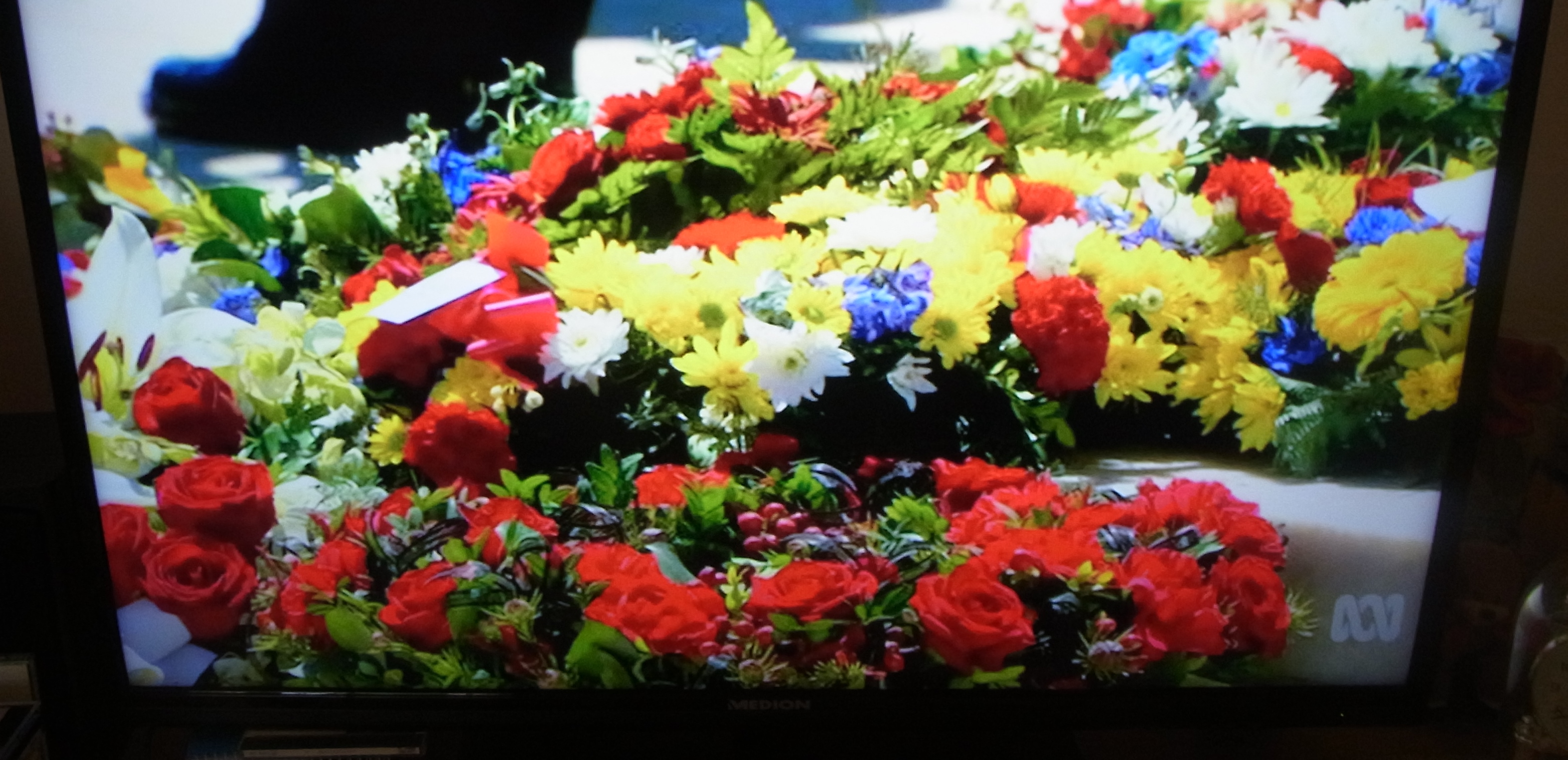
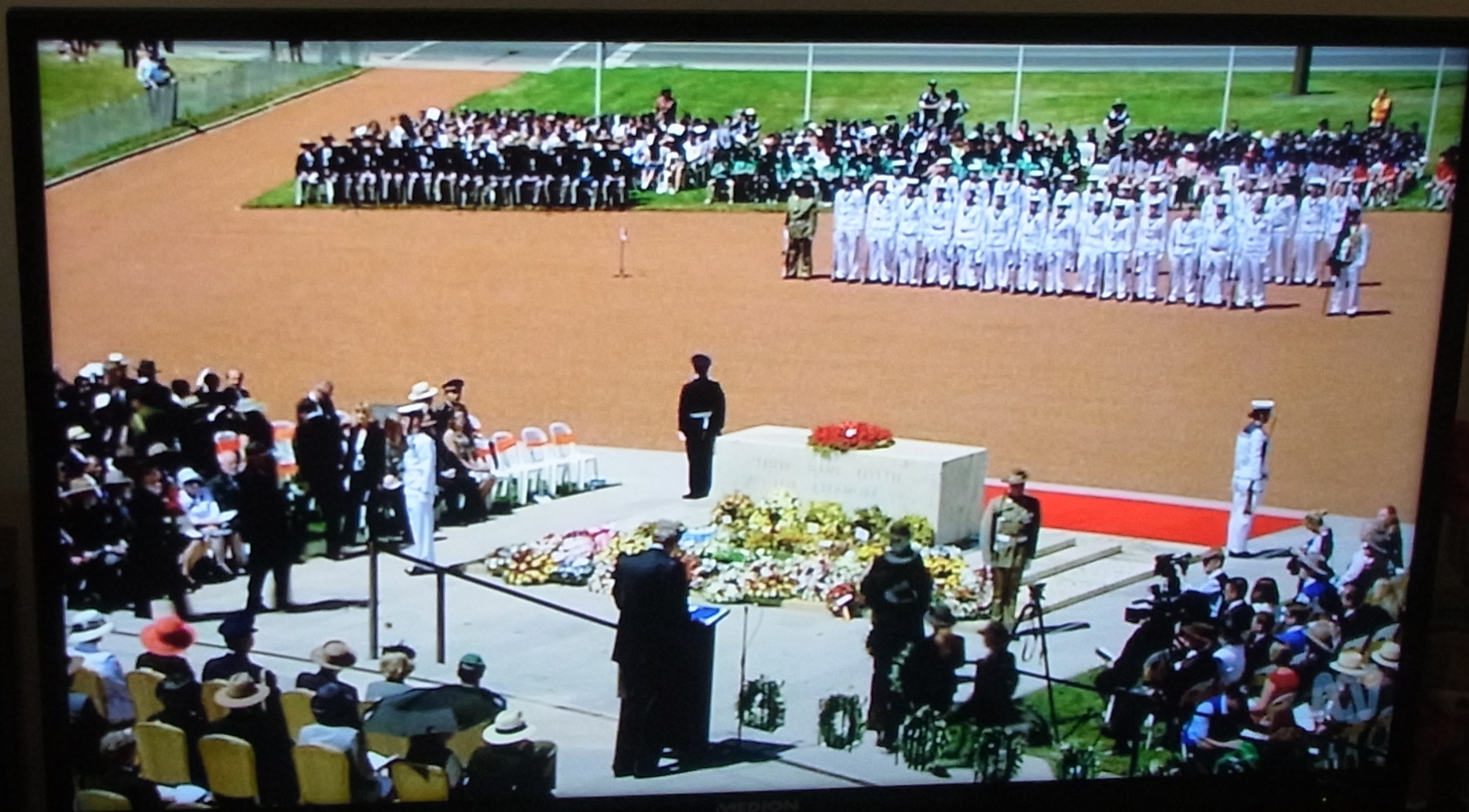
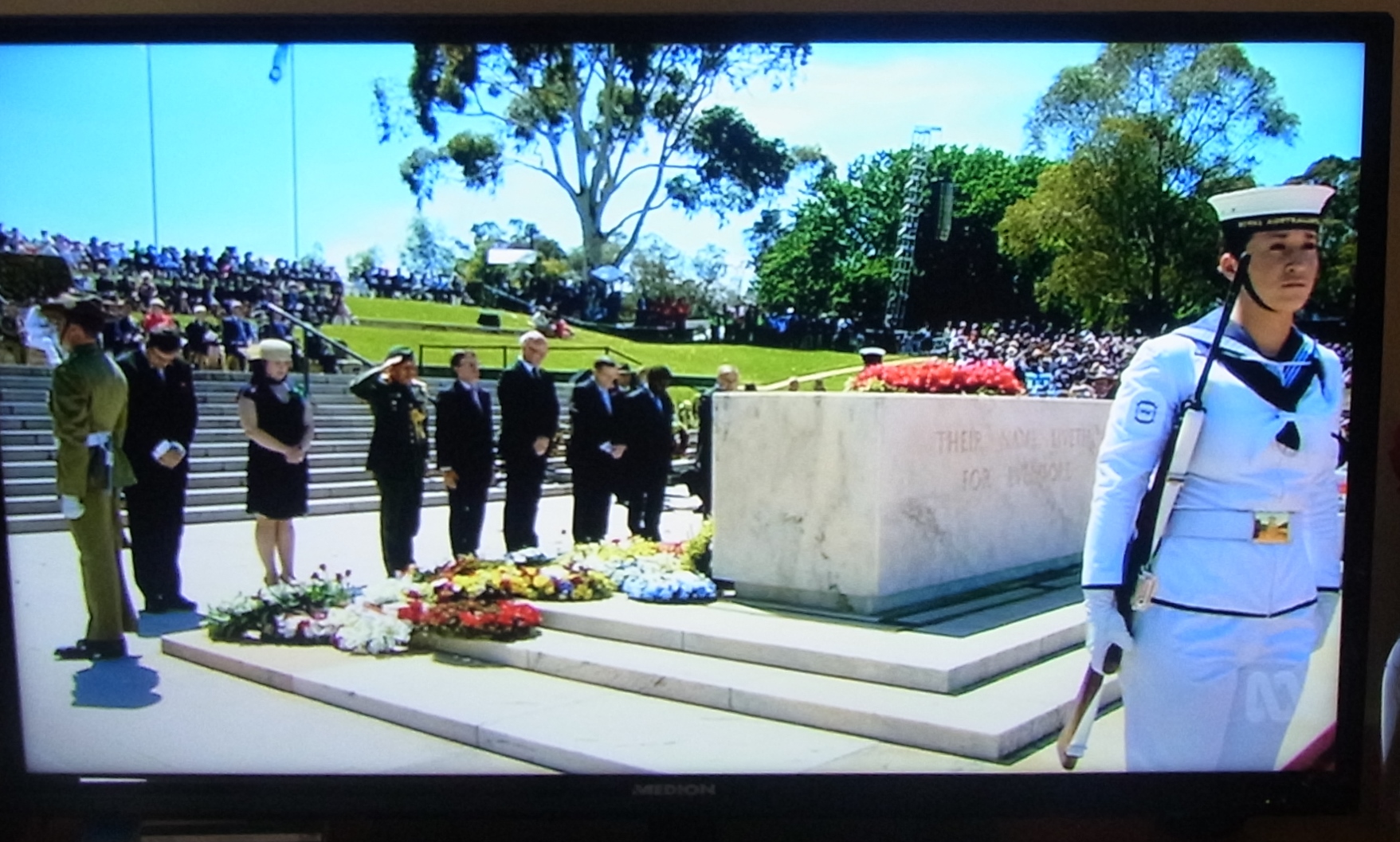
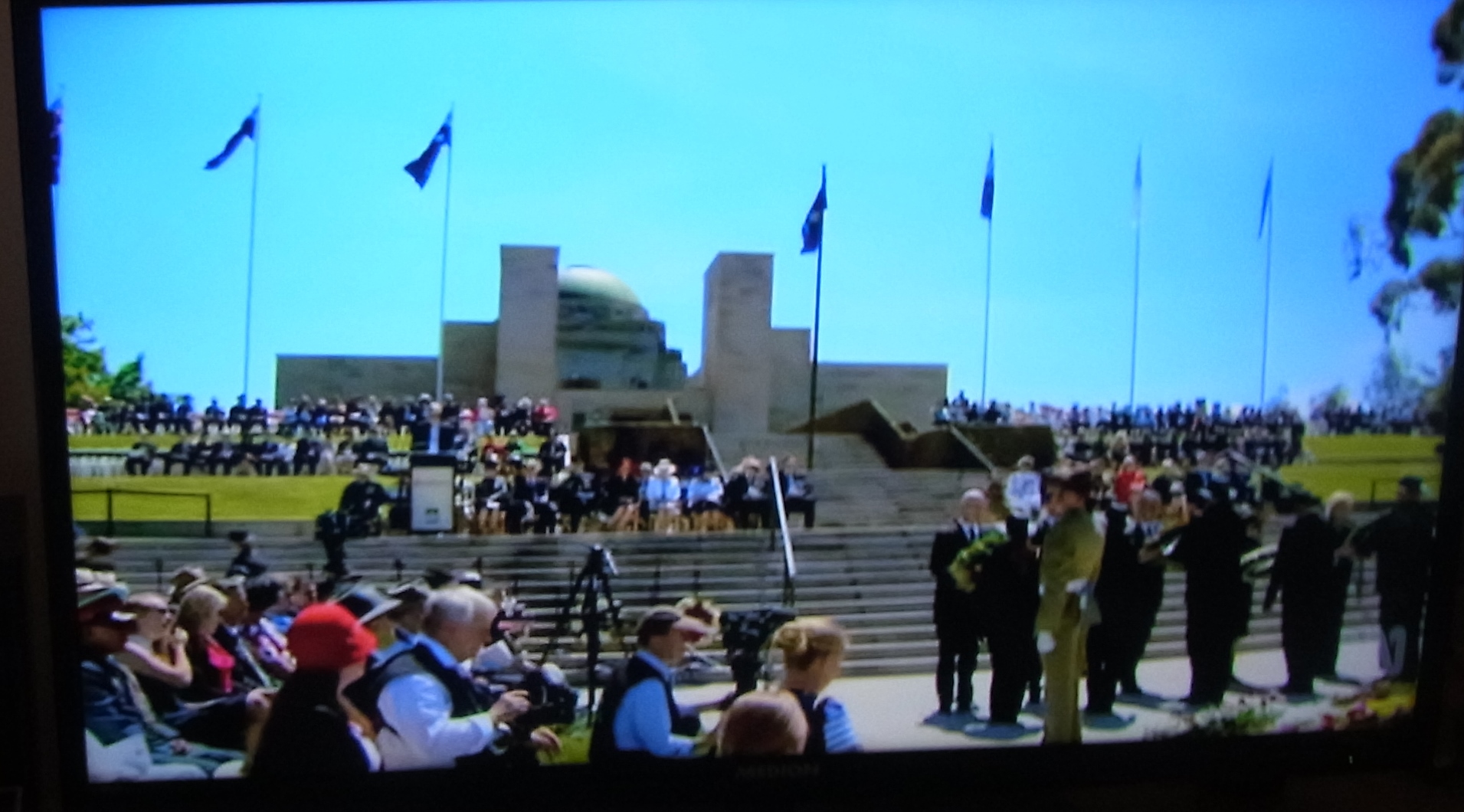
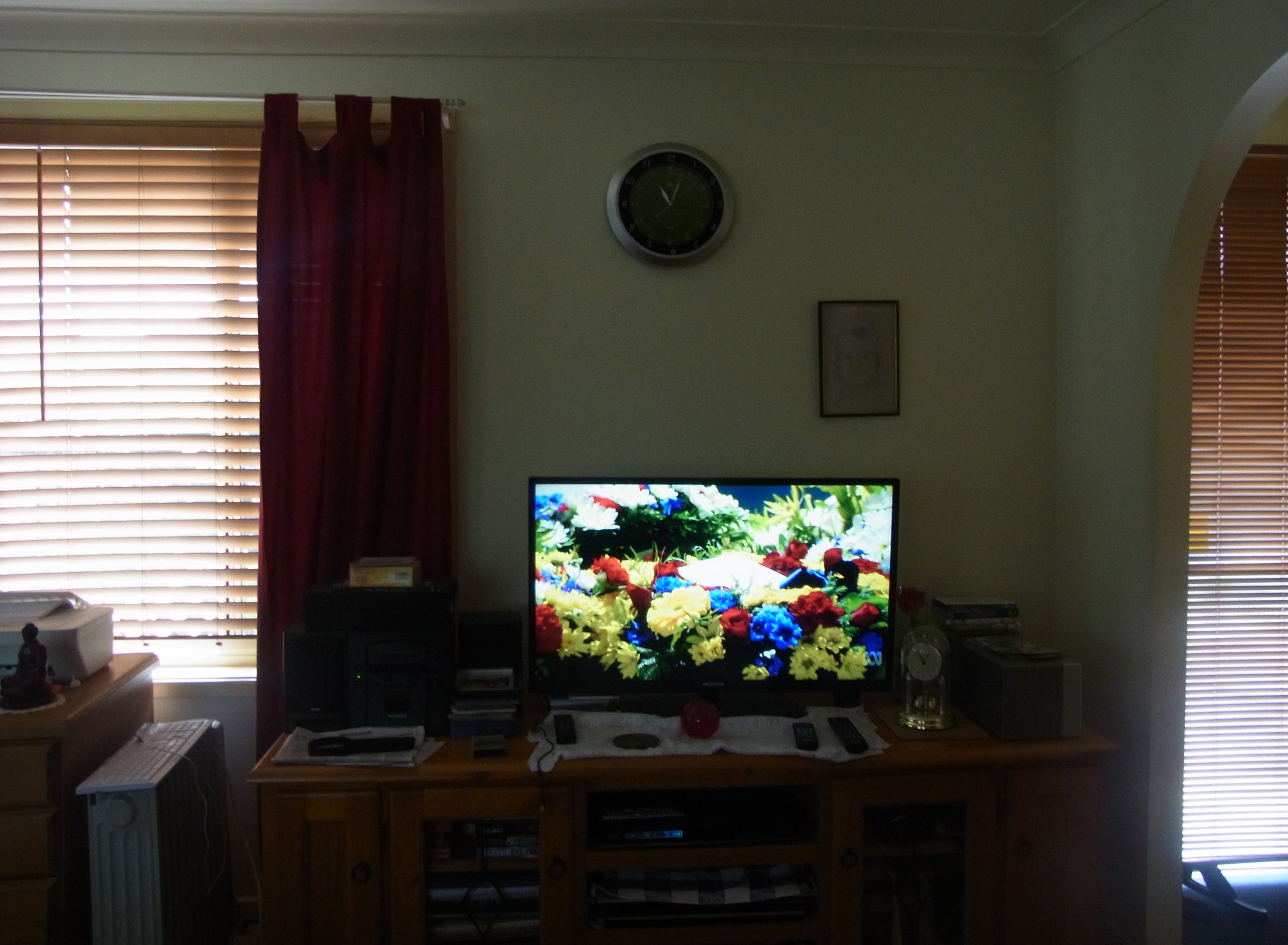
All the above pictures I took from our TV screen this morning during a special ABC broadcast from the Australian War Memorial in Canberra.
http://www.abc.net.au/news/2014-11-11/rememberance-day/5881352
Remembrance Day ceremonies are being held throughout the country to commemorate the Australians who have died serving their country.
Director of the Australian War Memorial Brendan Nelson said it was important to reflect on the lives lost in conflict, particularly those lost during The Great War.
Mr Nelson said the number of Australians killed in World War I and the impact it had on the nation was beyond comprehension.
“Today, I think it shouldn’t be too much to ask every Australian to perhaps set the alarm on your phone for 10:59am AEDT; and what you’re doing at 11:00am AEDT, just stop for a moment and think,” he said.
“You know, we sing our national anthem regularly, ‘Australians all let us rejoice for we are young and free’.
“Just reflect on the fact that we are young and free in no small way because 102,700 Australians have given their lives in our uniform, in our name.”
The Great War was the crucible in which our nation’s identity was forged.
Prime Minister Tony Abbott
In a recorded video message, Prime Minister Tony Abbott called on all Australians to pause and “remember the suffering and loss that’s occurred in all wars”.
“This Remembrance Day marks 96 years since the guns fell silent at the end of The Great War. The Great War was the crucible in which our nation’s identity was forged,” he said.
“From a population of under 5 million, 417,000 enlisted, 332,000 served overseas, 152,000 were wounded and 61,000 never came home.
“Today we will remember the courage, achievements, pain and loss of all who have served in our name and we draw strength from their memory. Lest we forget.”
In Canberra, former prime minister John Howard delivered a commemorative address before a minute’s silence at 11:00am AEDT.
“We honour first and foremost the extraordinary sacrifice of more than 102,000 Australians who have died in the defence of the values of this country and in defence of this country,” he said to the crowd.
“We also gather to honour the spirit of Australia which has moved this nation not to go to war to conquer and subjugate, but rather to go to war and defend the vulnerable, and defend the values of which this nation has always proudly stood.
“The sacrifice of Australians that we honour today is quite remarkable. It is a sacrifice as we contemplate the beginning of World War I, a sacrifice in that war which reached extraordinary proportions.”
In Victoria a $45 million redevelopment of Melbourne’s Shrine of Remembrance will be unveiled as part of that state’s commemorations.
A new gallery and education space will be opened to mark the 80th anniversary of the shrine, and will be officially dedicated after the Remembrance Day ceremony.
The Shrine of Remembrance Foundation’s chief executive Denis Baguley said the Galleries of Remembrance was an important addition.
“It really will ensure that the shrine will remain relevant for future generations. After all, our World War II veterans have passed on. So it’s a very important project in the sense of not only commemoration but education,” he said.
A day to remember returned veterans from recent conflicts
The Returned and Services League of Australia (RSL) urged people to use Remembrance Day to also reflect on those young veterans who have returned from recent conflicts with mental health and substance abuse issues.
President of the Tasmanian RSL, Robert Dick, said almost half of all Tasmanian men fought in the war.
“The Tasmanian presence was very strong, for an area that had a very small population at the time,” he said.
“Of the Tasmanians that actually went and served at the Western Front and at Gallipoli and the Middle East, one in four did not come home, they actually died either of wounds or were killed outright.”
New South Wales RSL president Don Rowe said many young veterans in their 20s and 30s were struggling to return to civilian life after tours of duty in Afghanistan, Iraq and Timor.
He said the sale of red poppies on Remembrance Day was part of an RSL fundraising drive to give returned soldiers the support and services they needed.
“Mental illness obviously is a very large issue. We’re also finding that the homeless issue is another one that’s happening out there to those who’ve served,” he said.
“A number of them just need help and support out there to just get their lives back into order … after serving in our defence forces.”
http://www.abc.net.au/news/2014-11-11/rememberance-day/5881352
This is a link to the above article.
Australians are being asked to pause for a second minute of silence to honour those veterans who have taken their own lives after returning from battle.
“[Australians should pause] to remember those who have come back and unfortunately succumbed to their wounds,” John Bale, a 30-year-old veteran said.
 AuntyUta
It is also 39 years since the sacking of Gough Whitlam. That was a day to remember too.
Hi, Eliabeth! Oh yes, this day in 1975, what a day to remember!
This is what John Pilger wrote: “On 11 November – the day Whitlam was to inform Parliament about the secret CIA presence in Australia – he was summoned by Kerr. Invoking archaic vice-regal “reserve powers”, Kerr sacked the democratically elected prime minister. The “Whitlam problem” was solved, and Australian politics never recovered, nor the nation its true independence.”
Pilger’s article I published here:
https://auntyuta.com/2014/10/29/john-pilger-writes-about-the-forgotten-coup/
Exactly one year ago, on the eleventh day of the eleventh month of the year 2013, I wrote the following:
Today is Armistice Day. World War One ended on this day 95 years ago. We remember the soldiers from this war and all the other wars who did not grow old, who did not come home.
We arrived at Dapto Mall at 11 o’clock in the morning right at the start of the remembrance minute. Everybody stopped in their tracks for the remembrance. Where Peter and I stood there was a flower-shop nearby. Later on I started taking pictures of the beautiful flowers. The sales-woman approached me asking whether she could do anything for me.I said I’d just like to take some pictures of the flowers. And the woman let me do this and went on with her work sorting out and arranging flowers for display.
Armistice means: A state of peace agreed to between opponents so they can discuss peace terms.
Maybe ninety-five years ago people were hoping that this had been the war to end all wars. How many people have been sent to war since then? Why cannot people live in peace everywhere in every country?
Even without wars, how many people are there who loose their lives in natural disasters? Thinking of the mass casualties after super typhoon Haiyan swept the Philippines last Friday, I feel very weepy. So many people died, and so many people lost everything and need an awful lot of help just to survive. The pictures of devastation are horrendous. All the countries and agencies who are in a position to organise some kind of help work none stop to do just this right now. This is wonderful that there are people in this world to give selflessly of their expertise and time not matter what the difficulties. Sometimes they give their lives so that others can live, same as all the soldiers who are remembered today. We should never forget their sacrifice.
http://www.abc.net.au/news/2014-11-11/davies-this-isnt-a-cold-war-it-could-be-worse/5881618
The following is just one of many comments to the above article:
R Supwood
11 Nov 2014 11:55:01am
There is a chance that Russia and Europe, through German intercession, will grow and accommodate each other sufficiently. There is a chance that China and Russia will grow closer, with USA clumsiness the usual catalyst. There is a chance of an Asian solidarity, if China and Japan can overcome certain bitterness. As the Berlin wall fell (I never thought it would in my lifetime) so other positions will rise and fall, with the likely relative decline of the USA being a problem while its military might is a dangerous political weapon. Putin seems capable of being able to outfox and outbox over time, and who knows what USA leadership and policy will emerge over the next decade, during which Putin may outlast all other leadership positions and persons in the broad west. Russian gas exports will underpin a decade’s diplomacy in Europe. May this lead to sense, peace, prosperity, understanding. The USA is not capable of decent and flexible diplomacy with its traditions of sabre rattling, undermining, spying, intrusions.
Rememberance day for me is a lost emotion Uta, funny thing for someone to say who served twenty years in the Army, but I just cant get my mind around this tradition we have invented, for remembering the futility of war and the losses, we teach children to remember, children who have no concept of war, then we become involved in more wars, more rememberance days, more young children to brainwash, its a cycle of war and rememberance.
The biggest lesson we should have learnt out of the First World War, was that war is futile and serves no purpose to mankind.
Brainwash our kids on the tenets of Love and Peace and Harmony.
I dont want my descendants to dwell upon my service in Vietnam, a hundred years or so from now, its a wasted emotion, learn from my experience and heed my words, all countries must learn from their mistakes, not revisit the memories in misplaced respect, especially by the children.
Just my ponderings Uta.
Ian
I agree, Ian, that most wars are futile. Of course it is better to try to prevent wars and strive for Love and Peace and Harmony. But the same as we need a police force, the same we do need a defense force. It is said we do have now less wars than in the past, Whether this is true or not, I do not know. To my mind we seem to spend excessive amounts of money on bombs and weapons. A lot of this money could probably be better spent for peaceful purposes.
However, I think that commemorations are important. If the young ones learn how people before them sacrificed their lives they ought to respect this and honor it and veterans should be well looked after at all times.
I wished we had leaders who do not commit us to join futile wars.
Uta
Hi Ian, maybe you like Anzak Day better? I found this in Wikipedia about Anzak Day:
“Anzac Day /ˈænzæk/[1] is a national day of remembrance in Australia and New Zealand that broadly commemorates all Australians and New Zealanders “who served and died in all wars, conflicts, and peacekeeping operations” and “the contribution and suffering of all those who have served.”[2][3] Originally 25 April every year was to honour the members of the Australian and New Zealand Army Corps (ANZAC) who fought at Gallipoli in the Ottoman Empire during World War I. Anzac Day is also observed in the Cook Islands, Niue, Pitcairn Islands, and Tonga[citation needed]. It is no longer observed as a national holiday in Papua New Guinea or Samoa.[4][5] It is unofficially recognized and observed in Newfoundland, as they were an independent dominion and the Royal Newfoundland Regiment was the only North American army to fight at Gallipoli.”
We call it Veteran’s Day, but it’s evident that the motivation and the feelings are the same.
Hi Robert,
I found the following in Wikipedia:
“In Germany and the Netherlands, the Carnival season is traditionally opened on 11/11 (often at 11:11 a.m.). This dates back to celebrations before the former longer Advent season (40 days now reduced to about four weeks)”
“In 1816, Prussia introduced a new date for the remembrance of the Dead among its Lutheran citizens: Totensonntag, the last Sunday before Advent. This custom was later also adopted by the non-Prussian Lutherans in Germany, but it has not spread much beyond the Protestant areas of Germany.”
“During the slaughter of the First World War, Pope Benedict XV on 10 August 1915, allowed all priests everywhere to say three Masses on All Souls’ Day. The two extra Masses were in no way to benefit the priest himself: one was to be offered for all the faithful departed, the other for the Pope’s intentions, which at that time were presumed to be for all the victims of that war. The permission remains.
Each Eucharistic Prayer of the Order of Mass has a prayer for the departed.”
In World War I, Australia and New Zealand had the highest death rates per capita of any British Colony – approximately 1.3 – 1.4% for Australia and 1.5 – 1.6% for New Zealand.
Many of my friends had WWI veterans in their family. They all told stories about British officers using the Anzac troops as cannon fodder. When troops were ordered to evacuate, typically the officers would pull their own troops out, leaving the Anzac troops to be slaughtered.
All this in the context of a war that didn’t even concern us. A war instigated by the Rothschild’s, who increased their wealth exponentially by backing both sides. And which started as a spat between cousins (a British monarch and a German chancellor) over who would control the oil rich Middle East countries when the Ottoman Empire broke up.
In Holland, freedom’s day is celebrated more than remembering the fallen soldiers. War remembrances are looked upon with some trepidation if not horror and they certainly don’t have that yearly march of men, women with their medals. Nor, as far as I know do they have clubs with poker machines and every day a 6 o’clock pm minute’s silence reflecting on glories of past wars and mayhem before going back to the schooner and pokie.
In England too, I think they revel in looking back on wars and subsequent slaughter.
Of course the Dutch celebrate the deliverance from occupation and appreciate the efforts by other countries and in tragically having lost so many lives, but to blow the bugle and go on about wars somehow being noble and heroic almost weekly. No, I think countries that have been bombed and occupied generally do not dwell on those miserable times too much. The horror is too much!
Hello Stuart and hello Gerard, thank you both for commenting.
For me it is not a matter of glorifying war, far from it, but when your country goes to war – for whatever reason – then if you are a soldier your country needs you. If you are not a soldier and conscription is introduced you should be allowed to be a conscientious objector. But once you have enrolled to become a soldier that’s it. Often a soldier may find himself in a bind when things are being asked of him that go against his conscience. And of course he may become very scared at times and still he has to go on doing his duty, helping his fellow soldiers. Often men do show much bravery in circumstances like this. Any soldier who is sent into a war may have to cope with very tough situations where he has to show some bravery or maybe sometimes bravery may elude him, I assume a soldier would still try to do his very best and should be praised and honored foor that.
I have one question: If you are a soldier already and a war is being declared that you consider to be unjust, do you still have then the option to leave the army as a conscientious objector if you do it straight away before you are even being asked to go into that war?
I guess if in wartime you encourage people to become conscientious objectors you are probably risking severe penalties!
Yes, but I so wish we had clubs celebrating peace and abhorring wars. A minute silence for remembering another year without bombs and turmoil. Bravery in wars is secondary to bravery in avoiding wars and embrace peace.
We need peace medals more than war medals.