Hypocrisy Overload as the line between Church and State is crossed by the LNP

Jenni's avatarUnload and Unwind

1-BlackmailIt appears that blackmail, be it financial or emotional, is the new form of due process by the Australian Federal Government.  Much has been said recently about the appalling manipulation the LNP and Scott Morrison displayed when seeking to push the new Asylum Seeker laws through the parliament. What is also true is that this is merely the most vile example of this practice to date.

I have spoken previously about the current governments attempts to force the chaplaincy program into state run schools but it bears mentioning again when you consider how they are going about it.  It also bears mentioning the new initiative of this government to fund those who wish to enter the Seminary and study for the priesthood.  This is at the same time they are gutting funding to university education and attempting to drive legislation through the parliament that would leave Australians paying up to…

View original post 825 more words

A Most Immoral Act

http://theaimn.com/immoral-act/

In a lifelong experience of following politics I have, until now, never witnessed children being horse traded, and senators being blackmailed, for the passing of legislation. In this case to reintroduce Temporary Protection Visas.

It looks as though Immigration Minister Scott Morrison (and the senators) have taken the yes side on the ageless Christian ethical dilemma “Does the end justify the means”.

It is a fascination to me as to why people assume that religion has some form of monopoly on morality. And even worse, they pretend to speak on Gods behalf in dispensing it.

Morrison said:

“I will not take moral lectures from Bill Shorten or Sarah Hanson-Young when it comes to border protection on that or any other issues,’’

Abbott said:

“So this is a win for Australia, it’s also a win for humanitarian values, it’s a win for human decency’’

Jesus said:

“Do unto others as you would have them do unto you”

We are all wired for decency and conscience with or without religion. Some understand it better than others illustrated by either what we do or don’t do. By our mercy and compassion or deficiency in it.

Morrison like many of the Cabinet are serious practicing Christians who interpret God’s word to fit snugly with their political ideology. They easily accommodate policy with their own definition of scripture, justifying their immorality to themselves. An evil in itself.

As someone who spent many years in a church environment similar to Morrison s (now an open-minded atheist) I can assure the reader that there are many who think like Morrison. They worship their politics and religion without demarcation. In doing so they believe that telling the truth isn’t necessarily in their best interests.

This government seems intent on imposing its own particular form of Christianity on an unsuspecting population. And I might add, one that is completely at odds with current Papal uttering on social inequality.

The decision to sack highly credentialed social workers, doing excellent work in high schools and replace them with accredited Chaplains is outrageous.

And now it seems that taxpayer funds are to be used to fund the training of Priests in religious institutions.

What ever happened to the secular society?

The fools that frequent the senate.

The inexperienced cross-bench senators buckled into the ransom dangled before their collective conscience and awarded the executive the power to ‘’play God ‘’ with the lives of those seeking safety from this supposed Christian nation.

In all fairness it could not have been an easy decision.

Senator Muir, said he was:

“Forced into a corner to decide between a bad decision and a worse decision, a position I do not wish on my worst enemies”.

Maybe the Palmer United Party senators felt the same.

It has also been reported that Morrison’s department had children on Christmas Island phone Muir and beg their freedom even giving them the phones to do so. Now that’s something straight out of the “classic hostage situation” handbook. That’s what terrorists do with hostages.

So, with the passing of this Bill what have we ended up with?

Crikey put it this way, calling it an immoral disgrace:

“At 8.06 this morning it was done: the House of Representatives passed the government’s Migration and Maritime Powers Legislation Amendment (Resolving the Asylum Legacy Caseload) Bill 2014, following its passage and amendment just after midnight in the Senate. Parliamentarians then got to go home for Christmas, having delivered the Immigration Minister extraordinary powers that in effect obliterate any further pretence that Australia regards asylum seekers as human beings.

The bill restored the failed Howard-era policy of temporary protection visas, a mechanism that actually increased boat arrivals when last attempted. Whether Clive Palmer seriously believes that there is a pathway to citizenship contained in a kind of homeopathic form within the legislation — or it merely suits its purposes to pretend there is — we don’t know, but Scott Morrison has been crystal clear that TPVs will never provide permanent protection.

But the bill goes much further, freeing Australia from any obligations associated with the Refugee Convention, including giving Morrison and his department — which has repeatedly demonstrated it is profoundly incompetent and resistant to the most basic forms of accountability — the power to return people to torture and persecution without judicial review.”

On the one hand cross bench senators like Ricky Muir, Nick Xenophon might argue that the end does indeed justify the means. After all there will be many freed from their dreadful incarceration and the migrant intake has been increased. But did they consider that Morrison already held powers to resolve these issues, to release people. Especially children. His threat was that unless they passed his legislation they could rot in hell.

They could have called his bluff.

Their pretentious anguish at having to deal with such a choice can’t hide the grim reality of their actions.

Greg Barnes (a spokesman for the Australian Lawyers Alliance and barrister) put this way:

“But in passing this legislation Senator Muir and his colleagues have done what many would think is unconscionable in a society that supposedly subscribes to the rule of law – allow the executive to “play God” with the lives of those in our world who want to put their case for asylum to a rich, developed world country with ample capacity to take them.”

Morrison is now effectively above the High Court and our conformity to the International Convention on Refugees has been written out of our law.

The bill, in all probability is the most immoral ever passed by an Australian Parliament.

Not only that, it is also bad policy. It says much about the leaders of this country and their shameful misrepresentation of the faith they profess to follow.
No matter in what sphere of government policy (immigration, health, pensioners, education etc) one looks, you find the hand of Abbott’s hate on those who refuse to join Team Australia.

He seeks to reward those who follow and punish those who don’t. In the past week much has been written about the horrendous failings of his government.

A lot has centered on Abbott’s credentials as a leader. Therein lies the fundamental problem. For those of us who have followed his career closely, it’s easy. He has none.

Leviticus 19:33-34
“When a stranger sojourns with you in your land, you shall not do him wrong. You shall treat the stranger who sojourns with you as the native among you, and you shall love him as yourself, for you were strangers in the land of Egypt: I am the Lord your God.

Excerpts from a recent Speech by Putin

1) Crimea is Russian forever:

It was an event of special significance for the country and the people, because Crimea is where our people live, and the peninsula is of strategic importance for Russia as the spiritual source of the development of a multifaceted but solid Russian nation and a centralised Russian state. It was in Crimea, in the ancient city of Chersonesus or Korsun, as ancient Russian chroniclers called it, that Grand Prince Vladimir was baptised before bringing Christianity to Rus.

In addition to ethnic similarity, a common language, common elements of their material culture, a common territory, even though its borders were not marked then, and a nascent common economy and government, Christianity was a powerful spiritual unifying force that helped involve various tribes and tribal unions of the vast Eastern Slavic world in the creation of a Russian nation and Russian state. It was thanks to this spiritual unity that our forefathers for the first time and forevermore saw themselves as a united nation. All of this allows us to say that Crimea, the ancient Korsun or Chersonesus, and Sevastopol have invaluable civilisational and even sacral importance for Russia, like the Temple Mount in Jerusalem for the followers of Islam and Judaism.   And this is how we will always consider it. 

2) Russia will never become an EU colony: 

By the way, Russia has already made a major contribution to helping Ukraine. Let me reiterate that Russian banks already invested some $25 billion in Ukraine. Last year, Russia’s Finance Ministry extended a loan worth another $3 billion. Gazprom provided another $5.5 billion to Ukraine and even offered a discount that no one promised, requiring the country to pay $4.5 billion. Add it all up and you get as much as $ 32.5-33.5 billion that were provided only recently.

Of course, we have the right to ask questions. What was this Ukrainian tragedy for? Wasn’t it possible to settle all the issues, even disputed issues, through dialogue, within a legal framework and legitimately?   But now we are being told that this was actually competent, balanced politics that we should comply with unquestionably and blindfolded.

This will never happen.   If for some European countries national pride is a long-forgotten concept and sovereignty is too much of a luxury, true sovereignty for Russia is absolutely necessary for survival. 

3)  The Empire was Russia’s mortal enemy long before Crimea

We remember well how and who, almost openly, supported separatism back then and even outright terrorism in Russia, referred to murderers, whose hands were stained with blood, none other than rebels and organised high-level receptions for them. These “rebels” showed up in Chechnya again. I’m sure the local guys, the local law enforcement authorities, will take proper care of them. They are now working to eliminate another terrorist raid. Let’s support them.

Let me reiterate, we remember high-level receptions for terrorists dubbed as fighters for freedom and democracy. Back then, we realised that the more ground we give and the more excuses we make, the more our opponents become brazen and the more cynical and aggressive their demeanor becomes.

Despite our unprecedented openness back then and our willingness to cooperate in all, even the most sensitive issues, despite the fact that we considered – and all of you are aware of this and remember it – our former adversaries as close friends and even allies, the support for separatism in Russia from across the pond, including information, political and financial support and support provided by the special services – was absolutely obvious and left no doubt that they would gladly let Russia follow the Yugoslav scenario of disintegration and dismemberment. With all the tragic fallout for the people of Russia.

It didn’t work. We didn’t allow that to happen.

Just as it did not work for Hitler with his people-hating ideas, who set out to destroy Russia and push us back beyond the Urals. Everyone should remember how it ended.

4) Russia will not be bullied

No one will ever attain military superiority over Russia. We have a modern and combat ready army. As they now put it, a polite, but formidable army. We have the strength, will and courage to protect our freedom.

We will protect the diversity of the world. We will tell the truth to people abroad, so that everyone can see the real and not distorted and false image of Russia. We will actively promote business and humanitarian relations, as well as scientific, education and cultural relations. We will do this even if some governments attempt to create a new iron curtain around Russia.

We will never enter the path of self-isolation, xenophobia, suspicion and the search for enemies.   All this is evidence of weakness, while we are strong and confident.

Our Parliament in Disarray

Jenni of  ‘Unload and Unwind’  says in a comment from today that they are ‘trying a number of avenues to force a double dissolution of parliament which mean an immediate election. The government has managed to dodge it so far and parliament has risen for the year. There won’t be another opening until 2015 when it sits again so for the next month we’re going around Australia door knocking for signatures in every state. It’s a combined effort of a number of aid agencies and community groups as well as backing by the different churches and business leaders – it’s all we have at the moment. I just hope it will be enough.

So I understand that Jenni thinks door knocking for signatures in every state is all they have at the moment. I have a few questions to this. How many signatures would you need to get the PM to call for a double dissolution? Is it not essential to first of all get the elected representatives on your side? Instead of aiming for an immediate election would it not be preferable to get more people in the coalition government on your side, meaning that the coalition government could possibly come to the conclusion that it would be better to elect new leaders who consider a bit more the human aspect in their legislations?

Personally I do imagine that a lot of the coalition members hate the new legislation!


http://www.smh.com.au/national/ricky-muirs-anguish-on-asylum-vote-20141205-1219av.html

‘ . . . . .


Refugee advocates and lawyers expressed alarm at the passage of the laws, which restore temporary protection visas for the “legacy” caseload of 30,000 asylum seekers who arrived before July 19 last year and will allow those detained on Christmas Island to be transferred to the mainland.

The legislation also dramatically strengthens the government’s powers to detain asylum seekers at sea and take them “anywhere in the world”, introduces a new safe-haven enterprise visa and includes fast-track processing that Amnesty International says will see “some refugees returned to the hands of their torturers”.

Senator Muir and other crossbenchers said they had supported the legislation because the government had said that, if it did not pass, the 30,000 would be “left in limbo” and 1550 who arrived between July 19 and the election would be sent to Nauru.

Greens Senator Sarah Hanson-Young launched a scathing attack on Mr Morrison saying he had “successfully blackmailed” the Senate cross bench by holding refugee children hostage.

“Tonight we saw children on Christmas Island being handed the phone number of Senator Muir, and they were asked to call that number and beg that senator to let them out. If that is not treating children as hostages, what is it?” she told the Senate.

A spokesman for Senator Muir said he had not spoken to any children on the island and a defiant Mr Morrison replied that he did not take moral lectures from Senator Hanson-Young or Labor leader Bill Shorten. “They have proven themselves irrelevant and impotent when it comes to having solutions on border protection,” he said.

Refugee lawyer David Manne said the new laws were “patently unfair, undermine the rule of law and will endanger lives”.’

My First Railway Journey Part II

Your memories about this train trip to Friedland are astounding. I want to reblog it for I think it is a very good and interesting read.

berlioz1935's avatarBerlioz1935's Blog

When the train started to move, Frau Fischer opened the compartment window and said,

“Have a look whether you can still see your mother. I’m certain she is waving.”

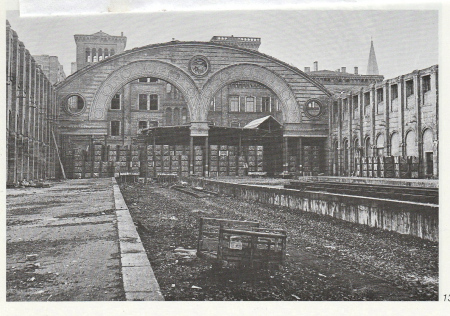
The war ravaged Görlitzer Bahnhof. My train left from the platform on the far right along the wall. Even from this photo one can get an idea of the beautiful architecture. The war ravaged Görlitzer Bahnhof. My train left from the platform on the far right along the wall. Even from this photo one can get an idea of the beautiful architecture.

I did not see her and it saddened me. We had gone too far. People on the platform and steam from our train blocked my view. Almost without sound the train glided out of the huge station hall. From time to time there was a little jolt when the carriage went with a “clickety, clack” over a set of points. The tall yard lights were standing between the train tracks and shone onto the rails. I was wondering whether the light would stay on during an air raid. We could hear the…

View original post 2,214 more words

Our Landlord in 1943/1945

Our toilets were “plumps-closets” some distance away from the house. Water for cooking and washing had to be fetched from a pump in the backyard. Fetching water from the pump kept both maids, Maria and Katja, very busy indeed. For lights we had kerosene-lamps, for heating there were coal-fired stoves which could also be used for cooking. Everything was very basic.

Gradually some changes were being made. The first big change was that our landlord had electricity laid on. All the workers who lived with their families in the other part of the building, received the benefit of electricity at the same time. This certainly was a very welcome improvement for them.

The ‘Ausbau’ was built close to a dirt-track which meandered through wide open barley-, oat- and potato-fields. On the track it was a good half hour to walk to the next village. Bike-riding however made it a bit quicker.

Werner Mann, the owner of all those fields that went on for miles and miles, was an acquaintance of Tante Ilse. People said he was a millionaire. Apart from these Ländereien he owned extensive brick-works (Ziegeleien). He was our landlord and he liked to spoil us. With no strings attached! Tante Ilse only had to voice a wish and Werner Mann immediately did whatever he could to fulfill her wish. He spoiled all of us by constantly getting produce delivered to us such as: Potatoes, cabbage (for making sauerkraut), wonderful treacle made of sweet-beets, and coal for our stoves.

Even I, as a nine year old, could see that sixty year old Werner Mann was hopelessly in love with Ilse. I also was quite aware, that she always kept him at a distance. He was happy to just be invited for ”Kaffee und Kuchen” on weekends and to spend some time with all of us. He always came to visit on his bike. On his daily inspection tours of the workers in the fields he also went around on his bike. He owned coaches with horses, but hardly ever used these to go anywhere.

Occasionally we were invited to his place (which people called ‘Schloss’), Then he sent a coach with a coachman to pick us up. Once in winter when there was plenty of snow, Werner Mann sent a ‘Pferde-Schlitten’ (horse-drawn sledge). On this sledge we were wrapped up in blankets under a clear night-sky with the moon and lots of stars shining on us. It was unforgettable and one of the rare highlights in our otherwise pretty dreary country-life existence.

The place, where Werner Mann lived, did not look like a castle at all, even though people called it ‘Schloss’. It was not even a mansion but a rather large, but fairly plain house. There was a huge, fenced in veggie garden next to the house. I have seen the veggie garden only once. However I was very impressed by it, because it seemed to be very large.

When we moved to the ‘Ausbau’, Ilse had already been divorced from her first husband. It was obvious that Werner Mann would have liked to marry Ilse. However, it never came to that. Tante Ilse married Onkel Peter aka Helmut Lorenz on July 20th, 1944.

**************

Our part of the building had a huge storage room on the top floor. A lot of our furniture was stored there. I loved to go exploring among the furniture where Mum used to store a lot of goodies. Especially in the weeks before Christmas Mum used to store there a lot of stuff. It was very exciting for me to find out what new things had been stored in that big room. I remember seeing huge chunks of nougat (a yummy hazelnut-paste) as well as heart-shaped marzipan-pieces. There was a pot with sweetened thick milk. Sometimes I dipped my finger into it to lick this wonderful sweet stuff! I also liked to eat a few of the stored raisins and prunes! There were smells of ginger bread and apples: It made me feel that Christmas was something to be looking forward to.

Where on earth did Mum get all these things from? It was war-time after all! We were in the midst of war. – However I knew very well where all this stuff came from. The parents of Mrs.T. had a distributing business. It was called ‘Backbedarf en Gros’. That meant they delivered goods to bakeries and cake-shops. Even in the midst of war deliveries of the above mentioned goods still took place! Of course there were shortages, but basically most things were still available. Mr. Fritz T. was in that business with his parents-in-law. This is why he stayed in Berlin during the week. But on weekends he left Berlin to stay with his family in the Ausbau. He usually was able to bring along some delicious Backbedarf. And apparently he was always willing to let my mum Charlotte have some of the goodies too. Mr.T., being over forty, was not required to join the German army.

Mr. Fritz T. and Mrs. Edith T., as well as Tante Ilse and Mum were all good friends. Every Saturday night they came together for some card games. Eight year old daughter Eva and I were allowed to stay up late on those nights. For hours we were watching the adults playing cards. At the same time we entertained ourselves with doodling on bits of paper. At around ten o’clock some cake and hot chocolate as well as coffee were served. But the maids did not have to do the serving, They were already in their rooms at this hour. The cake was usually freshly baked, very fluffy yeast cake topped with delicious butter-crumbs and filled with a thick custard. Hmm, yummy!

During the summer of 1944 Mr.T. and Mum liked to go on their bikes to a neighbouring nursery where they were able to trade sweets for fresh produce. Eva and I were often allowed to go along with them on our bikes. The sweets were traded for strawberries or cherries or gooseberries as well as peaches and apricots, and later on in the year for pears and apples. I remember the Boskop apples were still in season in late autumn. The owner of the nursery was a well-off looking middle-aged woman who was very fond of sweets and loved to trade her produce. At one time we found out that she thought Mr.T. and Mum were a couple and we girls were sisters. Laughing joyfully, Mum and Mr.T. explained, that this was not so.

Only once, as far as I remember, were we shown into the lady’s home. Mr.T. made complimentary remarks about the interior of the house. He said it showed off the owner’s good taste. I liked the lady’s house a real lot too. Our families used to have well furnished apartments in Berlin. But this modern looking villa in the midst of the nursery really was something else. My feelings were I would very much like to live in a place like that! However we had to be happy with our accommodation in the Ausbau. To us children it was always pointed out, that we should be happy that we did not have to live in Berlin where all these bomb raids occured. I’m pretty sure that by myself I felt that I’d rather live in Berlin, bomb-raids or not. I think to children bomb-raids usually didn’t seem as scary as to the adults. At the time we children had had no experience yet how absolutely horrible these bomb-raids could become.

In 1990, soon after the Fall of the Wall, we went for a visit to Germany and had a look at this area east of Berlin where we used to be hidden away. We discovered that the nursery as well as the lady’s house had completely vanished. There was nothing left of the ‘Ausbau’ either!

In 1943, after we had lived at he ‘Ausbau’ for a couple of months only, Mrs. T. delivered a healthy daughter in a regional hospital. The day after the baby was born, it may perhaps have been a Saturday or Sunday, Mr. T. and Eva went for the forty-five minute bike-ride to the Hospital. I was thrilled that I was allowed to go with them! The baby was rather tiny. I think this is why she was soon called Krümel (tiny crumb). Her given name was Ruth. Eva had a pet-name too. She was often called Honkepong.

As soon as Mrs.T. came home from hospital, there was a nurse waiting for her to take charge of the baby. Mr.T. said something like: “Katja is a very nice girl, but I would not trust her with our new born baby. I am glad that Nurse is here to help my wife to look after our Krümel.”

Nurse used for herself the bedroom next to our playroom. Sometimes she sat with us children in the playroom. Since Christmas was approaching, she taught us how to make some Christmas decorations. I was very impressed, because I was nine years old and nobody had ever taught me anything like it! Nurse also made sure, we learned our Christmas poems. We had to be prepared to recite them to Santa on Christmas Eve!

Maria, our Polish maid, had been with us since before my little brother was born. He regarded Maria as his ‘Dah-dah’, that is he always called her ‘Dah-dah’. By the end of January 1945 we had to flee from the ‘Ausbau’ as the Russians were approaching fast. We went to Berlin first and then by train to Leipzig to stay at Grandma Olga’s place. Maria remained in Berlin with her Polish fiancee, who was a butcher.

When we parted from Maria, little brother Peter had just turned three. Yet he must have missed her for quite a while since she had always looked after him and I am sure, he loved her very much and she loved him. Mum always trusted Maria, who was in every way caring and efficient at the same time. Mum was always impressed how quickly Maria worked. Any dirty dishes were washed immediately. She was indeed capable of doing all the housework. Mum was happy to let her do just about everything. An exception was the baking of a large cake on Saturdays, which Mum loved to do herself.

Maria always made some potato-salad for the weekend. I watched how she did it. To the cooked, peeled and sliced potatoes she added finely cut onion, some oil, pepper and salt. Then she poured hot vinegar-water over the potatoes as a finishing touch. The huge salad-bowl was placed outside on a shelf near the stairway so the salad could cool down. I often helped myself to some of the warm salad when nobody was looking, because I loved to eat the salad when it was still a little bit warm. It was the same every Saturday. I watched Maria preparing the salad and placing it on the shelf outside. Then it did not take long before I had a good taste of it!

Friday night was the night for our bath. Maria placed a small tin-tub on the kitchen-floor. She carried several buckets of water from the outside pump to the kitchen. Some of the water she heated on the kitchen-stove in an especially huge pot. I was always the first one to use the bath-water, then it was brother Bodo’s turn. Little brother Peter was always the last one. Some hot water was added for everyone, but still the water must have been quite dirty for little Peter after Bodo and I had had our baths!

When Maria first came to live with us, she knew very little German. However she was determined to learn German quickly. She liked to ask Bodo and me how to pronounce certain words. She also asked me how to write these words in German. Mum often praised Maria, that she was willing and able to learn quickly. This applied to everything she did. She was an amazingly efficient person. A ‘pearl of a maid’ people would say of her. Maria was a city girl. She came from Lodz, which was called ‘Litzmannstadt’ at the time. We had spent the summer-months of 1941 at Zokolniki (near Lodz) and that was when Maria was assigned to us as a help. Mum liked Maria and wanted her to come with us when we went back to Berlin. Maria told me later that she did not want to leave Poland. But she had not been given the choice to stay in her own country.

When Katja arrived, we could see that she was very different from Maria. She was a country-girl from Russia. She never learned German as well as Maria did. She could never be trusted to do all the house-work by herself. Mrs.T. always had to supervise her and do certain things herself because Katja took too long to learn to do it properly. But we all loved Katja. She was always cheerful and full of beans. As a country-girl she did not know certain things that a city-girl had been brought up with. Maria took to instructing Katja about certain things. I think they communicated in German. After they finished work in the evening, they had plenty of time to stay in their rooms together and keep each other company. Both girls always had to get up early. During summer, school-classes in the village started as early as seven o’clock. That meant, I had to get up at six o’clock to get ready for school. Mum never got up that early. But Maria always came down at six o’clock to start working for us. She often had to do Peter’s linen early in the morning, which I am sure was not one of her favourite tasks.

I mentioned in this post our landlord, Werner Mann. He is here in this picture which was taken by Mrs. T. on Christmas Eve 1943.

Werner Mann is on the left, on the right is Mr. Fritz T.

Tante Ilse is next to Werner Mann. together with cousin Renate. I am in the back with my doll. You can see me holding up one of my Käthe-Kruse-Dolls. Mum had knitted a lovely new dress for this doll.

The children in front are eight year old Eva T. and my five year old brother Bodo.

Next to Mr. T. is Mum and Grandma Olga (Mum’s mum) is on the left next to Werner Mann.

Christmas Eve 1943

This photo was taken in Tante Ilse’s livingroom. We were all sitting together for Christmas Eve celebrations. The photo is proof that my grandmother from Leipzig and cousin Renate were with us for Christmas 1943.

In the weeks before Christmas Mum loved to do some sewing of clothes as well as a lot of knitting for us children. When she did this we were not allowed in the living-room because she wanted the gifts to be a surprise for Christmas Eve. That meant of course that we had to be very, very patient. Naturally we thought Christmas Eve would never come!


Outback Choir

http://iview.abc.net.au/programs/outback-choir/

“Follow the heart-warming journey of a regional children’s choir, and its founder Michelle Leonard’s personal mission to bring a desolate musical landscape back to life.”

“Broadcast at 7:40pm on Sun 30 November 2014. Published 5 days ago, available until 8:40pm on 14 December 2014. File size approx. 289 MB”

We watched this broadcast last Sunday. Apparently this video about the Outback Choir is available only up to 14 December 2014. It is heartwarming to see the enthusiasm of these outback children who, if it were not for people like Michelle Leonard, would not get as much of a chance in life.

If you do not have time to watch the whole video, I would recommend you go at least to the last fifteen minutes of it to watch the concert of that choir! This concert is quite an achievement.

2014 ADVENT CALENDAR

RIMG0006

RIMG0004

This calendar with little chocolates and a picture in it for every day is for little Lucas. We are going to see him on Sunday, the 7th of December, meaning he may find chocolates from number 1 to 7! (Sorry, that we could not give him the calendar before the 1st of December.)

I had every year an Advent Calendar when I was a child. However my calendars never had any chocolates in it. The idea to have chocolates in advent calendars came up many years later. But for the 6th of December, on St. Nicolas Day, we usually got some special pre Christmas treat. The night before that day we had to put our shoes in front of our bedroom door. If we had been ‘good’ children, we would find on the morning of the 6th, that good St. Nicholas had put some delicious things into our shoes, like ginger bread, chocolates, nuts and apples.

http://german.about.com/library/weekly/aa113098.htm

“German and Austrian Christmas customs have spread throughout the world wherever Christmas (Weihnachten) is celebrated. From the Christmas tree (Tannenbaum) to “Silent Night” (“Stille Nacht“) and on to the Advent calendar (Adventskalender), people around the globe have adopted many traditions that began in the German-speaking world.”

This is our Advent Crown (Adventskranz) with four candles in it, one for each Sunday of Advent. This Adventskranz has been with us for many years. For each Advent we dig it out again. In times gone past we would of course rather have bought a fresh Adventskranz made of Tannenzweigen (fir-twigs).

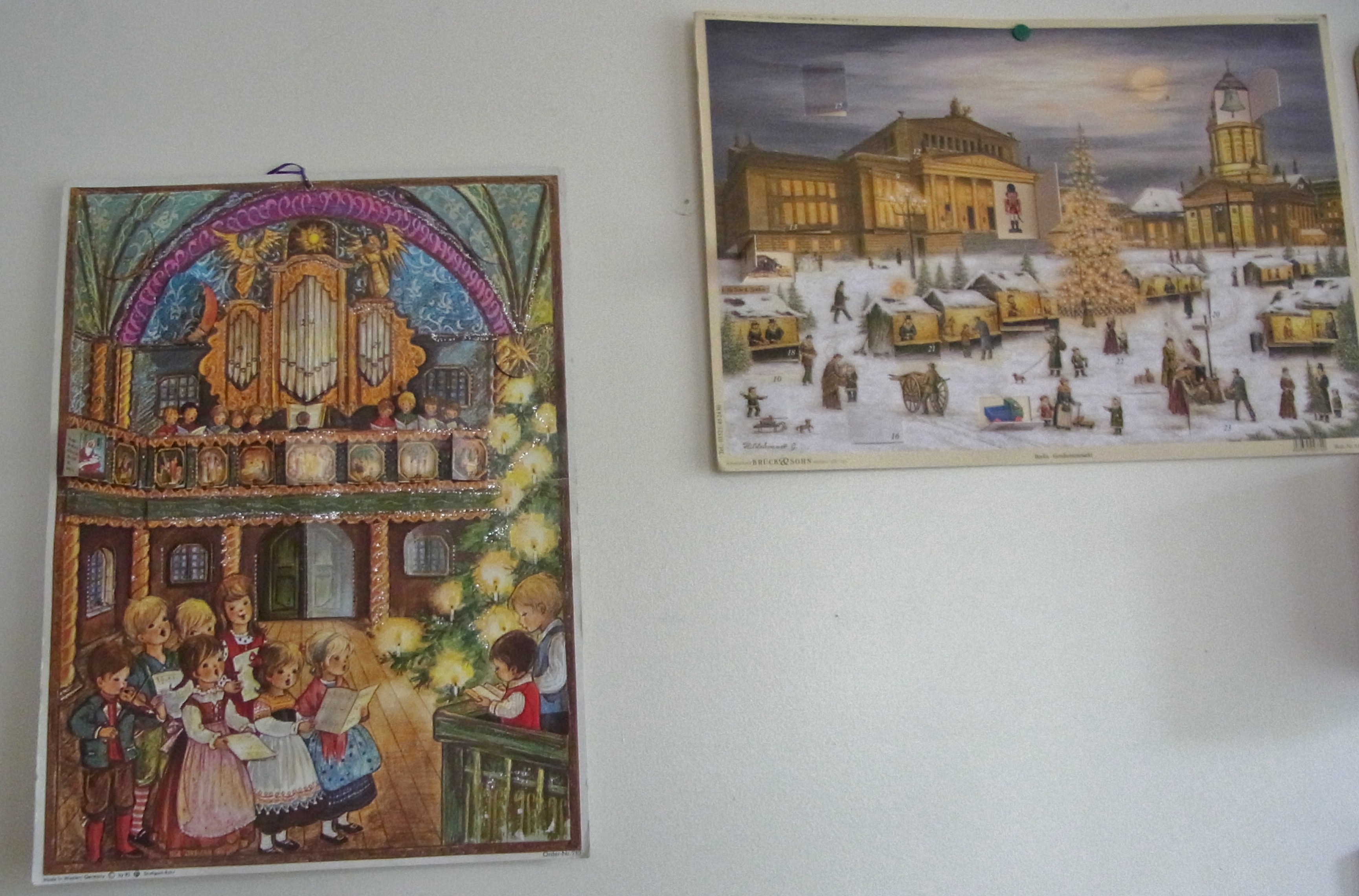
We also dig out some old advents calendars every year for advent. The numbers on the calendars go from 1 to 24, which is of course Christmas Eve.

Peter fastened the calendars to a wall and tries to find the relevant number of the day every morning! Some numbers are really hard to find!
This picture shows a Weihnachtsmarkt in Berlin  in the 19th century!
This picture shows a Weihnachtsmarkt in Berlin in the 19th century!

RIMG0003

Take a Breath Australia – Can You Smell the Brimstone?

Thanks for caring, Jenni. I want to reblog this.

Jenni's avatarUnload and Unwind

ourlivesbegintoendIt doesn’t feel like it’s enough anymore to simply sign a petition or wave a sign to protest this governments illegal detention and torture of asylum seekers.  Nor is it appropriate to close our eyes to the reality of the situation simply because it frightens us.

Do you really think that you are only judged for what you do in this life, often it’s what you don’t do that counts against you most. [I should know]  Just because you didn’t raise a hand to someone doesn’t absolve you of the responsibility to try to stop it once you know it’s occurring.

That time is passed and I don’t really care how upsetting you find the situation we’re in here in Australia we can no longer afford for the majority of us to simply sit back, hands in a flutter saying It’s so overwhelming.

Image courtesy of SMH - Sri Lankan refugees sent back by Australia enter court in Sri Lanka Image courtesy of SMH…

View original post 638 more words