We can identify three common elements in every crisis: The event is usually unexpected, the person or community is unprepared, and there is nothing anyone could do to stop it from happening…Bereft of words, all of us hold the same question: How could this be happening? Crisis Contemplation, p. 21
We don’t need to think very hard or very deep to identify crises in the last couple years. You may have experienced a personal crisis, alongside the communal ones our society has been enduring.
I don’t imagine many of us respond by moving into contemplation when a crisis strikes. Our more immediate response is action. This book does not negate that response, but at the same time Holmes encourages us to “allow for the possibility of contemplative refuge, respite, and renewal. To slow down and be still is to allow both the source of our troubles and options for recovery…
Dr Ruth: ‘Nobody has any business being naked in bed if they haven’t decided to have sex’
Sex therapist, child of the Holocaust, former sniper… Dr Ruth Westheimer has lived more than most. Now 90, she’s as busy as ever – and still has strong opinions on pornography and consentSun 12 May 2019 21.03 AEST
Early this spring, the Smithsonian Museum in Washington DC, famous as a time capsule of American history and culture, reached out to Dr Ruth Westheimer and asked her to donate an object to its vast collection. It’s there that you can find such iconic totems of Americana as the glittery red shoes Judy Garland wore in The Wizard of Oz, or influential TV cook Julia Child’s kitchen, fully reassembled. Soon you will also be able to find the microphone that Westheimer used at WYNY, the New York radio station that helped cement her fame as a frank-talking sex therapist in 1981, in no small part thanks to her unmistakable accent.
“I’m very lucky, because it’s a combination of the German, the Hebrew, the Swiss, the French, and that accent helped because as soon as people heard it they knew it was me,” she says as she directs me around her tiny kitchen, filling the kettle for tea, retrieving a knife to cut a cheesecake. If you find yourself on TV talking about vaginas, penises and clitorises, an accent like Westheimer’s might also feel like a blessing. It’s hard to feel indignant or vexed when the person dishing advice on erectile dysfunction is a 90-year-old Jewish lady with long rolling R’s and a Munchkin giggle.
Humour and charm has long been Westheimer’s reflex for diffusing anxiety and shame. “In the Talmud, it says that a lesson taught with humour is a lesson retained,” she says. “I came from an Orthodox Jewish home so sex for us Jews was never considered a sin.” Has she never felt flummoxed by a question, or found herself blushing? Westheimer thinks for a moment. “The best answer to that is that when someone asked me a question about sex with animals, and I responded: ‘I’m not a veterinarian.’” She peers into a cupboard and frowns. “I want to find some tea, but I don’t find tea,” she muses. Not a problem, I assure her. Whatever is easiest. “Orange juice is easiest,” she says, producing a carton of Tropicana from the fridge.
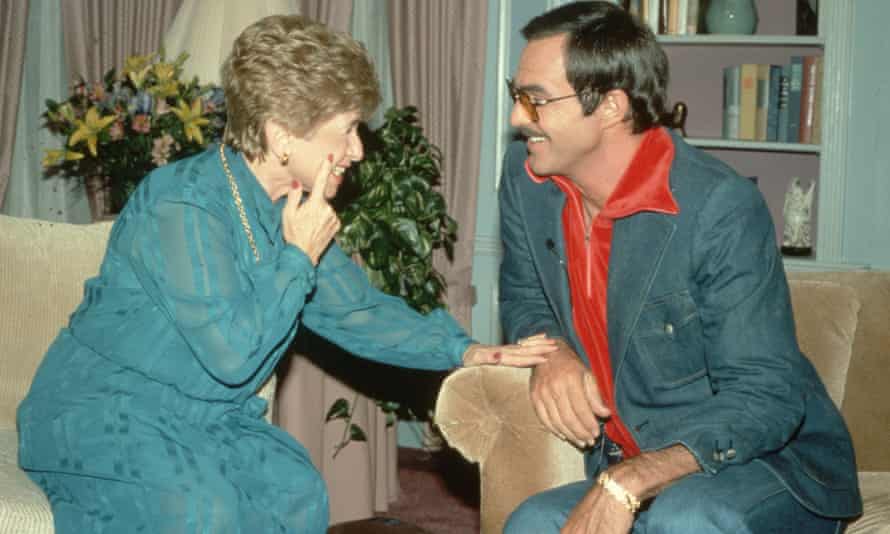
Star quality: chatting with Burt Reynolds. Photograph: Getty Images
We are in Manhattan where Westheimer has lived for 55 years in a two-bedroom apartment overlooking the Hudson River. From the window, she points to the other bank – a steep escarpment known as the Palisades. “That used to be for nuns, over there,” she says, indicating a monastery-style building. “And when it snows it’s beautiful.” In the wake of her ascent to fame, friends urged her to move to Fifth Avenue, but Westheimer always resisted. She likes the neighbourhood’s European flavour, the fact that it was settled by German Jews. And besides, in the nearby Fort Tryon Park, one of the city’s most beautiful, sits a bench named in honour of her third husband, Fred Westheimer, who died in 1997. She has added an inscription from the Bible: “My beloved has gone down to his garden to gather lilies.” Today she gets a kick whenever she sees couples kissing there. Being a widow, she says, is harder than being an orphan. Children are resilient, adults less so.
These are busy days for Westheimer, the subject of a new documentary, Ask Dr Ruth, that receives its European premiere at Sundance Film Festival London later this month. She will be visiting Japan for a screening, before hitting Oxford University to debate pornography (she’s a fan), in addition to annual trips to Switzerland, where she spent the war in an orphanage, and Israel. There are also her teaching schedules at Hunter and Columbia universities in New York, and a prodigious publishing output, including a column for Time, an upcoming children’s book, and a new edition of her bestselling guide, Sex for Dummies, that will include chapters addressing millennials and the metastasising issue of loneliness. Immediately after our interview she is due at the opening of an exhibition at the Museum of Jewish Heritage titled “Auschwitz: Not Long Ago, Not Far from Here.” Westheimer, who is on the board of the museum, is proud of the name. “It’s for the Holocaust deniers and those people who have Holocaust fatigue, who say, ‘Stop talking about it, it’s so long ago.’”
Everyone’s on the phone now, instead of concentrating on their relationship
We tour the living room, a jumble of tchotchkes and books – a copy of Michael Wolff’s Trump exposé, Fire and Fury, Ruth Bader Ginsburg’s autobiography. There are mementoes of Shirley Temple, Westheimer’s favourite actor, and photos of her with the Obamas, with the Clintons and one of her dancing with the conductor Zubin Mehta, a memory that provokes particular delight. She was at a fundraiser for the Israel Philharmonic Orchestra. “I was dancing with a Japanese guy, and a man came and tapped me on the shoulder and said: ‘The Maestro wants to dance with you.’ I dropped the Japanese like a hot potato and danced with Zubin.”
Advertisement
Just inside the entrance, in pride of place, is a photo of David Ben-Gurion and Golda Meir, the first and fourth prime ministers of Israel. Westheimer was a member of the Jewish underground after the war, operating as a sniper (she learned to shoot by imagining Hitler was her target), and fighting the British, until she almost lost her legs in an explosion. But she would like readers to know she is grateful to Britain for organising the Kindertransport that brought 10,000 children to the UK. “Some of the children were able to save their parents, by going from house to house and asking for help in finding them work. When I was in Switzerland, I still had the fantasy I could have saved my parents and family if I’d stayed in Germany.” She shakes her head. “All nonsense. If they had not made the sacrifice to send their only child to Switzerland, I wouldn’t be alive.”
A powerful scene in Ask Dr Ruth, rendered into animation, shows young Westheimer waving goodbye to her mother and grandmother at Frankfurt station. It’s the last time she would see them. Her parents gave her life twice, she says: “Once when I was born, and once when they sent me to Switzerland.” When the war ended the children at her orphanage were gathered together while names of surviving parents were read aloud. Her parents were not among them. Put on a train, she was sent to Marseille, where she boarded a ship to Palestine. She was 17.
Frank talking: addressing newspaper editors. Photograph: Scott Stewart/AP
In the 1950s she returned to France, divorced her first husband, married a second time, and booked a passage to New York, travelling fourth class. Although she intended to return to Israel the arrival felt like a homecoming. She never left. Her marriage did not survive, although they had a daughter, Miriam. For Westheimer, the failure of marriage two was an important lesson: not having a satisfying sex life could be a problem, but intellectual boredom was insurmountable.
At this year’s New York Pride, Westheimer will ride on a carnival float to mark the 50th anniversary of Stonewall, a tribute to her outsize presence in the 1980s when her empathy cut through a miasma of bigotry. In the long, dark years of the Aids panic, she was among the few pinpricks of light. It was Dr Ruth who insisted there was no such thing as “normal” – everything was normal, as long as it involved two consenting adults in the privacy of their home. She recalls attending the Institute for Human Identity in the 1980s. “I wanted to learn how to work with homosexuals,” she says. “There were no lesbian couples coming; maybe lesbians didn’t need sex therapy. Maybe one woman knew better how to give another woman an orgasm.”
Time has finally caught up with Dr Ruth. Her attitudes no longer seem atypical. But if her approach to sex is now mainstream, anxiety around sexual desire and consent threaten to place her at odds with the very people who once welcomed her sex-positive thesis. “This idea that once you are aroused and have already started that you should then ask, ‘Can I touch your left breast, or your right breast?’ is just nonsense,” she says. “Nobody has any business being in bed, naked – two guys, two women, or a man and a woman – if they haven’t decided to have sex.”
Tall tales: a hug with Barack Obama in 2013. Photograph: Pete Souza/The White House
She frets, also, that innocent compliments risk being stigmatised. “You can’t tell a woman any more that you like her blouse,” she says, and then gestures to herself. “By the way, do you like my blouse?”
Although no technophobe – in the documentary we see her conversing with Alexa – Westheimer believes our phones may be eroding our talents for conversation. “You walk into a restaurant these days, and what you see is everyone with their phone next to them,” she says. “That is terrible. Instead of concentrating on the relationship, on the needs and activities and interests of the other person, they are constantly looking at their phone.”
And she is sceptical of the idea that millennials are too busy to form relationships. “Don’t put sexual experience on the back burner,” she says. “Make time. After all, immigrants to this country worked much harder. They had to come in on Saturdays, even if they were observant Jews, otherwise they were told, ‘Do not come in Monday.’
Westheimer has a rule about not talking politics, but she also knows sex is political. Endorsing homosexuality or championing a woman’s right to choose, puts her firmly on one side of America’s culture wars. The one issue on which she will not stay silent is the one she feels compelled to speak about from personal experience. “I do say how upset I am when I see children being separated from their parents,” she says. “I have in my bones, and in my blood, the knowledge that you have to help the people who are persecuted.”
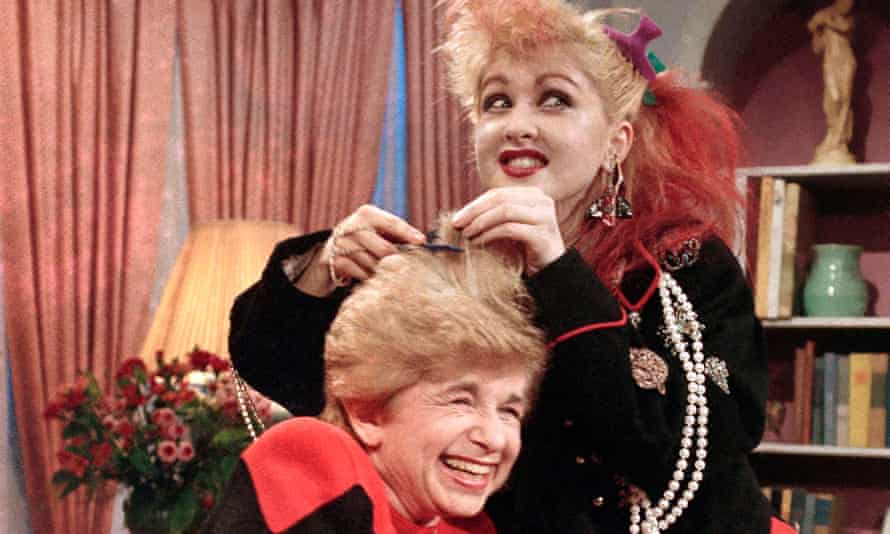
Reaching the young: having her hair done, punk style, by Cyndi Lauper. Photograph: Nancy Kaye/AP
In spite of her curtailed childhood, Westheimer fizzes with energy. She fetches a leather frame on which is embossed in gold letters, It Can Be Done. “I love this,” she says. “It really is my motto in life.” She reads out the brand: “A-S-P-R-E-Y. I got it for free,” she says.
Does she think she’ll ever slow down? “No,” she says, then gestures to my notepad: “Write that down.” On 4 June, Westheimer turns 91. “This time I’m not going to make a big party,” she says. By not big, she means around 30 to 40 people. Last year there were more than 300.
In her chatty 2015 book, The Doctor is In, Westheimer offers a useful insight into how she lives with the trauma of her childhood. The solution, she says, is to focus on the present: “Pay attention to the people around you. Ask questions and listen to the answers. Tell everyone what happened to you during the day and make it as amusing as possible. Accentuate the positive, try to bring everyone’s spirits up; by doing that, you’ll find your own elevated.”
It’s a philosophy that has guided Westheimer through life. In the lobby of her building, the doorman pinches his fingers together, and brings them to his lips in a kiss when I mention I am coming from Dr Ruth’s. “A sweetheart,” he says. “If there were more people like that we’d never be at war. She’s nothing but a good-hearted person.”
Dr Ruth’s top 15 tips
Sex before dinner, afterplay, and fun with onion rings…
1. People are not Siamese twins. They don’t want to have sex, or the same amount of sex, at the same time. The important thing is that a couple adjusts to it.
2. I do suggest that people have sex before they go out to dinner.
3. Many people grow jealous of their partner’s fantasy lovers. That’s a big mistake. After years of being together, many people need fantasy to become sufficiently aroused for sex… with their partner!
4. If you’re always waiting for that orgasm, you won’t enjoy the rest of the lovemaking as much. You risk being goal oriented, impatiently waiting for that orgasm.
5. You don’t have to share your fantasies. If you have sex with your partner, and the woman thinks about a whole football team in bed with her, that’s OK, but keep your mouth shut about it.
6. Your sex life is not supposed to come to an end just because you’ve hit a certain age.
7. Men, want stronger sperm? Eat walnuts.
8. Make up your own events. Like an onion ring tossed on to an erect penis!
9. Put down the screen and get to know each other.
10 A good sexual experience needs time: for arousal as well as for hugging and kissing after sex. Afterplay is part of the arousal phase for the next encounter.
11. The more women engage in sex, the less severe the symptoms of menopause related to good sexual functioning will be.
12. In nursing homes, I would like to make sure that there’s a dating room, with a sign like in a hotel that says do not disturb. There’s a need for caressing and being held at every age.
13. Parade your body in front of your partner, show it off, try to feel good about it.
14. You’re on a business trip; you go out to dinner with a coworker; you each have too much to drink… and end up having sex, even though you’re both married. You have no feelings for this person, you both regret what happened, and you promise yourself that you will never let this happen again. Do you tell your spouse? I say you don’t. No matter how well your spouse takes this news, it’ll leave a scar on your relationship.
15. Older people have to be sexually literate. No sex in the evening when they’re tired. The best way for older people to engage in sex is after a good night’s sleep.
Ask Dr Ruthhas its European premiere at Sundance Film Festival: London on 2 June, at Picturehouse Central. Tickets are available at
The Prime Minister surprised the nation when he whipped out a ukulele during an interview on 60 Minutes this week. Now 7.30’s resident satirists Mark Humphries and Evan Williams have the behind-the-scenes story of that unforgettable musical moment.
I just have been reading again this old blog of mine and found it very interesting! And I love all the pictures in it! 🙂
The links to Peter’s Blogs also are of great interest to me! 🙂
Last Sunday at Mass I was confronted with the above question. As it happened it was a day when I was in quite a bit of physical pain. The pain didn’t start out to be really bad. I would be all right walking to church, so I thought. But far from it. After walking the distance, which took about twenty-five minutes, the pain was getting quite considerable. I arrived at the church at the last minute. But Father was still standing there shaking hands. He shook my hand too.
I happened to find a seat beside Sister Kevin. I greeted her and sat down. I told myself if I could just rest my knee and concentrate on my breathing, the pain would be bearable. I started reflecting on how God probably wanted to tell me something. Maybe God wanted me to make changes…
The problems I experience at times with anxiety and stress seem to increase more and more the older I get!
On the other hand, the times when I can stay totally anxiety and stress free are just wonderful! 🙂
Sadly I don’t seem to be able to avoid anxiety and stress at all times. The medical profession is worried, that I could die when my blood pressure goes up to over 200. From my point of view there is really nothing to worry about if I happen to die because of super high blood pressure! After all, I already had an extremely long, good life. What more can I expect at this stage? Do they want me to live like a zombie just to prolong my life? I must say this does not have all that much appeal to me since I would very much like to die a Natural…
4K Cozy Coffee Shop with Relaxing Jazz Piano Music for Studying, Working, Sleeping. Watch snow falling outside from the comfort of a cozy coffee shop. You can work from here, or you can study. But this room is also perfect for relaxing after a long day. This video is filmed at 4K with a high-quality camera, so feel free to watch it in full screen and enjoy the best quality! The artwork, animation and audio on the Cozy Coffee Shop channel were created by the channel owner.
UMG (on behalf of Craft Recordings); PEDL, ASCAP, LatinAutor – PeerMusic, UMPG Publishing, MINT_BMG, UNIAO BRASILEIRA DE EDITORAS DE MUSICA – UBEM, ARESA, LatinAutorPerf, and 9 Music Rights SocietiesSHOW LESS
In 2008, Uhlmann switched to television, and was political editor for The 7.30 Report, ABC News, and ABC News channel. In December 2010, he was appointed as co-host of the ABC Television current affairs program, 7.30.[1] In 2012, the show was revamped again, with Uhlmann returning to the political editor role, and Leigh Sales hosting the program.[3]
In 2013, Uhlmann stepped down as 7.30‘s political editor. He announced that he would be working on a documentary about the Rudd and Gillard Governments for the ABC.[4]
In February 2014, Uhlmann became the 14th presenter of AM, the ABC Radio news and current affairs program.[5] He took over after Tony Eastley resigned to take up a senior presenter role with ABC News 24.
In January 2015, Uhlmann was appointed in a newly-created position as ABC News political editor.[6] As a result of the new position Uhlmann left his role as presenter of AM, and was replaced by Michael Brissenden.
In August 2017, Uhlmann announced that he would be leaving the ABC to join Nine News as political editor, replacing Laurie Oakes.[8]
Uhlmann is also a fill-in presenter on Today. In August 2018, amid the 2018 Liberal Party leadership spill, Uhlmann gained popularity again on social media when he appeared on Today, where he stated that the Sky News television channel, 2GB radio station and News Corp were “waging a war” against Prime Minister of Australia Malcolm Turnbull. When asked how he expected presenters on Sky or 2GB to respond, he said he “couldn’t give a rat’s arse”, adding “If you dish it out, you have to be prepared to take it”.[9]
Uhlmann unsuccessfully contested the ACT 1998 general election for the electorate of Molonglo with the Osborne Independent Group.[12] The conservative group was named after Paul Osborne, who was strongly pro-life and advocated blocking both euthanasia legislation and any attempt to decriminalise abortion.[13] Osborne and Uhlmann fell out when Osborne moved to severely restrict abortion in the ACT.[14] Six years earlier, Uhlmann had written in support of establishing an abortion clinic in the territory.[15]
With Steve Lewis, Uhlmann has written a series of political novels set in Canberra: The Marmalade Files (2012), The Mandarin Code (2014) and The Shadow Game (2016).[16] These feature a political reporter, Harriet Dunkley, investigating a conspiracy involving China, the US and Australian security organisations. In 2016 the first two books were adapted as the Australian television series Secret City.
During the Lantern Festival, children go out at night carrying paper lanterns and solve riddles on the lanterns (traditional Chinese: 猜燈謎; simplified Chinese: 猜灯谜; pinyin: cāidēngmí).[3][4] In ancient times, the lanterns were fairly simple, and only the emperor and noblemen had large ornate ones.[5] In modern times, lanterns have been embellished with many complex designs.[4] For example, lanterns are now often made in the shape of animals. The lanterns can symbolize the people letting go of their past selves and getting new ones,[6] which they will let go of the next year. The lanterns are almost always red to symbolize good fortune.[7]
The festival acts as an Uposatha day on the Chinese calendar.[8][9] It should not be confused with the Mid-Autumn Festival; which is sometimes also known as the “Lantern Festival” in locations such as Indonesia, Malaysia, and Singapore.[2][10] Lantern Festivals have also become popular in Western countries, such as the Water Lantern Festival held in multiple locations in the United States.[11] In London, the Magical Lantern Festival is held annually.[12]
There are several beliefs about the origin of the Lantern Festival. However, its roots trace back more than 2,000 years ago and is popularly linked to the reign of Emperor Ming of the Han dynasty at the time when Buddhism was growing in China.[citation needed] Emperor Ming, an advocate of Buddhism, noticed Buddhist monks would light lanterns in temples on the fifteenth day of the first lunar month. As a result, he ordered all households, temples and the imperial palace to light lanterns on that evening.[13] From there it developed into a folk custom. Another likely origin is the celebration of “the declining darkness of winter” and community’s ability to “move about at night with human-made light,” namely, lanterns. During the Han dynasty, the festival was connected to Ti Yin, the deity of the North Star.[1]
Red lanterns, often seen during the festivities in China
Taiwan Lantern Festival
There is one legend that states that it was a time to worship Taiyi, the God of Heaven in ancient times. The belief was that Taiyi controlled the destiny of the human world. He had sixteen dragons at his beck and call and he decided when to inflict drought, storms, famine or pestilence upon human beings. Beginning with Qin Shi Huang, the first emperor of China, all the emperors ordered splendid ceremonies each year. The emperor would ask Taiyi to bring favorable weather and good health to him and his people.[14][5]
Emperor Wu of the Han dynasty directed special attention to this event. In 104 BCE, he proclaimed it to be one of the most important celebrations and the ceremony would last throughout the night.
Another legend associates the Lantern Festival with Taoism. Tianguan is the Taoist deity responsible for good fortune. His birthday falls on the fifteenth day of the first lunar month. It is said that Tianguan likes all types of entertainment, so followers prepare various kinds of activities during which they pray for good fortune.[15]
Another legend associates with the Lantern Festival with an ancient warrior named Lan Moon, who led a rebellion against the tyrannical king in ancient China. He was killed in the storming of the city and the successful rebels commemorated the festival in his name.[15]
Yet another common legend dealing with the origins of the Lantern Festival speaks of a beautiful crane that flew down to earth from heaven. After it landed on earth it was hunted and killed by some villagers. This angered the Jade Emperor in heaven because the crane was his favorite. So, he planned a storm of fire to destroy the village on the fifteenth lunar day. The Jade Emperor’s daughter warned the inhabitants of her father’s plan to destroy their village. The village was in turmoil because nobody knew how they could escape their imminent destruction. However, a wise man from another village suggested that every family should hang red lanterns around their houses, set up bonfires on the streets, and explode firecrackers on the fourteenth, fifteenth, and sixteenth lunar days. This would give the village the appearance of being on fire to the Jade Emperor. On the fifteenth lunar day, troops sent down from heaven whose mission was to destroy the village saw that the village was already ablaze, and returned to heaven to report to the Jade Emperor. Satisfied, the Jade Emperor decided not to burn down the village. From that day on, people celebrate the anniversary on the fifteenth lunar day every year by carrying lanterns on the streets and exploding firecrackers and fireworks.[16]
Another legend about the origins of Lantern Festival involves a maid named Yuan-Xiao. In the Han dynasty, Dongfang Shuo was a favorite adviser of the emperor. One winter day, he went to the garden and heard a little girl crying and getting ready to jump into a well to commit suicide. Shuo stopped her and asked why. She said she was Yuan-Xiao, a maid in the emperor’s palace and that she never had a chance to see her family since she started working there. If she could not have the chance to show her filial piety in this life, she would rather die. Shuo promised to find a way to reunite her with her family. Shuo left the palace and set up a fortune-telling stall on the street. Due to his reputation, many people asked for their fortunes to be told but everyone got the same prediction – a calamitous fire on the fifteenth lunar day. The rumor spread quickly.[15]
Everyone was worried about the future so they asked Dongfang Shuo for help. Dongfang Shuo said that on the thirteenth lunar day, the God of Fire would send a fairy in red riding a black horse to burn down the city. When people saw the fairy they should ask for her mercy. On that day, Yuan-Xiao pretended to be the red fairy. When people asked for her help, she said that she had a copy of a decree from the God of Fire that should be taken to the emperor. After she left, people went to the palace to show the emperor the decree which stated that the capital city would burn down on the fifteenth. When the emperor asked Dongfang Shuo for advice, the latter said that the God of Fire liked to eat tangyuan (sweet dumplings). Yuan-Xiao should cook tangyuan on the fifteenth lunar day and the emperor should order every house to prepare tangyuan to worship the God of Fire at the same time. Also, every house in the city should hang red lantern and explode fire crackers. Lastly, everyone in the palace and people outside the city should carry their lanterns on the street to watch the lantern decorations and fireworks. The Jade Emperor would be deceived and everyone would avoid the disastrous fire.[16]
The emperor happily followed the plan. Lanterns were everywhere in the capital city on the night of the fifteenth lunar day and people were walking on the street and there were noisy firecrackers. It looked as if the entire city was on fire. Yuan-Xiao’s parents went into the palace to watch the lantern decorations and were reunited with their daughter. The emperor decreed that people should do the same thing every year. Since Yuan-Xiao cooked the best tangyuan, people called the day Yuan-Xiao Festival.
For each Festival celebrated, a switch in the Chinese Zodiac takes place. If this year is the year of the cow, the next will be the year of the tiger.
In the early days, young people were chaperoned in the streets in hopes of finding love. Matchmakers acted busily in hopes of pairing couples. The brightest lanterns were symbolic of good luck and hope. As time has passed, the festival no longer has such implications in most of Mainland China, Taiwan, or Hong Kong.[10]
Eaten during the Lantern Festival, tangyuan ‘湯圓’ (Southern China, Taiwan and Southeast Asia) or yuanxiao ‘元宵’ (Northern China) is a glutinous rice ball typically filled with sweet red bean paste, sesame paste, or peanut butter.[3] Actually, tangyuan is different from yuanxiao due to different manual making and filling processes.[17] It can be boiled, fried or steamed, each has independent taste. However, they are very similar in shape and taste, so most people do not distinguish them for convenience and consider them as the same thing.[17] Chinese people believe that the round shape of the balls and the bowls in which they are served symbolize family togetherness, and that eating tangyuan or yuanxiao may bring the family harmony, happiness and luck in the new year.[2][4]
Until the Sui dynasty in the sixth century, Emperor Yang invited envoys from other countries to China to see the colourful lighted lanterns and enjoy the gala performances.[18]
By the beginning of the Tang dynasty in the seventh century, the lantern displays would last three days. The emperor also lifted the curfew, allowing the people to enjoy the festive lanterns day and night. It is not difficult to find Chinese poems which describe this happy scene.[18]
In the Song dynasty, the festival was celebrated for five days and the activities began to spread to many of the big cities in China. Colorful glass and even jade were used to make lanterns, with figures from folk tales painted on the lanterns.[citation needed]
However, the largest Lantern Festival celebration took place in the early part of the 15th century. The festivities continued for ten days. The Yongle Emperor had the downtown area set aside as a center for displaying the lanterns. Even today, there is a place in Beijing called Dengshikou. In Chinese, deng means lantern and shi is market. The area became a market where lanterns were sold during the day. In the evening, the local people would go there to see the beautiful lighted lanterns on display.[citation needed]
Today, the displaying of lanterns is still a major event on the fifteenth day of the first lunar month throughout China. Chengdu in southwest China’s Sichuan Province, for example, holds a lantern fair each year in Culture Park. During the Lantern Festival, the park is a virtual ocean of lanterns. Many new designs attract large numbers of visitors. The most eye-catching lantern is the Dragon Pole. This is a lantern in the shape of a golden dragon, spiraling up a 38-meter-high pole, spewing fireworks from its mouth. Cities such as Hangzhou and Shanghai have adopted electric and neon lanterns, which can often be seen beside their traditional paper or wooden counterparts. Another popular activity at this festival is guessing lantern riddles (which became part of the festival during the Tang dynasty).[19] These often contain messages of good fortune, family reunion, abundant harvest, prosperity and love.[citation needed] Just like the pumpkin carved into jack-o’-lantern for Halloween in the western world, Asian parents sometime teach their children to carve empty the inner tubing of Oriental radish /mooli/ daikon into a Cai-Tou-Lantern (traditional Chinese: 營菜頭燈; simplified Chinese: 营菜头灯; pinyin: yíng cai tóu dēng) for the Festival.[citation needed]
This painting, by an imperial court painter in 1485, depicts the Chenghua Emperor enjoying the festivities with families in the Forbidden City during the traditional Chinese Lantern Festival. It includes acrobatic performances, operas, magic shows and setting off firecrackers.
Lion dance (舞獅), walk on stilts (踩高蹺), riddle games (猜燈謎), dragon dance (耍龍燈) are very popular during lantern festival.
The lantern riddle, according to Japanese scholars, became popular as early as the Northern Song Dynasty (960-1126). The lantern riddles are done by a host blocking one side of the lantern and pasting riddles on the remaining three sides of the lanterns. Participants will guess the blocked side by solving the riddles, which is called “breaking/solving lantern riddles”. The theme of riddles can be drawn from classics, biographies, poetry, the various philosophers’ well-known stories and novels, proverbs, (the names of) all kinds of birds, animals, and insects, as well as flowers, grasses, vegetables, and herbs. Participants can tear off the riddle of the lantern and let the host verify their answers. Those who answer the correct answer can get a “riddle reward”, including ink, paper, writing brushes, ink slabs, fans, perfumed sachets, fruit, or eatables.






.jpg)
 AuntyUta


.jpg)


.jpg)
.jpg)
