
http://landdestroyer.blogspot.com/p/blog-page.html
The Land Destroyer Report is maintained by Tony Cartalucci, an independent American geopolitical analyst based in Thailand.
Land Destroyer can be followed on Twitter here and Facebook here. Comments, questions, corrections, and article submissions should be sent to cartalucci@gmail.com, or through the Contact LD page.
Hong Kong Protests: Fading Foreign Tantrum, Not Genuine Revolution
Self-Sufficiency: A Local Solution to a Global Problem
Tony Cartalucci
ATNN – LD
October 28, 2012
For an extreme in-depth look at Thailand’s “Sufficiency Economy” and “New Theory” economics, please see, “Wisdom from the Orient: Self-Sufficiency.”
Thailand’s answer to the IMF, and globalization in general was profound in both implications as well as in its understanding of globalization’s end game. Fiercely independent and nationalistic, and being the only nation in Southeast Asia to avoid colonization, Thailand’s sovereignty has been protected for over 800 years by its revered monarchy. The current dynasty, the House of Chakri, has reigned nearly as long as America has existed as a nation and the current king is regarded as the equivalent of a living “Founding Father.” And just as it has for 800 years, the Thai Monarchy today provides the most provocative and meaningful answer to the threats facing the Kingdom.
The answer of course is self-sufficiency. Self-sufficiency as a nation, as a province, as a community and as a household. This concept is enshrined in the Thai King’s “New Theory” or “self-sufficiency economy” and mirrors similar efforts found throughout the world to break the back of the oppression and exploitation that results from dependence on an interdependent globalized system.
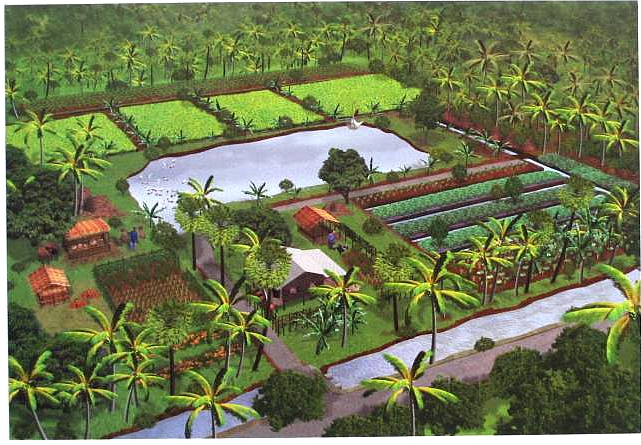
The foundation of the self-sufficiency economy is simply growing your own garden and providing yourself with your own food. This is portrayed on the back right-hand side of every 1,000 baht Thai banknote as a picture of a woman tending her garden. The next step is producing surplus that can be traded for income, which in turn can be used to purchase technology to further enhance your ability to sustain yourself and improve your life-style.

The New Theory aims at preserving traditional agrarian values in the hands of the people. It also aims at preventing a migration from the countryside into the cities. Preventing such migrations would prevent big agricultural cartels from moving in, swallowing up farming land, corrupting and even jeopardizing entire national food supplies (see Monsanto). Those familiar with the UN’s Agenda 21, and the more recent UN “Climate Change Program,” may understand the deeper implications and dangers of such a migration and why it needs to be stopped.
By moving to the city, people give up private property, cease pursuing productive occupations, and end up being folded into a consumerist paradigm. Within such a paradigm, problems like overpopulation, pollution, crime, and economic crises can only be handled by a centralized government and generally yield political solutions such as quotas, taxes, micromanagement, and regulations rather than meaningful technical solutions.
Also, such problems inevitably lead to a centralized government increasing its own power, always at the expense of the people and their freedom. The effects of economic catastrophe are also greater in a centralized, interdependent society, where everyone is subject to the overall health of the economy for even simple necessities like food, water, and electricity.

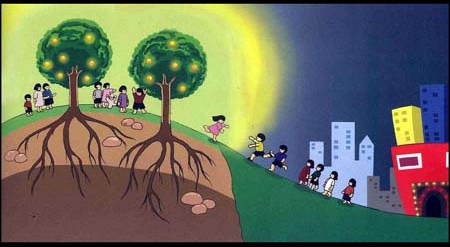
Under the “New Theory,” demonstration stations all across Thailand have been created promoting education in matters of agriculture and self-sufficient living. The program is competing against the contemporary globalization system, which as of now, is mired in many parts of the world with economic meltdown. The relatively self-sufficient nature of Thais in general has weathered this economic chaos fairly well. In 10 years, a plate of food still costs the same amount of money, as do many everyday commodities. This only further vindicates the value of being self-sufficient and now more than ever, in both Thailand, and abroad, it is a good time to get involved and get self-sufficient.
The key to stopping these foreign interests dead in their tracks is seizing back from them the mechanisms of civilization – and we have done that already in terms of the alternative media. Such success is necessary in all aspects of our life, and as the King in Thailand suggests, it can start with something as simple as growing your own garden.
Today and Into the Future
Of course in Thailand, agricultural self-sufficiency is coupled with technology to enhance efficiency and improve the quality of life. Even in the city, small independent businesses are adopting the latest technology to improve their production, increase their profits, and even out-compete larger corporations. Computer controlled machining equipment can be found in small workshops crammed into old shop-houses, automatic embroidering machines allow a single woman to fulfill orders for name tags on new school uniforms – rather than both businesses sending off orders to factories owned by a handful of wealthy investors. A multitude of examples can be seen walking around any city block in Thailand’s capital of Bangkok.
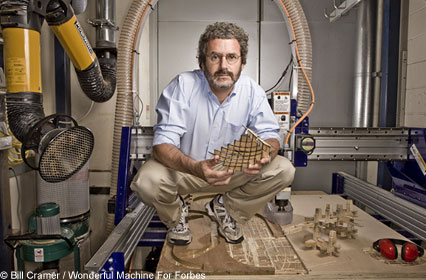
Bringing this sort of technology to rural people, even enabling people to create their own technology rather than just employ it, is not just science fiction but is a reality of today. MIT Professor Dr. Neil Gershenfeld has developed the “fabrication laboratory” or “Fab Lab.” The Fab Lab is a microfactory that can “make almost anything.” His Fab Lab has since been replicated all over the world in what he calls the personal fabrication revolution. It aims at turning a world of dependent consumers into independent designers and producers.’
Dr. Gershenfeld in his own words articulates the problem of finding support amongst institutions and governments, stating that individuals are very enthusiastic about this revolution “but it breaks their organizational boundaries. In fact it is illegal for them, in many cases, to equip ordinary people to create rather than consume technology.”
This indeed not only encapsulates Dr. Gershenfeld’s dilemma, but describes to a “t” the mentality of oligarchs and the fears they harbor about empowering the people, a fear reflected in the “organizational boundaries” of their corporations and governmental institutions. This is a feature of oligarchy described as early as 300 B.C. in ancient Greece in “The Athenian Constitution.” In it, a character referred to as “the Old Oligarch” describes his contempt for the social mobility the technology of the Athenian navy affords the lower echelons of Athenian society.
Dr. Gershenfeld goes on to encapsulate the true potential of his Fab Labs by stating, “the other 5 billion people on the planet aren’t just technical “sinks,” they are “sources.” The real opportunity is to harness the inventive power of the world to locally design and produce solutions to local problems.” Dr. Gershenfeld concludes by conceding he thought such a possibility was 20 years off, but “it’s where we are today,” noting the success his Fab Labs are already having around the world.
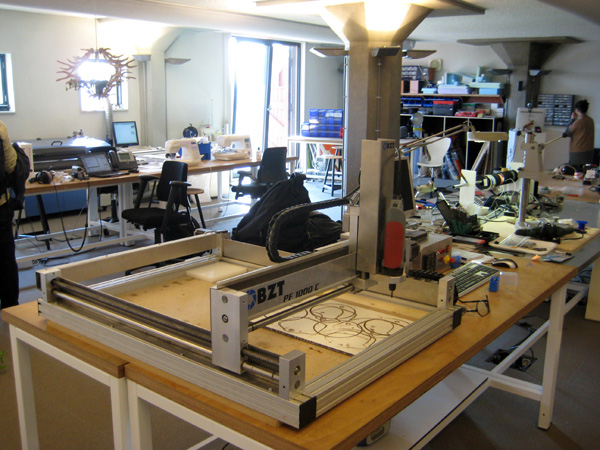
Image: The interior of a “Fab Lab” in Amsterdam, featuring a array of personal manufacturing technology.
Dr. Gershenfeld’s message resonates with the current culture of Thailand and the ambitions of the “self-sufficiency economy.” In many ways, Thailand’s patchwork of micro-businesses, already successfully by-passing capital intensive centralized production, vindicates the work and optimism of Dr. Gershenfeld. It also, however, resonates strongly with the self-reliant traditions that had made America great. The technical possibility for this to change the world is already a reality, but Dr. Gershenfeld himself concedes that the biggest obstacle is overcoming social engineering – in other words – creating a paradigm shift in the minds of the population to meet the technical paradigm shift that has already taken place.
Self-sufficiency and the harnessing of technology in the hands of the people are the greatest fears of the corporate-financier oligarchy – fears that oligarchs throughout the centuries have harbored. Simply boycotting multinational corporations and replacing them with local solutions is something everyone can afford to do starting today. And by simply looking into Dr. Neil Gershenfeld’s “Fab Lab,” similar ideas such as “hackerspaces,” raising awareness of the personal fabrication revolution, and even in the smallest way participating can help overcome the obstacle of social-engineering and spur a profound paradigm shift. We have begun to seize back the media, now it is time to seize back the other levers of power. Now is the time to recognize true freedom as being self-sufficient as a nation, as a community, and as a household, and start living it everyday.





 “[For] ten years we were brainwashed with British propaganda against Germany in the war.” says Ruth, “As a small child, I believed it all. Most 14 year olds in England today are much more capable of thinking and questioning. I was very sheltered, so that the experience of being made to go to Germany was terribly shocking. That shattered my trust.
 I thought I’d go to Germany and try to really get to know my parents.” she says, “I honestly wanted to give it a chance, because I knew that I hadn’t been able to when I was repatriated at 14. But it didn’t work.”
 AuntyUta
Thanks for the review of this very interesting story. I was quite interested in the book after watching the two-part (3-hour) video entitled ‘Redemption Road’ via streaming on MHZ Networks in German with English subtitles.
Like
Hi Bill, I thank you for mentioning this video. I found it here:
https://mhzchoiceblog.com/first-look-redemption-road/
Now Streaming
It says: “Redemption Road, a two-episode limited series based on the novel Landgericht by Ursula Krechel (which was translated into English as State Justice, so as not to be confused with Redemption Road, a 2016 thriller novel by John Hart, nor with Redemption Road, a 2010 limited release feature film …The two episodes are beautifully directed by Matthias Glasner (Blochin), and star German fave Ronald Zehrfeld (The Weissensee Saga, In the Face of Crime) and the fantastic Johanna Wokalek as a married German couple, Richard and Claire, dealing with the trauma and subsequent fallout of Nazi persecution. He’s Jewish, she’s not, and – good news! – neither of them die in the war! Neither do their children! No one ends up in a concentration camp! Sounds great, except… well, agony is relative, but it’s still agony.”
In the review something interesting is mentioned about the German constitution!
Article 3 of the German constitution (Grundgesetz) says:
“No person shall be favoured or disfavoured because of sex, parentage, race, language, homeland and origin, faith, or religious or political opinions.”
Vickrey says: “The central figure in the novel, the Jewish barrister Richard Kornitzer, is forced to flee the Nazis and finds sanctuary in Havana for ten years. . . .”
After his return during the postwar years “Kornitzer is treated as an outsider – both as a Jew and because of his special status an Opfer des Faschismus. And he is not alone as an outsider in new “democratic” West Germany . . .”
“That simple act of reading out loud a passage from the constitution is viewed as scandalous, and Kornitzer is forced into early retirement. . .”
Yes, so much about how people may be treated in the new “democratic” West Germany!
This is what it says further on about the movie:
“Redemption Road presents something of a unique perspective of the life of German Jews in WWII. By now, we’ve absorbed accounts of the Holocaust, historical and fictional, delving into Nazi atrocities of imprisonment, starvation, unfathomable physical abuse, and murder in the camps. Less often told are the stories of the people who, through foresight or luck, managed to get out, to escape their homeland as their citizenship was revoked, and their livelihoods taken away. Richard, a district judge who has devoted his life to the rule of law, sees the writing on the wall and, just in time, sends his little children to England as part of the kindertransport.
With subtle horror, the show captures the utter nightmare and surreality of what it must be like for a parent to see their children taken from them, not knowing what will happen to them, not knowing if they’ll ever be together again. How could anyone survive the distress? For a person such as Richard, devoted to logic and order, the lost decade and mental toll in the face of the injustice of it all, is severe. His family stays alive, but at what cost? If you were obsessed with A French Village, here’s a look at the war’s aftermath from another angle.
The road back
Having outlasted the war, Richard makes a return to Germany that was just as painful as his exit, and is reunited with Claire. Will putting the pieces back together prove futile? Is there any hope that justice will be served for the millions of fortunes destroyed, families torn apart and innocent lives lost in the name of war? Is there any point in seeking acknowledgment of the decimation done to so many? What does it take to make a life worth living after you have merely survived evil inflicted on you by your own country? These are but a few of the questions asked by Redemption Road as its characters go on with their lives, separately and together, seeking answers.”