From Wikipedia: Eurozone

Eurozone

https://en.wikipedia.org/wiki/Eurozone

From Wikipedia, the free encyclopedia

The eurozone, officially called the euro area, is a monetary union of 19 of the 28 European Union (EU) member states which have adopted the euro (€) as their common currency and sole legal tender. The other 9 members of the European Union continue to use their own national currencies.

The eurozone consists of Austria, Belgium, Cyprus, Estonia, Finland, France, Germany, Greece, Ireland, Italy, Latvia, Lithuania, Luxembourg, Malta, the Netherlands, Portugal, Slovakia, Slovenia, and Spain. Other EU states (except for Denmark and the United Kingdom) are obliged to join once they meet the criteria to do so. No state has left, and there are no provisions to do so or to be expelled. Andorra, Monaco, San Marino, and Vatican City have formal agreements with the EU to use the euro as their official currency and issue their own coins. Kosovo and Montenegro have adopted the euro unilaterally, but these countries do not officially form part of the eurozone and do not have representation in the European Central Bank (ECB) or in the Eurogroup.

The ECB, which is governed by a president and a board of the heads of national central banks, sets the monetary policy of the zone. The principal task of the ECB is to keep inflation under control. Though there is no common representation, governance or fiscal policy for the currency union, some co-operation does take place through the Eurogroup, which makes political decisions regarding the eurozone and the euro. The Eurogroup is composed of the finance ministers of eurozone states, but in emergencies, national leaders also form the Eurogroup.

Since the financial crisis of 2007–08, the eurozone has established and used provisions for granting emergency loans to member states in return for the enactment of economic reforms. The eurozone has also enacted some limited fiscal integration, for example in peer review of each other’s national budgets. The issue is political and in a state of flux in terms of what further provisions will be agreed for eurozone reform.

Main article: Enlargement of the eurozone

Nine countries (Bulgaria, Croatia, Czech Republic, Denmark, Hungary, Poland, Romania, Sweden, and the United Kingdom) are EU members but do not use the euro. Before joining the eurozone, a state must spend two years in the European Exchange Rate Mechanism (ERM II). As of 2015, the National Central Bank (NCB) of Denmark participates in ERM II.

Denmark and the United Kingdom obtained special opt-outs in the original Maastricht Treaty. Both countries are legally exempt from joining the eurozone unless their governments decide otherwise, either by parliamentary vote or referendum. Sweden, which joined the EU in 1995 after the Maastricht Treaty was signed, is required to join the eurozone under the terms of its accession treaty as soon as it fulfils the convergence criteria, which include being part of ERM II for two years. However, the Swedish people turned down euro adoption in a 2003 referendum and since then the country has intentionally avoided fulfilling the adoption requirements by not joining ERM II, which is voluntary.

Interest in joining the eurozone increased in Denmark, and initially in Poland, as a result of the 2008 financial crisis. In Iceland, there was an increase in interest in joining the European Union, a pre-condition for adopting the euro. However, by 2010 the debt crisis in the eurozone caused interest from Poland, as well as the Czech Republic, to cool. Lithuania adopted the euro in 2015.

Non-member usage

Further information: International status and usage of the euro

Eurozone participation
19 European Union member states in the eurozone

7 European Union member states not in ERM II but obliged to join once convergence criteria are met

1 European Union member state in ERM II, with an opt-out (Denmark)

1 European Union member state not in ERM II, with an opt-out (United Kingdom)

4 non-European Union member states using the euro with a monetary agreement (Andorra, Monaco, San Marino and Vatican City)

2 non-European Union member states using the euro unilaterally (Kosovo and Montenegro)
he euro is also used in countries outside the EU. Four states – Andorra, Monaco, San Marino, and Vatican City — have signed formal agreements with the EU to use the euro and issue their own coins. Nevertheless, they are not considered part of the eurozone by the ECB and do not have a seat in the ECB or Euro Group.

Kosovo[g] and Montenegro officially adopted the euro as their sole currency without an agreement and, therefore, have no issuing rights. These states are not considered part of the eurozone by the ECB. However, sometimes the term eurozone is applied to all territories that have adopted the euro as their sole currency. Further unilateral adoption of the euro (euroisation), by both non-euro EU and non-EU members, is opposed by the ECB and EU.

Expulsion and secession

Further information: Greek withdrawal from the eurozone

Although the eurozone is open to all EU member states to join once they meet the criteria, the treaty is silent on the matter of states leaving the eurozone, neither prohibiting nor permitting it. Likewise there is no provision for a state to be expelled from the euro.[33] Some, however, including the Dutch government, favour such a provision being created in the event that a heavily indebted state in the eurozone refuses to comply with an EU economic reform policy.[34] Jens Dammann has argued that even now EU law contains an implicit right for member states to leave the eurozone if they no longer meet the criteria that they had to meet in order to join the eurozone.

The outcome of leaving the euro would vary depending on the situation. If the country’s own replacement currency was expected to devalue against the euro, the state might experience a large-scale exodus of money, whereas if the currency were expected to appreciate then more money would flow into the economy. A rapidly appreciating currency would be detrimental to the country’s exports.

One problem is that if Greece were to replace the euro with a new currency, this cannot be achieved very quickly. Banknotes must be printed for example, which takes up to six months. The changeover would likely require bank deposits be converted from euros to the new devalued currency. The prospect of this could lead to currency leaving the country and people withdrawing cash, causing a bank run and necessitating capital controls.

Administration and representation

Further information: European Central Bank, Eurogroup and Euro summit

The European Central Bank (seat in Frankfurt depicted) is the supranational monetary authority of the eurozone.

Euro Group President Jeroen Dijsselbloem
The monetary policy of all countries in the eurozone is managed by the European Central Bank (ECB) and the Eurosystem which comprises the ECB and the central banks of the EU states who have joined the eurozone. Countries outside the eurozone are not represented in these institutions. Whereas all EU member states are part of the European System of Central Banks (ESCB). Non EU member states have no say in all three institutions, even those with monetary agreements such as Monaco. The ECB is entitled to authorise the design and printing of euro banknotes and the volume of euro coins minted, and its president is currently Mario Draghi.

The eurozone is represented politically by its finance ministers, known collectively as the Eurogroup, and is presided over by a president, currently Jeroen Dijsselbloem. The finance ministers of the EU member states that use the euro meet a day before a meeting of the Economic and Financial Affairs Council (Ecofin) of the Council of the European Union. The Group is not an official Council formation but when the full EcoFin council votes on matters only affecting the eurozone, only Euro Group members are permitted to vote on it.

Since the global financial crisis of 2007–08, the Euro Group has met irregularly not as finance ministers, but as heads of state and government (like the European Council). It is in this forum, the Euro summit, that many eurozone reforms have been decided upon. In 2011, former French President Nicolas Sarkozy pushed for these summits to become regular and twice a year in order for it to be a ‘true economic government’.

In April 2008 in Brussels, Juncker suggested that the eurozone should be represented at the International Monetary Fund as a bloc, rather than each member state separately: “It is absurd for those 15 countries not to agree to have a single representation at the IMF. It makes us look absolutely ridiculous. We are regarded as buffoons on the international scene.” However Finance Commissioner Joaquín Almunia stated that before there is common representation, a common political agenda should be agreed upon.

The Greek Crisis, an Article in THE CONVERSATION

Eurozone's shared identity the final tragedy of the Greek crisis

Wesley Widmaier, Griffith University

Economic policy is not a morality tale. The Greek tragedy is that the Europeans have treated the Greek crisis as a question of national character. In their outrage at the Greeks – in the context of broader view of austerity as the way out of the European crisis – they have not only weakened their collective economies, but also jeopardised the fate of the European experiment itself.

The risk is that the larger goal of the European project – to create a sense of shared identity – may be undermined by an incidental economic means to that end, in the creation of a euro – a mechanism of economic discipline.

The reasons for this tragedy go deep into European history. Coming out of World War II, European leaders decided nationalist excesses should never again be permitted to divide their people. They therefore sought to create a supranational union, one that would unite the continent in a common vision. In 1950, French Foreign Minister Robert Schuman proposed the establishment of the original European Coal and Steel Community – the grandfather to the modern EU – as a way to “make war not only unthinkable but materially impossible”.

Ironically, given what the Euro has become, Schuman’s vision was never based on any commitments to “hard money” or free trade. Quite the opposite. The tragedies of the 1930s were widely attributed to a classical gold standard that had enforced austerity on the European people. As the European economies collapsed in the early 1930s, states were forced to cut spending and raise taxes – contributing to an ever-worsening slump.

In contrast, the point of the European Coal and Steel Community was to raise the prices of its members’ commodity and manufacturing exports. The ECSC would do this by enabling its initial six countries – most importantly, including France and Germany – to collude and fix coal and steel prices. In this sense, the early European ideal was not about free trade or convertible currencies – it was about enhancing the collective welfare as a means to political union.

Over the decades to follow, the economic dog nevertheless came to wag the collective welfare tail. As the German economy grew more important, German influences in European economic institutions would increase – leading to a shift toward more free market, hard money views. There were deep cultural reasons for this: German memories of the 1920s were of hyperinflation, while the German successes of the 1930s in using fiscal stimulus were repressed from collective memory, for obvious reasons.

The result would see European economic institutions – most notably the European Central Bank – evolve and place financial rectitude and monetary stability ahead of growth. This has been the case even when intellectual arguments for austerity – primarily as a means to limit inflation – make little sense, as the high unemployment of recent years has broken any link between fiscal deficits and inflation.

Large deficits absent full employment are not a problem – they are the solution, enabling revived growth. Greek austerity only makes Greek repayment more difficult, whatever one’s view of their pension system.

Over the past five years, the EU has taken what should have been a practical matter of economic policy – to run deficits during a recession – and turned it into a morality tale.

Internal Greek politics have nothing to do with the macroeconomic needs of the European Union – which would benefit from debt forgiveness across the continent to enable rising demand. On top of this economic malpractice, one can superimpose political error, as austerity politics have revived political extremism and nationalist sentiment across the continent. This is the very essence of a tragedy – as the postwar European dream may be undermined by incidental mechanisms established to bring it into being.

The Conversation

Wesley Widmaier is Australian Research Council Future Fellow at Griffith University.

This article was originally published on The Conversation.
Read the original article.

Articles in THE CONVERSATION about GREECE

https://theconversation.com/uk/topics/greece?utm_medium=email&utm_campaign=The+Weekend+Conversation+-+3059&utm_content=The+Weekend+Conversation+-+3059+CID_fe3a29e66f3d3afbdfa29aebe856959d&utm_source=campaign_monitor&utm_term=Greece%20topic%20page

Articles in THE CONVERSATION about GREECE

https://theconversation.com/institutions/university-of-warwick

The University of Warwick is one of the UK’s leading universities with an acknowledged reputation for excellence in research and teaching, for innovation, and for links with business and industry. Founded in 1965 with an initial intake of 450 undergraduates, Warwick now has in excess of 22,000 students and is ranked in the top 10 of all UK university league tables.

https://theconversation.com/now-the-greek-people-will-decide-why-tsipras-referendum-is-the-right-move-43974

Author Marianna Fotaki
Network Fellow, Edmond J Safra Center for Ethics, Harvard University and Professor of Business Ethics at University of Warwick.

. . . . . .

The shrinking of the economy and rising unemployment levels have exceeded those that hit the US in the financial crisis of the 1930s.

The human and social costs have been even more staggering in Greece. Incomes have fallen by an average of 40%, and the unemployment rate reached 26% in 2014 (and higher than 50% for youth). With hundreds of thousands of people depending on soup kitchens, and thousands of suicides in the years 2010-2015, the moral case for debt forgiveness seems just as strong as the technical one based on economics.

The creditors’ offer

Yet in the terms presented to Greece by their creditors there is no commitment to reducing Greece’s crippling debt (which all commentators acknowledge is unrepayable). Nor is there any tangible proposal for rebuilding the Greek economy.

Germany, France, and the EU, aided by the IMF and ECB, continue to insist on implementing policies that have so manifestly failed Greece. They do so to avoid having to justify the massive bailouts of their own financial systems – shifting the burden from banks to taxpayers – if Greece fails to make the repayments.

. . . . .

Broken Europe

But the social and political costs of these policies have put the legitimacy of the entire European integration project in question. By being locked into austerity policies, Europe is tearing itself apart.

This brings to the fore the faulty institutional framework that has exacerbated these issues. European integration was conceived by a set of elites, while many EU citizens have never fully embraced the idea: the EU tends to be regarded as an economic entity rather than a cultural or social one. The “ever closer union” remains an aspiration, while EU institutions patch up compromises between its most powerful members.

The ill-thought and haphazard implementation of the common currency is perhaps the most costly compromise of all. The Greek government is therefore right to ask for generous debt relief to allow the economy to have a fresh start in exchange for reforms that will address the perennial problems of corruption and inequality that bedevil Greek society.

The right decision

Greece has many problems – including unfair taxation (64% of taxes are paid by salaried employees and pensioners), corrupt elites who have governed the country for at least four decades with fellow European governments repeatedly turning a blind eye to their flouting of rules, and the oligarch-owned media which are neither independent nor free. But accepting the bailout would only feed into the system that got Greece into this crisis.

Meanwhile, the newcomer to Greek politics, Syriza, has been told it will only receive the funds agreed under the previous bailout terms if it is ready to implement further policies that will decimate the poor and impoverish the middle class even more. Cutting pensions, many of which are already below the eurozone average when almost one in two of them are facing poverty, would be a mistake.

No country has ever succeeded in emerging from financial crisis by means of austerity. Further austerity would have made the impossibly bad situation that Greece is in worse still. In rejecting the creditors’ further demands, the Greek government stands for the working people of Greece – and Europe too.

Fear of Death

http://www.rawstory.com/2015/06/for-believers-fear-of-atheists-is-fueled-by-a-fear-of-death/

For believers, fear of atheists is fueled by a fear of death
THE CONVERSATION
18 JUN 2015 AT 06:29 ET

Scepticism about the existence of God is on the rise, and this might, quite literally, pose an existential threat for religious believers.

It’s no secret that believers generally harbor extraordinarily negative attitudes toward atheists. Indeed, recent polling data show that most Americans view atheists as “threatening,” unfit to hold public office and unsuitable to marry into their families.

But what are the psychological roots of antipathy toward atheists?

Historically, evolutionary psychologists argue that atheists have been denigrated because God serves as the ultimate source of social power and influence: God rewards appropriate behaviors and punishes inappropriate ones.

The thinking has gone, then, that believers deem atheists fundamentally untrustworthy because they do not accept, affirm and adhere to divinely ordained moral imperatives (ie, “God’s word”). Research has backed up the deep distrust believers feel toward atheists. For example, in one study, Canadian undergraduates, who are typically less religious than their US counterparts, rated atheists as more untrustworthy than Muslims – and just as untrustworthy as rapists!

Still, it hasn’t been clear why the leeriness of atheists is so profound. We decided to find out, and through two separate studies, discovered that believers’ overwhelming scorn of atheists may come from a surprising source: fear of death.

According to the terror management theory (TMT), human beings are unique in that we are self-aware and can anticipate the future. For the most part, these are highly beneficial cognitive adaptations. They allow us to formulate plans and foresee the consequences of our actions. But they also make us realize that death is inevitable and unpredictable.

These unwelcome thoughts give rise to a potentially paralyzing terror: the fear of death. This fear, then, is “managed” by embracing cultural worldviews – beliefs about reality that we share with others – that provide us with a sense of comfort. It could mean becoming involved in religions that espouse spiritual immortality, or by strongly valuing one’s national identity.

This process works the other way around, too: when confronted with threats to our cherished worldview beliefs, our protective “terror management” shield drops and our apprehension about death resurfaces.

We then cling to those beliefs more tightly, and respond more negatively to those who threaten us. For example, research shows that in the wake of the September 11 terrorist attacks, Islamic symbols increased thoughts of death in non-Muslim Americans. Likewise, concern for death increased hostility toward Islam.

So how do existential concerns about death relate to atheism?

Past research has shown that hostility toward atheists is partly driven by the fact that many perceive atheists as a threat to morals and values.

So we reasoned that if atheists threaten values, then they also likely threaten worldview beliefs.

We then hypothesized that atheists, simply by existing, would likely elicit intimations of mortality – which, in turn, would promote increased negativity toward atheists.

We tested this idea in two different experiments. In the first, we recruited 236 students from the College of Staten Island CUNY. We excluded the few participants who reported as atheist or agnostic, and we asked half of the remaining participants to answer two questions: “What do you think will happen to you as you physically die?” and “What are the emotions that the thought of death causes for you?” The other half responded to similar questions about being in extreme pain.

After thinking about either death or pain, half of the 236 participants were asked to provide their attitudes toward atheists, while the other half responded with their attitudes toward Quakers – a nonthreatening religious group. Participants reported their overall warmth, their levels of trust, and behavioral avoidance by indicating how they felt about these people “marrying into their family” or “working in their office.”

As expected, participants were more negative toward atheists overall than toward Quakers. More importantly, however, we found that thinking about death increased negativity toward atheists – but not toward Quakers.

Those who had pondered their own death showed less warmth, greater behavioral prejudice (also known as social distancing) and greater distrust toward atheists, while thoughts of death did not affect reactions toward Quakers, a fellow theistic group.

To read on please go to:

http://www.rawstory.com/2015/06/for-believers-fear-of-atheists-is-fueled-by-a-fear-of-death/

An Article in The Conversation

https://theconversation.com/god-religion-and-fundamentalism-an-unholy-trinity-42326?utm_medium=email&utm_campaign=Latest+from+The+Conversation+

Dianna Theadora Kenny does not work for, consult to, own shares in or receive funding from any company or organisation that would benefit from this article, and has no relevant affiliati. She is Professor of Psychology and Music at University of Sydney. She wrote this article:

God, religion and fundamentalism: an unholy trinity
July 3, 2015 6.15am AEST

I think this article is well worth reading. To find it, please go to the above link!

Landlord’s Game or Monopoly?

Some time ago Harper’s Magazine wrote about the antimonopolist history of the world’s most popular board game.

You can look it up here:

http://harpers.org/blog/2012/10/monopoly-is-theft/?single=1

I was especially interested in finding out what “Anti-Monpolist” rules had been suggested!

http://landlordsgame.info/games/lg-1906/lg-1906.html

THE LANDLORD’S GAME
PATENTED JAN 5, 1904.  NO 748628 BY LIZZIE J MAGIE.

E C O N O M I C  G A M E  C O,  N E W  Y O R K.

NOTE TO READERS: The origianl rule set was OCR scanned; however, I did not fully proof
them prior to posting. There are some spelling errors that need corrected. This will be corrected.
If you have questions about any errors you find please email me at landlordsgame@gmail.com

THE MONARCH OF THE WORLD.

The Landlord’s Game is based on present prevailing business methods.  This the players can prove for themselves; and they can also prove what must be the logical outcome of such a system, i.e., that the land monopolist has absolute control of the situation.  If a person wishes to prove this assertion — having first proven that the principles of the game are based on realities — let him do so by giving to one player all of the land and giving to the other players all other advantages of the game.  Provide each player with $100 at the start and let the game proceed under the rules with the exception that the landlord gets no wages.  By this simple method one can satisfy himself of the truth of the assertion that the land monopolist is monarch of the world.  The remedy is the Single Tax.

THE SINGLE TAX.

If the players wish to prove how the application of the Single Tax would benefit everybody by equalizing and opportunities and raising wages, they may at any time during the game put the single tax into operation by a vote of at least two of the players.

RULES.Players were left in possession of their holdings and, with the exception that the Title Deeds are of no value, the gain goes on as before under the following rules:

RULE 1.    Pay no taxes on Absolute Necessities.

RULE 2.   All land rent is paid into the public treasury to be used for public improvements.  (Begin game under single tax with empty PUBLIC TREASURY.)

RULE 3.    All railroad fares and franchise rates are paid to the individual owners as before until the public takes control of them (see Rule 6), when they are FREE.

RULE 4.    When a player stops upon an unimproved lot (except Government Reservations, see following rule) he first pays the full land rent into PUBLIC TREASURY, and then, if he so desires and can afford it, he may improved the lot by erection of a house thereon.  But if the space upon which he has stopped is already improved by another player’s house, he first pays the full land rent into the PUBLIC TREASURY and then pays the full house rent to the owner of the house.  If that anytime a player has money to invest, he may, in his turn, erect a house on anyunimproved lot he chooses, whether his checker is on that space or not, provided no other player bids against him for the privilege of building there.

The “bid” money (or rent) is paid into the PUBLIC TREASURY.

RULE 5.    HOGG”S GAME PRESERVES and LORD BLUEBLOOD’S ESTATE are supposed to be reserved by the Government for Free College sites (see part c, Rule 6), and until the colleges are erected a player whose throw brings him upon one of the use spaces is trespassing and must go to JAIL.

RULE 6.  (a) When the cash in the PUBLIC TREASURY from land rents and fines amounts to $50 it is paid to the holder of the SOAKUM LIGHTING SYSTEM charter for the purchase of the plant, which is then owned and operated by the public, (the change to public ownership being by condemnation, excluding value of right of way).  The card is returned to the pack, and henceforth the Lighting System space is free to all players.  If the card is still in the pack the $50 is paid into the MISCELLANEOUS pile.

(b) When the cash in the PUBLIC TREASURY amounts to $50 more, go through the same process with SLAMBANG TROLLEY; then P.D.Q.R.R.; then GEE WIZZ R. R., and so on around the board until all the railroads are free.

(c) Then when the cash in the PUBLIC TREASURY amounts to $50 more it is put into the MISCELLANEOUS pile from which a Free College is taken and placed on LORD BLUEBLOOD’S ESTATE and the jail penalty is annulled.

(d) When the cash in the PUBLIC TREASURY amounts to $50 more it is transferred to the MISCELLANEOUS pile and WAGES ARE RAISED TO $110.  When the cash amounts to $50 more, wages are raised to $120, and so on, raising wages $10 for every $50 in the TREASURY, until the end of the game.

RULE 7.    After the first FREE COLLEGE is erected, if a player goes to college he takes a blue card marked Education and when he gets four of these cards he exchanges them for a card marked Professor, which card counts him 100 at the end of the game.

RULE 8.    Under the Single Tax the Poor House is eliminated because all players have access to land — the natural opportunities to labor.    If a player cannot afford to make the move called for by his thrown, he puts his checker upon any NATURAL OPPORTUNITY space (inner corners) he may choose, back of the space to which is throw would bring him.  Then just before throwing in his next turn he takes from the MISCELLANEOUS pile the wages called for by the NATURAL OPPORTUNITY space upon which he has placed his checker, pays his rent for such space into the PUBLIC TREASURY, throws his dice, and moves out.  A player must make the move, if possible, even if it takes him to JAIL

This was published in HARPERS Magazine in October 2012 about the “Landlord’s Game” versus “Monopoly

http://harpers.org/blog/2012/10/monopoly-is-theft/?single=1

Monopoly Is Theft

The antimonopolist history of the world’s most popular board game

The players at Table 25 fought first over the choice of pawns. Doug Herold, a forty-four-year-old real estate appraiser, settled on the car. The player across from him, a shark-eyed IT recruiter named Billy, opted for the ship and took a pull from a can of Coors. The shoe was taken by a goateed toxic-tort litigator named Eric, who periodically distracted himself from the game on a BlackBerry so that he “could get billable hours out of this.” The dog was taken by a doughy computer technician named Trevis, who had driven from Canton, Ohio, as a “good deed” to help the National Kidney Foundation, sponsor of the 25th Annual Corporate Monopoly Tournament, which is held each year in the lobby of the U.S. Steel Tower in downtown Pittsburgh. On hand for the event, which had attracted 112 players, divided into twenty-eight tables of four, were the Pittsburgh Steelers’ mascot, Steely McBeam, who hopped around the lobby grunting and huzzahing with a giant foam I beam under his arm; three referees dressed in stripes, with whistles around their necks; and a sleepy-looking man, attired in a long judges’ robe and carrying a two-foot-long oaken gavel, who was in fact a civil-court judge for Allegheny County donating his time “to make sure these people follow the rules.”

I had spoken the night before with Doug, who won the previous year’s tournament, about his strategy for victory. “Well, last year I managed to get Boardwalk and Park Place, and then everybody landed on them,” he explained, chalking his success up to dumb luck. “What you have to do,” he said, “is get a monopoly, any monopoly, as quickly as you can.” I asked him if he knew the secret history of the game. He confessed that he did not.

The official history of Monopoly, as told by Hasbro, which owns the brand, states that the board game was invented in 1933 by an unemployed steam-radiator repairman and part-time dog walker from Philadelphia named Charles Darrow. Darrow had dreamed up what he described as a real estate trading game whose property names were taken from Atlantic City, the resort town where he’d summered as a child. Patented in 1935 by Darrow and the corporate game maker Parker Brothers, Monopoly sold just over 2 million copies in its first two years of production, making Darrow a rich man and likely saving Parker Brothers from bankruptcy. It would go on to become the world’s best-selling proprietary board game. At least 1 billion people in 111 countries speaking forty-three languages have played it, with an estimated 6 billion little green houses manufactured to date. Monopoly boards have been created using the streets of almost every major American city; they’ve been branded around financiers (Berkshire Hathaway Monopoly), sports teams (Chicago Bears Monopoly), television shows (The Simpsons Monopoly), automobiles (Corvette Monopoly), and farm equipment (John Deere Monopoly).

The game’s true origins, however, go unmentioned in the official literature. Three decades before Darrow’s patent, in 1903, a Maryland actress named Lizzie Magie created a proto-Monopoly as a tool for teaching the philosophy of Henry George, a nineteenth-century writer who had popularized the notion that no single person could claim to “own” land. In his book Progress and Poverty (1879), George called private land ownership an “erroneous and destructive principle” and argued that land should be held in common, with members of society acting collectively as “the general landlord.”

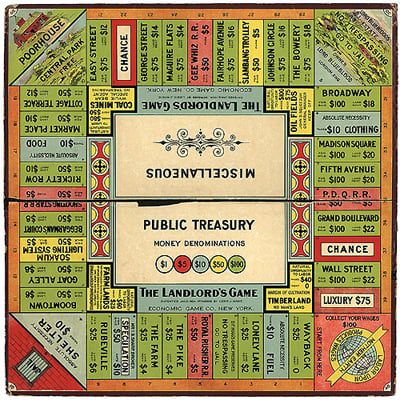
The Landlord's Game, 1906

Magie called her invention The Landlord’s Game, and when it was released in 1906 it looked remarkably similar to what we know today as Monopoly. It featured a continuous track along each side of a square board; the track was divided into blocks, each marked with the name of a property, its purchase price, and its rental value. The game was played with dice and scrip cash, and players moved pawns around the track. It had railroads and public utilities—the Soakum Lighting System, the Slambang Trolley—and a “luxury tax” of $75. It also had Chance cards with quotes attributed to Thomas Jefferson (“The earth belongs in usufruct to the living”), John Ruskin (“It begins to be asked on many sides how the possessors of the land became possessed of it”), and Andrew Carnegie (“The greatest astonishment of my life was the discovery that the man who does the work is not the man who gets rich”). The game’s most expensive properties to buy, and those most remunerative to own, were New York City’s Broadway, Fifth Avenue, and Wall Street. In place of Monopoly’s “Go!” was a box marked “Labor Upon Mother Earth Produces Wages.” The Landlord Game’s chief entertainment was the same as in Monopoly: competitors were to be saddled with debt and ultimately reduced to financial ruin, and only one person, the supermonopolist, would stand tall in the end. The players could, however, vote to do something not officially allowed in Monopoly: cooperate. Under this alternative rule set, they would pay land rent not to a property’s title holder but into a common pot—the rent effectively socialized so that, as Magie later wrote, “Prosperity is achieved.”

For close to thirty years after Magie fashioned her first board on an old piece of pressed wood, The Landlord’s Game was played in various forms and under different names—“Monopoly,” “Finance,” “Auction.” It was especially popular among Quaker communities in Atlantic City and Philadelphia, as well as among economics professors and university students who’d taken an interest in socialism. Shared freely as an invention in the public domain, as much a part of the cultural commons as chess or checkers, The Landlord’s Game was, in effect, the property of anyone who learned how to play it.

Thousands of Monopoly tournaments are held in the United States each year: county tournaments, school tournaments, church tournaments, corporate tournaments, tournaments in basements, in boardrooms, in lunchrooms, in public libraries, and online. Every four or five years there are the big officiated tournaments—the U.S. Championship and the World Championship—sponsored by Hasbro, which hands out $20,580 pots to the winners of each. I missed the big tournaments—both were last held in 2009—and instead ended up in the lobby of U.S. Steel. I thought the venue fitting, as the corporation was the brainchild of supermonopolists Andrew Carnegie and J. P. Morgan, the latter being the inspiration for Monopoly’s top-hatted, monocled, tails-wearing mascot, Rich Uncle Pennybags.

The emcee called the lobby to order, shouting into his microphone, “You have ninety minutes. Let’s play Monopoly!” Immediately, the men at Table 25 began rolling dice and frantically buying property as they rounded the board. Doug snagged Pacific Avenue (an expensive investment at $300), two yellow parcels, and several slummier properties. Trevis’s portfolio included two railroads and Marvin Gardens, the most expensive property in the yellow group. Billy held the ultrachic Boardwalk ($400). Eric got Tennessee Avenue and St. James Place ($180 each). These last are among the properties most coveted by competitors, because they are relatively cheap and frequently landed on, along with the other properties that sit directly downboard of the jail, where odds are the players will spend a lot of time.

Sixteen minutes into the game Doug offered Billy a trade. (“The propensity to truck, barter, and exchange one thing for another,” writes Adam Smith in The Wealth of Nations, “is common to all men, and to be found in no other race of animals.”) Land was already growing scarce, and as land becomes scarce in Monopoly—as in the real world—its market value rises, often beyond its nominal value. “This,” said Doug, holding up one of his yellow deeds, “for that,” pointing at one of Billy’s slum deeds, “plus three hundred bucks.”

Billy was unimpressed. “No, you give me three hundred bucks.”

“Give you three hundred bucks?”

“Cash is king!”

This in turn inspired Trevis and Eric to start haggling, with Billy and Doug interjecting to gum up the talks when their own interests were threatened. The table got loud. The parties offered, counteroffered, rejected all offers, sweetened the original offers, rejected the sweetened deals with greater aplomb. Doug heaved a great sigh. “We’re just gonna go around the board and around the board,” he said, “and collect our little money.”

“It’s gotta make sense for me,” said Trevis.

“This guy wants my left testicle,” Doug replied.

In what amounted to open conspiracy, Billy then told Eric that if they made a trade and each received a monopoly as a result, they’d share a “free ride”—no rent would be charged—when they landed on one another’s monopolies: a corrupt duopoly, in effect, targeting Doug and Trevis.

Doug shrugged as Eric pondered the deal, but Trevis was aghast. “You can’t do that—it’s against the rules.”

“Rules!” said Billy. “I’m gonna set my price.”

“Bullshit!”

“Ref!”

A referee, whistle around his neck, hurried over—the judge with the gavel had disappeared—to decide on the matter as the players barked at each other. “You can’t do that,” he said finally.

A few weeks before the tournament, I’d had a conversation with Richard Marinaccio, the 2009 U.S. national Monopoly champion. “Monopoly players around the kitchen table”—which is to say, most people—“think the game is all about accumulation,” he said. “You know, making a lot of money. But the real object is to bankrupt your opponents as quickly as possible. To have just enough so that everybody else has nothing.” In this view, Monopoly is not about unleashing creativity and innovation among many competing parties, nor is it about opening markets and expanding trade or creating wealth through hard work and enlightened self-interest, the virtues Adam Smith thought of as the invisible hands that would produce a dynamic and prosperous society. It’s about shutting down the marketplace. All the players have to do is sit on their land and wait for the suckers to roll the dice.

Smith described such monopolist rent-seekers, who in his day were typified by the landed gentry of England, as the great parasites in the capitalist order. They avoided productive labor, innovated nothing, created nothing—the land was already there—and made a great deal of money while bleeding those who had to pay rent. The initial phase of competition in Monopoly, the free-trade phase that happens to be the most exciting part of the game to watch, is really about ending free trade and nixing competition in order to replace it with rent-seeking.

Henry George was not formally trained in economics. At age sixteen, he shipped out of his native Philadelphia as a mast boy on the freighter Hindoo,bound for Australia and India, where he watched the crew threaten mutiny over their miserable working conditions. By the age of twenty, transplanted to California, he was working as a printer’s apprentice, a rice weigher, and a tramp farmworker. George was soon married and broke, caught up in a wave of unemployment on the West Coast, and by the winter of 1865 his pregnant wife was starving. “Don’t stop to wash the child,” the doctor told George upon the birth of a son that January. “Feed him.” Poverty turned his mind to economics, to the question of why poverty proliferated in a land of plentiful resources. Economics turned him to newspapers, where he imagined he might get paid for his ideas. Eventually, journalism brought him to live in New York City.

What puzzled George was that wherever he saw advanced means of production arise in the United States—wherever industry was built up and capital accumulated—more poor people could be found, and in more desperate conditions. It was for him a stunning paradox. “It is the riddle which the Sphinx of Fate puts to our civilization, and which not to answer is to be destroyed,” wrote George. “So long as all the increased wealth which modern progress brings goes but to build up great fortunes . . . progress is not real and cannot be permanent.” In 1879, he published the book that made him famous, Progress and Poverty: An Inquiry into the Cause of Industrial Depressions and of Increase of Want with Increase of Wealth—The Remedy, which provided a sweeping answer to the riddle: land monopoly was the reason progress brought greater poverty. As American civilization advanced, as populations grew and aggregated in and around cities, land became scarce, prices soared, and the majority who had to live and work on the land paid those prices to the minority who owned it. For the laboring classes, rent slavery was the result. “To see human beings in the most abject, the most helpless and hopeless condition,” George wrote, “you must go, not to the unfenced prairies and the log cabins of new clearings in the backwoods, where man singlehanded is commencing the struggle with nature, and land is yet worth nothing, but to the great cities where the ownership of a little patch of ground is a fortune.”

From those little patches, primarily in New York City, had arisen the dynasties of the American nouveau riche: the Astors, the Beekmans, the Phippses, the Stuyvesants, the Roosevelts, and, later, the Tishmans, the Rudins, the Roses, the Minskoffs, the Dursts, and the Fisher and Tisch brothers. According to George, the sequestering of valuable land assets in private hands was itself the product of a system of property “as artificial and as baseless as the divine right of kings.” “Historically, as ethically,” he wrote, “private property in land is robbery. . . . It has everywhere had its birth in war and conquest.” This was, in fact, the original sin of Western civilization:

In California our land titles go back to the Supreme Government of Mexico, who took from the Spanish King, who took from the Pope, when he by a stroke of the pen divided lands yet to be discovered between the Spanish or Portuguese—or if you please they rest upon conquest. In the eastern states they go back to treaties with Indians and grants from English kings; in Louisiana to the government of France; in Florida to the government of Spain; while in England they go back to the Norman conquerors. Everywhere, not to a right which obliges, but to a force which compels.

George noted that many premodern tribes recognized no right of land ownership; the tribesman’s property was the bow and arrow he built with his hands, not the land he hunted on. Nor was such a right recognized under the laws of the Old Testament, in which land was “treated as the gift of the Creator to his common creatures.” Moses had, after all, instituted the jubilee, under which land was redistributed every fifty years, and the debts incurred against land were canceled—a tradition ended by Roman rule. Everywhere George reviewed the annals of the precapitalist world, he saw the “struggle between this idea of equal rights to the soil and the tendency to monopolize it in individual possession.”

By the nineteenth century, however, the “superstition” of “absolute individual property in land,” represented by the complex array of state-sanctioned deeds and titles, had become fundamental to the American legal system. It could not be crushed—nor should it be, said George. Land seizure and nationalization, he believed, would lead to tyranny. “Let the individuals who now hold it still retain, if they want to, possession of what they are pleased to call their land.” George would not revoke the right to buy and sell property or to will land to one’s descendants. Instead he argued that society might leave landowners “the shell” of their holdings if it could “take the kernel.” As George wrote, “It is not necessary to confiscate land; it is only necessary to confiscate rent. . . . In this way the State may become the universal landlord without calling herself so.”

Rent was the key. In line with classical economics from the time of Adam Smith, George defined rent as the unearned income owners derived from the rising value of land, meaning it was distinct from the labor that went into property in the form of improvements, the construction of homes and offices and factories, and the cultivation of fields. A community’s productivity was the invisible hand that caused land values to increase. The cabin in the woods became a prize when a mine opened up across the field, a road linked the cabin to the mine, a country store opened to supply the miners, more homes were built, a railroad came in, a town was born. The land under the cabin derived its worth from what society built around it. Its increase in value therefore belonged to society, and George said this value was to be assessed and taxed at market rates. This “single tax” on land and natural resources offered a reform of capitalism—whose self-destruction George believed it was his task to prevent—that “open[ed] the way to a realization of the noble dreams of socialism.” [1]

Georgism, as it came to be known, was denounced by wealthy landowners as the most radically lunatic notion of its time, and the single tax as more insidious than all the writings of Karl Marx put together. The Catholic Church ruled George’s thought “worthy of condemnation.” Yet within five years of the publication of Progress and Poverty, hundreds of thousands of Americans would come to believe in the gospel of the single tax. In New York City, the populist priest Father Edward McGlynn referred to George simply as “this prophet . . . this messenger from God.” Mark Twain proselytized as a Georgist, as did the philosopher John Dewey. “It would require less than the fingers of the two hands,” wrote Dewey, “to enumerate those who, from Plato down, rank with Henry George among the world’s social philosophers.”

Leo Tolstoy proclaimed that George would “usher in an epoch.” “The method of solving the land problem has been elaborated by Henry George to such a degree of perfection that, under the existing State organization and compulsory taxation, it is impossible to invent any other better, more just, practical, and peaceful solution,” wrote Tolstoy. “The only thing that would pacify the people now is the introduction of the system of Henry George.”

In 1886, the United Labor Party, fresh from the battles and boycotts of the first May Day, nominated George as its candidate for mayor of New York. His campaign offered a radical vision for the time: wherever railroads, telegraphs, telephones, and gas, water, electric, and heating utilities could be operated more efficiently at scale, as “natural monopolies,” the public would own them; transit in New York would be made free for all; city government would be responsible for social services; he would end child labor and mandate an eight-hour workday. The land-value tax would pay for his programs.

Though not a single major newspaper endorsed him, clubs were founded in George’s name in twenty-four districts across the city. Members financed his campaign, each contributing twenty-five cents, and George, in between sixteen-hour days of speeches and rallies, sat at headquarters rolling coins for distribution to his workers. The coalition he built with the ULP was big-tent, crossing lines of class, ethnicity, and religion that had long divided New York. Three days before the election, his supporters—merchants, lawyers, doctors, tailors, plumbers, cigar makers, brassworkers, Germans, Irish, Russians, Poles, Italians, Jews—gathered by the tens of thousands in lower Manhattan. They carried banners reading HONEST LABOR AGAINST THIEVING LANDLORDS, and at Tompkins Square, in driving rain, they chanted, “Hi! Ho! The leeches must go!” But George was defeated, amid allegations that Tammany Hall had engineered massive voter fraud to ensure his loss.

George returned to journalism, went on the lecture circuit, wrote five more books, and dedicated himself to spreading the word of the single tax. He has been credited with inspiring a generation of progressive reformers. William Jennings Bryan said thatProgress and Poverty “ought to be read by every thinking man and woman.” Samuel Gompers, Jacob Riis, Upton Sinclair, and Ida Tarbell read him and sang his praises. But George showed little interest in reform beyond the single tax. A believer to the end in Adam Smith, he denounced the socialists and labor organizers who were his strongest supporters, and, as one critic wrote, came to lead single-tax supporters “of intolerably dogmatic and doctrinaire spirit.” He refused to accept that unearned income might be gleaned from investments other than land, and thus he was accused of failing to confront the rising power of finance capitalism, which made money off of the socially created value behind stocks and bonds. By the time of his death in 1897, when 100,000 New Yorkers lined up to view his body in state, George’s “great idea” was already, as Tolstoy would lament in 1908, on the long road to being forgotten.

About a month before the Pittsburgh tournament, an amateur Monopoly historian and game collector named Richard Biddle invited me to the village of Arden, Delaware, to have a look at the first Landlord’s Game ever fashioned. Arden had been founded as a Georgist experiment in 1900, four years after a failed attempt to implement the single-tax system across the state. It was envisioned as a self-sufficient utopia on 160 acres of woodland, and it soon attracted artists, poets, actors, anarchists, and freethinkers. Upton Sinclair had a cottage there, dubbed the Jungalow. Ardenites were barred from “owning” their plots, instead purchasing ninety-nine-year leases on cooperatively held land. It didn’t matter whether the residents built mansions or shacks: they were taxed only on the underlying value of the land, often at very high rates. This revenue paid for roads, parks, a commons, playgrounds, and utilities.

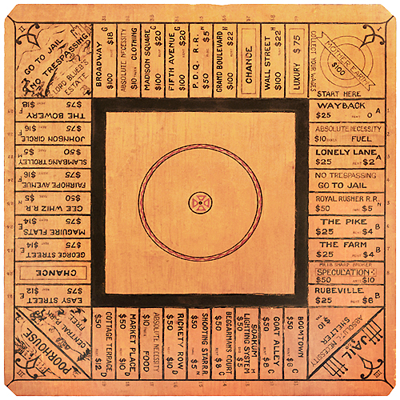
Lizzie Magie visited the village not long after its founding, and brought with her an oilcloth mock-up of her Landlord’s Game, which soon became a pastime among residents. While at Arden, she built a board for the game with the help of a resident carpenter. Biddle spoke solemnly of this alpha board; he estimated that it could be worth a million dollars.

We met at the village green and walked a few blocks, where we found the owner of the board, an eighty-year-old retired autoworker named Ronald Jarrell, standing outside his cottage looking nervous. Apprised of our visit, Jarrell had earlier in the day gone to his safe-deposit box at the local bank to retrieve the board. We entered his living room, where, amid a collection of antique china, jade statues, and old dolls, he laid out the prized artifact on his coffee table. Jarrell’s three yapping poodles made it difficult to talk.

“It was the summer of 1903,” he said. “A woman was down visiting here—”

“Lizzie Magie,” said Biddle.

“I don’t remember the name,” said Jarrell, “but she had an idea for a game.” He told us his stepgrandfather, a Georgist carpenter named Robert Woolery, had grown tired of playing checkers at the general store and needed new entertainment. Woolery looked over the plans drawn up by Magie on the oilcloth and immediately set about making the board.

Arden Board, 1904

Biddle held it up and nodded his head approvingly. It was hand-painted and hand-carved out of the backside of a reclaimed pressed-wood crokinole board, and it smelled like an old shoe.

I had earlier looked up Magie’s 1904 rule set, which she produced several months before she and Woolery completed the original board. Oddly, it contained no rule about forming monopolies out of the property groups, nor did it mention charging players higher fees after they’d built houses or hotels (constructions that also didn’t exist in Magie’s original rules). Nor was there anything about Henry George, land-value taxation, or the evil of rent. If the game was designed to teach Georgism, it seemed Magie hadn’t quite thought out the lesson. Two years later, when the game was officially published,the rules had evolved: the business principle of monopoly was fully established, as was the Georgist alternative of cooperation. Theories abound as to how the changes arose; one holds that someone in Arden had pushed The Landlord’s Game in the direction of Henry George, and also in the direction of the Monopoly we know today.

I asked Biddle about the discrepancy. “Ask the Monopoly monopolist,” he said.

“Excuse me?”

“Patrice McFarland. The Monopoly monopolist. She’d have all the answers because she is now the possessor of Lizzie Magie’s diaries. And a lot of other key stuff. But she isn’t talking.”

McFarland, I later learned, was a former exhibit specialist at the New York State Museum who in 1992 had received $25,000 from a Georgist organization, the Robert Schalkenbach Foundation, to produce a biography of Magie. In the ensuing years, Biddle said, she had acquired, along with Magie’s diaries, a trove of early Landlord’s Game prototypes handcrafted by players in Arden and elsewhere. But she had never produced her book, nor, according to Biddle, had she been willing to share the information or documents she’d amassed. “She’s a tough player,” he said. “I once bid against her on eBay for my 1939 Landlord’s Game. Bid almost $10,000.” (I called and emailed McFarland several times to ask about her alleged Monopoly monopolism, but she never responded.)

With us in Jarrell’s cottage was Mike Curtis, an Ardenite who twenty years earlier had played a round of Magie’s original 1906 Landlord’s Game (one of his opponents, as it happened, was Patrice McFarland). The Georgist rules by which Curtis had played were known as the Single Tax set, and they went beyond having players simply pay rent into Magie’s “Public Treasury.” They also aimed to teach the shared ownership of public goods. Under Single Tax rules, when the amount in the treasury reached fifty dollars, the player who owned the lighting utility was forced to sell it, and thereafter the utility cost no money to land on, as it was now publicly owned. This process repeated itself with the Slambang Trolley, then with the railroads, then with the Go to Jail space, which became a public college that, instead of sending players to jail, provided extra wages at the end of the game. After that, each fifty-dollar deposit in the treasury raised players’ wages by ten dollars. A “win” in Single Tax, which Magie later dubbed Prosperity Game, occurred when the player with the least amount of money had doubled his original capital. “The Landlord’s Game,” said Magie, “shows why our national housekeeping has gone wrong and Prosperity Game shows how to start it right and keep it going right.” Curtis admitted that he didn’t think much of the game, pronouncing it “kind of boring after a while.” [2]

In the summer of 1971, Ralph Anspach, a game inventor and retired economics professor who lives in San Francisco, emerged from a crushing Monopoly defeat in his living room—his eight-year-old son had bankrupted him—and found himself considering the salability of a board game that was explicitly antimonopolistic. “My game would have to start,” he wrote in a self-published memoir, The Billion Dollar Monopoly Swindle, “where Monopoly ends, when the board is full of monopolies.” The goal of play would be to break them up, with monopolists fighting off trustbusters. The game Anspach created, Anti-Monopoly, sold 200,000 copies in 1973, its first year of production, and was on pace to top 1 million sales by Christmas of 1974. Parker Brothers, at that time a subsidiary of General Mills, was not pleased. The company threatened to sue Anspach for trademark infringement. Instead, he preemptively sued Parker Brothers—“a sort of buckshot maneuver,” his lawyer called it—on the theory that he could show the company’s Monopoly trademark was invalid.

One of Anspach’s first discoveries as he built his case was the existence of The Landlord’s Game. But he could not explain how Magie’s invention, with its promotion of socialized land and shared wealth, had been transformed into the proprietary commodity that made billions of dollars for Parker Brothers. The key to the mystery, he learned, was a radical socialist professor of economics named Scott Nearing, who taught at the Wharton School of Finance from 1906 to 1915. Anspach spoke to Nearing in 1974, when Nearing was ninety-one years old. The professor said he had learned to play the game around 1910, while living in Arden, then taught it to his students at Wharton in order that they might learn, in his words, “the antisocial nature of monopoly,” and in particular “the wickedness of land monopoly.” The students apparently taught it to their friends. It was around this time that the game became known as “monopoly”—denoted in lowercase, like checkers, chess, or dominoes. The game spread widely over the next several years, to the hometowns of Nearing’s students and to other universities. It would slowly lose its antimonopolistic message, however, as players came to the conclusion that Magie’s vision of Georgist redistribution was not nearly as entertaining as ruining one another.

By 1913, monopoly had made its way to Altoona, Pennsylvania, and four years later it arrived in Philadelphia. The economist Rexford Tugwell, a future member of FDR’s “kitchen cabinet,” remembered having played it in 1915. By the 1920s, camp counselors in the Poconos were playing it, as were students at the University of Pennsylvania, Columbia, Harvard, Haverford, Princeton, and Swarthmore. During the early stages of the Depression, the game reached Indianapolis, where a Quaker schoolteacher-in-training named Ruth Hoskins played it. Hoskins soon traveled to Atlantic City and taught the game to two fellow Quakers, Jesse and Eugene Raiford.

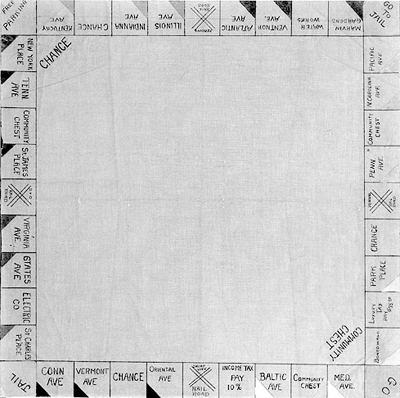
The brothers were so taken with the game that they worked to improve it. Along with other members of the Quaker community, they changed the pawns to household objects: tie clips, hairpins, keys, thimbles. They changed the names and property values to reflect those of Atlantic City. Baltic and Mediterranean Avenues, slums in the Raifords’ hometown, became slums on the board; Boardwalk and Park Place, the carrefour of chic, became the most expensive deeds to purchase. The rules related by Ruth Hoskins stipulated that properties were to be auctioned when players landed on them; Jesse Raiford instead set the prices on the board. (This change later made the game marketable to children, who had difficulty understanding how auctions worked.)

The Raifords taught the game to a friend of theirs, Charles Todd, who taught it to its putative inventor, Charles Darrow. Sometime in 1932, Darrow copied the layout of the board, the rules of play, the property names, the deed values, and the Chance cards, and made his own version of the game. His only innovation seems to have been to claim the mantle of sole inventor. He would soon be assumed into the pantheon of American heroes of commerce.

The irony was not lost on Anspach. Before being monopolized by a single person working in tandem with a corporation, Monopoly had in fact been “invented” by many people—not just Magie and the Raifords but also the unknown player who gave the game its moniker and the unsung Ardenite who had perhaps aided Magie in advancing its rules. The game that today stresses the ruthlessness of the individual and defines victory as the impoverishment of others was the product of communal labor.

None of the information Anspach uncovered helped his case when it went to trial in 1976. The widows of Eugene and Jesse Raiford testified, as did seven other witnesses who claimed to have played monopoly as many as twenty years before Darrow marketed his game. Anspach even put Robert Barton, the former president of Parker Brothers, on the stand. Barton, who was pivotal in helping Darrow secure a patent for his “invention,” admitted under oath that he was fully aware of the game’s history and that he knew Darrow had not in fact invented it. The judge was unmoved. He dismissed Anspach’s complaint, ordering all unsold copies of Anti-Monopoly to be “deliver[ed] up for destruction.” Seven thousand of the games were bulldozed into a garbage dump in rural Minnesota, where officials from Parker Brothers oversaw the interment. [3]

After forty minutes of play, the game at Table 25 had stalled—or, depending on your view, was going along just fine, because no one had a monopoly and no one could raise rents. So Billy paid rent to Eric, who paid about the same rent to Doug, who paid to Billy, who paid to Trevis, who paid to Eric, who made a bad roll and briefly went to jail. Then Doug Herold landed on his third lucrative green property, allowing him to form a monopoly. He had enough cash on hand to build several houses, and one after another the players fell afoul of his outrageous rent hikes. Billy and Trevis handed over several properties in lieu of cash, giving Doug three monopolies. “You see,” he said, turning to me, “I don’t have to deal with these knuckleheads anymore.” There was no further need for trading, no need for the dynamism of the marketplace. He had done the work, built the houses, invested in the properties. Now he did no work, took no risks, made no investments. And yet wealth moved inexorably in his direction. When after ninety minutes time was called, Doug oversaw five monopolies and a wad of $10,293 in cash, more than half the money in the Monopoly bank. He was declared not only the victor at Table 25, but the all-around winner of the U.S. Steel tournament for the second year in a row.

I’d invited Richard Biddle to the tournament, and as Doug had started his run Biddle wandered off to watch the other tables. Every so often I could see him peering over the shoulders of the players, a pinched look on his face. He did not like what had become of Lizzie Magie’s invention. “My brother taught me how to play Monopoly when I was five,” he had told me. “It was pivotal in helping me understand the importance of lying, cheating, and stealing.” I’d asked him to bring along his reproduction of The Landlord’s Game, which he carried in a backpack. Earlier in the evening he had gingerly taken it out to share with whomever he could waylay. “This is the real Monopoly,” Biddle would tell the players, before attempting a sort of CliffsNotes explanation of what Lizzie Magie had in mind. The players nodded politely, their smiles freezing into nervous masks. “That’s very nice, thank you so much,” they said, and then they walked away.


[1] University of Missouri–Kansas City economics professor Michael Hudson has noted that property tax today functions in exactly the opposite fashion from George’s proposed single tax. The Federal Reserve Board is responsible for assessing the total market value of real estate in the United States, Hudson says, yet it routinely produces “nonsensical undervaluations of land.” In fact, the FRB mostly ignores land itself; instead, it considers buildings and capital improvements as the chief markers of value, basing its calculations on the historical cost of original construction and the replacement cost of structures. Land value is an afterthought. The amateur in the real estate marketplace need not read Henry George to know this flies in the face of common sense, the mantra being “location, location, location,” not “replacement cost, replacement cost, replacement cost.” Hudson has conducted some of the few authoritative analyses of the FRB’s sleight of hand, the tax losses that result, and how it benefits the finance, insurance, and real estate sectors, which together have lobbied the FRB to maintain its approach.
[2] Curtis also didn’t think much of Arden’s Georgist experiment, saying it had degenerated into something of a failure. The leaseholders, he told me, had learned to game the system by electing land assessors who based their assessments on the town’s budget needs rather than the land’s real market value, and so they avoided paying taxes at appropriate rates. “To be frank,” he said, “the people in Arden today don’t give a damn about Henry George.”
[3] Anspach twice appealed the decision, and in 1982 a California appellate court ruled in his favor, concluding that Parker Brothers had in fact committed fraud in the Darrow patent, and was thus under threat of losing its trademark. General Mills Fun Group appealed to the Supreme Court in 1982, backed by amicus briefs from nearly every major American industry group, including the U.S. Chamber of Commerce, the National Association of Manufacturers, the U.S. Trademark Association, the Bar Association of the District of Columbia, and the Committee on Trademarks of the Bar of the City of New York. The Court declined to hear the appeal. Anspach was nearly bankrupted, his house thrice mortgaged, his game business on the edge of ruin, his distributors unwilling to work with him because of a ten-year legal cloud. He was free, however, to continue selling Anti-Monopoly. In the past four years, he has sold 454,000 copies in European markets. Domestic sales, he says, have been comparatively small because Hasbro has used “its monopoly power to monopolize the Monopoly market” in the United States.

LVTFan’s Blog

LVTFan’s Blog

vtfan.typepad.com/lvtfans_blog/henry_george/

August 08, 2014

April 14, 2014

FREE TRADE AGREEMENTS – WHY?

http://www.abc.net.au/news/2015-06-29/verrender-dont-expect-ftas-to-live-up-to-their-name/6579408


TPP debacle: don’t expect this free trade agreement to live up to its name

OPINION

Updated about an hour ago

Who would fall for a brazen scheme that strengthens protection under the guise of free trade? Maybe it’s worth looking at the supposed free trade deal we signed with America a decade ago, writes Ian Verrender.

You’ve probably heard the old saying that the definition of insanity is doing the same thing over and over again but expecting a different result.

No-one has ever really nailed down the author. Some reckon it was Albert Einstein. Others say it was Benjamin Franklin.

Regardless of who exactly owns the copyright to that little pearl of wisdom, it’s a sentiment with a particular resonance as Australia once again lines up to sign yet another free trade agreement with America: this time the wistfully named Trans Pacific Partnership.

As any first year student of economics can attest, there is absolutely nothing wrong with free trade. In fact, it is the holy grail, the fundamental principle that underpins much of modern economic thinking.

The problem is free trade agreements. In most cases, they have very little to do with trade at all, and in almost all cases, nothing at all to do with free trade.

For the most part, they are political documents. They offer politicians a stage, a platform upon which to demonstrate that they are “getting on with the job”; they keep bureaucrats busy; and they offer everyone involved the opportunity to speak in acronyms.

When it comes to economic benefits, however, they can be downright harmful.

And just like the Australia US Free Trade Agreement (AUSFTA to the cognoscenti) signed a little over a decade ago, the Trans Pacific Partnership has the potential to seriously compromise Australian sovereignty while delivering almost nothing in economic terms.

Trade Minister Andrew Robb recoils at the suggestion. A few months back, when fears over the TPP and the incredible secrecy behind it all began to grow louder, he thundered that it was all a “scare campaign” and promised that he would not sign anything that damaged Australia’s health system.

“Why would I? Why would I go and tear up the system?” he asked. Why indeed?

Back in 2004, then health minister Tony Abbott made a similar promise as Australian trade negotiators were on the cusp of signing that historic free trade deal with America.

It was a trade deal that fundamentally altered Australia’s Pharmaceutical Benefits Scheme, limited the Commonwealth’s power to price medicines cheaply, and contributed to the soaring costs of our health system. More on that later.

Those whipping up the “scare campaign” against the TPP were delivered a beautifully timed snippet of academic firepower last week in the form of an annual trade and assistance review from the Productivity Commission.

Bureaucrats don’t usually take to criticising government achievements, but commission chairman Peter Harris wasn’t mincing words as he took a microscope to the furious round of recent signings.

Preferential trade deals, according to the report, add to the cost and complexity of international trade.

This wasn’t a new message. In 2010, the Commission penned a wide-ranging report into our bilateral and regional trade deals that should have been compulsory reading for our politicians. Sadly, it seems, they took no notice.

The best way a nation can benefit from free trade is to dismantle its own trade barriers, the report concluded. Australia has already done just that.

Just to rub a little salt into the wounds, the report noted that “it appears that businesses generally have made limited use of the opportunities available from Australia’s existing BRTAs”.

The reason is that they are complex legal documents. A trade deal with one country bears no resemblance to one negotiated with another country. They become an exercise in dreaded “red tape” that tend to limit rather than foster trade.

It’s not just academics and bureaucrats pooh-poohing the grand achievements of our pollies.

A survey conducted by the Australian Chamber of Commerce and Industry, while supporting trade agreements, found that accessing the benefits was a “hit and miss” exercise.

In another damning report last year, the business lobby group said most agreements were so poorly drafted and so complex that they were next to useless in a commercial sense.

Just to add to the mind-boggling complexity, ask yourself this: If you own a business and want to trade with Japan, should you access the recently inked Australia Japan deal? Or should you go with the TPP?

The TPP is being driven by America. Like most of these deals, it is politically driven. Fearful of China’s rise, America wants to corral its allies under a trade umbrella. In the process, it also wants to further the interests of American corporations and American workers.

Specifically, it wants copyright laws and patents tightened and extended. These are agreements that offer protection to corporations and investors, usually justified on the grounds that innovation requires a reward.

The problem is, protection is the antithesis of free trade. Only a slippery politician could come with a strategy of strengthening protection under the auspices of a free trade deal.

Who would fall for a brazen scheme like that? Er, maybe it’s worth a look at the supposed free trade deal we signed with America a decade ago.

For a good explanation of the debacle visited upon Australia by our ineptitude during those negotiations,it is worth reading Australian National University’s Thomas Faunce’s excellent piece in The Conversation.

Since 1940, when the Pharmaceutical Benefits Scheme was formed by a referendum, the Federal Government had used a method known as “reference pricing” to screw down the cost of medicines, to the benefit of ordinary Australians.

But the trade deal of a decade ago outlawed that practice. Either we didn’t see it, or didn’t understand it. It seems our politicians and negotiators appeared only to discover the full effect of what they signed after the document had been ratified.

From 2007 on, the PBS was divided into two separate formularies, which significantly raised the cost of medicines in Australia.

In his first budget last May, the Treasurer Joe Hockey honed in on the soaring cost of medicines noting: “Over the past decade, the Pharmaceutical Benefits System has increased by 80 per cent.”

It was a clarion call for a round of future austerity.

There was no mention of the AUSFTA debacle, a pact that cemented the power of big pharmaceutical companies and dealt a fatal blow to the hopes of some American politicians who wanted to emulate Australia’s Pharmaceutical Benefits System.

Having won in Australia, America then used the same tactic in its negotiations with South Korea.

In the past week, President Barack Obama has managed to rescue what just weeks ago appeared to be a doomed trade proposal.

He’s been given fast track approval to proceed with the deal. Given our acquiescence on all things American and the propensity of our politicians to grandstand at any opportunity, expect this one to go through pronto.

Hopefully, it doesn’t give Einstein’s estate – or Franklin’s, for that matter – ammunition to sue me for copyright breaches. That’d be insane.

Ian Verrender is the ABC’s business editor.


Discounted Travel

THE SYDNEY MORNING HERALD, NSW

Mike Baird grants discounted travel to asylum seekers

Date
June 26, 2015 – 1:05PM
“This group is one of the most vulnerable in our society”: Mike Baird. Photo: Chris Pearce

Asylum seekers in NSW will be eligible for the most generous travel concessions in the country, after Premier Mike Baird said the state had a responsibility to help those who had nowhere else to turn.

Asylum seekers who meet certain criteria will, from next year, be eligible for travel at $2.50 a day – the same travel concession available to those on the Gold Pension Concession Card.

“NSW is Australia’s economic powerhouse, but there is little point in having a strong economy unless we use this strength to help the vulnerable among us,” Mr Baird said in a statement.

“NSW has shown we are prepared to help asylum seekers in our community and we want to do even more,” he said.

“This group is one of the most vulnerable in our society, often living below the poverty line. Evidence suggests that lack of access to dispersed services is a key impediment to their health and well-being.”
Premier Baird’s stance marks a clear contrast with the federal government’s treatment of, and rhetoric towards, asylum seekers. The Premier, whose politician father Bruce resisted the Howard government’s policy toward asylum seekers, has already said Prime Minister Tony Abbott should do more to help the vulnerable.
Under the policy announced on Friday, applicants for concession travel must either be holding a bridging visa or applying for one, they must be over 17 years of age and receiving aid from a designated agency.

Mr Baird said: “Until now, it has been the non-government community agencies funding transport for asylum seekers in NSW. This change allows those NGOs to be putting more of their limited resources into food, counselling and housing – where it is needed most.”

Transport Minister Andrew Constance said: “We are providing these travel discounts to asylum seekers to help them participate more fully in our society and access a range of social and community services.

“Many of the asylum seekers in NSW are at the very start of the process of applying for a protection visa. This means that they need access to a wide range of services in order to navigate this process and rebuild their lives.”

http://www.smh.com.au/nsw/mike-baird-grants-discounted-travel-to-asylum-seekers-20150626-ghyevf.html