Address to the National Press Club by Malcolm Turnbull

https://www.malcolmturnbull.com.au/media/address-to-the-national-press-club-september-2021

29 September 2021With the swirl of media soundbites, the impression has been created that the Australian Government has replaced a diesel electric French designed submarine for a nuclear powered American, or British, one. This is not the case.

Australia now has no new submarine programme at all. We have cancelled the one we had with France and have a statement of intent with the UK and the US to examine the prospect of acquiring nuclear powered submarines.

Over the next eighteen months there will be a review of the possibilities – the biggest probably being whether the new submarine should be based on the UK Astute[1] submarine or the larger US Virginia class[2].

The hyperbole around the new AUKUS partnership has been dialed up to 11. No three nations in the world already have closer security, intelligence, and technology collaboration than Australia, the US and the UK. And it has been getting closer in recent years. As Canada’s Justin Trudeau observed this is all about selling submarines to Australia[3].

The Australian Government has chosen to terminate a contract with France’s largely state-owned Naval Group to build 12 Attack class submarines. While based on the design of France’s latest nuclear sub they were to be conventionally powered – a modification stipulated by Australia in the competitive tender process begun in 2015 and concluded in April 2016 when it was approved by my Government’s NSC of which the current Prime Minister, Defense Minister and Foreign Minister were all members. 

But nothing is agreed. There is no design, no costing, no contract. The only certainty is that we won’t have new submarines for 20 years and their cost will be a lot more than the French subs. However, high hopes and good intentions are in abundance. But there were plenty of them when we did the deal with France too. 

The first of the Attack class[4] submarines was to be in the water by 2032, with the rest of the fleet coming out of the shipyards every two years until the full complement had been constructed. It was the largest defence procurement in our history – a partnership of generations between France and Australia.

The nagging concern about the French submarines was that they were not nuclear powered. Nuclear powered subs have unlimited underwater range – nuclear reactors, unlike diesel engines, do not need oxygen. Their endurance is only limited by the need to keep the crew sustained. They can operate at much higher sustained speeds underwater, about 25 knots, than a diesel/electric submarine.  And they don’t need to surface, or snort, to recharge their batteries by running their diesel motors.

So, given the long distances our subs have to travel, and our vast maritime domain, why did Australia decide not to order nuclear powered submarines? The answer is, or was, that we do not have, and by law are not able to have, a civil nuclear industry which is needed to support the maintenance of a nuclear navy. There is no country with a nuclear navy that does not also have a civil nuclear industry.

The choice of a conventional submarine had been made long before I became Prime Minister, and the competitive tender was well underway. This determination was confirmed to us on numerous occasions not just by our own Navy, but by the expert advisory board chaired by Don Winter, an engineer and former US Secretary of the Navy and included three US Navy Admirals with direct command and engineering experience in nuclear submarines.[5]

There were three bids – from France, Japan and Germany.  It was my Government, which chose the French bid on the basis that it was the best – especially in terms of stealthiness, which is the prime requirement for a submarine. 

In 2018 I tasked the Defence Department to formally reconsider the potential for nuclear powered submarines in Australia. Technologies were changing, the risk environment was worsening, I was concerned that conventionally powered boats would not be good enough in the future. The big question, however, remained whether we could sustain and maintain a nuclear-powered navy in Australia without local, Australian nuclear facilities and the advice remained that we could not.

Leaving aside the politics it was plain enough that we did not need a civil nuclear industry to generate electricity. It was very clear that the cheapest forms of new generation were renewables backed by storage – batteries or pumped hydro. So, any local nuclear industry would have as its overwhelming justification the support of a nuclear navy.

The alternative, I was advised, would have been to have a nuclear-powered sub that required maintenance in another country. This would have meant our submarine capability was not sovereign – if you can’t maintain your own ships, you are not in full control of them.

One of the attractions of the French subs was that they were originally designed for nuclear propulsion. So, if we decided to switch to nuclear we had a partner that had the expertise to do it with us.

In its natural state uranium is 99% made up of a stable isotope U238, the unstable radioactive isotope U235 is only about 0.7%. The more U235, the more radiation, reactivity and energy. Highly enriched Uranium (HEU) has a concentration of 20% or more U235. Low enriched uranium (LEU) as used in nuclear power stations is typically between 2-5%.

The United States, United Kingdom and Russia are the only countries still to use HEU in their naval reactors. It is enriched to about 95% and is drawn from stockpiles built up for nuclear weapons. 

For Australia, a non-nuclear weapons state, using HEU in a submarine is not a breach of the Treaty on Non Proliferation (NPT), but it does set a precedent which other currently non-nuclear weapons states, like Iran, will seek to exploit as a justification for producing HEU.

Following the AUKUS announcement, I was advised by the Government that the work I had commenced on nuclear options continued and it had been concluded that Australia could use the modular HEU reactors currently deployed in the UK Astute and US Virginia class submarines which, because of their HEU fuel, do not require replacement during the 35 year life of the sub. This, it is contended, means that Australia could have a nuclear-powered submarine without any need to maintain, service or refuel the nuclear reactor.

This is very different advice to that given to the Government as recently as three years ago. It sounds too good to be true; Australia would have submarines powered by nuclear reactors running on weapons grade uranium. And we would not need to have any of our own nuclear facilities or expertise? 

Is it credible to have a hands-off plug and play nuclear reactor filled with weapons grade uranium and not inspect it for 35 years?  The US and UK will know for sure in about thirty years.  And until then if something does go wrong, both nations have extensive nuclear facilities and expertise to deal with it.

Australia does not.

The French nuclear propulsion system however uses low enriched uranium (LEU) – somewhat more enriched than that used in civil nuclear plants. By law they inspect their reactors and refuel them every ten years. All submarines go in for a lengthy, year or more, refit every decade. The refueling of the French naval reactor takes a few weeks.   In this regard at least, French naval nuclear reactor safety standards are stricter than those applied in the United States and the UK.

The new AUKUS submarines, we are told, will still be built in Adelaide. But if there are no nuclear facilities there, that must mean the submarine hulls will be transported to the US or the UK to have the reactor installed together with all of the safety and other systems connected to it.

You don’t need to be especially cynical to see it won’t be long before someone argues it looks much simpler to have the first submarine built in the US or the UK, and then the second, third and so on.

Australia is the first country to receive access to US naval reactors since the technology transfer to the UK in 1958. But the UK was and remains a nuclear weapons state with a substantial civil nuclear industry. Australia will be the first country without any civil nuclear industry to operate a nuclear submarine and the first non-nuclear weapon state to use HEU in a naval reactor. So, if we are not going to develop nuclear facilities of our own (as Mr Morrison has promised) then we will no more be sharing nuclear technology with the US than the owner of an iPhone is sharing smartphone technology with Apple.

A new submarine, under the new AUKUS arrangement, would not be in the water until 2040, we are told. That is about eight years after the first Attack class sub would have been in service. So, we are now without any new submarines for the best part of 20 years. In the meantime, the Collins Class submarines are going to be refitted so they can last another decade. Let’s hope that works. But it doesn’t get us to 2040. So whichever way you look at this there is going to be an even bigger capability gap.

For several years now the Attack Class submarine programme has been accused of cost blow outs – from $50 to $90 billion. The $50 billion was the estimate of the cost of the total programme in 2016 dollars. This included the Lockheed Martin combat and weapons system and the construction of a new dockyard in Adelaide. The $90 billion figure is no more than the estimated cost of the project in nominal dollars over its 35- year life. It is a rough estimate based on assumptions about inflation, exchange rates and technologies over decades.[6]

Of course, now that the flurry of the media announcement is over, the question remains whether we will be able to negotiate a satisfactory deal with the US and UK to deliver a nuclear-powered submarine for Australia. If the Astute is preferred because of its size, then for practical purposes we will be price takers. 

Tony Abbott was of the view that Australia could not build the new diesel/electric submarines itself and his original plan was that they would all be built in Japan. With the support of my colleagues, I determined that all submarines should be built in Australia. This was to be the biggest element in a new continuous sovereign shipbuilding industry in Australia, itself an engine of innovation, science, and technology with enormous spillover benefits to the rest of the economy.

How can we maintain that commitment without having the nuclear facilities in Australia to enable maintenance and support of the new submarines’ reactor and connected systems? If that is where we are heading, and I believe it should be, then a reactor fueled with LEU is safer in every respect than one fueled with HEU.

Nonetheless, in 2040 if we have the first of a nuclear-powered submarine fleet, that will be a good development in that the submarine will have range and capabilities a diesel/electric boat does not.

But the way we are getting there has been clumsy, deceitful, and costly. Too many questions are not being asked, and fewer answered. The blustering attempts to wedge those who seek answers do not serve our national interest.

Our national security does not rely on fleets and armies alone. And that is just as well, for we will never have military might to match that of potential rivals.

Echoing our 2017 Foreign Affairs White Paper[7], as Marise Payne said on Monday “Australia is respected when we engage with the region honestly and consistently.”[8]

Diplomacy matters, and at the heart of diplomacy is trust. Australia’s reputation as a trusted and reliable partner has been an enormous asset to us on the international stage, just as a trustworthy reputation is an enormous asset to someone in business.

Some of you may have read the transcript (fairly accurate) of my notorious phone call with Donald Trump in January 2017 in which I persuaded him to stick to the refugee resettlement deal I had struck with President Obama. My argument was that America had given its word, and he should stick to it. When he suggested I had broken agreements in my business life, I said that I had not. Furious he may have been, but Trump did not renege on the deal.

Imagine if he had been able to say, “How about the time you double crossed the French?”

It was only a few years ago that our partnership with France was to be one for generations. As the sun set over Sydney Harbour in March 2018, from the deck of HMAS Canberra, President Macron described the partnership with Australia as the cornerstone of France’s Indo Pacific strategy. This was not just a contract to build submarines, it was a partnership between two nations in which France chose to entrust Australia with its most sensitive military secrets – the design of their latest submarines.

France is an Indo Pacific power. With two million citizens and 7,000 troops across the two oceans, drawing closer to France as a security partner made enormous sense both for us and the United States.

France is the world’s sixth (and the EU’s second) largest economy, a permanent member of the Security Council, a nuclear weapons state with its own nuclear technology for energy, naval propulsion and weapons. With Merkel’s retirement, Macron will be the most influential of the EU leaders. Always inclined to protectionism, France became a strong supporter of our bid for an FTA with the EU, invited Australia (for the first time) to the G7 and aligned its Indo Pacific strategy, and ultimately that of the EU, to ours.

Mr Morrison has not acted in good faith. He deliberately deceived France. He makes no defense of his conduct other than to say it was in Australia’s national interest. So, is that Mr Morrison’s ethical standard with which Australia is now tagged.: Australia will act honestly unless it is judged in our national interest to deceive?

It was as recently as 30 August that our Defence and Foreign Ministers met with their French counterparts and publicly re-emphasised the importance of the submarine programme. Two weeks later, on the day Mr Morrison dumped the President of France with a text message, the Department of Defence formally advised Naval Group that the project was on track and ready to enter into the next set of contracts.

The media has been gleefully briefed that Mr Morrison struck the deal with Boris Johnson and Joe Biden at the G20 in July shortly before going to Paris where the PM confirmed to President Macron his continuing commitment to the submarine deal.

France’s Foreign Minister has described Australia’s conduct as a stab in the back, a betrayal. Macron recalled his Ambassadors to Canberra and Washington. Dan Tehan can’t get a meeting with the French Trade Minister any more than he can with the Chinese Trade Minister.

France’s Europe Minister has already poured cold water on the prospects of concluding an EU-Australian free trade agreement. Australia has proved it can’t be trusted, he has said.

France believes it has been deceived and humiliated, and she was. This betrayal of trust will dog our relations with Europe for years. The Australian Government has treated the French Republic with contempt. It won’t be forgotten. Every time we seek to persuade another nation to trust us, somebody will be saying “Remember what they did to Macron? If they can throw France under a bus, what would they do to us?”

So, what should have been done? The conventional/nuclear debate was hardly news. Morrison could have told the truth.  He could have said to Macron that we wanted to explore the potential for acquiring nuclear powered submarines. Macron would have been supportive. The French Government had already invited such a discussion. The Americans, who were supplying the weapons system, should have been engaged. President Biden has acknowledged this has been mishandled and that there should have been “open consultations among allies on matters of strategic interest to France and our European partners.”[9]

If after that honest discussion it was concluded that we could not use a French reactor, the inclusion of a US or British reactor could have been considered. Let us assume that after this discussion the conclusion was that only a US or UK submarine would do. If the contract was terminated at that point, nobody could say Australia had been dishonest or sneaky. France would be disappointed, but not betrayed, disrespected or humiliated.

Morrison’s response is to say that he could not be open and honest with Macron because the French might have run to Washington and urged Biden not to do the deal. That tells you a lot about how confident he is about the commitment of the Americans.

As Paul Kelly records[10] (with approbation), Scott Morrison deliberately and elaborately set out to persuade the French their deal was on foot and proceeding until he knew he had an alternative deal whereupon he dumped the French and his deceitful conduct was exposed.

Despite this awkward birth, I hope that AUKUS turns out to be a great success. It should be. We are already the closest of friends and allies – none closer.

As Prime Minister I argued we should not see our region as a series of spokes connected to Washington or Beijing but rather as a mesh where nations like Australia would build their security by stronger ties with all our neighbours – great and small. This approach delivered a much stronger relationship with Indonesia and most nations of ASEAN. It secured in 2017 a commitment from the four leaders to revive the Quadrilateral dialogue between India, Japan, Australia and the USA. In the same year, with Shinzo Abe, we were able to defy the doubters (at home and abroad) and conclude the Trans Pacific Partnership without the United States.

Throughout this time, and since, our security alliance and cooperation with the United States became stronger and more intense. But we always made our own decisions. Of course, our rivals and critics have said Australia will always fall in with the US. Years ago, the foreign minister of one of our neighbours said to me, “If Australia is seen as just a branch office of the US, why should we take much time with you – better to talk direct to head office.”

If we want to have influence in our region we must be trusted. Our word must be our bond. We must be seen to have an independent foreign policy and sovereign defence capabilities. We need to have, develop and retain relationships with other nations, in our region and beyond – like the TPP – which are not simply derivatives of our alliance with the United States.

And at the heart of all this is trust.

New polling: Australians say fire up the nukes

Charles Pier

Getty Images

Charles Pier

28 September 2021

This is one of those bonus weeks for poll wonks when we get a Newspoll on Monday and the fortnightly Essential Research poll just 24 hours later.

Essential’s topics can vary and this week they’ve got a beauty. They haven’t just asked about support for the AUKUS/nuclear submarines announcement (a solid majority are in favour). They’ve also asked about nuclear-generated electricity.

In a fascinating development, 50 per cent of Australians support the idea while 32 per cent are opposed.

Interestingly, while the strongest support for nuclear power is found among the over 55s, there are solid blocks of younger voters prepared to entertain the concept — indicating a recognition of the significance of nuclear energy in maintaining reliable baseload power and the limits of renewables.

Indeed, the Essential Poll shows that as many as 29 per cent of Australians would support the use of nuclear energy “to establish Australia’s nuclear weapon capabilities”. That’s a fascinating result.

The simplistic nuclear taboos of the past are crumbling as Australians recognise both the challenges of providing reliable electricity and our strategic environment.

No one’s talking about nuclear weapons but the time is clearly ripe to begin serious policy discussions on nuclear energy.

Australians are ready. Can our politicians please catch up. Got something to add? Join the discussion and comment below.

$1 million per month: more secret costs of vaccine failure

Charles Pier

Getty Images

Charles Pier

17 August 2021

6:37 PM

The Innovation Australia website has another cracking story. What’s the reward for the government’s vaccine rollout failure? A million dollars a month.

Over to InnovationAus:

The federal government is paying global consulting giant PwC nearly $1 million per month across 2021 to assist with its troubled COVID-19 vaccine rollout, under a previously secret contract released publicly nine months after it was signed and nearly eight months after government was obliged to make it public.

The Department of Health entered into a contract with PwC worth $11.4 million on 14 December last year, running until 14 December 2021, for “COVID-19 vaccination program management support”…

PwC’s role in the work was announced by Health Minister Greg Hunt on Christmas Eve, but no contract was posted to AusTender and further details on its work have been significantly restricted, and no information has been provided on what has been delivered by PwC.

The contract, which will see PwC paid $950,000 per month for all of 2021, was issued following a closed tender process, with the Department using an exemption due to its necessity to “protect human health”.

PwC is acting as the federal government’s “program delivery partner for the vaccine rollout”.

And how did this scandalous “previously secret contract” get made public. That’s a second scandal of its own:

Despite signing the contract nearly nine months ago, it was only made public last week, on the same day InnovationAus published a story on the lack of a contract with PwC for its vaccine rollout work, and after questions were put to the Department on this issue.

The Department said the contract was kept secret due to it being “incorrectly registered” as being exempt from reporting. The exemption does not, however, apply to consultancy services, and the error was picked up by “routine assirance activities” with a correction made “as quickly as practicably”, a department spokesperson told InnovationAus.

The government can’t manage its own programs, can’t provide fundamental accountability — but is going to keep us safe from the virus.

Yeah. Right.Got something to add? Join the discussion and comment below.

Preliminary research finds that even mild cases of COVID-19 leave a mark on the brain – but it’s not yet clear how long it lasts


September 24, 2021 10.37pm AEST


The new findings, although preliminary, are raising concerns about the potential long-term effects of COVID-19. Yuichiro Chino via Getty Images

https://theconversation.com/preliminary-research-finds-that-even-mild-cases-of-covid-19-leave-a-mark-on-the-brain-but-its-not-yet-clear-how-long-it-lasts-166145

“Interestingly, when the researchers separated the individuals who had severe enough illness to require hospitalization, the results were the same as for those who had experienced milder COVID-19. That is, people who had been infected with COVID-19 showed a loss of brain volume even when the disease was not severe enough to require hospitalization.”

With more than 18 months of the pandemic in the rearview mirror, researchers have been steadily gathering new and important insights into the effects of COVID-19 on the body and brain. These findings are raising concerns about the long-term impacts that the coronavirus might have on biological processes such as aging.

As a cognitive neuroscientistmy past research has focused on understanding how normal brain changes related to aging affect people’s ability to think and move – particularly in middle age and beyond. But as more evidence came in showing that COVID-19 could affect the body and brain for months or longer following infection, my research team became interested in exploring how it might also impact the natural process of aging.

Peering in at the brain’s response to COVID-19

In August 2021, a preliminary but large-scale study investigating brain changes in people who had experienced COVID-19 drew a great deal of attention within the neuroscience community.

In that study, researchers relied on an existing database called the UK Biobank, which contains brain imaging data from over 45,000 people in the U.K. going back to 2014. This means – crucially – that there was baseline data and brain imaging of all of those people from before the pandemic.

Get news that’s free, independent and based on evidence.

Get newsletter

The research team analyzed the brain imaging data and then brought back those who had been diagnosed with COVID-19 for additional brain scans. They compared people who had experienced COVID-19 to participants who had not, carefully matching the groups based on age, sex, baseline test date and study location, as well as common risk factors for disease, such as health variables and socioeconomic status.

The team found marked differences in gray matter – which is made up of the cell bodies of neurons that process information in the brain – between those who had been infected with COVID-19 and those who had not. Specifically, the thickness of the gray matter tissue in brain regions known as the frontal and temporal lobes was reduced in the COVID-19 group, differing from the typical patterns seen in the group that hadn’t experienced COVID-19.

In the general population, it is normal to see some change in gray matter volume or thickness over time as people age, but the changes were larger than normal in those who had been infected with COVID-19.

Interestingly, when the researchers separated the individuals who had severe enough illness to require hospitalization, the results were the same as for those who had experienced milder COVID-19. That is, people who had been infected with COVID-19 showed a loss of brain volume even when the disease was not severe enough to require hospitalization.

Finally, researchers also investigated changes in performance on cognitive tasks and found that those who had contracted COVID-19 were slower in processing information, relative to those who had not.

While we have to be careful interpreting these findings as they await formal peer review, the large sample, pre- and post-illness data in the same people and careful matching with people who had not had COVID-19 have made this preliminary work particularly valuable.

What do these changes in brain volume mean?

Early on in the pandemic, one of the most common reports from those infected with COVID-19 was the loss of sense of taste and smell.

A woman with COVID-19 symptoms tries to sense the smell of a fresh tangerine.
Some COVID-19 patients have experienced either the loss of, or a reduction in, their sense of smell. Dima Berlin via Getty Images

Strikingly, the brain regions that the U.K. researchers found to be impacted by COVID-19 are all linked to the olfactory bulb, a structure near the front of the brain that passes signals about smells from the nose to other brain regions. The olfactory bulb has connections to regions of the temporal lobe. We often talk about the temporal lobe in the context of aging and Alzheimer’s disease because it is where the hippocampus is located. The hippocampus is likely to play a key role in aging, given its involvement in memory and cognitive processes.

The sense of smell is also important to Alzheimer’s research, as some data has suggested that those at risk for the disease have a reduced sense of smell. While it is far too early to draw any conclusions about the long-term impacts of these COVID-related changes, investigating possible connections between COVID-19-related brain changes and memory is of great interest – particularly given the regions implicated and their importance in memory and Alzheimer’s disease.

Looking ahead

These new findings bring about important yet unanswered questions: What do these brain changes following COVID-19 mean for the process and pace of aging? And, over time does the brain recover to some extent from viral infection?

These are active and open areas of research, some of which we are beginning to do in my own laboratory in conjunction with our ongoing work investigating brain aging.

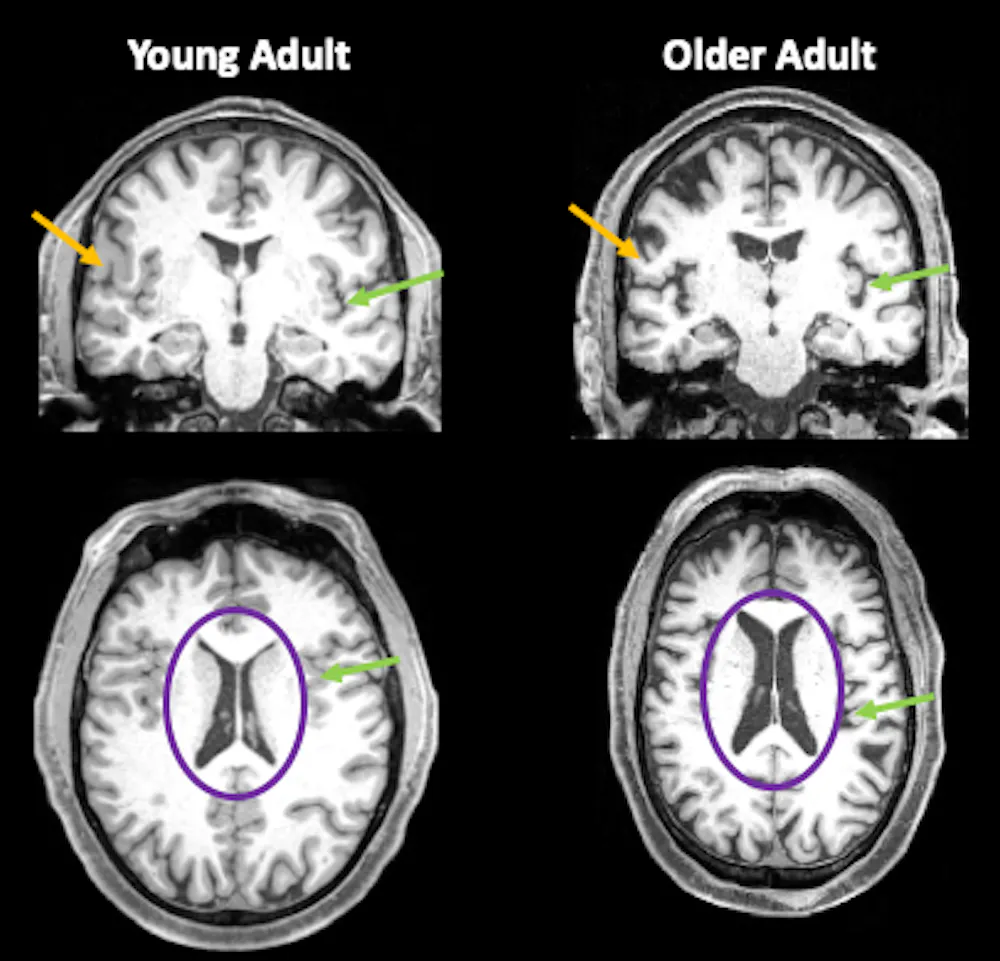
Brain scans from a person in their 30s and a person in their 80s, showing reduced brain volume in the older adult brain
Brain images from a 35-year-old and an 85-year-old. Orange arrows show the thinner gray matter in the older individual. Green arrows point to areas where there is more space filled with cerebrospinal fluid (CSF) due to reduced brain volume. The purple circles highlight the brains’ ventricles, which are filled with CSF. In older adults, these fluid-filled areas are much larger. Jessica Bernard, CC BY-ND

Our lab’s work demonstrates that as people age, the brain thinks and processes information differently. In addition, we’ve observed changes over time in how peoples’ bodies move and how people learn new motor skills. Several decades of work have demonstrated that older adults have a harder time processing and manipulating information – such as updating a mental grocery list – but they typically maintain their knowledge of facts and vocabulary. With respect to motor skills, we know that older adults still learn, but they do so more slowly then young adults.

When it comes to brain structure, we typically see a decrease in the size of the brain in adults over age 65. This decrease is not just localized to one area. Differences can be seen across many regions of the brain. There is also typically an increase in cerebrospinal fluid that fills space due to the loss of brain tissue. In addition, white matter, the insulation on axons – long cables that carry electrical impulses between nerve cells – is also less intact in older adults.

As life expectancy has increased in the past decades, more individuals are reaching older age. While the goal is for all to live long and healthy lives, even in the best-case scenario where one ages without disease or disability, older adulthood brings on changes in how we think and move.

Learning how all of these puzzle pieces fit together will help us unravel the mysteries of aging so that we can help improve quality of life and function for aging individuals. And now, in the context of COVID-19, it will help us understand the degree to which the brain may recover after illness as well.

[Get the best of The Conversation, every weekend. Sign up for our weekly newsletter.]

Before you go…

Producing evidence-based journalism comes at a cost. At a time when Australian media is in crisis, The Conversation produces trusted news coverage written by experts and we rely on donors to keep our lights on. If you value us, please show us by becoming a monthly donor.

Give today

Misha Ketchell

Editor

Illawarra-Shoalhaven warned of ‘increasing’ COVID cases as region records two more deaths

https://www.abc.net.au/news/2021-09-22/wollongong-woman-and-kiama-man-die-due-to-covid-19/100482964

ABC Illawarra / By Ainslie Drewitt-SmithPosted Wed 22 Sep 2021 at 3:33pmWednesday 22 Sep 2021 at 3:33pm

A low high-rise building that says "Piccadilly Centre", with a smaller sign saying "Motor Inn".
The Piccadilly Motor Inn on Crown Street has officially been declared a “high risk” premises. (ABC News: Billy Cooper)

Help keep family & friends informed by sharing this articleabc.net.au/news/wollongong-woman-and-kiama-man-die-due-to-covid-19/100482964COPY LINKSHARE

Another two COVID-related deaths have been recorded in the Illawarra as case numbers in the region continue to rise.

Key points:

  • Another 62 cases were confirmed in the LHD on Wednesday
  • Both people who died had underlying conditions and had received immunisation shots
  • No new cases from two locked down buildings have been confirmed, but a third premises has been deemed “high risk”

A man from Kiama and a woman from Wollongong were among five deaths confirmed across the New South Wales today.

Their deaths bring the local total to three — a Wollongong woman in her 80s died on Sunday.

NSW Chief Health Officer Kerry Chant said the second woman was also aged in her 80s and died in Wollongong Hospital.

“She had received two doses of the COVID vaccine but had underlying health conditions,” Dr Chant said.

“A man in his 70s from Kiama died at Wollongong Hospital and he had received one dose of the COVID vaccine and had underlying health conditions.”

A bespectacled woman with highlights in her hair – Kerry Chant – speaks to the media in front of NSW Health branding.
Kerry Chant said both residents had other health issues.(AAP: Jenny Evans)

‘Increasing cases’

Of 1,035 cases recorded across the state in the latest reporting period, 62 were confirmed in the Illawarra-Shoalhaven Local Health District (ISLHD).LIVE UPDATES: Read our blog for the latest news on the COVID-19 pandemic

Thirty-four are from the Wollongong local government area (LGA), 20 are from Shellharbour, five are from the Kiama LGA and three are in the Shoalhaven.

Only 24 are linked to previously reported cases.

Dr Chant urged residents in the region to book in for a vaccination and get tested.

“I want to highlight that we are seeing increasing cases in the Illawarra area, in the Wollongong, Shellharbour and Kiama area,” she said.

“Please come forward and get vaccinated.”

Driveway in front of Wollongong Hospital.
A woman in her 80s and a man in his 70s died in Wollongong Hospital on Tuesday.(Supplied: ISLHD)

‘High risk’ premises

There were three new cases recorded in the Wingecarribee Shire, bringing the total cases confirmed in the LGA since the beginning of the Delta outbreak to 32.

There were no new cases reported from two apartment buildings under lockdown in Wollongong, but NSW Health officially declared the 35-room Piccadilly Motor Inn on Crown Street a “high risk” premises.

What you need to know about coronavirus:

At least three people on the premises have tested positive.

The order, signed by deputy Chief Health Officer Marianne Gale, commenced at 10:30am on Wednesday.

Under the order, the building will remain closed for 14 days.

Play Video. Duration: 5 minutes 18 seconds
Families and kids share their lives in lockdown

How do we know graphene oxide isn’t used in COVID-19 mRNA vaccines?

https://health-desk.org/articles/how-do-we-know-graphene-oxide-isn-t-used-in-covid-19-mrna-vaccines

byHealth Desk|Published onAugust 4, 2021–Updated onAugust 4, 2021|Explainer

What our experts say

The Pfizer/BioNTech and Moderna COVID-19 mRNA vaccines do not contain any graphene oxide. The ingredient list for both vaccines have been published and tested by outside parties. They were not found to contain any graphene oxide in their formulas, including their lipid nanoparticles.

Lipid nanoparticles, basically tiny balls of fat, are used in mRNA vaccines to protect delicate RNA molecules so the vaccine can enter the human body without being destroyed. Lipid nanoparticles have been recognized as potential drug delivery systems (ways to get medications into human cells, especially injectable drugs) since the 1960s. Lipids are fatty, oily, or waxy and include fats and oils (triglycerides), waxes, and steroids, among other things.

Sometimes a compound called polyethylene glycol (PEG) can be used to help keep lipid nanoparticles stable, as they are used in the COVID-19 mRNA vaccines. However, there is no graphene oxide in the PEG-lipid nanoparticles

No WHO authorized vaccines produced by Pfizer, Moderna, AstraZeneca, CanSino, Sinovac, Sputnik V, or Janssen contain graphene oxide. The Novavax COVID-19 vaccine has not yet published a list of its ingredients in a peer-reviewed or open access publication.

Graphene oxide is a compound that contains carbon, oxygen, and hydrogen. It is used in many applications, from sensors to textiles to the potential application of medicine. This material is cheap, readily available, and can disperse in water. It is water soluble, so it may be a great solution for helping medications be absorbed. It can be produced as a powder or a solution for various uses.

Graphene oxide may be a useful tool in vaccine delivery in the future, because scientists and chemical engineers believe it can be engineered to be a safe delivery vehicle for vaccines, and help increase their effectiveness. Like lipid nanoparticles, graphene oxide is also a nanoparticle and has recently been used in an intranasal influenza vaccine platform with promising results.

Additionally, these nanoparticles have been shown to increase macrophages and T cells, which can boost our immune systems and generate potentially stronger immune responses. Recent studies have shown that graphene and graphene-related materials may have antiviral and antimicrobial properties, so evaluating them for use in medication and vaccine design is warranted.

While certain amounts of graphene oxide could be toxic to humans, current research on the use of this compound in other vaccines indicate that the amount that would be in potential vaccines would be so small that it would not be toxic to human cells. A 2016 study showed that graphene-base materials (like graphene oxide) might cause dose-dependent toxicity, decreased cell viability, formations of lung granuloma, and cell apoptosis. Notably, these studies were performed on mice, but graphene oxide specifically showed no obvious toxicity at low doses or middle doses from .1 to .25 mg. It was chronically toxic at higher doses of .4 mg, where it was found to deposit in the lungs, liver, spleen, and kidneys. It is important to note that this .4 mg of graphene oxide is proportionally much greater in mice than it would be in humans, considering their size and biological differences. Further, this study was completed 10 years ago and the graphene oxide was not chemically engineered in a manner that may make it safer or more tolerable for living organisms.

Many more studies and trials are needed to determine whether or not graphene oxide is an effective, completely safe, and useful material for biomedical applications including drug delivery, imaging, and biosensors. Current research on the compound has produced mixed results but optimism have been increased due to the success of recent research projects as of late.

Context and background

Viral videos, posts, and articles have been falsely written about the role of graphene oxide in COVID-19 vaccines, despite any actual evidence to support these findings. The ingredients of COVID-19 vaccines have been published and evaluated by independent groups, outside of Novavax, and found no graphene oxide in any part of their formulas.

Graphene oxide is currently being investigated to determine whether or not it can be a safe and effective tool for use in vaccines among other biomedical properties.

Resources

  1. Fact sheet for recipients and caregivers: Emergency use authorization (EUA) of the Moderna COVID-19 Vaccine to Prevent Coronavirus disease 2019 (COVID-19) in individuals 18 years of age and older (United States Food and Drug Administration)
  2. Fact sheet for recipients and caregivers: Emergency use authorization (EUA) of the Pfizer-BioNTech COVID-19 Vaccine to Prevent Coronavirus disease 2019 (COVID-19) in individuals 12 years of age and older (United States Food and Drug Administration)
  3. DEADLY SHOTS! Former Pfizer Employee Confirms Poison in COVID ‘Vaccine’ (Rumble)
  4. Nano coronavirus recombinant vaccine taking graphene oxide as carrier (Google Patents)
  5. Fact Check-COVID-19 vaccines do not contain graphene oxide (Reuters)
  6. COVID-19 vaccine tracker and landscape (World Health Organization)
  7. Nanomedicine: A Diagnostic and Therapeutic Approach to COVID-19 (Frontiers in Medicine)
  8. Are COVID-19 Vaccines Mostly Graphene Oxide? Here’s What Experts Have to Say (The Science Times)
  9. Toxicity of graphene-family nanoparticles: a general review of the origins and mechanisms (Particle and Fibre Toxicity)
  10. Biocompatibility of Graphene Oxide (Nanoscale Research Letters)
  11. Antiviral performance of graphene-based materials with emphasis on COVID-19: A review (Medicine in Drug Discovery)
  12. Graphene Oxide In Pfizer Covid-19 Vaccines? Here Are The Latest Unsupported Claims (Forbes)
  13. Comprehensive Review on Graphene Oxide for Use in Drug Delivery System (Current Medicinal Chemistry)
  14. Solid Lipid Nanoparticles for Drug Delivery: Pharmacological and Biopharmaceutical Aspects (Frontiers in Molecular Biosciences)
  15. Without these lipid shells, there would be no mRNA vaccines for COVID-19 (Chemical & Engineering News)
  16. Understanding the nanotechnology in COVID-19 vaccines (CAS: American Chemical Society)
  17. Biochemistry, Lipids (StatPearls)
  18. PEG shedding-rate-dependent blood clearance of PEGylated lipid nanoparticles in mice: Faster PEG shedding attenuates anti-PEG IgM production (International Journal of Pharmaceutics)
  19. COVID-19 Vaccines for People with Allergies (United States Centers for Disease Control and Prevention)
  20. Drug and Gene Delivery Technologies (Biomaterials Nanoarchitectonics)
  21. Biomimetics: Research explores the potential of graphene oxide (Binghampton University)
  22. What is graphene oxide? (Biolin Scientific)
  23. Graphene Oxide (Jiaxing Huang Group)
  24. Graphene Oxide (GO) Market 2021: Application Coverage by Different Demand Market by Region, Main Consumer Profile, Market Size & Forecast 2024 (MarketWatch)
  25. Recent progress of graphene oxide as a potential vaccine carrier and adjuvant (Acta Biomateriala)
  26. Functionalized graphene oxide serves as a novel vaccine nano-adjuvant for robust stimulation of cellular immunity† (Nanoscale)
  27. Potential of graphene-based materials to combat COVID-19: properties, perspectives, and prospects (Materials Today Chemistry)
  28. Graphene and the Immune System: A Romance of Many Dimensions (Frontiers in Immunology)
  29. Intranasal vaccination with influenza HA/GO-PEI nanoparticles provides immune protection against homo- and heterologous strains (Proceedings of the National Academy of Sciences of the United States of America)
  30. Dispersibility-Dependent Biodegradation of Graphene Oxide by Myeloperoxidase (Nano Micro Small)
  31. In vivo biodistribution and toxicology of functionalized nano-graphene oxide in mice after oral and intraperitoneal administration (Biomaterials)
  32. Graphene Hydrogel Could Help mRNA Vaccine Target Cancer More Effectively (Clinicalomics)
  33. Ultrasmall Graphene Oxide Supported Gold Nanoparticles as Adjuvants Improve Humoral and Cellular Immunity in Mice (Advanced Functional Materials)
  34. Exploration of graphene oxide as an intelligent platform for cancer vaccines† (Nanoscale)

From escaping the Taliban to Kiwi academic excellence

https://www.rnz.co.nz/national/programmes/sunday/audio/2018809228/from-escaping-the-taliban-to-kiwi-academic-excellence

Abbas Nazari’s memoir couldn’t have come at a more poignant time as he watches his country fall to the same forces his family escaped from 20 years ago.

In After the Tampa: From Afghanistan to New Zealand, Nazari recounts a harrowing journey to leave Afghanistan at the age of 7 and being rescued by the MV Tampa, which resulted in an international diplomatic rift.

Graduating from the University of Canterbury, pictured with his mother and father.

Ali (left), his father (middle) and Abbas helping a Sungjoy family with their apricot harvest in 2017.

First day of school in Pakistan.

Talking to NZ with Mike McRoberts one week after 15th March.

The Nazari clan one year into their lives in Christchurch.

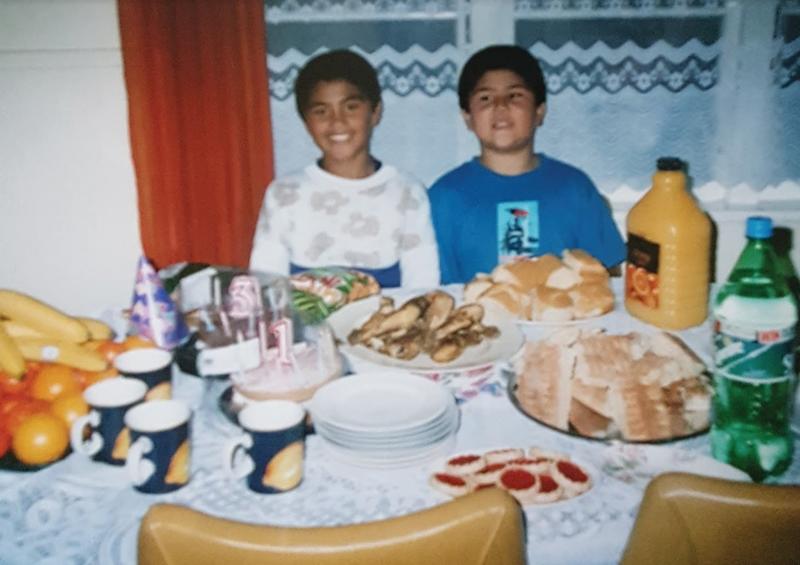
Ali and Abbas learnt about birthdays at school and convinced their mum to throw a joint party.

Listen to the full interview with Abbas Nazari here duration27′ :01″Add to playlistDownload

Listen to the full interview with Abbas Nazari here

Nazari’s story echoes the agonising decisions some in Afghanistan are having to make at every turn.

“The war is coming in and it’s getting more dangerous by the day and so [my parents] had a choice, do we stay and face persecution or potential killing by the Taliban? Or do we pack up our things and seek security elsewhere? And for my parents back then, that was across the border in Pakistan,” Nazari tells Jim Mora.

“There’s so many points along the way where they had to make a decision, to stay or to go into the unknown.”

With the persecution of the Hazaras ethnic minority in Afghanistan, his family became fearful. Having Central Asian genes, speaking a different language, and with most belonging to the Shia’a sect of Islam, they were a visible target, Nazari says.

“Over centuries, that has meant we are an ‘other’, a minority group that is unwanted in the land of the majority.

“In the book, I detail countless instances of massacres, of genocidal acts, culminating with the Taliban takeover and the many massacres and atrocities they committed against the Hazaras Afghans. That is a genuine fear, that now with the Taliban back in power, that they’ll continue what they started in the ’90s.

“Right now when viewers and readers are tuning in to the harrowing images of what’s happening in Afghanistan … we see statistics and crowds of people, but each person there is an individual story, where they’ve either had to say goodbye to their families, where they’ve had their families killed, or whether they’ve had absolute fear of staying because they might be an ethnic minority, a translator, or a woman.

“All that is lost when we talk about what’s happening in Afghanistan.”

The Taliban have claimed that their rule will be different to last time, while Nazari hopes that will be true, he says “their actions speak louder than words”.

“Keep in mind, they’re incredibly tech-savvy now. They have biometric data from all the technology they’ve seized, so they know exactly who has worked with the foreign troops, they know exactly who the journalists are, who the critical thinkers are, and they know exactly where people live.”

Now there’s a sea of people surrounding Kabul Airport, and Nazari says even though they probably have tickets to get out, militants are controlling the checkpoints and have been firing bullets over the crowds to make them withdraw.

His own journey to cross the border was troublesome, he says, when “every second feels like an eternity.”

Barely getting through there to Pakistan and finally Indonesia, they get on a rickety fishing boat with more than 400 asylum seekers, heading to Australia.

“That chapter describes the rollercoaster of emotions we went through. We were in the belly in the hull of the ship that was being torn apart by the wave, I remember the decking falling apart, holes in the sides, the beams are splitting and people are sliding across those decks … and it was the most horrendous experience I’ve ever been through … that particular night is installed in high definition in my memory.

“I remember one of the parents next to me, gripping on to his child, and his prayer he uttered was something along the lines of ‘oh God, if we were to die tonight then let our bodies wash ashore so we can be buried on land’. What more do you need to show how desperate and fearful people were about their circumstances.”

They were rescued by cargo ship Tampa, which was refused entry by Australia and spent 35 days at sea before New Zealand struck a deal to take in 150 people, among them Nazari’s family.

“That was one of the happiest times of my life … I learned my ABCs at Mangere, I remember eating all the mounds of food we were given.

“And how starkly different my life was to the 300-odd men and single dads and elder sons who had ventured alone, who were sent to Nauru, some who would spend three years there before they were given resettlement elsewhere.”

While the story of escaping the violence can be quite grim and dark, Nazari also hopes to show through his book that Afghanistan has known peace before and believes it can be accomplished again.

Nazari is now a Fulbright scholar, and recently came back to Aotearoa from his studies in the United States at Georgetown University. He was due to appear alongside former prime minister Helen Clark at a WORD event – which has now been cancelled due to the Covid-19 outbreak.

Novavex Delay

The vaccine cannot cause you to get COVID-19.

The Novavax vaccine uses a version of the spike protein made in the lab. The spike proteins are assembled into tiny particles called “nanoparticles” which aim to resemble the structure of the coronavirus, however they cannot replicate once injected and the vaccine cannot cause you to get COVID-19.

In order for these subunit vaccines to generate strong protective responses, they need to include molecules that boost your immune system, called “adjuvants”. The goal of these adjuvants is to mimic the way the real virus would activate the immune system, to generate maximum protective immunity.

COVID Vaccine Rollout: Anthony Albanese has slammed Prime Minister Scott Morrison for the delay in Australia’s Novavax vaccines. 51 million doses expected to arrive later this year will now only be available from 2022, which the Opposition Leader says is a “further setback” on Australia’s road to recovery from COVID-19.

“Scott Morrison had two big jobs this year – the rollout of the vaccine and effective national quarantine – and unfortunately, both of them have been botched.”
Share this:

How does the Novavax vaccine work?

The Novavax vaccine is given as two doses, similar to the Pfizer and AstraZeneca shots already being used in Australia.

It can be stored for up to three months at fridge temperature, which differs from the Pfizer mRNA vaccine which needs to be kept at ultra-low temperatures. In saying that, the TGA said last week the Pfizer vaccine can be stored at normal freezer temperatures for two weeks during transport, and at fridge temperatures for five days — though must still be kept ultra-cold after transport and in the long-term.

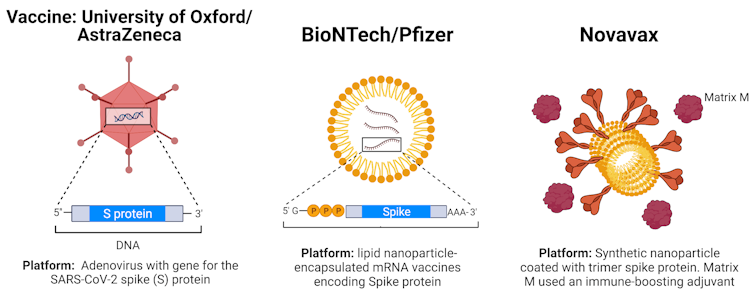
A graphic comparing Australia's three vaccine options
Comparing Australia’s three COVID-19 vaccine options. Jamie Triccas, made with BioRender, CC BY-ND

The vaccine also uses a different technology to the Pfizer and AstraZeneca vaccines. It’s a “protein subunit” vaccine; these are vaccines that introduce a part of the virus to the immune system, but don’t contain any live components of the virus.

The protein part of the vaccine is the coronavirus’ “spike protein”. This is part of the other COVID-19 vaccines in use but in a different form.


Read more: New coronavirus variant: what is the spike protein and why are mutations on it important?

The Novavax vaccine uses a version of the spike protein made in the lab. The spike proteins are assembled into tiny particles called “nanoparticles” which aim to resemble the structure of the coronavirus, however they cannot replicate once injected and the vaccine cannot cause you to get COVID-19.

In order for these subunit vaccines to generate strong protective responses, they need to include molecules that boost your immune system, called “adjuvants”. The goal of these adjuvants is to mimic the way the real virus would activate the immune system, to generate maximum protective immunity.

Novavax includes an adjuvant based on a natural product known as saponin, an extract from the bark of the Chilean soapbark tree.

How effective is the vaccine compared to those already in use in Australia?

The interim data from phase 3 testing, released in March, was very encouraging. When tested in the UK in a clinical trial including more that 15,000 people, the vaccine was 96% effective at preventing COVID-19 disease for those infected with the original strain of the coronavirus.

This compares well to the Pfizer vaccine, with an efficacy of 95%, and recent data from AstraZeneca demonstrating 76% efficacy against COVID-19.

The Novavax vaccine is also safe. In early clinical testing the vaccine caused mainly mild adverse events such as pain and tenderness at the injection site, and no serious adverse reactions were recorded. In the larger trials, adverse events occurred at low levels and were similar between the vaccine and placebo groups.

https://www.smh.com.au/business/companies/novavax-plans-to-trial-combined-flu-and-covid-super-jab-in-australia-20210806-p58gfk.html

Novavax plans to trial combined flu and COVID super jab in Australia

Emma Koehn
By Emma Koehn

August 6, 2021

In a statement on Friday morning, the company said it expects “to initiate [a] Phase 1 clinical trial in Australia later this year”.

Australia has already been key to Novavax’s development of its standalone COVID-19 vaccine, with an ongoing US-Australian study applying the initial two doses to local volunteers and then giving certain participants boosters

One Million without Power!

Right now, one Million without Power in America! One Million. Is this fake news? I don’t think so:

Shepard Smith joins the Halftime Report with information about the search and rescue efforts in Mississippi and Louisiana following Hurricane Ida. For access to live and exclusive video from CNBC subscribe to CNBC PRO: https://cnb.cx/2NGeIvi

Hurricane Ida made landfall in Louisiana on Sunday as a Category 4 storm with winds of 150 miles per hour, one of the strongest storms to hit the region since Hurricane Katrina, the National Oceanic and Atmospheric Administration said. Ida has since been downgraded to a tropical storm and is expected to move farther inland over southeastern Louisiana and into southwestern Mississippi later this morning, the National Hurricane Center said. Maximum sustained winds have decreased to near 60 mph (95 km/h) with higher gusts. Late Sunday, President Joe Biden approved a major disaster declaration for Louisiana, unlocking federal funding for recovery efforts. The storm is expected to weaken rapidly over the next day or so, and the NHC said Ida is expected to become a tropical depression by this evening. The NHC warned that a life-threatening storm surge is expected for Grand Isle, Louisiana, to the Alabama/Florida border, including Lake Pontchartrain, Lake Maurepas, and Metropolitan New Orleans.

The NHC said winds will likely damage trees and trigger power outages as Ida continues to move inland over southeastern Louisiana. Heavy rainfall is expected through Monday across southeast Louisiana, coastal Mississippi as well as southwestern Alabama, and could trigger “considerable to life-threatening flash and urban flooding.” As of early Monday, more than 1 million Louisiana utility customers are without power, according to PowerOutage.us. On Sunday evening, New Orleans said the entire city lost power after “catastrophic transmission damage.” Ida made landfall on the anniversary of Katrina, the dangerous Category 3 storm that devastated Louisiana and Mississippi 16 years ago, killing more than 1,800 people and causing $125 billion in damage. The strength and path of Ida will be a significant test of New Orleans’ post-Katrina flood defenses, including levees, flood walls and gates that were built to provide storm protection. Katrina had caused levee breaches and catastrophic flooding in New Orleans.

Ida has also triggered concerns about the city’s hospitals, which are already overwhelmed with Covid-19 patients and have little room for evacuated patients. In Galliano, Louisiana, the struggle to care for patients as the storm roared ashore was exacerbated after a part of the roof of Lady of the Sea General Hospital blew off. President Joe Biden has declared a state of emergency for Louisiana and Mississippi, a move that authorizes the Department of Homeland Security and Federal Emergency Management Agency (FEMA) to coordinate all disaster relief efforts. “The storm is a life-threatening storm,” the president said during a briefing at the FEMA headquarters on Sunday. “Its devastation is likely to be immense. Everyone should listen to the instructions from local and state officials.” Louisiana Gov. John Bel Edwards on Sunday afternoon requested a presidential major disaster declaration from Biden after the storm slammed into the state’s coast. “Hurricane Ida is one of the strongest storms to ever hit Louisiana,” Edwards said in a statement. “It is our goal to assist our local agencies and the citizens of the state as quickly as possible, and we have pre-positioned search and rescue teams, boats and other assets to begin helping people as soon as it is safe.” Damaging winds will spread into southwestern Mississippi on Sunday night and early Monday, likely causing widespread tree damage and power outages, and heavy rainfall and is expected across the central Gulf Coast, the Hurricane Center said. » Subscribe to CNBC TV: https://cnb.cx/SubscribeCNBCtelevision »

Subscribe to CNBC: https://cnb.cx/SubscribeCNBC » Subscribe to CNBC Classic: https://cnb.cx/SubscribeCNBCclassic Turn to CNBC TV for the latest stock market news and analysis. From market futures to live price updates CNBC is the leader in business news worldwide. The News with Shepard Smith is CNBC’s daily news podcast providing deep, non-partisan coverage and perspective on the day’s most important stories. Available to listen by 8:30pm ET / 5:30pm PT daily beginning September 30: https://www.cnbc.com/2020/09/29/the-n… Connect with CNBC News Online Get the latest news: http://www.cnbc.com/ Follow CNBC on LinkedIn: https://cnb.cx/LinkedInCNBC Follow CNBC News on Facebook: https://cnb.cx/LikeCNBC Follow CNBC News on Twitter: https://cnb.cx/FollowCNBC Follow CNBC News on Instagram: https://cnb.cx/InstagramCNBC https://www.cnbc.com/select/best-cred… #CNBC #CNBCTV