Uta’s Birthday 1940

In 1940 I turned six, brother Bodo was a cute two. I was allowed to invite all my friends to a birthday party, boys and girls. I was so fond of all of them. The older girls were both ten. One is my cousin Sigrid, the other my friend Sieglinde. I think Sieglinde’s brother, who is also in the picture, is only eight. The younger girl with the huge bow on top of her head is five year old Eva. (I mentioned her a lot in my blogs.) Apart from little Bodo there are adorable Jürgen and very friendly Heinz in the picture, who both lived in the same building where we lived. There was a huge chestnut-tree opposite, which still stands now. It grew a lot more over the years. I believe it is about as high as the surrounding five story houses!

In the photos we are gathered under this tree and also in front of one of the sides of our house. Tante Ilse’s gift to me for my birthday were two Käthe-Kruse-Puppen, a boy and a girl. Of course they had to be in the pictures too. And of course Mum took all the photos which she always did on our birthdays.

About two years later during summer we had a dressing up party. Mum took a picture of us on Tante Ilse’s balcony. I think my brother Bodo looks lovely in the picture dressed up in long pants. I wear one of Mum’s dresses. Friend Eva is in the centre of the picture. The lovely young lady in the long dress is my sixteen year old cousin Renata. My friend Sieglinde on the right side is twelve and friend Inge with the blond hair probably ten. I think I wouldn’t have remembered the dressing up party if I hadn’t this picture. Pictures like these are truly a great memory boost!

When I was Fourteen

Das Mädchen mit der schönen Figur
(The Girl with the Beautiful Figure)

Mum liked to see the woman doctor who had her consulting rooms a few blocks down the road from where we lived. The woman doctor was always duely concerned about Mum’s heart condition. Mum used to praise her a lot for saying kind words to her whenever she visited. Naturally Frau Doktor would prescribe the right kind of medicine too. In other words she was a very praiseworthy doctor. Her waiting room was never short of patients.

Once Mum sent me to see Frau Doktor. I think it had something to do with my irregular periods. The doctor’s sister lived with the doctor on the premises. She was the one who always received the patients. She liked to talk and was friendly with everyone.

While I was waiting my turn, the doctor’s sister started to talk to me. It did not take her long before she told me, that she had been watching me walking along the street. She said I had caught her eye because of my very erect posture. She also mentioned that she always thought of me as ‘The Girl with the Beautiful Figure’. Was I, a fourteen year old, embarrassed by all this talk? – – –
My word I was!

Memory Triggers

Pictures as Memory Triggers

 Two brothers, both students at the University of Leipzig (Germany), went out together to see a movie. Two young girls, who wore identical dresses, in a giggly mood followed the students into the cinema and sat down behind them. One of the students was my father Alexander, twenty-one at the time, and one of the girls was my mother Charlotte.

Naturally, the two young students did get to know the two girls. Soon the four of them went on outings together, and before long the two young men even started visiting the girls’ home, where they were well received by the girls’ widowed mother.

.

Five years later Charlotte and Alexander were married. In the meantime Charlotte’s sister Ilse had been engaged to Alexander’s brother Edmund for a few months. Ilse broke the engagement off and later  married well- to -do  Adolf S.

After World War II my parents separated. My father lived in West-Germany. My two brothers and I stayed with my mother in West-Berlin. At the beginning of 1951 I found out from my father, that some months previously my parents did get a divorce. My mother had never bothered to tell me this.

A few years later, when I went to visit my father, he told me that my mother had the marriage annulled by the pope, which would mean, that we three children had been born as bastards. My father was totally outraged about this.

Apparently my mother had the marriage annulled, so that she could marry another man, who happened to be Catholic. But when that other man wanted my mother to move with him to another city, she decided she didn’t want to marry him after all. So my mother stayed in Berlin, where she had lived since 1931 and where she died in 1994.

I keep looking at this photo, which has triggered all these memories. On the photo I see: Ilse and Charlotte; Edmund and Alexander. The girls are dressed in fashionable cotton-shifts. Both dresses had been sewn by fourteen year old Charlotte, who was very good at the sewing machine, whereas Ilse shunned machine sewing. Her contribution was doing the hems, which she could do by hand. Charlotte would sit at her sewing machine all day to finish the two identical dresses, so that the sisters could wear them for going out on that same day.

 My mother had another sister called Martha and a brother called Kurt. Cousin Sigrid is the daughter of Martha. Cousins Renata and Wolfgang are twins and the children of Kurt. Ilse never had any children.  Cousin Sigrid once hinted that she had had a botched abortion and that was why she couldn’t have any children. I would say her second husband didn’t mind this at all.

 Her second husband was Helmut L., but she called him Peter. Tante Ilse and ‘Onkel Peter’ were very much in love. They married on July 20th, 1944. It was a good marriage right to the end. Ilse died of breast cancer in 1978. Onkel Peter tried to stay in touch with us. But I think my mother rejected him. Somehow she had a grudge against him. All my life I found that my  mother had a grudge against various people, which did puzzle me no end. Why, why, this negativity all the time? I never wanted to step into her shoes! She would call me ‘Opppositions-Geist’. I guess, that is what I was. I found myself opposing her in a lot of things.

Just before my mother died, I was able to spend a few weeks with her in Berlin. She became very child-like and very likable in her old age. I just did get along fine with her towards the end. Her funeral became very problematic though and upset me no end. But that is another story.

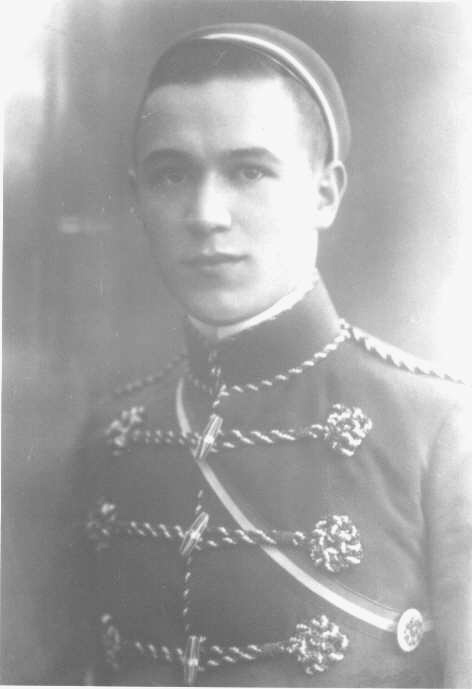
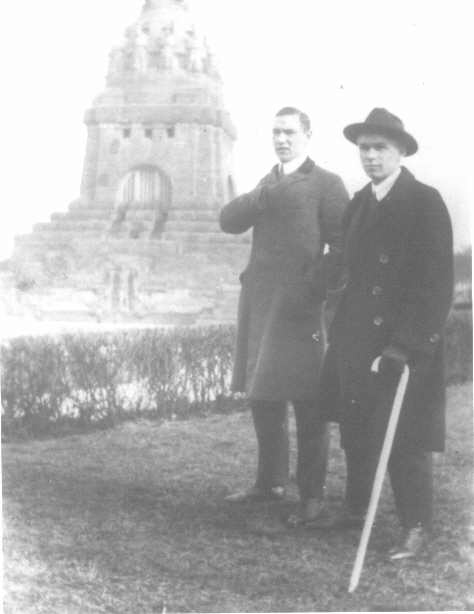
Here is the little picture that triggered my memory. The other pictures show Alexander and Edmund as students in Leipzig.  I guess all these pictures are from 1925.

School starts: September 1941

In 1940 the enrolment for new pupils had been at Easter-time. I had not been allowed to go to school then because I was not six years old yet. (I turned six in September 1940). That means, when I was finally allowed to go to school, I was nearly seven., because in 1941 enrolments did not take place till September. In our school we had four first year classes: two boys’ classes and two girls’ classes. In each class were fifty children!

School lessons lasted for twice fifty minutes. There was a ten minute break (Pause) in between the two lessons. For me it was very important to be eating my buttered bread roll (Butterbrötchen) during that ‘Pause’. And when during the following year we sometimes had three lessons in one day, gee, that made me feel really grown up! I could not wait to have more and more lessons. I liked school that much!

On enrolment day my mother took me to school. I was given a large cone shaped bag that day. This cone shaped bag – Zuckertüte – was filled with sweets and fruit to sweeten the day. It is still the custom in Germany, that a child who starts school, be given such a bag. Of course, there are always pictures taken to commemorate the occasion!

My class was called 1 A and my teacher was a lovely elderly lady called Fräulein Anders. Rosemarie, a girl who lived a few blocks away from me, was in 1 B and her teacher’s name was Fräulein Bröde. We children would quite naughtily talk about her as ‘Fräulein Blöde’, which means ‘Miss Stupid”.

Rosemarie and I would walk to school together. We would have been shocked, if somebody had seen us being taken to school by an adult. No adult ever would have thought to accompany us on our fifteen minute walk to school. It was unheard of, that children could not walk to school on their own! Even when our school was evacuated to another school-building further away, we always walked to school on our own.

Here is the picture of me with my ‘Zuckertüte’ in front of the school!


Childhood Memories


Towards the End of Worldwar II and after the War

During my year at the village school in Lichtenow, I had become used to a very individual teaching style. This changed however, when after the summer holidays of 1944 I was enrolled in year four of the Herzfelde Primary School, and I found myself there in a class of about thirty girls.

In this class we spent most of the time doing reading, writing and arithmetic. We also learnt a few songs, especially ‘marching songs’. We had to know these songs because they came in handy, when we marched through town, which happened about once a week. We thought, it was great fun, when all the girls of our class marched along in rows of two, singing all the marching songs, which we knew so well. I believe this marching business came about, because we were supposed to have a bit of exercise to keep us healthy and fit. We did not have a sports’ teacher at the time, which meant, that sport as such was not on the curriculum. Of course we had our class-teacher accompanying us on our marching sessions through town and surroundings.

Once a week we were given dictation. Every spelling mistake was marked by the teacher, counting one bad point for every mistake and half a bad point for a punctuation mistake. The student with the least mistakes was seated at the top of the class. All students were seated according to the number of mistakes they made in dictation. The students who made the most mistakes were seated at the bottom of the class right in front of the teacher.

Thanks to the good schooling I had received in Lichtenow, I was able to spell quite well and usually ended up among the top three students in the class. I felt lucky in that regard. My handwriting however was terrible. Handwriting had always been my worst subject. Luckily for me, it was a separate subject and did not influence the marking of any other subject!

That the teacher praised students with the better marks, was nothing new to me. It was also generally accepted, that the teacher let the other students know, who was in the lower range in any subject. For instance, when we were writing a composition on a given theme, the teacher would collect the finished compositions and take them home to mark them. Once the marked compositions were handed back to us, the teacher discussed in front of the whole class, who had written a good composition; also whose composition was satisfactory, just satisfactory or unsatisfactory.

I went to the school in Herzfelde for about three months only. From that time on I had a preference for sitting in the back rather than the front of the class. When I went to high-school in Berlin later on, I always tried to get a seat in one of the back-rows. I was rather glad, that In high-school we were allowed to choose ourselves, where to sit. I used to pity the girls in the front-rows, who often had to suffer a lot of spitting out of the mouth of this very old German teacher, Dr. Petzel. The standard joke after an enormous spitting session was, that the girls in the front rows should put up umbrellas, when Dr. Petzel was talking!

Right through my childhood I was made to wear a roll of hair on top of my head, which hovered over the midst of my forehead. On my tenth birthday I was finally allowed to comb my hair to the side. Because of this, I felt, I was on the way to becoming a grown-up person.

So here’s the picture from my tenth birthday and another picture that was taken a bit after my 10th birthday. The other picture was taken when I was only about 8 and my friend Eva was 7.


Easter Photos from 1935


Apparently Mum’s mother came from Leipzig to Berlin for a visit  around Eastertime, when I would have been about six months. I think the dress I wear may have been knitted by Mum. Grandma volunteers to hold me up so I can show myself properly to the camera!

In the photo with Mum we see some Fruit, Easter-Eggs and Toys on the table.

The photo with Dad was also taken on Easter Sunday.


From my Childhood


I was born in September of 1934. I was my parents’ first born child. They had married four years earlier in September of 1930 when my mother was 19 and my father was 26.

I show here a picture of my parents’ wedding day and a picture with me as a baby; my mum and the proud grandparents looking on! I think the grandparents must have been proud of the new addition because I was the daughter of ‘Oleg’ who everyone said was their favourite son. At the time the grandparents had already two grandsons by one daughter and a grandaughter by another daughter.


A Challenging Teacher


Dr. Petzel, our seventy year old German teacher, fled from East-Prussia, when the Russians approached. Dr. Petzel seemed ancient to us girls. Instead of teaching German, he would often tell us about his experiences on the road from East Prussia to Berlin in the bitter cold of winter. I was amazed to hear, that people were able to continue walking even after their toes were frozen! How did they do it? How could they walk for hundreds of kilometers with frozen toes or worse? I really felt sorry for all the refugees. The sub-zero temperatures affected just about every one of them, especially babies, whose nappies all too often froze onto their bodies. I don’t know, whether under those circumstances any baby really had a chance to survive. Often babies were just left at some Red Cross station, either dead or dying.

But back to Dr. Petzel. He was of very small stature and had hair like a hedgehog. What little hair could be seen, looked grey. He often made remarks, how important it was to get a good education. ‘Look at me’, he would say, ‘I lost everything because of the war. But one thing no-one can take away from me, is, what is in my head.’ Another one of his favourite sayings was, that he studied German at university, that is he studied ‘Germanic Languages’, but still cannot say, that he knows German . ‘There is so much to know about the German language’, he said, ‘no-one can really know it perfectly.’ Before he started on this elaboration, he went around the class, stopped in front of one student, then another one, and another one. He asked each of them, whether they knew German. Of course every-one answered with ‘yes’. Finally Dr. Petzel informed us quite gleefully, they were all wrong, since we did not know very much German at all, neither did he, even though he studied it.

 At High School all the teachers in those days, rightly or wrongly, had the habit of looking up in the files, what profession the students’ parents had. Then they picked on those students, whose father or mother had acquired a doctorate. One girl, Irene Flemming, had a mother, who was a medical doctor. Other than that there were only two girls in our class, whose father had the title of ‘doctor’. I was one of them, the other one was Franziska von Kopp. Irene, Franziska and I were often singled out by Dr. Petzel (and other teachers as well) as being the daughters of academics and therefore, naturally, we had to be smarter than the rest of the girls!

It so happened that I found it relatively easy, to understand grammar as well as punctuation. Needless to say, that was something for Dr. Petzel. One day he asked a difficult question about grammar, that none of the girls were able to find an answer for. Then he said to me: ‘Frl. Spickermann, can you give me an answer to my question?’ I stood up in order to say, what I had to say. Dr. Petzel walked very close up to me. He looked me straight in the face, standing on tip-toe to make himself as tall as I was. And believe it or not, I was able to provide the right answer!

When the lesson was finished, some of my friends came up to me, saying: ‘Gee, how come, you stayed so calm, when Hedgehog came right up to you trying to look into your blouse?’ I was surprised, that they thought, this had been going on. I think I was only thirteen and had hardly any bosom to speak of yet. And honestly, I had not felt threatened at all. I think my friends admired me for my so called ‘coolness’. To me it felt great, that my friends thought my behaviour was admirable.

Pictures from 1938

My brother Bodo was born on the 9th of June 1938. I remember waking up in the morning and being told by Auntie Elsa that I have a little brother –  ‘ein Brüderchen’. He was beautiful! I saw him lying in his cot in my parents’ bedroom.I was overjoyed that this was my brother!

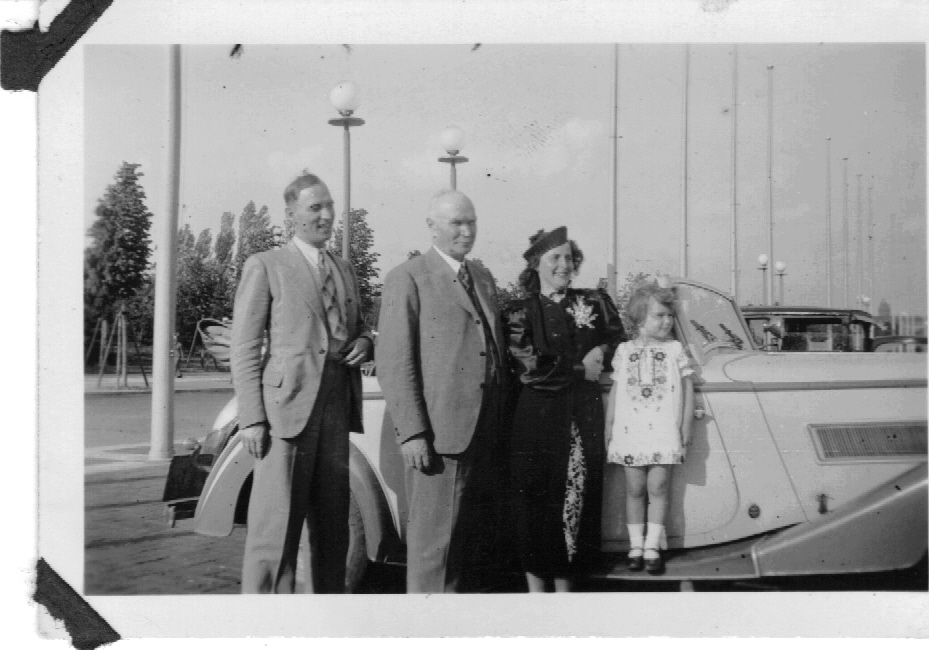
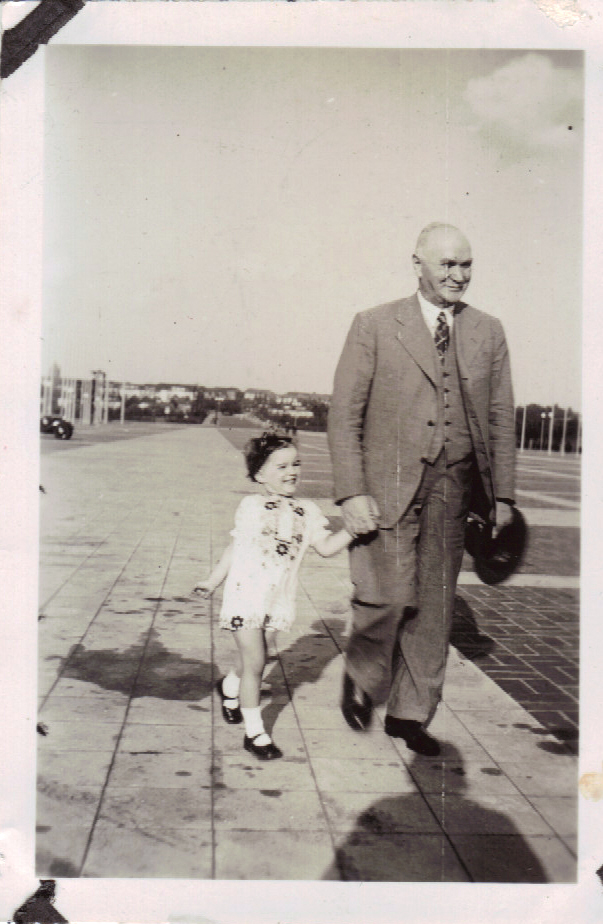
That same month my Dad’s father came to visit. Uncle Adi and Aunty Elsa drove Grandad, Dad and me to the Olympic Stadium  in their huge car. There were some pictures taken in the big square in front of the stadium. I look so very happy walking along with Grandad. Mum didn’t come along with us on that day because she had to stay with little Bodo. I think she kept still to her bed at the time. So it must have been soon after Bodo’s birth which was a planned home-birth. For years to come Aunty Elsa would talk a lot about it how it eventuated. She said coming home from seeing a movie at the cinema she noticed a hanky that had been placed on our balcony so it could be seen from the street. This was the sign, that the delivery of the baby had started and Aunty Elsa got very excited and rushed up to be with her sister. Apparently a midwife had been on call all the time and the delivery went on very smoothly. I never did get disturbed by it and must have been sleeping right through the night in the neighbouring room!

We already had a telephone at the time. To this day I remember our number! I was allowed to answer the phone. I was told to say: ‘Hier bei Dr. Spickermann!’ when answering the phone.

The picture with me beside Mum’s bed looking at Bodo in Mum’s arms shows that my parents’ beds had been seperated for the delivery of the baby. Normally these two beds would have been close together.

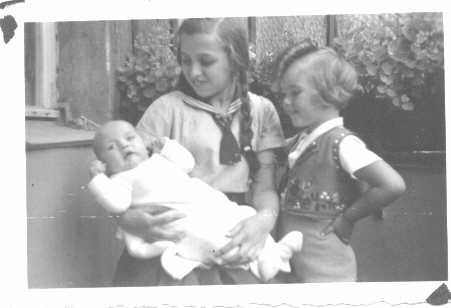
A few months later we had another visitor to Berlin: My cousin Ursula. The picture which was taken on our balcony shows Ursula holding little Bodo and me looking on.

And for good measure I’m going to add a picture of Grandfather and Grandmother from 1934 when I was a little baby.

Before and after the War

Before and After the War

Extracts from my Memories

In 1942/1943 my friends in Berlin and I had often contemplated what life might be like, once we had peace again. Our dreams for the future were very basic. We all wanted to get married and have children. We all wanted our husbands to have occupations that would enable us to live in comfortable houses. My friend Siglinde and I were for ever drawing house-plans. There would be at least three bed-rooms: one for the parents, one for two boys and another one for two girls. Yes, to have two boys as well as two girls, that was our ideal.

Before we married, we would finish school and go to university and our husbands would of course be university educated. In peace-time we would be able to buy all the things we had been able to buy before the war started: Bananas, pineapples, oranges and lemons; all this would be available again! Somehow we knew, we were only dreaming about all this. We had no idea, what would really happen, once the war ended.

I turned eight in September of 1942. Most of my friends were around the same age. My friend Siglinde however was four years my senior, the same as my cousin Sigrid.

After I started high-school, some time after the war had finished, Cousin Sigrid made a remark, that put a damper on my wishful thinking. Sigrid had noticed, that I got very good marks in high-school. So she said in a quite friendly way: ‘I see, you’ll probably end up becoming a Fräulein Doctor!’ This remark made me furious inside. It sounded to me, that once I embarked on becoming a ‘Fräulein Doctor’ I would have no hope in the world of acquiring a husband and children. ‘Who in their right mind would study to achieve a doctorate and miss out on having a husband and children?’ I thought to myself.

Mum, Tante Ilse and Uncle Peter loved to read romance and crime fiction. Most of the books they read were translations from English. Mum and Tante Ilse loved Courts-Mahler, Uncle Peter liked Scotland Yard stories best. They all had read ‘Gone with the Wind’. Even my father, who boasted, he never read any novels, read this one.

I read ‘Gone with the Wind’, when I was fourteen. My father’s sister Elisabeth, on hearing this, was shocked, that my mother let me read this novel. According to Tante Lisa, I was much too young to read something like this. However some of my girl-friends read this book too. They all loved Rhett Butler. About Scarlett the opinions were divided. Personally I did not care for the way she treated Melanie. I thought by constantly making passionate advances towards Ashley, she showed total disregard for Melanie’s feelings. Rhett adored Melanie. He showed her great respect as a person with a noble character. In contrast, he was well aware that Scarlet was anything but noble. Often he found Scarlett’s irrational behaviour highly amusing. Ashley treated Scarlett in a very gentleman like way. Not so Rhett. This impressed my friends. They all admired Rhett! I think, I admired Ashley more. –

Mum and Tante Ilse borrowed books from a lending library. A middle-sized novel cost one Deutsche Mark to borrow for one week, a real big novel cost two Marks. In secret I once read a translation of ‘Amber’. Fascinating stuff this was.

When I read ‘Amber’, I was probably thirteen. I read it only, when I was by myself in the apartment, which happened often enough. I was able to consume the whole big novel without anybody noticing it. I knew, Mum and Tante Ilse had read the book already, because they often talked about it, how good it was. But the book was still lying around at our place. There were a few more days before it had to be returned to the library. I found out, that Amber was a fifteen year old country-girl, who went to London. The time was the seventeen hundreds. Because of her beauty, Amber was able to make it in the world. She had lots of lovers. She always made sure, that her next lover was of a higher ranking than the previous one. That made it possible for her, to climb up the social ladder. – Well, this is about as much as I still remember from that novel.

During the first years after the war we lived like paupers. Still, I realized – maybe a bit to my regret – that there was a big difference between a desperately poor girl from the country and me, desperately poor city girl from a ‘good’ family. I knew then, whether I wanted it or not, I had to put up with an extremely low standard of living for some time yet. And I mean by ‘low standard’ not the low standard that everyone went through during the adjustments after the war, but a standard, where it was necessary for us to get social services payments!

Was I out to enhance my appearance in order to catch a prosperous male as an escort to take me out to fun-parties and adult entertainment? No way! Something like that was just not for me. I felt I was plain Uta who was never invited to go out anywhere with anyone.

Was I really that plain? I wonder. Up to age fourteen I may have had some chances with the opposite sex, given the opportunity. However by age fifteen I had put on so much weight, that I felt to be totally unattractive. I was right, because no attractive male ever made an attempt to woo for my attention, not until I was about seventeen and a half that is. But even then things didn’t change much for me. I honestly felt like some kind of a social freak during most of my teenage years.

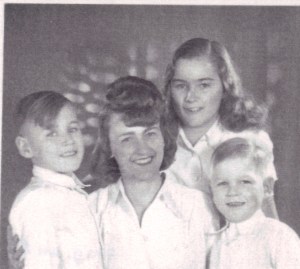
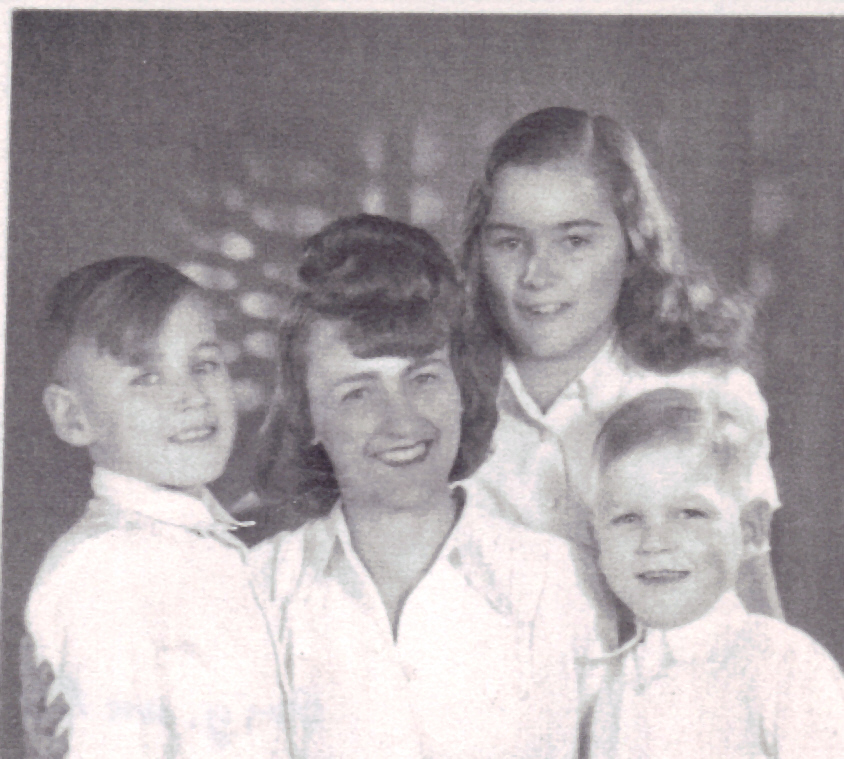
Here is a photo which was taken in 1948 with Mum

and my brothers, who were 7 and 10 years and I was 14.