As far as Greta Thunberg is concerned, I can only say that I feel as emotional as she does about the establishment’s inaction about climate change. Yesterday I did look through a number of YouTube videos that give great information about scientist’s view in regard to the crisis for humanity and the urgency to do something about climate change. I cannot, absolutely cannot understand, why the economy always has priority in our leaders’ thinking over issues to do with climate change. How dare our leaders tell young people ‘not to worry’!!
Here are some examples what scientists say about climate change. These facts, that are stated in these videos, all of us should know about:
The Land Destroyer Report is maintained by Tony Cartalucci, an independent American geopolitical analyst based in Thailand.
Land Destroyer can be followed on Twitter here and Facebook here. Comments, questions, corrections, and article submissions should be sent to cartalucci@gmail.com, or through the Contact LD page.
September 27, 2019 (Joseph Thomas – NEO) – Just as unfolded in 2014 during the so-called “Umbrella protests” or “Occupy Central” movement, a growing backlash has begun across Hong Kong against US-funded protests that have attempted to disrupt governance and commerce as part of a floundering movement to maintain Western influence in the region.
Thailand’s answer to the IMF, and globalization in general was profound in both implications as well as in its understanding of globalization’s end game. Fiercely independent and nationalistic, and being the only nation in Southeast Asia to avoid colonization, Thailand’s sovereignty has been protected for over 800 years by its revered monarchy. The current dynasty, the House of Chakri, has reigned nearly as long as America has existed as a nation and the current king is regarded as the equivalent of a living “Founding Father.” And just as it has for 800 years, the Thai Monarchy today provides the most provocative and meaningful answer to the threats facing the Kingdom.
The answer of course is self-sufficiency. Self-sufficiency as a nation, as a province, as a community and as a household. This concept is enshrined in the Thai King’s “New Theory” or “self-sufficiency economy” and mirrors similar efforts found throughout the world to break the back of the oppression and exploitation that results from dependence on an interdependent globalized system.
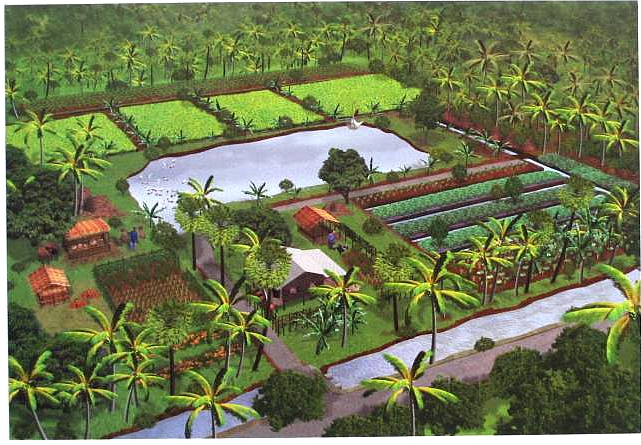
Image: A vision of self-sufficiency in Thailand. Agrarian values and the self-reliance they engender are the hallmarks of real freedom.
….
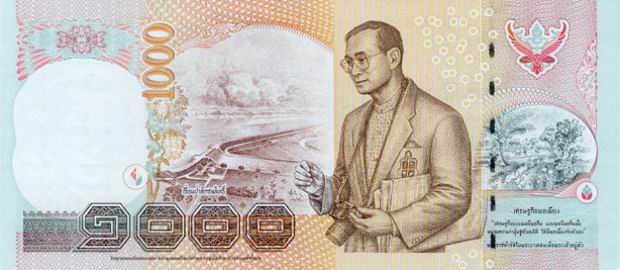
The foundation of the self-sufficiency economy is simply growing your own garden and providing yourself with your own food. This is portrayed on the back right-hand side of every 1,000 baht Thai banknote as a picture of a woman tending her garden. The next step is producing surplus that can be traded for income, which in turn can be used to purchase technology to further enhance your ability to sustain yourself and improve your life-style.
Image: The Thai 1000 baht banknote. Left is one of the many dams controlling floods and producing electricity throughout the Kingdom. Center is the current King of Thailand. Right is a depiction of a local garden providing food in a self-sufficient manner.
….
The New Theory aims at preserving traditional agrarian values in the hands of the people. It also aims at preventing a migration from the countryside into the cities. Preventing such migrations would prevent big agricultural cartels from moving in, swallowing up farming land, corrupting and even jeopardizing entire national food supplies (see Monsanto). Those familiar with the UN’s Agenda 21, and the more recent UN “Climate Change Program,” may understand the deeper implications and dangers of such a migration and why it needs to be stopped.
By moving to the city, people give up private property, cease pursuing productive occupations, and end up being folded into a consumerist paradigm. Within such a paradigm, problems like overpopulation, pollution, crime, and economic crises can only be handled by a centralized government and generally yield political solutions such as quotas, taxes, micromanagement, and regulations rather than meaningful technical solutions.
Also, such problems inevitably lead to a centralized government increasing its own power, always at the expense of the people and their freedom. The effects of economic catastrophe are also greater in a centralized, interdependent society, where everyone is subject to the overall health of the economy for even simple necessities like food, water, and electricity.
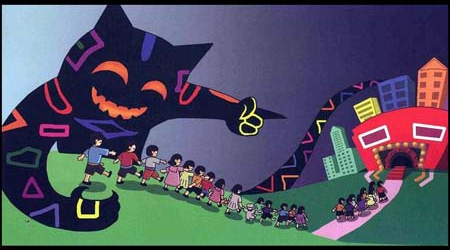
Image: A slide presenting the “New Theory” depicting a manifestation of greed leading the people from their rural private property and into a “city of extravagance.” If Agenda 21 had an illustrated cover, this could be it.
….
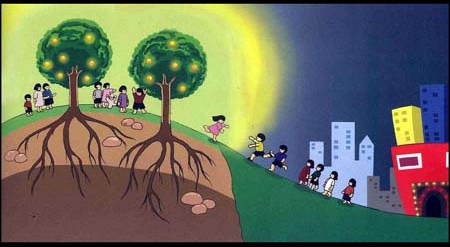
Image: The goal of the “New Theory” is to have people return to the countryside from the cities and develop their communities in a self-reliant manner. It is, in other words, Agenda 21 in reverse.
….
Under the “New Theory,” demonstration stations all across Thailand have been created promoting education in matters of agriculture and self-sufficient living. The program is competing against the contemporary globalization system, which as of now, is mired in many parts of the world with economic meltdown. The relatively self-sufficient nature of Thais in general has weathered this economic chaos fairly well. In 10 years, a plate of food still costs the same amount of money, as do many everyday commodities. This only further vindicates the value of being self-sufficient and now more than ever, in both Thailand, and abroad, it is a good time to get involved and get self-sufficient.
Western corporate-financier interests know what’s going on already and they are moving against it while the majority of humanity still sleeps in ignorance and apathy. Thailand is but one nation of many, in China’s “String of Pearls” that is targeted for destabilization and US State Department sponsored “liberation.”
The key to stopping these foreign interests dead in their tracks is seizing back from them the mechanisms of civilization – and we have done that already in terms of the alternative media. Such success is necessary in all aspects of our life, and as the King in Thailand suggests, it can start with something as simple as growing your own garden.
Today and Into the Future
Of course in Thailand, agricultural self-sufficiency is coupled with technology to enhance efficiency and improve the quality of life. Even in the city, small independent businesses are adopting the latest technology to improve their production, increase their profits, and even out-compete larger corporations. Computer controlled machining equipment can be found in small workshops crammed into old shop-houses, automatic embroidering machines allow a single woman to fulfill orders for name tags on new school uniforms – rather than both businesses sending off orders to factories owned by a handful of wealthy investors. A multitude of examples can be seen walking around any city block in Thailand’s capital of Bangkok.
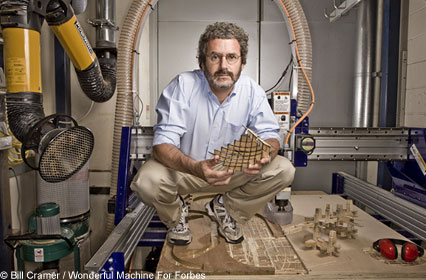
Image: MIT’s Dr. Neil Gershenfeld inside his “Fab Lab,” arguably the birthplace of the personal fabrication revolution.
….
Bringing this sort of technology to rural people, even enabling people to create their own technology rather than just employ it, is not just science fiction but is a reality of today. MIT Professor Dr. Neil Gershenfeld has developed the “fabrication laboratory” or “Fab Lab.” The Fab Lab is a microfactory that can “make almost anything.” His Fab Lab has since been replicated all over the world in what he calls the personal fabrication revolution. It aims at turning a world of dependent consumers into independent designers and producers.’
Video: Dr. Neil Gershenfeld presents his Fab Lab at TED.
….
Dr. Gershenfeld in his own words articulates the problem of finding support amongst institutions and governments, stating that individuals are very enthusiastic about this revolution “but it breaks their organizational boundaries. In fact it is illegal for them, in many cases, to equip ordinary people to create rather than consume technology.”
This indeed not only encapsulates Dr. Gershenfeld’s dilemma, but describes to a “t” the mentality of oligarchs and the fears they harbor about empowering the people, a fear reflected in the “organizational boundaries” of their corporations and governmental institutions. This is a feature of oligarchy described as early as 300 B.C. in ancient Greece in “The Athenian Constitution.” In it, a character referred to as “the Old Oligarch” describes his contempt for the social mobility the technology of the Athenian navy affords the lower echelons of Athenian society.
Dr. Gershenfeld goes on to encapsulate the true potential of his Fab Labs by stating, “the other 5 billion people on the planet aren’t just technical “sinks,” they are “sources.” The real opportunity is to harness the inventive power of the world to locally design and produce solutions to local problems.” Dr. Gershenfeld concludes by conceding he thought such a possibility was 20 years off, but “it’s where we are today,” noting the success his Fab Labs are already having around the world.
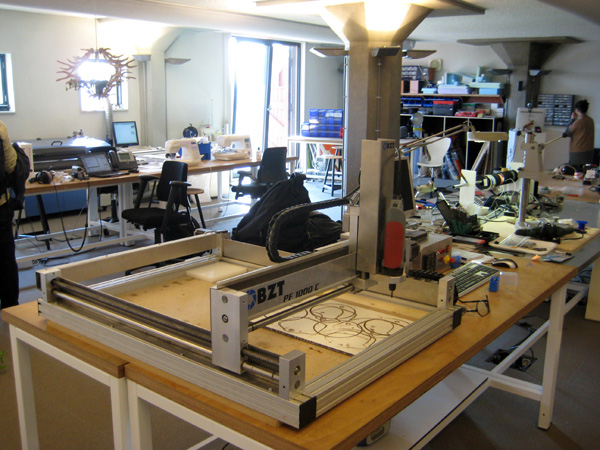
Image: The interior of a “Fab Lab” in Amsterdam, featuring a array of personal manufacturing technology.
….
Dr. Gershenfeld’s message resonates with the current culture of Thailand and the ambitions of the “self-sufficiency economy.” In many ways, Thailand’s patchwork of micro-businesses, already successfully by-passing capital intensive centralized production, vindicates the work and optimism of Dr. Gershenfeld. It also, however, resonates strongly with the self-reliant traditions that had made America great. The technical possibility for this to change the world is already a reality, but Dr. Gershenfeld himself concedes that the biggest obstacle is overcoming social engineering – in other words – creating a paradigm shift in the minds of the population to meet the technical paradigm shift that has already taken place.
Self-sufficiency and the harnessing of technology in the hands of the people are the greatest fears of the corporate-financier oligarchy – fears that oligarchs throughout the centuries have harbored. Simply boycotting multinational corporations and replacing them with local solutions is something everyone can afford to do starting today. And by simply looking into Dr. Neil Gershenfeld’s “Fab Lab,” similar ideas such as “hackerspaces,” raising awareness of the personal fabrication revolution, and even in the smallest way participating can help overcome the obstacle of social-engineering and spur a profound paradigm shift. We have begun to seize back the media, now it is time to seize back the other levers of power. Now is the time to recognize true freedom as being self-sufficient as a nation, as a community, and as a household, and start living it everyday.
I wrote the following in my diary from the 2nd September 2015:
“When I think of my parents, the most remarkable memory about them is, how very different they were. Here is a bit of how my father may have influenced me, and then how my mother’s influence was so very different.
My father was the most open minded and tolerant person. He liked to talk to me about a lot of things. He always treated me as though I was trustworthy and mature for my age, able to understand different points of view. Very rarely did I see him being angry with me. He only tended to be somewhat angry when, all of a sudden, I behaved in a very unpredictable way. Despite his open mindedness he was basically a very conservative man. If I showed signs of departing from his view of the world, this would upset him personally. Still, he was loving and forgiving, and eventually he was always able to accept my departure from some of his conservative views.
Now, my mother was in every way the opposite of my father. On the whole she was maybe rather tolerant as far as I was concerned because she loved me. But she made it very clear, that she did not love my father anymore. She showed not the least bit of tolerance towards him, on the contrary, she showed a lot of hatred, for in her opinion he was a “Versager” who did not do anything for his children. She thought it was not up to her to look after him when he had serious health issues. Maybe she thought he was just pretending. Also, she hardly ever talked to me about things that were important to me. She tended to keep very important things from me, for she wanted ‘to protect’ me! At least, this is how I remember it. I knew she loved me very much. Still, I always felt I was not the daughter she imagined I should be. I remember she telling me, I was an “Oppositionsgeist”. So I must have been speaking up about some things that disturbed me a great deal. I felt very bad for opposing her, but I could not help it. Of course, on the outside I tried very hard to go along with what she expected of me, just to keep the peace. Alas, I think I came into inner conflict about it. In short, I often did not feel happy about myself.
I ask myself now, how come, when I felt very much loved by both parents, I still did not feel very happy in myself a lot of the time? I think I felt torn between my parents . . . . ”
“Mum kept a big photo album with pictures of me. Growing up, I always liked to look at all these pictures. However, I remember distinctly that the following pictures annoyed me quite a bit. I felt awful that the pictures showed me being so very plump! When I was told I looked ‘cute’ I tended not to believe it. I was self conscious at an early age and mostly didn’t feel ‘cute’ at all. I still often don’t like my picture taken because I think I might look awful! The adults in the pictures are my Mum, Tante Ilse and Onkel Addi. I wonder who took the pictures with all three adults in it. Was it perhaps my father? Pussi was Tante Ilse’s dog. Apparently I loved carrying this dog.
My father, Alexander Spickermann, was born in Lodz on the 13th of May 1904. The following picture of him was taken in about 1916. This is the earliest picture I have of him. Alexander’s brother Edmund Spickermann, was born in 1902. Both brothers studied in Leipzig, Germany. The following pictures are from 1925 in the city of Leipzig. There is first Alexander and then Edmund. Both brothers are in their student outfits. And then there is a picture of both of them in front of the Völkerschlacht-Denkmal in Leipzig.
Alexander and Charlotte are my parents. They were married on the 25th of September 1930. Earlier that year, that is in 1930, Alexander promoted to Dr. phil and Edmund to Dr. rer.pol. The above picture is from 1925 when Alexander and Edmund first met Charlotte and Ilse. Charlotte was only fourteen years old at the time. Her sister Ilse was eighteen. Below is my parents’ wedding photo from the 25th of September 1930. (Charlotte was born on the 23rd of March 1911 and Ilse on the 27th of February 1907).”
My parents’ weddig photo: 25th September 1930
My parents lived apart a lot of the time during and after World War II and then divorced after having lived apart for many years.
Mum and her sister Ilse in June 1940
Mum with me and my brothers Bodo and Peter Uwe in 1947
Trump says future belongs to “patriots,” not “globalists,” in U.N. General Assembly speech
BY KATHRYN WATSON
/ CBS NEWS
President Trump’s third address to the United Nations General Assembly was an unmistakably nationalist one, with the president reiterating the theme of his foreign policy doctrine, that all nations should be looking inward and considering their own interests first.
In a sober, scripted speech Tuesday, he focused more on criticizing other nations that he believes treat the U.S. unfairly than on uniting nations around principles of democracy and humanity.
The president hit on each of his favorite themes — unfair trade, imbalanced defense spending, illegal immigration, and socialism — reading from the teleprompter in a somewhat subdued manner.
“The future does not belong to globalists. The future belongs to patriots,” Mr. Trump said in one of the defining quotes of his more than 30-minute speech.
He singled out Iran for criticism, saying that the country deserves a government that cares about jobs for its people and for decreasing poverty. Mr. Trump said that after four decades of failure, it’s time for Iran’s leaders to stop threatening other countries and build up their own country.
But he followed up his critique with words of peace, stating that the U.S. is ready to embrace friendship with those who seek it, and it “has never believed in permanent enemies.”
“America knows that while anyone can make war, only the most courageous can seek peace,” he said.
His address came amid heightened instability in the Middle East, following the recent attack on Saudi oil facilities that the U.S. believes was carried out by Iran.
Mr. Trump also listed his complaints against China, including its “massive market barriers,” product dumping practices and forced technology transfers. He railed against the World Trade Organization for failing to compel China to liberalize its economy and called for “drastic change” to the international trade system. The second-largest economy in the world, he said, should not be allowed to declare itself a developing country at the expense of others.
Earlier updates on the president’s day at the U.N. appear below.
Trump says U.N. has great potential
Mr. Trump, speaking at a lunch hosted by the U.N. secretary general, said he’s always suggested the U.N. has a lot of potential, either for war or for peace. But now, the U.N. is demonstrating great potential for peace, he said.
Then the president raised a toast, although he doesn’t drink himself.
Trump says India’s Modi is like Elvis to Indians
Mr. Trump praised his “chemistry” with Indian Prime Minister Narendra Modi during a bilateral meeting with Modi. Modi, Mr. Trump remarked, is like “Elvis” to Indians.
“My personal chemistry is as good as it can get” with Modi, the president said, adding later, “Maybe he’s the father of India.”
Mr. Trump said he thinks Modi and the Pakistani Prime Minister Imran Khan can work out a solution to Kashmir, but ignored American reporters’ questions about Kashmir. Mr. Trump praised Indian reporters present instead, taking their less pointed questions.
“You have great reporters. I wish I had reporters like that,” Mr. Trump said.
Trump says Boris Johnson isn’t going anywhere
Mr. Trump, in a meeting with British Prime Minister Boris Johnson, said his British counterpart isn’t going anywhere. Their meeting came after the U.K.’s Supreme Court ruled Johnson illegally suspended Parliament. Jeremy Corbyn, leader of the Labour Party, called on Johnson to resign.
Johnson, asked about the ruling, replied that he respects the judiciary even though he disagrees with its decision.
“I disagree profoundly with what they had to say,” Johnson said, adding that the U.K. needs to “get on” with Brexit.
President Trump called that question from a reporter “nasty.”
Mr. Trump, who joked that Johnson is having an easy time with his job, said he has no response to the ruling.
“I had no reaction,” Mr. Trump said. “I just asked Boris and for him it’s just another day in the office.”
During that bilateral meeting, the president also continued to defend his phone call with the Ukrainian president after admitting he brought up the Bidens and foreign aid during the call.
Trump concludes his teleprompter address
At 10:49 a.m., the president concluded his address which he read from the teleprompter, and delivered with little inflection in his voice.
The president received some applause upon concluded, although his audience of world leaders remained quiet as he spoke.
Trump says his administration is working to stop the criminalization of homosexuality
The president said his administration is working to stop the criminalization of homosexuality across the globe, although he didn’t give examples. It’s critical that LGBTQ people be protected, he said.
The Trump administration has often been criticized for its policies affecting LGBTQ people domestically.
Mr. Trump also insisted the U.S. is working to ensure women across the globe can have the same rights as men to own and inherit property, travel freely and access credit.
Trump uses Venezuela “nightmare” to blast socialism
The president said the U.S. is watching the Venezuela situation “very closely.” The Trump administration has long insisted the Maduro regime will be outside soon, but despite months of sanctions and support, that has yet to happen.
Mr. Trump, as his administration often does, used Venezuela as a tool to blast socialism. Socialism only benefits the ruling class, he said.
The Trump administration and Trump campaign has looked to label all Democratic presidential candidates as some variety of socialist, although Mr. Trump didn’t bring up any of his potential rivals in his Tuesday morning address.
Trump says open-border activists promote “cruel” and “evil” policies
Mr. Trump then hit on another favorite topic of his — illegal immigration.
He suggested the U.S. won’t tolerate illegal migration, and said those who promote open-borders policies are only promoting smuggling and abuses of human rights.
Mr. Trump insisted those who promote “open-borders” policies are only promoting “cruel” and “evil” policies, cloaked in the guise of social justice.
He said that as long as he’s president, the U.S. will enforce its laws and protect its borders. Anyone who enters illegally, he said, will not be allowed to stay.
Trump urges other nations to join U.S. in pressuring Iran
The president then moved on to Iran, urging other nations to join America in cutting the nation off financially.
The Trump administration blames Iran for the recent strikes against Saudi oil facilities.
“All nations have a duty to act,” Mr. Trump said. “No responsible government should subsidize Iran’s bloodlust. As long as Iran’s menacing behavior continues sanctions will not be lifted. They will be tightened.”
But the president made no new specific threats and did not mention any potential military options. The Pentagon announced at the end of last week that the U.S. would be sending troops to aid Saudi Arabia in a defensive posture.
Trump says U.S. seeks “justice” with China
Mr. Trump then went on to criticize China over its trade practices, with China’s representative looking ahead toward him.
The president said China’s “abuses” have been “ignored” or “encouraged” for years.
“Globalism exerted a religious pull” on many nations’ leaders, Mr. Trump said, making them overlook their own national interests.
Mr. Trump said “hopefully” the U.S. and China will strike a fair deal, but he won’t accept anything less.
“I will not accept a bad deal for the American people,” he vowed.
The president also brought up Hong Kong, saying the world expects China to uphold its agreement.
“We are all counting on President Xi as a great leader,” he added.
Trump emphasizes nationalist approach to trade and defense
Mr. Trump, who has long emphasized the importance of fair trade and every allied nation paying their fair share for defense, did so again on Tuesday.
The room was quiet as the commander-in-chief hit those central themes.
Trump blasts “globalists,” says future belongs to “patriots”
The president, introduced as “his excellency,”began speaking at 10:13 a.m.
Mr. Trump said the current time is one of “high stakes” and “clear choices.”
The president said the essential divide is the choice between those who have a thirst for control, and people and nations who want only to rule themselves.
Mr. Trump then went on to say the U.S. is the most powerful nation with the greatest military, and he hopes America never has to use that power.
“The future does not belong to globalists. The future belongs to patriots,” the president said.
Trump defends temporarily withholding Ukraine aid
President Trump, when asked about his decision to block aid to Ukraine shortly before his call with Ukrainian President Volodymyr Zelensky, he said he “wanted other countries to put up money.”
“We paid the money,” he said, arguing that other European countries should help Ukraine with its defenses. “That’s been my complaint from the very beginning,” Mr. Trump added.
And in language that echoed his sentiment about the 2016 Russia investigation, Mr. Trump decried the Ukraine controversy as a “witch hunt” when addressing reporters shortly before his speech before the United Nations General Assembly.
He again described his call with Ukrainian President Volodymyr Zelensky as “perfect” and maintained that he had applied no pressure on him to investigate Joe and Hunter Biden.
“But there was pressure put on with respect for [Joe] Biden’s son,” he argued. “That’s something they should be looking at,” he said.
Excerpts of the president’s speech
The White House sent along a few lines of the president’s prepared speech before delivery. In the speech he plans to return to themes urging countries to act in accordance with their own interests above all. He’ll also call for reform of the international trade system and will state that the U.S. seeks peace and cooperation.
The excerpts follow:
“If you want freedom, take pride in your country. If you want democracy, hold on to your sovereignty. If you want peace, love your nation.”
…
“At the center of our vision for national renewal is an ambitious campaign to reform international trade. For decades, the international trading system has been easily exploited by nations acting in bad faith. As jobs were outsourced, a small handful grew wealthy at the expense of the middle class.”
…
“The United States does not seek conflict with any other nation. We desire peace, cooperation, and mutual gain with all. But I will never fail to defend America’s interests.”
…
“When you undermine border security you are undermining human rights and human dignity.”
…
“Love of our own nations makes the world better for all nations.”
Trump to address China, Iran and Venezuela
Counselor to the president Kellyanne Conway told Fox News Tuesday morning that the president will focus on putting America’s policies first in his speech.
The speech, which she described as “very powerful” will include discussing China and Iran.
The president will also bring up Venezuela, according to a senior State Department official.
Christina Ruffini contributed to this post.
Trump’s Ukraine call
Mr. Trump’s presence at the U.N. General Assembly has so far been dominated by questions about a phone call this summer with Ukrainian President Volodymyr Zelensky, in which Mr. Trump confirmed he discussed former Vice President Joe Biden and aid to Ukraine. Indeed, his most anticipated meeting at the U.N. is the one he’ll have on the sidelines of the General Assembly with Zelensky.
On Monday, Mr. Trump denied that he ever pressured Zelensky and threatened to withhold funding from Ukraine, and when he was asked about whether he’d be willing to release a transcript of the call, he said that he hoped reporters would be able to see the transcript, although he also said he’d “rather not do it, from the standpoint of all of the other conversations I have.”
He offered this prediction to reporters about the transcript: “You’ll be very disappointed when you see it.”
Today, I looked at some of my old blogs. I like this picture blog very much. It brings back beautiful memories. This is why I copy it here together with a few other blogs.
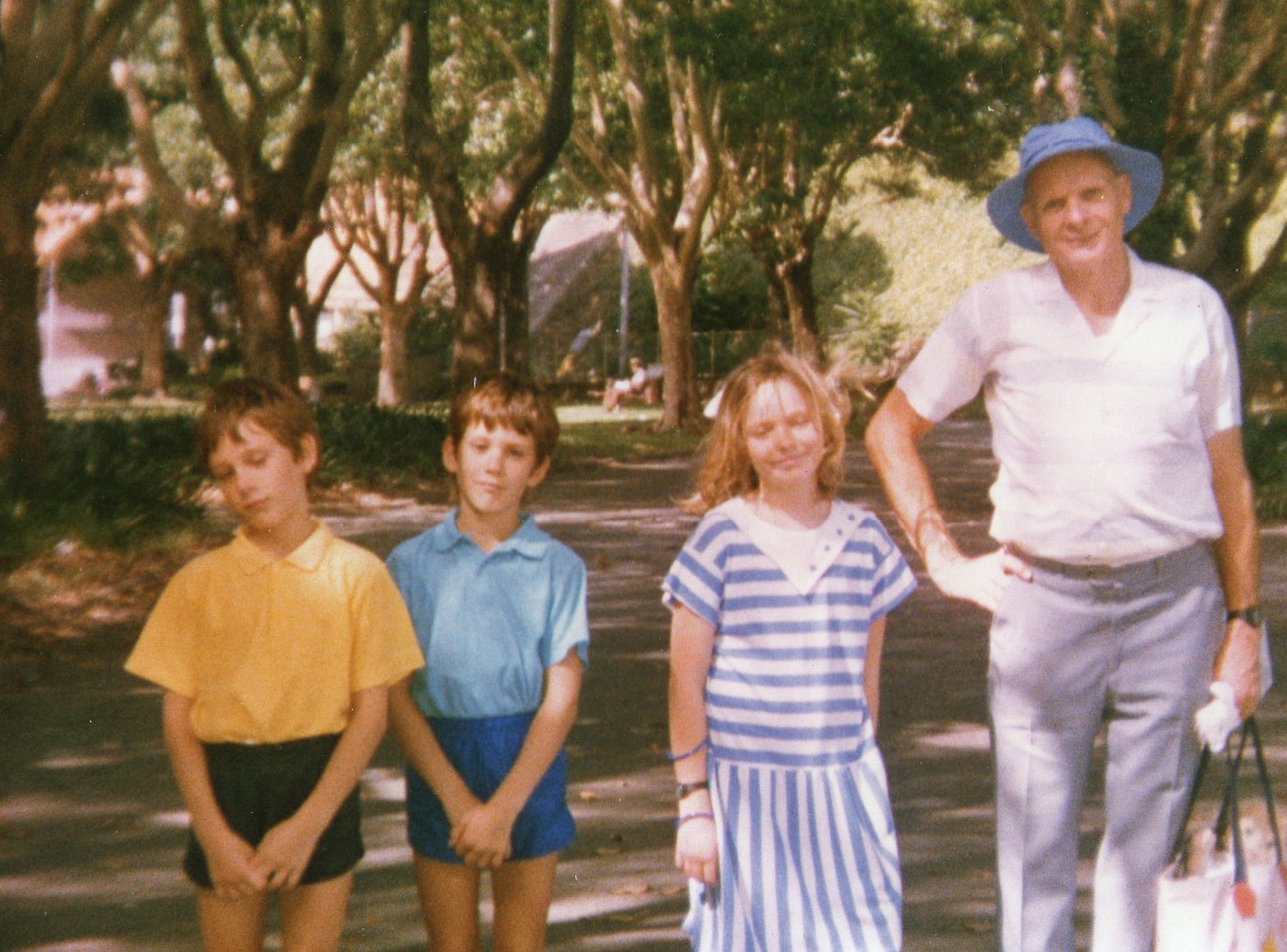
In this picture Peter and I are with all our four children. Daughter Caroline stands next to Peter. All five children of daughter Monika are in the picture too! Her very tall twin sons are eighteen, her two little daughters in the front are Natasha and Roxanne. Well, this was more than sixteen years ago!
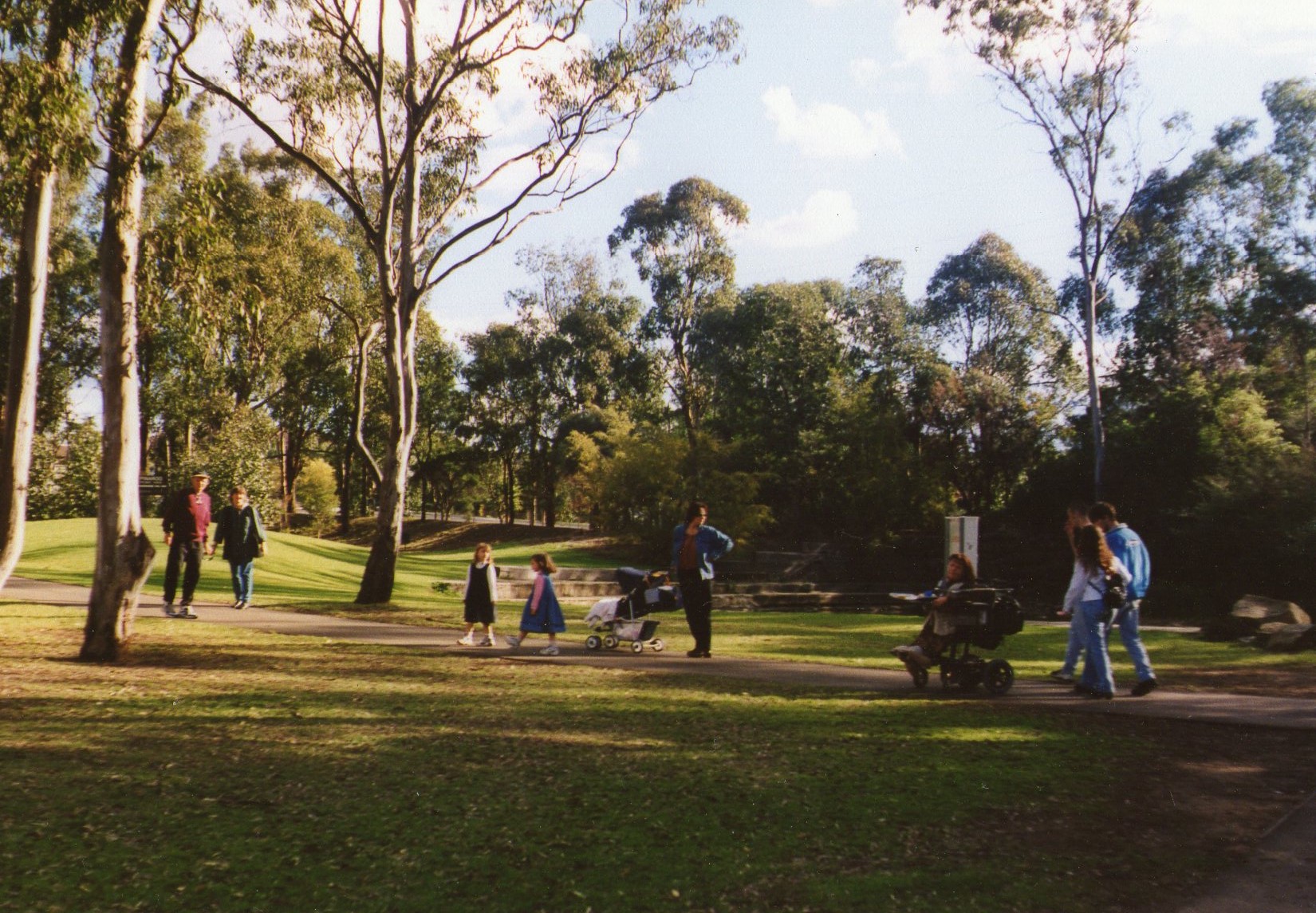
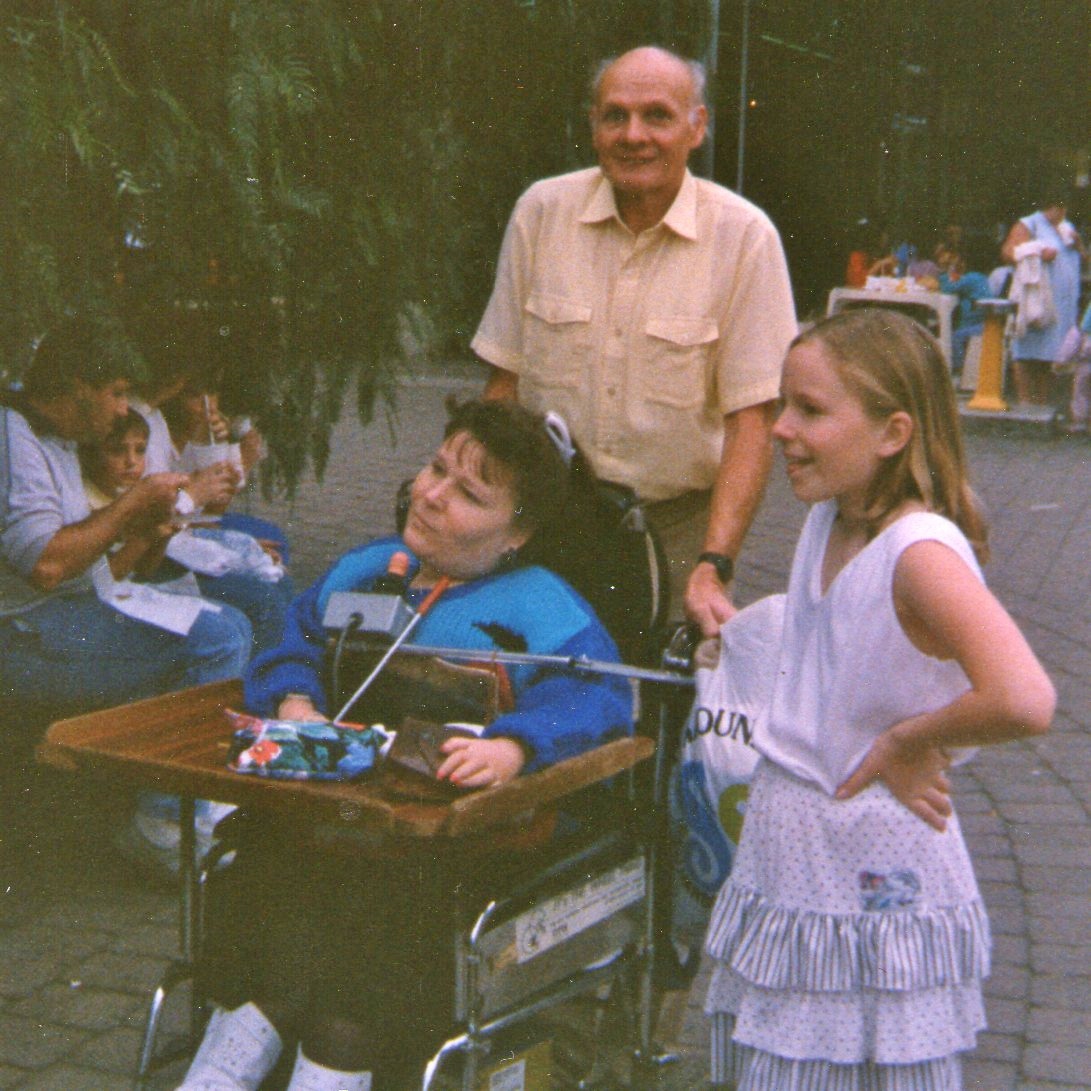
This picture was taken at the beginning of September 1997, a few days after our daughter Gaby’s 40th birthday! We all met for a picnic lunch at Central Park in Merrylands near Gaby’s and David’s home. David, Gaby’s carer, stands in the middle of the photo behind Gaby’s wheelchair. Our son Martin (who’s holding onto the wheelchair) lived in Newcastle at the time and had come to Sydney to see us all. Merrylands is a Western Suburb of Sydney. The Central Park there is a very popular recreational place.
Our daughter Monika holds Krystal, her five months old baby daughter. Gaby and Martin are in the picture too.
In the picture below Troy, who is one of the twins, walks with his girlfriend.
Ryan, the other twin, as well as Caroline, Martin and David presumably walked ahead.
However one of them must have taken this picture, right? Maybe Caroline?
After our picnic lunch we all walked right through the park towards the little waterfall. It looks like at the time there was still quite a bit of water to be seen. Sadly, after a few years without much rain, there was no water left in this area. When we took a picture there two years ago, everything looked completely dry. Maybe in the meantime the water situation has improved somewhat. We should go there one day and have a look.
Here we are with Monika’s daughter Natasha on that day in early September 1997.
Recently I reflected a lot on our past two overseas travels. One trip to Berlin we did five years ago and another one two and a half years ago. When we travel we always try to economise, meaning we are not out to stay in expensive hotels or visit restaurants that are well above our budget. The greatest extra expense we consider to be the air-travel ticket plus insurance. Since both Peter and I are going to be past eighty when we travel next time the insurance is going to be sky high! We usually book a flight well in advance and look for special offers. The last two times we did fly with Malaysian Airline from Sydney to Kuala Lumpur and from there we had connecting flights with KLM. We thought these flights via Kuala Lumpur were pretty good. Soon we want to find out what’s on offer for next year.
2016 is going to be a huge family reunion in Berlin. Our Australian family is already planning for all this. Some members in our family have never been to Berlin yet and are very keen to get to know a bit about the city and the German family members who live there. Especially Peter’s sister Ilse is very hopeful that a large family meeting can take place next year in Berlin. She and Finn are already thinking about all the arrangements that can be made. One of our grandsons is busy making plans about all the destinations where he and his family intend to travel to. He worked out that a nine day stay in Berlin could be included. They also want to stay for a few days in London and maybe some days in Switzerland, and I think there was also talk about Paris.
When Peter heard that they plan on staying for nine days in Berlin, he soon thought about a number of places he could show them in Berlin. Peter knows Berlin very well, partly from personal experience but a lot he knows because he keeps himself always up to date on the internet about what is going on in Berlin. When it come to history, he can tell you a thing or two about Berlin’s history as well. The past few days he published memories about the last days in Berlin before the end of World War Two. You can look it up under:
There are diary entries of Peter’s mother which he translated. Also, Peter’s own comments about these eventful days continue for several days.
It is amazing how much Peter remembers about this time seventy years ago. This was just a few days before he turned ten! He also likes to read up on official records about the last days in Berlin before the end of the war, and he is also always looking for relevant pictures from that time.
Today I wanted to write about our overseas travels. So I checked what, I had written about it before. Luckily, I was able to find quite a bit of information under the title ‘Memories from August 2010’. (There is a link at the top of this post!)
Anyone who goes to this post from 2010 is going to find out that even by 2010 we had done already quite a bit of overseas travelling. In the meantime we travelled overseas two more times, namely in 2012 and then in 2016.
Living in Australia and having some family in Germany makes us want to travel overseas as often as possible. So far we had the good fortune of being able to use all this airline travel. On top of it, Airlines do still offer low price airfares!
At least a few people must be aware by now, that air travel is extremely bad for the environment. But how many people do actually try to avoid air travel these days as much as possible?
In 1990 we did do a trip around the world. I wrote about it here:
Our first trip overseas was in 1977. Caroline was born in December 1978. We travelled with Caroline to Berlin in November 1980 and then again in March 1986 when Caroline was seven.
In 1977 Peter and I visited my cousin Renate and her family in Munich. From Munich we did a day trip to visit my uncle Edmund and his wife Flora in Augsburg. Among other things we visited with them the Augsburg Fuggerei. For lunch they invited us to the close by FUGGEREI STUBE.
In 1977 we travelled a bit around Western Germany staying with family and friends. But most of the time in 1977 we spent visiting our family in Berlin.
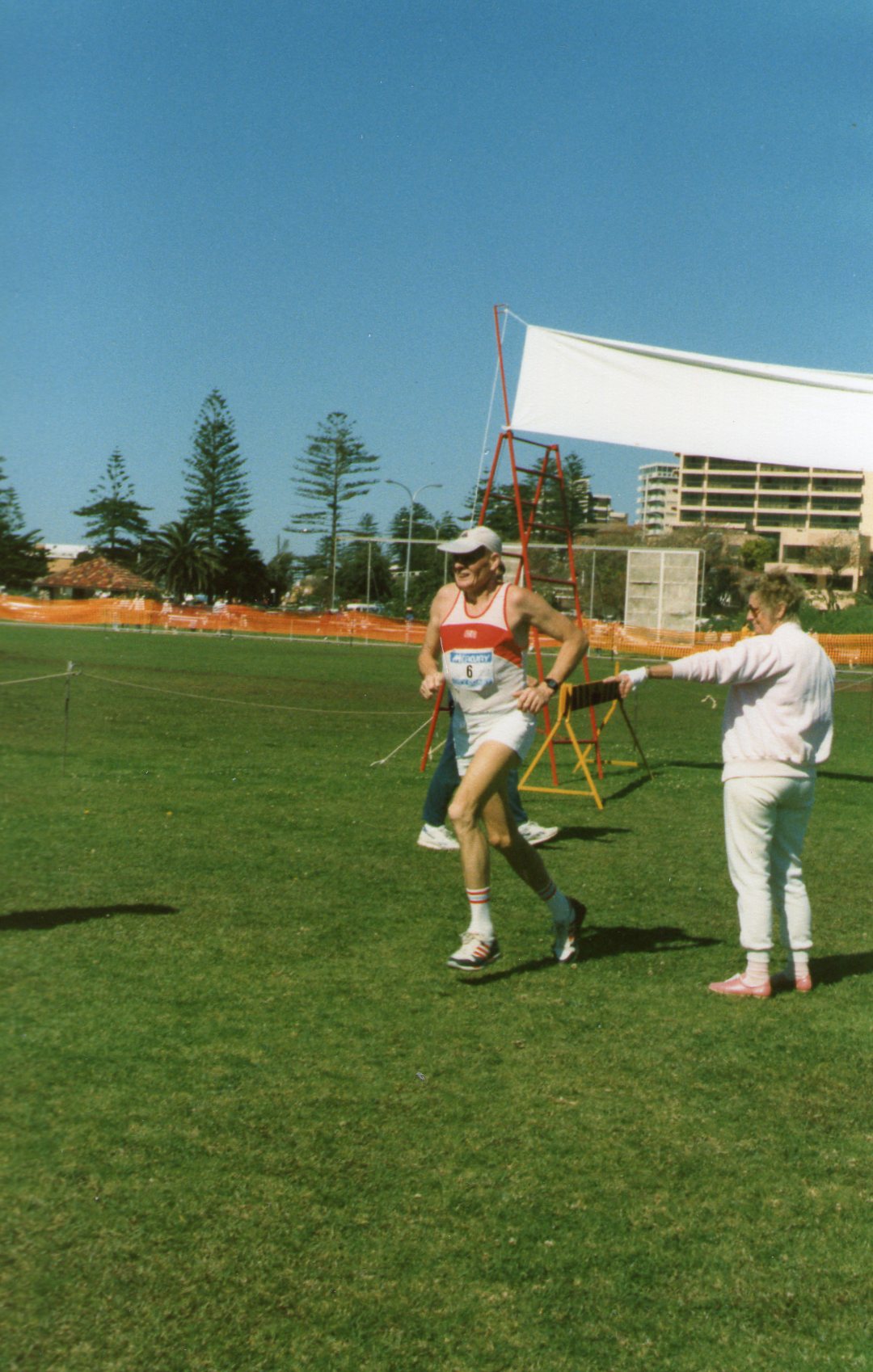
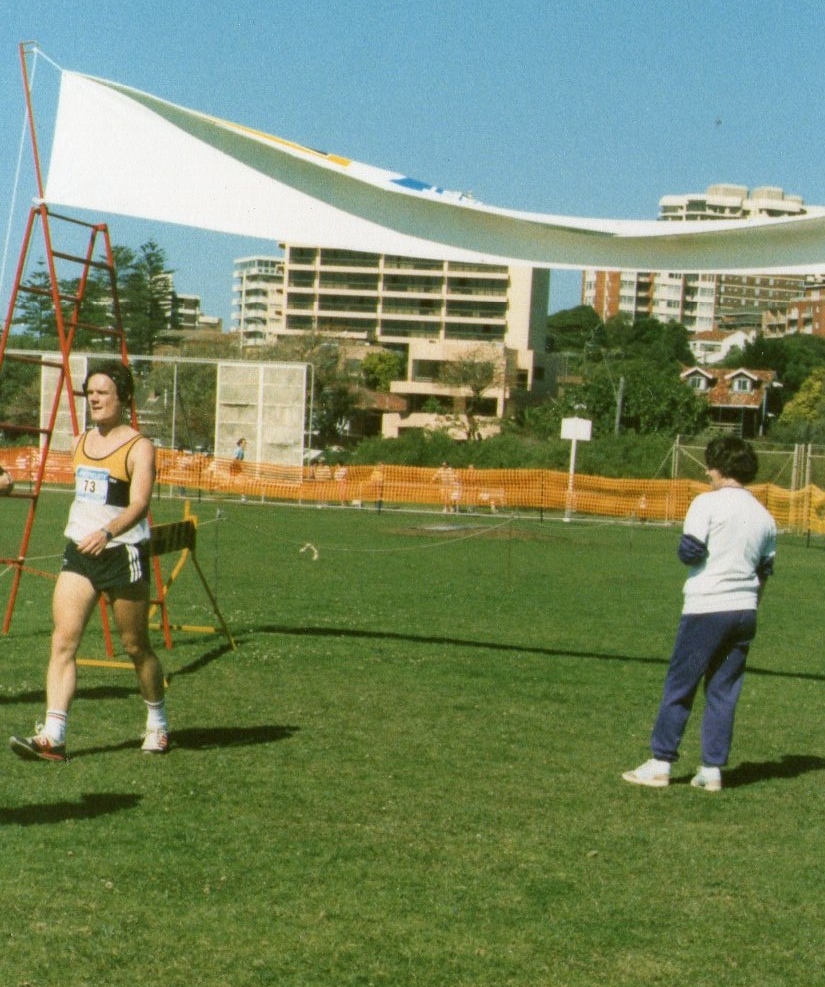
Half Marathon finishing at Stuart Park, Wollongong, 23-8-1987
Peter is still in full flight after 1hr27:33, which is his best time so far.Martin goes across the finishing line.
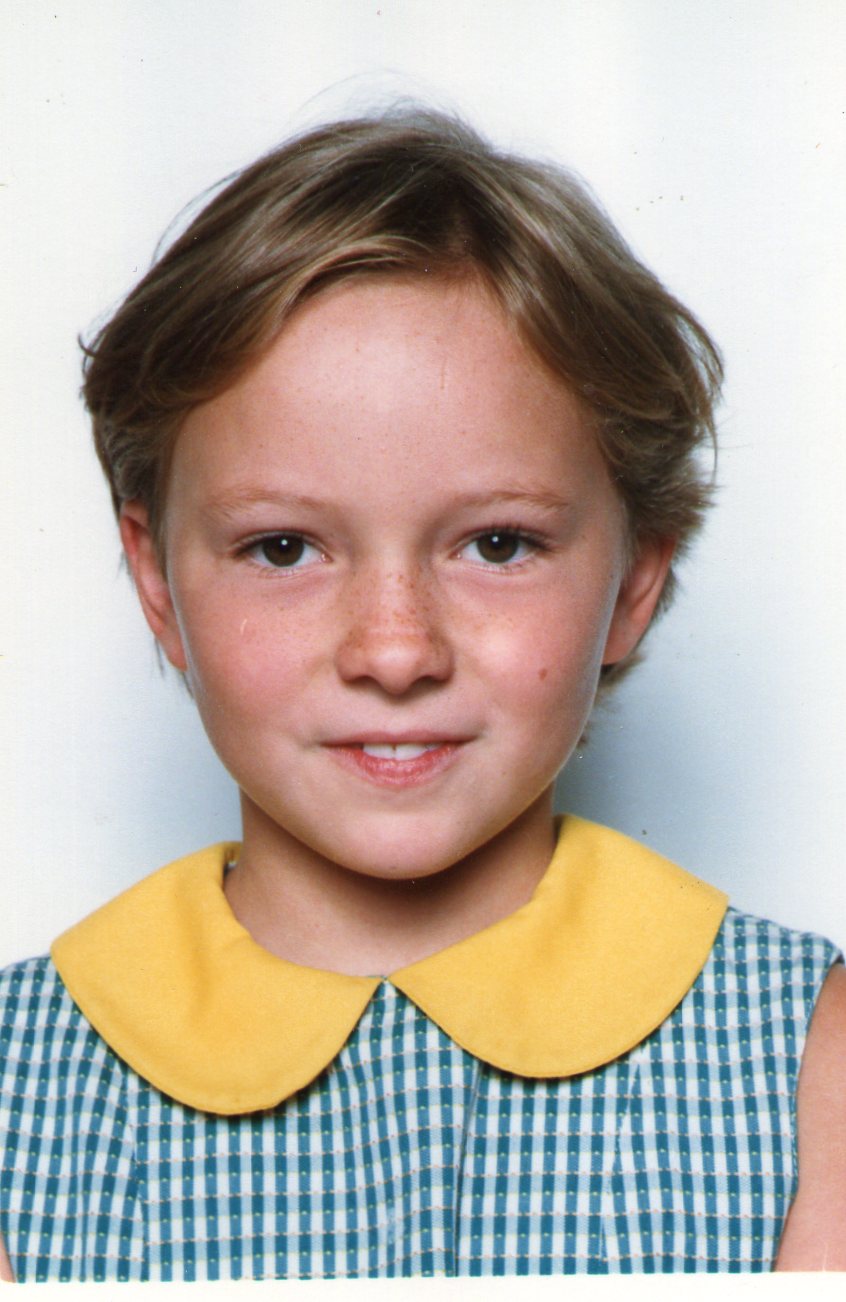
This is a school portrait of Caroline from 1987 that she sent to her grandmother in Berlin.
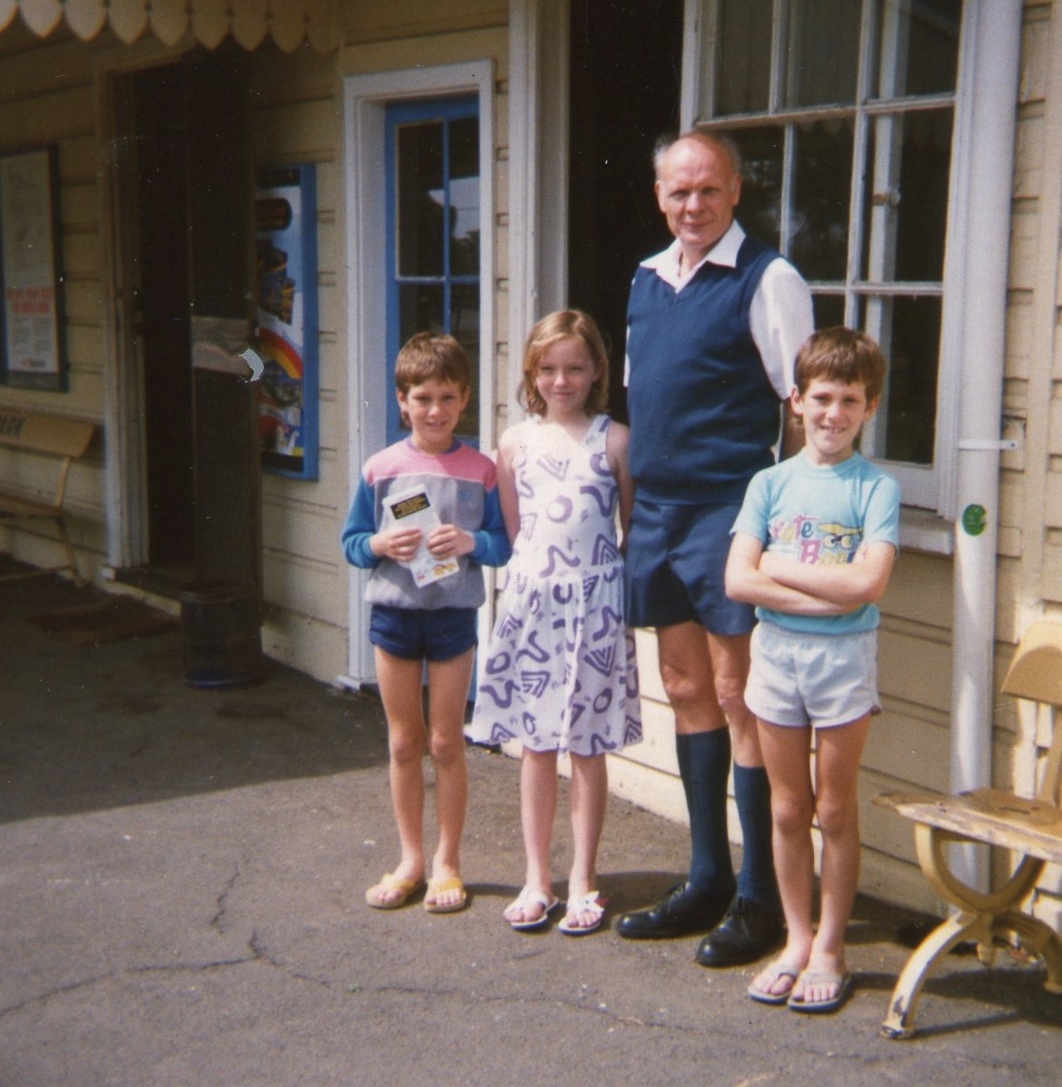
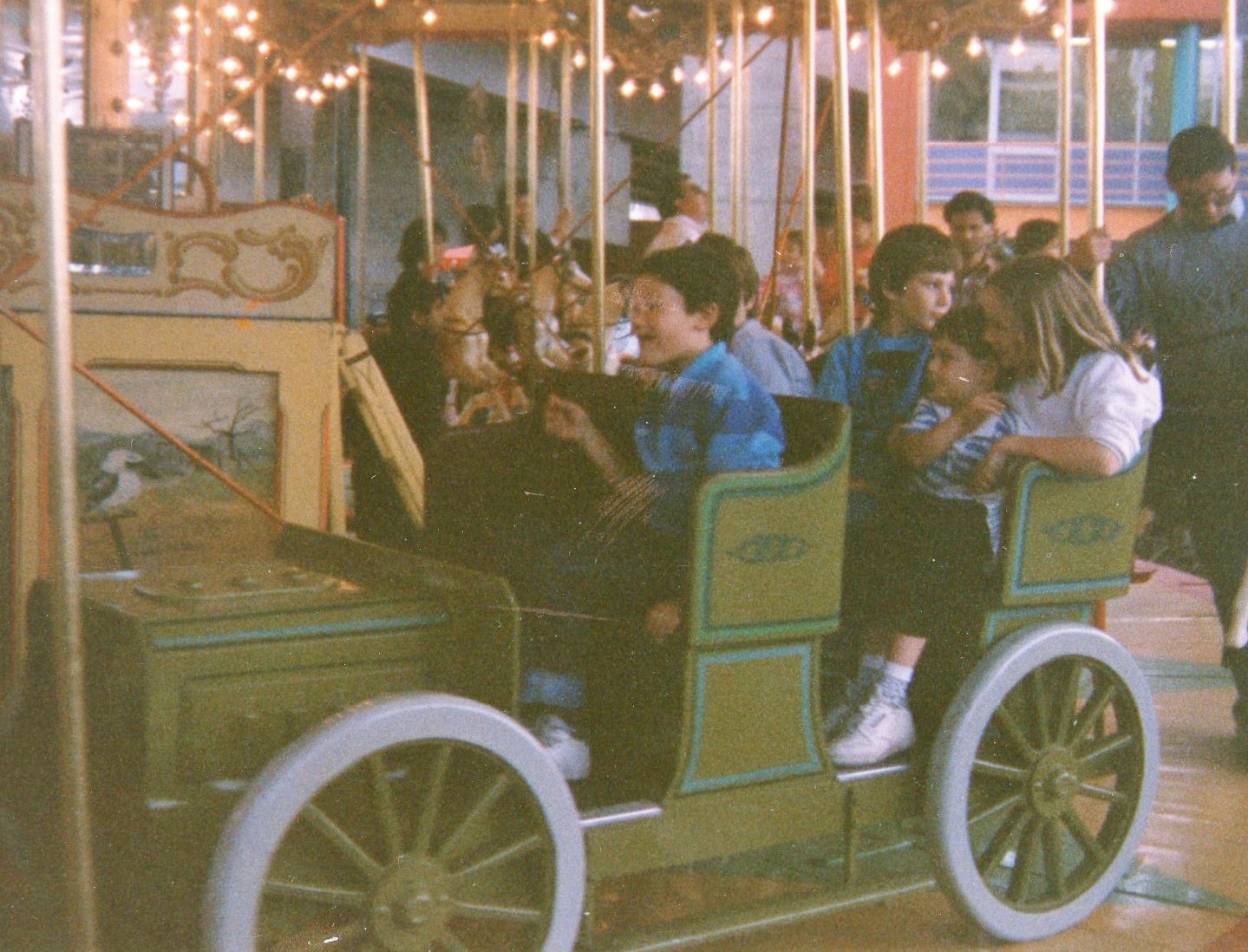
On a Sunday in 1987 this picture was taken at Albion Park Station by an enthusiastic passenger: Peter with Caroline and the Twins.Tristan is two and a half years old riding his bike at Ashfield, Dec. 1987Christmas Eve 1987 at David’s Parents Place.
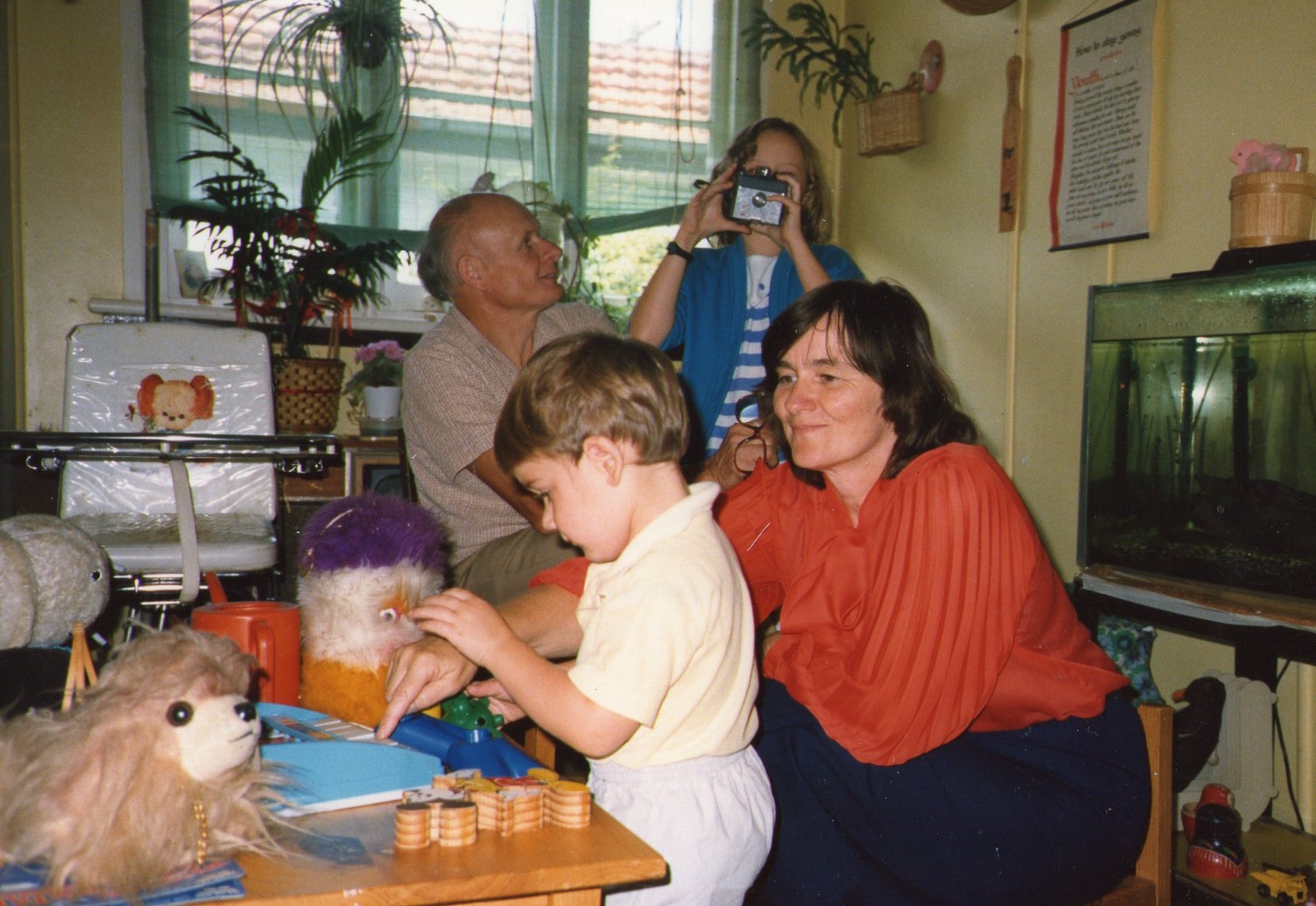
Caroline tries to take a picture of Tristan playing, Peter looking on. Grandma Uta enjoys watching Tristan.
Peter with Caroline and the twins at Belmore Park in Sydney. Dec.1987This is already May 1988. It is Peter’s Birthday!
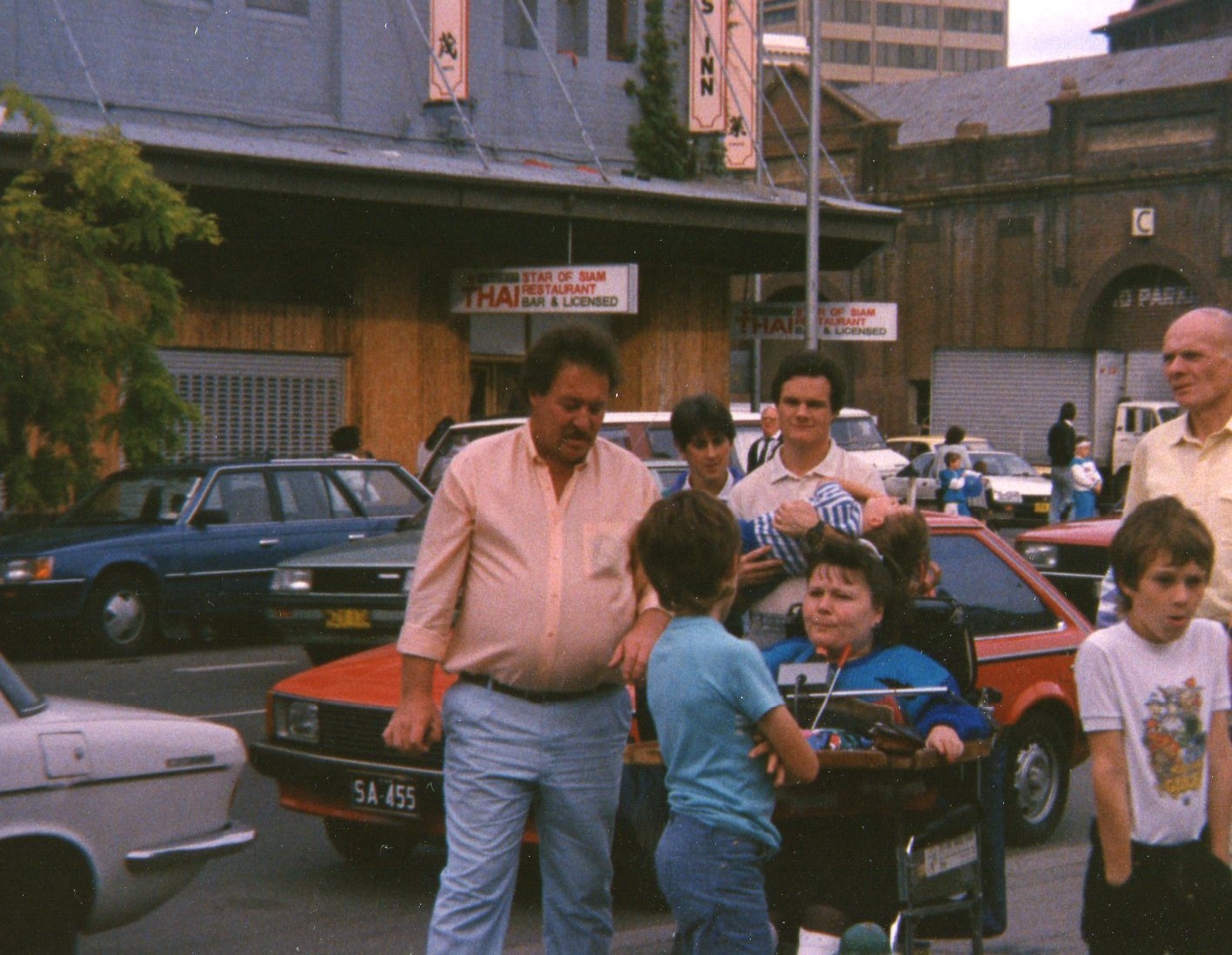
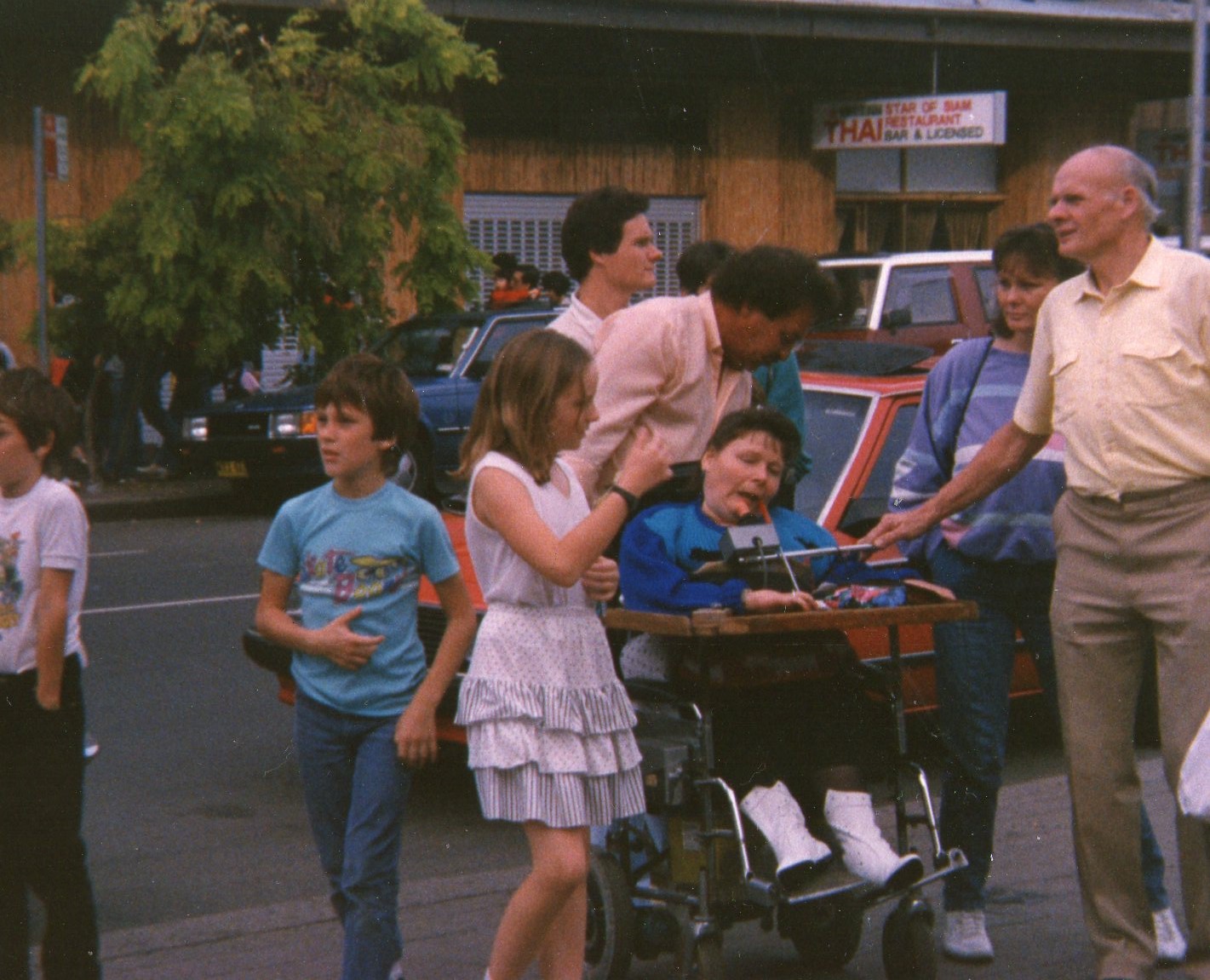
We have Lunch at Chinatown in Sydney for Peter’s Birthday.Caroline, Tristan and also Troy and Ryan enjoy a ride at Darling Harbour.
Another photo from Peter’s Birthday. Tristan is already very tired.Gaby and David go back to Merrylands West in a Wheelchair Taxi.
After reading my account regarding the lucky escape from the bombs in 1945, two of my grand-children had a few questions. One asked, whether there had been a lot of noise, when the bombs came down, the other one wanted to know, which song little Peter had been singing, when we were bombed. And had the lights gone off?
Well, we always had some candles handy, in case the lights would go out. On this occasion for sure the lights all went out instantly. The noise was horrifying as the bombs hit us. It was such a terrific noise that nobody could be in any doubt, our house had been hit this time. In the quiet that followed and before people started to move around to look for an escape, they did light a few candles.
Five bombs had hit our building in quick succession. Immediately afterwards it was absolutely quiet. That meant, there were no more planes in the air. What if the last plane, that was around, just had to get rid of the last five bombs before flying back to follow the other planes who were on their way back already?
As far as little Peter’s song is concerned, I think it was probably the song about little Jack who wanders off into the world and his tearful mother stays behind. After seven years the boy thinks of his mother and very quickly runs back home.
This is a fictionalised incident I wrote some time ago about how the bombs were dropped onto the house where my grandmother lived and where we stayed at the time!
“Damned, the chute is jammed!”
“Hurry up, hurry up, we must go back!”
Finally the bombs are released: All five of them are dropped close together in a residential area. The plane with three men on board follows the other planes. It is April 1945. Today most bombers make it safely back to England. It is their lucky day.
The five bombs hit a house in Sophien Strasse in Leipzig. They ripped apart a solidly built five story residential building.The whole building is completely gone, except for the groundfloor: Bits and pieces of the ground-floor are still standing! Even some completely undamaged furniture can be seen somewhere on the ground-floor.
The rest is just loads of rubble near the road in the front and also in the back. Where the entrance to the building used to be, there is just an immense heap of debris. It looks like nobody would have come out from under there, if this is where the entrance to the people’s air-raid shelter had been.
Miraculously everyone did come out from under all that debris. The cellar-rooms were not damaged at all. One of the cellar-rooms had a window out to the street, which was not blocked at all and people were able to get out through there.










 AuntyUta