“Don’t Worry, Life Is Easy” by Agnès Martin-Lugand. Also my Opinion on Gay Marriages

This book can be downloaded and read in iBooks on your Mac or iOS device.

https://itunes.apple.com/au/book/dont-worry-life-is-easy/id1159625953?mt=11


“Description

Now in Paperback: The much-anticipated, bestselling sequel to the international phenomenon Happy People Read and Drink Coffee.

Diane needs to start over again. After returning from Ireland and turning the page on her stormy relationship with Edward, the brooding Irish photographer, she is determined to rebuild her life in Paris with help from her best friend Félix. She focuses solely on getting her literary café back on track-until she meets Olivier.

He is kind and thoughtful, and she may have a future with him…until she stumbles across her former love at a photography exhibit. What is Edward doing in Paris? Why didn’t he reach out? Faced with a hail of questions, her old flame remains cold and unresponsive. Apparently, he, too, has moved on.

In order to put the past behind her, Diane must go back over her tracks. Ireland saved her before. Can she get answers there and find peace again?”


I got the above book from the local library and enjoyed reading it very much. When I can find  “Happy People Read and Drink Coffee” I am going to read this too. However I find it is all right too to just read   “Don’t Worry, Life Is Easy”  without having read “Happy People Read and Drink Coffee” .

Above I copied the

iTunes Preview of  “Don’t Worry, Life Is Easy” 

Several people are mentioned: Diane,  Félix , Oliver and Edward. It says:

“In order to put the past behind her, Diane must go back over her tracks. Ireland saved her before. Can she get answers there and find peace again?”

So Diane does go back over her tracks, namely to Mulranny where she spent quite a bit of time not so long ago and did get to know and love quite a few people who helped her in a personal crisis after having lost her husband and young daughter in a car accident.

https://en.wikipedia.org/wiki/Mulranny

Diane loves Félix like a brother and treats him very respectfully as her partner in that business she owns, namely her literary café.  Félix is gay and a very good friend to Diane. He loves her and always looks out for her. With the postal survey about same sex marriage, that we just had in Australia, the issue of ssm is a lot on peoples’ mind these days. In this fictional story that I have just read, this guy  Félix is a very happy and friendly Parisian bloke who loves to go out a lot and meet his friends. Towards the end of the book the issue comes up that someone would like to have Félix  as a permanent partner because he loves him. It is left open whether they really get together. But if it should happen that they want to stay together, why should they not be allowed to marry? What harm would a marriage like that do to anyone?

Heterosexual couples usually get very excited about marrying, even if they have already lived together for some time. Once a marriage proposal has been accepted, there is joyful excitement all the way which usually extends to friends and family as well. Why should not gay people have the option to go for marriage? I do not know the statistics about the duration of such marriages, however I am inclined to believe gay or lesbian marriages probably last at least for as long as heterosexual marriages, on average that is.

Going back to the above book, I would like to copy here a few sentences from page 15 of the book. Here is what Diane says about the bookstore:

“I had wanted the bookstore to become a warm, welcoming place, open to everyone, somewhere that all types of literature would find a home.  . . .  “

Paying the price for India’s appetite for coal

http://www.dw.com/en/paying-the-price-for-indias-appetite-for-coal/av-41362693

DW NEWS

“India is ravenous for energy and much of that comes from coal — the dirtiest of fossil fuels. India plans to double its coal output by 2020. But coal production is already having a disastrous impact on the environment and on people.”

Going to the above link there is a follow up video to the video that was to be found here:

https://auntyuta.com/2017/11/13/the-hellish-coal-fields-of-jharia/


My Diary nearly halfway through November 2017

.https://auntyuta.com/2017/11/14/burning-for-over-100-years-jharkhands-underground-fire-affects-5-lakh-500000-people/

I just published the above post and talked to Peter about it. He says I should say in my own words what I feel about it. It is good advice for I have some rather passionate feelings about it,especially since Peter pointed out to me how the ADANI company is presumably involved in all these dealings. How so?

As far as I know, quite a significant number of Indian power stations are still operated with coal. When I looked under “coal” in THE HINDU, I noticed this article from November 01, 2017:

http://www.thehindu.com/business/Industry/coal-stocks-start-building-up-at-power-plants-says-secretary/article19962323.ece

I understand that the Indian Government wants to see to it that a sufficient power supply is guaranteed.

I have not found out yet, whether at present Australia does export coal to India. But I found in THE HINDU a recent article that Australia wants to export ADANI coal to China:

http://www.thehindu.com/business/Industry/australia-notified-china-of-adani-coal-mine-approvals-in-letter/article19924918.ece

I found the following article from June 2016:

http://www.thehindu.com/business/Industry/Adani-may-abandon-Australian-coal-mine-project/article14386236.ece?gclid=CjwKCAiAoqXQBRA8EiwAIIOWspXkDxMbToHeWP8UR58tDj8l57SCxod9TMG3TmZwB637N5I_UjGcnhoCKpEQAvD_BwE

“Adani may abandon Australian coal mine project
PTI MELBOURNE, JUNE 05, 2016 12:56 IST
UPDATED: SEPTEMBER 16, 2016 10:50 IST
Adani.jpg
In this June 23, 2015 photo, Adani Group chairman Gautam Adani speaks with Australia’s Trade and Investment Minister Andrew Robb at the Australia India CEO Forum in New Delhi.
Gautam Adani tells “The Australian” that the project was yet to receive the green light after six years of environmental assessments and court battles.

Bogged by a six-year delay, Adani may pull out from the proposed $21.5 billion rail and mine project in Australia amid a series of legal challenges from environmental groups against the Indian energy giant’s plans to build one of the world’s largest coal mines.

Stating that he was “disappointed”, the company’s founder and chairman Gautam Adani told The Australian newspaper that the “pit to plug” project was yet to receive the green light after six years of environmental assessments and court battles.

“You can’t continue just holding. I have been really disappointed that things have got too delayed,” Mr. Adani said.

Mr. Adani said he hoped the court challenges to Australia’s largest proposed coalmine would be finalised in early 2017.

However, with one court case yet to be heard in the Federal Court, and at least two groups threatening High Court action, Mr. Adani warned he could not wait indefinitely.

Mr. Adani said that he was already scouting alternatives to feed his power stations in India.

Confirming he had met Australian Prime Minister Malcom Turnbull in December 2015 to seek to deliver greater certainty on such projects, Mr. Adani said, “We were suggesting how to bring in the certainty of the timing.

“We were asking how we get certainty of the time schedules… that is the most important for us in committing all of our resources.”

“It’s just covering up the real fact that what is damaging the reef is an increase in the temperature of the seas through climate change,” he said.

Another new Federal Court challenge to the mining lease for Carmichael, issued by the Palaszczuk Labour government, will be heard this year.

Mr. Adani said he originally believed the approvals process would take two to three years and that he has already spent $3 billion buying the tenements and the Abbot Point port lease.

The company is still exploring the financing issue of the project.

Mr. Adani said if there were no more unexpected delays, he had confidence that the project would get financing and “still be competitive” against other alternative sources of coal in India and Indonesia.

Adani Australia chief executive Jeyakumar Janakaraj said the co-ordinated campaign by anti-coal activists to block the mine had damaged Australia’s international reputation.

He said the business community in India had expressed concern about future investment in Australia. “I think it has already turned off a lot of switches. I am not saying it is going to be permanent, but there has been damage.”

Mr. Turnbull’s office did not comment on Saturday about Mr. Adani’s call for greater certainty to the approvals process. But the government has argued that all commonwealth approvals are in place and there are no remaining federal obstacles to the project proceeding.

Adani’s coal mines plan in Australia has been hampered time and again. A federal court in August 2015 had revoked the original approval due to environmental concerns.

In October 2015, the project got a new lease of life after the Australian government gave its re-approval.

Australia’s Queensland State government in April 2016 gave Adani permission to mine coal reserves estimated at 11 billion tonnes and to build roads, workshops, power lines and pipelines associated with the mine.

Environmentalists are fighting the approvals, saying the project will jeopardise the State’s future and destroy national treasures like the Great Barrier Reef.


More In
BusinessIndustryIndia coal Australia
Related Articles
Three French banks refuse to fund Adani project in Australia
Australia approves $2 bn rail line for Adani project
Adani’s Australia coal mine project cleared
No public funding in Adani’s coal mine: Turnbull
Decks cleared for Adani’s coal project in Australia: Envoy
File picture shows Gautam Adani, Chairman and Founder, Adani Group with Australia’s Investment Minster Andrew Robb during the India-Australia CEOs Forum Meeting, in New Delhi recently. Photo: V. Sudershan
Australian court revokes environmental nod for Adani’s $ 16-bn coal mine project
Three French banks refuse to fund Adani project in Australia
Australia approves $2 bn rail line for Adani project
Adani’s Australia coal mine project cleared
No public funding in Adani’s coal mine: Turnbull
Decks cleared for Adani’s coal project in Australia: Envoy
File picture shows Gautam Adani, Chairman and Founder, Adani Group with Australia’s Investment Minster Andrew Robb during the India-Australia CEOs Forum Meeting, in New Delhi recently. Photo: V. Sudershan
Australian court revokes environmental nod for Adani’s $ 16-bn coal mine project

This article is closed for comments.
Please Email the Editor”


Burning for over 100 years, Jharkhand’s underground fire affects 5 lakh (500000) people

https://yourstory.com/2017/06/jharia-coal-fire/

Jharia coal field has been burning underground for over a hundred years, as residents living across 250 sqkm sit on a ticking time bomb. .  .  .”


Yesterday we saw in a program of the “Deutsche Welle” this story which I copied and published in my blog page:

https://auntyuta.com/2017/11/13/the-hellish-coal-fields-of-jharia/#comment-11962

The question is: Why are these fires not being extinguished?

India creates a record, allows Jharia coalmine fires to burn for a century

Jayanta Gupta| TNN | Feb 10, 2016, 12.18 PM IST

I found the following in the above article. I ask myself, why are governments so weak and are unable or unwilling to do what is necessary for the people and for the environment?

So here I copy the last part of the above article by Iavant Gupta:

“It was recognized by BCCL that some of the fires not only cause severe environmental threat through emission of steam, smoke and noxious gases but also pose a serious health hazard to inhabitants.

 “They bring forth irreplaceable damage to land and scarce water resources. And above all, it endangers surface structures and human lives with the potentiality to cause disaster. The existing fire scenario in Jharia Coalfield continue to be alarming and there is urgent need to address the problem in right perspective,” was admitted by BCCL in 2014, when it invited Expressions of Interest from companies across the world.
Only two companies participated in the process. One of them was from India and the other from Germany. On April 24, 2015, a meeting of the technical committee of BCCL was held in Dhanbad, Jharkhand. The participating companies were asked to clarify queries and give presentations regarding their experience and expertise in the presence of 39 experts from BCCL. The only participant was the company from Germany that has been quenching coal mine fires since 1880.
 “We have quenched coal mine fires in Germany and also in China. In India, we have tracked fires in the Nimcha and Samdih mines of West Bengal under Eastern Coalfields Ltd (ECL). With our expertise, these fires were extinguished. During the presentation, we made it clear that resources can be mined progressively even as the fires are extinguished. No relocation of the population will be required either. Our company would only be providing the technical support.

All other work would be carried out by Indians. It has been over nine months now but we have received no communication from BCCL. Finally, we wrote to the Prime Minister and were directed by his office to take the matter up with the coal ministry. On communicating with the coal ministry, we were asked to get in touch with Coal India Ltd and BCCL. This makes no sense. They were the ones who have remained silent after the 2014 meeting. We are running around in circles here. Now we are hearing convoluted statements that there is no technology in the world to deal with such fires. This is incorrect. The truth is that there seems to be a lack of will in tackling the fires, We could have been told earlier and would not have wasted our efforts here” said a member of the DMT Group of Germany that had participated in the EoI.”


A Headline in the Aim (Australian Independent Media) Network

The Turnbull Solution: “MPs must make a declaration that the declaration that they made wasn’t an untrue declaration!”

https://theaimn.com/turnbull-solution-mps-must-make-declaration-declaration-made-wasnt-untrue-declaration/

This headline really caught my attention. I read it with some kind  of   amusement. Our  lives are filled more  and more with some kind of declaration or another. Do I remember my mother’s maiden name? Luckily I do. and this is the truth.

Conflict Resolution – The Psychology of Conflict

In an article in the Sydney Morning Herald by Peter Hartcher

http://www.smh.com.au/comment/the-one-bright-spot-amid-the-worlds-problems-20171023-gz67gh.html

I found the following about Sharia law:

” . . . an international group of psychologists interviewed some 80 men who had fought with or lived under Daesh and published their conclusions last month in the journal Nature Human Behaviour.Daesh, they said, “has imbued a generation of young Sunni Arabs with a strict belief in Sharia law as the only way to govern society; and this is a value they are willing to fight and die for. They described strict Sharia as the only way to eliminate oppression and corruption, and many believe that ISIS’s foreign fighters truly fought for this.” Unless governments can show their people a better way to wipe out oppression and corruption, the appeal of Islamist extremism will live on.”

To my mind the key words were “oppression  and corruption”.  I googled these two words and ended up reading this article:

http://www.beyondintractability.org/essay/oppression-power

“Overcoming Oppression with Power” was the heading. It was interesting what was said about Nelson Mandela’s  strategies. Some very interesting, mind boggling details were mentioned. The article was written by Morton Deutsch.  Here is what it says about Morton Deutsch’s work in the field of conflict resolution.

http://www.beyondintractability.org/contributors/morton-deutsch

“Morton Deutsch is one of the founding fathers of the field of conflict resolution, specializing in the psychology of conflict. Currently Professor Deutsch is the E.L. Thorndike Professor Emeritus of Psychology and Education at Teachers College, Columbia University. He founded and is still active in Columbia’s International Center for Cooperation and Conflict Resolution. He is the author of countless articles and books, including the 1973 Resolution of Conflict, which is still in use today.”

All this shows me that in academia people know so much about such subjects like “oppression and corruption” as well as conflict resolutions.

Why is it that most people are not much aware of that knowledge? Should not at least the people in power be made aware of all that knowledge?

My Paternal Grandparents in Lodz, visiting Lodz on a joined Passport!

Haus von Josef und Hulda Spickermann during the 40ties

Above the house of Josef and Hulda Spickermann in Lodz during the years before the end of World War Two.

Josef Alexander and Hulda celebrated their 50th Wedding Anniversary in November 1943. All their children with all their spouses and most of the grandchildren were present. Josef and Hulda had three daughters and three sons: Olga, Jenny, Elisabeth (Lies) and Edmund (E), Alexander (Oleg) and Ludwig (Luttek). I have a picture of the Golden Wedding with everyone in it. Here it is:

Golden Wedding (2)

This is a picture of Dad's sisters from 1927 in Lodz.
1927 in Lodz: This is a picture of Dad’s sisters Olga, Jenny and Elisabeth.

My father was the second son of Josef and Hulda. He married my mother, Irma Charlotte Summerer, on the 30th of September 1930. My mother was only nineteen at the time. Four years later, on the 21st of September 1934, I was born. In June of 1935 my parents travelled with me to Lodz (Poland) to visit Dad’s family there. My mother and I, we did not have our own passports. We were included in Dad’s passport as can be seen in the following picture.

Passport 1935

As far as I know we stayed in Lodz with Tante Lies (Elisabeth) and Onkel Alfred. I have several pictures that show me with their son Horst who was born on the 7th of February 1935. Tante Lies was about the same age as my mother. Whereas Onkel Alred was twenty years older than his wife. He owned huge properties. We always thought they were rich.

Juni 1935 in Haeuslers Pk Lodz

In the above picture I am in the pram with my cousin Horst. There are also cousins George and Gerd, the sons of Tante Olga as well as cousin Ursula, the daughter of Tante Jenny. (Olga and Jenny were of course the older sisters of my father.) The picture is taken in the park of the Häuslers, Horst’s parents.

Ute ist 6 Wochen alt

When I was six weeks old the grandparents, Hulda and Josef, came to Berlin for a visit, where they saw me for the first time. They were proud to have a grandchild by one of their sons. (Their other two sons did not have any children yet at the time). I think my twenty-three year old mother looks very pretty in that picture.

9.Juni 1938 Bodo ist nur ein paar Stunden alt

On the 9th of June 1938 my brother Bodo Alexander was born. He was born at home in our apartment in Berlin, Bozener Strasse. Here in this picture he is only a few hours old. I was thrilled to have a baby brother! I believed the ‘Klapperstorch’ had brought him. Mum’s sister Ilse was very excited about this addition to the family as well. Later on I always heard stories about how this home delivery took place. And I did sleep through all of it. When I woke up in the morning, Tante Ilse led me to the cot in the parent’s bedroom. And surprise, surprise, der Klapperstorch had brought a beautiful baby boy. There he was lying in the cot!

Ute mit Opa Spickerman am Reichssportfeld Juni 1938

Here I am with Opa Spickermann at the ‘Reichssportfeld’ in June 1938 soon after the birth of brother Bodo. It  was a time when Mum still had to stay in bed. Tante Ilse and her husband Adolf Schlinke owned a ‘Wanderer’ car. In that they drove Dad, Opa and me to the Reichssportfeld for an outing. Probably so Opa could see a bit of Berlin. Presumably he had come all the way from Lodz to Berlin to see his first born grandson by the name of Spickermann.

Dad, Granddad, Tante Ilse and little Uta, (I guess, Onkel Addi took the picture.)

Dad, Granddad, Tante Ilse and little Uta,
(I guess, Onkel Addi took the picture.)

What Mum wrote in the Book “UNSER KIND – OUR CHILD” and some of my Toddler and early Childhood Photos and Photos of my Parents and Family

UNSER KIND’ – OUR CHILD , this is the title of a book Mum used for recording notes about my development. Here are some of the notes:

“Uta was born on Friday, 21st September 1934, at 19 hrs and 55 min. in Berlin-Schöneberg. Her birth weight was 3200 g, she was 51 cm in length.

Friday, 5th October 1934, Uta 14 days old. This is the day when she was outside for the first time. She had her first solid food on the 23rd December. She enjoyed eating biscuit with orange juice. On 2nd April 1935 she drank out of a small cup all by herself.

On 27th February 1935, Tante Ilse’s birthday, she wore a dress for the first time. She congratulated Aunty with some violets in her hand. When Uta was four months old she raised herself up into a sitting position for the first time. She could already stand quite well when she was six months. She was ten months and two days old when she took the first two steps all by herself. She could climb one step by herself at twelve months without holding onto anything.

Her first tooth appeared when she wasn’t quite seven months old yet. At twelve months she had six teeth at the top and two at the bottom. These teeth appeared one after another without any problems. On the 20th of March Uta wore ‘Schuhchen’ (little shoes) for the first time.

On the 24th of March 1935, a Sunday, she was baptised in the ‘Kirche zum Heilbronn’ by Pfarrer Wiligmann. Uta’s first words were “wau, wau”. Later she said “Mama” and then “Papa” and “Buh”. With “Buh” she meant ball.

She had three small pox vaccinations, because the first two weren’t successful. (Unsuccessful on 12.5.36 and 24.10.36. Successful vaccination on 13.4.37.)”

Here now is what Mum wrote on the 26th of September 1935: “Uta likes children a real lot. She wants to play with every one. She loves to play in the sand. – When I take her out she always likes to stand up in her pram and she smiles at every one. People always take notice of her. When Uta was ten months old I took her on a bike-tour. She was placed in a basket-seat which was fastened to my handle-bar. We went along the Promenade of Münster. It started raining a bit. Because of this she ended up with a bit of a cold.

She was eleven months when she was for the first time in an outside water, the Aasee of Münster. The temperature was 24 degrees (Celsius). Uta went across the German border into Poland when she was nine months. This was her first major trip. Destination Lodz.

For Uta’s first birthday we were still in Münster. Sissi and Teo were our guests. Uta loved all the presents. All day long she played with her toys.”

And there’s a list of all the presents I received, from Aunty in Berlin, from Grandma in Leipzig and also from the grandparents in Lodz.

These are pictures from Lodz in June 1935. I’m in the pictures with my cousin Horst who was born in February 1935.

These are pictures of me from July 1935 in Münster/Westphalia

These are two more pictures from September 1935

Mum wrote I loved to play with sand. Here I’m sitting at one of the sand-boxes (Buddelkasten) with my ‘boy-friend’. I think I was fond of boys at a young age!

The last two pictures are taken in my ‘Kinderzimmer’. I have great fun sitting in the little bed which is for dolls and teddies. There’s one of the chairs which was a gift all the way from Lodz for my first birthday.

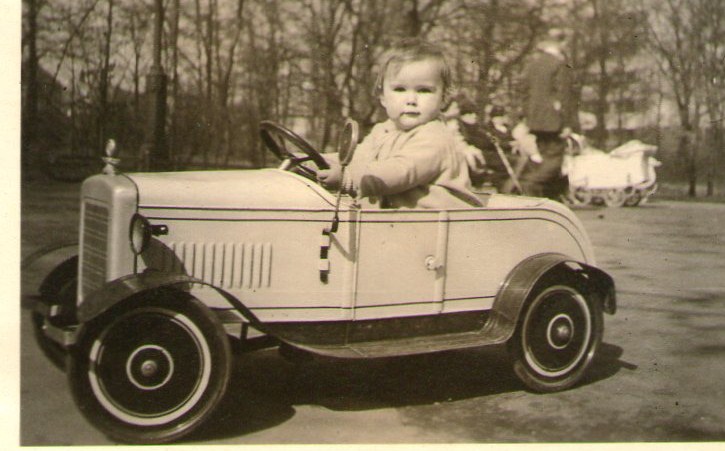
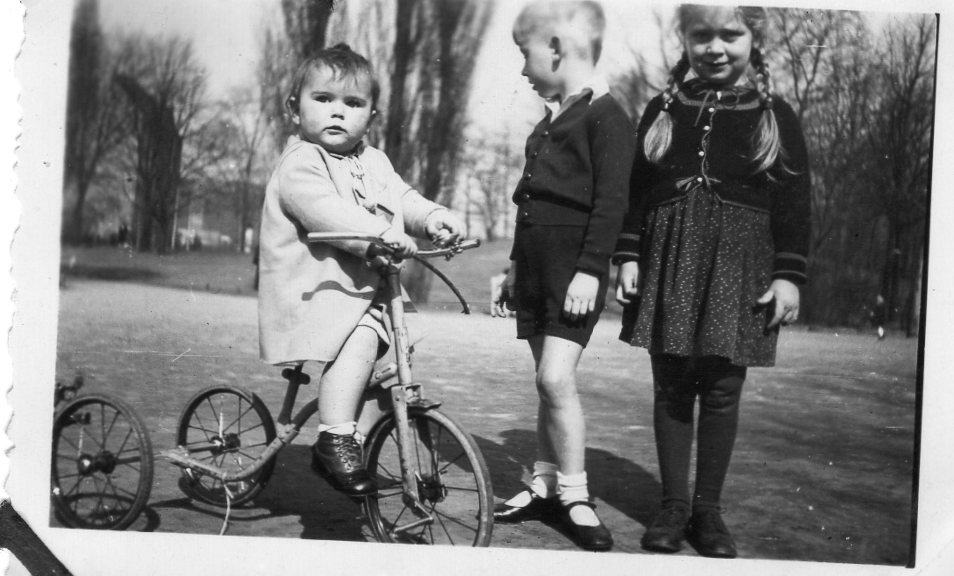
I have here a few more pictures Mum took of me as a toddler. Apparently I wanted to try out whatever other children had, be it a toy car, a doll’s pram or a big tricycle. I didn’t own any of these things, but gee I was keen on trying them out!

How on earth did Mum convince the children to let me try out their things so she could take these photos?

.

On my fourth birthday Tante Ilse gave me a ‘Puppenwagen’, a pram for my
dolls.

Mum kept a big photo album with pictures of me. Growing up, I always liked to look at all these pictures. However, I remember distinctly that the following pictures annoyed me quite a bit. I felt awful that the pictures showed me being so very plump! When I was told I looked ‘cute’ I tended not to believe it. I was self conscious at an early age and mostly didn’t feel ‘cute’ at all. I still often don’t like my picture taken because I think I might look awful! The adults in the pictures are my Mum, Tante Ilse and Onkel Addi. I wonder who took the pictures with all three adults in it. Was it perhaps my father? Pussi was Tante Ilse’s dog. Apparently I loved carrying this dog.

For good measure I want to include here another blog with my father and mother in it and some of the extended family.

My father, Alexander Spickermann, was born in Lodz on the 13th of May 1904. The following picture of him was taken in about 1916. This is the earliest picture I have of him.

Alexander’s brother Edmund Spickermann, was born in 1902. Both brothers studied in Leipzig, Germany. The following pictures are from 1925 in the city of Leipzig. There is first Alexander and then Edmund. Both brothers are in their student outfits. And then there is a picture of both of them in front of the Völkerschlacht-Denkmal in Leipzig.

Alexander ca 1916

Leipzig ca. 1925

Edmund ca 1925

Alexander und Edmund am Voelkerschlachts Denkmal after 1925

Alexander, Charlotte, Ilse, Edmund 1925

Alexander and Charlotte are my parents. They were married on the 25th of September 1930. Earlier that year, that is in 1930, Alexander promoted to Dr. phil and Edmund, I think, to Dr. rer.pol. The above picture is from 1925 when Alexander and Edmund first met Charlotte and Ilse. Charlotte was only fourteen years old at the time. Her sister Ilse was eighteen. Below is my parents’ wedding photo from the 25th of September 1930. (Charlotte was born on the 23rd of March 1911 and Ilse on the 27th of February 1907).

25.9.1930

ca 1930

Ostern 1935 mit Oleg

Above is another photo of Dad from 1930. The next photo was taken around Easter of 1935.

Dad is holding me. I had been born on the 21st of September 1934. So I am about six months in that picture.

2-06-2009 5;02;29 PM

In the above picture Dad is probably not quite forty yet. And then there is the photo of the Grandparents’ Golden Wedding Anniversary in Litzmannstadt (Lodz) in November of 1943. On the left is my sixteen year old cousin Ursula; next are Dad and Mum and I am in front beside Grossmutter (Grandma). I am nine years old.

Golden Wedding (2)

Below now is the picture that was taken in June of 1938 soon after the home-birth of my brother Bodo. Since February of 1930 Ilse had been married to Adolf Schlinke (Onkel Addi). They owned this beautiful car, called ‘Wanderer’.
Grossvater Josef Spickermann (Granddad) was in Berlin for a visit. Presumably to see Bodo, his new grandson. The Schlinkes took Granddad, Dad and me for an outing in their car. The picture was taken in Berlin at the Reichssportfeld. Dad is in the picture on the left.

The next picture is taken at the Baltic seaside resort of Graal/Müritz in 1940. In the ‘Strandkorb’ are Mum and Tante Ilse, Dad is standing next to them.

Oleg,Joseph,Ilse,Ute an Schlinkes Wagen

Alexander mit Charlotte und Ilse Graal Mueritz 1940

I copied three more photos, probably all from the 1950s. The first one is Dad in his office, the two others are party photos with Dad and his family. In the last photo are Dad and his three sisters and two brothers. They were probably celebrating someone’s birthday. The Spickermanns liked to come together as a family.

In the Office MNid 1950

Lies, Alfred, Gertrud, Alexander,Ludwig, Horst 13.5.1964

Geschw. Spickermann, Alexander, Ludwig, Jenny, Olga, Lies, Edmund 13.5.1964

Bayerisches Viertel in Berlin, Germany

http://www.touristinspiration.com/knowledge/things-to-see-and-do/bayerischer-platz-12454.html

” . . . .  The ”Bayerischer Platz” is the center of the ”Bayerisches Viertel”, (Bavarian district), with many streets named after Bavarian cities, which was destroyed a lot [more] during World War II (about 60%).  . . . .  ”

I just had a look at my post from January 2015 about Bayerishces Viertel. We used to live in Bozener Strasse. I always assumed that the town of “Bozen” was in Bavaria. I know now that is not the case.

Bolzano (Bozen) is in Southern Tyrol and belongs now to Italy.

https://en.wikipedia.org/wiki/Bolzano

“During the gradual decline of the Romans’ influence in the 7th century, Bavarian immigration took place and the first mention of a Bavarian ruler in Bolzano dates from 679.[5] At that time, the Bavarians named the nearby villages around Bolzano Bauzanum or Bauzana.[6] Germanpopulations have been present in the region of Tyrol since this time.”

It seems, even though it belongs to Italy, the German population in Southern Tyrol is predominant. Here is what I found in wikipedia about the modern-day South Tyrol:

https://en.wikipedia.org/wiki/History_of_South_Tyrol

“Modern-day South Tyrol, an autonomous Italian province created in 1948, was part of the Austro-Hungarian County of Tyrol until 1918 (then known as Deutschsüdtirol and occasionally Mitteltirol[1]). It was annexed by Italy following the defeat of the Central Powersin World War I. It has been part of a cross-border joint entity, the Euroregion Tyrol-South Tyrol-Trentino, since 2001.


My friend Eva Todtenhausen once tought me the text to the following Tyrol melody:


I was ten at the time, and I still remember the words!

https://auntyuta.com/2015/01/27/bayerisches-viertel-2/

This post brings back memories about Bozener Strasse. This is the street where I lived during most of my childhood and early adulthood years. Some of the buildings look a lot more colourful now than they used to. I like some of the very bright colours. During the 1930s and 1940s we children would use Bozener Strasse as our playground because there were usually no cars parked there. Our street was very out of the way and had no through traffic. Tante Ilse and Onkel Addi for instance parked their car in a nearby garage. I think to that garage it was a five minute walk!

I sometimes like to just browse through some older posts of mine. Being able to ‘search’ for certain subjects, often helps to find some posts that I am specially looking for.  Today for instance I wanted to find a picture from my first birthday. I assumed that at  some time  I had published this picture that was taken on my first birthday. Inserting “first Birthday” in the search space, resulted in the following:

https://auntyuta.com/?s=first+Birthday&submit=Search

Alas, nothing came up about my first birthday, but on the other hand quite a few posts that I enjoyed having another look at. Feel welcome, to browse through some  of my  posts too. I hope you find some of the posts interesting.

Cheerio, and have a good day!


“All the Birds, Singing” by Evie Wyld

https://www.theguardian.com/books/2013/jun/30/evie-wyld-birds-singing-review

In our cabin at BIG4 Nambucca Beach Park I actually was able to do a lot of reading. I had taken “All the Birds, Singing” along. I had started reading this novel some time ago, but had not read very much of it yet. Our double bed had very good reading lamps on each side above the bed. So both Peter and I felt encouraged to spend quite a bit of time reading. My book did get extremely interesting and I could not put it down anymore. Each day, that is Sunday, Monday, Tuesday and Wednesday, I was reading, reading, reading. We had to leave the cabin Thursday morning. Alas, I got to the last pages on Wednesday and finished reading this book. I learned about the fate of a girl from Australia, who went through some horrible experiences. But in the end it only made her stronger. She became a sheep farmer and owned her own farm  on a very lonely island. At first I thought how can a life like this be very interesting? This story is told in the first person. It was absolutely captivating to gradually find out what happened to her as a child and during her teenage years.

Below I copied a bit from an interview at the Sydney Writers’ Festival:

https://writersedit.com/fiction-writing/sydney-writers-festival-evie-wyld-all-the-birds-singing/

On Writing Novels & Endings with Evie Wyld at Sydney Writers’ Festival

The Roslyn Packer Theatre was abuzz with chatter, much about Evie Wyld and her latest novel All the Birds, Singing. There’s often much contention about the ending, and while people tossed up theories and commented on Wyld’s Miles Franklin win, the lights went down and Evie stepped onto the stage.

With her fringe and bright yellow shoes she was already a character in herself. And throughout the hour, Wyld spoke with wit and wisdom (my notes are a slanted scribble that’s hard to decipher; a testament to the great things I heard and couldn’t get down quick enough).

Evie Wyld

Gothic and Horror as a Modern Genre

Wyld started by reading from her novel, All the Birds Singing, emphasising the imagery of death and blood, bringing a chill and a hush over the theatre. The first question asked was about the gothic canon, and how Wyld has used horror as a genre in a contemporary way. I’d never thought of All the Birds, Singing as a gothic novel and having it pointed out (and listening to Wyld read), it seemed rather obvious! The moody English island, the dark past, the mangled deaths of sheep…