
Category: Film Review
Diane Keaton Movie: Hampstead
Peter and I saw today this Diane Keaton movie about Hampstead. Peter had first to go to the Private Wollongong Hospital for an appointment with his podiatrist who is fitting him some insoles. These insoles might help him with his walking. The podiatrist spent with Peter a bit over an hour. It was already 11,45 when we left the hospital. This left us less than half an hour to make it to the GALA in Warrawong to see the movie. But we were lucky. We still made it on time. This movie was well worth seeing. I am glad we did make it.
http://villagecinemas.com.au/movies/hampstead
“Starring Diane Keaton and Brendan Gleeson, Hampstead is a heartwarming romantic comedy set around the beautiful Hampstead Heath in London, a quiet piece of countryside in a vast metropolis. Living in a lovely old apartment on the edge of the Heath, American widow Emily Walters (Keaton) feels like she is drifting aimlessly through life. Then she meets Donald (Gleeson), who has lived harmoniously on the Heath for 17 years in a ramshackle hut. When property developers attempt to destroy his home, Emily steps up to defend Donald in the escalating battle and soon finds that, despite his gruff exterior, there is something special about this gentle and unconventional man.”
Human Flow review – Ai Weiwei’s urgent look at the scale of the refugee crisis
https://www.theguardian.com/film/2017/aug/31/human-flow-review-ai-weiwei-refugee-crisis
Gorgeous shots in Greece, Calais and elsewhere, many filmed from drones, create a visual tone poem that proves both epic and highly human
“The international co-productions of the mid-20th century often boasted myriad shooting locations in far-flung places. Who would have guessed the Chinese artist Ai Weiwei would pick up where moguls such as Sam Spiegel left off.
Ai’s new film, Human Flow, while certainly epic in scope, is not exactly meant as entertainment. This is an urgent, deep soak in the current refugee crisis. There has been no dearth of documentaries about this topic, but this one comes closest to understanding the totality of the issue. . . . .”
I copied the above from The Guardian
My father, a stranger from North Korea
- Date 26.06.2015
- Author Esther Felden / sri
- Related Subjects Asia, North Korea, Communism
- Keywords Asia, North Korea, German Democratic Republic, Renate Hong, Communism
- Share Send Facebook Twitter Google+ More
- Feedback: Send us an e-mail. Please include your name and country in your reply.
- Print Print this page
- Permalink http://p.dw.com/p/1Fnhl
http://www.dw.com/en/my-father-a-stranger-from-north-korea/a-18542325
“Loved, Engaged, Lost” – A documentary that tells the love story between women from former East Germany and North Korean men sent to the former Communist nation for studying. A relationship with painful consequences.

The eyes of the protagonists in Sung-Hyung Cho’s “Loved, Engaged, Lost” reveal that their roots do not lie in the former German Democratic Republic, at least not entirely. They grew up with their mothers in the ex-Communist nation, but their fathers come from North Korea.
The men were sent to East Germany by the North Korean government during the 1950s – some of them during the Korean War – to attend university and later use their knowledge to re-build their war-torn nation.
During their stay, however, some of the men entered relationships with East German women. But the children born out of these relations did not see their fathers for long, as the men were ordered to return to their homeland in the 1960s, resulting in a break-up of the families.
A documentary film made by Sung-Hyung Cho, which premiered in Germany on June 25, tells the stories of these families and takes a look at their lives. Although there is no precise figure on the number of families affected, the director is aware of 18 such cases. In a DW interview, Sung-Hyung Cho talks about the idea behind the film and her experiences in making it.
 Sung-Hyung: ‘It wasn’t easy at first to win over the support of the protagonists’
DW: What was the idea behind the film?
Sung-Hyung Cho: The story of Renate Hong was very popular in South Korea. In 2006, her story became the talk of the town after a South Korean historian – who had conducted some research in Jena about the relationship between North Korea and East Germany – met Renate Hong by chance.
She narrated her story, and he propagated it on the Internet. The response was overwhelming. The Koreans were blown away by the sad but beautiful love story.
Most Koreans, myself included, know the story. Moreover, I was greatly interested in knowing and better understanding former East Germany. I also wanted to know more about North Korea, even if only indirectly.
How did you manage to find the films’ protagonists?
It wasn’t easy at first to win over the support of the protagonists, especially given that this is both a painful subject and an unsolved issue for most of them. It was especially hard for them to reminisce about their past relationships.
As a result, many didn’t want to be reminded of it, let lone talk about it. In addition, they were cautious and distrustful of the media.
However, the fact that I’ve been regularly attending the meetings of these German-Korean families helped me in terms of slowly earning their trust. A couple of years later, they probably asked themselves when this Korean woman would finally shoot the film about them.
Do you know of stories in which children got to meet their fathers and their love for each other stood the test of time?
The Hong family eventually managed to track down the father. Renate and her sons ultimately traveled to North Korea for what turned out to be a very emotional, touching but also peculiar reunion following so many years of separation.
In your view, how do these children, who are now grown-ups, feel about their North Korean fathers?
Just like anywhere else, this depends on the child. What they all have in common is a longing to get to meet their respective fathers or at least learn something about their lives. They are very curious, asking themselves who the man is, what he has achieved and whether he is even alive. But tracking these men down is often extremely difficult.
How do the women mostly remember their former partners?
In different ways. Some decided at some point to distance themselves emotionally and go about their lives as if their partner had died. Others, however, tried to keep the memory alive and to simply come to terms with the situation. And then there are others who decided to actively track them down.
 The story of Renate Hong was very popular in South Korea
To which extent does the children’s Korean background play a role in their daily lives?
Those are their roots. And even though some of these parents remain unknown to them, these roots remain and simply do not disappear. It sometimes plays a bigger role and sometimes a lesser one. But the father’s influence is always reflected in the children’s physical appearance.
Have you yourself tried to track down and contact one of the fathers?
This was mainly done by the children. There are even German-Korean associations to assist in this regard.
Is there a single story that has touched you in a special way?
Each story is extremely touching in its own way, so I can’t just pick one. The story of the Hong family was the first one I ever heard, but then came so many others and each one of them was moving and touching.
Born in South Korea, Sung Hyung Cho is a Germany-based editor and director, known for Full Metal Village (2006), Endstation der Sehnsüchte (2009) and 11 Freundinnen (2013).
Going non-traditional
This is about the movie “My Happy Family”.
NEW DIRECTORS/NEW FILMS 2017 – NANA EKVTIMISHVILI, SIMON GROSS: MY HAPPY FAMILY/CHEMI BEDNIERI OJAKNI (2017)
Peter and I watch quite regularly ‘Der Tag’, that is a program on the Deutsche Welle (DW). Today film director Simon Groß was interviewed on that program. Simon pointed out that he made the above movie together with his wife and that to have a close working relationship with your wife may cause some problems.
In the movie,. the middle aged school-teacher, who lives with her husband in an extended very large family, decides she has to move out and live on her own because ‘she cannot breathe”.
This movie is set in Georgia, ” where the language has a special lilt, and where any festive gathering means people will sing, in a rich, resonant chorus. . . .”
Here is a bit more of what it says in one of the reviews to the movie:
“Manana and Soso live with her family, which she’s sick of (and we can see why). They consist of her querulous and bossy mother (Berta Khapava), her brother, her grandfather, her husband, son Lasha (Giorgi Tabidze) and daughter Nino (Tsisia Qumsashvili) and daughter’s husband, augmented on occasion by aunts, uncles and other relatives, as needed. The big squabbles concern Manana’s decision to move into a cheap apartment on her own, leaving her husband and all the rest, but the squabbles themselves show us why Manana would want to take this liberating step. It’s not that she can’t get along with her husband. She can’t breathe.
Her departure is against the wishes of everyone over 25. But it’s a foregone conclusion we’re aware of from the first scene, when she views a sunny if shabby flat in an unfashionable but quiet neighborhood. The price is right, and the decision is made. The objections confirm its validity. But will Manana stay with this decision? Will the tomatoes she plants on the balcony bear fruit? Stay tuned – though the film ends with a question mark, as it should. The conflicts here depicted between traditional and nuclear families, couples and independence, aren’t easily resolved. . . . .”
http://www.chrisknipp.com/writing/viewtopic.php?f=1&t=3592
I am intrigued by the questions that come up because of the movie’s ending. Who knows the answers to all these questions:
Is it better to live in a traditional or in a nuclear family?
Is it better if couples live together or is there some benefit to a couple’s relationship if they each have their own place?
What makes for happy families?
http://www.imdb.com/name/nm0344144/

Uta’s May 2017 Diary

“The Dry” by Jane Harper. I was able to get this novel from the library and started reading it last week on Wednesday when Peter had his treatment day in Wollongong Hospital. Last weekend I finished reading this book in between sleeping a lot. I needed a lot of extra rest for I had a tummy upset. Still, it was good that I could use the resting time to finish reading “The Dry”. I was really interested to find out how this crime novel would end. It is a first novel by Australian author Jane Harper. The novel is set in a small country town in outback very dry and hot Victoria. A family is being murdered during the hot summer month of February. Who is the murderer? I thought there were very interesting clues and characters in this novel. After a while I just could not put it down anymore.
My tummy ache had already started early in the morning last Saturday. But this was the day when we had planned lunch with our friends at the club’s Treasure Court Restaurant. I actually managed to eat my vegetables with ginger/shallot sauce and boiled rice.

These vegetable were very crisp and fresh. I think this sort of meal was just the right thing for me to eat on that day.
Yesterday, Monday, I felt much better. But to be on the safe side, I stayed home all day. Today was different. Peter and I left early in the morning to go to Warrawong to see a movie in the GALA CINEMA. Our choice to see was
VICEROY’S HOUSE, a movie about the partition of India in 1947.
In the review by
-
Paul Byrnes
it is said towards the end:
” . . . This last bit is where Chadha may have taken liberties. She relies on a book by former Indian diplomat Narendra Singh Sarila, a junior member of Mountbatten’s staff. Sarila contends that Churchill decided two years earlier that partition was necessary to ensure that a newly created Pakistan would become a strong bulwark against the USSR, thus protecting the Middle East oilfields. . . . ”
I wonder now, whether film director Chadha has taken liberties or not.
George Orwell’s Nineteen Eighty-Four
The following is a copy of one of my blogs from October 2014. You can find the blog with the above title here:
https://auntyuta.com/2014/10/11/george-orwells-nineteen-eighty-four/
I still did not finish reading the whole novel on ‘kindle’. Today I thought about it that we once watched a film version of the book. I wanted to see, whether wikipedia said something about the movie. I did find quite a bit about different movie versions. I also found the following entry about the book in wikipedia.
http://en.wikipedia.org/wiki/Nations_of_Nineteen_Eighty-Four#Airstrip_One
Here is a bit of what it says on the above page of wikipedia:
“Ambiguity
Almost all of the information about the world beyond London is given to the reader through government or Party sources, which by the very premise of the novel are unreliable. Specifically, in one episode Julia brings up the idea that the war is fictional and that the rocket bombs falling from time to time on London are fired by the government of Oceania itself, in order to maintain the war atmosphere among the population (better known as a false flag operation). The protagonists have no means of proving or disproving this theory. However, during preparations for Hate Week, rocket bombs fell at an increasing rate, hitting places such as playgrounds and crowded theatres, causing mass casualties and increased hysteria and hatred for the party’s enemies. War is also a convenient pretext for maintaining a huge military–industrial complex in which the state is committed to developing and acquiring large and expensive weapons systems which almost immediately become obsolete and require replacement.
Because of this ambiguity, it is entirely possible that the geopolitical situation described in Goldstein’s book is entirely fictitious; perhaps The Party controls the whole world, or perhaps its power is limited to just Great Britain as a lone and desperate rogue nation using fanaticism and hatred of the outside world to compensate for political impotence. It’s also possible that a genuine resistance movement exists, or that Oceania is indeed under attack by outside forces.”
I say all this sounds pretty ambiguous. But what I remember about the novel and the film and what I’ve re-read this far this is the sort of picture I do get from this novel. All in all some pretty scary ideas about an imagined world. Sometimes these things do sound a little bit too true for comfort!
With the following link you can find a piece about what our Orwellian destiny might b e written in the AIM Network by By Ad astra:
https://theaimn.com/twenty-twenty-four-orwellian-destiny/
Twenty Twenty-Four – our Orwellian destiny?
The End Is My Beginning
http://cineuropa.org/nw.aspx?t=newsdetail&l=en&did=200173
Terzani recounts his life in
The End Is My Beginning
by Vittoria Scarpa
25/03/2011
A man on his deathbed recounts his life and experiences to his son in what should be a film teeming with flashbacks, seeing as how the man is Tiziano Terzani and the theatre of his adventures are Vietnam and its devastating war, Mao’s China, Ghandi’s India and the Himalayas.
Instead, The End Is My Beginning [+], an adaptation of the bestseller by the great Italian writer and journalist, directed by Jo Baier, is a long dialogue between father and son, noteworthy performances from the leads (Bruno Ganz and Elio Germano), a theatrical film shot in one setting: Terzani’s real house in Tuscany, where he spent his last days among the pristine countryside and mountains, talking to his son Folco about life, disease and death.
Adapted for the big screen by Folco Terzani and the film’s German producer, Ulrich Limmer, the memories of the unforgettable Asian correspondent for Der Spiegel and Corriere della Sera, who passed away in 2004, are presented directly and simply: “We wondered whether or not to use flashbacks,” said Limmer, “but then decided to show something increasingly more rare: one man speaking, and another listening”.
The choice was a decidedly courageous one, and it paid off thanks to the intensity of the cast, the quality of the dialogue, and viewers’ awareness that they are watching an authentic and in some way illuminating adventure. “More than a film, it’s a unique experience,” said Germano, who to portray Folco spent two months at the Terzani’s house “in contact with the stars, mountains and wind, and collecting chestnuts”.
The challenge pays off also thanks to the total lack of melodrama. Everything is measured, restrained, like Germano’s emotions. Though his gazes and silences, the actor expresses the undeniable conflict of a son towards a larger-than-life father, as well as his curiosity and the desire to understand his parent.
Produced by Collina Film Production and B.A. Production in collaboration with Beta Film and RAI Cinema, The End Is My Beginning is released in Italy on April I by Fandango on 60 screens, after having garnered 230,000 admissions in Germany.
(Translated from Italian)
“Good vs Evil”
Reducing Foreign Policy to Good vs Evil
Last year in March Dr. Stuart Bramhall published a Film Review by Adam Curtis (BBC).
At the moment I was mostly interest in what it said about Good vs Evil. I copy it here:
“Reducing Foreign Policy to Good vs Evil
Like Ronald Reagan, George W Bush attempted to reduce the US role in Afghanistan to a simple battle of good vs evil. The political reality was far more complex. US and Saudi intervention during the Soviet occupation brought corrupt warlords to power who supported their fiefdoms through Afghanistan’s heroin trade.
The Taliban, consisting mainly of Afghan orphans raised in Pakistani Madrassa, were primarily driven by a desire to end the heroin trade and this endemic corruption, which they (rightly) blamed on the interference of western imperialists in their country’s domestic affairs.”
A simple battle of good vs evil? Certainly not. I think it still has not become clear to us what is at spiel. It still is not simple, on the contrary, it seems to become more and more complicated. See here:
Brexit,Trump, Syria and the Fabricated War on Terror
I reblogged the avove!
Qantas Flight Singapore to Sydney
There were Touch Screens on the last leg of our flight back home to Sydney. For instance I very much enjoyed the Louis Armstrong music.
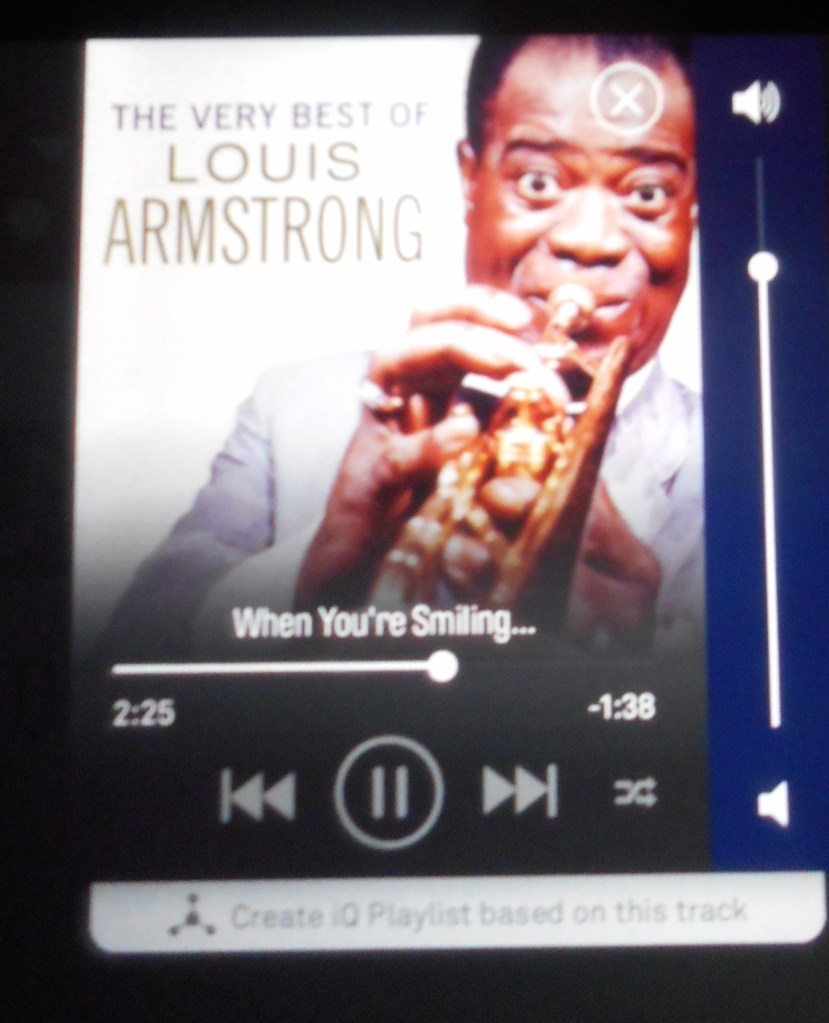
I listened to the whole tape twice in a row, even though there was plenty of other music available that I could have listened to.
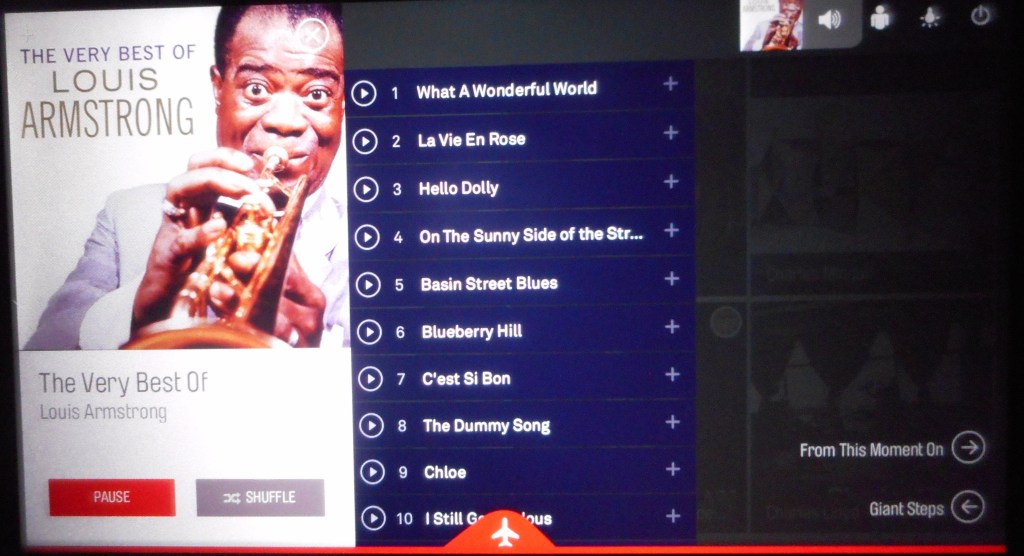
Also, bottles of water were frequently passed around for whoever wanted them. We did fly right through the night till we arrived in Sydney at 6 am. Some people slept most of the time, but others had their screens turned on in front of them. I very much liked these easy to handle touch screens. I ended up getting very interested into an American TV series called ‘The 100’ and copy here some information about it from Wikipedia.
“From Wikipedia, the free encyclopedia:
The 100 (pronounced The Hundred is an American post-apocalyptic science fiction drama television series that premiered on March 19, 2014. The series, developed by Jason Rothenberg, is loosely based on a book of the same name, the first in a trilogy by Kass Morgan.”
I do find the plot very interesting. Here I copy again from encyclopedia something about the plot:
“The series is set 97 years after a devastating nuclear apocalypse wiped out almost all life on Earth. The only known survivors lived on 12 space stations in Earth’s orbit prior to the apocalyptic event. The space stations banded together to form a single massive station named “The Ark”, where about 2,400 people live under the leadership of Chancellor Jaha.[1] Resources are scarce, so all crimes – regardless of their nature or severity – are punishable by ejection into space (“floating”) unless the perpetrator is under 18 years of age. After the Ark’s life-support systems are found to be critically failing, 100 juvenile prisoners are declared “expendable” and sent to the surface – near former Washington, D.C.[7] – in a last ditch attempt to determine whether Earth is habitable again, in a program called “The 100”. The teens arrive on a seemingly pristine planet they have only seen from space. They attempt to find refuge and supplies at an old military installation, Mount Weather Emergency Operations Center, located in the foothills of the Blue Ridge Mountains. However, they land some distance from the intended target and soon face other problems. Confronting both the wonders and the dangers of this rugged new world, they struggle to form a tentative community. They soon discover that not all humanity was wiped out – some survived the war: the grounders who live in clans locked in a permanent power struggle, another group of grounders who have become cannibals are known as Reapers, and Mountain Men, who live in Mount Weather, who locked themselves away before the apocalypse and are killed by the residual radiation outside.
In the second season, the remaining 48 of the 100 are taken to Mount Weather, where they discover a community of survivors. It is eventually revealed that the medical staff are extracting bone marrow from the 100 and the grounders so they will finally be able to survive on the outside. Meanwhile, the inhabitants of the Ark have successfully crash-landed various stations on Earth and begun an alliance with the grounders to save groups of people, naming the main settlement at Alpha Station “Camp Jaha”.”
 AuntyUta