I want to write about our friends Nick Tap and Nell Tap. They were both of Dutch origin. Nell died in January 2013. I have no idea what happened to Nick. He had major health problems. There were widespread family members, including three sons.
Nick and Nell were both born ln 1933. They suffered a lot under the German occupation in World War Two. The food that the Dutch people did grow ended up on German tables. For the Dutch population there was hardly anything to eat. The children suffered severe starvation.
As I said in the previous post Peter and I liked to visit the Taps. I remember how they told us about the scarcity of food. Once a German soldier very secretly had given Nick a piece of bread. This soldier could have been severely punished for this!
I find my comment ftom Dec 2017 rather interesting. What do you think?
I had read the original German version of this article. I published here the automatic translation into English. I noticed now that some of the English writing sounds rather obscure. For instance in the last paragraph it is being referred to ‘her’ health, so it should say as ‘she’ grew older . . . .
My apologies for taking the easy way out by publishing this ‘automatic’ translation. Tell me please, if you find more obscure sections in this article.
However, some sections seem to come out well in translation. For instance this paragraph:
“Even after her marriage Christiane was accepted as a “Geheimrätin von Goethe” by the Weimar society only reluctantly and hesitantly. To change the social rejection of his wife, Goethe asked the wealthy widow Johanna Schopenhauer , mother of the philosopher Arthur Schopenhauer , to break the barrier with an official invitation to tea. She did it with the remark: “If Goethe gives her his name, we will be able to give her a cup of tea.” („Wenn Goethe ihr seinen Namen gibt, werden wir ihr wohl eine Tasse Tee geben können.“)
This remark by Johanna Schopenhauer does sound quite sarcastic, don’t you think?
I like this post by Berlin companion and reblogged it in 2021. I came across it today and would like to copy it to post it again!
I hope this is okay that I copy it!
Image from a Dutch magazine “Het Leven” (via Spaarnestadt Archive).
Here is a typical Berlin Balkonia, little man’s and woman’s green paradise, in its rooftop edition: as a small garden and a chicken-pen.
This model example of self-sufficiency was necessary to survive dire food-shortages of the First World War – shortages which were particularly acute in the capital and led to long periods of starvation not only among the poorest. Many Berlin children did not survive those and if they did, they often suffered their consequences – mentally and health-wise – for the rest of their lives.
This idyllic image is a witness to a very bitter truth: that unless you were able to provide your own food yourself, your family was in danger. And that in 99% of the cases this responsibility had to be shouldered by women – whose children were at great risk.
I had taken the painkilling tablets the doctor had prescribed for me. I was supposed to take three times two tablets per day, however not more than six a day with intervals of at of at least six hours. For three days I took the six tablets per day. On Friday I already felt much better. I walked a lot in the sun. The right hand didn’t feel as painful any more. There was still some feeling of pins and needles, but I was able to do a lot more house-work than during the past few weeks. Friday afternoon Irene and Marion came to my place. We played a game of scrabble as we always do when we meet on a Friday afternoon. Then we had our coffee break. And after coffee and cake it was time for some games of Rummy. Irene said she’d have to leave early for her son was to come to have dinner with them. She went home just before five. We had had three hours of togetherness. For me three hours was plenty. I honestly felt very, very tired and was glad when Marion decided to go home too. Maybe she would have liked to stay a bit longer. I don’t know. However I did not hold back and proclaimed that I felt dead tired and desperately needed a bit of a rest. I did lie down on the sofa in the living-room.
Peter had been doing his things all afternoon but he agreed that he would cook dinner. He cooked some lovely cauliflower with breadcrumbs in plenty of butter. I needed only a short rest. Soon I got up again to have dinner with Peter. I felt very grateful that Peter had undertaken kitchen duties. This bit of a rest was so good for me. Before Peter started cooking he took my blood pressure. It was extremely low, however the pulse rate was very high. Peter gave me a glass of water. When he took my blood pressure again after about half an hour, the pulse rate had normalised and the blood pressure seemed pretty normal overall. It’s amazing what a difference a bit of rest can make!
On Saturday morning I got up very early because I had gone to sleep early the night before. My right arm and hand felt like it was improving a lot. I took a shower and continuously did exercises with arms and hands. Since I felt so much better and it promised to be a calm sunny morning, I had the idea to be walking to the pool. I very much longed for the solar heated water of the pool. Just the perfect morning to stretch out in the water for a few minute, I thought.
I had breakfast with Peter. I planned to arrive at the pool towards ten o’clock. There was some time to do a few things around the house and in the kitchen. Ten thirty am is the time when we like to watch the German News Program from Berlin. At the same time we usually have a cup of morning tea. When I told Peter I would be walking to the pool he reminded me I would not be able to watch the German News then. My response was that if he picked me up from the pool by twenty minutes past ten we could both be sitting in front of the TV by half past ten. Peter agreed that he would pick me up at the set time.
So I walked to the pool. It was a very pleasant walk. I did not have to walk too fast. Very cheerfully I arrived at the pool and talked to some attendants at the entrance. I soon noticed there was a class of women in the deep end of the pool. The instructress stood at the edge of the pool and gave instructions to some lively music. I was happy to stay at the shallow end of the pool. I had the whole area to myself. The water was flooded with beautiful sunshine. Doing my movements I felt very invigorated. I loved to have this bit of music from the top end. It helped me with moving about rather enthusiastically. I thanked God for such a wonderful morning.
After a few minutes all the women from the class did get out of the pool and assembled in the shower room. I soon followed. I was ready on time for Peter to pick me up. A bit after eleven we got ready to go to Dapto Shopping Centre. It took us nearly an hour to finish our shopping there. We bought some very good food and felt very happy with our purchases. However on our list were a lot more things to buy at another place. This would have taken us another hour. We decided to buy the other things on the following day, which was a Sunday. We wanted to go home and get lunch ready.
Saturday night I did fall asleep in front of the TV. When I woke up I noticed the TV had been turned off and Peter was in the other room talking to his sister Ilse on Skype. Ilse lives in Berlin where they have a great heat wave at the moment. I could hear every word Peter was saying and also every word Ilse was saying. After a while Peter came looking whether I was awake. He suggested I come over and talk to Ilse for a bit too. I love having a conversation with Ilse. I went to talk to her. There is always something to talk about with Ilse. This talk with Ilse cheered me up a lot.
Sunday morning I was up early again, early enough to walk to the early Mass at the Catholic Church in Dapto. Our Vietnamese priest is still on vacation, however the old priest who is taking his place for the time being, is a dear old man with a wonderful singing voice. Gee, I love the way he sings his hymns so enthusiastically! On my walk to the church I had touched my ZEN stone a lot. The fingers of my right hand had not been able to make a fist for over a month. However the painkilling tablets and exercising the fingers with this stone and sometimes also with some Chinese Iron Balls made my hand much better now. It was so comforting to say some prayers during mass. I came to realise once more how important my Catholic faith really is to me.
As I said we had to do a lot more shopping on Sunday. We also bought some lovely flowers. For afternoon tea we used our red teacups. We took pictures of our afternoon tea with the newly bought flowers on the table as well.
Today, Monday, we had another beautiful sunny day. Peter and I drove to the lake and took quite a few pictures there. I am going to show these in another post.
Sunday,28th July 2013 I left the house as the sun came up to walk to the church.
Since Saturday I have reduced the intake of these painkilling tablets by half. Tomorrow at ten o’clock I have to be at Southern Neurology in Wollongong.
caption id=”attachment_3964″ align=”aligncenter” width=”300″] The GURU Coffee Lounge in Dapto Shopping Centre[/caption]
We went there early in the morning this week for a coffee break. I had been seeing a doctor in the Medical Centre across the road quite early in the morning. At 9am I had to go back to the Medical Centre for some tests.
The following day we went to Sydney to see my Prothetist at an Orthoplant Dental Laboratory who took on the immensely difficult task of making for me some new dentures. At the moment I was provided with some temporary dentures. Once I get used to them, he can create the real dentures.
After the appointment with the Prothetist (it was already my third visit to him!) Peter and I felt like going for a special treat. We chose the Lind cafe at Martin Place.
Later on we went to Hyde Park where Peter was feeding the birds with some of his muffin.
After our train-trip to Sydney yesterday (Wednesday) I had to go back to Dapto Medical Centre early this morning to find out about the test results. It was established there is no thrombosis, the blood test was normal too. But because I suffer from pain in my right arm, wrist and pins and needles in my right hand, some other test revealed that it has to do with a nerve strung. I did get now an appointment for next week at Southern Neurology in Wollongong. The doctors reckons all this has to do with old age. Ah, the blood test showed that I have Osteo Arthritis.
Today, Thursday, I went with Peter to Wollongong for Peter had to pick up there one of his hearing aids which had been repaired. Then we had time to go again to this beautiful cafe where we had been with Sylvia the previous Saturday. On the way we saw a few little toys. We thought it would be nice to have these toys for our three great grandchildren. So we bought the three toys.
With our little bag of gifts we entered the cafe. Surprise, surprise, we met there Monika, our daughter with Krystal, who is sixteen and Monika’s youngest daughter. It was such a beautiful surprise to see them there!
Going back to where we had our car parked, we took some pictures of MacCabe Park.
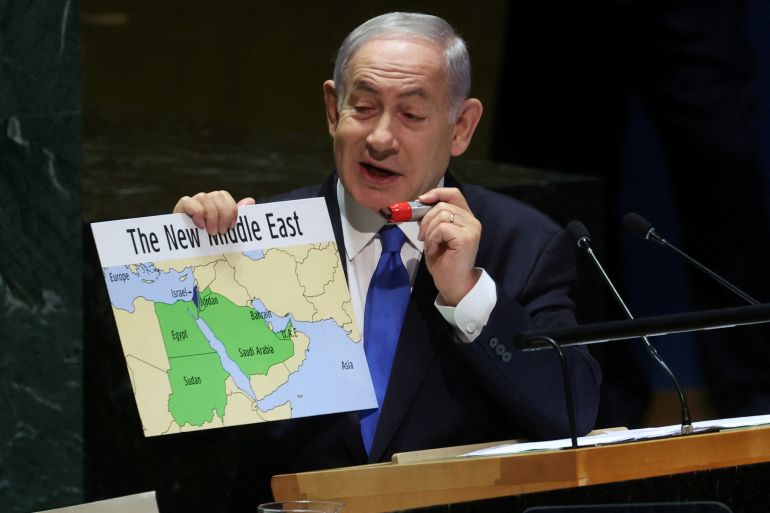
Israeli Prime Minister Benjamin Netanyahu addresses the 78th United Nations General Assembly at the UN headquarters in New York on September 22, 2023 [File: Reuters/Mike Segar]
Israeli Prime Minister Benjamin Netanyahu has spent the past three decades sounding the alarm about Iran’s nuclear programme and threatening to attack the country on countless occasions. Most recently in September, he said in a speech to the United Nations General Assembly that Tehran must face a “credible nuclear threat” before his office corrected the record to “credible military threat”.
After Hamas’s attack on October 7, Netanyahu may finally be able to act on his threats. The gruesome scenes in southern Israel have provided the Israeli prime minister with the necessary pretext and international backing for a wider response.
Netanyahu has both a political and a personal stake in all this. A drawn-out regional conflict would block or at least postpone any official accountability for his utter failure to prevent Hamas’s attack from happening in the first place and could also put his multiple indictments on corruption charges on an indefinite hold.
Overnight, he transformed from a failed and embattled prime minister to a wartime leader, with opposition parties clamouring to join him in a national unity government.
He declared war and ordered an immediate retaliation against Hamas’s stronghold in Gaza. The Israeli army unleashed a vicious campaign of bombardment on the overpopulated Gaza Strip, killing more than 500 people, and preparing for a potential land invasion.
Netanyahu has not elaborated on the next phases of the war, but he has received the unconditional support of Western governments to do what it takes, as long as it takes, to “defend Israel”. The administration of US President Joe Biden has gone even further, providing Israel with more arms and ammunition, dispatching its most modern and sophisticated aircraft carrier, the Ford, along with a number of destroyers to the Eastern Mediterranean, and beefing up other forces stationed in the region, enough to start World War III.
Biden’s motivation for the escalatory deployment is, reportedly, strategic deterrence, meant to ensure that “no enemies of Israel can or should seek advantage from the current situation”. But historically, Israel has never allowed any foreign boots on its soil, and is in no need of the US armadas to take on Hamas.
Biden’s incentive, therefore, could also be political, ie to ensure that the GOP doesn’t exploit the Israeli drama at his expense ahead of the presidential elections in 2024. Already, Republican opponents have tried to link Biden’s recent prisoner swap deal with Iran, which involved the unfreezing of $6bn in Iranian assets, to the Hamas attacks.
But Netanyahu and his fanatic ministers may have something very different in mind for the US deployment, that goes beyond military deterrence and political posturing. He may try to widen the scope of the war to include Iran.
His government has already accused Iran of supporting and directing Hamas’s operation, as it has previously done about other Palestinian attacks on Israelis. Scores of Israel supporters and neoconservatives, as well as mediapundits in the US and Europe, have joined in by making the case for Iranian involvement.
Sign up for Al Jazeera
Week in the Middle East
Catch up on our coverage of the region, all in one place.Sign up
The Wall Street Journal even reported – based on interviews with unnamed local sources – that Iranian officials and members of the Islamic Revolutionary Guards Corps were directly involved in orchestrating and planning the attacks over several weeks.
US officials have said they haven’t seen evidence of Tehran’s involvement, yet.
For its part, Iran has called the attack a spontaneous Palestinian action in self-defence, but officials have not tried to hide their glee at Israel’s misfortune. They have expressed confidence that the attack will deter further Arab, meaning Saudi, normalisation with Israel, and eventually lead to its downfall.
Meanwhile, Iran’s ally the Lebanese Hezbollah has praised the Hamas operation and engaged the Israeli forces in the Israeli-occupied Shebaa Farms, threatening greater involvement if Israel enters Gaza.
Iran and its allies’ temerity may well come back to haunt them, just as Israel’s hubris did – leading to its utter humiliation at the hands of Hamas fighters. Neither Iran nor Israel is learning from history, as they continue to escalate their proxy conflict towards war.
For years, the Israeli army and secret services have sabotaged the Iranian nuclear programme and targeted Iranian assets abroad. Iran for its part has supported various client armed groups in the Middle East, attacking US and Israeli allies.
Despite his bluster and bravado, Netanyahu couldn’t and wouldn’t attack Iran, without a green light and support from the US. But the bloody attacks are a game-changer, giving the Israeli prime minister the perfect opportunity to realise his fantasy of crushing Iran, by tricking the Biden administration into war.
This will not be easy considering Biden’s presumed commitment to end “the forever wars”, reflected in the humiliating withdrawal from Afghanistan in 2021. His administration has also moved to prioritise the great power competition with China and Russia, especially after the latter’s invasion of Ukraine.
But in reality, the US has not withdrawn from the Middle East, it has merely moved around its forces and military assets in the region. Biden himself has vowed to “not walk away and leave a vacuum to be filled by China, Russia, or Iran”.
Once the case against Tehran’s role in the attacks has been fully articulated by Israel and the US, they might first try to pressure it into facilitating the release of Israeli captives taken by Hamas – a top priority for Netanyahu.
If Iran refuses and chooses to use Hezbollah as leverage against Israel, this could well trigger a wider confrontation that draws in the US with incalculable consequences. Unfortunately, in the adulterated world of Washington politics, unconditional US support of Israel is the only thing that Republican and Democrats agree on.
It is crucial to remember that the situation in 2023 is vastly more challenging and complicated than the lead-up to the invasion of Iraq in 2003, which ended in utter disaster for the US and Iraqis. A repeat against Iran is sure to be far worse for all concerned.
Marwan BisharaSenior political analyst at Al Jazeera.Marwan Bishara is an author who writes extensively on global politics and is widely regarded as a leading authority on US foreign policy, the Middle East and international strategic affairs. He was previously a professor of International Relations at the American University of Paris.
Nov 7, 2019In this first of two sessions hosted by the C.S. Lewis Society of California, Dr. Graham H. Walker discusses the landmark book, “The City of God,” the highly influential work of Christian philosophy by Saint Augustine of Hippo (Aurelius Augustinus Hipponensis, 354-430 A.D.). Watch Part Two in this link: https://www.youtube.com/watch?v=zC_Yz… First published in the first part of the 5th century A.D., this expansive theological work provided an articulate defense of Christianity against the claims that it led to the downfall of Rome in the years preceding its publication. It outlines a citizenship that goes beyond the worldly, the political, and the self-centered, instead focusing on a place where the inhabitants are devout, God-focused, and seeking grace. In examining history with a clear perception of good and evil, Augustine was in effect interpreting human actions in relation to eternity. He contrasts earthly and heavenly cities to great effect, in addition to inspecting pagan religions, Greek philosophers like Plato and Aristotle, and the Bible. A monumental influence upon Augustine’s contemporaries, “The City of God” is today considered a seminal and foundational book of Christianity philosophy as the basis for Western Civilization itself. The book has established Augustine as one of the world’s most important thinkers and a central Church Father of the Catholic, Protestant, and Eastern Orthodox Churches. “The City of God” further continues to resonate widely with both Christians and non-Christians in discussing the ideas and institutions of liberty, law and justice, civic virtue and human well-being. This session focuses on the following sections of “The City of God:” • Book V: Chapters 9-20 (especially Ch. 12-13) (Political virtues of pagan Rome) • Book XI: Chapters 1, 4, 9-10, 16-18, 22-28 (Order of creation) • Book XII: Chapters 1-8, 25-27 (Nature and vice) • Book XIII: Chapters 1-5 (The fall of man) • Book XIV: Chapters 1, 3-7, 11-15, 28 (especially Chapters 11-15, 28) (Human nature, love, will, dynamics of human fallenness) Graham H. Walker is the Executive Director the Independent Institute. http://www.independen
In Book One of his composition on free will and human action, Augustine defines authority, and wisdom. According to Augustine, wisdom arises from an ordered soul operating in synthesis with the pursuit of virtue. Alternatively, authority he splits between temporal and eternal jurisdictions.
Excerpts:
“The law of the people merely institutes penalties sufficient for keeping the peace among ignorant human beings, and only to the extent that their actions can be regulated by human government. But those other faults deserve other penalties that I think Wisdom alone can repeal.
“If a people is well-ordered and serious minded, and carefully watches over the common good, and everyone in it values private affairs less than the public interests, is it not right to enact a law that allows this people to choose their own magistrates to look after their interests – that is, the public interest?
“When reason, mind, or spirit controls the irrational impulses of the soul, a human being is ruled by the very thing that ought to rule according to the law that we have found to be eternal.
“For I reserve the term ‘wise’ for those whom truth demands should be called wise, those who have achieved peace by placing all inordinate desire under the control of the mind.
“What is a good will? It is a will by which we desire to live upright and honorable lives and to attain the highest wisdom.
*All excerpts have been taken from On Free Choice of the Will, Hackett Publishing Company.
During the mid-19th century a revolutionary struggle swept across ibero American nations and in the course of several decades monarchical systems of empire that had established themselves across the Americas began to lose their hold on power and a new system of republics were instituted. Certainly this movement cannot be said to be bad as the ideals of “self-government”, “inalienable rights” and the “consent of the governed” contained in these republican struggles are preferable to systems of hereditary power… but the question remains: Why was the hand of British Intelligence so often found helping these anti-spanish revolutionary groups? Were these revolutionary movements as pure as we are told? Could something better have occured had anglo-American imperial intrigue not subverted many of these movements? Similarly, it has become commonplace to label everything done under spanish/portuguese rule prior to the age of revolutions to be entire evil and rapacious. Certainly it cannot be argued that great evils were not done under the helm of such empires, but in embracing such black legends that paint everything pre-revoluationary as totally evil with no redeeming value to be found, are we not also missing the virtuous struggles by Christian humanist movements who fought to do great works of good that reverberate to this day? In this Rising Tide Foundation lecture, Adam Sedia sheds new light on Ibero American history as you’ve never seen it beginning with the fight between oligarchical vs Christian humanist factions of Spain during the days of Columbus and onward to our present age.
Since ancient times, philosophers have sought the remedy to humanity’s recurrent plunges into war, division, chaos, ignorance and all the moral, temporal and spiritual ills that accompany those disharmonies.
In ancient Greece, this effort was spearheaded by Plato (427-347 BCE) and his school of disciples that applied the methods of their master Socrates (470-399 BCE) to unlocking not only scientific mysteries in astronomy, mechanics, geometry and medicine, but also natural law in the form of the Plato’s ongoing effort to organize philosopher kings capable of raising society to a standard of excellence whereby all citizens and rulers alike could finally access the pathway towards awakening self-understanding, agapic love of truth, beauty and the good and ultimately true happiness.
Paralleling this development many thousands of miles across the world island, the followers of Confucius (551-479 BCE) were engaged in an identical combat but with Chinese characteristics. By the 4th century BCE, this fight was spearheaded by Mencius (372-289 BCE) who worked tirelessly to organize a philosopher king during the dark days of the warring states period who would be capable of uniting the people under a unified state governed by Li (principle), Ren (agape/benevolence) and the Mandate of Heaven (Tian Ming).
Like Plato, whose efforts to educate Dionysius I and II to the status of Philosopher Kings of Syracuse were thwarted in his lifetime, so too did Mencius watch his efforts come undone by lesser souls incapable of seeing a higher reality beyond the limits of their senses. Yet despite these set-backs both philosophers established powerful schools of thought that endured far beyond the bookends of their lives which transmitted their teachings over many generations and which resulted in the greatest leaps of progress, peace, and creativity ever recorded among both eastern and western civilizations.
It is in this spirit that The Rising Tide Foundation is proud to present a new study group led by Dr. Quan Le which plunges into the geopolitical history of ancient China while also exploring the diverse philosophical currents, personalities and more in the form of a series of dialogues composed by the students of Mencius and translated by Professor Robert Eno.
To access the original text of Robert Eno’s translation of the Mencius, click here.
To access Dr. Quan Le’s class: “Plato and Confucius: Spiritual Brothers at Two Ends of the World Island”, click here.
Write to info@risingtidefoundation.net to participate in future lectures and readings
The Library’s Oral History and Folklore Collection dates back to the 1950’s and includes a rich and diverse collection of interviews and recordings with Australians from all walks of life.
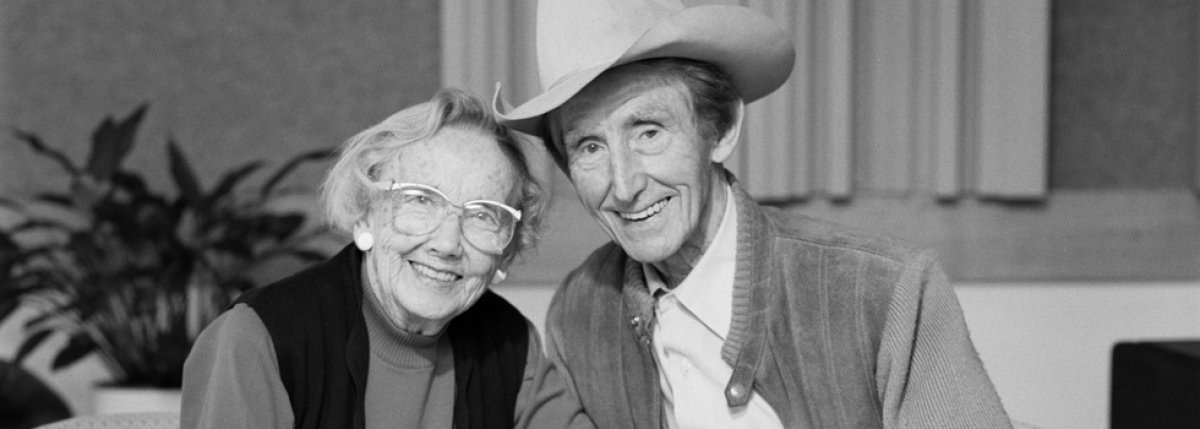
Portrait of Smoky and Dot Dawson
Smoky Dawson interviewed by Rob Willis for the Rob Willis folklore collection.
Our Oral History and Folklore collection records the voices that describe our cultural, intellectual and social life. The collection consists of over 55,000 hours of recordings, the earlier ones dating back to the 1950s when the tape recorder became available. More than 1000 hours of interviews, music and accents are added to the collection each year. Increasingly the collection is available online or may be requested from the catalogue. You can listen to:
Folklore recordings – popular culture, traditional songs, dances, music, stories and more
Interviews with distinguished Australians – scientists, writers, artists, politicians and sports people
Interviews with people who have lived through significant social trends and conditions – unemployment, the impact of child removals from families, the Depression, and migration to Australia
Environmental sound – the historical sound of the built and natural environment.
Some interviews have transcripts or summaries and our online audio delivery system helps you search the content of our collection, which can be searched through Trove.
Highlights
Interviews by Hazel de Berg – 1,290 recordings of interviews and readings dating from the 1950s of prominent Australian poets, artists, writers, composers, actors, academics, publishers, librarians, scientists, anthropologists, public servants and politicians.
Folk music by John Meredith – over 500 recordings between 1953 and 1994 of traditional Australian folk music, songs, recitations, bush dance music, yarns and reminiscences. John Meredith was a foundation member of the Bushwhackers and helped form the Bush Music Club and the Australian Folklore Society.
Bringing Them Home oral history project – These include over 300 interviews collected between1998 and 2002 of Indigenous people and others, such as missionaries, police and administrators, involved in or affected by the process of child removals. Listen online to a selection of interviews.
Australian Paralympic stories– interviews with key people responsible for the growth and success of Paralympic sport in Australia. Listen online to Australian Paralympic stories.
The back of our home where we had morning tea with Frances
Our daughter Monika said the other day: ‘I knew, Mum, that you’d like Frances.’ She wasn’t surprised at all that I very much loved having her around. Peter and I were always very much looking forward seeing her here at our home. This was some weeks ago. Very soon now we should get the result of these recording sessions with Frances.
I think Frances saw our daughter Gaby just a few days before Gaby died. Sadly the planned interview with Gaby could not take place at the time. There was some difficulty with incoming calls Gaby was expecting that day. Apparently Gaby was reluctant to switch off her mobile phone!
Gaby’s passing must have been a shock to Frances as it was to all of us. Frances had already been looking with Gaby at some of her documents. She was aware how Gaby caught polio at age four, and that she had lived as a quadriplegic with breathing difficulties for over fifty years. After Gaby’s passing she was keen to interview someone of Gaby’s family.
Frances found out from daughter Monika that we, Gaby’s parents, had gone overseas soon after Gaby’s death and wouldn’t be back for quite some time. In the meantime Frances started interviewing Monika. This is how Monika did get to know Frances. Monika agreed to be interviewed about her life in connection with Gaby. So Frances recorded twice one hour with Monika. Some time later, after our return from our long overseas trip, Peter’s and my tale was recorded too. Peter’s took eight times one hour, mine seven times one hour.









 AuntyUta
