
Published on Jan 19, 2012
https://www.fibershed.com/about/

Our Mission & Vision
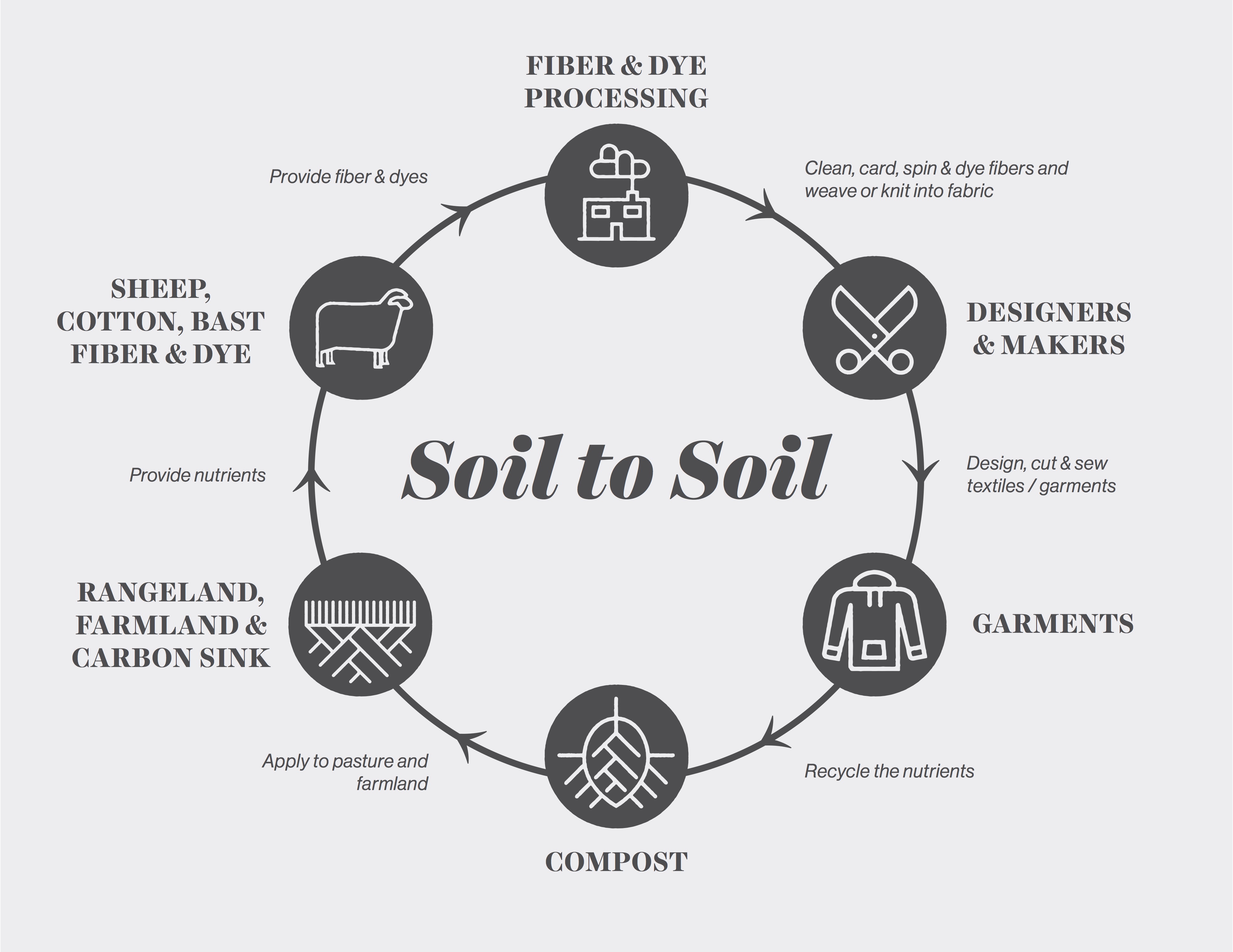
Fibershed develops regional and regenerative fiber systems on behalf of independent working producers, by expanding opportunities to implement carbon farming, forming catalytic foundations to rebuild regional manufacturing, and through connecting end-users to farms and ranches through public education.
We envision the emergence of an international system of regional textile communities that enliven connection and ownership of ‘soil-to-soil’ textile processes. These diverse textile cultures are designed to build soil carbon stocks on the working landscapes on which they depend, while directly enhancing the strength of regional economies. Both fiber and food systems now face a drastically changing climate, and must utilize the best of time-honored knowledge and available science for their long-term ability to thrive.
As each Fibershed community manages their resources to create permanent and lasting systems of production, these efforts to take full responsibility for a garment’s lifecycle will diminish pressure on highly polluted and ecologically undermined areas of the world. (China produces 52% of the world’s textiles. The industry is the third largest fresh water polluter in the country.) Future Fibershed communities will rely upon renewable energy powered mills that will exist in close proximity to where the fibers are grown. Through strategic grazing, conservation tillage, and a host of scientifically vetted soil carbon enhancing practices, our supply chains will create ‘climate beneficial’ clothing that will become the new standard in a world looking to rapidly mitigate the effects of climate change. We see a nourishing tradition emerging that connects the wearer to the local field where the clothes were grown, building a system that can last for countless generations into the future.
How did the Fibershed project start?
The project began in 2010 with a commitment by its founder, Rebecca Burgess, to develop and wear a prototype wardrobe whose dyes, fibers and labor were sourced from a region no larger than 150 miles from the project’s headquarters. Burgess had no expected outcomes from the personal challenge other than to reduce her own ecological footprint and maybe inspire a few others.
Burgess teamed up with a talented group of farmers and artisans to build the wardrobe by hand, as manufacturing equipment had all been lost from the landscape more than 20 years ago. The goal was to illuminate that regionally grown fibers, natural dyes, and local talent was still in great enough existence to provide this most basic human necessity—our clothes. Within months, the project became a movement, and the word Fibershed and the working concept behind it spread to regions across the globe. Burgess founded Fibershed’s 501c3 to address and educate the public on the environmental, economic and social benefits of de-centralizing the textile supply chain.
Richard William Heinberg is an American journalist and educator who has written extensively on energy, economic, and ecological issues, including oil depletion. He is the author of 13 books, and presently serves as the senior fellow at the Post Carbon Institute. Wikipedia
https://www.climatecouncil.org.au/about/
Mozart, Wolfgang Amadeus, Concerto in A Major for Basset Clarinet K. 622: II. Adagio
Both Peter and I staight away did think of the lyrics of -Ich hatt’ einen Kameraden – –
Published on Mar 26, 201
The Clarinet Concerto in A, K622, completed in 1791, the year of Mozart’s death, marked his farewell to instrumental music. It was also the first clarinet concerto to be written by a major composer – except that Mozart did not write it for the clarinet at all.
In fact, it is rare that we ever hear this most famous of wind concertos played on the instrument Mozart intended – the basset clarinet, a clarinet that has four semitones added to its lower range.
The inventor of the basset clarinet, and its leading virtuoso, was Mozart’s friend and fellow Mason, Anton Stadler, for whom Mozart had written the Clarinet Quintet in A, in 1789. “Never,” wrote Mozart to Stadler, “would I have thought that a clarinet could be capable of imitating the human voice as deceptively as it is imitated by you. Truly your instrument has so soft and lovely a tone that nobody with a heart could resist it.”
Far from being entirely the product of Mozart’s miraculously inspired final year, the first 199 bars of the clarinet concerto are identical to an abandoned concerto for basset horn (an instrument Stadler also played) that he began as early as 1787. By looking at this fragment (preserved at Winterthur, Switzerland) we can see, from the scribbles and erasures, that Mozart was uncharacteristically lacking in decision, often changing his mind and obviously under stress.
What may have stimulated Mozart into completing the abandoned basset horn concerto for Stadler and his basset clarinet, was his journey to Prague for the premiere of La Clemenza di Tito. One of his travelling companions was his pupil Süssmayr, who revealed that he was writing a basset clarinet concerto for Stadler. Mozart could not allow himself to be outdone. The concerto was written in Vienna some time between the end of September and the beginning of October 1791. The completed score was sent off to Stadler in Bohemia and it received its first performance at Stadler’s benefit concert in the Prague Theatre on October 16, 1791. Seven weeks later, Mozart was dead.
The concerto was not published until 1802, with the solo part adapted for the clarinet rather than the obsolete basset clarinet. The whereabouts of the original manuscript are unknown.
Rupert Read is affiliated with Extinction Rebellion and the Green Party.
Rupert Read says:
“I’m a Reader in Philosophy at the University of East Anglia and I have thrown myself headfirst into this movement. Our long-term aim is to create a situation where the government can no longer ignore the determination of an increasingly large number of people to shift the world from what appears to be a direct course towards climate calamity. Who knows, the government could even end up having to negotiate with the rebels.”
Further on he says:
“The Extinction Rebellion challenges oligarchy and neoliberal capitalism for their rank excess and the political class for its deep lack of seriousness. But the changes that will be needed to arrest the collapse of our climate and biodiversity are now so huge that this movement is concerned with changing our whole way of life. Changing our dietsignificantly. Changing our transport systems drastically. Changing the way our economies work to radically relocalise them. The list goes on.
This runs up against powerful vested interests – but also places considerable demands upon ordinary citizens, especially in “developed” countries such as the UK. It is therefore a much harder ask. This means that the chances of the Extinction Rebellion succeeding are relatively slim. But this doesn’t prove it’s a mistaken enterprise – on the contrary, it looks like our last chance.”
So he admits that the chances of the Extinction Rebellion succeeding are relatively slim. Still, I think we should want it to succeed, because it looks like this maybe our last chance!!
When I looked up the above link to ‘changing our diets’ I found this article in The Guardian:
What do you think, does it look like that a huge reduction in meat-eating should be achievable? I think we would have to get governments to agree to want to be working towards achieving such a reduction. If governments had the will to introduce certain policies, policies that would for instance be necessary in war-time, then a real lot could be achieved.
To use our cars less, is another thing that we could all keep in mind!
“Changing the way our economies work to radically relocalise them”: Do you have any ideas how this could work?
Peter and I saw this movie several years ago. It is one of those movies that stay in one’s memory.
 Author:gradyharpfrom United States
29 September 2005
*** This review may contain spoilers ***
DE TWEELING (TWIN SISTERS), based on the highly successful novel by Tessa de Loo and adapted brilliantly for the screen by Marieke van der Pol, is assuredly one of the most touching films to date about the strength of family bonds decimated by the horrors of WW II. Director Ben Sombogaart follows Dutch writer de Loo’s lead in making this story about the differing fates of twin girls separated at the death of their parents more of a parallel tale than capitalizing on the grim reality of Hitler’s influence. The result is a cinematically magnificent, gently hued verismo style of film that succeeds even more in its impact than if it were constantly doused in the dark side of its subject.
Germany 1920. Lotte Bamberg (played…
View original post 526 more words
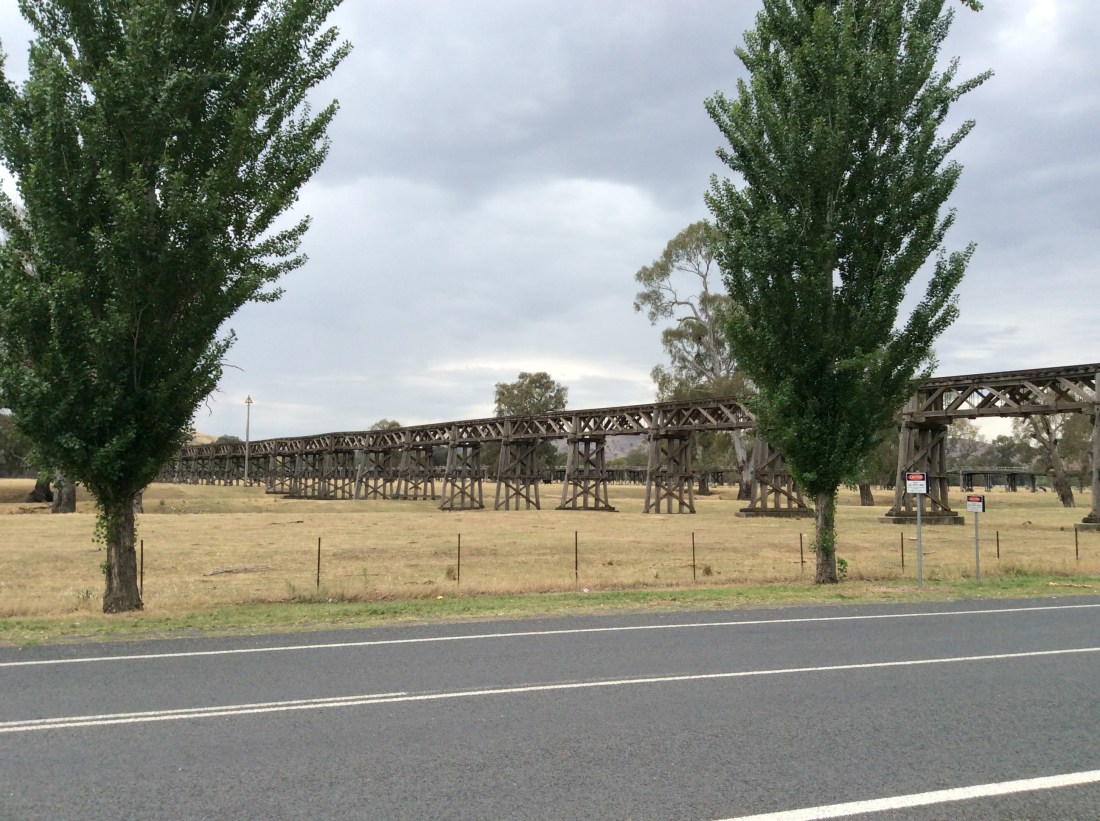

http://www.visitgundagai.com.au/8-2/
Gundagai Railway Station
https://en.wikipedia.org/wiki/Gundagai_railway_station
Click to access Gundagai_Bridges_Nomination.pdf
Some more pictures from our day at the Zoo:
And here some more pictures from Gundagai:
https://auntyuta.com/2018/11/15/nearly-one-week-away-from-home-in-november-2018/
This is what I wrote on the 15th of November 2018:
“We have just come back from a great few days away from home. I found our trip was very relaxing, and we did quite a few things that are worth remembering. It is always good to be able to go away for a little while. This creates memories.
Both Peter and I are in our eighties. That we still enjoy doing a bit of travelling, I find remarkable. Peter is battling to maintain some normality to his life while old age and sickness diminish his fitness. The one thing he is still pretty good at, is driving a car. He says driving a car on good roads for certain distances he finds relaxing. Our old Audi goes well on highways. In towns where there are a lot of traffic lights, Peter has to stop the car too often. This is when the car uses a lot of petrol pro km. However on freeways and highways the car uses much, much less petrol, and it makes Peter very happy and joyful to not have to stop all the time. However, Peter being 83 and having a few health issues that can make him feel perhaps too tired after a longer drive, he agreed not to drive the 650 km to Benalla in one day, but rather to stay overnight somewhere, that is at about the halfway point. This time we came up with the idea to stop at Gundagai for our overnight stays. This worked out very well. I wrote here that we stayed at the “Gundagai Motel”:
https://auntielive.wordpress.com/
After our one night’s stay at Gundagai we stayed at our son’s place at Benalla for three nights. And on the way back we stayed again for one night at Gundagai. This means we left home on a Friday morning and arrived back home on a Wednesday afternoon. So this makes it close to one week! I reckon we did very well, considering our age and Peter’s health problems. And of course I too have sometimes a few minor health problems related to old age!
Peter is booked in for some more treatment in the hospital. We hope the result of these treatments is going to be as good as possible so that perhaps in future we are still going to be able to do similar beautiful trips!”
Today is the 25th of March 2019 and write here a little P.S.:
In less than two weeks we are going for another trip to Benalla. Peter’s treatment in the hospital has been delayed. We don’t know yet, whether he can get some treatment soon. This may be a good thing, for Peter has not symptoms that he is unduly concerned about. So we booked a few stays at the Gundagai Motel again. And Martin knows already that we want to be with him for his birthday on the 8th of April.



 AuntyUta