Uta’s December Diary 2017

DSCN3543

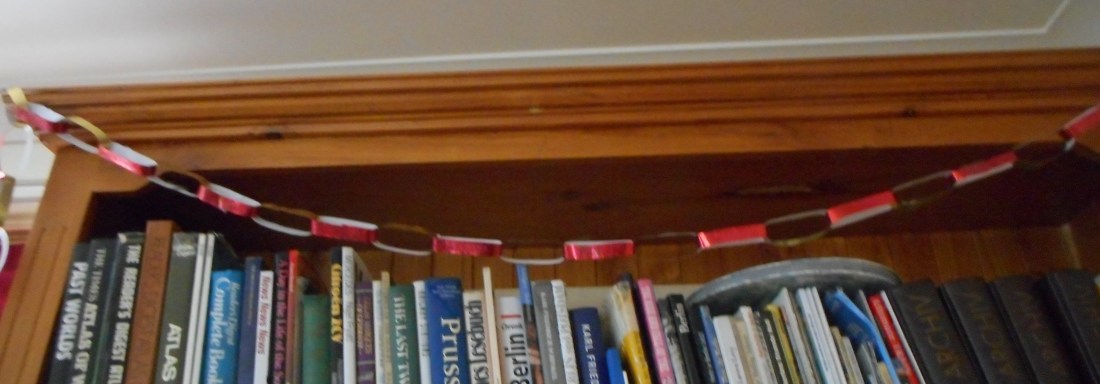
The other day Peter made some “Papierschlangen” (paper snakes). He remembered how he learned to make these as a nine year old at a boys’ home in Friedland (Silesia) where he was to be away from the bomb raids over Berlin.

DSCN3544

Peter did hang up his paper snakes at various places in our living room.


DSCN3545

He also found some colourful electric lights to hang up. I think we used to have them on our old Christmas tree.

Here are some books for the great-grandsons to enjoy when they come to visit.

December Diary 2017

DSCN3541

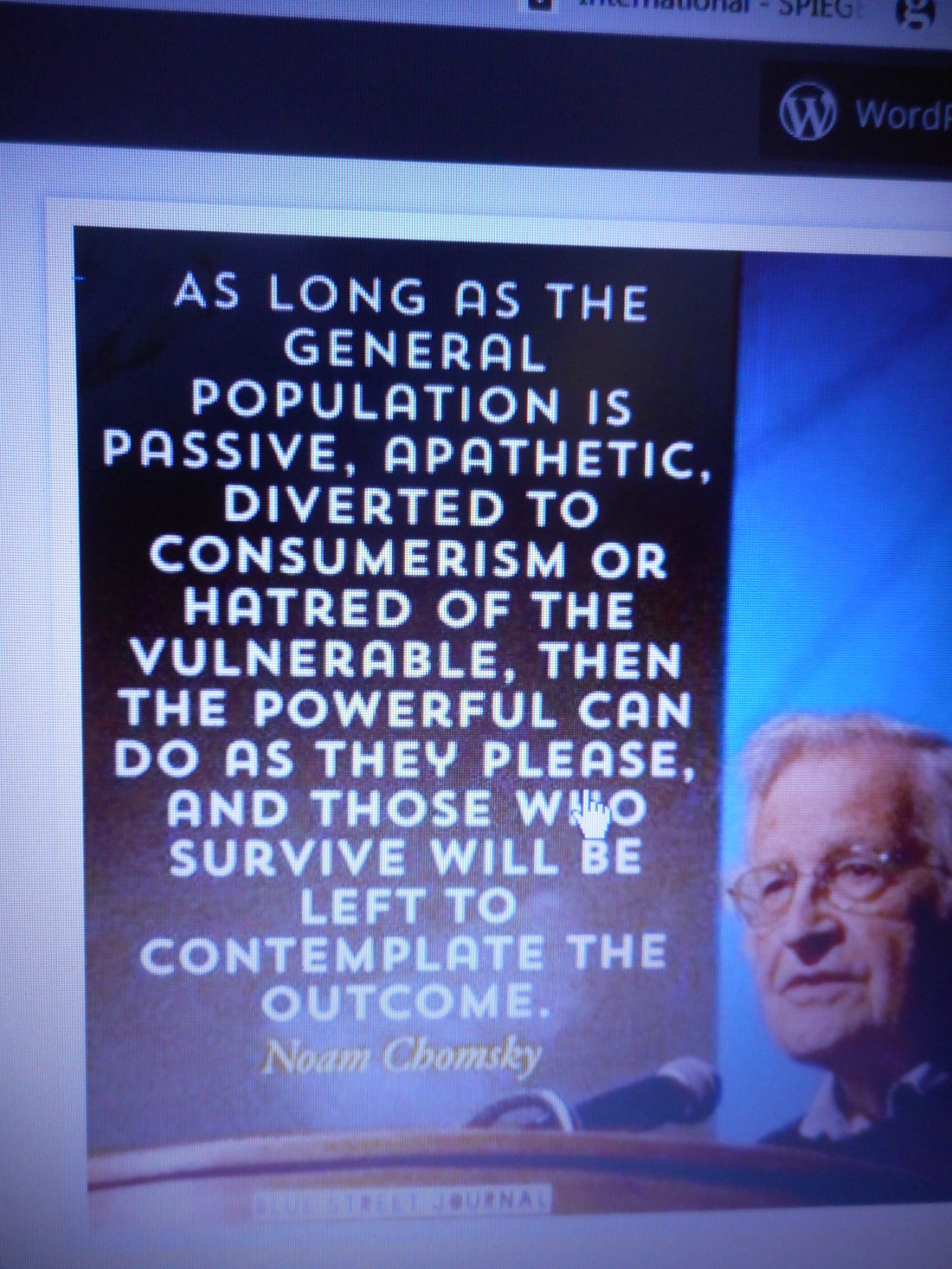
Well, so far I survived for eighty-three years. So what is there to contemplate? The answer: There is a whole lot to contemplate!

I looked this up in Wikipedia:

Avram Noam Chomsky(US: /ævˈrɑːm ˈnm ˈɒmski/ (About this sound listen) av-RAHMNOHM CHOM-skee; born December 7, 1928) is an American linguistphilosophercognitive scientisthistoriansocial critic, and political activist. Sometimes described as “the father of modern linguistics,” Chomsky is also a major figure in analytic philosophy and one of the founders of the field of cognitive science. He is the author of over 100 books on topics such as linguistics, war, politics, and mass media. Ideologically, he aligns with anarcho-syndicalism and libertarian socialism. He holds a joint appointment as Institute Professor Emeritus at the Massachusetts Institute of Technology (MIT) and laureate professor at the University of Arizona.[22][23]

Born to middle-class Ashkenazi Jewishimmigrants in Philadelphia, Chomsky developed an early interest in anarchism from alternative bookstores in New York City. At the age of 16 he began studies at the University of Pennsylvania, taking courses in linguistics, mathematics, and philosophy. . . . .”

It seems, that today is his birthday. So, HAPPY BIRTHDAY, Noam!

From the above quote the expression “diverted to consumerism or hatred of the vulnerable” demands my attention. As a pensioner in Australia without major assets (except for owning own house), I would have to count myself to the bottom half in the population. And yet I must say I lead a comfortable life with most medical expenses covered by Medicare.. Is it because the general population in Australia is “diverted to consumerism”? Or is it “hatred of the vulnerable” especially hatred of so called illegal migrants that makes us prosper in Australia? Well, this is something to contemplate. If we stop being “apathetic and passive” does our good life end then? How important is it to have a “good ” life at the expense of the vulnerable? Would the vulnerable have a better life if we stopped consuming so much?

So, the powerful think they can do as they please. They may think they can do it, but surely eventually this must lead to some kind of disaster. I mean some major disasters like wars are affecting the vulnerable already, but maybe it is only a matter of time when major disasters hit everyone on this planet. So should there be any survivors, they are going to have a lot to contemplate . . . .


Diary in December 2017

https://en.wikiquote.org/wiki/Johann_Wolfgang_von_Goethe

This morning I went to Wikipedia to look for a certain quote by Johann Wofgang von Goethe. When I saw the above Wikiquote page I was immediately hooked. My thoughts were, that this page is very, very interesting. I could not look enough at it. How wonderful it would be if I could study it for hours and hours!

I have the feeling time is running away with me. What with more and more medical tests and all the every day things in life that still need doing if one wants to live independently, one would love to have a bit more time left for reflection and writing.

In old age everything does slow down a lot, in my case maybe more physically than mentally. But the mental capacity is very much reduced too, I am sure. It is often difficult to concentrate on just one thing. The frequent dizzy spells do not help in this regard.

I very much wish to approach the end of my life in a calm, thoughtful way. Haste in any form is obnoxious to me. Alas, quite often it cannot be avoided. Maybe sometimes I feel rushed unnecessarily. But this is how I often feel: “Not being able to accomplish things as promptly as required!” Is that the reason for my blood pressure going sky high? Or are there some other underlying causes?

I am looking forward to some relaxing Christmas celebration with joyful company, some alcoholic beverages and a choice of excellent food. Plus I hope for some soothing music and at other times also some very joyful, exuberant music.

DSCN3529 (2)

DSCN3529

The other day I bought myself some beautiful sandals in this special shoe shop in Piccadelli, Wollongong.. Afterwards I sat down in that cafe opposite for some coffee and a snack while I was waiting for Peter to return from his medical appointment.

On another day I waited for Peter in the car in Burelli Street in Wollongong. The car happened to be parked where some more retirement building is going on. I took some pictures from the car. When Peter returned we talked about how very convenient it would be to be able to live in an apartment in that new retirement building in the centre of Wollongong. Alas, we would have to have at least half a million to afford a place like this. Our place in Dapto is worth quite a bit, but not quite this much! So I guess we will be staying in our beautiful place in Dapto for as long as possible, trying to look after it as well as possible while we are aging more and more.I really do feel sad sometimes that our place shows some signs of neglect. but on the other hand it is really a beautiful not too  expensive place, and we love it!!

Birthdays in December 2017

Today is the 59th birthday of one daughter, and only four days later another daughter of ours is going to turn 39. We are going to celebrate both birthdays with the whole family this coming Sunday. I am very much looking forward to this.

Early in the morning I checked on our tomatoes. I got a surprise when I saw that one tomato is turning already a little bit red!

The first picture is from this morning, the other pictures I took recently on different days:


DSCN3542

DSCN3537

Christiane von Goethe

In my previous post I published my thoughts regarding the equality of women in connection with the Life of ChristianeVulpius: 

https://auntyuta.com/2017/12/03/christiane-vulpius/https:/

The following is another article about her Life that I just copied from Wikipedia:

“Christiane Vulpius spent her childhood in the Luthergasse, one of the oldest parts of Weimar. Her paternal ancestors were academics for several generations. On the mother’s side she came from a craftsman family. Her father Johann Friedrich Vulpius , office archivist in Weimar, d. H. File copyist, had studied law for a few semesters , but stopped studying. His job was poorly paid, the family lived in very distressed conditions, especially since the father did everything to allow the eldest son Christian August tostudy. Christiane was forced to work as a cleaning lady in a small Weimar factory with Caroline Bertuchaccept; this was a branch of Friedrich Justin Bertuch , who was not only active in the publishing business. This was all the more necessary as the father was dismissed prematurely because he was charged with an irregularity. But she was not a worker, but was one of the employed “unemployed girls of the middle classes”. From her six siblings later her brother Christian August was known as a writer of entertainment novels.

Christiane and August von Goethe, watercolor by Johann Heinrich Meyer(1793)

Memorial plaque on the house Luthergasse 5 in Weimar

Grave on the Jacobsfriedhof in Weimar

Due to various requests for help and applications Goethe knew the location of the family. On July 13, 1788, he met Christiane Vulpius himself in the park on the Ilm , where she gave him a petition for her brother Christian August. In fact, Goethe later repeatedly advocated for his future brother-in-law.

In that summer a passionate love affair developed rapidly between Goethe and Vulpius. The following year, on December 25, 1789, the first child, the son of August , was born. Four other children followed, all dying very early. The happy life and love in this conscience inspired Goethe to his most serene and erotic poems, starting with the Roman Elegies – which not only processed the amorous adventures of his first trip to Italy, but also indirectly sang Christiane – to the 1813 dedicated to his wife poem found (“I went so in the forest for myself …”).

Goethe took the young woman to his house together with her half-sister Ernestine and her aunt Juliane; their sphere of influence remained completely limited to the house and garden. The Weimar court and the society rejected the illegitimate and improper connection, so that Goethe, on the advice of the Duke, had to leave the house on the Frauenplan in the center of Weimar and temporarily move to the “Jägerhaus” on Marienstraße. The victory of the Napoleonic troops after the Battle of Jena and Auerstedt on October 14, 1806 met Weimar hard. When the city was looted by French soldiers, the house on the Frauenplan was also threatened: Christiane energetically opposed invading soldiers and was able to stop the looting until Goethe had achieved official protection by the French commander.

Even after her marriage Christiane was accepted as a “Geheimrätin von Goethe” by the Weimar society only reluctantly and hesitantly. To change the social rejection of his wife, Goethe asked the wealthy widow Johanna Schopenhauer , mother of the philosopher Arthur Schopenhauer , to break the barrier with an official invitation to tea. She did it with the remark: “If Goethe gives her his name, we will be able to give her a cup of tea.”

Von Goethe’s letters to her husband show a natural and common sense, but also their educational gaps. Joyful, practical and energetic, she took on the extensive household. For example, after the death of Goethe’s mother, she regulated Aja , in Frankfurt am Mainthe inheritance matters. Goethe often enjoyed social gatherings, danced with pleasure and often attended theatrical performances in Weimar, but also in other places such as. B. Bad Lauchstädt, where the Weimar Theater Society guested in the summer. Even a harmless flirt she was not averse. The correspondence with Goethe proves that he also tolerated occasional “making an apex”. Goethe possessed aesthetic sensibility and the ability to differentiate, and he was sometimes able to advise Goethe. Thus Goethe confessed that he could not and would not continue the theatrical affairs in Bad Lauchstädt without her. These were, of course, sites that remained hidden to many, even close acquaintances. But it was not completely hidden from posterity, which was expressed, among other things, in that one of the Weimar court sculptorsCarl Gottlieb Weisser’s bust of Christiane von Goethe was set up as a bronze copy in the specially erected pavilion of the spa park Bad Lauchstädt at the end of the 19th century .

As he grew older, Goethe’s state of health fluctuated. In 1815 she suffered a stroke. The following year, severe renal failure was added in severe pain. After a week of painful suffering, she died on June 6, 1816. The funeral, in which Goethe did not participate, took place at the Jacobsfriedhof Weimar . Her grave was lost for a long time and was only found again in 1888 and provided with a grave plate. She wears Goethe’s Farewell verses: “You try, O sun, in vain, / To shine through the gloomy clouds! / The whole profit of my life / Is to mourn her loss.”

Christiane Vulpius

These days we hear a lot about women’s equality,  that means, women have the same rights as men. So, at least in our Western societies we have achieved a lot as far as women’s rights is concerned. I keep asking myself, why do some men still not want women to have equal rights? Maybe it is a reflection of what nearly all men were like in the past, Maybe some men just find it too difficult to change. For sure a lot has to do with upbringing and education and what they feel a man must be like.

I am very interested in finding out how prominent women used to live during the time of Johann Wolfgang von Goethe’s life. In that connection I am especially interested in finding out about women that did not belong to the nobility as for instance Christiane Vulpius who rather late in life became Frau von Goethe, the wife of Wolfgang von Goethe.

It seems to me what class you belonged to very much affected your upbringing and your lifestyle. The class system of course also very much affected men; still the fact remains that men had far more opportunities for advancement than women. with perhaps one exception namely when a women at the right time in her life managed to marry into a different class. In Christiane Vulpius’s case this seemed not to have worked out very satisfactorily. By the time Goethe married Christiane the couple already had a sixteen year old son. And she died ten years later.  I think this is why it is interesting to read about Christiane’s life. I read the biography that Dieter Wunderlich wrote. I copy here the last part of it:

http://www.dieterwunderlich.de/Christiane_Vulpius.htm

“After the defeat of Prussia and Saxony against Napoleon on October 14, 1806 at Jena and Auerstedtplundered the French Weimar. What exactly happened the following night is not guaranteed. Allegedly, Christiane Vulpius saved her lover’s life by courageously putting herself in the way of the soldiers who wanted to plunder the house on the Frauenplan. She held the men down until October 16, when Goethe received a sauvegarde , a letter of protection issued in the name of the Emperor, which kept him and his house safe from French soldiers.

Three days later, on October 19, 1806, Johann Wolfgang von Goethe and Christiane Vulpius married in the Jakobskirche. Her sixteen-year-old son August was there.

In order to introduce his wife into Weimar society, Goethe persuaded Gdańsk’s widow Johanna Schopenhauer (1766 – 1838) – the mother of the philosopher Arthur Schopenhauer – who moved to Weimar only a few weeks ago, to have tea with them on 20 October. However, the hostility in the population against Christiane von Goethe persisted.

Johann Wolfgang von Goethe not only traveled without Christiane, but also lived alone in Jena for months. And when he was at home, he retired to write in the evening, while Christiane played cards with friends.

Goethe’s and Christiane’s life is largely separate. (Sigrid Damm, loc. Cit., Page 214)

Christiane von Goethe was anything but an intellectual, but she liked to go to the theater; she had common sense, was practically gifted, and led the big household with a strong hand. When her mother-in-law Katharina Elisabeth died in 1808, Christiane took care of the inheritance matters of her husband, so that he could write undisturbed.

At the beginning of 1815 Christiane von Goethe suffered two strokes. A third stroke took place at the end of May 1816. Presumably, Johann Wolfgang and Christiane von Goethe saw each other for the last time on May 30, because the poet kept away from his terminally ill wife and lay in bed himself after a painful week on the 6th. June – probably due to uremia – died. He also did not participate in the funeral on the Jacobsfriedhof in Weimar.”


How to live an ethical life and change the world

https://www.theguardian.com/australian-ethical-invest-for-a-better-world/2017/sep/25/how-to-live-an-ethical-life-and-change-the-world

Paid for by:

https://www.australianethical.com.au/

“Ethics is about making the right choices for ourselves and the society we live in. With so many challenges facing us and the planet, what can we be doing better?”

I just had a look at this article. I must say that a lot that is pointed out in this article I find fascinating. I am going to copy here just a few sections in this article that I noticed in particular. But I think it is to be recommended to take the time and read the whole article and maybe look at some of the links also. Apparently there are among very successful people quite a few who want to do something good for the society we live in!

In the following copied section is talk about ‘Tribalism’ and how it stands in the way of an honest discussion.

I just read a few pages in Chapter Nineteen of Judy Nunn’s new novel “Sanctuary”.  It seems to me the discussion among people in this chapter shows how tribalism affects the thinking of people. Judy Nunn is very good in showing this in her writing.

https://www.penguin.com.au/books/sanctuary-9780143783855

The following are a few copied sections about what we can do to change the world:

“To live a more ethical, sustainable life we need to avoid letting habits or impulses guide our actions. We need to engage in ethical reflection and conversation. We need to understand ourselves, and we need to talk to others.”

With so much ethical and factual complexity in the modern world, Dr Palmer stresses it is essential to challenge our assumptions and seek out different sources of information, as well as different perspectives on that information.

 “We need to have constructive conversations with people who know
things we don’t, and with people we disagree with.”

Working against this, however, is a tendency towards “tribalism”, which means we often fiercely defend shared opinions rather than investigating issues with an open mind and engaging in complex debate.

Climate change tribalism is one clear example, he says, with similar challenges facing the discussion of issues like refugees and migration, marriage equality, and inequality and discrimination more generally.

“There are different policy approaches we can take (on climate change). But that’s not the roadblock. Tribalism is standing in the way of an honest discussion of the urgent action needed, like a price on carbon to accelerate the transition from fossil fuels to renewables.

“People resist and embrace change to different degrees, but our capacity to change is part of our humanity, and change is going to be essential to meet the massive social and environmental challenges we face.”


Life and style Empty nest? Not a chance

Saskia Sarginson writes in The Guardian about “millennials”. She says if you Google “millennials” you will come across several negative articles citing their failings. I just read Saskia’s article where she points out that her children millennials, but far from the stereotypes society pokes fun at.

https://www.theguardian.com/profile/saskia-sarginson

My children are millennials, but are far from the stereotypes society pokes fun at

Her article with the above heading was published in The Guardian on 25th  November 2017. Saskia explains that a millennial is a young adult, aged 18-34, She says about the millennials the following:

“They are depicted as entitled, narcissistic and lazy, sponging off  their parents while procrastinating about what to do with their lives; their favourite occupation is documenting every detail of their days in a series of selfies; if they do indulge in a little light ‘adulting’, say microwaving their own supper, then this too will be recorded and posted.”

But Saskia says that her own children are not entitled, narcissistic or lazy but angry, for instance that they have no prospects for getting on the property ladder. Most of all they are angry about the state of the world, such as:

“Global warming, plastic floating in the oceans, fracking, the destruction of the rainforests, pollution, and the evils of factory farming.”

Saskia says that none of her children plan to procreate. Her son says this is the right decision because the world is “so fucked up”. It saddens Saskia, that her children have so little hope for the future.

To read the whole article please go to:

https://www.theguardian.com/profile/saskia-sarginson