Secret Trade Deal

http://usawatchdog.com/we-dont-know-how-bad-secret-obama-trade-deal-really-is-ellen-brown/

By Greg Hunter’s USAWatchdog.com

June 24, 2015

Attorney and public banking expert Ellen Brown says the recent Obama trade deal is bad news. Brown contends, “We don’t even know how bad it is. All we know we got out of WikiLeaks. It’s all secret. They are negotiating what would be called a treaty which should require a two-thirds vote under the Constitution. They are negotiating it for “fast-track” and it is completely secret. . . . These documents are supposed to be kept classified for four years after this thing passes. How is that even possible? There are two other agreements that are coming down the pipe that are also covered by “fast-track,” which means they go directly to an up or down vote. Only get a brief time to look at it. They don’t get to use filibusters. They don’t get to debate. Besides the TPP (Trans Pacific Partnership) which is bad enough because what we know of it is horrible, there is the Trans-Atlantic Agreement which is similar to the TPP with Pacific Rim countries. There’s another one that we only just heard about which is the TiSA, which is the Trade in Services Agreement. This covers 80% of the American economy and all sorts of services, including financial services, which means banking. So, we can’t regulate banking anymore, and that is basically what it means.”

So, instead of getting a government “Of the people, by the people and for the people,” we are getting a government of the corporations, by the corporations and for the corporations. Brown contends, “That is totally correct. It is alarming what is happening. Corporations totally run our government. We think this is for the benefit of the American people, but it is for the benefit of the large American corporations, and they’re not even American corporations. They are large international corporations. These corporations can sue us, our local governments for trying to protect the people against whatever they want to destroy—our economy, our environment, our jobs.”

Obama’s secret trade deals greatly helps out big banks. Brown says, “It looks to me the banking system is in control. That’s where all the big money comes from, and that’s where the two big parties got their money. It’s been this way ever since Rockefeller and Morgan back then in 1900—the Democrats and the Republicans. Brown goes on to say, “The goal here is “they” want to own everything and rent it back to us. So, law is no longer a way to protect the people. Law is now to protect the corporations and serve the corporations.”

Brown does not give up hope and says, “To me, the only hopeful thing about all this is that it is so outrageous and so many people are upset that you hear the word treason bantered about. It is becoming obvious that neither party is representing us ‘we the people.’ People are coming together from the left and the right to oppose what we got, and hopefully to organize something else like a whole new movement. . . . a movement for the people that supports the people and defends the people instead of the big corporations.

Join Greg Hunter as he goes One-on-One with Ellen Brown, creator of The Web of Debt Blog.

(There is much more in the video interview.)

After the Interview:

Ellen Brown is a prolific writer and posts regularly on her Web of Debt blog. Her work, which she posts for free, can be found on

ellenbrown.com.

More about Tulsi Gabbard

https://auntyuta.com/2016/03/13/sanders-campaign-gets-sparks-and-sparkle/

https://bryanhemming.wordpress.com/2016/03/12/sanders-campaign-gets-sparks-and-sparkle/

The above is a link to Bryan Hemming’s post that I reblogged yesterday.

Now I googled Tulsi Gabbard and found an article in The Guardian from February 28. I find this article explains in a few words what Tulsi Gabbard’s position is right now in supporting Bernie Sanders.

http://www.theguardian.com/us-news/2016/feb/28/tulsi-gabbard-quits-dnc-support-bernie-sanders

Above is a link to the article in The Guardian that I copied and you can find below here:

Congresswoman Tulsi Gabbard quits DNC to support Bernie Sanders
Former vice-chair is an Iraq war veteran whose words come as a boost to the Vermont senator, who faces criticism over his lack of foreign policy experience.

Tulsi Gabbard: ‘It’s important for us to recognize the necessity to have a commander-in-chief who exercises good judgment.’

Alan Yuhas
@alanyuhas
Monday 29 February 2016 07.27 AEDT Last modified on Monday 29 February 2016 09.43 AEDT
Share on Pinterest Share on LinkedIn Share on Google+
Shares
2,097
Comments
339

Representative Tulsi Gabbard resigned from her post as vice-chair of the Democratic National Committee on Sunday, in order to support Bernie Sanders in his run for the party’s presidential nomination.

Gabbard made the announcement on Sunday, appearing as a panel member on the NBC show Meet the Press.

“I think it’s most important for us, as we look at our choices as to who our next commander-in-chief will be, is to recognize the necessity to have a commander in chief who has foresight, who exercises good judgment,” she said.

Sanders suffered a serious loss to Hillary Clinton in Saturday’s South Carolina primary, with only 26% to Clinton’s 74% of the vote. Afterwards, speaking from Minnesota, where he flew from Texas to concentrate on states staging Super Tuesday primaries this week, he vowed to continue to carry the battle to Clinton.

“In politics on a given night sometimes you win, sometimes you lose,” he said. “Tonight we lost. I congratulate Secretary Clinton on her very strong victory. On Tuesday over 800 delegates are at stake and we intend to win many, many of them.”

He was more downbeat during his own appearances on the Sunday talk shows, telling the same NBC show: “Well, we got decimated. It was pathetic, from our perspective. But by the way, the glimmer of positive news for our group was we won the 29 and younger.”

Gabbard, 34, an Iraq war veteran and now representative for Hawaii, became the fourth member of Congress to endorse Sanders. She elaborated on her decision, by saying it stemmed from Sanders’ cautious foreign policy.

“As a veteran and as a soldier I’ve seen first-hand the true cost of war,” she said.

“I served in a medical unit during my first deployment, where every single day I saw first hand the very high human cost of that war. I see it in my friends who now, a decade after we’ve come home, are still struggling to get out of a black hole.”

Could foreign policy be Bernie Sanders’ undoing? Yes – if you believe the polls

“I think it’s most important for us,” she continued, “to recognize the necessity to have a commander-in-chief who has foresight, exercises good judgment, who looks beyond the consequences, looks at the consequences of the actions they’re looking to take, before they take those actions, so we don’t continue to find ourselves in these failures that have resulted in chaos in the Middle East and so much loss of life.”

Gabbard’s words will come as a boost for Sanders, who has faced criticism from Clinton and questioning from the media over his perceived lack of foreign policy experience.

On the campaign trail and the debate stage, the senator has pointed to his vote against the Iraq war – which Clinton, then a senator for New York, supported – as evidence of his pragmatism and caution on such key foreign policy issues.

He also highlighted another, more contemporary difference of opinion with the former secretary of state on Sunday: US military intervention in Libya, which Clinton strongly supported during the revolution against dictator Muammar Gaddafi there.

“These are terrible dictators, but you’ve got to be thinking about the day after,” Sanders said on NBC. “I would’ve done it differently if I were president of the United States.”

Pressed on how he would have acted, the senator said he “would’ve worked more patiently. I know it was a difficult situation, but you can’t just go thinking about regime change.”

He agreed, however, with President Barack Obama’s decision not to try to create a no-fly zone over Syria, another proposal supported by Clinton. Obama and the chairman of the joint chiefs of staff have shied from this form of intervention for fears of entanglement and “unintended consequences”.

More news Topics
US elections 2016 Democrats Bernie Sanders US politics

Sanders Campaign gets Sparks and Sparkle

I think Tulsi Gabbard is a very interesting person.

Bryan Hemming's avatarBryan Hemming

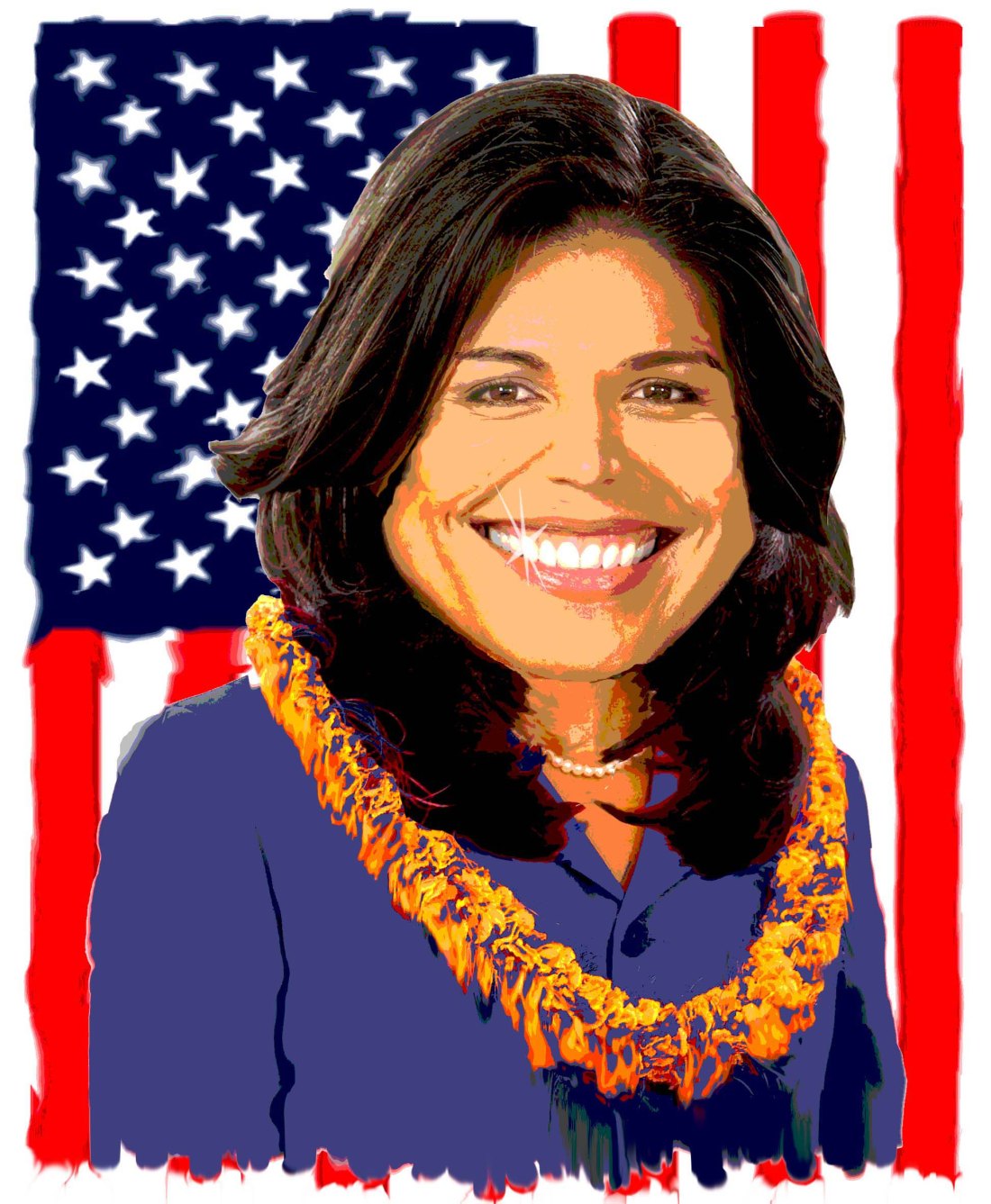
Tulsi 3 Caricature – Bryan Hemming  © 2016

On February 12th this year Dan Froomkin, the influential Washington Editor of the Intercept, used an article slamming Hillary Clinton’s slavish adherence the doctrines of Henry Kissinger to solicit likely names for a ‘dream foreign policy team. Taking up the challenge, I dashed off an email expressing grave doubts as to whether there were anywhere near enough politicians in the U.S. political establishment possessing sufficient knowledge of foreign affairs to form a whole team.

Having said that, I do believe there is one politician eminently qualified to lead a dream foreign policy team, and she might even get to do it.

“I cannot remain neutral any longer; the stakes are too high.”

Using those words Congresswoman Tulsi Gabbard resigned from her post as vice-chair of the Democratic National Committee on February 28th to endorse the candidacy of Bernie Sanders. Announcing her…

View original post 1,384 more words

Uta’s Diary two Weeks before Easter 2016

I am a bit overwhelmed when I think about it that it is only two more weeks to Easter. I feel like I am just drifting from day to day. Sharing temporarily our house with our daughter and her partner, our life has changed. It is like having moved to a different house.

Often I imagine what it would be like to have to move to a retirement village, to a hostel or to a nursing home. How much of our stuff could we take with us, and if it cannot be a place where we can have an independent living unit, what then? Could Peter and I stay together in a hostel or a nursing home? Not very likely, not at all.

C and M lead very busy lives. Still, since they have moved in with us, there have been quite a few very enjoyable hours when we could spend time together. The young people are such good company for us. We had to make a bit of room for them in our little house. That meant we had to get rid of a lot of our stuff, for instance books:

DSCN0837

I probably do have a better understanding now why people find it very difficult to move from a long established larger residence into a very much smaller residence. It is hard to make the decision that there are certain things in your life that you do not need any more.

Our daughter lived in her flat in the Eastern suburbs of Sydney for more than ten years. Her partner and his teenage son (he turns 21 this month) lived there with her for close to ten years. They established their own household. They worked out a plan how to move some of their household stuff into our home. The plan worked out on the whole surprisingly well. Most of these boxes with their stuff they were able to unpack and find some room for the contents:

DSCN0841

Since I walk around a lot barefoot, I ended up with some very hard skin, especially under my right foot. Actually this week it got somewhat inflamed after I tried to cut off some of the skin. So for a couple of days I suffered quite a bit of pain. Thankfully it is getting better now.

DSCN0842

I like to sit outside in the morning sun. This simple garden furniture from their porch/terrace in Waverly (Sydney), which C and M had painted themselves many years ago, they wanted to throw out. But I told them I love it. So it is now installed at the north side of our house. There are a lot of trees, but the morning sun gets through a bit, and we love to sit there with our morning tea.

Women, Peace, and Security

http://www.peacewomen.org/member-states

MEMBER STATES

National Action Plans for the Implementation of UNSCR 1325 on Women, Peace, and Security

How do states implement the Women, Peace, and Security Agenda? How can civil society hold states accountable? National Action Plans (NAPs) are one way to implement Women, Peace, and Security commitments at the country level and to advance accountability. Regional Action Plans (RAPs) are another way of coordinating work in a broader area.

As of February 2016, fifty-seven nations have created a National Action Plan on UNSCR 1325. The following countries have released their NAPs during 2015: Afghanistan, Japan, New Zealand, Palestine and Paraguay. Furthermore, other countries have committed to develop NAP in 2015: Algeria, Angola, Brazil, Kazakhstan, Kenya, Latvia, Portugal, Thailand, Ukraine and United Republic of Tanzania. There are a handful Regional Action Plans as well, such as the one of the African Union and of the European Union.

Both governments and civil society groups are the movers and shakers putting the Women, Peace, and Security Agenda into action. PeaceWomen’s Action Plan Initiative monitors, analyses, and shares UN Member State and Regional Action Plans. PeaceWomen and WILPF more broadly also work at the local and national level to advance National Action implementation.

This section of Who Implements: Member States includes an overview of action plans and lists of action plans by country, region, and theme. It also includes resources for civil society, national, and global reviews, and information on commitments beyond NAPs including a call for action on 2015 commitments and highlights of current innovative work.

PeaceWomen Spotlight

Latest National Action Plan

In December 2015, the government of Paraguay launched the Paraguayan National Action Plan for the implementation of UNSCR 1325 on Women, Peace and Security…

[read more]
PeaceWomen Spotlight

Call to Action on 2015 Commitments

October 2015 marked the 15 Anniversary of UNSCR 1325 and the Security Council hold an Open Debate on Women Peace and Security. Member states had the opportunity to renovate and make new commitments. Do you want to know what each country committed to? Click here!

[read more]

This is a Copy of an article from October 31, 2013: Dying to Be Men: Symposium Digs for Roots of Gender Violence

http://www.usip.org/publications/dying-be-men-symposium-digs-roots-of-gender-violence

Dying to Be Men: Symposium Digs for Roots of Gender Violence

Published:
October 31, 2013
By:
Viola Gienger
Colonel Birame Diop is considered a rare success in his family’s neighborhood in Senegal — a pilot in his country’s Air Force who went on to serve as a top adviser to the Chief of Staff and a global expert on the role of military in society.

Under Senegal’s social norms, his achievements reflect well on his mother and show that she was a good wife to his father, Diop explained to an audience at the U.S. Institute of Peace this week during a two-day symposium called “Men, Peace and Security: Agents of Change.” Senegalese men are expected to find a house and protect the family’s health and security, regardless of whether their wives work, as they often do, or even regardless of which of them makes more money.

But in a country where 70 percent of the population is between 16 and 35 and jobs are scarce, such expectations pose an almost impossible hurdle to the ideal of manhood.

“The situation is so challenging that men, who are considered as being at the epicenter of everything in our society — the pressure on these people is so high that failure is not at all an option for them,” said Diop, who serves as director of Partners Senegal: Center for Change and Conflict Management. “Some who have not been able to be what their society expected them to be can turn against the same society to express their frustration” through violence, he said.

Diop and more than three dozen keynote speakers and panelists at the symposium waded into volatile subjects like the paradox of hyper-masculinity, the threat of “failed adulthood,” and the lure of power through violence. The 245 participants and a follow-up training for practitioners on a third day explored how male identity and societal norms contribute to violent conflict and, conversely, might be altered to support peace.

The symposium was co-hosted by the World Bank, the North American office of the Stockholm International Peace Research Institute (SIPRI); Washington-based Women in International Security (WIIS); the U.S. arm of the Brazilian non-governmental organization Instituto Promundo; and the South Africa-based Sonke Gender Justice Network. The event grew, in part, out of a two-year study on lessons learned about programs for women in Iraq and Afghanistan. One of the most consistent recommendations for ensuring sustainable programs that advance peace and security was to include men.

“The tendency among us is to use gender and women interchangeably,” said Kathleen Kuehnast, director of USIP’s Center for Gender and Peacebuilding. “However, this leaves us with half a solution to many of the problems that plague women and girls in conflict and fragile settings.”

The symposium title is a play on the title of United Nations Security Council Resolution 1325 on Women, Peace and Security, adopted 13 years ago this week to urge governments to devise plans for protecting women and increasing their decision-making role during and after conflicts. More than 40 countries have adopted national action plans, addressing a broad range of issues like representation of women in armed forces and at peace negotiations or ending the scourge of sexual assault and other violence against women.

“This isn’t just a question of women,” said Ambassador Donald Steinberg, deputy administrator at the U.S. Agency for International Development. “This is a question of men, it is a question of society, it is a question of equity, it is a question of global peace and security.”

Research has found “only limited evidence that men are more inherently violent than women,” according to a new USIP Special Report entitled “The Other Side of Gender: Men as Critical Agents of Change.” “Violence is ultimately learned and encouraged in the social environment, which suggests that it can also be unlearned.”

Although most men are not, by nature, violent, men do commit much of the violence, Kuehnast told the symposium. Steinberg cited research showing that men are up to six times more likely to commit and be victims of homicides. But at the same time, studies indicate the propensity has “as much to do with early exposure to violence, with economic frustration, with the militarization of societies, with boys’ coming-of-age rituals and gender-based proliferation of light weapons as it does with testosterone,” he said.

“In excluding the very roles and experiences of men in conflict, including as witnesses and victims themselves of violence, we are also limiting our approaches to solving difficult problems like gender-based violence,” Kuehnast said.

The thought-provoking titles of sessions during the symposium capture the quandaries and the questions: “Dying to be Men: Masculinities in Conflict and After;” “How Men Are Made: Cultures of Hyper-Masculinities;” “All Revved Up and Nowhere to Go;” and “Nurturing the Ex-Combatant.”

“What we’re discovering is that there is a societal fragility that we often don’t pay attention to,” said Ian Bannon, sector manager of the Fragile States, Conflict and Social Development Unit in the Africa Region of the World Bank. “And we believe that this question of masculinity, of how do you become a man, has something to do with that.”

Bannon and other experts at the symposium outlined a range of factors contributing to the puzzle. In South Sudan, the “bride price” a young man must pay his intended wife’s family, often in cows, has become exhorbitant, sometimes leading to thefts and resulting in violence. In Rwanda, a young man isn’t considered a man until he builds a house and marries, a prospect made extremely difficult with new housing regulations.

In Afghanistan, riven by three decades of war, boys learn that “if they use violence, they will gain membership in a powerful peer group,” said Haji Nasrullah Baryalai Arasalai, a Pashtun tribal elder and director of the Community Association and the International Foundation of Hope. He remembers his youth in the years before the conflicts that began in 1978, when he attended university to study agriculture alongside girls.

“The last three decades of war … have heavily damaged the social fabric of Afghanistan,” he said.


Zainab Hawa Bangura

Christopher Kilmartin
Zainab Hawa Bangura, the United Nations Secretary General’s Special Representative on Sexual Violence in Conflict, recounted the daily horrors she hears about: A Somali woman who was raped, along with her daughter. A father fighting for justice for his two daughters, both under six years old and both of whom had been raped. In Bosnia 20 years after the war there, perpetrators walk the streets freely, run for political office, and are allowed to police their communities. She’s also met men who were sexually assaulted in wartime.

“In combating sexual violence in conflict, we must bring everybody [to] the table,” Bangura said, “because there’s no such thing as women’s peace or men’s security.”

The U.S. military also has struggled with accepting women in its forces, most conspicuously with the menace of sexual assault – an estimated 30,000 incidents a year. Sexual assault perpetrators often are survivors of childhood maltreatment, hold hypersexual ideologies, believe in rape myths, and think of men and women as adversaries, said Christopher Kilmartin, a Distinguished Visiting Professor at the U.S. Air Force Academy and a professional psychologist.

Kilmartin called the incidence of rape in the military “outrageous,” but he also lamented what he said was the accepted but counter-productive American concepts of “opposite sex,” or worse, the “battle of the sexes.”

“I don’t think we are going to be able to solve this problem until we start to see men and women as being on the same team,” Kilmartin said, noting that he was speaking only for himself, not the Academy. “We’ve got to end sexism as a social activity.”

The issue is becoming more prominent in the U.S. military as more women join the forces, said General Ray Odierno, the Army Chief of Staff. “We have to change our culture,” he said. “We have this thing in the Army – never leave a fallen soldier. That should include all walks of life.”

Men – and women — can be successfully encouraged and taught to redefine masculinity and take constructive action, such as soldiers challenging colleagues on pornography or young men being encouraged to express emotions without violence. Programs in Lebanon and Croatia work with boys and young men to deconstruct traditional, stymying ideas of masculinity.

“We do know that boys are born with the inherent ability to form … connections of solidarity with others,” said Gary Barker, international director of Instituto Promundo, a Brazil-based non-governmental organization that works for gender equality and an end to violence against women, children and youth. “This is not a male or female trait; that’s a human trait.”

Diop, the Senegalese Air Force colonel, said that, at a more national level, governments can help with measures that provide jobs to the burgeoning numbers of youth but also better governance and effective communication about cultural beliefs.

“Culture can change, even if it takes time,” Diop said. “Beliefs can evolve positively. If you discuss it the right way, and you have the patience and you use the right wording to discuss these issues, they can change.”

October 31, 2013
Issue Areas:
GenderSecurity Sector Governance
All Countries

All Issue Areas

Apply
About Our Experts

Kathleen Kuehnast
Senior Gender Advisor
@kathkuehnast
Countries of Expertise:
Kyrgyzstan, Kazakhstan, Tajikistan, Russia, Northern Ireland
Issue Areas of Expertise:
Conflict Analysis and Prevention, Countering Violent Extremism, Economics, Gender, Post Conflict Reconstruction, Religion
Related Event

Women in the Peace Process: Making Peace Last in Colombia
Date
March 8, 2016 – 9:30am
Washington
Women have played groundbreaking roles in Colombia’s peace process between the government and the country’s largest rebel group, the FARC. With a peace agreement in sight and on the occasion of International Women’s Day, join the U.S. Institute of Peace on March 8 for a briefing on the status of women in peace processes, with a focus on the Colombia case. The discussion is co-sponsored by USIP’s Colombia Peace Forum and the Conflict Prevention and Resolution Forum.

To receive the latest updates sign up for USIP’s newsletters.
Sign Up

More On: Countering Violent Extremism, Gender

About USIP

The United States Institute of Peace works to prevent, mitigate, and resolve violent conflict around the world. USIP does this by engaging directly in conflict zones and by providing analysis, education, and resources to those working for peace. Created by Congress in 1984 as an independent, nonpartisan, federally funded organization, USIP’s more than 300 staff work at the Institute’s D.C. headquarters, and on the ground in the world’s most dangerous regions.

Download About the United States Institute of Peace factsheet (PDF).

The Futures Past of the Women, Peace and Security Agenda

Maybe we would do well to give the work of the UN in general a bit more credit. Who knows what they’ve been trying to achieve for women’s rights?

drljshepherd's avatarThe Disorder Of Things

"What are you doing for Peace?" Launch Event UN Secretariat staff mark the occasion of the 70th anniversary of the United Nations. 17 September 2015. UN Photo/Rick Bajornas.

This essay is a much abridged and lightly edited version of an article of the same name by Paul Kirby and Laura J. Shepherd published on 8 March 2016 in International Affairs.

UNSCR 1325, the foundational resolution of the eight that form the Women, Peace and Security (WPS) policy architecture, has strikingly few critics – or, at least, few who would openly dispute its headline ambition: to achieve global gender equality. It seems particularly appropriate to celebrate the WPS agenda on International Women’s Day, adopted by the United Nations in recognition of the ongoing global struggle for women’s rights. Our modest contribution to IWD celebrations this year is the launch of a special issue of International Affairs, which documents the advances and limits of the WPS agenda…

View original post 1,237 more words

New Fences on the Old Continent: Refugee Crisis Pushes Europe to the Brink

Even as Chancellor Merkel continues pursuing a deal with Turkey, Austria and its Balkan neighbors to the south have taken things into their own hands. With fences going up across the region, Greece is in trouble and the EU can’t figure out what to do. By SPIEGEL Staff

Please go to:

http://www.spiegel.de/international/europe/border-closures-spell-refugee-back-up-in-greece-a-1080643.html#spLeserKommentare