
Tomorrow is the 21st of February, the birthday of Les. One year ago, my age was 89 and five months, and Les turned 86. Les and I had last year nine months of wonderful togetherness. Then this most lovely heart of Les stopped beating, just like that. The last three months without Les have been very lonely for me.
Tag: Australia
A Blog from the Past – Another Friend Gone
auntyuta Diary, Life in Australia, Memories January 16, 2013 1 Minute
This is about an elderly couple, both born in 1933, just a few months older than Peter is and I am. We’ve known them for ages. When we moved, we lost touch for a while. Then we found out they had moved too. It turned out they lived not far away from where we lived. Indeed, what a surprise this was! They had moved into a very beautiful new home in a village for the elderly. From then on we started seeing each other about once a month for coffee and cake and a few games of Rummy. They always enjoyed playing this game with us. We had some good times together. Both of them suffered some ill-health; we thought the husband more so than the wife. We couldn’t see them for quite some time because the husband apparently was in a bad way, so the wife said on the phone not to come and visit. Should we have made an effort to see them anyway? Instead, I always waited for them to tell us when we could see them again. I wrote them a Christmas card. They knew that we had gone overseas for a while and that one of our daughters had died shortly before we left. So I wrote in the card a bit about our overseas trip and that we were now back home again. When we didn’t hear from them, I should have made a phone-call finding out how they were. But I didn’t ring. Why do I tend to put off phone-calls like this?
Then, yesterday, we got a phone-call from one of their sons. “Mum died last Friday,” he said. I thought I hadn’t heard right. “Did you say your Mum died?” I asked. He confirmed it and explained the funeral service would be on Friday at 11 o’clock at the Catholic Church in Dapto with the funeral procession going to the Memorial Park in Dapto after the service. And he said all the details were in the Illawarra Mercury if we wanted to have a look. “How’s your Dad?” I asked. His response was that he’s very shocked. But the family is with him. They are of Dutch origin and have a large family in Australia and overseas.
8 likes
15 thoughts on “Another Friend gone”


In the afternoon of that Friday Peter and I went to Wollongong for a scheduled Body.Cooperative meeting. Nearly all the home owner residents turned up for the meeting despite the heat. Since Saturday the temperature is back in the twenties.
Peter and I had a very quiet weekend. From next Thursday on we’re going to be very busy again. Peter’s older sister, who lives in Austria, is back in hospital again. It looks like she’s not going to make it much longer. I think the family is prepared for this.Reply
My Brother Peter Uwe
A missed Cruise, but still some beautiful Birthday Celebrations
Nearly two months ago was my 90th birthday. It was not celebrated the way it had been planned. Come to think of it, the changes were not all that bad. I tell myself, I am still a lucky person. I am grateful for being alive and able to enjoy life a lot. Here is what I published before:
All this about September 2024 I published one month ago in October. Here is a reply to that post from dear Linda (Rangewriter) and my reply to it:
- rangewriter What a bitter disappointment.
https://auntyuta.com/2024/10/13/remembering-september-2024-continued/
As you know, on Wednesday, September 18th, the ship left without us. My daughter Caroline drove me back home on that day.
Three days later was Friday, and this was my 90th birthday. On that day I had a good time staying overnight in a nearby hotel with my friend Les. Naturally we spent the following weekend together too.
Thursday September 27 was the day that the Carneval returned to Sydney, and our luggage was there to be collected. I had borrowed from Les a big suittcase for the cruise! The suitcase had done the trip to Vanuatu and back without me. My family picked it up for me and I was happy that I got it returned in a good condition.
On the following Sunday, the 30th of September, we had as planned a family gathering to celebrate my turning ninety as well as great-grandson Alexander turning ten on the 27th of September just a few days after my birthday!
We had a nice birthday lunch as well as afternoon cafe and birthday cake at the neraby German Club. About ten people were present, including the birthday boy of course. Unfortunately some people could not join us on that day because of illness.
I feel sorry for Monika and Natasha that they had to miss out on a cruise that had cost them so much money. All that money is lost now. But they still hope eventuallyto be able to go onto another cruise. I made up my mind now: I do not want to book another cruise again. I prefer to stay close to my home.
Our Overseas Visits
https://wordpress.com/post/auntyuta.com/761
Today I wanted to write about our overseas travels. So I checked what, I had written about it before. Luckily, I was able to find quite a bit of information under the title ‘Memories from August 2010’. (There is a link at the top of this post!)
Anyone who goes to this post from 2010 is going to find out that even by 2010 we had done already quite a bit of overseas travelling. In the meantime we travelled overseas two more times, namely in 2012 and then in 2016.
Living in Australia and having some family in Germany makes us want to travel overseas as often as possible. So far we had the good fortune of being able to use all this airline travel. On top of it, Airlines do still offer low price airfares!
At least a few people must be aware by now, that air travel is extremely bad for the environment. But how many people do actually try to avoid air travel these days as much as possible?
In 1990 we did do a trip around the world. I wrote about it here:
https://auntyuta.com/2014/02/05/our-trip-around-the-world/
Our first trip overseas was in 1977. Caroline was born in December 1978. We travelled with Caroline to Berlin in November 1980 and then again in March 1986 when Caroline was seven.
In 1977 Peter and I visited my cousin Renate and her family in Munich. From Munich we did a day trip to visit my uncle Edmund and his wife Flora in Augsburg. Among other things we visited with them the Augsburg Fuggerei. For lunch they invited us to the close by FUGGEREI STUBE.
In 1977 we travelled a bit around Western Germany staying with family and friends. But most of the time in 1977 we spent visiting our family in Berlin.
Six facts that tell a different immigration story than we hear from politicians
https://www.abc.net.au/news/2019-03-21/australian-immigration-what-do-the-numbers-tell-us/10919970
This is a fairly long article with very interesting data. I copy here only one small part, but to be more up to date with Australian migration programs please go to the above link! So this is what it says towards the end of the article:
We’ve seen more refugees — and the sky didn’t fall in
“One big change in recent Australian immigration policy — receiving little fanfare from the Prime Minister — was the increase in the annual humanitarian (refugee) intake from 13,750 to more than 18,000.
In addition, then PM Tony Abbott in 2015 announced an additional one-off intake of 12,000 refugees from the Syrian conflict. Most of these arrived in 2017 and were Christians from Syria and Iraq.
This meant an effective doubling of refugee intake in 2017. The sky didn’t fall in. While the service providers to newly arrived refugees were stretched, they coped well.”
Berlin in 26 Days from the 4th to the 30th of June 2016
This Berlin visit was a true family event for Peter and me. I would like to tell about the 26 days in Berlin in three different parts. First there were 8 days with Martin, Caroline and Matthew, then 9 days spent just with Martin and the last 9 days in Berlin we saw a lot of Monika and her family who came to visit Berlin from the 21st to the 30th of June.
When we arrived in Berlin on Saturday, the 4th of June, we were five adults from Australia, and we were renting a three bedroom apartment in Rubensstrasse, Berlin-Friedenau. Our rented apartment was just great, very spacious and well equipped.
The other family group from Australia had booked an apartment in Prenzlauer Berg which is a bit North-East from the centre of Berlin, whereas Friedenau is South of Berlin’s centre. Monika’s group stayed in Berlin for 9 days after already having visited London, Paris and Zuerich. On Thursday, the 30th of June, they travelled back to London to stay there for another four nights and then to fly back to Sydney, Australia.
Thursday, the 9th of June was my brother Bodo’s 78th birthday. Peter, Martin, Matthew and Caroline went on that day to Kreuzberg (Cross-Mountain). Peter wanted to show them the place where he had grown up. My brother Peter Uwe came to go with me to visit Bodo.
Bodo is being looked after in a home for the Aged.
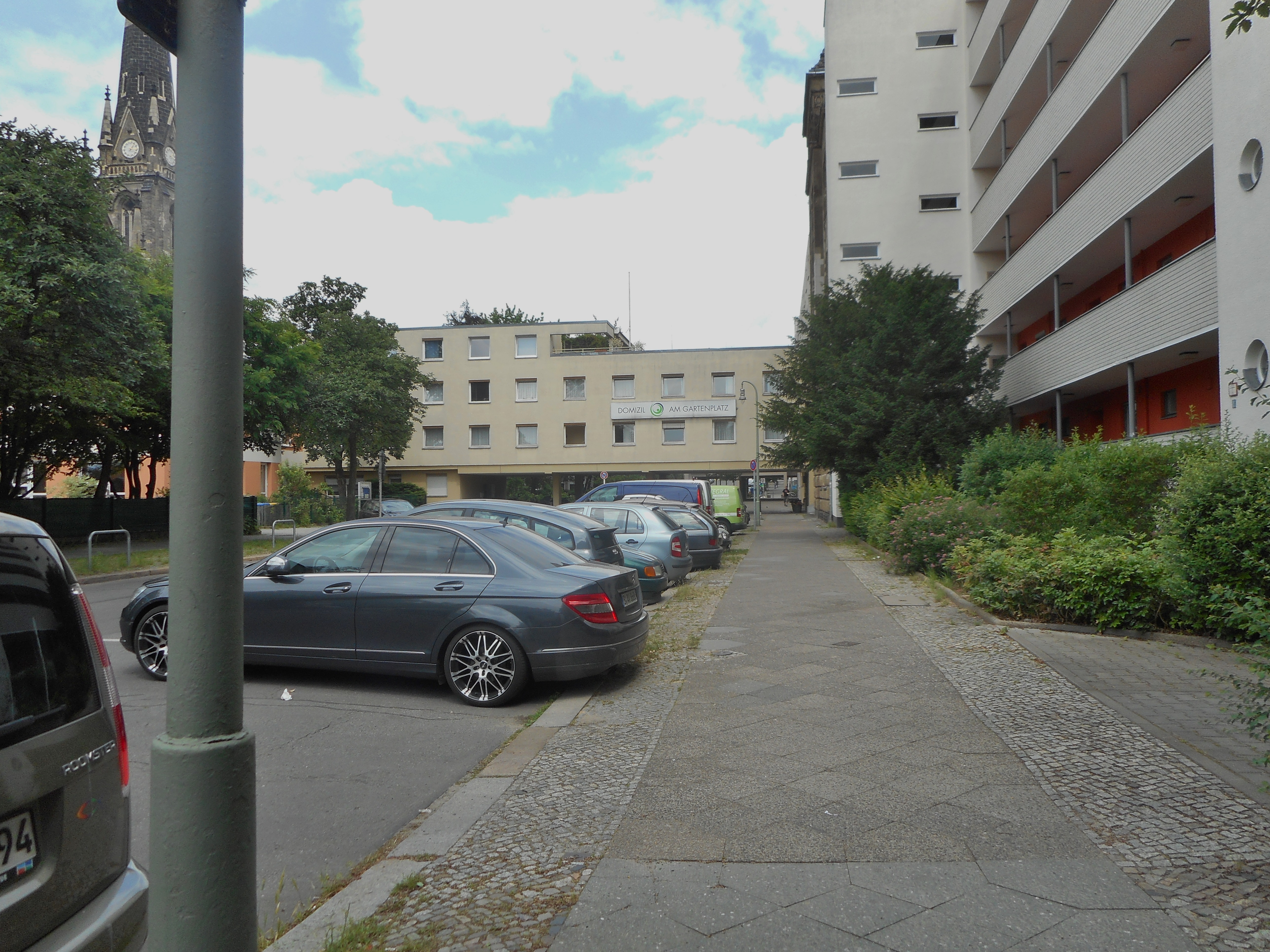
We walked along here to get to the home where Bodo lives.


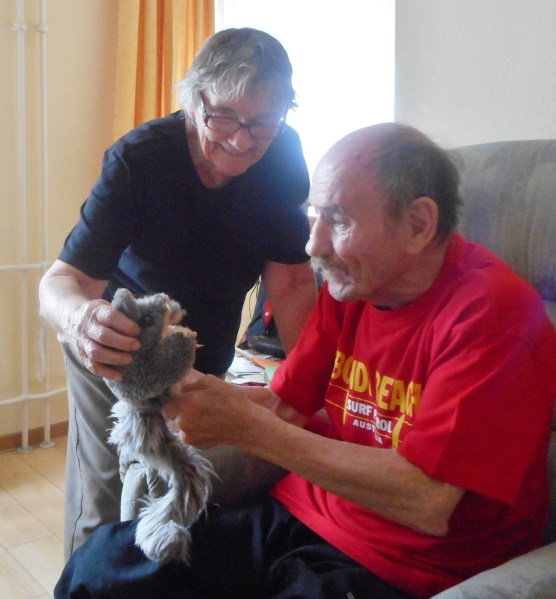

Below a few pictures I took one morning in our apartment. Matthew is in the background, Martin is on the left, and Caroline and Peter on the right.


What sort of country are we?
Published by The Conversation
Julian Burnside: What sort of country are we?
September 28, 2015 7.30pm AEST
Author
Julian Burnside
Adjunct Professor, Australian Catholic University
Disclosure statement
Julian Burnside is a patron of the Asylum Seeker Resource Centre. He does not accept any fees when acting for asylum seekers, and any offers of payment for other services in this area are politely declined.
Partners
Australian Catholic University
Australian Catholic University provides funding as a member of The Conversation AU.
Republish this article
We believe in the free flow of information. We use a Creative Commons Attribution NoDerivatives licence, so you can republish our articles for free, online or in print.
Republish
Julian Burnside at a hearing during the Tampa case in 2001. AAP/John Hargest
Email
Twitter134
Facebook588
LinkedIn1
Print
This piece is based on the 2015 Hamer Oration, delivered by Julian Burnside on September 28, 2015.
It was with some surprise that I found myself engaged in such a hotly political issue as refugee policy. I had never been involved in politics, nor interested in it. My best explanation of how this happened lies in a story I heard a long time ago. It involves a family whose ten-year-old son had never spoken a word. The parents had passed from anxiety to despair to resignation: there was no organic reason for his silence.
One morning, as a novelty, the mother decided to serve porridge at breakfast. She had never served it before.
The ten-year-old took a spoonful of porridge, looked up sharply and said:
I think porridge is revolting.
His parents were astonished.
It’s a miracle! You can speak! Why haven’t you spoken before this?
He said:
Everything has been satisfactory until now.
Tampa, refugees and the collapse of values
The arrival of the Tampa in Australian waters was misrepresented to the public as a threat to our national sovereignty. The people on Tampa were rescued at the request of the Australian government. They comprised for the most part terrified Hazaras from Afghanistan, fleeing the Taliban. The Taliban’s regime was universally recognised as one of the most brutal and repressive in recent times.
The notion that a handful of terrified, persecuted men, women and children fleeing such a regime could constitute a threat to our national sovereignty is so bizarre that it defies discussion.
I was shocked to see Australia’s response to Tampa. The government denied the Tampa’s request to land is bedraggled cargo in Australia; it sent the SAS onto the ship. 438 men, women and children were held on the deck in the tropical sun, day after day. I knew nothing about our refugee policy, but I knew it was wrong to treat human beings that way.
By the time the case was over, I knew a lot more about refugee policy, and a lot more about the Australian character. I knew that it was not possible to stay in this country unless I tried to do something to combat these obvious injustices. It was my great “porridge moment”. On August 26, 2001, MV Tampa rescued 438 people whose boat, the Palapa, had sunk. It rescued them at Australia’s request. It acted according to the tradition of sailors the world over.
The people rescued by Tampa were, mostly, terrified Hazaras from Afghanistan: men, women and children. They were fleeing the Taliban. We knew all this. We also knew that the Taliban were a brutal and repressive regime. We knew that Hazaras, one of the three ethnic groups in Afghanistan, had been persecuted for centuries, but that the persecution had become increasingly harsh under the Taliban who come from the Pashtun ethnic group.
The captain of Tampa asked for medical help. Many of the women and children were ill or injured. When Tampa entered Australian territorial waters off Christmas Island, Australia sent the SAS and took control of the ship at gunpoint to prevent the refugees from coming ashore.
The arrival of the Tampa in Australian waters was misrepresented to the public as a threat to our national sovereignty. The notion that 438 terrified, persecuted men, women and children constitute a threat to national sovereignty is so bizarre that it defies discussion.
The idea that Prime Minister John Howard could revive his flagging prospects for re-election by using the SAS to keep those people from safety reflected a profound malaise in the Australian character.
The judgment in the Tampa case was handed down at 2.15PM Eastern Standard Time on September 11, 2001, nine hours before the terrorist attack on America. From that moment, the government ran two different ideas together: border control and security. The catch-cry “border protection” confuses national security with refugee policy. In that confusion we lost our moral bearings.
The government denied the Tampa’s request to land is bedraggled cargo in Australia. AAP/Wallenius Wilhelmsen
The Pacific Solution is born
During the Tampa litigation, the Howard government cobbled together the Pacific Solution. It is hard to believe, but the first incarnation of the Pacific Solution, terrible though it was, was more benign than the present version.
But it had its victims. One of them was Mohammad Sarwar.
On August 26, 2002, the Afghans who had been rescued by Tampa were preparing to commemorate the 12-month anniversary of their rescue. That morning, Sarwar woke, sat up, uttered two short cries and fell back dead.
His friends wrote to us:
We regret to inform you that in early morning of 26th August Mohammad Sarwar ID NO 391 an Afghan Tampa Asylum Seeker died.He was quite young and seemed to be in his mid 20s. He was a Hazara from Central Afghanistan. He was one of the 438 asylum seekers who were rescued from ocean by the Norwegian freighter MV Tampa. He spent almost one year on board the Tampa and Manoora and in detention on Nauru. He was hospitalised in Nauru for the first few weeks on Nauru.
He was refused refugee status by the United Nations High Commissioner for Refugees. Just a few days earlier to his death he was interviewed on his appeal to the negative decision he had received on his claim for protection. His close associates, who had seen him coming out of the interview room, had seen he was very concerned and unhappy for the ways he was asked question. In the recent weeks he was seen to be stressed, worried, depressed and almost isolated. But Mohammad Sarwar was proved to be a voiceless, quiet and would speak very little of his concerns and pains he might be suffering. Recently, he was seen sitting alone and thinking very deeply.
Eventually, he has sought the asylum only God can grant.
Both Australia and Nauru refused to conduct an autopsy.
At the time Sarwar died, the Australian government was forcing and cajoling Afghans to return to their country. Sarwar’s family asked that his corpse be returned to Kabul. Australia refused, saying it was unsafe to return a corpse to Afghanistan.
Sarwar was an early victim of the Pacific Solution. Another was Australia’s character.
Terror
In the wake of 9/11, the government sent a care package to every Australian household. It included a fridge magnet – a sure protection against terrorism – and a letter from Howard. The letter included this observation:
Dear Fellow Australian,
I’m writing to you because I believe you and your family should know more about some key issues affecting the security of our country and how we can all play a part in protecting our way of life.
As a people we have traditionally engaged the world optimistically … our open, friendly nature makes us welcome guests and warm hosts.
Don Watson wrote about this:
This rose-coloured boasting smells of some nightmare ministry of information … the phrase as a people might not be a lie, but it smells like one. And it sits askew to the element of conservative political philosophy that opposes all attempts to categorise people by class or historic tendency, or any other conceit that will serve as an excuse for eliminating them.
The people of Australia is not so rank because it does not carry the suggestion that some mythic or historic force unites us in our destiny. But if we must have as a people, then traditionally has to go, and not only because optimistically is sitting on top of it. It has to go because it is so at odds with Australian history it could be reasonably called a lie.
Traditionally we built barriers against the world we are alleged to have engaged so optimistically; traditionally we clung to the mother country for protection against that same world; traditionally … we took less of an optimistic view of the world than an ironic, fatalistic view of the world.
The smugness of the sentence about our being lovely guests and warm hosts is so larded by fantasy and self-delusion, it transcends Neighbours and becomes Edna Everage.
It will occur to some readers, surely, that it has been our nature recently to play very cold hosts to uninvited guests, the sort of people we don’t want here, who throw their children into the sea, who are not fun-loving, welcoming, warm, sunny, etc.
Given (our) recent history, we might wonder if the words are as ingenuous as they sound. The thought, even the subconscious thought, might have been of a piece with Medea’s “soft talk”. Thus – as a people Australians are very nice; people who don’t agree with this proposition are not nice people; people who are not nice are not Australians in the sense of Australians as a people. People who are not prepared to be Australian as a people should shut up or piss off back where they came from.
There is the problem: by our response to boat people since August 2001, we may have redefined our national character.
The Howard government set up the ‘Pacific Solution’ for dealing with boat arrivals. AAP/Laura Friezer
Hamidi
Mr Hamidi had fled Saddam Hussein’s regime. Within a couple of weeks of his arrival in detention in Australia, officers of the Immigration Department noted that he had suffered torture in Iraq at the notorious Abu Ghraib Prison and that the form of torture which most frightened him was being locked in a small room. In Abu Ghraib, he had regularly been held in a small cell where he was randomly electrocuted through water in the floor.
After about 15 or 18 months in detention, he fell into hopelessness and despair. It is typical for asylum seekers in Australia’s detention system to lose hope after about 15 or 18 months. When Mr Hamidi fell into hopelessness, he started self-harming. Whenever he could find a bit of broken glass or a bit of razor wire, he would cut himself.
When he cut himself, the Immigration Department did two things: they gave him Panadol (which seems to be the universal treatment in immigration detention) and they put him in solitary confinement – in a small cell. This did not help him.
After a couple of weeks in solitary confinement, he would come out even more desperate than when he went in. He would then harm himself again and the Department would give him Panadol and solitary confinement. This went on for five years.
Eventually, some lawyers in Adelaide took a case to the Federal Court of Australia seeking an order requiring that Mr Hamidi, and some others in similarly desperate circumstances, should be taken to the Glenside psychiatric hospital in Adelaide for assessment and, if necessary, for treatment. The Commonwealth resisted the application and fought the case for several weeks. Eventually, the judge determined that the detainees should be sent to Glenside for assessment and if necessary for treatment.
When Mr Hamidi was taken to Glenside he was assessed mentally and physically. The physical assessment showed that he had ten metres of scarring on his body from his self-harming in Immigration Detention. He subsequently got a protection visa, but his health is ruined. Saddam Hussein tried to kill him and failed. Australia tried to incapacitate him and succeeded. Chance bludgeoned him almost to death.
One girl
There was the case which, for me at least, forever changed my view of this lucky country. It concerned an Iranian family – mother, father and two daughters aged 11 and seven at the relevant time. They were members of a small, pre-Christian religion: a religion which, in Iran, is regarded as unclean. If ever you think chance has dealt you a bad hand, try being a member of a religion which is regarded as unclean. There are plenty of historical precedents which show what a hard time those people get.
This family stayed on in Iran for as long as they could bear it, because their parents and grandparents were buried there. But one day, after a shocking incident involving the 11-year-old, the family fled Iran and ended up in detention at Woomera.
After about 15 or 18 months, all of them were in a bad way but especially the 11-year-old. The 11-year-old girl had stopped caring for herself: she had stopped grooming herself, she had stopped brushing her hair; she was careless with her clothing; she had stopped eating. She was frightened to go to the toilet block, which was about 100 metres from their cabin, and she would wet the bed at night and wet her clothing during the day.
Back then, if you were held in Woomera and had serious psychiatric needs, you would get to see the visiting psychiatrist approximately once every six months. The 11 year-old-girl needed daily psychiatric help. A psychiatrist from Adelaide, who had heard about the case, went to Woomera and delivered a report to the Immigration Department saying that it was essential that the family be removed from Woomera and placed in a metropolitan detention centre so that the 11-year-old could get daily psychiatric help. The report emphasised that the child was at extreme risk.
Eventually, the Department agreed to move the family from Woomera in the South Australian desert to Maribyrnong in the western suburbs of Melbourne. There, although the purpose for moving them was that the 11-year-old should get daily psychiatric help, for the first two and a half weeks of their stay nobody came to see her: not a psychiatrist, not a psychologist, not a doctor, not a nurse, not a social worker – nobody at all. It was as if they hadn’t even arrived.
On a Sunday night in May 2002, while her mother and father and young sister were up in the mess hall having their evening meal, this little girl alone in their cell in Maribyrnong Detention Centre took a bedsheet and hanged herself. But she was only little and didn’t know how to tie the knot properly, so she was still strangling when the family came back from dinner. They took her down and she and her mother were taken straight away to the general hospital nearby. They were accompanied by two ACM guards so that, as a matter of legal analysis, they were still in Immigration Detention.
Kon from the Asylum Seeker Resource Centre, who had been looking after the family’s visa application, heard about the incident and went to the hospital at about 9.30 that night. He said hello to the guards, who know him well because he is a regular visitor of Maribyrnong. He said he just wanted to speak to the mother to see if there was anything he could do to help. They said: “No you’re not allowed to see them, because lawyers’ visiting hours in Immigration Detention are nine to five” and they sent him away. Kon then rang me at home and told me what had happened.
Are we a country which treats children that way? Apparently we are.
The Woomera detention centre in South Australia hosted hundreds of detainees. AAP
The 2013 election
By 2008 the boats had virtually stopped arriving. In July 2008, the first Rudd government introduced a number of reforms to the Migration Act which satisfied about 90% of the concerns of refugee advocates. A while later, however, chance played another wild card: Tony Abbott became opposition leader by one vote.
As soon as he became opposition leader, Abbott began complaining publicly and loudly about boat people. Kevin Rudd responded by mounting a ferocious attack on people smugglers. It seems that in the heat of the moment he had forgotten that his moral hero – Dietrich Bonhoeffer – had been a people smuggler, albeit a benevolent one. He had forgotten, it seems, that Oskar Schindler and Gustav Schroeder, the Captain of the St Louis, were both people smugglers.
When Julia Gillard became Australia’s first female prime minister, she ran a very ambivalent line about boat people. While expressing some concern for the circumstances which led them to flee, she said that she understood why Australians were concerned about boat people arriving in Australia. The asylum seeker debate went off on a new tack at about that time.
The lowpoint of the debate was seen in the campaign that preceded the federal election of September 2013. That election campaign, for the first time in Australia’s political history, saw both major parties try to outbid each other in their promises of cruelty to boat people.
Abbott won the election and made good of his promise to mistreat boat people. We now have the harshest imaginable policies in relation to boat people and arguably the harshest treatment of boat people of any country that has signed the Refugees’ Convention.
In broad outline it goes like this.
When boat people arrive
When boat people arrive at Christmas Island, they have typically spent eight or ten days on a rickety boat. They have typically come from landlocked countries and have typically never spent time on the ocean.
Typically, they have had not enough to eat and not enough to drink. Typically, they have had no opportunity to wash or to change their clothes. Typically, they arrive distressed, frightened and wearing clothes caked in their own excrement.
They are not allowed to shower or to change their clothes before they are interviewed by a member of the Immigration Department. It is difficult to think of any decent justification for subjecting them to that humiliation.
When they arrive, any medical appliances they have will be confiscated and not returned: spectacles, hearing aids, false teeth, prosthetic limbs, are all confiscated. If they have any medications with them, those medications are confiscated and not returned.
According to doctors on Christmas Island, one person has a full-time job of sitting in front of a bin popping pills out of blister packs for later destruction.
If they have any medical documentation with them, it is confiscated and not returned. The result of all of this is that people with chronic health problems find themselves denied any effective treatment.
The results can be very distressing. For example, a doctor who worked on Christmas Island told me of a woman who had been detained there for some weeks and who was generally regarded as psychotic. Her behaviour was highly erratic for reasons that no-one understood. The consultation with this woman was very difficult because, although the doctor and the patient were sitting across a table from each other, the interpreter joined them by telephone from Sydney.
Eventually, the doctor worked out that the problem was that the woman was incontinent of urine. She could not leave her cabin without urine running down her leg. It was driving her mad. When the doctor worked out that this was the cause of the problem, she asked the Department to provide incontinence pads. The Department’s initial response was “we don’t do those”. The doctor insisted.
The Department relented and provided four incontinence pads per day: not enough, so that the woman needs to queue for more but the incontinence pads made a profound difference to her mood and behaviour.
When boat people arrive at Christmas Island, they have typically spent eight or ten days at sea. AAP
‘Pacific Solution’ mark two
Asylum seekers who arrive at Christmas Island are assessed to see if there is any medical reason why they cannot be sent offshore, to Nauru or Manus Island.
In either place, they are held in detention centres run by Transfield Services (an Australian company). Guards are provided by Wilson Security (another Australian company). Medical Services are provided by IHMS: International Medical and Health Services (an Australian subsidiary of a French company).
Nevertheless, Australia insists that what happens in offshore detention is nothing to do with Australia. That is not only absurdly false, it overlooks the small detail that we spend about A$5 billion a year on the detention system. If that number is unimaginably big, it is the equivalent of one million Geelong chopper rides a year.
Manus
A few days ago I got an email from a health worker on Manus:
… The situation as you can imagine is very grim. Around 80% of transferees suffering serious mental health issues. PNG staff are slowly being “trained” to take over various roles with mostly undesirable results. East Lorengau is not working. One refugee is lingering in hospital for over two weeks with undiagnosed stomach problems. One refugee doctor is suffering severe mental health issues…
Here is an extract from a statement by a doctor who worked on Manus whose professional experience includes the provision of healthcare services in maximum-security prisons in Australia:
… On the whole, the conditions of detention at the Manus Island OPC are extremely poor. When I first arrived at the Manus Island OPC I was considerably distressed at what I saw, and I recall thinking that this must be similar to a concentration camp.
The detainees at the Manus Island OPC are detained behind razor wire fences, in conditions below the standard of Australian maximum-security prison.
My professional opinion is that the minimum medical requirements of the detained population were not being met. I have no reason to believe that the conditions of detention have improved since I ceased employment at the Manus Island OPC.
The conditions of detention at the Manus Island OPC appeared to be calculated to break the spirit of those detained in the Manus Island OPC. On a number of occasions the extreme conditions of detention resulted in detainees abandoning their claims for asylum and returning to their country of origin.
At the Manus Island OPC, bathroom facilities are rarely cleaned. There was a lot of mould, poor ventilation, and the structural integrity of the facilities is concerning.
No soap is provided to detainees for personal hygiene.
When detainees need to use the bathroom, it is standard procedure that they first attend at the guards’ station to request toilet paper. Detainees would be required to give an indication of how many ‘squares’ they will need. The maximum allowed is six squares of toilet paper, which I considered demeaning.
A large number of detainees continue to be in need of urgent medical attention.
Formal requests for medical attention are available to the detainees. The forms are only available in English. Many of the detainees do not have a workable understanding of English and the guards will not provide assistance.
Reza Barati
In February 2014 Reza Barati was killed on Manus Island. Initially, Australia said that he had escaped from the detention centre and was killed outside the detention centre. Soon it became clear that he was killed inside the detention centre. It took months before anyone was charged with his murder.
Just a couple of weeks after Barati was killed, I received a sworn statement from an eyewitness. The statement included the following:
J … is a local who worked for the Salvation Army. … He was holding a large wooden stick. It was about a metre and a half long … it had two nails in the wood. The nails were sticking out …
When Reza came up the stairs, J … was at the top of the stairs waiting for him. J … said ‘fuck you motherfucker’ J … then swung back behind his shoulder with the stick and took a big swing at Reza, hitting him on top of the head.
J … screamed again at Reza and hit him again on the head. Reza then fell on the floor …
I could see a lot of blood coming out of his head, on his forehead, running down his face. His blood is still there on the ground. He was still alive at this stage.
About 10 or 15 guards from G4S came up the stairs. Two of them were Australians. The rest were PNG locals. I know who they are. I can identify them by their face. They started kicking Reza in his head and stomach with their boots.
Reza was on the ground trying to defend himself. He put his arms up to cover his head but they were still kicking.
There was one local … I recognised him … he picked up a big rock … he lifted the rock above his head and threw it down hard on top of Reza’s head. At this time, Reza passed away.
One of the locals came and hit him in his leg very hard … but Reza did not feel it. This is how I know he was dead.
After that, as the guards came past him, they kicked his dead body on the ground …
Australia regards itself as having no responsibility for Barati or anyone else held on Manus Island or Nauru. But we pay Transfield Services to run the detention centres there. We pay Wilson Security, the Australian company which employs the guards. When the government disclaims responsibility for what happens in offshore detention centres, it is deliberately misleading you.
Some will be aware that I have been running a campaign to encourage Australians to write letters to people held on Nauru and Manus. Just before Christmas last year, 2000 letters I had sent to Nauru were returned to me, unopened and marked “Return to Sender”.
So far, the Department of Immigration has not responded to the four emails I have sent them asking for an explanation why those letters had not been delivered to the people to whom they were addressed. They have told members of the press that the named recipients of the letters did not wish to receive letters.
Apart from being implausible, it stands awkwardly with the fact that, during the second half of last year, the Department assured me that the letters were being received and distributed.
Iranian asylum seeker Reza Barati was killed on Manus Island. AAP/Dan Peled
International criticism
Australia’s system of mandatory detention has been trenchantly criticized by Amnesty International and UNHCR. In late 2013, the UN High Commissioner for Refugees (UNHCR) delivered a report on conditions in the Regional Processing Centre (RPC) on Manus Island, saying:
UNHCR was deeply troubled to observe that the current policies, operational approaches and harsh physical conditions at the RPC do not comply with international standards.
It also reported on conditions in Nauru and said:
Assessed as a whole, UNHCR is of the view that the transfer of asylum-seekers to what are currently harsh and unsatisfactory temporary facilities, within a closed detention setting, and in the absence of a fully functional legal framework and adequately capacitated system to assess refugee claims, do not currently meet the required protection standards.
Just as a person’s character is judged by their conduct, so a country’s character is judged by its conduct. Australia is now judged overseas by its behaviour as cruel and selfish. We treat frightened, innocent people as criminals. It is a profound injustice.
It is a hard thing to be forced by circumstances to leave the country of your birth in search for a place that is safe. The play of chance is worse again for those who must seek protection in a country whose language and culture is radically different from your own.
How much worse must it be to find that your bid for freedom ends up with punishment as harsh as anything you might have experienced at home. I have received messages from many refugees from many countries over the course of many years which say, in substance: “In my home country they kill you quickly; in Australia they kill you slowly”.
Our politicians lie to us
One of the most distressing things about the present situation is that it is based on a series of lies. When politicians called boat people “illegals” and “queue jumpers” they are not telling the truth. When politicians say that they are concerned about people drowning in their attempt to reach safety, they are not telling the truth.
The Abbott government reintroduced temporary protection visas (TPVs). Temporary protection visas offer only three years’ protection, and they include a condition which denies they prospect of family reunion.
That has one obvious practical consequence: families who wish to rejoin the husband or father who is living in Australia on a TPV are not allowed to come to Australia by any orthodox means, so the only way in which the family can be reunited is by the women and children using the services of a people smuggler. TPVs are a positive incentive for people to use people smugglers.
Quite apart from that, there is something indecent about the idea that in order to prevent people from drowning in their attempt to reach safety you punish the ones who don’t drown. That is precisely what this country is doing right now.
The former Abbott government made an election pledge to ‘stop the boats’. AAP/Ava Benny-Morrison
Conclusion
Like most of you, I am aware that Donald Horne was speaking ironically when he wrote of Australia as “the lucky country”. But in most important ways, compared with the boat people who try to reach safety in Australia, we are indeed lucky.
Over the past 15 years, 94% of boat people have been assessed, by us, as refugees genuinely fleeing the fear of persecution. In Australia, most members of the community never have to fear persecution; never have to fear for the late night knock on the door; never have to fear for their human rights.
But it is all because of the play of chance. Imagine for a moment that you are a Hazara from Afghanistan. You have fled your country and you have come down the northwest corridor through Malaysia and Indonesia. You can travel through both of those countries because they give you a one-month visa on arrival.
While you are in Indonesia you can go to the UNHCR office in Jakarta and apply for refugee status. If you are a Hazara from Afghanistan, you will almost certainly be assessed as a refugee. But when your one-month visa expires, you have to hide because if you are found by the police, they will jail you.
You cannot work because if you work you will be found and then you will be jailed. You cannot send your children to school because if you do you will be found and then you will be jailed. If the UNHCR has assessed you as a refugee, you can wait patiently in the shadows until some country offers to resettle you. That may take 20 or 30 years.
Now, for just one minute, imagine that chance has put you in that position: you are that person. Will you wait in the shadows for 20 or 30 years or will you take your courage in both hands and get on a boat? I have never met an Australian who would not get on the boat. It’s a very strange thing that we criticise, revile and punish those who do precisely what we would do if by chance we had not the luck to belong to this country.
Whether this thinking will bear fruit may soon be tested. In the last weeks of its existence, the Abbott government shifted its position quickly in response to public opinion. It had initially resisted the idea of receiving Syrian refugees.
Public opinion could see however that bombing Syrians and turning our backs on them was not a good look. Germany conspicuously agreed to take 800,000 Syrian refugees, with very few questions asked. That made our claim to be “the most generous country in the world” look a bit hollow. Given that Germany’s population is about four times ours, we would have had to receive 200,000 refugees rather than the present quota of 13,750.
Abbott volunteered that we would take 12,000 Syrians. Whether the Turnbull government engages in cherry-picking remains to be seen. There is a real risk that the Howard government sentiment will survive: “If they come in the front door, they are (more or less) welcome; if they come in the back door, we will jail them”.
It’s too early to tell whether community attitudes have actually changed. If they have, government attitudes are likely to change.
The second matter was equally surprising and even more encouraging. Melbourne responded swiftly and decisively against the idea of Border Force officers cruising the streets and “speaking to anyone who crosses our path”. The original idea, apparently, was to have squads of public transport officers, police, and Border Force officers who would intercept people at places like Flinders Street Station and check their Myki card, their identity and their visa status.
Melbourne heard of the proposal on the morning of Friday, August 28. Melbournians turned out in force to protest. By mid-afternoon, the exercise had been cancelled, in a flurry of buck-passing.
In my view, Melbourne’s reaction – so swift and decisive – showed that we know when and where to draw the line. Perhaps I am an optimist, but I think it showed what sort of country we are. I think that, at heart, we are still the country that David Hamer and Dick Hamer served with such distinction. Perhaps someone should tell our politicians.
Refugees
Asylum seekers
Nauru
Manus Island
Offshore detention
Long read
Uta’s Diary, 3rd of September 2015
In September 2013 my blogger friend Linda wrote in a comment to one of my blogs:
“As I grow up 🙂 I discover that families the world over and through the centuries have been weird. Just plain weird! It’s a good thing to know. More kids should recognize this fact so they wouldn’t feel so isolated by the facts of their families.”
And my reply was:
“Quite amazing, Linda, isn’t it? What exactly do you mean by ‘weird’? Families that are somehow ‘dysfunctional’? What about divorce? Hasn’t this been on the increase in our time? Maybe it has partly to do with the increase in life expectation? In any case I believe it is important for children to know who their parents are. Whether they stay through all their growing up years with one, two or none of their parents this is a different matter. Some parents might not be the best option for a child, but the same goes for some institutions. It all depends. I did get to know during my growing up years some very well functioning families. I am talking about our extended family and about the families of some of my friends. I also saw examples of desperately struggling war widows with for instance four children and a bone breaking job with very little money. When I was a child a lot of people seemed to blame WW II for the increase in dysfunctional families.”
I experienced my growing up years in Berlin, Germany. During my teenage years I was always dreaming of living in some other country with a different family. I feel, having lived in Australia since 1959 I grew more and more apart from Berlin. Over the years I have been back to Berlin for some family visits. But I am always glad when I am back in Australia. It is quite amazing how Berlin has changed over the years. I can understand how a lot of young people feel now


attracted to living in Berlin. However, I definitely want to spend the last few years of my life in Australia. Even my husband Peter, who has still very strong attachments to Berlin, prefers to live in Australia for as long as he can still afford to go back to Berlin for regular visits!
My parents separated soon after WW II. Then, around 1950, my mother demanded a divorce. During 1948/49 Peter’s mother left Peter’s father and got a divorce from him. Peter and his two sisters moved along with their mother. Both our fathers, Peter’s and mine, died long before our mothers. Both fathers had suffered badly due to war experiences.
All my cousins seem to come from very stable families. The generation of my nieces and nephews is different though. Whereas Peter’s nieces and nephews seem to come from rather stable families. Of course, Germans these days have very small families. Some people point out, the increased influx of migrants to Germany could be a blessing, for there are too many old people in Germany and not enough young people. Still, this enormous influx of refugees, that is taking place right now, does cause major upheavals. I hope, all this can be settled in a humane way, and a lot of effort will be directed towards avoiding outbreaks of violence.
Before and after the Fall of the Wall (Memories)
Sunday, the 16th of September, 2012.
On that day we were travelling by public transport to Borgsdorf visiting Ingrid and Erhard at their summer place. Ingrid is related to Peter’s family. Over the years we were always happy to visit Ingrid and Erhard whenever we happened to be in Berlin. On the phone Ingrid wanted to make sure we would come on Sunday. When I mentioned I still had a bit of a cold she said, not to worry, it was going to be a lovely, sunny day. I could just sit outside in the sun and this would do me good. I didn’t have to do anything. She was going to cook lunch for us, she said.
She did serve us a wonderful lunch. She loves to cook with healthy ingredients and lots of herbs and vegetables from her garden. I really felt all right sitting in the autumn sun for hours and hours, being served a lovely meal and later on coffee and cakes. Before the coffee break we all went for a walk to the close by river. Borgsdorf is a very secluded little village. In people’s gardens we could see fruit trees with hundreds of red apples on them.
This is an extract from a blog I wrote after our visit to Berlin in 2012:
My brother Peter Uwe had dropped us off at Berlin Tegel Airport. It was already afternoon, so he wanted to drive back straight away to his place in Mecklenburg/Vorpommern, where we had stayed with him and Astrid for the last few days of our holiday.
We checked in and then had plenty of time to have a drink with the six family members who had come to see us off:
Peter’s cousin Ingrid, Peter’s nephew Daniel, Peter’s sister Ilse, and all their partners, all had come to farewell us.
It turned out, the flight to Amsterdam was delayed. Because of this, we got into trouble with our connecting flight in Amsterdam. We had in Amsterdam actually less than one hour to get to our connecting flight. When I pointed this out to a cabin crew member he inquired about my age and whether I could walk all right. I told him I couldn’t walk as fast as younger people. Voila, a drive on a buggy was arranged for Peter and me.
Being driven through the immense airport with passengers roaming about and making way for the buggy, we felt like in a movie. It was a long, long drive to the departure point for our connecting flight. I doubt I could have made it in time by walking. We were extremely grateful for the lift and were able to board on time on the long stretch to Kuala Lumpur.
At Kuala Lumpur Airport we had a seven hour rest. From there we took off on a seven hour flight to Sydney. The longest non-stop stretch was from Amsterdam to Kuala Lumpur, namely eleven hours! During this long flight Peter got sick. After that he had hardly anything to eat anymore.
I got distracted again. Searching for some pictures of Ingrid and Erhard, I finally found the departure pictures that Peter took at Berlin Tegel Airport. You can look at them here:
All the above happened in 2012. The wall had come down already in 1989. We were still thinking about it and all the changes it had brought. Berlin was an undivided city again, East- and West-Germany were one country. But we could still remember what it was like before the Fall of the Wall.
BACK IN AUSTRALIA
I wrote the following on the 19th of November 2012:
Peter and I landed safely back in Australia. Yesterday morning our daughter Caroline picked us up from Sydney airport and drove us to our home (100 km south of Sydney). So we’ve been back home now for nearly thirty hours and are gradually getting rid of our jet legs. Everything is fine at our place. Our lovely daughter is going to stay with us till tomorrow (Tuesday).
Six people had come to Berlin Tegel airport on Friday to see us off. We found the perfect place to have a drink with them. This was very relaxing for us. We knew already that our plane to Amsterdam was going to leave somewhat later than originally planned. My brother had driven us to the airport from his place in Mecklenburg-Vorpommern. He had only dropped us off, for he wanted to be back home before it got too dark.
In Amsterdam we had scarce time to catch the connecting flight to Kuala Lumpur. We made sure we’d get some help by the airport people. Just as well! It turned out we had to go right to the other end of the airport. This would have meant a tremendous walk for us. We were very grateful for being driven to our departure point. I doubt that we could have made it on time by walking.
In Kuala Lumpur we had close to seven hours to catch our Malaysian connecting flight to Sydney. This meant we had no problem with being on time for boarding at the departure gate. It also gave us the opportunity to stretch our legs a bit and then take a break in a beautifully furnished cafe with French songs playing in the background. The toilet facilities were also very welcome. We couldn’t take a walk through the airport’s beautiful open air jungle walk since it was closed for renovations. What a pity!
Near our departure gate we found some stretch-out chairs. To be able to stretch out on these chairs we welcomed very much.
Some pictures of these stretch out chairs you can actually find in this blog:
I wrote in this blog further on:
We were grateful for the long break at Kuala Lumpur Airport. It gave us ample time to recover a bit from the previous eleven hour non-stop flight. In Kuala Lumpur Peter even enjoyed the coffee and cake we had at one of the airport’s coffee-shops. At some other establishment we had a large glass of iced Chi tea. This tasted very good and was very refreshing. On the next seven hour stretch to Sydney Peter refused food again. However he had lots of drinks all the time: Mainly water, but also some juice and coffee. He just didn’t feel like eating.
My main purpose of looking up all these posts was actually that I wanted to be reminded what experiences we had on previous visits to Berlin when the city was divided by that Wall. There was a lot of confusion going on about currencies in East and West, lifestyle changes dividing East and West, crippling shortages in the East. a lot of spying going on in the East, West-Berliners making nasty remarks about the “poor” East-Berliners and so on.
And after the Fall of the Wall? To this day these parts of Germany that had previously been GDR territory are still a bit less prosperous than their cousins in the other parts of Germany. Yes, it is one country again, but you do find differences. People in the East seem to be somewhat different from people in the West. The unemployment rate is much higher in the eastern parts of Germany. West-German companies seem to prefer to go to a neighbouring Eastern country where they can pay lower wages.
For some time low cost housing was available in East-Germany. In areas where there is work or tourism, housing prices are on the up. In some remote areas, where there is no work, low cost housing is of no use to the people. It is unbelievable, but people who cannot afford any more to pay for housing and live on the streets for most of the year, these people are on the increase, while other people gentrify their places, and they invest in places they can let for more and more rent. How about this attitude that “the Market” regulates all?
 AuntyUta