Sunday, the 1st of September 2019

Today is the official start of spring. It happens also to be Fathers Day because it is the first Sunday in September. And it is the Anniversary of the outbreak of WW II some eighty years ago!

Well, I grew up in Berlin, in Germany. I was born in September 1934. So I do remember that war started on the 1st of September 1939 when I was not quite five years old.

Soon now I am going to be 85. Personally I am happy, that since Germany’s capitulation on the 8th of May 1945 I did not have to experience any more wars.  For sixty years, that is since 1959, I lived with my husband in Australia.

https://en.wikipedia.org/wiki/German_Instrument_of_Surrender

“The German Instrument of Surrender was the legal document which effected the extinction of Nazi Germany and ended World War II in Europe. . . .”


and

Before and after the War, a Reblog.

In 1942/1943 my friends in Berlin and I had often contemplated what life might be like, once we had peace again. Our dreams for the future were very basic. We all wanted to get married and have children. We all wanted our husbands to have occupations that would enable us to live in comfortable houses. My friend Siglinde and I were for ever drawing house-plans. There would be at least three bed-rooms: one for the parents, one for two boys and another one for two girls. Yes, to have two boys as well as two girls, that was our ideal.

Before we married, we would finish school and go to university and our husbands would of course be university educated. In peace-time we would be able to buy all the things we had been able to buy before the war started: Bananas, pineapples, oranges and lemons; all this would be available again! Somehow we knew, we were only dreaming about all this. We had no idea, what would really happen, once the war ended.

I turned eight in September of 1942. Most of my friends were around the same age. My friend Siglinde however was four years my senior, the same as my cousin Sigrid.

When I was about thirteen, Cousin Sigrid made a remark, that put a damper on my wishful thinking. Sigrid had noticed, that I got very good marks in high-school. So she said in a quite friendly way: ‘I see, you’ll probably end up becoming a Fräulein Doctor!’ This remark made me furious inside. It sounded to me, that once I embarked on becoming a ‘Fräulein Doctor’ I would have no hope in the world of acquiring a husband and children. ‘Who in their right mind would study to achieve a doctorate and miss out on having a husband and children?’ I thought to myself.

Mum, Tante Ilse and Uncle Peter loved to read romance and crime fiction. Most of the books they read were translations from English. Mum and Tante Ilse loved Courts-Mahler, Uncle Peter liked Scotland Yard stories best. They all had read ‘Gone with the Wind’. Even my father, who boasted, he never read any novels, read this one.

I read ‘Gone with the Wind’, when I was fourteen. My father’s sister Elisabeth, on hearing this, was shocked, that my mother let me read this novel. According to Tante Lisa, I was much too young to read something like this. However some of my girl-friends read this book too. They all loved Rhett Butler. About Scarlett the opinions were divided. Personally I did not care for the way she treated Melanie. I thought by constantly making passionate advances towards Ashley, she showed total disregard for Melanie’s feelings. Rhett adored Melanie. He showed her great respect as a person with a noble character. In contrast, he was well aware that Scarlet was anything but noble. Often he found Scarlett’s irrational behaviour highly amusing. Ashley treated Scarlett in a very gentleman like way. Not so Rhett. This impressed my friends. They all admired Rhett! I think, I admired Ashley more. –

Mum and Tante Ilse borrowed books from a lending library. A middle-sized novel cost one Deutsche Mark to borrow for one week, a real big novel cost two Marks. In secret I once read a translation of ‘Amber’. Fascinating stuff this was.

When I read ‘Amber’, I was probably thirteen. I read it only, when I was by myself in the apartment, which happened often enough. I was able to consume the whole big novel without anybody noticing it. I knew, Mum and Tante Ilse had read the book already, because they often talked about it, how good it was. But the book was still lying around at our place. There were a few more days before it had to be returned to the library. I found out, that Amber was a fifteen year old country-girl, who went to London. The time was the seventeen hundreds. Because of her beauty, Amber was able to make it in the world. She had lots of lovers. She always made sure, that her next lover was of a higher ranking than the previous one. That made it possible for her, to climb up the social ladder. – Well, this is about as much as I still remember from that novel.

During the first years after the war we lived like paupers. Still, I realized – maybe a bit to my regret – that there was a big difference between a desperately poor girl from the country and me, desperately poor city girl from a ‘good’ family. I knew then, whether I wanted it or not, I had to put up with an extremely low standard of living for some time yet. And I mean by ‘low standard’ not the low standard that everyone went through during the adjustments after the war, but a standard, where it was necessary for us to get social services payments!

Was I out to enhance my appearance in order to catch a prosperous male as an escort to take me out to fun-parties and adult entertainment? No way! Something like that was just not for me. I felt I was plain Uta who was never invited to go out anywhere with anyone.

Was I really that plain? I wonder. Up to age fourteen I may have had some chances with the opposite sex, given the opportunity. However by age fifteen I had put on so much weight, that I felt to be totally unattractive. I was right, because no attractive male ever made an attempt to woo for my attention, not until I was about seventeen and a half that is. But even then things didn’t change much for me. I honestly felt like some kind of a social freak during most of my teenage years.

ESCAPE FROM PARIS

‘Escape from Paris’, a novel written by CAROLYN HART. The time is WW II during the German occupation of Paris. I’ve just read this novel as an e-book. I felt very much for the characters in the book. I wonder whether this story has been made into a movie yet? Americans, English, French and Germans, all of them are main characters. The writing brings vividly to life how the war affects all of them. There is so much viciousness, suffering, outright hunger being depicted, but also great love and compassion amongst some people.

I was very moved by what the experiences of people were during this time. It makes me wonder again why there have to be wars and suffering which people inflict on each other. However it also makes me believe in the goodness of people and how they sometimes put their own lives in danger to help somebody else.

CAROLYN HART is a well established author and has written many other books.

In Love with Leipzig

This is a copy of one of my earlier blogs!

“I found an interesting contribution about the German city of Leipzig.

http://blog.goethe.de/meet-the-germans/archives/179-In-Love-with-Leipzig.html

As a ten and eleven year old in 1945/46 I did get to know a bit about this city. Sure, when we first moved there to stay at grandmother’s place, the war hadn’t finished yet and we experienced quite a few bomb raids.

As I told in another blog, one bomb raid in April 1945 turned out to be disastrous for us. This was probably the very last bomb raid that Leipzig had to endure, because soon after the American troops together with some Canadians occupied the city. When the Canadians moved through neighbouring streets to lay out some cables, we kids were watching them. We were impressed by their appearance. They were all very young looking, tall and lean in immaculate uniforms. We welcomed the foreign troops.Them being with us meant, we wouldn’t be bombed any more. From now on we could sleep in peace!

We were a family of six. Having lost our home in the bomb raid, we applied for accommodation for our family. We were given a flat in an area where the buildings weren’t damaged at all. We were assigned an apartment that had  three rooms plus kitchen and bathroom. Had grandmother been just with Renate she would not have been able to get an apartment  of this size. Only families of five or more were assigned accommodation with that many rooms! So we were lucky again. Grandmother stayed in this apartment in Friedrich-Ebert-Strasse for many more years. She died in 1957.

About Leipzig I remember the ‘Ratskeller’, where we had a few times a lovely meal. I always thought it was something special to eat out somewhere. But I loved Grandma’s cooking too. Like magic she always produced excellent meals even when there was not much food available. She was a great one for improvising. And never ever was any bit of food thrown out. She always pointed out to us, to throw away good food, was a sin. This kind of thinking still sticks with me today!

I also  remember the Thomaner Church in Leipzig and the Thomaner Choir. I believe the journalist who wrote the blog about present day Leipzig is from England and lives in Berlin now. He went for a visit to Leipzig and ended up loving this city. If ever I have a chance to visit Germany again, I plan on paying Leipzig a visit together with Peter, my husband, and Peter, my brother. If you are interested in finding out more about Leipzig, please look up the above link.”

Last year during our visit to Germany we did not forget that we had wanted to visit the city of Leipzig. We  actually went there for a day visit. We had in our minds to search for  the grave of my paternal grandfather who had died in 1947. After a lot of searching we were able to locate his grave site. We made some pictures which I published in a blog. Leipzig seems to be a thriving city these days. We would have liked to stay there a bit longer. But we had to go back to Berlin the same day.  The Main Leipzig Railway Station (Hauptbahnhof) has been very modernised. A huge modern shopping center is located within its premises.

Thoughts on the End of War

Here in the blogger world there are always a few people who respond to what I write. I am very grateful for this. It keeps me going. I mean I would like to continue writing anyway but getting some kind of response helps a lot in actually proceeding with it.

When I write about my experiences during war time and after the war,  people instinctively respond in proclaiming their thoughts upon the horrors of war. Undoubtedly the horrors of war are immense. I know it,  just about everyone has some inkling about it. It may sound strange, but I always had the feeling that I personally escaped real horror.

Did I experience hunger? Real hunger and starvation that resulted in problems with health? I don’t think so. When I hear stories from people who were absolutely starved,  it makes me feel terrible. Why did my Dutch-Australian friend, who was about the same age as I was during the war, why did she at times have to go absolutely without food in Holland whereas I had in Germany always a little bit to eat? It is just not fair. War is not fair!

During the war the Nazi propaganda machine constantly bombarded us with slogans how we as Germans had to believe that we were going to win this war. We all had to work towards the ‘Endsieg’ (the winning at the end). By 1944 hardly anyone I knew still believed that Germany could win the war. My grandmother was the exception. She expressed an unshakable belief in the ‘Führer’ (Hitler). For this she was ridiculed by the family.  She believed stories about the ‘Wunderwaffe’ (wonder weapon) which would safe us.

More and more everyone talked about it how they wished an end to the war. All our lives were put on hold so to speak. And this went on for quite some time after the war too. Schools were closed a few months before the end of the war. Where I was I couldn’t go back to school until four months after the war had finished.

My eighteen year old cousin couldn’t go to uni as she had planned. She had to work in a munitions factory instead, getting up at five o’clock every morning to travel by train to her place of work. I heard everyone saying to continue with the war was madness. But still everyone seemed to go on doing what they were supposed to do. Even the bomb raids generally didn’t effect people’s behaviour very much. I mean most people went on doing what they had to do bomb raids or not.

Amazingly a lot of foreign workers seem to have helped Germany by doing a proper job. For which after the war the Russians I believe handed out punishment. It is said that they treated their own people badly if they found out they had ‘co-operated’ with the Germans. However during the war years the Germans would send anyone who hindered the war effort away to concentration camps. Probably executions on the spot were not unknown either. During the first days after the war the Russians took everyone who looked like he could have been a soldier away. A lot of these men were never seen again. They may have ended up in a work camp in Siberia where starvation was rampant.

No doubt about it, Germans had a hard time during the first post war years. But still it was an end to fighting. There was a future without any war. Everyone could live in peace. Peace, peace, peace, this is what we wanted. We were very relieved that the war had ended. Tough times, yes, but at least there was no more war. We could concentrate on peaceful things. What a relief. What hope for the future!

Childhood Memories 1943/44

Towards the end of September 1943 we left Berlin to live in the country. We moved to a place called the ‘Ausbau’, which meant that eventually ‘more’ was to be added to the building.. It was a simple rectangular red brick complex with several entrances around the building. There was no plumbing or electricity. The entrance for us ‘Berliners’ was on the left side at the front of the building. We had a cellar, a ground floor and two upper floors.

Mum, my two younger brothers and I, shared a bedroom on the first upper floor. We also had a small kitchen and a living-room. I would sleep in the living-room when my dad came home on leave. Two maids, one Polish, the other Russian, shared two rooms on the top floor. All the rooms on the top floor had sloping ceilings. Our Polish maid was in her early twenties. Her name was Maria. She was very efficient and always rather serious.. The T. Family, who lived on the ground floor, employed Katja, the Russian maid, who was only eighteen and extremely fun loving.

My mum’s sister, Tante Ilse, also had her rooms on the first upper floor. She had a bedroom and a living-room. On the ground floor, right underneath her upper rooms, she had a kitchen and a dining-room. She hardly ever used those downstairs rooms. Our friends from Berlin, the T. Family, occupied three rooms downstairs, namely a kitchen, a living-room and a bedroom, the same arrangement of rooms that we had on the upper floor.

There was an additional larger room for storage under the sloping roof. T. Family and my Family stored in that room additional larger furniture which we wanted to save from the bombs in Berlin. — In that room Mum stored a lot of Boskop-apples during the cold season. They were neatly spread out on some straw. Come Christmas-time, other delicious food was also hidden somewhere among our stored furniture. It was very tempting for me to go exploring in that room! Mum noticed sometimes, that some food was missing. And I admitted, when questioned, that I had helped myself to some of the goodies. However I was never punished for doing such a thing. That shows, that Mum must have been quite tolerant. —

On the same upper floor right under the roof was a playroom, which my brothers and I shared with eight year old Edith T. There was another room next to the playroom where Mrs. T.’s parents had stored some bedroom furniture. The parents were Mr. and Mrs. B. and had a business in Berlin. They sometimes stayed at the ‘Ausbau’ in that bedroom in order to be with their family away from the bombs in Berlin.

Our toilets were “plumps-closets” some distance away from the house. Water for cooking and washing had to be fetched from a pump in the backyard. Fetching water from the pump kept both maids very busy indeed. For lights we had kerosene-lamps, for heating there were coal-fired stoves which could also be used for cooking. Everything was very basic.

Gradually some changes were being made. The first big change was that our landlord had electricity laid on. All the workers who lived with their families in the other part of the building, received the benefit of electricity at the same time. This certainly was a very welcome improvement for them.

The ‘Ausbau’ was built close to a dirt-track which meandered through wide open barley-, oat- and potato-fields. On the track it was a good half hour to walk to the next village. Bike-riding however made it a bit quicker.

Werner M., the owner of all those fields that went on for miles and miles, was an acquaintance of Aunty Elsa. He was apparently quite rich an d also owned extensive brick-works (Ziegeleien). It was said of him that he was a millionaire. He was our landlord and he liked to spoil us. With no strings attached! Tante Ilse only had to voice a wish and Werner M. immediately did whatever he could to fulfill her wish. He spoiled us by constantly getting produce delivered to us: Potatoes, cabbage for making sauerkraut, wonderful treacle made of sweet-beets, and coal for our stoves.

Even I, as a nine year old, could see that sixty year old Werner M. was hopelessly in love with Ilse. I also was quite aware, that she always kept him at a distance. He was happy to just be invited for ”Kaffee und Kuchen’ on weekends and to spend some time with all of us. He always came to visit on his bike. On his daily inspection tours of the workers in the fields he also went around on his bike. He owned coaches with horses, but hardly ever used these to go anywhere.

Occasionally we were invited to his place (which people called ‘Schloss’), Then he sent a coach with a coachman to pick us up. Once in winter when there was plenty of snow, Werner M. sent a ‘Pferde-Schlitten’ (horse-drawn sledge). On this sledge we were wrapped up in blankets under a clear night-sky with the moon and lots of stars shining on us. It was unforgettable and one of the rare highlights in our otherwise pretty dreary country-life existence.

The place where Werner M. lived, did not look like a castle at all, even though people called it ‘Schloss’. It was not even a mansion but a rather large, but fairly plain house. There was a huge, fenced in veggie garden next to the house. I have seen the veggie garden only once. However I was very impressed by it, because it seemed to be so very large.

When we moved to the ‘Ausbau’, Ilse had already been divorced from her first husband. It was obvious that Werner M. would have liked to marry Ilse. However, it never came to that. Tante Ilse married Onkel Peter aka Helmut L. on July 20th, 1944.

***************************

It was a big thrill for me to go exploring among the furniture in that big storage-room, especially in the weeks before Christmas! Mum used to store lot of goodies during the Christmas season. It was very exciting for me to find out what new things had been stored in that big room. I remember seeing huge chunks of nougat (a yummy hazelnut-paste) as well as heart-shaped marzipan-pieces. There was a pot with sweetened thick milk. Sometimes I dipped my finger into it to lick this wonderful sweet stuff! I also liked to eat a few of the stored raisins and prunes! Smells of ginger bread and apples: It made me feel that Christmas was something to be looking forward to.

Where on earth did Mum get all those things from? It was war-time, wasn’t it? We were in the midst of war! I knew very well where all this came from. The parents of Mrs.T. had a distributing business. It was called ‘Backbedarf en Gros’. That meant they delivered goods to bakeries and cake-shops. Even in the midst of war deliveries of the above mentioned goods still took place! Of course there were shortages, but basically most things were still available.

Mr.T. and Mrs.T., as well as Tante Ilse and Mum were all good friends. Every Saturday night they came together for some card games. Eight year old daughterEva and I were allowed to stay up late on those nights. For hours we were watching the adults playing cards. At the same time we entertained ourselves with doodling on bits of paper. At around ten o’clock some cake and hot chocolate as well as coffee were served. But the maids did not have to do the serving, They were already in their rooms at this hour. The cake was usually freshly baked, very fluffy yeast cake topped with delicious butter-crumbs and filled with a thick custard. Hmm, yummy!

Mr.T. always stayed in Berlin during the week, where he worked in the business of his parents-in-law. Being over forty, he was not required to join the German army. Mr.T. always brought some sweet goodies along when he came home from Berlin for the weekend.

During the summer of 1944 Mr.T. and Mum liked to go on their bikes to a neighbouring Nursery where they were able to trade sweets for fresh produce. Eva and I were often allowed to go along with them on our bikes. The sweets were traded for strawberries or cherries or gooseberries as well as peaches and apricots, and later on in the year for pears and apples. I remember the Boskop apples were still in season in late autumn. The owner of the nursery was a well-off looking middle-aged woman who was very fond of sweets and loved to trade her produce. At one time we found out that she thought Mr.T. and Mum were a couple and we girls were sisters. Laughing joyfully, Mum and Mr.T. explained, that this was not so.

Only once as far as I remember were we shown into the lady’s home. Mr.T. made complimentary remarks about the interior of the house. He said it showed off the owner’s good taste. I liked the lady’s house a real lot too. Our families used to have well furnished apartments in Berlin. But this modern looking villa in the midst of the nursery really was something else. My feelings were I would very much like to live in a place like that. However we had to be happy with our accommodation in the Ausbau. To us children it was always pointed out, to be happy that we did not have to live among the bomb raids in Berlin. I’m pretty sure that by myself I felt that I’d rather live in Berlin, bomb-raids or not. I think to children bomb-raids usually didn’t seem as scary as to the adults. At the time we children had had no experience yet how absolutely horrible these bomb-raids could become.

In 1990, soon after the Fall of the Wall, I went with my family to have a look at the area where we used to be hidden away from the bomb-raids. We discovered that the nursery as well as the lady’s house had completely vanished. There was nothing left of the ‘Ausbau’ either!

In 1943, when we had lived at he ‘Ausbau’ only for a couple of months, Mrs. T. delivered a healthy daughter in a regional hospital. The day after the baby was born, it may perhaps have been a Saturday or Sunday, Mr. T. and Eva went for the forty-five minute bike-ride to the Hospital. I was thrilled that I was allowed to go with them! The baby was rather tiny. I think this is why she was soon called Krümel (tiny crumb). Her given name was Ruth. Eva had a pet-name too. She was often called Honkepong.

As soon as Mrs.T. came home from hospital, there was a nurse waiting for her to take charge of the baby. Mr.T. said something like: “Katja is a very nice girl, but I would not trust her with our new born baby. I am glad that Nurse is here to help my wife to look after our Krümel.”

Nurse used for herself the bedroom next to our playroom. Sometimes she sat with us children in the playroom. Since Christmas was approaching, she taught us how to make some Christmas decorations. I was very impressed, because I was nine years old and nobody had ever taught me anything like it! Nurse also made sure, we learned our Christmas poems. We had to be prepared to recite them to Santa on Christmas Eve!

 Maria, our Polish maid, had been with us since before my little brother was born. He regarded Maria as his ‘Dah-dah’, that is he always called her ‘Dah-dah’. By the end of January 1945 we had to flee from the ‘Ausbau’ as the Russians were approaching fast. We went to Berlin first and then by train to Leipzig to stay at Grandmother’s place. Maria remained in Berlin with her Polish fiancee, who was a butcher.

 When we parted from Maria, little brother Peter had just turned three. Yet he must have missed her for quite a while since she had always looked after him and I am sure, he loved her very much and she loved him. Mum always trusted Maria, who was in every way caring and efficient at the same time. Mum was always impressed how quickly Maria worked. Any dirty dishes were washed immediately. She was indeed capable of doing all the housework. Mum was happy to let her do just about everything. An exception was the baking of a large cake on Saturdays, which Mum loved to do herself.

Maria always made some potato-salad for the weekend. I watched how she did it. To the peeled and sliced potatoes she added finely cut onion, some oil, pepper and salt. Then she poured hot vinegar-water over the potatoes as a finishing touch. The huge salad-bowl was placed outside on a shelf near the stairway so the salad could cool down. I often helped myself to some of the warm salad when nobody was looking, because I loved to eat the salad when it was still a little bit warm. It was the same every Saturday. I watched Maria preparing the salad and placing it on the shelf outside. Then it did not take long before I had a good taste of it!

Friday night was the night for our bath. Maria placed a small tin-tub on the kitchen-floor. She carried several buckets of water from the outside pump to the kitchen. Some of the water she heated on the kitchen-stove in an especially huge pot. I was always the first one to use the bath-water, then it was brother Bodo’s turn. Little brother Peter was always the last one. Some hot water was added for everyone, but still the water must have been quite dirty for little Peter after Bodo and I had had our baths!

When Maria first came to live with us, she knew very little German. However she was determined to learn German quickly. She liked to ask Bodo and me how to pronounce certain words. She also asked me how to write these words in German. Mum often praised Maria, that she was willing and able to learn quickly. This applied to everything she did. She was an amazingly efficient person. A ‘pearl of a maid’ people would say of her. Maria was a city girl. She came from Lodz, which was called ‘Litzmannstadt’ at the time. We had spent the summer-months of 1941 at Zokolniki (near Lodz) and that was when Maria was assigned to us as a help. Mum liked Maria and wanted her to come with us when we went back to Berlin. Maria told me later that she did not want to leave Poland. But she had not been given the choice to stay in her own country.

When Katja arrived, we could see that she was very different from Maria. She was a country-girl from Russia. She never learned German as well as Maria did. She could never be trusted to do all the house-work by herself. Mrs.T. always had to supervise her and do certain things herself because Katja took too long to learn to do it properly. But we all loved Katja. She was always cheerful and full of beans. As a country-girl she did not know certain things that a city-girl had been brought up with. Maria took to instructing Katja about certain things. I think they communicated in German. After they finished work in the evening, they had plenty of time to stay in their rooms together and keep each other company. Both girls always had to get up early. During summer, school-classes in the village started as early as seven o’clock. That meant, I had to get up at six o’clock to get ready for school. Mum never got up that early. But Maria always came down at six o’clock to start working for us. She often had to do Peter’s linen early in the morning, which I am sure was not one of her favourite tasks.

I mentioned in this post our landlord, Werner M.  He is here in this picture which was taken by Mrs. T. on Christmas Eve 1943.

Werner M. is on the left, on the right is Mr. T.

Tante Ilse is next to Werner M. together with cousin Renate. I am in the back with my doll.

The children in front are Eva T. and my brother Bodo.

Next to Mr. T. is Mum and Grandma Olga (Mum’s mum) is on the left next to Werner M.

Christmas Eve 1943

Needlework – Handarbeit

I mentioned recently that as a child I didn’t like ‘girly’ things. And in a post that followed I said that in 1944 I was taught some knitting and mending at school. That year I also liked to do  needlework in the presence of Aunty Ilse. I was nine years old then,  going on ten. Come to think of it this must have been about the only year when I did learn a bit about needlework. Any other year I totally shied away from doing anything like sewing or knitting or embroidering. I just wasn’t interested. It is a fact that never again during all my school years was I required to do such work again.

Mum would always sew a lot of things for us children. When she was at her sewing machine she was not to be interrupted. She wanted to be able to concentrate on her work. She would sit all day at her sewing machine until the garment at hand was finished to her satisfaction.

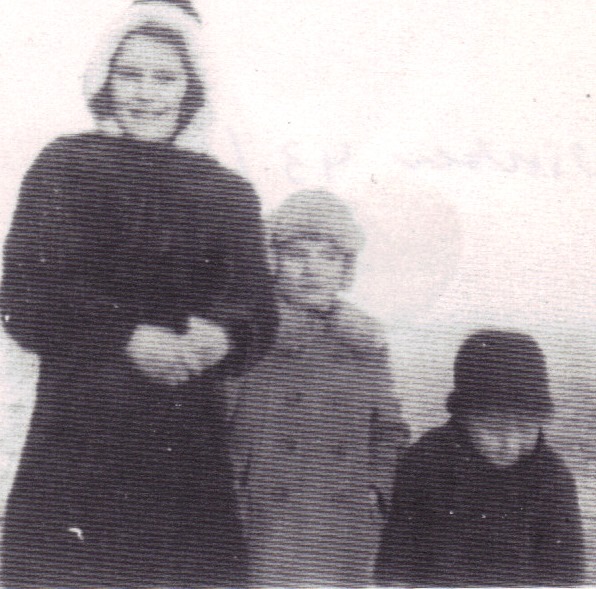
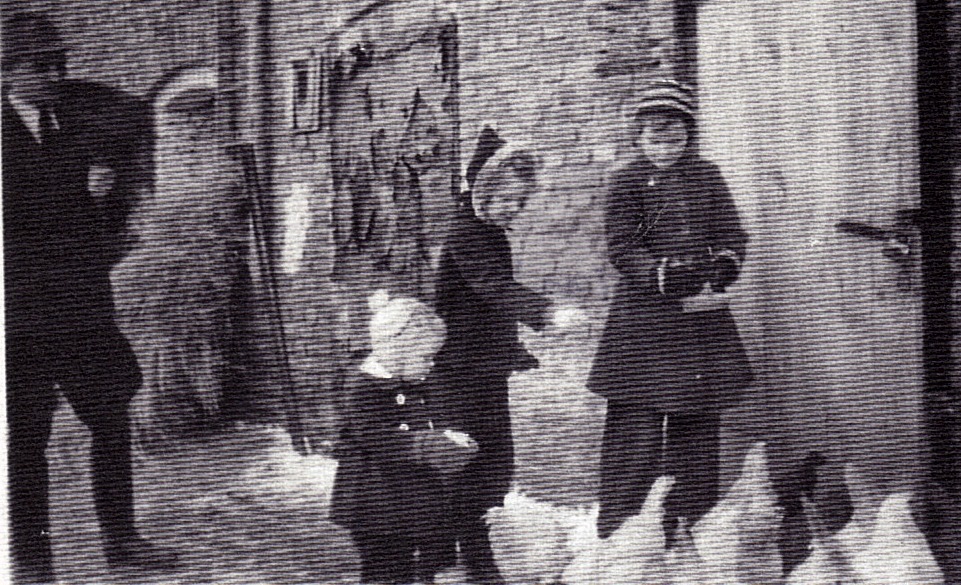
The winter 1943/44 was rather severe especially in the open countryside. We lived there because of air-raid attacks over Berlin. Mum had sewn us warm winter coats and hats to match. In the following picture you can see what we wore to keep out the cold.

2-06-2009 5;00;32 PM

I and my two year old brother with Eva T and  her father looking on.
I and my two year old brother with Eva T in the middle and her father looking on.

Mum did sew the coat I’m wearing, also my little brother’s outfit. Mum also knitted the hats and gloves.