Waking Up to the Century of Declines. One of the world’s foremost Peak Oil educators gives us his insight into the coming century. Recorded in Orewa on Tuesday 9th October 2007.
Even though this video (several more parts following directly after Part 1) was published some time ago, it shows nonetheless very impressive charts about the huge amounts of energy we produce now comparing the increase in energy use since the time humans evolved! The increase during the last few years is absolutely frightening . . . .
Richard William Heinberg is an American journalist and educator who has written extensively on energy, economic, and ecological issues, including oil depletion. He is the author of 13 books, and presently serves as the senior fellow at the Post Carbon Institute. Wikipedia
Richard Heinberg- whose latest book describes The End of Growth- isn’t looking for when the recession will end and we’ll get back to “normal”. He believes our decades-long era of growth was based on aberrant set of conditions- namely cheap oil, but also cheap minerals, cheap food, etc- and that looking ahead, we need to prepare for a “new normal”. The problem, according to Heinberg, is our natural resources just aren’t so cheap and plentiful anymore, and he’s not just talking about Peak Oil, Heinberg believes in Peak Everything (also the title of one of his books). Heinberg thinks for many, adjusting to a life where everything costs a bit more, could be very hard, but he also thinks the transition to a new normal might actually make life better. “Particularly in the Western industrialized countries we’ve gotten used to levels of consumption that are not only environmentally unsustainable, they also don’t make us happy. They’ve in fact hollowed out our lives. We’ve given up things that actually do give us satisfaction and pleasure so that we can work more and more hours to get more and more money with which to buy more and more stuff- more flatscreen tvs, bigger SUVs, bigger houses and it’s not making us happier. Well, guess what, it’s possible to downsize, it’s possible to use less, become more self sufficient, grow more of your own food, have chickens in your backyard and be a happier person.” This is not all theoretical. In the backyard of the home Heinberg shares with his wife, Janet Barocco, the couple grow most of their food during the summer months (i.e. 25 fruit & nut trees, veggies, potatoes.. they’re just lack grains), raise chickens for eggs, capture rainwater, bake with solar cookers and a solar food drier and secure energy with photovoltaic and solar hot water panels. Their backyard reflects Heinberg’s vision for our “new normal” and it’s full of experiments, like the slightly less than 120-square-foot cottage that was inspired by the Small Home Movement. It was built with the help of some of Heinberg’s college students (in one of the nation’s first sustainability classes) using recycled and natural materials (like lime plaster). Heinberg admits it’s not a real tiny house experiment since they don’t actually live in it- his wife uses it as a massage studio, he meditates there and sometimes it’s used as a guest house (though that’s hush hush due to permitting issues). But their tiny cottage points to the bigger point behind why a transition to a less resource intensive future could equal greater happiness. “Simplify. Pay less attention to all of the stuff in your life and pay more attention to what’s really important. Maybe for you it’s gardening, maybe for you it’s painting or music. You know we all have stuff that gives us real pleasure and most of us find we have less and less time for that because we have to devote so much time to shopping, paying bills and driving from here to there and so on. Well, how about if we cut out some of that stuff and spend more time doing what really feeds us emotionally and spiritually and in some cases even nutritionally.”
In the morning we always like to listen to ABC Classic with Russel Torrance.
At 8:30 this morning we listened on ABC Classic to this:
Mozart, Wolfgang Amadeus, Concerto in A Major for Basset Clarinet K. 622: II. Adagio
Craig Hill (clarinet) + Australian Brandenburg Orchestra
Both Peter and I staight away did think of the lyrics of -Ich hatt’ einen Kameraden – –
It is a catching melody with catching lyrics. We both remembered having known the lyrics when we were children. We thought about how it would be interesting to find out how Mozart did incorporate the melody in his concerto. Sure enough now we know that the music is based on the tune of a Swiss folk song and the lyrics, written by Ludwig Uhland in 1809 are inspired by what happened during the Tyrolean Rebellion of 1809!
Following is some information I took from Google, and the videos are on YouTube. I like to brouse like this on the internet. It is truly amazing that so much information can be found there.
“Der gute Kamerad” (“The good Comrade”), also known by its incipit as Ich hatt’ einen Kameraden (“I had a comrade”) is a traditional lament of the German Armed Forces.The text was written by German poet Ludwig Uhland in 1809. Its immediate inspiration was the deployment of Badener troops against the Tyrolean Rebellion. In 1825, the composer Friedrich Silcher set it to music, based on the tune of a Swiss folk song.”
The Clarinet Concerto in A, K622, completed in 1791, the year of Mozart’s death, marked his farewell to instrumental music. It was also the first clarinet concerto to be written by a major composer – except that Mozart did not write it for the clarinet at all.
In fact, it is rare that we ever hear this most famous of wind concertos played on the instrument Mozart intended – the basset clarinet, a clarinet that has four semitones added to its lower range.
The inventor of the basset clarinet, and its leading virtuoso, was Mozart’s friend and fellow Mason, Anton Stadler, for whom Mozart had written the Clarinet Quintet in A, in 1789. “Never,” wrote Mozart to Stadler, “would I have thought that a clarinet could be capable of imitating the human voice as deceptively as it is imitated by you. Truly your instrument has so soft and lovely a tone that nobody with a heart could resist it.”
Far from being entirely the product of Mozart’s miraculously inspired final year, the first 199 bars of the clarinet concerto are identical to an abandoned concerto for basset horn (an instrument Stadler also played) that he began as early as 1787. By looking at this fragment (preserved at Winterthur, Switzerland) we can see, from the scribbles and erasures, that Mozart was uncharacteristically lacking in decision, often changing his mind and obviously under stress.
What may have stimulated Mozart into completing the abandoned basset horn concerto for Stadler and his basset clarinet, was his journey to Prague for the premiere of La Clemenza di Tito. One of his travelling companions was his pupil Süssmayr, who revealed that he was writing a basset clarinet concerto for Stadler. Mozart could not allow himself to be outdone. The concerto was written in Vienna some time between the end of September and the beginning of October 1791. The completed score was sent off to Stadler in Bohemia and it received its first performance at Stadler’s benefit concert in the Prague Theatre on October 16, 1791. Seven weeks later, Mozart was dead.
The concerto was not published until 1802, with the solo part adapted for the clarinet rather than the obsolete basset clarinet. The whereabouts of the original manuscript are unknown.
Rupert Read is affiliated with Extinction Rebellion and the Green Party.
Rupert Read says:
“I’m a Reader in Philosophy at the University of East Anglia and I have thrown myself headfirst into this movement. Our long-term aim is to create a situation where the government can no longer ignore the determination of an increasingly large number of people to shift the world from what appears to be a direct course towards climate calamity. Who knows, the government could even end up having to negotiate with the rebels.”
Further on he says:
“The Extinction Rebellion challenges oligarchy and neoliberal capitalism for their rank excess and the political class for its deep lack of seriousness. But the changes that will be needed to arrest the collapse of our climate and biodiversity are now so huge that this movement is concerned with changing our whole way of life. Changing our dietsignificantly. Changing our transport systems drastically. Changing the way our economies work to radically relocalise them. The list goes on.
This runs up against powerful vested interests – but also places considerable demands upon ordinary citizens, especially in “developed” countries such as the UK. It is therefore a much harder ask. This means that the chances of the Extinction Rebellion succeeding are relatively slim. But this doesn’t prove it’s a mistaken enterprise – on the contrary, it looks like our last chance.”
So he admits that the chances of the Extinction Rebellion succeeding are relatively slim. Still, I think we should want it to succeed, because it looks like this maybe our last chance!!
When I looked up the above link to ‘changing our diets’ I found this article in The Guardian:
Huge reduction in meat-eating ‘essential’ to avoid climate breakdown
What do you think, does it look like that a huge reduction in meat-eating should be achievable? I think we would have to get governments to agree to want to be working towards achieving such a reduction. If governments had the will to introduce certain policies, policies that would for instance be necessary in war-time, then a real lot could be achieved.
To use our cars less, is another thing that we could all keep in mind!
“Changing the way our economies work to radically relocalise them”: Do you have any ideas how this could work?
Author:gradyharpfrom United States 29 September 2005 *** This review may contain spoilers ***
DE TWEELING (TWIN SISTERS), based on the highly successful novel by Tessa de Loo and adapted brilliantly for the screen by Marieke van der Pol, is assuredly one of the most touching films to date about the strength of family bonds decimated by the horrors of WW II. Director Ben Sombogaart follows Dutch writer de Loo’s lead in making this story about the differing fates of twin girls separated at the death of their parents more of a parallel tale than capitalizing on the grim reality of Hitler’s influence. The result is a cinematically magnificent, gently hued verismo style of film that succeeds even more in its impact than if it were constantly doused in the dark side of its subject.
This is what I wrote on the 15th of November 2018:
“We have just come back from a great few days away from home. I found our trip was very relaxing, and we did quite a few things that are worth remembering. It is always good to be able to go away for a little while. This creates memories.
Both Peter and I are in our eighties. That we still enjoy doing a bit of travelling, I find remarkable. Peter is battling to maintain some normality to his life while old age and sickness diminish his fitness. The one thing he is still pretty good at, is driving a car. He says driving a car on good roads for certain distances he finds relaxing. Our old Audi goes well on highways. In towns where there are a lot of traffic lights, Peter has to stop the car too often. This is when the car uses a lot of petrol pro km. However on freeways and highways the car uses much, much less petrol, and it makes Peter very happy and joyful to not have to stop all the time. However, Peter being 83 and having a few health issues that can make him feel perhaps too tired after a longer drive, he agreed not to drive the 650 km to Benalla in one day, but rather to stay overnight somewhere, that is at about the halfway point. This time we came up with the idea to stop at Gundagai for our overnight stays. This worked out very well. I wrote here that we stayed at the “Gundagai Motel”:
After our one night’s stay at Gundagai we stayed at our son’s place at Benalla for three nights. And on the way back we stayed again for one night at Gundagai. This means we left home on a Friday morning and arrived back home on a Wednesday afternoon. So this makes it close to one week! I reckon we did very well, considering our age and Peter’s health problems. And of course I too have sometimes a few minor health problems related to old age!
Peter is booked in for some more treatment in the hospital. We hope the result of these treatments is going to be as good as possible so that perhaps in future we are still going to be able to do similar beautiful trips!”
Today is the 25th of March 2019 and write here a little P.S.:
In less than two weeks we are going for another trip to Benalla. Peter’s treatment in the hospital has been delayed. We don’t know yet, whether he can get some treatment soon. This may be a good thing, for Peter has not symptoms that he is unduly concerned about. So we booked a few stays at the Gundagai Motel again. And Martin knows already that we want to be with him for his birthday on the 8th of April.
“The Valentine’s artisan sourdough bakery and coffee shop operates out of three locations – Rutherglen, Albury and Wodonga.”
After having left Benalla, Peter and I had a lunch break at Wodonga. We went to the Valentine’s coffee shop in Wodonga. The bread was very much to our liking. There were a variety of fresh healthy options to go with the bread. And the coffee was very good too.
On our way back home to Dapto we were staying overnight in Gundagai. Peter’s driving in our ancient Audi went very well. He loves driving the Audi long distances. The Hume Motorway is not a bad road to drive on.
We went to this Art Show on Sunday the 11th of November. This Art Show a bit further away from Benalla was part of the Benalla Festival. There were some good pictures by local artists exhibited.
The following pictures were taken at the Mansfield Zoo where we went on Monday, the 12th of November. Peter took these pictures during our visit to Mansfield Zoo. Mansfield is not very far from Benalla.
AT THE MANSFIELD ZOO
This is our son Martin with a bucket full of feed for the animals.
We stayed at Gundagai overnight on our way to Benalla.
We left Dapto early in the morning on Friday, the 9th of November 2018. At Moss Vale we stopped for breakfast at our favourite cafe where we always like to stop for breakfast. This time we ventured to a table in a snug little room. We could make ourselves comfortable while waiting for the ordered cooked breakfast to arrive.
After breakfast it didn’t take us long to reach the Hume Highway where Peter could drive the Audi at a very good speed of nearly always a comfortable 110 km.
By 12 o’clock we were already in Gundagai where we had booked to stay overnight.
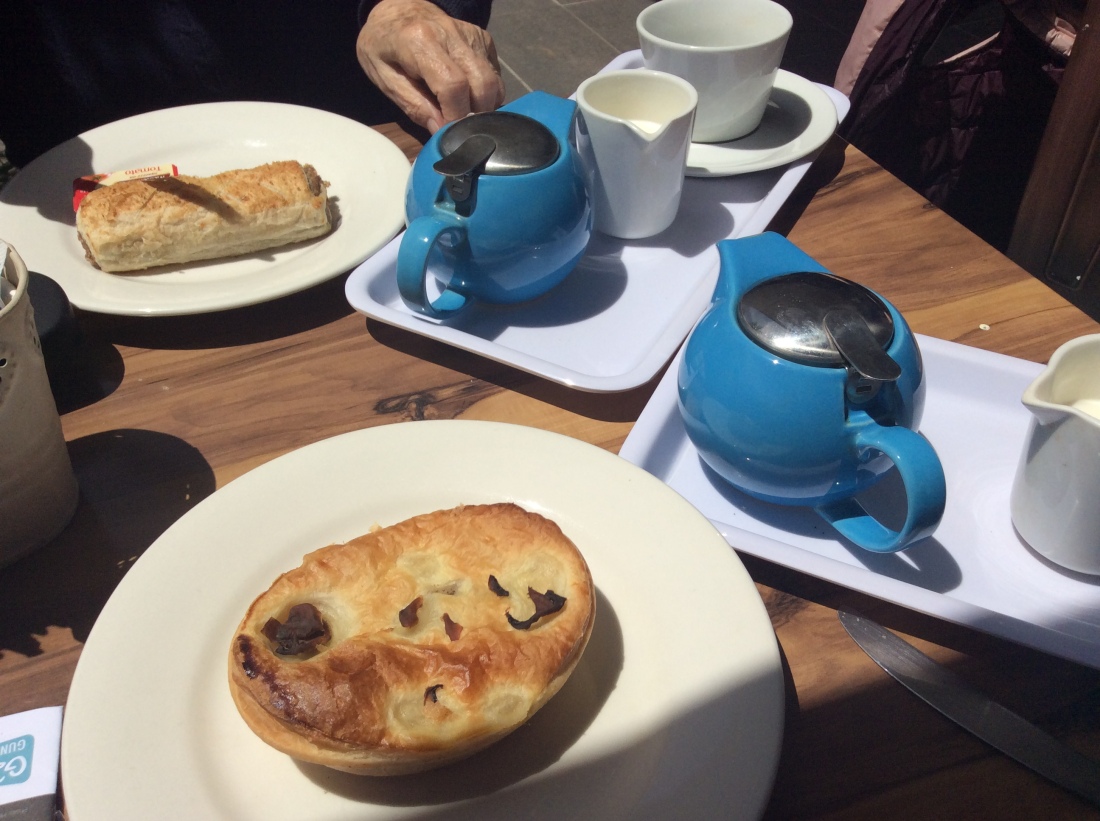
We went for lunch at this very old bakehouse:
We had tea and pies at an outside table.
The motel where we were staying is called GUNDAGAI MOTEL. (We stayed there again on Tuesday, the 13th, on our way back home!)


 Author: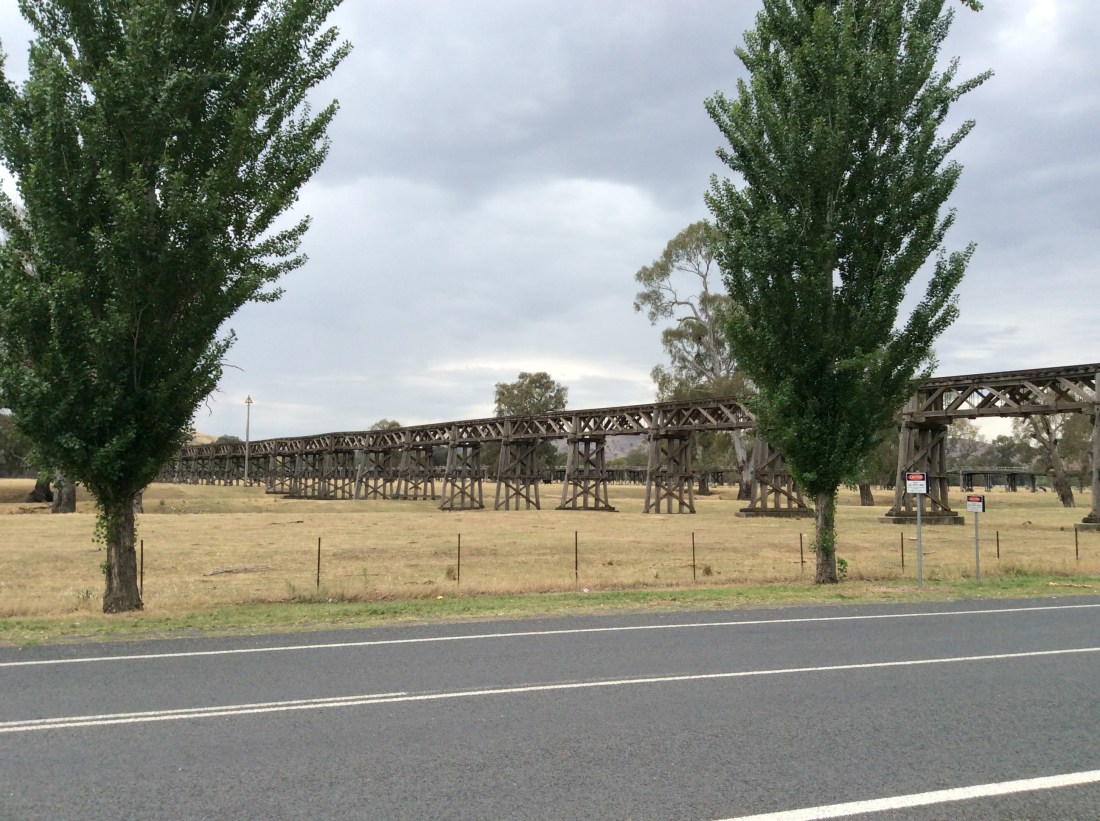


 AuntyUta