Anatomy of a ‘mega-blaze’

https://www.abc.net.au/news/2020-07-27/gospers-mountain-mega-blaze-investigation/12472044?nw=0

As the first Black Summer inquiry prepares to report,  we reveal the inside story of Australia’s biggest bushfire.

By Kevin NguyenPhilippa McDonald and Maryanne TaoukUpdated 27 Jul 2020, 5:05amPublished 27 Jul 2020, 5:05am

It burned for 79 days and remains seared in the memory of all who feared and fought it.

The statistics are staggering. Over a million hectares burned; a hundred homes destroyed on Sydney’s doorstep.

Gospers Mountain became famous as Australia’s first “mega-blaze”.

But behind the smoke, flames and evacuations, there is still much to learn about the monster.

The ABC has pieced together data, imagery and interviews to form a new narrative of the fire.

The NSW Rural Fire Service (RFS) and National Parks and Wildlife Service (NPWS) contributed information and access to operational commanders, some speaking for the first time.

We can reveal the fire’s starting point, and how close Sydney’s suburbs came to disaster.

Firefighters tell of raised hopes as the flames faltered, and despair as backburns backfired.

This is how the mega-blaze unfolded.

Please go to:

https://www.abc.net.au/news/2020-07-27/gospers-mountain-mega-blaze-investigation/12472044?nw=0

Which mask works best? We filmed people coughing and sneezing to find out

https://www.abc.net.au/news/2020-07-27/which-face-mask-works-best-filmed-people-sneezing-coughing/12494174

By C Raina MacIntyre, Abrar Ahmad Chughtai, Charitha de Silva, Con Doolan, Prateek Bahl and Shovon Bhattacharjee

Posted 2 hours ago

How face coverings and masks minimise spreading coronavirus

Share

If you’re not sure whether wearing a face mask is worth it, or you need to wear a mask but are unsure which type, our new research should help you decide.

We took videos of what happens when you talk, cough and sneeze in different scenarios — while not wearing a mask, wearing two different types of cloth masks, or wearing a surgical mask.

The results, published in the journal Thorax, are clear.

A surgical mask was the most effective at blocking droplets and aerosols from talking, coughing and sneezing.

But if you can’t get hold of one, a cloth mask is the next best thing, and the more layers the better.For the latest news on the coronavirus pandemic follow our live coverage.

Here’s what we did and what we found

You can be infected with the coronavirus, but not show symptoms. So you cannot identify an infected person just by looking at them.

And you may be infected (and infectious) but not know it.

Facts about face masks

A man with a white mask stands in front of a red background with coronavirus graphics.

So we wanted to compare how effective different types of masks were at preventing outward transmission of droplets while talking, coughing and sneezing.

These are the types of masks the public might use to reduce community transmission.

We compared using no mask with two different types of cloth masks made from DIY templates provided online (one mask had a single layer of cloth; the other had two layers), and a three-layered surgical mask.

To visualise the droplets and aerosols you may not otherwise see, we used an LED lighting system with a high-speed camera.

We confirmed that even speaking generates substantial droplets. Coughing and sneezing (in that order) generate even more.

A three-ply surgical mask was significantly better than a one-layered cloth mask at reducing droplet emissions caused by speaking, coughing and sneezing, followed by a double-layer cloth face covering.

A single-layer cloth face covering also reduced the droplet spread caused by speaking, coughing and sneezing but was not as good as a two-layered cloth mask or surgical mask.

The difference between no masks and three different types of mask.
We compared using no mask with two different types of cloth masks made from DIY templates provided online and a three-layered surgical mask.(Supplied)

We do not know how this translates to infection risk, which will depend on how many asymptomatic or mildly symptomatic infected people are around.

However, it shows a single layer is not as good a barrier as a double layer.

What does this mean?

With mandated mask use in Greater Melbourne and the Mitchell Shire, we may face shortages of surgical masks.

So it is important to understand the design principles of cloth masks.How do I make a face mask?How do I make a face mask for coronavirus? Are they mandatory? Where can I get them? Your questions, answeredRead more

We did not test more than two layers, but generally, more layers are better.

For example, a 12-layered cloth mask is about as protective as a surgical mask, and reduces infection risk by 67 per cent.

We acknowledge it’s difficult to sew together 12 layers of fabric. But there are steps you can take to make cloth masks more effective. You can:

  • increase the number of layers (at least three layers)
  • use a water-resistant fabric for the outer layer
  • choose fabric with a high thread count (so a tighter weave, for instance from a good quality sheet is generally better than a fabric with a looser weave that you can clearly see light through)
  • hybrid fabrics such as cotton–silk, cotton–chiffon, or cotton–flannel may be good choices because they provide better filtration and are more comfortable to wear
  • make sure your mask fits and seals well around your face
  • wash your mask daily after using it.

To keep the COVID-19 outbreak under control we need to keep growth factor below 1.0

Australia’s current
growth factor is
1.04Jun 12Jul 26

Average 395 cases per day for the past 7 daysHIGHEST1.28 Mar 18thLOWEST0.87 Apr 14thFIND OUT MORE →

The evidence is mounting

In practice, we don’t yet know which has a greater effect — wearing masks to prevent infected people spreading to others or protecting well people from inhaling infected aerosols. Probably both are equally important.

In Missouri, two infected hairdressers kept working while infectious, but wore a mix of cloth and surgical masks, as did their 139 clients. No client was infected.https://www.youtube.com/embed/UNCNM7AZPFg?feature=oembed&enablejsapi=1&origin=https%3A%2F%2Fwww.abc.net.auYOUTUBEThe difference between face masks

However, one hairdresser infected her household family members, as she did not wear a mask at home, and neither did her family.

This is reassuring evidence that infection risk is reduced when everyone wears masks.

C Raina MacIntyre is professor of global biosecurity, NHMRC Principal Research Fellow, Head, Biosecurity Program, Kirby Institute, UNSW. Abrar Ahmad Chughtai is an epidemiologist at UNSW. Charitha de Silva is a lecturer at UNSW. Con Doolan is professor, School of Mechanical and Manufacturing Engineering, UNSW. Prateek Bahl is a PhD Candidate, School of Mechanical and Manufacturing Engineering, UNSW. Shovon Bhattacharjee is a PhD Candidate, The Kirby Institute, UNSW. This article originally appeared on The Conversation. Several authors of this article have received research grants from Paftec, Sanofi and Seqirus, Department of Defence and Australian Research Council.

What you need to know about coronavirus:

https://modules.wearehearken.com/abc-national/embed/5075/share?abcnewsembedheight=890&abcnewsembedheightmobile=1000Posted 2hhours agoShare

Related Stories

‘You don’t want me as your doctor’: Intensive care director doesn’t mince words as he issues COVID-19 warningSkin flaring up after wearing a face mask all day? Here are the experts’ top tipsHere’s what Melbourne looked like on the first day of mandatory masksMore on:

More on coronavirus

See our full coverage of coronavirus

The visit of the Queen of Sheba to King Solomon 1890

https://www.artgallery.nsw.gov.au/collection/works/898/

On the way to see the Queen of Sheba we also saw this picture:

https://en.wikipedia.org/wiki/On_the_Wallaby_Track

On the wallaby track
Frederick McCubbin - On the wallaby track - Google Art Project.jpg
Artist Frederick McCubbin
Year 1896
Medium oil on canvas
Dimensions 122.0 cm × 223.5 cm (48.0 in × 88.0 in)
Location Art Gallery of New South WalesSydney

On the wallaby track is a 1896 painting by the Australian artist Frederick McCubbin. The painting depicts an itinerant family; a woman with her child on her lap and a man boiling a billy for tea. The painting’s name comes from the colloquial Australian term “On the wallaby track” used to describe itinerant rural workers or “swagmen” moving from place to place for work.[1] The work has been described as “among the best known and most popularly admired of Australian paintings”.[1]

A print of it hangs above our bed. Since we have prints of both of these paintings we are very familar with them and are always overjoyed when we are able to see them again at the Gallery.

This year it was a very brief visit of us to the Art Gallery. But it was worth it. It was very good that our daughter could take us there.

STAN GRANT’S SPEECH ON RACISM IN AUSTRALIA

https://mannerofspeaking.org/2016/01/26/stan-grants-speech-on-racism-in-australia/

Stan Grant, an indigenous Australian journalist, gave a speech in October 2015 at a debate on racism in Australia. The video of that speech has gone viral.

Stan Grant
Stan Grant

Several people are touting it as the Australian equivalent of Martin Luther King’s I Have a Dream speech. While I would not elevate this speech to that status—and Grant himself has said that, while he is flattered, he is “not in any way worthy of that sort of comparison”—it is an excellent speech. Forceful, hopeful, compelling, moving.

Interestingly, Grant apparently delivered the speech off-the-cuff.

I didn’t want to write anything, I didn’t want to be standing there looking down at notes. I just wanted to look people directly in the eye. I wanted to make a statement about how we live with the weight of history.

He succeeded.

What I liked

  • Grant was right to stand behind the lectern. Usually, a speaker should be out in front of the lectern so as to shrink the distance between himself and the audience. But certain occasions mandate the use of a lectern. A debate such as this is one of those times.
  • He has great eye contact throughout the speech.
  • Grant’s voice was powerful without being overbearing. He maintained a good pace and he excellent pauses.
  • He uses good hand gestures to emphasize his points. Even when he holds his hands together (starting at 1:05), it works well. Typically, speakers want to adopt and open posture and not hold their hands together; however, this is a good example of an exception to the rule.
  • He anchors his speech by returning to a phrase, “The Australian Dream”, 11 times. This certainly has echoes of Martin Luther’s King’s speech in front of the Lincoln Memorial. In that speech, King invoked the phrase “I have a dream” eight times.
  • He uses alliteration to frame his arguments: “We heard a howl. We heard a howl of humiliation that echoes across two centuries of dispossession, injustice, suffering and survival.” / “The Australian Dream is rooted in racism.”
  • Grant tells personal stories of his family members and the indignities that they suffered, whether they were indigenous or white. He thereby enhances his own credibility when it comes to the subject of racism in Australia.
  • Grant is humble in crediting his success to his family members who came before him.
  • He uses statistics to support his arguments. “My people die young in this country. We die ten years younger than average Australians and we are far from free. We are fewer than three percent of the Australian population and yet we are 25 percent, a quarter of those Australians locked up in our prisons and if you are a juvenile, it is worse, it is 50 percent. An Indigenous child is more likely to be locked up in prison than they are to finish high school.”
  • Grant invokes passages from important Australian songs and poems—the Australian National Anthem and Dorothea Mackellar’s My Countryand then uses antimetabole to show how the state of indigenous peoples in Australia has been the opposite of what is praised in song and verse.

We sing of it, and we recite it in verse. Australians all, let us rejoice for we are young and free. My people die young in this country. We die ten years younger than average Australians and we are far from free.

I love a sunburned country, a land of sweeping plains, of rugged mountain ranges. It reminds me that my people were killed on those plains. We were shot on those plainsdisease ravaged us on those plains.

  • He uses commoratio to emphasize the disdain and hatred with which the British regarded the indigenous peoples of Australia:

And when British people looked at us, they saw something sub-human, and if we were human at all, we occupied the lowest rung on civilisation’s ladder. We were fly-blown, stone age savages and that was the language that was used.

  • Notwithstanding the foregoing, Grant sounds a hopeful note by appealing to the higher instincts of Australians.

The Australian Dream. We’re better than this. I have seen the worst of the world as a reporter. I spent a decade in war zones from Iraq to Afghanistan, and Pakistan. We are an extraordinary country. We are in so many respects the envy of the world.

Of course racism is killing the Australian Dream. It is self evident that it’s killing the Australian dream. But we are better than that. The people who stood up and supported Adam Goodes and said, “No more,” they are better than that. The people who marched across the bridge for reconciliation, they are better than that. The people who supported Kevin Rudd when he said sorry to the Stolen Generations, they are better than that. My children and their non-Indigenous friends are better than that. My wife who is not Indigenous is better than that.

  • He concludes by returning to the line from the Australian that he referenced at the beginning. He thus has a circular ending. But more than that, he emphasizes the word “all” to show his hope for the future:

And one day, I want to stand here and be able to say as proudly and sing as loudly as anyone else in this room, Australians all, let us rejoice.

Congratulations, Stan Grant on your excellent speech. Here’s hoping that it leads to some positive, concrete steps in your country. And elsewhere.

Stan Grant’s challenge to Australia: How seriously are you going to take me?

https://www.smh.com.au/lifestyle/stan-grants-challenge-to-australia-how-seriously-are-you-going-to-take-me-20160406-gnzk7r.html

Stan Grant has faced up to prejudice, poverty, public judgment and private agony. Now, the Indigenous journalist says he knows more – and has worked harder – than any of our frontbench politicians. And he’s ready to take them on.

Karla’s wish is Granted

https://www.news.com.au/entertainment/celebrity-life/karlas-wish-is-granted/news-story/db04b5173ffc8889a7021834fc57e264

THREE years ago, Stan Grant whisked his two sons off to live with him and his partner Tracey Holmes in China _ leaving his ex-wife Karla nearly 9000km away from her kids.

Finally, Karla will get them back for good.

The SBS Living Black host, at the centre of a messy marriage breakdown with former Today Tonight host Grant after he was caught with sports reporter Holmes at the 2000 Athens Olympics, will have boys John, 12, and Dylan, 9, back under her roof later before the end of the year.

“They’ve been away for a couple of years now. It has been tough,” Karla said yesterday.

“It’s been a great experience for them in terms of going to school, learning a whole new different culture and meeting kids from all different countries so I think it will help them in the fture.”

Karla, who presented an award at last night’s Deadly Awards, said it had been a mutual agreement with her ex-husband for the boys to join him in Beijing, where he works as a presenter for CNN.

“I’ve got custody of the kids but he asked me if he could take them over there and I thought it would be a great experience for them,” she said.

Karla also added weight to rumours Grant himself may return to Sydney with now wife Holmes and their own son, Jesse, to be closer to his family.

“He’s looking at coming back. I’m not sure whether he’ll be back for good,” she said.

Karla was joined by 19-year-old daughter Lowanna at the Deadlys, where, ironically, Grant’s father Stan Grant Snr picked up the award for Outstanding Achievement in Education for his contribution to preserving the Wiradjuri language.

Other major winners of Indigenous Australia’s highest honour included Troy Cassar-Daley for artist of the year, Anthony Mundine (male sportsperson of the year) and Jamie Gulpilil (actor of the year)

Originally published asKarla’s wish is Granted

Elizabeth Jolley

From Wikipedia, the free encyclopedia

Jump to navigationJump to search

Elizabeth Jolley
Elizabeth Jolley.gif

Professor Elizabeth Jolley
Born
Monica Elizabeth Knight

4 July 1923

Birmingham, England
Died 13 February 2007 (aged 83)

Occupation Novelist, professor of creative writing
Spouse(s) Leonard Jolley
Children 3

Monica Elizabeth Jolley AO (4 June 1923 – 13 February 2007) was an English-born Australian writer who settled in Western Australia in the late 1950s and forged an illustrious literary career there. She was 53 when her first book was published, and she went on to publish fifteen novels (including an autobiographical trilogy), four short story collections and three non-fiction books, publishing well into her 70s and achieving significant critical acclaim. She was also a pioneer of creative writing teaching in Australia, counting many well-known writers such as Tim Winton among her students at Curtin University.[1]

Her novels explore “alienated characters and the nature of loneliness and entrapment.”[2]

Life[edit]

Elizabeth Jolley and (younger) sister Madelaine Winifred reading, ca. 1927

Jolley was born in Birmingham, England as Monica Elizabeth Knight, to an English father and Austrian-born mother who was the daughter of a high ranking Railways official.[3] She grew up in the Black Country in the English industrial Midlands. She was educated privately until age 11, when she was sent to Sibford School, a Quaker boarding school near Banbury in Oxfordshire which she attended from 1934 to 1940.

At 17 she began training as an orthopaedic nurse in London and later in Surrey. She began an affair with one of her patients, Leonard Jolley (1914–1994), and subsequently became pregnant. Leonard Jolley was already married to Joyce Jolley, who was also pregnant. Elizabeth moved in with the Jolleys, and her daughter Sarah was born five weeks before the birth of Susan Jolley, the child of Leonard and Joyce.[4][5]

Elizabeth and Leonard subsequently emigrated to Australia in 1959 after they had married. They eventually had three children and Leonard was appointed chief librarian at the Reid Library at the University of Western Australia, a job he held from 1960–1979. Leonard told his family in England that it was Joyce and Susan with whom he had moved to Australia. For several years, Elizabeth wrote letters purportedly from Joyce and Susan to Leonard’s British relatives. Leonard eventually asked his former wife to tell their daughter Susan that he had died.[4]

Elizabeth and Leonard lived in the riverside Perth suburb of Claremont. In 1970 they also bought a small orchard in Wooroloo, a town in the Darling Ranges approximately 60 kilometres inland from Perth.[6]

Elizabeth Jolley worked at a variety of jobs including nursing, cleaning, door-to-door sales and running a small poultry farm, and throughout this time she also wrote works of fiction including short stories, plays and novels. Her first book was published in 1976, when she was 53.

From the late 1970s, she taught writing at the Western Australian Institute of Technology, later Curtin University, and one of her students was another Australian novelist, Tim Winton.[7] Her students have won many prizes including “several Australian/Vogel Awards (for a first novel), several different Premier’s Awards, the Commonwealth Poetry Prize and the Miles Franklin Award”.[1]

She developed dementia in 2000, and died in a nursing home in Perth in 2007. Her death prompted many tributes in newspapers across Australia, and in The Guardian in the United Kingdom. Her diaries, stored at the Mitchell Library in Sydney, will be closed until after the deaths of her children or 25 years after her death.[8]

Andrew Riemer, the Sydney Morning Herald’s chief book reviewer, wrote in his obituary for her, “Jolley could assume any one of several personas – the little old lady, the Central European intellectual, the nurse, the orchardist, the humble wife, the university teacher, the door-to-door salesperson – at the drop of a hat, usually choosing one that would disconcert her listeners, but hold them in fascination as well”.[9]

On 16 November 2007, the performance of Johannes Brahms‘s A German Requiem by the West Australian Symphony Orchestra, chorus and soloists, under conductor Lothar Zagrosek, was dedicated to Jolley, for whom the Requiem had been a great source of joy and inspiration.[10]

Literary career[edit]

Jolley began writing early in her twenties, but was not recognised until much later. She had many rejections by publishers, 39 in one year alone. Delys Bird suggests that it was the post-modern features of her writing – “motifs repeated within and between novels and short stories, self-reflexivity and open-endedness”[11] – that made it hard for them to be published at that time. She suggests that her eventual success owes a little to “the 1980s awareness of ‘women’s writing'”, which had been catapulted to the mainstream after the success of other Australian female writers such as Helen Garner and Germaine Greer.[11]

In the 1960s some of her stories were accepted by the BBC World Service and Australian journals, but her first book Five Acre Virgin was not published until 1976. Soon following were Woman in a Lampshade and Palomino, but it would not be until much later that these books would receive either positive reviews or high circulation.

She lapsed in her writing, discouraged by earlier failures, and was only to be published again in 1983 with Miss Peabody’s Inheritance and Mr Scobie’s Riddle. The latter won The Age Book of the Year and high acclaim, especially in Australia and the United States. A year later, Milk and Honey was awarded Christina Stead Prize for fiction in the New South Wales Premier’s Literary Awards. In 1986, The Well won the top Australian literary prize – the Miles Franklin AwardThe Sugar Mother was, as Riemer writes, “her characteristically idiosyncratic way of fulfilling a commission to write a novel commemorating the bicentenary of 1988”.[12]

Later in her career she wrote an autobiographical fiction trilogy, “My Father’s Moon” (1989), “Cabin Fever” (1990) and ‘The George’s Wife” (1993). In an article in The Age newspaper, 20 February 2007, written after her death, literary critic Peter Craven, was reported as saying, “She was a master of black comedy and she went on to write a wholly different form of autobiographical fiction that was lucid, luminous and calm”.[13]

Lovesong, her third last novel, is, Riemer suggests, “the riskiest book she wrote”.[12] It deals with the subject of paedophilia and demonstrates “an admirable refusal to be deflected from what she must have seen as the demands of her art and vocation”.[12]

In 1993, a diary she kept before her novels were published which recorded the experience of buying a hobby farm was published as Diary of a Weekend Farmer. A partly autobiographical collection of pieces, Central Mischief, appeared in 1992. She also wrote numerous radio plays broadcast by the Australian Broadcasting Corporation, and several of her poetic works were published in journals and anthologies during the 1980s and 1990s.

Jolley was made a Professor of Creative Writing at Curtin University in 1998.

On 8 February 2008, Curtin University Library launched the online Elizabeth Jolley Research Collection, a virtual research centre for scholars interested in studying her and her work.

Awards and nominations[edit]

Literary works[edit]

Novels[edit]

Short stories and plays[edit]

Non-fiction[edit]

This is a copy of an article about the environmental cost of air travel

Here is the link to the original article by DW:

https://www.dw.com/en/to-fly-or-not-to-fly-the-environmental-cost-of-air-travel/a-42090155

Though air travel is more popular than ever, the vast majority of people in the world have never been on a plane. As that dynamic slowly changes, the environment stands to suffer. Is flying less the only solution?

    
An airplane flies with contrails in its wake

When was the last time you traveled by plane? Various researchers say as little as between 5 and 10 percent of the global population fly in a given year.

But things are changing. According to International Civil Aviation Organization (ICAO) estimates, there were 3.7 billion global air passengers in 2016 — and every year since 2009 has been a new record-breaker.

By 2035, the International Air Transport Association (IATA) predicts a rise to 7.2 billion. Like the planes themselves, the numbers just keep going up. And given the damage flying does to the planet, that is food for thought.

Not just the CO2

Many estimates put aviation’s share of global CO2 emissions at just above 2 percent. That’s the figure the industry itself generally accepts.

But according to Stefan Gössling, a professor at Sweden’s Lund and Linnaeus universities and co-editor of the book Climate Change and Aviation: Issues, Challenges and Solutions, “That’s only half the truth.”

Other aviation emissions such as nitrogen oxides (NOx), water vapor, particulates, contrails and cirrus changes have additional warming effects.

A Boeing 747 jet being assembledBeyond emissions made solely in flight, manufacturing effects within the aviation industry add considerably to its overall footprint

“The sector makes a contribution to global warming that is at least twice the effect of CO2 alone,” Gössling told DW, settling on an overall contribution of 5 percent “at minimum.”

But IATA spokesperson Chris Goater told DW the science behind this so-called ‘radiative forcing’ is “unproven”.

Even if we accept the 2 percent emissions figure as final, if only 3 percent of the world’s population flew last year, that relatively small group still accounted for a disproportionate chunk of global emissions.

A few years ago, environmental group Germanwatch estimated that a single person taking one roundtrip flight from Germany to the Caribbean produces the same amount of damaging emissions as 80 average residents of Tanzania do in an entire year: around four metric tons of CO2.

“On an individual level, there is no other human activity that emits as much over such a short period of time as aviation, because it is so energy-intensive,” Gössling explains.

The WWF carbon footprint calculator is instructive in this regard. Even a serious environmentalist who eats vegan, heats using solar power and rides a bike to work, but who still take the occassional flight, wouldn’t look very green at all.

Just two hypothetical short-haul return flights and one long-haul round-trip in a given year would outweigh otherwise exemplary behavior.

Infografik persöhnliche Klimafußabdruck reduzieren ENG

New tech can’t solve everything

As awareness of the need to reduce our individual and collective carbon footprints in order to prevent climate catastrophe grows, several industries have come under sustained pressure to find clean solutions.

The aviation sector made its own promises — in October 2016, 191 nations agreed a UN accord which aims to cut global aviation carbon emissions to 2020 levels by 2035. Another ambitious target of that agreement is for the aviation industry to achieve a 50 percent carbon emission reduction by 2050, compared to 2005 levels.

Goater says there are four ways in which the aviation industry intends to achieve these things: through carbon offsetting in the short-term, the continued development of more efficient planes, deeper investment in sustainable fuels — such as biofuels — and through better route efficiency.

“Basically air traffic control is very inefficient,” he explains. “It creates unnecessary fuel burns and more efficient use would create a 10 percent reduction in emissions.”

He also highlights the fact that a number – albeit very few – of commercial flights are now powered with sustainable fuels every day, despite the fact that the first such flight took off less than a decade ago.

“That was something that happened much faster than anyone was expecting,” he says. The key now, in his view, is for the industry to prioritise investment in the area and for governments to commit in the same way they have to e-mobility in the automobile sector.

But Gössling and many of his peers remain unconvinced.
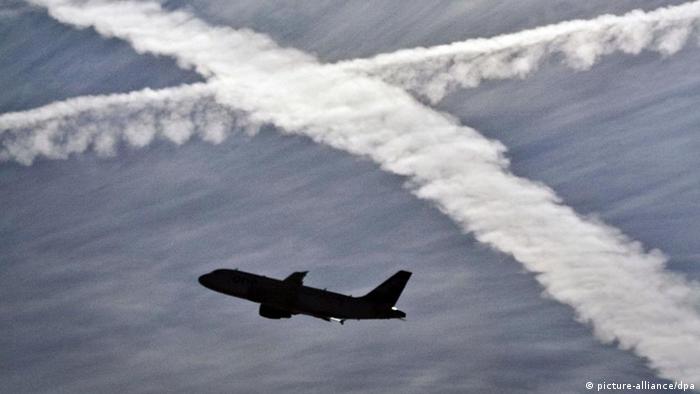
There were 3.6 billion individual passenger flights in 2016 — the number is expected to double by 2035A plane launches in front of two contrails in the sky.

“I think that essentially we need price hikes,” he says. “We did interviews with industry leaders a few months ago and many of them agreed, secretly — they were anonymous interviews — that if we don’t have a major price hike for fossil fuels, then there is no way alternative fuels could ever make it.”

Daniel Mittler, political director of environmental NGO Greenpeace, agrees that fossil fuels need to be more expensive. “The first step is to end all fossil fuel subsidies, including those going to aviation and to properly tax the aviation industry,” he told DW.

For Goater, that is not realistic. “Fuel is already a significant proportion of an airline’s costs,” he says. “Believe me, if we could fly without oil we would.”

The hard truth?

So what’s to be done? Gössling, who has devoted more than 20 years of research to the subject, sees only one solution.

“Do we really need to fly as much as we do, or is the amount we fly induced by the industry?” he asks. In addition to artificially low airplane ticket prices, the industry also promotes a lifestyle, he argues.

“Airline campaigns project an image where you can become part of a group of people who are young, urban frequent flyers, visiting another city every few weeks for very low costs,” he says.

Yet for Goater, the idea of dictating who can fly and when is as unrealistic as it is outdated.
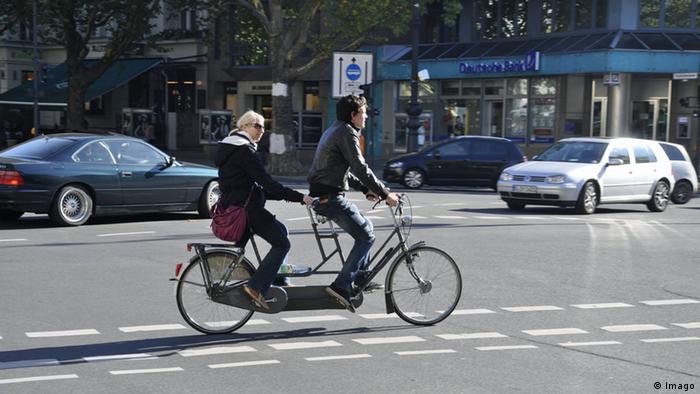
Two passengers ride a tandem bicycle in Berlin, GermanyCan we look toward simpler methods of transport than jet-fueled airplanes?

“Reducing emissions needs to be balanced with allowing people the opportunity to fly — I believe that’s a settled consensus amongst the mainstream for many years,” he says. “It’s not up to people in one part of the world to take it on themselves to deny people in other parts of the world those opportunities.”

For Mittler, it comes down to individual choice as much as anything else and he believes that while efficiency gains are vital, the first step is to reduce the amount we fly.

“We need to move towards a more sharing and caring way of living on this planet,” he says, adding that doing without the weekend shop in New York might be one of the least painful ways of contributing to that.

“We need a prosperity that is based on community and based on real wealth of collective vision, rather than one that is based on relentless consumption. Aviation is a symbol of the kind of consumption that we need to leave behind.”

This article was updated on January 24, 2020. A previous estimate of 3% for the percentage of people who fly in a given year has been updated to a figure of 5-10%, based on a wider range of estimates from various sources.

Diary: What should I drink?

https://www.rdhmag.com/patient-care/patient-education/article/14033922/hidden-fluoride-in-tea-and-other-foods-and-beverages

Effects of excessive fluoride

“. . . .  Now consider the effects of a heavy tea-drinking habit on fluoride accumulation in body tissues. We know that dental fluorosis caused by excess fluoride is a risk only in childhood, since fluorosis occurs during tooth formation. Children probably aren’t likely to drink tea in large amounts, so dental fluorosis from that source isn’t common. There have, however, been documented cases of skeletal fluorosis linked to tea. This type of fluorosis, caused by chronic consumption of fluoride, can be a crippling condition in which bones become weak and joints are stiff and painful. Deformities are seen in severe cases. There can also be neurological complications.9

A 2011 study in the Journal of Clinical Endocrinology and Metabolism concluded that skeletal fluorosis “can result from chronic consumption of large volumes of brewed tea” and that “daily consumption of 1-2 gallons of instant tea can lead to skeletal fluorosis.”10

. . . .”

My Joints are “stiff and painful”, very much so!! And this seems to be getting worth. Is it possible that this is not just due to old age?

I never buy tootpaste with fluoride in it, but of course I use a lot of our fluoridated town water. I heard before that excessive black tea drinking can be bad, This article in an RDH magazine now tells me all about the dangers of drinking too much black tea!

Do I drink perhaps a bit too much black tea? Should I perhaps drink only green tea and herbal teas? I wonder. If I totally gave up drinking black tea, would I then have a chance to reduce the painfulness in my joints? I do think now it could probably help, and that I should give it some more thought!


Corona crisis: How are pandemics environmental degradation and climate change related?

Jonas Schmidt-Chanasit is a German virologist and Professor of Arbovirology at the University of Hamburg. Schmidt-Chanasit is also the Deputy Director of the WHO Collaborating Centre for Arbovirus and Haemorrhagic Fever Reference and Research at the Bernhard Nocht Institute for Tropical Medicine. Wikipedia

“The destruction of intact ecosystems and climate change play a crucial role in the spread of new viral diseases such as Sars-CoV-2. An interview with tropical medicine specialist Jonas Schmidt-Chanasit about the origin of the virus and the fight against pandemics. . . “
I am not going to copy this interview here, but I am very interested in this discussion how pandemics are related to environmental degradation and climate change. 
Here you can find out more about this interview: It is written out in English!
And here is another interesting person who tells us a lot about the reason for pandemics:

Prof. Johannes Vogel, Ph.D.

Johannes Vogel
Fax: +49 30 889140 – 8561
Museum für Naturkunde
Leibniz-Institut für Evolutions- und Biodiversitätsforschung
Invalidenstraße 43
10115 Berlin
Deutschland

Tasks

  • Leadership of the Museum für Naturkunde Berlin as its Director General
  • Representation in national and international fora
  • Professor of Biodiversity and Public Science, Humboldt University, Berlin

Research

Research interests:

  • Role of museums in science and society
  • Public engagement with science
  • National and international science policy
  • evolution & biodiversity research

Research projects:

2020    EU Commission & BMBF „A Citizen Science Decade 2020-2030“,
conference & festival supporting Germany’s EU Council Presidency.

2017 – 2021    DFG. Erschließung der Brandenburgisch-Preußischen Kunstkammer.
Humboldt Universität (HU), Stiftung Preußischer Kulturbesitz (SPK), MfN, D.

2017 – 2021    Mercator Stiftung, The Open Science Policy Platform and its impact on the
development of Open Science in Europe
. D.