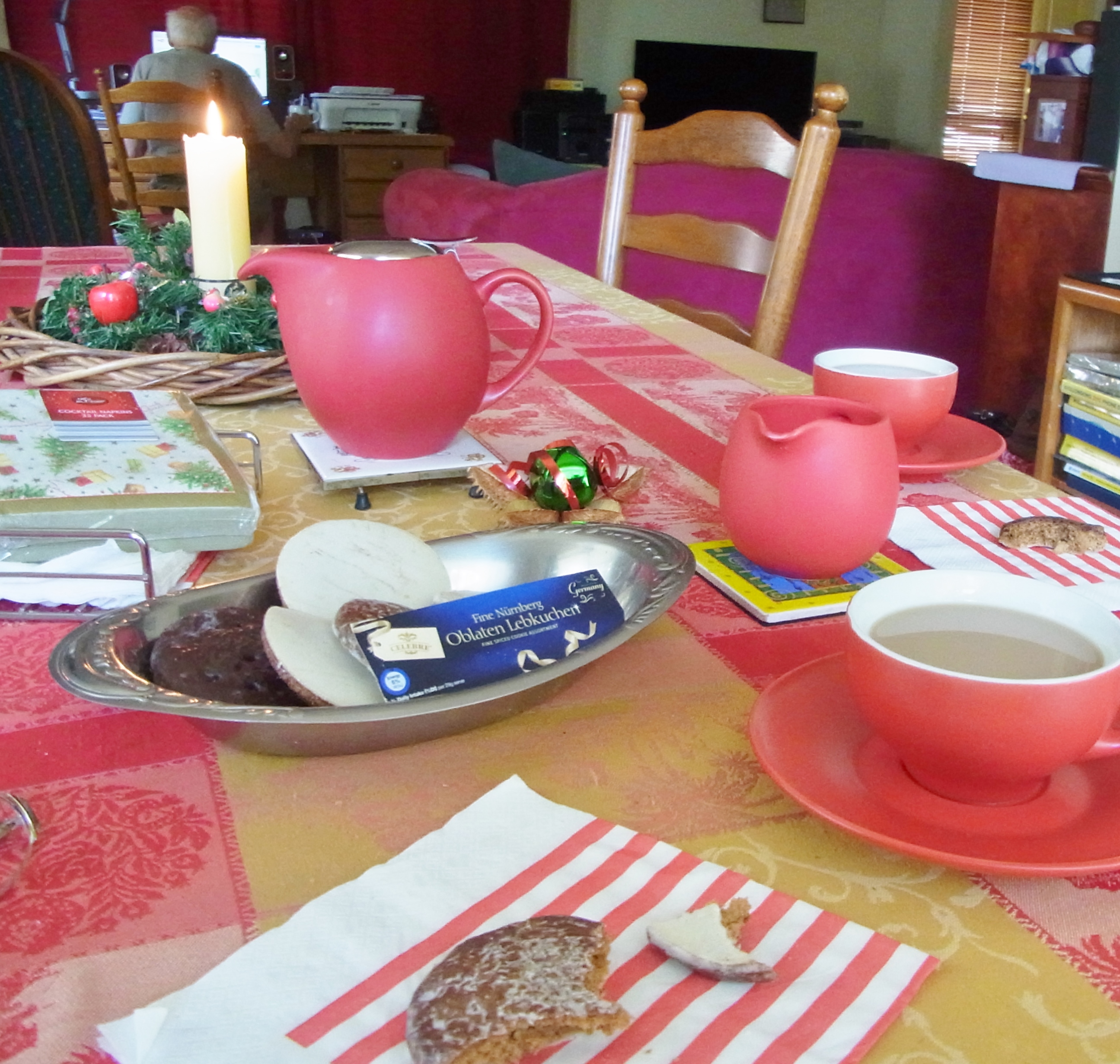
Early Memories (A Copy}

The other day I could not copy the pictures to this blog. I have no idea what went wrong that day. Today I tried it again, and it worked immediately! So I publish here once again the whole blog. I guess some bloggers who have already been reading this blog might like to see the pictures that go with it. I did write this blog in 2013.

https://auntyuta.com/2013/06/02/early-memories/

Before I was three we lived in Taunus Strasse, Berlin- Friedenau. Some time during 1937 we moved to Bozener Strasse in Berlin-Schöneberg. This is where Tante Ilse and Onkel Addi lived as well and also my friend Cordula and her parents. Later on we did get to know Family T. who lived in the house opposite our apartment building.

During my early childhood Bozener Strasse was a very quiet street. There were no cars parked in the street.

Tante Ilse had this narrow but very long balcony with a lot of plants to water. As a two year old I loved to help with watering some of the plants!

Uta loves to water the plants. Mum is looking on.

Here Mum still has this “Bubikopf” which I believe became fashionable already in the 1920s.

In the next picture, which was taken in Bozener Strasse on 21st September 1947, my brother Peter is nearly six. I stand behind Peter. I turned thirteen on this day. My brother Bodo is on the left. He is nine. Beside him Eva Todtenhausen, who is going on twelve and beside Eva is Cordula who is twelve. Today I found out that Cordula died in July 2011, aged 76. This was very sad news for me. 😦
2-06-2009 5;02;21 PM23-02-2009 6;29;31 PM

The above picture is from my birthday in 1940. We stand under the huge chestnut tree. Cordula spent part of the war outside of Berlin. She is not in the 1940 picture.

We took the following picture of Bozener Strasse during our Berlin visit in September 2012. It is still the same chestnut tree. But look at all the cars now!

DSCN3831

Our apartment was on the third floor, Tante Ilse lived two floors further up. Mum quite often went up with me to visit Tante Ilse. One of my early memories is that Tante Ilse and Mum were lying  under the bright lights of some tanning lamps (Höhensonne).  They used some oil on their skin which smelled beautiful and made their skin look shiny. Their skin usually had quite a bit of a tan. They wore some protective dark glasses. Sometimes they made me lie under the lamp for a little while.  I  liked it when some of this nice smelling oil was rubbed all over my body. I too had to wear these dark glasses. I liked to wear them for a little while. But I was required to lie totally still. Very soon  I did get sick of it, not wanting to lie still any more under the hot tanning lamp. I was then always glad when I was allowed to get up again.

I remember thinking that Auntie was a very beautiful looking woman with her very long curly hair. In the three way mirrors of her dressing table I remember watching  how Auntie brushed her hair. It was very strong and long chestnut-coloured hair.  Auntie usually brushed it slightly back so it stayed behind her ears. She often wore very long blue earrings. Oh, I loved the look of these blue earrings.  They looked beautiful hanging down from Auntie’s ears! I think Mum did not wear any earrings, because her ears were covered by her hair. Mum’s brown hair was very fine and much shorter than Auntie’s. My hair was rather fine too. Mum always cut it quite short. I often wished  that I could wear my  hair longer but Mum would not let me grow it longer.

Both Auntie Ilse and Mum wore identical three big rolls of hair horizontally on top of their heads. The front rolls covered the top of their foreheads, the other two rolls were rolled behind the front roll. They often wore identical clothes, for instance light pink angora wool tops with identical grey suits.

1948: Mum 37, Uta 14, Bodo 10 and Peter 7.

Mum features her three big rolls of hair, I am already allowed to wear my hair long!

———-

Mum often called me  ‘MAUSEL’ or ‘Mauselchen’, whereas Auntie liked to call me ‘HERZCHEN’ or ‘LIEBLING’. Dad sometimes said ‘HERZEL’ to me, but he usually called me by my name. Mausel is derived from Maus (mouse), Herzchen means ‘little heart’, Liebling means ‘darling’.

Cordula’s mum once told  me, that her name meant ‘heart’ in the Latin language, but not to tell anyone otherwise some children would make fun of the name. I did not want anyone to make fun of Cordula. So I promised myself to keep the meaning of the name to myself.

My brother Bodo was born in June 1938. I think Cordula’s  brother Tilwin was born a few months after that. Mum said that Tilwin was an extremely odd name. It turned out he grew up with very bright red hair. The children in the street teased him about his hair. As much as possible Cordula always stood up for her  brother. I think for the most part Tilwin avoided playing with other children.

The Lepsius apartment was on the same side as our apartment, just two floors further up. (Auntie Ilse’s apartment was on the other side of the fifth floor). I often went up to the Lepsius apartment all by myself to play with Cordula. They had a ‘roof-garden’ (Dachgarten) above their apartment. It was the size of a big room and had no roof above it. I remember the sun shining right into it. The floor was concrete and along the walls were garden-beds . Cordula was allowed to look after her own little garden-bed.. Once Cordula’s Mum let me have a portion of a little garden-bed too! Cordula’s Mum and Dad were always kind to me. They made me feel welcome and included.

Cordula’s family had food that I had never seen before.. For snacks we children were often given some kind of brown flakes and raisins. Sometimes we were given dates or figs. I loved this food! My Mum thought it was strange to eat something like that. In Mum’s opinion this family was rather odd because they had lived in the Middle East for a while. Cordula’s  father was an architect. My Mum called him ‘the Hunger-Architect’ (Hungerleider)  since he seemed to get hardly any work in his profession.

Mum must have seen their apartment once for I remember her remarking how sparsely furnished it was.  Mum found their choice of furniture quite odd. There were a great number of shelves stacked full with books. These shelves went from floor to ceiling. Herr Lepsius sometimes showed us children books with colourful  illustrations. He also told us stories. We loved one story in particular which had a funny ending. We demanded to be told that story again and again. Each time we laughed our heads off and Herr L laughed with us. The story was about a beggar who knocked at the door of an apartment. A ily had two connecting apartments across two buildings; that is, the wall between the buildings had beautiful maid opened the door. Some time later the beggar knocked at another door of an apartment in the neighbouring building. And the same beautiful maid opened the door! We found the astonishment of the beggar very funny! Herr L explained to us, that a wall had been broken through to connect the apartments on that floor. This was actually where the family of Herr L had lived, when he was a boy.

Herr L was old and bald. He was about twenty years older than his wife. Quite a few years later Cordula and I went to the same high-school. We walked there together every morning. One morning I climbed up the stairs to  Cordula’s  apartment to find out why she  had not come down yet to go to school with me. I rang the bell. Frau L opened the door. She was in tears. She did not let me come in but went with me to the top of the stairs. She said: “Our father just died; I haven’t even told Cordula yet.”  She looked at me with despair in her face.  I did not know what to say. She hugged me and then she disappeared in her apartment.

Childhood Memories

Early Memories

I was born on the 21st of September 1934. This was when we lived in Taunus Strasse, Berlin- Friedenau. Some time during 1937 we moved to Bozener Strasse in Berlin-Schöneberg. This is where Tante Ilse and Onkel Addi lived as well and also my friend Cordula Lepsius and her parents. Later on we did get to know Family Todtenhausen who lived in the house opposite our apartment building.

We lived on the third floor, Tante Ilse lived two floors further up. Mum quite often went up with me to visit Tante Ilse. One of my early memories is that Tante Ilse and Mum were lying  under the bright lights of some tanning lamps (Höhensonne).  They used some oil on their skin which smelled beautiful and made their skin look shiny. Their skin had usually a bit of a tan. They wore some protective dark glasses. Sometimes they made me lie under the lamp for a little while.  I  liked it when some of this nice smelling oil was rubbed all over my body. I too had to wear these dark glasses. I liked to wear them for a little while. But I was required to lie totally still. Very soon  I did get sick of it, not wanting to lie still any more under the hot tanning lamp. I was then always glad when I was allowed to get up again.

I remember thinking that Auntie was a very beautiful looking woman with her very long curly hair. I remember watching In the three way mirrors of her dressing table how Auntie brushed her hair. It was very strong and long chestnut-coloured hair.  Auntie usually brushed it slightly back so it stayed behind her ears. She often wore very long blue earrings. Oh, I loved the look of these blue earrings!  They looked so beautiful hanging down from Auntie’s ears. I think Mum did not wear any earrings, because her ears were covered by her hair. Mum’s brown hair was very fine and much shorter than Auntie’s. My hair was rather fine too. Mum always cut it quite short. I often wished  that I could wear my  hair longer but Mum would not let me grow it longer.

Later on both Auntie Ilse as well as Mum wore identical three big rolls of hair horizontally on top of their heads. The front rolls covered the top of their foreheads, the other two rolls were rolled behind the front roll. They also often wore identical clothes, for instance light pink angora wool tops with identical grey suits.

Mum often called me  ‘MAUSEL’ or ‘Mauselchen’, whereas Auntie liked to call me ‘HERZCHEN’ or ‘LIEBLING’. Dad sometimes said ‘HERZEL’ to me, but he usually called me by my name. Mausel is derived from Maus (mouse), Herzchen means ‘little heart’, Liebling means ‘darling’.

Cordula’s  mum once told  me, that her name meant ‘heart’ in the Latin language, but not to tell anyone otherwise some children would make fun of the name. I did not want anyone to make fun of Cordula. So I promised myself to keep the meaning of the name to myself.

My brother Bodo was born in 1938. I think Cordula’s  brother Tilwin was born one year later. Mum said that Tilwin was an extremely odd name. And on top of it he grew up with very bright red hair. The children in the street teased him about his hair. As much as possible Cordula always stood up for her  brother. I think for the most part Tilwin avoided playing with other children.

We lived on the third floor. The Lepsius apartment was on the same side as our apartment, just two floors further up. (Auntie Ilse’s apartment was on the other side of the fifth floor). I often went up to the Lepsius apartment by myself to play with Cordula. They had a ‘roof-garden’ (Dachgarten) above their apartment. It was the size of a big room and had no roof above it. I remember the sun shining right into it. The floor was concrete, and along the walls were garden-beds . Cordula was allowed to look after her own little garden-bed.. Once Cordula’s Mum let me have a portion of a little garden-bed too! Cordula’s Mum and Dad were always kind to me. They made me feel welcome and included.

Cordula’s family had food that I had never seen before. For snacks we children were often given some kind of brown flakes and raisins. Sometimes we were given dates or figs. I loved this food! My Mum thought it was strange to eat something like that. In Mum’s opinion this family was rather odd because they had lived in the Middle East for a while. Cordula’s father was an architect. My Mum called him ‘the Hunger-Architect’ (Hungerleider) since he seemed to get hardly any work in his profession.

Mum must have seen their apartment once for I remember her remarking how sparsely furnished it was. Mum found their choice of furniture quite odd. There were a great number of shelves stacked full with books. These shelves went from floor to ceiling. Herr Lepsius sometimes showed us children books with colourful illustrations. He also told us stories. We loved one story in particular which had a funny ending. We demanded to be told that story again and again. Each time we laughed our heads off, and Herr Lepsius laughed with us. The story was about a beggar who knocked at the door of an apartment. A beautiful maid opened the door. Some time later the beggar knocked at another door of an apartment in the neighbouring building. And the same beautiful maid opened the door! We found the astonishment of the beggar very funny! Herr Lepsius explained to us, that the family had two connecting apartments across two buildings; that is, the wall between the buildings had been broken through to connect the apartments on that floor. This was actually where the family of Herr Lepsius had lived, when he was a boy.

Herr Lepsius was old and bald. I believe he was about twenty years older than his wife. Quite a few years later Cordula and I went to the same high-school. We walked there together every morning. One morning I climbed up the stairs to  Cordula’s apartment to find out why she   had not come down yet to go to school with me. I rang the bell. Frau Lepsius opened the door. She was in tears. She did not let me come in but went with me to the top of the stairs. She said: “Our father just died; I haven’t even told Cordula yet.”  She looked at me with despair in her face.  I did not know what to say. She hugged me and then she disappeared in her apartment.

Now I found out that Cordula died on the 25th of July 2011, aged 76. This was very sad news for me. 😦

    • Thanks for commenting, Mary-Ann.
      I feel sorry that I had lost contact with Cordula over the years. The last time I had seen her was in 1986. I probably could have done more to keep in touch with her. All I know is that at the time her priorities were to give her two children the best possible start in life and to establish a business with her older and already retired husband.
      The death notice Peter found by googling Cordula’s name. It was in a church bulletin from October 2011. It was definitely a death notice for Cordula. It showed the correct spelling of her first name and double surname.

  1. WordsFallFromMyEyesJune 5, 2013 at 10:16 pm Edit #

     I can’t imagine handling that many kids!

    Re the oil over your body – I agree. I would have loved that 🙂

    • auntyutaJune 5, 2013 at 10:31 pm Edit #

      Funny you should think three kids is too many. Actually Tante Ilse thought so too. She thought two children would have been plenty, especially during times of war.
      The oil, yes Noeleen, I really loved the smell. I can still imagine all the beautiful smells in Auntie’s bedroom. I am still very sensitive to smell. Some smells I love, others I detest.

  2. The EmuJune 5, 2013 at 11:07 pm Edit #

    Beautiful yet sad memories Auntyuta, I see by one of the other comments that your friend Cordula passed away in 2011, a beautiful friendship spanning many years.
    Emu

    • auntyutaJune 6, 2013 at 12:18 am Edit #

      Emu, thanks very much for your comment. I have so many memories about Cordula, going as far back as 1937,  I believe. It’s kind of strange that there are big gaps when she wasn’t around because of the war. There were some beautiful years of friendship after the war. However she was in a different school year and had not the same friends that I had. Maybe Lieselotte, who was in my class, was the only mutual friend we had. Her Dad had died and then her Mum died too. This was when she moved away from Berlin to stay with her aunts in Stuttgart.  Later on she lived in the Middle East. She wrote me beautiful letters. She had a good job. She married late in life. Had two children, sent me lovely photos of her family. She moved with her husband back to Germany. I only saw her once again for an afternoon visit. This was in 1986, such a long time ago! There’s so much I don’t know. Maybe there’s a chance to find out where Tilwin, her brother, is. The last we heard from him, he lived with his wife and two children in Düsseldorf. But this goes back maybe fifty years. Such gaps in time.
      I can only say that I always thought that Cordula was a very special person. Maybe I’m imagining things, but I believe she was filled with inner beauty. No, I’m not imagining this. This is how she was. I am sure she led a good life. You’re right, Emu, beautiful yet sad memories.

Once more remembering 1943/1944

Having read once more a few of my blogs on childhood memories, I came to the conclusion, it might be best if I tried to put all these blogs about my childhood as ‘pages’ together in the one place, so I could find them more easily when I wanted to look something up. It would make it easier for my children too to read up on my childhood. For now I plan to first copy the relevant blogs. I’ll probably need a few days or weeks for this. As far as possible I might refrain from putting anything else in my posts. Just as well, for ‘news’ items, as far as politics are concerned, usually do not give me much pleasure. And personal news, well, I could probably catch up with them at a later stage.

At the moment I collect the childhood memories rather randomly. Here is one about remembering 1943/1944:

Towards the end of September 1943 we left Berlin to live in the country. We moved to a place called the ‘Ausbau’, which meant that eventually ‘more’ was to be added to the building.. It was a simple rectangular red brick complex with several entrances around the building. There was no plumbing or electricity. The entrance for us ‘Berliners’ was on the left side at the front of the building. We had a cellar, a ground floor and two upper floors.

Mum, my two younger brothers and I, shared a bedroom on the first upper floor. We also had a small kitchen and a living-room. I would sleep in the living-room when my dad came home on leave. Two maids, one Polish, the other Russian, shared two rooms on the top floor. All the rooms on the top floor had sloping ceilings. Our Polish maid was in her early twenties. Her name was Maria. She was very efficient and always rather serious.. The T. Family, who lived on the ground floor, employed Katja, the Russian maid, who was only eighteen and extremely fun loving.

My mum’s sister, Tante Ilse, also had her rooms on the first upper floor. She had a bedroom and a living-room. On the ground floor, right underneath her upper rooms, she had a kitchen and a dining-room. She hardly ever used those downstairs rooms. Our friends from Berlin, the T. Family, occupied three rooms downstairs, namely a kitchen, a living-room and a bedroom, the same arrangement of rooms that we had on the upper floor.

There was an additional larger room for storage under the sloping roof. T. Family and my Family stored in that room additional larger furniture which we wanted to save from the bombs in Berlin. — In that room Mum stored a lot of Boskop-apples during the cold season. They were neatly spread out on some straw. Come Christmas-time, other delicious food was also hidden somewhere among our stored furniture. It was very tempting for me to go exploring in that room! Mum noticed sometimes, that some food was missing. And I admitted, when questioned, that I had helped myself to some of the goodies. However I was never punished for doing such a thing. That shows, that Mum must have been quite tolerant. —

On the same upper floor right under the roof was a playroom, which my brothers and I shared with eight year old Edith T. There was another room next to the playroom where Mrs. T.’s parents had stored some bedroom furniture. The parents were Mr. and Mrs. B. and had a business in Berlin. They sometimes stayed at the ‘Ausbau’ in that bedroom in order to be with their family away from the bombs in Berlin.

Our toilets were “plumps-closets” some distance away from the house. Water for cooking and washing had to be fetched from a pump in the backyard. Fetching water from the pump kept both maids very busy indeed. For lights we had kerosene-lamps, for heating there were coal-fired stoves which could also be used for cooking. Everything was very basic.

Gradually some changes were being made. The first big change was that our landlord had electricity laid on. All the workers who lived with their families in the other part of the building, received the benefit of electricity at the same time. This certainly was a very welcome improvement for them.

The ‘Ausbau’ was built close to a dirt-track which meandered through wide open barley-, oat- and potato-fields. On the track it was a good half hour to walk to the next village. Bike-riding however made it a bit quicker.

Werner M., the owner of all those fields that went on for miles and miles, was an acquaintance of Tante Ilse. He was apparently quite rich and also owned extensive brick-works (Ziegeleien). It was said of him that he was a millionaire. He was our landlord and he liked to spoil us. With no strings attached! Tante Ilse only had to voice a wish and Werner M. immediately did whatever he could to fulfill her wish. He spoiled us by constantly getting produce delivered to us: Potatoes, cabbage for making sauerkraut, wonderful treacle made of sweet-beets, and coal for our stoves.

Even I, as a nine year old, could see that sixty year old Werner M. was hopelessly in love with Ilse. I also was quite aware, that she always kept him at a distance. He was happy to just be invited for ”Kaffee und Kuchen’ on weekends and to spend some time with all of us. He always came to visit on his bike. On his daily inspection tours of the workers in the fields he also went around on his bike. He owned coaches with horses, but hardly ever used these to go anywhere.

Occasionally we were invited to his place (which people called ‘Schloss’), Then he sent a coach with a coachman to pick us up. Once in winter when there was plenty of snow, Werner M. sent a ‘Pferde-Schlitten’ (horse-drawn sledge). On this sledge we were wrapped up in blankets under a clear night-sky with the moon and lots of stars shining on us. It was unforgettable and one of the rare highlights in our otherwise pretty dreary country-life existence.

The place where Werner M. lived, did not look like a castle at all, even though people called it ‘Schloss’. It was not even a mansion but a rather large, but fairly plain house. There was a huge, fenced in veggie garden next to the house. I have seen the veggie garden only once. However I was very impressed by it, because it seemed to be so very large.

When we moved to the ‘Ausbau’, Ilse had already been divorced from her first husband. It was obvious that Werner M. would have liked to marry Ilse. However, it never came to that. Tante Ilse married Onkel Peter aka Helmut L. on July 20th, 1944.

***************************

It was a big thrill for me to go exploring among the furniture in that big storage-room, especially in the weeks before Christmas! Mum used to store lot of goodies during the Christmas season. It was very exciting for me to find out what new things had been stored in that big room. I remember seeing huge chunks of nougat (a yummy hazelnut-paste) as well as heart-shaped marzipan-pieces. There was a pot with sweetened thick milk. Sometimes I dipped my finger into it to lick this wonderful sweet stuff! I also liked to eat a few of the stored raisins and prunes! Smells of ginger bread and apples: It made me feel that Christmas was something to be looking forward to.

Where on earth did Mum get all those things from? It was war-time, wasn’t it? We were in the midst of war! I knew very well where all this came from. The parents of Mrs.T. had a distributing business. It was called ‘Backbedarf en Gros’. That meant they delivered goods to bakeries and cake-shops. Even in the midst of war deliveries of the above mentioned goods still took place! Of course there were shortages, but basically most things were still available.

Mr.T. and Mrs.T., as well as Tante Ilse and Mum were all good friends. Every Saturday night they came together for some card games. Eight year old daughterEva and I were allowed to stay up late on those nights. For hours we were watching the adults playing cards. At the same time we entertained ourselves with doodling on bits of paper. At around ten o’clock some cake and hot chocolate as well as coffee were served. But the maids did not have to do the serving, They were already in their rooms at this hour. The cake was usually freshly baked, very fluffy yeast cake topped with delicious butter-crumbs and filled with a thick custard. Hmm, yummy!

Mr.T. always stayed in Berlin during the week, where he worked in the business of his parents-in-law. Being over forty, he was not required to join the German army. Mr.T. always brought some sweet goodies along when he came home from Berlin for the weekend.

During the summer of 1944 Mr.T. and Mum liked to go on their bikes to a neighbouring Nursery where they were able to trade sweets for fresh produce. Eva and I were often allowed to go along with them on our bikes. The sweets were traded for strawberries or cherries or gooseberries as well as peaches and apricots, and later on in the year for pears and apples. I remember the Boskop apples were still in season in late autumn. The owner of the nursery was a well-off looking middle-aged woman who was very fond of sweets and loved to trade her produce. At one time we found out that she thought Mr.T. and Mum were a couple and we girls were sisters. Laughing joyfully, Mum and Mr.T. explained, that this was not so.

Only once as far as I remember were we shown into the lady’s home. Mr.T. made complimentary remarks about the interior of the house. He said it showed off the owner’s good taste. I liked the lady’s house a real lot too. Our families used to have well furnished apartments in Berlin. But this modern looking villa in the midst of the nursery really was something else. My feelings were I would very much like to live in a place like that. However we had to be happy with our accommodation in the Ausbau. To us children it was always pointed out, to be happy that we did not have to live among the bomb raids in Berlin. I’m pretty sure that by myself I felt that I’d rather live in Berlin, bomb-raids or not. I think to children bomb-raids usually didn’t seem as scary as to the adults. At the time we children had had no experience yet how absolutely horrible these bomb-raids could become.

In 1990, soon after the Fall of the Wall, I went with my family to have a look at the area where we used to be hidden away from the bomb-raids. We discovered that the nursery as well as the lady’s house had completely vanished. There was nothing left of the ‘Ausbau’ either!

In 1943, when we had lived at he ‘Ausbau’ only for a couple of months, Mrs. T. delivered a healthy daughter in a regional hospital. The day after the baby was born, it may perhaps have been a Saturday or Sunday, Mr. T. and Eva went for the forty-five minute bike-ride to the Hospital. I was thrilled that I was allowed to go with them! The baby was rather tiny. I think this is why she was soon called Krümel (tiny crumb). Her given name was Ruth. Eva had a pet-name too. She was often called Honkepong.

As soon as Mrs.T. came home from hospital, there was a nurse waiting for her to take charge of the baby. Mr.T. said something like: “Katja is a very nice girl, but I would not trust her with our new born baby. I am glad that Nurse is here to help my wife to look after our Krümel.”

Nurse used for herself the bedroom next to our playroom. Sometimes she sat with us children in the playroom. Since Christmas was approaching, she taught us how to make some Christmas decorations. I was very impressed, because I was nine years old and nobody had ever taught me anything like it! Nurse also made sure, we learned our Christmas poems. We had to be prepared to recite them to Santa on Christmas Eve!

 Maria, our Polish maid, had been with us since before my little brother was born. He regarded Maria as his ‘Dah-dah’, that is he always called her ‘Dah-dah’. By the end of January 1945 we had to flee from the ‘Ausbau’ as the Russians were approaching fast. We went to Berlin first and then by train to Leipzig to stay at Grandmother’s place. Maria remained in Berlin with her Polish fiancee, who was a butcher.

 When we parted from Maria, little brother Peter had just turned three. Yet he must have missed her for quite a while since she had always looked after him and I am sure, he loved her very much and she loved him. Mum always trusted Maria, who was in every way caring and efficient at the same time. Mum was always impressed how quickly Maria worked. Any dirty dishes were washed immediately. She was indeed capable of doing all the housework. Mum was happy to let her do just about everything. An exception was the baking of a large cake on Saturdays, which Mum loved to do herself.

Maria always made some potato-salad for the weekend. I watched how she did it. To the peeled and sliced potatoes she added finely cut onion, some oil, pepper and salt. Then she poured hot vinegar-water over the potatoes as a finishing touch. The huge salad-bowl was placed outside on a shelf near the stairway so the salad could cool down. I often helped myself to some of the warm salad when nobody was looking, because I loved to eat the salad when it was still a little bit warm. It was the same every Saturday. I watched Maria preparing the salad and placing it on the shelf outside. Then it did not take long before I had a good taste of it!

Friday night was the night for our bath. Maria placed a small tin-tub on the kitchen-floor. She carried several buckets of water from the outside pump to the kitchen. Some of the water she heated on the kitchen-stove in an especially huge pot. I was always the first one to use the bath-water, then it was brother Bodo’s turn. Little brother Peter was always the last one. Some hot water was added for everyone, but still the water must have been quite dirty for little Peter after Bodo and I had had our baths!

When Maria first came to live with us, she knew very little German. However she was determined to learn German quickly. She liked to ask Bodo and me how to pronounce certain words. She also asked me how to write these words in German. Mum often praised Maria, that she was willing and able to learn quickly. This applied to everything she did. She was an amazingly efficient person. A ‘pearl of a maid’ people would say of her. Maria was a city girl. She came from Lodz, which was called ‘Litzmannstadt’ at the time. We had spent the summer-months of 1941 at Zokolniki (near Lodz) and that was when Maria was assigned to us as a help. Mum liked Maria and wanted her to come with us when we went back to Berlin. Maria told me later that she did not want to leave Poland. But she had not been given the choice to stay in her own country.

When Katja arrived, we could see that she was very different from Maria. She was a country-girl from Russia. She never learned German as well as Maria did. She could never be trusted to do all the house-work by herself. Mrs.T. always had to supervise her and do certain things herself because Katja took too long to learn to do it properly. But we all loved Katja. She was always cheerful and full of beans. As a country-girl she did not know certain things that a city-girl had been brought up with. Maria took to instructing Katja about certain things. I think they communicated in German. After they finished work in the evening, they had plenty of time to stay in their rooms together and keep each other company. Both girls always had to get up early. During summer, school-classes in the village started as early as seven o’clock. That meant, I had to get up at six o’clock to get ready for school. Mum never got up that early. But Maria always came down at six o’clock to start working for us. She often had to do Peter’s linen early in the morning, which I am sure was not one of her favourite tasks.

I mentioned in this post our landlord, Werner M.  He is here in this picture which was taken by Mrs. T. on Christmas Eve 1943.

Werner M. is on the left, on the right is Mr. T.

Tante Ilse is next to Werner M. together with cousin Renate. I am in the back with my doll.

The children in front are Eva T. and my brother Bodo.

Next to Mr. T. is Mum and Grandma Olga (Mum’s mum) is on the left next to Werner M.

Christmas Eve 1943

I won’t copy the comments I received to this post, only my replies to them. If you want to see the comments, please go to: https://auntyuta.com/2013/06/02/childhood-memories-194344/

Here are my replies:

I experienced this country life nearly seventy years ago. It was very different from life in Berlin. Thanks for commenting, dear Catterel.

I hope some of my descendants are going to find it of interest, Robert.

Well, Emu, the memory can be quite shady. Some things we remember, some things we forget. We always seem to remember holiday times better than other times for instance. I think lots of things that have to do with how I felt at the time did get stuck in my memory. Maybe as a kid I didn’t often have a chance to really talk about my feelings. This is why I reflected a lot during the hours when I was by my lonely self. This reflecting came naturally to me. Nobody did give me instructions how to do it. When someone made a comment to me that stirred my feelings in some way, I would probably reflect on this comment for hours later on and never forget it. As a kid I seem to have analysed what sort of feelings certain persons gave me.
Auntyuta.

UTA’S DIARY, 20th January 2015 and Thoughts on the End of World War Two

RIMG0522

Peter and I eat a banana every day. When they are as large as the ones in the picture, we share one banana. We also have a few cherries every morning. At the moment Australian grapes and peaches are in season and taste very good. I think we spend more money on fruit and vegetables than on meaty things.

Today’s news is that next year one per cent of the global population are going to own as much as the rest of us together. I wonder how this shall go on!!

ST FRANCIS OF ASSISI said:

“Where there is charity and wisdom,
there is neither fear nor ignorance.”

I think it is fair to say that our civilisation is in crisis or very close to an immense crisis. I do not want to be ignorant about this, but I also do not want to give in to fear. Isn’t there always some light at the end of the tunnel?

Today I reblogged quite a few blogs that were written by very knowledgeable people, mainly by Joseph E. Stiglitz, who comes across to me as an economist who knows what he is talking about in a global sense. The warning signs are clearly there for everyone to see. Maybe it is mostly people and organisations with too much power and also people who think they have too much to lose who want everything to just to continue on and on and on. Common sense would tell them it just cannot go on like this indefinitely. But who wants to let common sense rule their lives?!

Enough of this for today. I am going to enjoy my life with what I have today. I plan on looking up one of my old posts. Actually I decided already on one that I want to re-post. Here it is:

https://auntyuta.com/2013/06/07/thoughts-on-the-end-of-war/#comments

Thoughts on the End of World War Two

Here in the blogger world there are always a few people who respond to what I write. I am very grateful for this. It keeps me going. I mean I would like to continue writing anyway but getting some kind of response helps a lot in actually proceeding with it.

When I write about my experiences during war time and after the war,  people instinctively respond in proclaiming their thoughts upon the horrors of war. Undoubtedly the horrors of war are immense. I know it,  just about everyone has some inkling about it. It may sound strange, but I always had the feeling that I personally escaped real horror.

Did I experience hunger? Real hunger and starvation that resulted in problems with health? I don’t think so. When I hear stories from people who were absolutely starved,  it makes me feel terrible. Why did my Dutch-Australian friend, who was about the same age as I was during the war, why did she at times have to go absolutely without food in Holland whereas I had in Germany always a little bit to eat? It is just not fair. War is not fair!

During the war the Nazi propaganda machine constantly bombarded us with slogans how we as Germans had to believe that we were going to win this war. We all had to work towards the ‘Endsieg’ (the winning at the end). By 1944 hardly anyone I knew still believed that Germany could win the war. My grandmother was the exception. She expressed an unshakable belief in the ‘Führer’ (Hitler). For this she was ridiculed by the family.  She believed stories about the ‘Wunderwaffe’ (wonder weapon) which would save us.

More and more everyone talked about it how they wished an end to the war. All our lives were put on hold so to speak. And this went on for quite some time after the war too. Schools were closed a few months before the end of the war. Where I was I couldn’t go back to school until four months after the war had finished.

My eighteen year old cousin couldn’t go to uni as she had planned. She had to work in a munitions factory instead, getting up at five o’clock every morning to travel by train to her place of work. I heard everyone saying to continue with the war was madness. But still everyone seemed to go on doing what they were supposed to do. Even the bomb raids generally didn’t effect people’s behaviour very much. I mean most people went on doing what they had to do bomb raids or not.

Amazingly a lot of foreign workers seem to have helped Germany by doing a proper job. For which after the war the Russians I believe handed out punishment. It is said that they treated their own people badly if they found out they had ‘co-operated’ with the Germans. However during the war years the Germans would send anyone who hindered the war effort away to concentration camps. Probably executions on the spot were not unknown either. During the first days after the war the Russians took everyone who looked like he could have been a soldier away. A lot of these men were never seen again. They may have ended up in a work camp in Siberia where starvation was rampant.

No doubt about it, Germans had a hard time during the first post war years. But still it was an end to fighting. There was a future without any war. Everyone could live in peace. Peace, peace, peace, this is what we wanted. We were very relieved that the war had ended. Tough times, yes, but at least there was no more war. We could concentrate on peaceful things. What a relief. What hope for the future!

Comments

rangewriter
rangewriter.wordpress.com
linda@rangewriter.biz
24.117.176.58
Submitted on 2013/06/10 at 12:12 pm | In reply to auntyuta.
Still, I can’t imagine what that must have felt like to those former believers. A bit like having your priest turn into a mass murderer. Was it you who suggested to me the book , The Shame of Survival? It’s interesting to read how a young girl came to recognize that she’d been duped.

Reply by Uta: We had the feeling we had all been duped, Linda. Over time most of former ‘believers’ had already changed their mind long before the war had actually ended. When you hear of all the atrocities later on of course you feel guilty then, guilty by association even if you were only a kid. I can’t help but feeling weary of all kinds of propaganda and indoctrination throughout my life. This kind of feeling of being duped never leaves me!
Linda, I think towards the end even my grandmother didn’t believe in the ‘Führer’ any more. Germany was well and truly defeated. I think Germany learned its lesson from this.

berlioz1935
berlioz1935.wordpress.com
berlioz1935@gmail.com
14.200.207.145
Submitted on 2013/06/10 at 10:49 am | In reply to gerard oosterman.
The big lesson for me in Australia was, that people from other countries CAN live together. Australians are not totally free from racism and prejudice but it has a much milder form as they don’t feel so much under pressure as people who live much closer like in Europe. Luckily the bad times in Europe are over.
People that go to another country are not necessarily the terrorist but they are the ones that want to avoid conflict. A decent job and income is foremost on their mind once they have arrived.
Give them a chance and the will become valuable citizens.

gerard oosterman
oosterman.wordpress.com/
oostermn@tpg.com.au
121.218.209.42
Submitted on 2013/06/07 at 11:11 pm
Acceptance of differences and inclusiveness might also be helpful in avoiding conflict. Break down barriers and learn to respect each other. Are fences between neighbours really necessary?

Reply by Uta: Gerard, you ask are fences between neighbours really necessary?
A very interesting question, indeed. I feel it’s possible to write a whole essay about it. My short answer would be communicate with each other while at the same time showing some respect for what is different in the other person. It’s good to feel included if this kind of respect is shown. Communication is good. But so is privacy. You need a balance, don’t you think?

berlioz1935
berlioz1935.wordpress.com
berlioz1935@gmail.com
14.200.207.145
Submitted on 2013/06/07 at 12:30 pm
You mentioned Holland in your post. Food that was grown there, was taken out of the country by the Germans to feed their own people.
I share your sentiments on war generally. Germany fares much better now trading with every other country and not making war and trying to conquer those countries.
Personally, we were lucky being spared the experience of trauma. But hearing, after the war, of all the atrocities done in our name, gave a big shock. And now? We learn every day from the news that other people do atrocities too. It seems to me one can declare someone an enemy and, Bingo, everything is allowed that you can do to them.
I think, of all the commandments “Love thy neighbour !” is the most important one.

Reply by Uta: Hi, Berlioz. it seems to me too “Love thy neighbour” is a very important commandment. It could help to avoid wars if people were willing to live up to this commandment

Memories of 1943/1944

Having read once more a few of my blogs on childhood memories, I came to the conclusion, it might be best if I tried to put all these blogs about my childhood as ‘pages’ together in the one place, so I could find them more easily when I wanted to look something up. It would make it easier for my children too to read up on my childhood. For now I plan to first copy the relevant blogs. I’ll probably need a few days or weeks for this. As far as possible I might refrain from putting anything else in my posts. Just as well, for ‘news’ items, as far as politics are concerned, usually do not give me much pleasure. And personal news, well, I could probably catch up with them at a later stage.

At the moment I collect the childhood memories rather randomly. Here is one about remembering 1943/1944:

Towards the end of September 1943 we left Berlin to live in the country. We moved to a place called the ‘Ausbau’, which meant that eventually ‘more’ was to be added to the building.. It was a simple rectangular red brick complex with several entrances around the building. There was no plumbing or electricity. The entrance for us ‘Berliners’ was on the left side at the front of the building. We had a cellar, a ground floor and two upper floors.

Mum, my two younger brothers and I, shared a bedroom on the first upper floor. We also had a small kitchen and a living-room. I would sleep in the living-room when my dad came home on leave. Two maids, one Polish, the other Russian, shared two rooms on the top floor. All the rooms on the top floor had sloping ceilings. Our Polish maid was in her early twenties. Her name was Maria. She was very efficient and always rather serious.. The T. Family, who lived on the ground floor, employed Katja, the Russian maid, who was only eighteen and extremely fun loving.

My mum’s sister, Tante Ilse, also had her rooms on the first upper floor. She had a bedroom and a living-room. On the ground floor, right underneath her upper rooms, she had a kitchen and a dining-room. She hardly ever used those downstairs rooms. Our friends from Berlin, the T. Family, occupied three rooms downstairs, namely a kitchen, a living-room and a bedroom, the same arrangement of rooms that we had on the upper floor.

There was an additional larger room for storage under the sloping roof. T. Family and my Family stored in that room additional larger furniture which we wanted to save from the bombs in Berlin. — In that room Mum stored a lot of Boskop-apples during the cold season. They were neatly spread out on some straw. Come Christmas-time, other delicious food was also hidden somewhere among our stored furniture. It was very tempting for me to go exploring in that room! Mum noticed sometimes, that some food was missing. And I admitted, when questioned, that I had helped myself to some of the goodies. However I was never punished for doing such a thing. That shows, that Mum must have been quite tolerant. —

On the same upper floor right under the roof was a playroom, which my brothers and I shared with eight year old Edith T. There was another room next to the playroom where Mrs. T.’s parents had stored some bedroom furniture. The parents were Mr. and Mrs. B. and had a business in Berlin. They sometimes stayed at the ‘Ausbau’ in that bedroom in order to be with their family away from the bombs in Berlin.

Our toilets were “plumps-closets” some distance away from the house. Water for cooking and washing had to be fetched from a pump in the backyard. Fetching water from the pump kept both maids very busy indeed. For lights we had kerosene-lamps, for heating there were coal-fired stoves which could also be used for cooking. Everything was very basic.

Gradually some changes were being made. The first big change was that our landlord had electricity laid on. All the workers who lived with their families in the other part of the building, received the benefit of electricity at the same time. This certainly was a very welcome improvement for them.

The ‘Ausbau’ was built close to a dirt-track which meandered through wide open barley-, oat- and potato-fields. On the track it was a good half hour to walk to the next village. Bike-riding however made it a bit quicker.

Werner M., the owner of all those fields that went on for miles and miles, was an acquaintance of Tante Ilse. He was apparently quite rich and also owned extensive brick-works (Ziegeleien). It was said of him that he was a millionaire. He was our landlord and he liked to spoil us. With no strings attached! Tante Ilse only had to voice a wish and Werner M. immediately did whatever he could to fulfill her wish. He spoiled us by constantly getting produce delivered to us: Potatoes, cabbage for making sauerkraut, wonderful treacle made of sweet-beets, and coal for our stoves.

Even I, as a nine year old, could see that sixty year old Werner M. was hopelessly in love with Ilse. I also was quite aware, that she always kept him at a distance. He was happy to just be invited for ”Kaffee und Kuchen’ on weekends and to spend some time with all of us. He always came to visit on his bike. On his daily inspection tours of the workers in the fields he also went around on his bike. He owned coaches with horses, but hardly ever used these to go anywhere.

Occasionally we were invited to his place (which people called ‘Schloss’), Then he sent a coach with a coachman to pick us up. Once in winter when there was plenty of snow, Werner M. sent a ‘Pferde-Schlitten’ (horse-drawn sledge). On this sledge we were wrapped up in blankets under a clear night-sky with the moon and lots of stars shining on us. It was unforgettable and one of the rare highlights in our otherwise pretty dreary country-life existence.

The place where Werner M. lived, did not look like a castle at all, even though people called it ‘Schloss’. It was not even a mansion but a rather large, but fairly plain house. There was a huge, fenced in veggie garden next to the house. I have seen the veggie garden only once. However I was very impressed by it, because it seemed to be so very large.

When we moved to the ‘Ausbau’, Ilse had already been divorced from her first husband. It was obvious that Werner M. would have liked to marry Ilse. However, it never came to that. Tante Ilse married Onkel Peter aka Helmut L. on July 20th, 1944.

***************************

It was a big thrill for me to go exploring among the furniture in that big storage-room, especially in the weeks before Christmas! Mum used to store lot of goodies during the Christmas season. It was very exciting for me to find out what new things had been stored in that big room. I remember seeing huge chunks of nougat (a yummy hazelnut-paste) as well as heart-shaped marzipan-pieces. There was a pot with sweetened thick milk. Sometimes I dipped my finger into it to lick this wonderful sweet stuff! I also liked to eat a few of the stored raisins and prunes! Smells of ginger bread and apples: It made me feel that Christmas was something to be looking forward to.

Where on earth did Mum get all those things from? It was war-time, wasn’t it? We were in the midst of war! I knew very well where all this came from. The parents of Mrs.T. had a distributing business. It was called ‘Backbedarf en Gros’. That meant they delivered goods to bakeries and cake-shops. Even in the midst of war deliveries of the above mentioned goods still took place! Of course there were shortages, but basically most things were still available.

Mr.T. and Mrs.T., as well as Tante Ilse and Mum were all good friends. Every Saturday night they came together for some card games. Eight year old daughterEva and I were allowed to stay up late on those nights. For hours we were watching the adults playing cards. At the same time we entertained ourselves with doodling on bits of paper. At around ten o’clock some cake and hot chocolate as well as coffee were served. But the maids did not have to do the serving, They were already in their rooms at this hour. The cake was usually freshly baked, very fluffy yeast cake topped with delicious butter-crumbs and filled with a thick custard. Hmm, yummy!

Mr.T. always stayed in Berlin during the week, where he worked in the business of his parents-in-law. Being over forty, he was not required to join the German army. Mr.T. always brought some sweet goodies along when he came home from Berlin for the weekend.

During the summer of 1944 Mr.T. and Mum liked to go on their bikes to a neighbouring Nursery where they were able to trade sweets for fresh produce. Eva and I were often allowed to go along with them on our bikes. The sweets were traded for strawberries or cherries or gooseberries as well as peaches and apricots, and later on in the year for pears and apples. I remember the Boskop apples were still in season in late autumn. The owner of the nursery was a well-off looking middle-aged woman who was very fond of sweets and loved to trade her produce. At one time we found out that she thought Mr.T. and Mum were a couple and we girls were sisters. Laughing joyfully, Mum and Mr.T. explained, that this was not so.

Only once as far as I remember were we shown into the lady’s home. Mr.T. made complimentary remarks about the interior of the house. He said it showed off the owner’s good taste. I liked the lady’s house a real lot too. Our families used to have well furnished apartments in Berlin. But this modern looking villa in the midst of the nursery really was something else. My feelings were I would very much like to live in a place like that. However we had to be happy with our accommodation in the Ausbau. To us children it was always pointed out, to be happy that we did not have to live among the bomb raids in Berlin. I’m pretty sure that by myself I felt that I’d rather live in Berlin, bomb-raids or not. I think to children bomb-raids usually didn’t seem as scary as to the adults. At the time we children had had no experience yet how absolutely horrible these bomb-raids could become.

In 1990, soon after the Fall of the Wall, I went with my family to have a look at the area where we used to be hidden away from the bomb-raids. We discovered that the nursery as well as the lady’s house had completely vanished. There was nothing left of the ‘Ausbau’ either!

In 1943, when we had lived at he ‘Ausbau’ only for a couple of months, Mrs. T. delivered a healthy daughter in a regional hospital. The day after the baby was born, it may perhaps have been a Saturday or Sunday, Mr. T. and Eva went for the forty-five minute bike-ride to the Hospital. I was thrilled that I was allowed to go with them! The baby was rather tiny. I think this is why she was soon called Krümel (tiny crumb). Her given name was Ruth. Eva had a pet-name too. She was often called Honkepong.

As soon as Mrs.T. came home from hospital, there was a nurse waiting for her to take charge of the baby. Mr.T. said something like: “Katja is a very nice girl, but I would not trust her with our new born baby. I am glad that Nurse is here to help my wife to look after our Krümel.”

Nurse used for herself the bedroom next to our playroom. Sometimes she sat with us children in the playroom. Since Christmas was approaching, she taught us how to make some Christmas decorations. I was very impressed, because I was nine years old and nobody had ever taught me anything like it! Nurse also made sure, we learned our Christmas poems. We had to be prepared to recite them to Santa on Christmas Eve!

Maria, our Polish maid, had been with us since before my little brother was born. He regarded Maria as his ‘Dah-dah’, that is he always called her ‘Dah-dah’. By the end of January 1945 we had to flee from the ‘Ausbau’ as the Russians were approaching fast. We went to Berlin first and then by train to Leipzig to stay at Grandmother’s place. Maria remained in Berlin with her Polish fiancee, who was a butcher.

When we parted from Maria, little brother Peter had just turned three. Yet he must have missed her for quite a while since she had always looked after him and I am sure, he loved her very much and she loved him. Mum always trusted Maria, who was in every way caring and efficient at the same time. Mum was always impressed how quickly Maria worked. Any dirty dishes were washed immediately. She was indeed capable of doing all the housework. Mum was happy to let her do just about everything. An exception was the baking of a large cake on Saturdays, which Mum loved to do herself.

Maria always made some potato-salad for the weekend. I watched how she did it. To the peeled and sliced potatoes she added finely cut onion, some oil, pepper and salt. Then she poured hot vinegar-water over the potatoes as a finishing touch. The huge salad-bowl was placed outside on a shelf near the stairway so the salad could cool down. I often helped myself to some of the warm salad when nobody was looking, because I loved to eat the salad when it was still a little bit warm. It was the same every Saturday. I watched Maria preparing the salad and placing it on the shelf outside. Then it did not take long before I had a good taste of it!

Friday night was the night for our bath. Maria placed a small tin-tub on the kitchen-floor. She carried several buckets of water from the outside pump to the kitchen. Some of the water she heated on the kitchen-stove in an especially huge pot. I was always the first one to use the bath-water, then it was brother Bodo’s turn. Little brother Peter was always the last one. Some hot water was added for everyone, but still the water must have been quite dirty for little Peter after Bodo and I had had our baths!

When Maria first came to live with us, she knew very little German. However she was determined to learn German quickly. She liked to ask Bodo and me how to pronounce certain words. She also asked me how to write these words in German. Mum often praised Maria, that she was willing and able to learn quickly. This applied to everything she did. She was an amazingly efficient person. A ‘pearl of a maid’ people would say of her. Maria was a city girl. She came from Lodz, which was called ‘Litzmannstadt’ at the time. We had spent the summer-months of 1941 at Zokolniki (near Lodz) and that was when Maria was assigned to us as a help. Mum liked Maria and wanted her to come with us when we went back to Berlin. Maria told me later that she did not want to leave Poland. But she had not been given the choice to stay in her own country.

When Katja arrived, we could see that she was very different from Maria. She was a country-girl from Russia. She never learned German as well as Maria did. She could never be trusted to do all the house-work by herself. Mrs.T. always had to supervise her and do certain things herself because Katja took too long to learn to do it properly. But we all loved Katja. She was always cheerful and full of beans. As a country-girl she did not know certain things that a city-girl had been brought up with. Maria took to instructing Katja about certain things. I think they communicated in German. After they finished work in the evening, they had plenty of time to stay in their rooms together and keep each other company. Both girls always had to get up early. During summer, school-classes in the village started as early as seven o’clock. That meant, I had to get up at six o’clock to get ready for school. Mum never got up that early. But Maria always came down at six o’clock to start working for us. She often had to do Peter’s linen early in the morning, which I am sure was not one of her favourite tasks.

I mentioned in this post our landlord, Werner M. He is here in this picture which was taken by Mrs. T. on Christmas Eve 1943.

Werner M. is on the left, on the right is Mr. T.

Tante Ilse is next to Werner M. together with cousin Renate. I am in the back with my doll.

The children in front are Eva T. and my brother Bodo.

Next to Mr. T. is Mum and Grandma Olga (Mum’s mum) is on the left next to Werner M.

Christmas Eve 1943

I won’t copy the comments I received to this post, only my replies to them. If you want to see the comments, please go to: https://auntyuta.com/2013/06/02/childhood-memories-194344/

Here are my replies:

I experienced this country life nearly seventy years ago. It was very different from life in Berlin. Thanks for commenting, dear Catterel.

I hope some of my descendants are going to find it of interest, Robert.

Well, Emu, the memory can be quite shady. Some things we remember, some things we forget. We always seem to remember holiday times better than other times for instance. I think lots of things that have to do with how I felt at the time did get stuck in my memory. Maybe as a kid I didn’t often have a chance to really talk about my feelings. This is why I reflected a lot during the hours when I was by my lonely self. This reflecting came naturally to me. Nobody did give me instructions how to do it. When someone made a comment to me that stirred my feelings in some way, I would probably reflect on this comment for hours later on and never forget it. As a kid I seem to have analysed what sort of feelings certain persons gave me.
Auntyuta.

Our Landlord in 1943/1945

Our toilets were “plumps-closets” some distance away from the house. Water for cooking and washing had to be fetched from a pump in the backyard. Fetching water from the pump kept both maids, Maria and Katja, very busy indeed. For lights we had kerosene-lamps, for heating there were coal-fired stoves which could also be used for cooking. Everything was very basic.

Gradually some changes were being made. The first big change was that our landlord had electricity laid on. All the workers who lived with their families in the other part of the building, received the benefit of electricity at the same time. This certainly was a very welcome improvement for them.

The ‘Ausbau’ was built close to a dirt-track which meandered through wide open barley-, oat- and potato-fields. On the track it was a good half hour to walk to the next village. Bike-riding however made it a bit quicker.

Werner Mann, the owner of all those fields that went on for miles and miles, was an acquaintance of Tante Ilse. People said he was a millionaire. Apart from these Ländereien he owned extensive brick-works (Ziegeleien). He was our landlord and he liked to spoil us. With no strings attached! Tante Ilse only had to voice a wish and Werner Mann immediately did whatever he could to fulfill her wish. He spoiled all of us by constantly getting produce delivered to us such as: Potatoes, cabbage (for making sauerkraut), wonderful treacle made of sweet-beets, and coal for our stoves.

Even I, as a nine year old, could see that sixty year old Werner Mann was hopelessly in love with Ilse. I also was quite aware, that she always kept him at a distance. He was happy to just be invited for ”Kaffee und Kuchen” on weekends and to spend some time with all of us. He always came to visit on his bike. On his daily inspection tours of the workers in the fields he also went around on his bike. He owned coaches with horses, but hardly ever used these to go anywhere.

Occasionally we were invited to his place (which people called ‘Schloss’), Then he sent a coach with a coachman to pick us up. Once in winter when there was plenty of snow, Werner Mann sent a ‘Pferde-Schlitten’ (horse-drawn sledge). On this sledge we were wrapped up in blankets under a clear night-sky with the moon and lots of stars shining on us. It was unforgettable and one of the rare highlights in our otherwise pretty dreary country-life existence.

The place, where Werner Mann lived, did not look like a castle at all, even though people called it ‘Schloss’. It was not even a mansion but a rather large, but fairly plain house. There was a huge, fenced in veggie garden next to the house. I have seen the veggie garden only once. However I was very impressed by it, because it seemed to be very large.

When we moved to the ‘Ausbau’, Ilse had already been divorced from her first husband. It was obvious that Werner Mann would have liked to marry Ilse. However, it never came to that. Tante Ilse married Onkel Peter aka Helmut Lorenz on July 20th, 1944.

**************

Our part of the building had a huge storage room on the top floor. A lot of our furniture was stored there. I loved to go exploring among the furniture where Mum used to store a lot of goodies. Especially in the weeks before Christmas Mum used to store there a lot of stuff. It was very exciting for me to find out what new things had been stored in that big room. I remember seeing huge chunks of nougat (a yummy hazelnut-paste) as well as heart-shaped marzipan-pieces. There was a pot with sweetened thick milk. Sometimes I dipped my finger into it to lick this wonderful sweet stuff! I also liked to eat a few of the stored raisins and prunes! There were smells of ginger bread and apples: It made me feel that Christmas was something to be looking forward to.

Where on earth did Mum get all these things from? It was war-time after all! We were in the midst of war. – However I knew very well where all this stuff came from. The parents of Mrs.T. had a distributing business. It was called ‘Backbedarf en Gros’. That meant they delivered goods to bakeries and cake-shops. Even in the midst of war deliveries of the above mentioned goods still took place! Of course there were shortages, but basically most things were still available. Mr. Fritz T. was in that business with his parents-in-law. This is why he stayed in Berlin during the week. But on weekends he left Berlin to stay with his family in the Ausbau. He usually was able to bring along some delicious Backbedarf. And apparently he was always willing to let my mum Charlotte have some of the goodies too. Mr.T., being over forty, was not required to join the German army.

Mr. Fritz T. and Mrs. Edith T., as well as Tante Ilse and Mum were all good friends. Every Saturday night they came together for some card games. Eight year old daughter Eva and I were allowed to stay up late on those nights. For hours we were watching the adults playing cards. At the same time we entertained ourselves with doodling on bits of paper. At around ten o’clock some cake and hot chocolate as well as coffee were served. But the maids did not have to do the serving, They were already in their rooms at this hour. The cake was usually freshly baked, very fluffy yeast cake topped with delicious butter-crumbs and filled with a thick custard. Hmm, yummy!

During the summer of 1944 Mr.T. and Mum liked to go on their bikes to a neighbouring nursery where they were able to trade sweets for fresh produce. Eva and I were often allowed to go along with them on our bikes. The sweets were traded for strawberries or cherries or gooseberries as well as peaches and apricots, and later on in the year for pears and apples. I remember the Boskop apples were still in season in late autumn. The owner of the nursery was a well-off looking middle-aged woman who was very fond of sweets and loved to trade her produce. At one time we found out that she thought Mr.T. and Mum were a couple and we girls were sisters. Laughing joyfully, Mum and Mr.T. explained, that this was not so.

Only once, as far as I remember, were we shown into the lady’s home. Mr.T. made complimentary remarks about the interior of the house. He said it showed off the owner’s good taste. I liked the lady’s house a real lot too. Our families used to have well furnished apartments in Berlin. But this modern looking villa in the midst of the nursery really was something else. My feelings were I would very much like to live in a place like that! However we had to be happy with our accommodation in the Ausbau. To us children it was always pointed out, that we should be happy that we did not have to live in Berlin where all these bomb raids occured. I’m pretty sure that by myself I felt that I’d rather live in Berlin, bomb-raids or not. I think to children bomb-raids usually didn’t seem as scary as to the adults. At the time we children had had no experience yet how absolutely horrible these bomb-raids could become.

In 1990, soon after the Fall of the Wall, we went for a visit to Germany and had a look at this area east of Berlin where we used to be hidden away. We discovered that the nursery as well as the lady’s house had completely vanished. There was nothing left of the ‘Ausbau’ either!

In 1943, after we had lived at he ‘Ausbau’ for a couple of months only, Mrs. T. delivered a healthy daughter in a regional hospital. The day after the baby was born, it may perhaps have been a Saturday or Sunday, Mr. T. and Eva went for the forty-five minute bike-ride to the Hospital. I was thrilled that I was allowed to go with them! The baby was rather tiny. I think this is why she was soon called Krümel (tiny crumb). Her given name was Ruth. Eva had a pet-name too. She was often called Honkepong.

As soon as Mrs.T. came home from hospital, there was a nurse waiting for her to take charge of the baby. Mr.T. said something like: “Katja is a very nice girl, but I would not trust her with our new born baby. I am glad that Nurse is here to help my wife to look after our Krümel.”

Nurse used for herself the bedroom next to our playroom. Sometimes she sat with us children in the playroom. Since Christmas was approaching, she taught us how to make some Christmas decorations. I was very impressed, because I was nine years old and nobody had ever taught me anything like it! Nurse also made sure, we learned our Christmas poems. We had to be prepared to recite them to Santa on Christmas Eve!

Maria, our Polish maid, had been with us since before my little brother was born. He regarded Maria as his ‘Dah-dah’, that is he always called her ‘Dah-dah’. By the end of January 1945 we had to flee from the ‘Ausbau’ as the Russians were approaching fast. We went to Berlin first and then by train to Leipzig to stay at Grandma Olga’s place. Maria remained in Berlin with her Polish fiancee, who was a butcher.

When we parted from Maria, little brother Peter had just turned three. Yet he must have missed her for quite a while since she had always looked after him and I am sure, he loved her very much and she loved him. Mum always trusted Maria, who was in every way caring and efficient at the same time. Mum was always impressed how quickly Maria worked. Any dirty dishes were washed immediately. She was indeed capable of doing all the housework. Mum was happy to let her do just about everything. An exception was the baking of a large cake on Saturdays, which Mum loved to do herself.

Maria always made some potato-salad for the weekend. I watched how she did it. To the cooked, peeled and sliced potatoes she added finely cut onion, some oil, pepper and salt. Then she poured hot vinegar-water over the potatoes as a finishing touch. The huge salad-bowl was placed outside on a shelf near the stairway so the salad could cool down. I often helped myself to some of the warm salad when nobody was looking, because I loved to eat the salad when it was still a little bit warm. It was the same every Saturday. I watched Maria preparing the salad and placing it on the shelf outside. Then it did not take long before I had a good taste of it!

Friday night was the night for our bath. Maria placed a small tin-tub on the kitchen-floor. She carried several buckets of water from the outside pump to the kitchen. Some of the water she heated on the kitchen-stove in an especially huge pot. I was always the first one to use the bath-water, then it was brother Bodo’s turn. Little brother Peter was always the last one. Some hot water was added for everyone, but still the water must have been quite dirty for little Peter after Bodo and I had had our baths!

When Maria first came to live with us, she knew very little German. However she was determined to learn German quickly. She liked to ask Bodo and me how to pronounce certain words. She also asked me how to write these words in German. Mum often praised Maria, that she was willing and able to learn quickly. This applied to everything she did. She was an amazingly efficient person. A ‘pearl of a maid’ people would say of her. Maria was a city girl. She came from Lodz, which was called ‘Litzmannstadt’ at the time. We had spent the summer-months of 1941 at Zokolniki (near Lodz) and that was when Maria was assigned to us as a help. Mum liked Maria and wanted her to come with us when we went back to Berlin. Maria told me later that she did not want to leave Poland. But she had not been given the choice to stay in her own country.

When Katja arrived, we could see that she was very different from Maria. She was a country-girl from Russia. She never learned German as well as Maria did. She could never be trusted to do all the house-work by herself. Mrs.T. always had to supervise her and do certain things herself because Katja took too long to learn to do it properly. But we all loved Katja. She was always cheerful and full of beans. As a country-girl she did not know certain things that a city-girl had been brought up with. Maria took to instructing Katja about certain things. I think they communicated in German. After they finished work in the evening, they had plenty of time to stay in their rooms together and keep each other company. Both girls always had to get up early. During summer, school-classes in the village started as early as seven o’clock. That meant, I had to get up at six o’clock to get ready for school. Mum never got up that early. But Maria always came down at six o’clock to start working for us. She often had to do Peter’s linen early in the morning, which I am sure was not one of her favourite tasks.

I mentioned in this post our landlord, Werner Mann. He is here in this picture which was taken by Mrs. T. on Christmas Eve 1943.

Werner Mann is on the left, on the right is Mr. Fritz T.

Tante Ilse is next to Werner Mann. together with cousin Renate. I am in the back with my doll. You can see me holding up one of my Käthe-Kruse-Dolls. Mum had knitted a lovely new dress for this doll.

The children in front are eight year old Eva T. and my five year old brother Bodo.

Next to Mr. T. is Mum and Grandma Olga (Mum’s mum) is on the left next to Werner Mann.

Christmas Eve 1943

This photo was taken in Tante Ilse’s livingroom. We were all sitting together for Christmas Eve celebrations. The photo is proof that my grandmother from Leipzig and cousin Renate were with us for Christmas 1943.

In the weeks before Christmas Mum loved to do some sewing of clothes as well as a lot of knitting for us children. When she did this we were not allowed in the living-room because she wanted the gifts to be a surprise for Christmas Eve. That meant of course that we had to be very, very patient. Naturally we thought Christmas Eve would never come!

2014 ADVENT CALENDAR

RIMG0006

RIMG0004

This calendar with little chocolates and a picture in it for every day is for little Lucas. We are going to see him on Sunday, the 7th of December, meaning he may find chocolates from number 1 to 7! (Sorry, that we could not give him the calendar before the 1st of December.)

I had every year an Advent Calendar when I was a child. However my calendars never had any chocolates in it. The idea to have chocolates in advent calendars came up many years later. But for the 6th of December, on St. Nicolas Day, we usually got some special pre Christmas treat. The night before that day we had to put our shoes in front of our bedroom door. If we had been ‘good’ children, we would find on the morning of the 6th, that good St. Nicholas had put some delicious things into our shoes, like ginger bread, chocolates, nuts and apples.

http://german.about.com/library/weekly/aa113098.htm

“German and Austrian Christmas customs have spread throughout the world wherever Christmas (Weihnachten) is celebrated. From the Christmas tree (Tannenbaum) to “Silent Night” (“Stille Nacht“) and on to the Advent calendar (Adventskalender), people around the globe have adopted many traditions that began in the German-speaking world.”
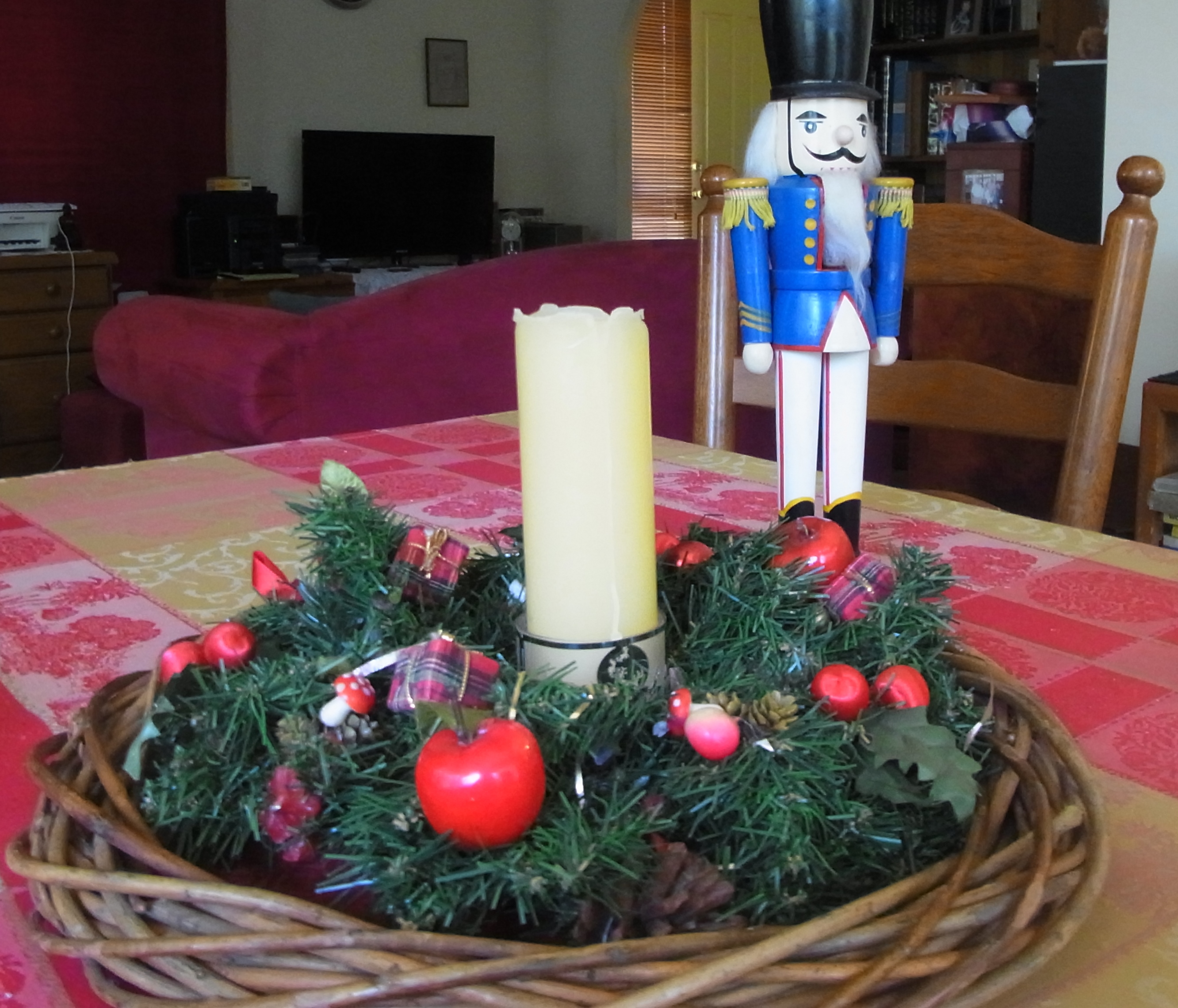
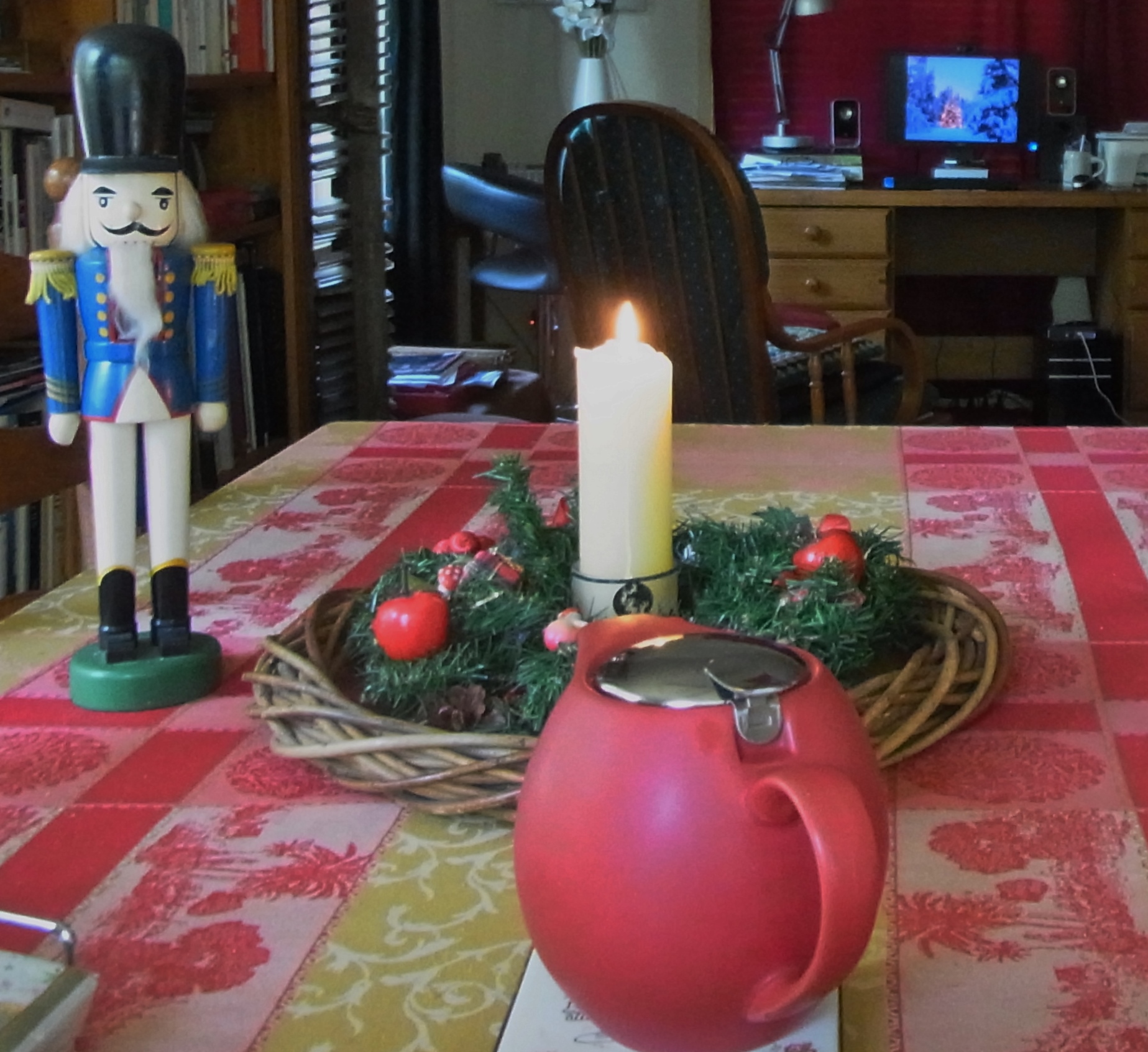
This is our Advent Crown (Adventskranz) with four candles in it, one for each Sunday of Advent. This Adventskranz has been with us for many years. For each Advent we dig it out again. In times gone past we would of course rather have bought a fresh Adventskranz made of Tannenzweigen (fir-twigs).

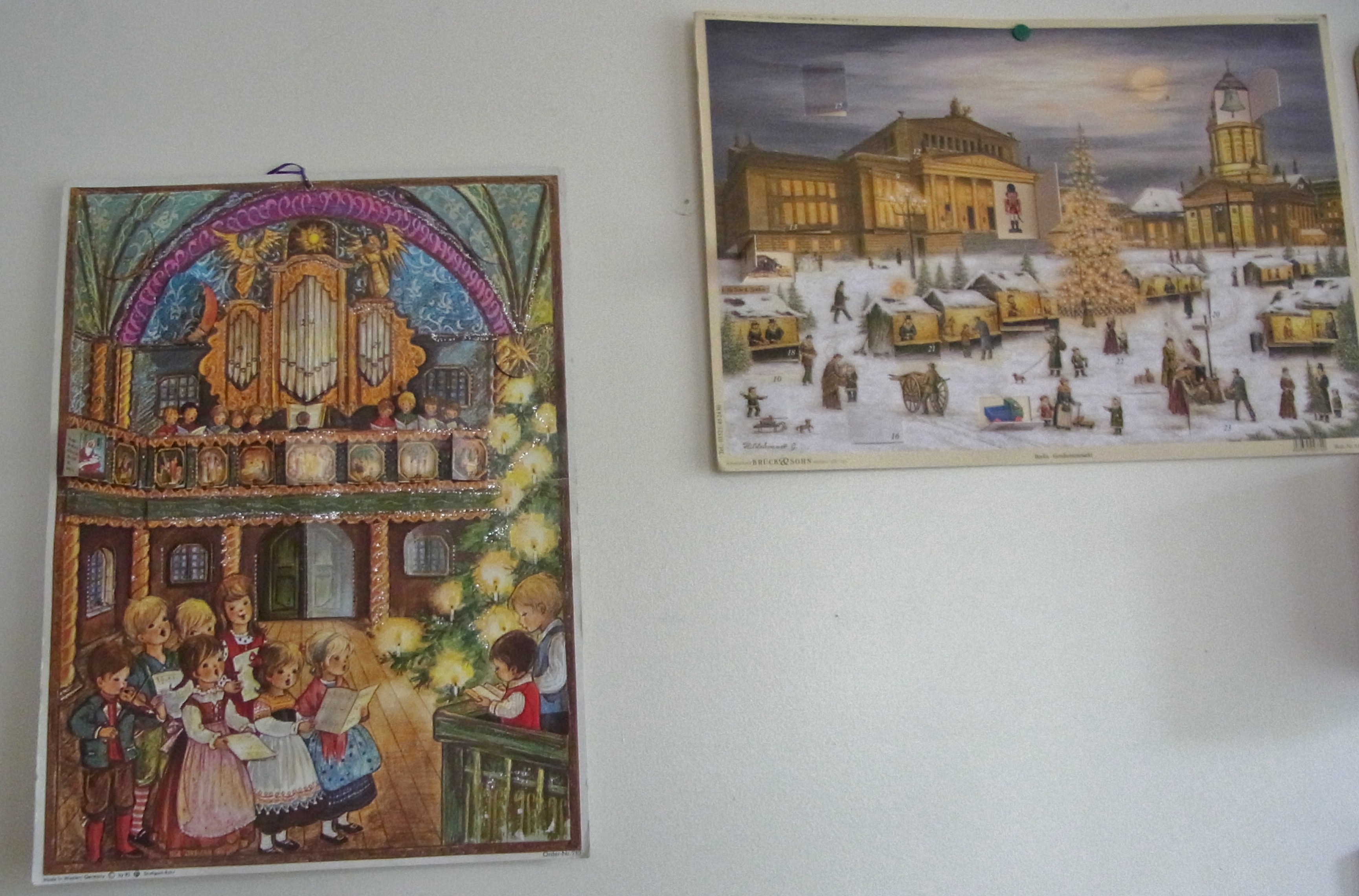
We also dig out some old advents calendars every year for advent. The numbers on the calendars go from 1 to 24, which is of course Christmas Eve.

Peter fastened the calendars to a wall and tries to find the relevant number of the day every morning! Some numbers are really hard to find!
This picture shows a Weihnachtsmarkt in Berlin  in the 19th century!
This picture shows a Weihnachtsmarkt in Berlin in the 19th century!

RIMG0003

Christmas Songs and some German Christmas Customs

http://german.about.com/library/weekly/aa113098.htm

German and Austrian Christmas customs have spread throughout the world wherever Christmas (Weihnachten) is celebrated. From the Christmas tree (Tannenbaum) to “Silent Night” (“Stille Nacht“) and on to the Advent calendar (Adventskalender), people around the globe have adopted many traditions that began in the German-speaking world.

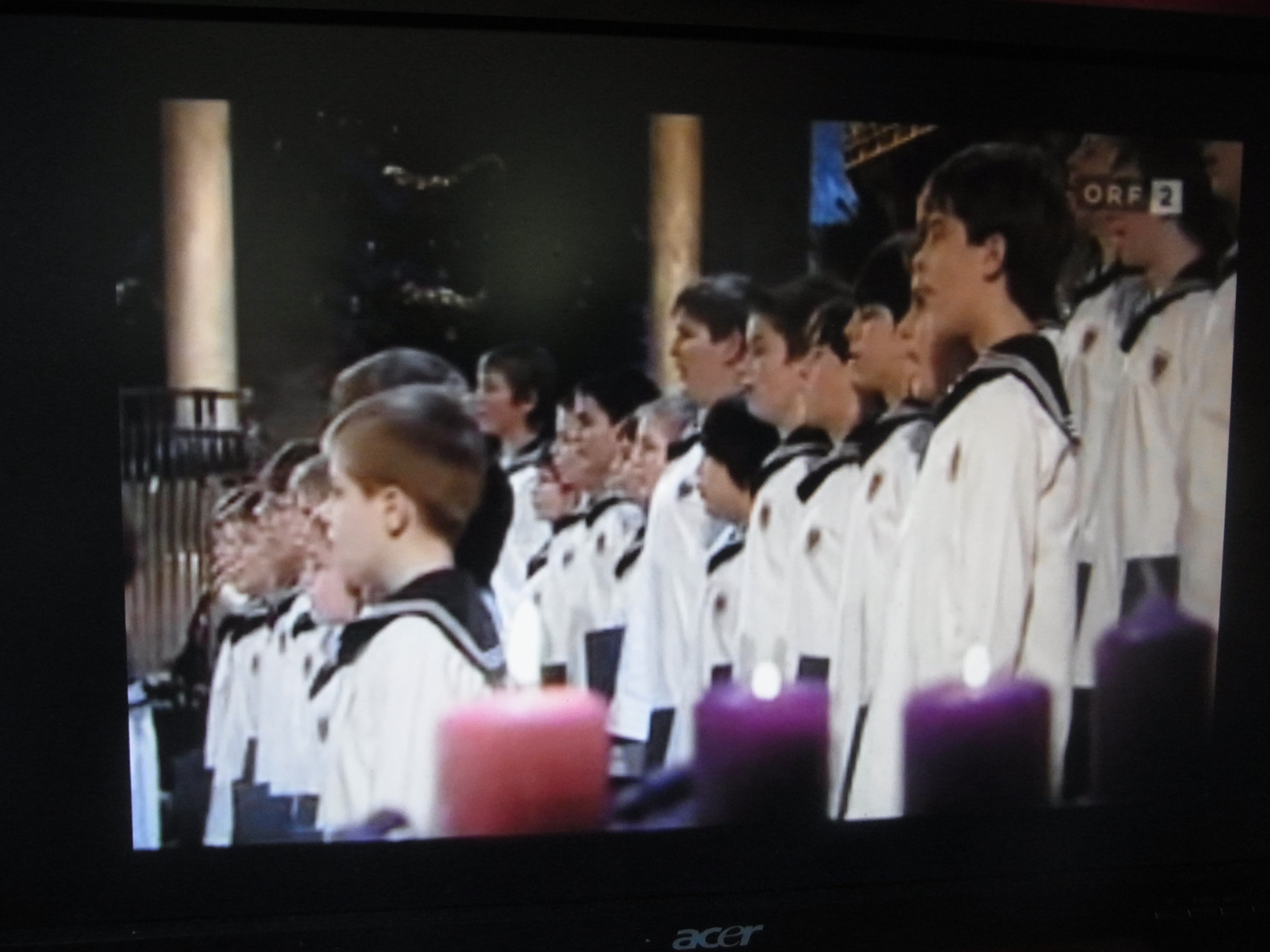
The Christmas songs, that I remember from my childhood, have a special meaning for me. Some songs were very joyful, others more reflective, that is ‘besinnlich’. Besinnlich meant we became deeply and seriously thoughtful while singing these songs . This kind of singing appealed to me. Advent was the only time of the year when my family would sing some songs together. And it went on for four Sunday afternoons in a row. After the fourth Sunday of Advent some serious preparations for Christmas Eve started. We children were not included in these preparations. As children we therefore became highly impatient while we were waiting for Christmas Eve – “Heiligabend” .

“Stille Nacht, heilige Nacht,” and “O du fröhliche” were very popular songs during my childhood. (I was born in 1934.)

German

Stille Nacht, heilige Nacht,
Alles schläft; einsam wacht
Nur das traute hochheilige Paar.
Holder Knabe im lockigen Haar,
Schlaf in himmlischer Ruh!

Stille Nacht, heilige Nacht,
Hirten erst kundgemacht
Durch der Engel Halleluja,
Tönt es laut von fern und nah:
Christ, der Retter ist da!

Stille Nacht, heilige Nacht,
Gottes Sohn, o wie lacht
Lieb’ aus deinem göttlichen Mund
, Da uns schlägt die rettende Stund’.
Christ, in deiner Geburt!

Words: Joseph Mohr, 1816
Music: Franz Xaver Gruber, 1818

English

Silent night, holy night
All is calm all is bright
‘Round yon virgin Mother and Child
Holy infant so tender and mild
Sleep in heavenly peace

Silent night, holy night,
Shepherds quake at the sight.
Glories stream from heaven afar,
Heav’nly hosts sing Alleluia;
Christ the Savior is born

Silent night, holy night,
Son of God, love’s pure light.
Radiant beams from Thy holy face,
With the dawn of redeeming grace,
Jesus, Lord, at Thy birth

http://german.about.com/od/christmas/a/StilleNacht.htm

O du fröhliche
This very popular German Christmas carol has Italian origins. In 1788 the German philosopher, theologian, and poet Johann Gottfried von Herder (1744-1803) brought the melody to Germany after a trip to Italy. Originally a Sicilian fisherman’s song, the melody was used for the Latin hymn “O Sanctissima.” Around 1816 Johannes Daniel Falk (1768-1826) wrote the German lyrics for what soon became one of the most popular German Weihnachtslieder. The English version is known as “O How Joyfully.”


O du fröhliche
O You Merry (Christmastide)

MELODIE: Sizilianisches Fischerlied – Johann Gottfried von Herder (1788)
TEXT: Johannes Daniel Falk (1816)

DEUTSCH
Johannes Daniel Falk, 1816O du fröhliche, o du selige,
Gnadenbringende Weihnachtszeit!
Welt ging verloren,
Christ ist geboren,
Freue, freue dich, o Christenheit!

O du fröhliche, o du selige,
Gnadenbringende Weihnachtszeit!
Christ ist erschienen,
Uns zu versöhnen,
Freue, freue dich, o Christenheit!

O du fröhliche, o du selige,
Gnadenbringende Weihnachtszeit!
Himmlische Heere
Jauchzen dir Ehre,
Freue, freue dich, o Christenheit!

ENGLISH (lit. prose)
See poetic version below
O you merry, o you blessed,
Merciful Christmastide!
The world was lost,
Christ was born,
Rejoice, rejoice o Christendom!

O you merry, o you blessed,
Merciful Christmastide!
Christ appeared,
To reconcile us,
Rejoice, rejoice o Christendom!

O you merry, o you blessed,
Merciful Christmastide!
Heavenly hosts,
Exult your honor,
Rejoice, rejoice o Christendom!

LISTEN > Melody for “O du fröhliche” (midi version)


English poetic version, author unknown
O How Joyfully (O du fröhliche)

O how joyfully, o how blessedly,
Comes the glory of Christmastime!
To a world so lost in sin,
Christ the Savior, enters in:
Praise Him, praise Him Christians, evermore!

O how joyfully, o how blessedly,
Comes the glory of Christmastime!
Jesus, born in lowly stall,
With His grace redeems us all:
Praise Him, praise Him Christians, evermore!

O how joyfully, o how blessedly,
Comes the glory of Christmastime!
Hosts of angels from on high,
Sing, rejoicing, in the sky:
Praise Him, praise Him Christians, evermore!

http://german.about.com/library/blmus_dufroehlich.htm

First of Advent 2014

RIMG0594

RIMG0598

Peter found a series of old German Christmas songs in the computer. It was very rewarding to be able to listen to all these songs while celebrating the First of Advent.

A picture from the computer of the Vienna Boy's Choir singing German Christmas songs.
A picture from the computer of the Vienna Boy’s Choir singing German Christmas songs.

RIMG0601 (2)

RIMG0601

We listened to a lot of Christmas songs by different groups and artists. They all sang the German texts that we are still quite familiar with, bringing back memories to what it was like when we were children. Here some names of the songs: O Tannenbaum, O du fröhliche, Ave Maria, Kling Glöckchen kling, Leise rieselt der Schnee, and so on.

We had tea and German ‘Oblaten Lebkuchen’.

Then I could not help myself taking a few more pictures!

RIMG0597

RIMG0592

RIMG0591

RIMG0590

RIMG0593

RIMG0600 (2)

Childhood Memories

I publish here a copy of something I had published already in May 2013. I did get some very interesting comments to this post at the time. So I copied all the comments and my replies as well. Some of my new blogger friends might want to have a look at it and maybe some of my older blogger friends also would like to have another look. 🙂

This now is what I published in May 2013:

‘I have now two pages about my childhood. One is just “Uta’s Early Childhood”, the other one is “Uta’s Early Childhood, Part II”. In the Part II I inserted today some pictures about my sixth birthday in 1940 plus one picture from summer of 1942. All these pictures were taken during the war, World War II that is, when we lived in Berlin, Germany.

Did we suffer during the first years of war? I don’t think so. Except that my father had moved away from Berlin. He became the manager in grandfather’s furniture factory in Lodz, Poland, which since the German occupation in 1939 was called Litzmannstadt. My father had grown up in Lodz. His family had lived in Lodz since the early 1800s, when this part of Poland belonged to Russia.

My father had studied in Leipzig, Germany. In 1930 he had married my mother in Leipzig. During the early years of their marriage they had for the most part lived in Berlin. Sometime during the early war years my father had some disagreements with some Nazi people he worked with in Berlin. I think he didn’t voice his disagreements publicly. Had he done so, he may have ended up in a concentration camp!

In the end he was allowed to remove himself from Berlin. As I said he became then the manager in grandfather’s factory. My mother typically chose to stay with us children in Berlin. We only went for some visits to “Litzmannstadt”.’

Submitted on 2014/10/15 at 9:49 am | In reply to auntyuta.
Just now I did re-read this whole post and all the comments. As Peter says, between “Will” and “Reason”, “Will” will always win. I think this is because most people will their emotions let their thinking rule. Well, this is the way it is, this is what humans are like.

To come back to how children experienced the Nazi area in Germany, one book, that deals with this, comes to mind. I read it only recently. It is set in a small place near Munich in southern Germany. I lived near Berlin and in Leipzig during the last years of the war. So I have no experience what life was like for children in Bavaria during these war years in Nazi time. However what Markus Zusak tells us in his historical novel THE BOOK THIEF sounds absolutely believable to me.

In the next comment section I post some details about the book from Wikipedia.

auntyuta
auntyuta.wordpress.com
utahannemann@hotmail.com
14.200.207.145
Submitted on 2014/10/15 at 9:30 am
THE BOOK THIEF

From Wikipedia, the free encyclopedia
This article is about the novel. For the film adaptation, see The Book Thief (film).
The Book Thief
The Book Thief by Markus Zusak book cover.jpg
1st Edition front cover
Illustrator Trudy White
Cover artist Colin Anderson/Brand X Pictures/Getty Images
Country Germany
Language English, German
Genre Novel-Historical Fiction
Publisher Picador, Australia; Knopf, US
Publication date
2005(Australia); 14 March 2006 (worldwide)
Media type Print (Hardback & Paperback)
Pages 550

The Book Thief is a novel by Australian author Markus Zusak.[1] Narrated by Death, the book is set in Nazi Germany, a place and time when the narrator notes he was extremely busy. It describes a young girl’s relationship with her foster parents, the other residents of their neighborhood, and a young Jewish man who hides in her home during the escalation of World War II. First published in 2005, the book has won numerous awards and was listed on The New York Times Best Seller list for over 230 weeks.[2]

berlioz1935
berlioz1935.wordpress.com
berlioz1935@gmail.com
14.200.207.145
Submitted on 2013/05/21 at 11:05 am | In reply to Robert M. Weiss.
Robert, you are spot on with your overall view of history. I always say, that the 2. WW was a continuation of WW I as it was finished in an unsatisfactory way. Meaning, nobody was thinking about the future. Versailles was a disaster. A much better solution was found at the end of WW II. The Germans, at the end of WW I, were hoping that Wilson’s 14 Points would be adhered to.

http://en.wikipedia.org/wiki/Fourteen_Points

As a result “The humiliation of the Treaty of Versailles”, as you say, let to the rise of Hitler.

You say further “By borrowing heavily from German mythology, Wagner, the concept of the ubermensch, Hitler instilled in the young a burning pride in Germany’s future. Hitler was also influenced by Schopenhauer’s “Will to Power”. This idea is the subject of a book. “The Jew of Linz” by Australian writer Kimberly Cornish

http://en.wikipedia.org/wiki/The_Jew_of_Linz.

Cornish has been criticised too, but I found it an interesting read on a certain view point of history. Schopenhauer stipulates, that in a contest between “Will” and “Reason”, “Will” will always win.

berlioz1935
berlioz1935.wordpress.com
berlioz1935@gmail.com
14.200.207.145
Submitted on 2013/05/21 at 10:27 am | In reply to The Emu.
The disagreement with the Nazis was on two levels: personal and about the conduct of war.

Personal: When Hitler came to power he joined the party as a “good” public servant would. Later the life style of his wife could have headed for divorce. This was intolerable for the Nazis and they asked him to discipline his wife or he could not remain a member of the party.

Contact of War: After the Sportpalast Speech

http://en.wikipedia.org/wiki/Sportpalast_speech

in which Goebels called for “Total War” to be waged. Uta’s father was of the opinion that it was pure propaganda. As an economist he could see that many mistakes were made and the German industry and population were not put on a war footing. He criticised the use of forced labour and called for the utilisation of German women in industry. Only 33% of women were working. Working women was an anathema for Hitler.

He wrote a Memorandum to Hitler and for his effort was hauled in front of Martin Bormann, secretary of Hitler, who advised him not to insist on sending the Memorandum to Hitler. Instead they sent him to the “Ostfront” because he was a Russian speaker.

This is the stuff novels are written about. A lot of what we know is only bits and pieces. Adults did not talk to children about it. Later, yes, but not all came to light.

auntyuta
auntyuta.wordpress.com
utahannemann@hotmail.com
14.200.207.145
Submitted on 2013/05/21 at 7:59 am
Thanks for this very insightful reply, Robert.

” . . . . nationalism has been responsible for many wars.” This is a known fact. Still, leaders don’t want to learn from this and continue to promote it.
Will there ever be a time when mankind can live in peace without any wars?
Maybe if there’s an outside threat we’ll then be acknowledging our common humanity.

So he marched to the death camp with his children . . . . . I wonder how many children were with him.

Is it that the Nazis rigorously went to eliminate everything that seemed foreign to them?Do a lot of people to this day have an innate fear about this what doesn’t fit into their view of the world?

I think not many people are interested in understanding the historical process. They are just interested in how they see their own little world, which is an island surrounded by things that frighten them. Does this lead to fundamentalism? Can fundamentalists live peacefully together with non-fundamentalists or other fundamentalists? If they don’t want peace, what do you do? Eliminate them? Every religion teaches you not to kill unless you are attacked. So for instance Talibans want to kill us. So we are allowed to kill them. Aren’t we? No objections to killing Talibans. Too bad if a few other people get killed along the way. And so it goes. No wonder I need prayers to stay sane. Because the historical process goes on whether I like it or not.

Robert M. Weiss
river4827.wordpress.com
forestbreeze40@earthlink.net
70.197.68.149
Submitted on 2013/05/21 at 3:00 am
Janusz Korczak was offered an opportunity to escape from Poland, but he did not take it. Instead, in 1942, he marched with his orphan children to the death camp of Treblinka…. No doubt people in great psychological need follow cults, and often utilize unhealthy coping mechanisms. What happens with countries brings matters to a larger scale, and nationalism has been responsible for many wars. The humiliation of the Treaty of Versailles, the rampant unemployment, and other factors went into the cauldron of Nazi Germany. Hitler’s genius was to work with the young people, and gain their support in actively supporting the Third Reich and its goals. By borrowing heavily from German mythology, Wagner, the concept of the ubermensch, Hitler instilled in the young a burning pride in Germany’s future. Hitler was also influenced by Schopenhauer’s “Will to Power”, the incendiary speeches of Bismarck, and the methods of American advertising… History is composed of a series of reactions and counter reactions. Perhaps one day we will succeed in isolating the variables responsible for the vagaries of history, and gain a more precise understanding of the historical process.

catterel
catterel.wordpress.com
catherine.sommer@bluewin.ch
86.168.203.38
Submitted on 2013/05/20 at 9:02 pm | In reply to auntyuta.
HiI Uta – yes, no, yes. I’m writing a memoir that gets added to sporadically, but haven’t published many old photos from that time. Maybe I should!

auntyuta
auntyuta.wordpress.com
utahannemann@hotmail.com
14.200.207.145
Submitted on 2013/05/20 at 3:10 pm | In reply to The Emu.
“The Marshall Plan (officially the European Recovery Program, ERP) was the American program to aid Europe, in which the United States gave economic support to help rebuild European economies after the end of World War II in order to prevent the spread of Soviet Communism. . . .”
Ian, this recovery program helped Germany enormously after WW II. Whereas what happened after WW I was a terrible disaster for Germany. The result was that the Nazis came to power!
The disagreements my father had with the Nazis had to do with the war. But sorry, I cannot recall properly what my father said about it. Anyhow the way I remember it, my father was objecting to the way the war was conducted. I think he moved to “Litzmannstadt” towards the end of 1940. This for instance would have been long before Pearl Harbour!
For a great part of 1941 we stayed with the grandparents in Poland.
By August 1941 we were back in our apartment in Berlin (without my father of course). In September 1941 I started school. I was then aged seven already! My second brother was born in October 1941.
My first school reports say my father’s occupation was “Betriebsführer” (Manager).
He was born in 1904. During the first war years he was regarded as being too old to be conscripted. But by 1943 his year, that is men having been born in 1904, were being called up for military duties. After some training my father was made straight away to be an officer. He was sent to the Eastern front.
He came back from the war with his health ruined. For many years after the war he suffered from these health problems without getting any support from my mother I might say. But his sisters and the sisters families as well as his mother who were all refugees from Poland, well everyone in his extended family supported him to the best of their ability. Eventually he did recover and was able to get full employment. At about 1949 my mother got a divorce from him. In the 1950s when he was gainfully employed again and his health had improved a lot, he asked my mother to marry him again. She refused.
He married his secretary in 1959. In 1966 he died of prostate cancer.

The Emu
aussieemu.wordpress.com
ian.anafelton@gmail.com
121.219.179.19
Submitted on 2013/05/20 at 11:37 am
Very interesting Auntyuta, to read of your background in those years, virtually a first hand account and must be recorded and handed down into your family and put into book form.
It intrigues me as to the disagreement your father had with the Nazi;s, maybe you could elaborate on this Auntyuta.
A great historical reading.
Emu aka Ian

auntyuta
auntyuta.wordpress.com
utahannemann@hotmail.com
14.200.207.145
Submitted on 2013/05/20 at 7:58 am | In reply to catterel.
Hi Cat, do you write a lot about your early childhood and do you have pictures of that time published? Do you find you cannot disclose too much about people who are still alive? It’s great for your kids to be told by you what life was like in the 1940’s and 50’s.

auntyuta
auntyuta.wordpress.com
utahannemann@hotmail.com
14.200.207.145
Submitted on 2013/05/20 at 7:46 am | In reply to Robert M. Weiss.
Hi, Robert, I have the feeling what you say about Hitler may be absolutely right. My generation (after all I was only a child during the Hitler years) on the whole has learned not to trust people like this.
Aren’t there certain people around in certain countries who somehow are able to get followers when clearly if they only started thinking a bit for themselves maybe they couldn’t be followers? Sadly people in general go more by their feelings and what’s in it for them rather than thinking about the consequences of their support. Aren’t most people selfish? If something is promised that advances them they go for it, don’t they?
I guess Janusz Korczak was a remarkable educator, right? I think you mentioned him in one of your blogs. But I can’t recall any details. Did he for instance survive the war years? Did he have family? It is of course admirable if people stand up for what they believe in.
The best example where protests by a lot of people resulted in an immense change happened in the Eastern part of Germany. The fall of the Iron Curtain, which for years and years looked rather impossible, all of a sudden was possible in a rather peaceful way. That it went ahead peacefully was thanks to some noble people who restrained themselves from interfering.
War and Peace, War and Peace, maybe this is the fate of mankind for ever and ever. Didn’t Orwell say, some people when they say peace mean war? Our previous Primeminister Keating here in Australia used to fight a lot in parliament. His attitude was it was better to fight in parliament rather than attack each other in the street.

Robert M. Weiss
river4827.wordpress.com
forestbreeze40@earthlink.net
70.197.70.2
Submitted on 2013/05/20 at 2:24 am
Many people at that time didn’t voice their opinions openly. Janusz Korczak, the Polish educator, did. He walked through the streets of Warsaw wearing his Polish army uniform, and was put in jail for his efforts… I continue to be amazed how the Germans could have supported such a madman as Adolf Hitler, which he clearly was. He misused Darwinism, Nietzsche, and never followed his main tenet: to produce children for the Fatherland. Perhaps he knew that that he was the most misbegotten cross and handicapped person of them all.

catterel
catterel.wordpress.com
catherine.sommer@bluewin.ch
86.166.198.202
Submitted on 2013/05/20 at 12:10 am
Yes, do please write about your childhood. It was so different then, and personal memories make it come alive for our children and grandchildren. My early life in England (1940’s and 50’s) seems like tales from a distant planet when I reminisce to the kids!

auntyuta
auntyuta.wordpress.com
utahannemann@hotmail.com
14.200.207.145
Submitted on 2013/05/19 at 4:36 pm
Hi Diana, thanks for the comment and welcome to my blogging. I read your about page and am interested in what happened to you when you turned forty. I remember, a long time ago when I turned forty my life seems to have undergone some kind of a change.
A lot of the subjects you write about look very interesting to me. I want to do some reading of your blogs pretty soon.
Cheerio, Aunty Uta.

Holistic Wayfarer
aholisticjourney.wordpress.com
dipumpkin@gmail.com
76.232.196.192
Submitted on 2013/05/19 at 1:51 pm
Keep writing. That was a fascinating era — and we are just so comfortable these days. We don’t appreciate what our parents and grandparents endured to sustain the basic things we take for granted.

We always wish

I thank Ajaytao for these words of wisdom and want to reblog them and write some thoughts about my own life.

Turning 80 this year I can say that I have had a good life. Even now at this advanced stage in my life I can still enjoy life and do not find it too hard to cope with age related aches and pains. Do I wish I could have changed something in my life? Oh yes, I wished I could have changed not having had to grow up in Germany during wartime and the difficult postwar years. Of course these are things we cannot change. But WW II for sure turned me in an antiwar person for the rest of my life.

False advertising, propaganda, and outright lies, these are the things I am very sensitive to. Blame my childhood experiences. I learned early on that you cannot believe everything a leader might tell you. We lived like paupers after the war. I went to school till I was eighteen, but I did not apply myself. I never learned to study hard. Probably I could not see any sense in it. At eighteen I started secretarial work. A few years later came marriage and children and migration to Australia.

Ever since I left school (and during my school years as well!) I had very little money to live on. However I was never desperate for more money. Throughout my life my motto was I have to make do with the little money I have. It turned out that somehow it was always enough. My husband and I are very good savers. We paid off our house with a building society loan. The first few second hand cars we bought on hire purchase. Apart from that we never went into debt. When we travelled overseas we used our own saved up money.

Do I wish I could have changed my past? Sure I would have liked to grow up without the deprivations of war. I would have liked my father to be home all the time. I would have liked my parents to live together after the war. These are things I definitely could not have changed. What could I have changed? Study hard, go to university, end up in a profession I would have loved to work in? Well, it was not to be. I did not have the guts to study hard.

Even though we were rather poor the first few years in Australia, I did not feel poor. I was happy having a family and I enjoyed the easy going Australian lifestyle. How much did I change over the years? Maybe not all that much. I am probably basically still the person I was when I came to Australia aged 25. Some major changes in my education would probably have been possible before I even entered high-school. I was just easy going at school, always got good marks without much effort; except towards the end of my school career at commercial school, which I hated!

I remember as a teenager I spent hours dreaming about a wonderful person who would come along and give me some guidance. I never did get to know such a person, except in my dreams! But I was very happy later on with romance and married life and children. Well, I must say, I am quite happy with the way things turned out to be in my personal life. Still, one thinks sometimes how things could have been somewhat different.