Humming Tops

RIMG1907

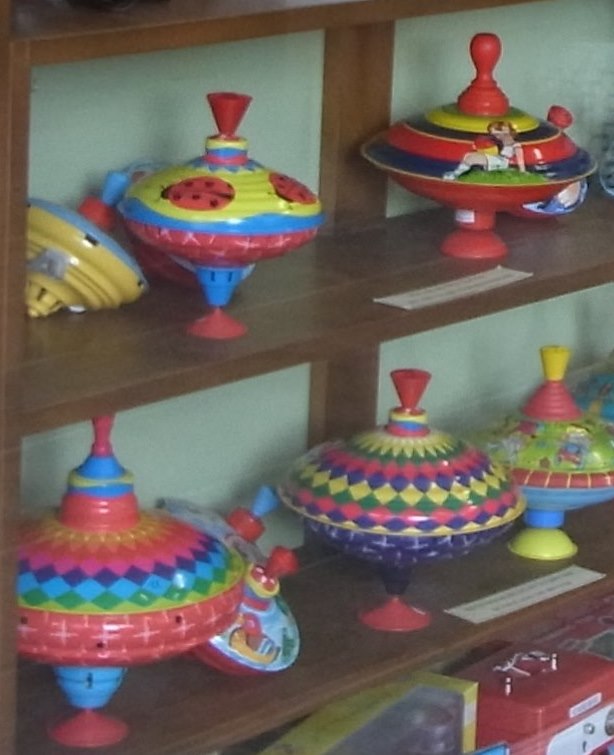
The other day we looked into a shop through a window. I noticed these tops. I believe they are called humming tops? I could not help myself, I had to take a picture of them. They reminded me so much of my childhood. Gee, did I love these tops as a kid! My humming top was probably one of my favourite toys. And I knew other kids who owned humming tops. Whenever I visited a friend with a humming top I would try out what kind of humming noise their top did make. This was so exciting!

My friend Eva, who was a bit younger than I was, had lots and lots of children’s picture books. I loved to have a look at all her books! Of course, I had a few picture books myself. However, I am sure Eva had many more than I had. So it was always a pleasure to go visiting her.

Eva had a large play-room all to herself, whereas I had to share my room with my little brother, who was about two when I was five or six. I was allowed to go across the road all by myself to visit Eva. I believe I had instructions to return home straight away if for some reason I could not stay at Eva’s. When I rang the bell at the door to their flat, it was usually the maid who opened the door.

My standard question was: “Guten Tag, can I play with Eva, please?” And then the maid would let me in and I’d join Eva in her room. Eva’s Mum usually came to Eva’s room to say hello and talk to us for a while. Over the years I did get to know their whole apartment. I still know where all their rooms were. But for playing we always stayed in Eva’s Kinderzimmer.

All this comes back to me just by looking at these humming tops! 🙂

I went visiting other kids too. For instance there was Cordula, who lived in the same building that we lived in.  I think I knew Cordula already when I was only about three.  Cordula had her own room too with lots of toys. Her Mum would open the door when I asked could I play with Cordula. (They did never have a maid.)

Other friends I visited in the neighbourhood were Siglinde, Gunhild and Rosmarie who had a younger sister called Gudrun. I knew all these friends before I started school. With all these friends and some boys as well we often played ball games and hide and seek and some singing games in our secluded street. This was a time when there were not many cars around. I cannot remember any cars ever going through our little street.

Tante Ilse and Onkel Addi owned a car since 1938, the year my brother Bodo was born.  They rented a garage for their car  some distance away. These days the street is full of parked cars. No children play in the street any more.

3-format10

Bayerisches Viertel

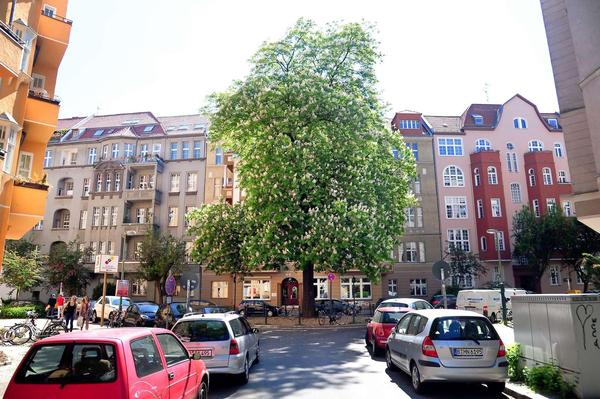
This is a view of Bozener Strasse towards the Chestnut Tree. This picture is to be found in
This is a view of Bozener Strasse towards the Chestnut Tree. This picture is to be found in this article by the Tagesspiegel  about Bayerisches Viertel.
Here is another picture of that Chestnut Tree.
This is a picture of Bozener Strasse seen from the
This is a picture of Bozener Strasse seen from the “Robbengatter” Restaurant.

The top three pictures were all taken from this Tagesspiegel article:

http://www.tagesspiegel.de/berlin/bezirke/bayerisches-viertel/kiezkneipe-robbengatter-im-bayerischen-viertel-dichtung-und-trunkenheit/9860760.html


On September 20th, 2012 I wrote the following:

“Yesterday, Tuesday, our destination was Bayerischer Platz. Just round the corner is Bozener Strasse, where I grew up. I felt quite nostalgic to see my old stomping ground again. We picked up a few large, shiny, rather big chestnuts from under the huge tree at the end of Bozener Strasse. I remember this tree very well from my childhood!”

I mentioned this chestnut tree in this blog: https://auntyuta.com/utas-early-childhood-2/

This picture under the chestnut tree was taken on the 9th June 1940, my brother Bodo's second birthday.
This picture under the chestnut tree was taken on the 9th June 1940, my brother Bodo’s second birthday.


9th June 1940: All the party guests are under the chestnut tree for picture taking.
Here I am under that tree in September 2012,
Peter in Bozener Strasse, the street where I grew up!

Before and after the War, a Reblog.

In 1942/1943 my friends in Berlin and I had often contemplated what life might be like, once we had peace again. Our dreams for the future were very basic. We all wanted to get married and have children. We all wanted our husbands to have occupations that would enable us to live in comfortable houses. My friend Siglinde and I were for ever drawing house-plans. There would be at least three bed-rooms: one for the parents, one for two boys and another one for two girls. Yes, to have two boys as well as two girls, that was our ideal.

Before we married, we would finish school and go to university and our husbands would of course be university educated. In peace-time we would be able to buy all the things we had been able to buy before the war started: Bananas, pineapples, oranges and lemons; all this would be available again! Somehow we knew, we were only dreaming about all this. We had no idea, what would really happen, once the war ended.

I turned eight in September of 1942. Most of my friends were around the same age. My friend Siglinde however was four years my senior, the same as my cousin Sigrid.

When I was about thirteen, Cousin Sigrid made a remark, that put a damper on my wishful thinking. Sigrid had noticed, that I got very good marks in high-school. So she said in a quite friendly way: ‘I see, you’ll probably end up becoming a Fräulein Doctor!’ This remark made me furious inside. It sounded to me, that once I embarked on becoming a ‘Fräulein Doctor’ I would have no hope in the world of acquiring a husband and children. ‘Who in their right mind would study to achieve a doctorate and miss out on having a husband and children?’ I thought to myself.

Mum, Tante Ilse and Uncle Peter loved to read romance and crime fiction. Most of the books they read were translations from English. Mum and Tante Ilse loved Courts-Mahler, Uncle Peter liked Scotland Yard stories best. They all had read ‘Gone with the Wind’. Even my father, who boasted, he never read any novels, read this one.

I read ‘Gone with the Wind’, when I was fourteen. My father’s sister Elisabeth, on hearing this, was shocked, that my mother let me read this novel. According to Tante Lisa, I was much too young to read something like this. However some of my girl-friends read this book too. They all loved Rhett Butler. About Scarlett the opinions were divided. Personally I did not care for the way she treated Melanie. I thought by constantly making passionate advances towards Ashley, she showed total disregard for Melanie’s feelings. Rhett adored Melanie. He showed her great respect as a person with a noble character. In contrast, he was well aware that Scarlet was anything but noble. Often he found Scarlett’s irrational behaviour highly amusing. Ashley treated Scarlett in a very gentleman like way. Not so Rhett. This impressed my friends. They all admired Rhett! I think, I admired Ashley more. –

Mum and Tante Ilse borrowed books from a lending library. A middle-sized novel cost one Deutsche Mark to borrow for one week, a real big novel cost two Marks. In secret I once read a translation of ‘Amber’. Fascinating stuff this was.

When I read ‘Amber’, I was probably thirteen. I read it only, when I was by myself in the apartment, which happened often enough. I was able to consume the whole big novel without anybody noticing it. I knew, Mum and Tante Ilse had read the book already, because they often talked about it, how good it was. But the book was still lying around at our place. There were a few more days before it had to be returned to the library. I found out, that Amber was a fifteen year old country-girl, who went to London. The time was the seventeen hundreds. Because of her beauty, Amber was able to make it in the world. She had lots of lovers. She always made sure, that her next lover was of a higher ranking than the previous one. That made it possible for her, to climb up the social ladder. – Well, this is about as much as I still remember from that novel.

During the first years after the war we lived like paupers. Still, I realized – maybe a bit to my regret – that there was a big difference between a desperately poor girl from the country and me, desperately poor city girl from a ‘good’ family. I knew then, whether I wanted it or not, I had to put up with an extremely low standard of living for some time yet. And I mean by ‘low standard’ not the low standard that everyone went through during the adjustments after the war, but a standard, where it was necessary for us to get social services payments!

Was I out to enhance my appearance in order to catch a prosperous male as an escort to take me out to fun-parties and adult entertainment? No way! Something like that was just not for me. I felt I was plain Uta who was never invited to go out anywhere with anyone.

Was I really that plain? I wonder. Up to age fourteen I may have had some chances with the opposite sex, given the opportunity. However by age fifteen I had put on so much weight, that I felt to be totally unattractive. I was right, because no attractive male ever made an attempt to woo for my attention, not until I was about seventeen and a half that is. But even then things didn’t change much for me. I honestly felt like some kind of a social freak during most of my teenage years.

What I wrote two Years ago

Two years ago when I had not been blogging for very long yet, I wrote the following about my parents:

‘Your father has always been a selfish person. He doesn’t send any money for you but I bet he sits down for breakfast with a soft boiled egg in front of him. He knows how to look after himself and doesn’t care whether his children have anything to eat.’

The voice of my mother still rings in my ears. When years later I talked to my father about his so called selfishness, he justified himself with a lot of words and by producing the Post Office receipts which proved that he had constantly sent money for us children. True, he never could send much, however Mum’s claim that he didn’t send any money at all was totally wrong, according to Dad. He made sure that I looked at all the relevant slips. It seemed very important to him that I should believe him.

I felt sorry for Dad and I felt sorry for Mum. I used to feel that I could not take sides for either of them: I was totally torn between them. My loyalty belonged to both in equal proportions, that means, I could never decide on who’s side I should be. Mum of course accused me constantly of siding with my father and rejecting her. She probably did not feel supported by me. She just could not stand it when I tried to defend Dad.

Dad was the opposite. No matter how much he complained about Mum and let it be known how frustated he was about Mum’s behaviour, he was never angry with me when I tried to defend Mum. He always listened patiently to what I had to say. On the contrary, he liked it when I pointed out how much Mum meant to me and the boys.

‘You are right, Uta,’ he would say, ‘it is very important for you and the boys that you have a good relationship with your Mum. After all she is your Mum. I certainly would not like you rejecting her. In her own way she loves all three of you. You should never forget this.’ Then he would continue to complain about it that Mum was not willing to leave Berlin and live together with him and us children as one family. He also had some gripes about Aunty Ilse. According to him it was she who had wrecked their marriage.

I loved Aunty Ilse. For me it was very hard to listen to Dad’s accusations about her. Dad claimed in a very angry voice that Ilse had lived a ‘Lotter-Leben’ (bad life) when she was younger. He said that she had now a very good marriage. He was of the opinion that marrying HL was the best thing that could have happened to her. Dad regarded HL as being of very good character. I could only agree. In my experience, this Uncle spoke of Dad always in a respectful way too, that is, I never heard him say anything bad about him. Come to think of it, neither did Aunty Ilse. The way I saw it, only Mum would talk about Dad in a very nasty kind of way. It shows that to her mind he must have been a great disappointment to her. Even as a child I tried to see both sides. This was mind boggling for me. A lot of the issues were about what normally only grown-ups would be concerned about. On the other hand – even though I had no way of being able to tell what for instance the sexual difficulties may have been – I none the less felt those vibes which told me, my parents had these very strong love/hate feelings towards each other. I also sensed Mum’s absolute disgust about the way Dad’s life had turned out to be. Yes, I can imagine what immense disappointment this was for her!

Some time after Dad had managed to set himself up in a secure position again he talked to me about how it would be best for all of us if he remarried Mum. I told him that I could not imagine this happening. And sure enough, when he asked Mum to live with him again, she refused.

In 1959 Peter and I migrated to Australia with our two baby-girls. The following year Dad married G. Peter and I were under the impression that the new wife was right for Dad in every way, I am sure, Dad had a very good marriage with G. They had only a short time together: At age sixty-two Dad died of prostate cancer. After having stayed in hospital for a while Dad pleaded with G to take him home. She did this and nursed him for the last six months of his life. It so happened, that G received Dad’s pension after he died. This upset my Mum and my brothers immensely! They thought, G had no right to receive all the benefits. They told me that the first wife should get more consideration for having had a much longer marriage as well as children. I felt awful when my family talked badly about G. I know that she had always been very welcoming, kind and supportive towards my brothers.

G is ninety-two now. Over the distance I still have some occasional contact with her. I am never going to forget, how, during the last years of his life, she gave Dad so much of herself. When I received her letter six months before he died, telling me about the seriousness of Dad’s illness, I cried and cried.

This was the end of my post.  What follows are some replies I wrote to  comments from some bloggers.

I must have been a sensitive child. It is interesting to observe how marriage break-ups effect children in different ways. I always say I had four  mothers: My birth-mother, my aunt, who was my mother’s sister and throughout her life treated me very much as though I was her own daughter (maybe because she never had a child of her own), then the third very much loved mother was my mother-in-law and finally my father’s second wife, whom I knew only through correspondence and photos. Later on, many years after my father’s death, I did get to know her personally on a few visits to Germany. It was so good to be able to talk to her about my father!

Some children grow up not knowing anything about their father. I for one feel blessed that I knew my parents, who both loved me, each in their own way. And I was also very much loved by many people in the large extended family. It is of course very sad, that my parents could not live a happy life together.  – – –  Yes, it saddened me, but I think it also matured me in my early teenage years. I always had a feeling wanting to understand the different characters. Maybe this brought on a longing in me to write about my feelings and the way I saw different people.

The way I see it, it was really my father who was bitter about the separation. My mother did not want to move to where my father was. My father was quite bitter about this. He was fighting sickness and not being able to get a proper job in the postwar years.

I reckon my teenage years were not as good as they could have been, but I’m not bitter about this Everything turned out all right for me in the end. I was the first born one and used to be a good student. Everyone always thought I’d make it to university. However this did not eventuate. To be honest, I really was not unhappy about this, not at all. I was overjoyed when among dozens of applicants I landed a job in an office at the age of 18. I did office work for five years. In the meantime I had married and started a family. When I was approaching 25 we moved to Australia under a migration program. We had two children under two and soon there followed a third one! We did not have much money, but we thought we were doing all right.

Uta with her children at Fairy Meadow Beach, NSW, Australia, June 1960

My Parents

May 1935 in Berlin Baby Uta with her Dad
May 1935 in Berlin
Baby Uta with her Dad

This is a reflection on my parents. Their marriage their frequent separations, their divorce, how they related to us children, their interests, their friends or partners, Dad’s second marriage.

When I was about fifteen, Mum introduced ‘Bambi’ into our lives. ‘Bambi’ was Herr Burghoff aka Tomscick. Of course only Mum called him ‘Bambi’. To us children he was ‘Herr Burghoff’. We did not have any problem with this. Later on I found out that Dad had a problem with calling him by his adopted new name. Dad insisted on calling him ‘Tomscick’.

Here is a conversation I had with Dad when I was about eighteen:

It was June 1953. I was on a one week leave from FLEUROP and had used this, my very first vacation, to visit Dad in DĂźsseldorf.

‘The boys told me that Tomscik never shared his supper with you children,’ said Dad.

‘Don’t worry, Dad,’ was my response. ‘We never wanted Herr Burghoff to act as our Dad. I thought it was perfectly all right that he bought “Abendbrot” only for himself and Mum. At the time he was still studying and didn’t have much money. Maybe it would have been different had he already been employed in the Public Service.’

‘And what is this, that he wants to marry Mum?’ asked Dad.

‘Well, it’s true, he wanted to marry her. You know, that as a Catholic he was not allowed to marry a divorced woman. That’s why they asked the Pope for special permission. It took a while, but they did get it in the end.’

‘Yea, by declaring the marriage invalid and my children bastards,’ screamed Dad.

‘I know, they established that she married under pressure of her mother and sister Ilse. They claim, she didn’t really know what she was getting into when she married you.’

Dad looked extremely upset. ‘That’s absolute nonsense!’ he shouted.

I felt very sorry for Dad. ‘Anyway, Dad, it seems Mum’s not going to marry him after all. Tante Ilse says so.’

‘And why would that be? What could possibly be a reason for not marrying him now?’

‘The reason? According to Tante Ilse there are several reasons. You know,  Herr Burghoff is now employed here in a town in the Rheinland. That is Mum would have to move away from Berlin, if she wanted to live with him. And you know what Mum’s like: She just does not want to leave Berlin!’

Dad nodded. He knew all about this: Mum had always refused to leave Berlin to live with him.

‘ And Tante Ilse told me something else. She said when Mum went to his new place for a visit, she noticed him praying a lot. At least twice a day he would fall on his knees praying in front of a statue. It was kind of acceptable for Mum to go with him to Sunday Mass in Berlin. But apparently she can’t stand all this praying at home. Tante Ilse thinks it was just too much for her to see him do this. Indeed, it must have been the straw that broke the camel’s back!’

Mum actually never re-married. An acquaintance of Mum’s helped her to acquire a permanent job in the Berlin Rathaus (Council Building). She worked there till she turned 65. She could have stopped working earlier, however she knew her pension would increase if she worked to age 65. She lived for her twice yearly vacations. She always saved up for these vacations to go on wonderful holiday trips. On one of these trips she met a widower who was keen on marrying her.  Years later she once told me, she chose not to marry him. He was elderly and she was too scared he might eventually need nursing care. The thought of having to nurse someone in old age just didn’t appeal to her. She thought she deserved to have the opportunity to still have a bit of fun in life. On each holiday she took lots of photos and meticulously preserved them in photo albums. She also wrote a few comments for every trip. There are some records in her recollections about two very elegant men who invited her for dinner. These men turned out to be homosexuals who greatly enjoyed the company of a well groomed presentable lady. And apparently she enjoyed being invited and appreciated. She told me she was glad that none of them  expected any sexual favours from her.

Dad was actually thinking of re-marrying Mum once he was back in secure employment. As far as I know he did ask her and she refused. Apparently she had no desire at all to get back together with him. I remember Dad did ask me at the time whether I thought it would be better for us children if he re-married our mother. Well, I must admit, I did not think so at the time. I just could not imagine the two of them being civil to each other after all the hostilities that had been going on between them for many years.  I think I was eighteen when this question came up. When I was younger I would so much have loved to be living with two parents under the one roof. At eighteen I had overcome these feelings of deprivation of not having two parents around all the time. Should I have thought more about my two younger brothers? Maybe Mum would have mellowed and been able to put up with Dad for the sake of the boys who definitely would have needed a father  – – – –

Mum with her three children: Uta, Bodo and Peter-Uwe.  1948 in Berlin
Mum with her three children: Uta, Bodo and Peter-Uwe.
1948 in Berlin

I don’t know whether Mum would have paid any attention to what I could have been saying. I always had the feeling I could not talk to Mum about these feelings. It was very different with Dad. He always wanted to hear my opinion on everything.

Anyhow as it turned out I left old Germany a few years later with my husband and two young children. Dad was quite devastated to see us leaving. He had become so attached to his first born granddaughter Gaby. She gave him such great joy!  We were soon well and truly settled in Australia. We felt Australia was for our young family much better than Germany. We never regretted having left Germany behind.

Dad’s secretary, Frau Kusche, was a war-widow. She came from Lodz in Poland the same as my Dad. She had raised a son and a daughter as a war-widow. I had seen Frau Kusche only once briefly at the office. I later heard her 28 year old son who was married and also had a little son, this 28 year old was suffering from terminal cancer. Before he died he was witness at the marriage of his sister who had been an air-hostess and was marrying an American. My father, who had married Frau Kusche in the meantime, was also present at the wedding, together with his new wife of course.

Frau Kusche’s first name starts with G. Dad had a few good years with her towards the end of his life. He too, sadly died of cancer when he was only 62. He and G made a few visits to America to see G’s daughter there. They had also planned to come and visit us in Australia. Sadly, this never eventuated. G. was looking after Dad when he was terminally ill. It took a lot  out of her. But she recovered eventually. She’s still alive and well now, being in her nineties, her daughter-in-law keeping an eye on her.

In Love with Leipzig

This is a copy of one of my earlier blogs!

“I found an interesting contribution about the German city of Leipzig.

http://blog.goethe.de/meet-the-germans/archives/179-In-Love-with-Leipzig.html

As a ten and eleven year old in 1945/46 I did get to know a bit about this city. Sure, when we first moved there to stay at grandmother’s place, the war hadn’t finished yet and we experienced quite a few bomb raids.

As I told in another blog, one bomb raid in April 1945 turned out to be disastrous for us. This was probably the very last bomb raid that Leipzig had to endure, because soon after the American troops together with some Canadians occupied the city. When the Canadians moved through neighbouring streets to lay out some cables, we kids were watching them. We were impressed by their appearance. They were all very young looking, tall and lean in immaculate uniforms. We welcomed the foreign troops.Them being with us meant, we wouldn’t be bombed any more. From now on we could sleep in peace!

We were a family of six. Having lost our home in the bomb raid, we applied for accommodation for our family. We were given a flat in an area where the buildings weren’t damaged at all. We were assigned an apartment that had  three rooms plus kitchen and bathroom. Had grandmother been just with Renate she would not have been able to get an apartment  of this size. Only families of five or more were assigned accommodation with that many rooms! So we were lucky again. Grandmother stayed in this apartment in Friedrich-Ebert-Strasse for many more years. She died in 1957.

About Leipzig I remember the ‘Ratskeller’, where we had a few times a lovely meal. I always thought it was something special to eat out somewhere. But I loved Grandma’s cooking too. Like magic she always produced excellent meals even when there was not much food available. She was a great one for improvising. And never ever was any bit of food thrown out. She always pointed out to us, to throw away good food, was a sin. This kind of thinking still sticks with me today!

I also  remember the Thomaner Church in Leipzig and the Thomaner Choir. I believe the journalist who wrote the blog about present day Leipzig is from England and lives in Berlin now. He went for a visit to Leipzig and ended up loving this city. If ever I have a chance to visit Germany again, I plan on paying Leipzig a visit together with Peter, my husband, and Peter, my brother. If you are interested in finding out more about Leipzig, please look up the above link.”

Last year during our visit to Germany we did not forget that we had wanted to visit the city of Leipzig. We  actually went there for a day visit. We had in our minds to search for  the grave of my paternal grandfather who had died in 1947. After a lot of searching we were able to locate his grave site. We made some pictures which I published in a blog. Leipzig seems to be a thriving city these days. We would have liked to stay there a bit longer. But we had to go back to Berlin the same day.  The Main Leipzig Railway Station (Hauptbahnhof) has been very modernised. A huge modern shopping center is located within its premises.

Leipziger Schauspielhaus

Leipziger Schauspielhaus Sophienbstrasse 17 - 19

Sophienstrasse 20

http://de.wikipedia.org/wiki/Leipziger_Schauspielhaus


The “Leipziger Schauspielhaus”  was a private theater in the southern part of Leipzig, Germany. This theater was situated in Sophienstrasse 17 – 19.  Sophienstrasse is now named Shakespearestrasse. During a bomb raid on 4th December 1943 the theater building was totally destroyed and has never been rebuilt.

For me it was interesting to find in the Wikipedia the above pictures and information about this particular theater. The house adjoining the theater is of special interest to me. This was  Sophienstrasse  20. It was the house my mother grew up in. This house was completely destroyed in a bomb raid in April 1945 while we, that is Mum, my two brothers and I, were there staying with my grandmother and cousin Renate.

Mum told us again and again that at the age of fourteen she did get a part as an extra. She played a page boy in a production of the famous Leipziger Schauspielhaus.. Being part of a theater production she found immensely exciting.

The above pictures are from 1906.  Mum’s sister Ilse was born in 1907 and Mum was born in 1911. Mum had another older sister and an older brother.

“Am 11. Oktober 1874 fand die ErĂśffnung unter dem Namen Carl-Theater statt. Hartmann nannte die Spielstätte Leipziger Schauspielhaus und erĂśffnete es am 10. September 1902.”

The theater was opened on 11th October 1874 under the name ‘Carl Theater’.  A bit later it was called ‘Carola Theater’. Around the turn of the century it was closed for a while. It was named ‘Leipziger Schauspielhaus’ by Anton Hartmann when he opened it on 10th September 1902.

The End of War

As I said before Mum enjoyed going to Berlin once a week. She was able to stay in our city apartment, which we were still renting. Of course, most of our furniture was in that country place where we were all staying. Mum had to take in several ‘Untermieter’ (sub-tenants). That is some rooms had to be sublet to people who had lost their homes during bomb raids. Towards the end of 1944 Mum was only left with one room to herself. None the less, she liked the excitement of being in Berlin.

I can’t recall Aunty Ilse going to Berlin on a regular basis during our stay in the country. Come to think of it she did not have an apartment to go to any more, since the top floor where her apartment had been, had been totally destroyed by fire-bombs. I cannot recall the exact date when this happened but I think it was probably soon after we had moved away from Berlin.

Mum had to walk for about half an hour to the next village to catch the bus which took her to the next train station. Going to the center of Berlin she then had to change trains a few times. All in all it was quite a long trip. But even in the fifth and sixth year of war buses and trains were still going pretty much on time.

As I mentioned before, Tante Ilse married Helmut L aka Onkel Peter on the 20th of July 1944. The wedding took place in Merane at the place of Onkel Peter’s parents. This is also the place where Tante Ilse went to towards the end of the war. Had she married Werner M. and possibly stayed at his place, she would have been in the midst of the Russian advances to Berlin in early 1945.

At the end of January 1945 Mum caught a train from Berlin to Leipzig with us three children to stay with Grandma and cousin Renate in Leipzig. Maria, who had been with us for more than three years, stayed with her fiancee in Berlin. I think the T. family, who had stayed with us in the ‘Ausbau’, moved to a town a bit further south of Berlin.

In Leipzig we were occupied by American and Canadian troops a few days before the end of the war. In what must have been the last bomb raid over Leipzig the house where we stayed was bombed. But we all survived in the very solidly built cellar under the apartment building. Grandma, having lived on the ground floor, was lucky that she could even save most of her furniture whereas the four stories above the ground floor were completely destroyed by bombs!

The area surrounding Berlin became the Russian zone at the finishing of the war. Property owners in the Russian zone had to give up their property. They were ‘enteignet’, meaning Werner M., the very wealthy man, lost everything in this ‘workers’ and ‘peasants’ state. Grandma had always wished for her daughter Ilse to marry this rich man. Just as well she didn’t! Anyhow Ilse had been very much in love with her Peter. She never seriously contemplated marrying Werner M. This is the way I see it.

What happened to Werner M. after the Russians occupied the country? Well, we do not know this. The Russian occupied zone became of course the GDR (German Democratic Republic) until the wall between East and West came down in 1989.

Early Memories

Before I was three we lived in Taunus Strasse, Berlin- Friedenau. Some time during 1937 we moved to Bozener Strasse in Berlin-SchĂśneberg. This is where Tante Ilse and Onkel Addi lived as well and also my friend Cordula and her parents. Later on we did get to know Family T. who lived in the house opposite our apartment building.

During my early childhood Bozener Strasse was a very quiet street. There were no cars parked in the street.

Tante Ilse had this narrow but very long balcony with a lot of plants to water. As a two year old I loved to help with watering some of the plants!

Uta loves to water the plants. Mum is looking on.

Here Mum still has this “Bubikopf” which I believe became fashionable already in the 1920s.

In the next picture, which was taken in Bozener Strasse on 21st September 1947, my brother Peter is nearly six. I stand behind Peter. I turned thirteen on this day. My brother Bodo is on the left. He is nine. Beside him Eva Todtenhausen, who is going on twelve and beside Eva is Cordula who is twelve. Today I found out that Cordula died in July 2011, aged 76. This was very sad news for me. 😦
2-06-2009 5;02;21 PM23-02-2009 6;29;31 PM

The above picture is from my birthday in 1940. We stand under the huge chestnut tree. Cordula spent part of the war outside of Berlin. She is not in the 1940 picture.

We took the following picture of Bozener Strasse during our Berlin visit in September 2012. It is still the same chestnut tree. But look at all the cars now!

DSCN3831

Our apartment was on the third floor, Tante Ilse lived two floors further up. Mum quite often went up with me to visit Tante Ilse. One of my early memories is that Tante Ilse and Mum were lying  under the bright lights of some tanning lamps (HÜhensonne).  They used some oil on their skin which smelled beautiful and made their skin look shiny. Their skin usually had quite a bit of a tan. They wore some protective dark glasses. Sometimes they made me lie under the lamp for a little while.  I  liked it when some of this nice smelling oil was rubbed all over my body. I too had to wear these dark glasses. I liked to wear them for a little while. But I was required to lie totally still. Very soon  I did get sick of it, not wanting to lie still any more under the hot tanning lamp. I was then always glad when I was allowed to get up again.

I remember thinking that Auntie was a very beautiful looking woman with her very long curly hair. In the three way mirrors of her dressing table I remember watching  how Auntie brushed her hair. It was very strong and long chestnut-coloured hair.  Auntie usually brushed it slightly back so it stayed behind her ears. She often wore very long blue earrings. Oh, I loved the look of these blue earrings.  They looked beautiful hanging down from Auntie’s ears! I think Mum did not wear any earrings, because her ears were covered by her hair. Mum’s brown hair was very fine and much shorter than Auntie’s. My hair was rather fine too. Mum always cut it quite short. I often wished  that I could wear my  hair longer but Mum would not let me grow it longer.

Both Auntie Ilse and Mum wore identical three big rolls of hair horizontally on top of their heads. The front rolls covered the top of their foreheads, the other two rolls were rolled behind the front roll. They often wore identical clothes, for instance light pink angora wool tops with identical grey suits.

1948: Mum 37, Uta 14, Bodo 10 and Peter 7.

Mum features her three big rolls of hair, I am already allowed to wear my hair long!

———-

Mum often called me  ‘MAUSEL’ or ‘Mauselchen’, whereas Auntie liked to call me ‘HERZCHEN’ or ‘LIEBLING’. Dad sometimes said ‘HERZEL’ to me, but he usually called me by my name. Mausel is derived from Maus (mouse), Herzchen means ‘little heart’, Liebling means ‘darling’.

Cordula’s mum once told  me, that her name meant ‘heart’ in the Latin language, but not to tell anyone otherwise some children would make fun of the name. I did not want anyone to make fun of Cordula. So I promised myself to keep the meaning of the name to myself.

My brother Bodo was born in June 1938. I think Cordula’s  brother Tilwin was born a few months after that. Mum said that Tilwin was an extremely odd name. It turned out he grew up with very bright red hair. The children in the street teased him about his hair. As much as possible Cordula always stood up for her  brother. I think for the most part Tilwin avoided playing with other children.

The Lepsius apartment was on the same side as our apartment, just two floors further up. (Auntie Ilse’s apartment was on the other side of the fifth floor). I often went up to the Lepsius apartment all by myself to play with Cordula. They had a ‘roof-garden’ (Dachgarten) above their apartment. It was the size of a big room and had no roof above it. I remember the sun shining right into it. The floor was concrete and along the walls were garden-beds . Cordula was allowed to look after her own little garden-bed.. Once Cordula’s Mum let me have a portion of a little garden-bed too! Cordula’s Mum and Dad were always kind to me. They made me feel welcome and included.

Cordula’s family had food that I had never seen before.. For snacks we children were often given some kind of brown flakes and raisins. Sometimes we were given dates or figs. I loved this food! My Mum thought it was strange to eat something like that. In Mum’s opinion this family was rather odd because they had lived in the Middle East for a while. Cordula’s  father was an architect. My Mum called him ‘the Hunger-Architect’ (Hungerleider)  since he seemed to get hardly any work in his profession.

Mum must have seen their apartment once for I remember her remarking how sparsely furnished it was.  Mum found their choice of furniture quite odd. There were a great number of shelves stacked full with books. These shelves went from floor to ceiling. Herr Lepsius sometimes showed us children books with colourful  illustrations. He also told us stories. We loved one story in particular which had a funny ending. We demanded to be told that story again and again. Each time we laughed our heads off and Herr L laughed with us. The story was about a beggar who knocked at the door of an apartment. A ily had two connecting apartments across two buildings; that is, the wall between the buildings had beautiful maid opened the door. Some time later the beggar knocked at another door of an apartment in the neighbouring building. And the same beautiful maid opened the door! We found the astonishment of the beggar very funny! Herr L explained to us, that a wall had been broken through to connect the apartments on that floor. This was actually where the family of Herr L had lived, when he was a boy.

Herr L was old and bald. He was about twenty years older than his wife. Quite a few years later Cordula and I went to the same high-school. We walked there together every morning. One morning I climbed up the stairs to  Cordula’s  apartment to find out why she  had not come down yet to go to school with me. I rang the bell. Frau L opened the door. She was in tears. She did not let me come in but went with me to the top of the stairs. She said: “Our father just died; I haven’t even told Cordula yet.”  She looked at me with despair in her face.  I did not know what to say. She hugged me and then she disappeared in her apartment.

Childhood Memories 1943/44

Towards the end of September 1943 we left Berlin to live in the country. We moved to a place called the ‘Ausbau’, which meant that eventually ‘more’ was to be added to the building.. It was a simple rectangular red brick complex with several entrances around the building. There was no plumbing or electricity. The entrance for us ‘Berliners’ was on the left side at the front of the building. We had a cellar, a ground floor and two upper floors.

Mum, my two younger brothers and I, shared a bedroom on the first upper floor. We also had a small kitchen and a living-room. I would sleep in the living-room when my dad came home on leave. Two maids, one Polish, the other Russian, shared two rooms on the top floor. All the rooms on the top floor had sloping ceilings. Our Polish maid was in her early twenties. Her name was Maria. She was very efficient and always rather serious.. The T. Family, who lived on the ground floor, employed Katja, the Russian maid, who was only eighteen and extremely fun loving.

My mum’s sister, Tante Ilse, also had her rooms on the first upper floor. She had a bedroom and a living-room. On the ground floor, right underneath her upper rooms, she had a kitchen and a dining-room. She hardly ever used those downstairs rooms. Our friends from Berlin, the T. Family, occupied three rooms downstairs, namely a kitchen, a living-room and a bedroom, the same arrangement of rooms that we had on the upper floor.

There was an additional larger room for storage under the sloping roof. T. Family and my Family stored in that room additional larger furniture which we wanted to save from the bombs in Berlin. — In that room Mum stored a lot of Boskop-apples during the cold season. They were neatly spread out on some straw. Come Christmas-time, other delicious food was also hidden somewhere among our stored furniture. It was very tempting for me to go exploring in that room! Mum noticed sometimes, that some food was missing. And I admitted, when questioned, that I had helped myself to some of the goodies. However I was never punished for doing such a thing. That shows, that Mum must have been quite tolerant. —

On the same upper floor right under the roof was a playroom, which my brothers and I shared with eight year old Edith T. There was another room next to the playroom where Mrs. T.’s parents had stored some bedroom furniture. The parents were Mr. and Mrs. B. and had a business in Berlin. They sometimes stayed at the ‘Ausbau’ in that bedroom in order to be with their family away from the bombs in Berlin.

Our toilets were “plumps-closets” some distance away from the house. Water for cooking and washing had to be fetched from a pump in the backyard. Fetching water from the pump kept both maids very busy indeed. For lights we had kerosene-lamps, for heating there were coal-fired stoves which could also be used for cooking. Everything was very basic.

Gradually some changes were being made. The first big change was that our landlord had electricity laid on. All the workers who lived with their families in the other part of the building, received the benefit of electricity at the same time. This certainly was a very welcome improvement for them.

The ‘Ausbau’ was built close to a dirt-track which meandered through wide open barley-, oat- and potato-fields. On the track it was a good half hour to walk to the next village. Bike-riding however made it a bit quicker.

Werner M., the owner of all those fields that went on for miles and miles, was an acquaintance of Aunty Elsa. He was apparently quite rich an d also owned extensive brick-works (Ziegeleien). It was said of him that he was a millionaire. He was our landlord and he liked to spoil us. With no strings attached! Tante Ilse only had to voice a wish and Werner M. immediately did whatever he could to fulfill her wish. He spoiled us by constantly getting produce delivered to us: Potatoes, cabbage for making sauerkraut, wonderful treacle made of sweet-beets, and coal for our stoves.

Even I, as a nine year old, could see that sixty year old Werner M. was hopelessly in love with Ilse. I also was quite aware, that she always kept him at a distance. He was happy to just be invited for ”Kaffee und Kuchen’ on weekends and to spend some time with all of us. He always came to visit on his bike. On his daily inspection tours of the workers in the fields he also went around on his bike. He owned coaches with horses, but hardly ever used these to go anywhere.

Occasionally we were invited to his place (which people called ‘Schloss’), Then he sent a coach with a coachman to pick us up. Once in winter when there was plenty of snow, Werner M. sent a ‘Pferde-Schlitten’ (horse-drawn sledge). On this sledge we were wrapped up in blankets under a clear night-sky with the moon and lots of stars shining on us. It was unforgettable and one of the rare highlights in our otherwise pretty dreary country-life existence.

The place where Werner M. lived, did not look like a castle at all, even though people called it ‘Schloss’. It was not even a mansion but a rather large, but fairly plain house. There was a huge, fenced in veggie garden next to the house. I have seen the veggie garden only once. However I was very impressed by it, because it seemed to be so very large.

When we moved to the ‘Ausbau’, Ilse had already been divorced from her first husband. It was obvious that Werner M. would have liked to marry Ilse. However, it never came to that. Tante Ilse married Onkel Peter aka Helmut L. on July 20th, 1944.

***************************

It was a big thrill for me to go exploring among the furniture in that big storage-room, especially in the weeks before Christmas! Mum used to store lot of goodies during the Christmas season. It was very exciting for me to find out what new things had been stored in that big room. I remember seeing huge chunks of nougat (a yummy hazelnut-paste) as well as heart-shaped marzipan-pieces. There was a pot with sweetened thick milk. Sometimes I dipped my finger into it to lick this wonderful sweet stuff! I also liked to eat a few of the stored raisins and prunes! Smells of ginger bread and apples: It made me feel that Christmas was something to be looking forward to.

Where on earth did Mum get all those things from? It was war-time, wasn’t it? We were in the midst of war! I knew very well where all this came from. The parents of Mrs.T. had a distributing business. It was called ‘Backbedarf en Gros’. That meant they delivered goods to bakeries and cake-shops. Even in the midst of war deliveries of the above mentioned goods still took place! Of course there were shortages, but basically most things were still available.

Mr.T. and Mrs.T., as well as Tante Ilse and Mum were all good friends. Every Saturday night they came together for some card games. Eight year old daughterEva and I were allowed to stay up late on those nights. For hours we were watching the adults playing cards. At the same time we entertained ourselves with doodling on bits of paper. At around ten o’clock some cake and hot chocolate as well as coffee were served. But the maids did not have to do the serving, They were already in their rooms at this hour. The cake was usually freshly baked, very fluffy yeast cake topped with delicious butter-crumbs and filled with a thick custard. Hmm, yummy!

Mr.T. always stayed in Berlin during the week, where he worked in the business of his parents-in-law. Being over forty, he was not required to join the German army. Mr.T. always brought some sweet goodies along when he came home from Berlin for the weekend.

During the summer of 1944 Mr.T. and Mum liked to go on their bikes to a neighbouring Nursery where they were able to trade sweets for fresh produce. Eva and I were often allowed to go along with them on our bikes. The sweets were traded for strawberries or cherries or gooseberries as well as peaches and apricots, and later on in the year for pears and apples. I remember the Boskop apples were still in season in late autumn. The owner of the nursery was a well-off looking middle-aged woman who was very fond of sweets and loved to trade her produce. At one time we found out that she thought Mr.T. and Mum were a couple and we girls were sisters. Laughing joyfully, Mum and Mr.T. explained, that this was not so.

Only once as far as I remember were we shown into the lady’s home. Mr.T. made complimentary remarks about the interior of the house. He said it showed off the owner’s good taste. I liked the lady’s house a real lot too. Our families used to have well furnished apartments in Berlin. But this modern looking villa in the midst of the nursery really was something else. My feelings were I would very much like to live in a place like that. However we had to be happy with our accommodation in the Ausbau. To us children it was always pointed out, to be happy that we did not have to live among the bomb raids in Berlin. I’m pretty sure that by myself I felt that I’d rather live in Berlin, bomb-raids or not. I think to children bomb-raids usually didn’t seem as scary as to the adults. At the time we children had had no experience yet how absolutely horrible these bomb-raids could become.

In 1990, soon after the Fall of the Wall, I went with my family to have a look at the area where we used to be hidden away from the bomb-raids. We discovered that the nursery as well as the lady’s house had completely vanished. There was nothing left of the ‘Ausbau’ either!

In 1943, when we had lived at he ‘Ausbau’ only for a couple of months, Mrs. T. delivered a healthy daughter in a regional hospital. The day after the baby was born, it may perhaps have been a Saturday or Sunday, Mr. T. and Eva went for the forty-five minute bike-ride to the Hospital. I was thrilled that I was allowed to go with them! The baby was rather tiny. I think this is why she was soon called Krümel (tiny crumb). Her given name was Ruth. Eva had a pet-name too. She was often called Honkepong.

As soon as Mrs.T. came home from hospital, there was a nurse waiting for her to take charge of the baby. Mr.T. said something like: “Katja is a very nice girl, but I would not trust her with our new born baby. I am glad that Nurse is here to help my wife to look after our Krümel.”

Nurse used for herself the bedroom next to our playroom. Sometimes she sat with us children in the playroom. Since Christmas was approaching, she taught us how to make some Christmas decorations. I was very impressed, because I was nine years old and nobody had ever taught me anything like it! Nurse also made sure, we learned our Christmas poems. We had to be prepared to recite them to Santa on Christmas Eve!

 Maria, our Polish maid, had been with us since before my little brother was born. He regarded Maria as his ‘Dah-dah’, that is he always called her ‘Dah-dah’. By the end of January 1945 we had to flee from the ‘Ausbau’ as the Russians were approaching fast. We went to Berlin first and then by train to Leipzig to stay at Grandmother’s place. Maria remained in Berlin with her Polish fiancee, who was a butcher.

 When we parted from Maria, little brother Peter had just turned three. Yet he must have missed her for quite a while since she had always looked after him and I am sure, he loved her very much and she loved him. Mum always trusted Maria, who was in every way caring and efficient at the same time. Mum was always impressed how quickly Maria worked. Any dirty dishes were washed immediately. She was indeed capable of doing all the housework. Mum was happy to let her do just about everything. An exception was the baking of a large cake on Saturdays, which Mum loved to do herself.

Maria always made some potato-salad for the weekend. I watched how she did it. To the peeled and sliced potatoes she added finely cut onion, some oil, pepper and salt. Then she poured hot vinegar-water over the potatoes as a finishing touch. The huge salad-bowl was placed outside on a shelf near the stairway so the salad could cool down. I often helped myself to some of the warm salad when nobody was looking, because I loved to eat the salad when it was still a little bit warm. It was the same every Saturday. I watched Maria preparing the salad and placing it on the shelf outside. Then it did not take long before I had a good taste of it!

Friday night was the night for our bath. Maria placed a small tin-tub on the kitchen-floor. She carried several buckets of water from the outside pump to the kitchen. Some of the water she heated on the kitchen-stove in an especially huge pot. I was always the first one to use the bath-water, then it was brother Bodo’s turn. Little brother Peter was always the last one. Some hot water was added for everyone, but still the water must have been quite dirty for little Peter after Bodo and I had had our baths!

When Maria first came to live with us, she knew very little German. However she was determined to learn German quickly. She liked to ask Bodo and me how to pronounce certain words. She also asked me how to write these words in German. Mum often praised Maria, that she was willing and able to learn quickly. This applied to everything she did. She was an amazingly efficient person. A ‘pearl of a maid’ people would say of her. Maria was a city girl. She came from Lodz, which was called ‘Litzmannstadt’ at the time. We had spent the summer-months of 1941 at Zokolniki (near Lodz) and that was when Maria was assigned to us as a help. Mum liked Maria and wanted her to come with us when we went back to Berlin. Maria told me later that she did not want to leave Poland. But she had not been given the choice to stay in her own country.

When Katja arrived, we could see that she was very different from Maria. She was a country-girl from Russia. She never learned German as well as Maria did. She could never be trusted to do all the house-work by herself. Mrs.T. always had to supervise her and do certain things herself because Katja took too long to learn to do it properly. But we all loved Katja. She was always cheerful and full of beans. As a country-girl she did not know certain things that a city-girl had been brought up with. Maria took to instructing Katja about certain things. I think they communicated in German. After they finished work in the evening, they had plenty of time to stay in their rooms together and keep each other company. Both girls always had to get up early. During summer, school-classes in the village started as early as seven o’clock. That meant, I had to get up at six o’clock to get ready for school. Mum never got up that early. But Maria always came down at six o’clock to start working for us. She often had to do Peter’s linen early in the morning, which I am sure was not one of her favourite tasks.

I mentioned in this post our landlord, Werner M.  He is here in this picture which was taken by Mrs. T. on Christmas Eve 1943.

Werner M. is on the left, on the right is Mr. T.

Tante Ilse is next to Werner M. together with cousin Renate. I am in the back with my doll.

The children in front are Eva T. and my brother Bodo.

Next to Mr. T. is Mum and Grandma Olga (Mum’s mum) is on the left next to Werner M.

Christmas Eve 1943