Christmas Eve 1943

Christmas Eve 1943
christmas eve 1943

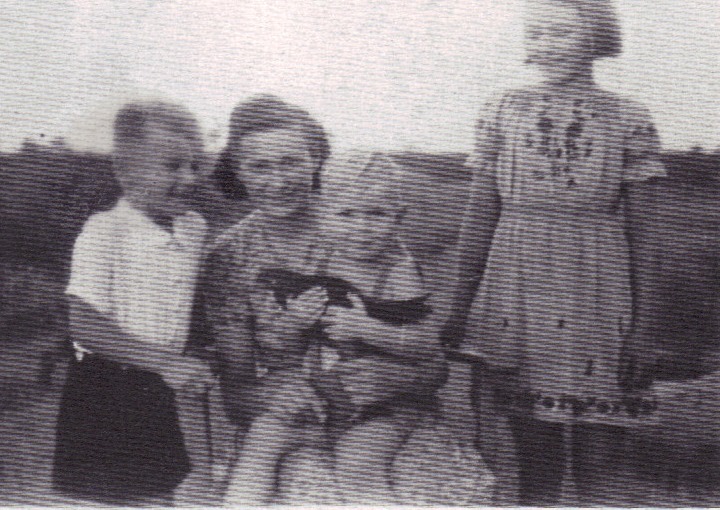
I have a photo which was taken in Tante Ilse’s livingroom. We were all sitting together for Christmas Eve celebrations. I gather Mrs T. took the picture since she isn’t in it. The photo is proof that my grandmother from Leipzig and cousin Renate were with us for Christmas 1943. Grandma is on the left, beside Grandma is Werner M, then Tante Ilse and cousin Renate. On the right is Mr T and beside him Mum. The children are 8 year old Edith T and my brother Bodo. I am in the picture too: You can see me holding up one of my Käthe-Kruse-Dolls. Mum had knitted a lovely new dress for this doll.

In the weeks before Christmas Mum loved to do some sewing of clothes as well as a lot of knitting for us children. When she did this we were not allowed in the living-room because she wanted the gifts to be a surprise for Christmas Eve. That meant of course that we had to be very, very patient. Naturally we thought Christmas Eve would never come!

Christmas Eve 1943
christmas eve 1943


My Friends in 1947/48

At age thirteen my best friends were Cordula and Lieselotte. The three of us started our own little club. We met several times a week. None of us had a boy-friend. However we talked about what it would be like to experience romance.  Just talking about it was very exciting!

One afternoon the three of us had our picture taken at a photographer’s. I still have this picture. Looking at this picture brings back memories how much at ease I felt then. Yet this Threesome lasted for a short time only. Cordula had already lost her dad. All of a sudden her mum died too. How upsetting for her! She moved away to live with her aunts in West-Germany. The departure happened so quickly that there wasn’t time to say good-buy. I felt shocked about it. Yet I sensed that there had been a need for the sudden departure.

The blockade of West- Berlin followed and I was air-lifted to West-Germany to live with Dad and Aunty Lies and her family. When I returned to Berlin I had no idea how Lieselotte was doing because we had completely lost touch. She had already turned fifteen and had left school to take up a job. Quite by chance I once noticed her walking along the street arm in arm with a boy-friend. I cannot recall what she wore, but she looked very grown up to me. I never thought of approaching her.

I continued to go to the same girls’ high-school. Many girls in my class were talking about their boy-friends. I did not have a boy-friend and did not have a clue, how on earth I could ever get to know some-one from the opposite sex. I stuck to day-dreaming. In my mind I fantasised about romantic meetings: I loved making up conversations with an interesting young man!

I had hardly any money to spend on clothes or make-up. I felt very inferior to other girls, who all seemed to be better off.

Uta and her friends 1947

I liked to keep my hair long and just a little bit permed. I was astonished and gratified when a girl in my class said she liked my hair-style.

2-06-2009 5;00;40 PM

CHILDHOOD MEMORIES 1943/1944 CONTINUED

Instead of having every Wednesday afternoon off, Maria had every second Wednesday the whole day off. That made it possible for her to go on the long journey to Berlin to see her butcher friend to whom she was engaged. When she came back, she always carried a large packet of smallgoods (wurst). There was liverwurst and salami and Berliner fleischswurst as well as frankfurts and ham. That Maria was willing to share all this with us, certainly shows that she must have regarded us very much as her family.

Yet as far as I remember, she alsways had her meals in the kitchen the same as our previous maids. I guess this was just the custom at the time. I don’t think any of the maids would have felt like complaining about that. Yet Maria once said to me, she would like to be allowed to go to Berlin every Wednesday. She pointed out to me, that Mum went to Berlin every Thursday. Therefore on Thursdays Maria had to look after us children all by herself. ‘Why cannot your Mum do the same for me everyWednesday? Certainly this is not too much to ask?’

I talked to Mum about it. Her answer was: ‘Now look, a maid is entitled to only one afternoon off per week. I am very generous that I let her stay away for the whole day every second Wednesday!’ And that was it. Nothing would have made her change her mind.

Mum enjoyed to go to Berlin once a week. She stayed in our city apartment, which we were still renting, even though there was hardly any furniture left in it. Eventually Mum had to take in several ‘Untermieter’ (sub-tenants). That is some rooms had to be sublet to people who had lost their homes during some bomb raids. Towards the end of 1944 Mum was only left with one room to herself. None the less, she liked the excitement of being in Berlin. I can’t recall Aunty Ilse ever going to Berlin. She did not have an apartment to go to any more, since the top floor where her apartment had been, had been totally destroyed by fire-bombs.

Towards the End of World War II

In Germany in 1944 no single unemployed woman was allowed to remain without a job. However married women with children were not obliged to work for the war effort. My cousin Renate in Leipzig was in her last year of high-school. After finishing high-school you would get the ‘Abitur’ qualifying you for university studies. Renate had to finish school half a year early. She did get only a ‘Not-Abitur’. She had to finish with this ‘Not-Abitur’ because she was required to work in a munitions factory.

 Aunty Ilse, being a single person, was supposed to have a regular job. Everyone who was capable to work, had to work for the war effort! That meant Ilse had to prove that she had a proper job. Naturally Werner M came to the rescue again. ‘You can work for me in the office,’ he said. And office work she did, however not in the office, but at home. She did not even have to collect the work!

One of the workers, who lived in our complex, was given the task of handing over the sheets of work-paper to Mrs. Ilse S. He did this when he came home from work. When Aunty had finished the paper-work , he took everything to the office on the way to his work-place. How did he transport the papers? He simply fastened the bundles unto the back of his bike. This worker was Herr F. He was a smith by trade and worked for Werner M. – – A smith was always needed in a huge estate with lots of horses and farm equipment. Even though Herr F was a qualified trades-man, he and his family lived extremely simple lives; indeed, he did not seem to live any better than an unqualified worker.

Mr. and Mrs. F, had two sons; one was ten, the other one fourteen. The older one was quite talented. He built complicated mechanical things out of odd bits and pieces. I admired him very much. The younger son told Edith and me stories about the ‘Lamp Angel’ (Lampen-Engel) who was supposed to have kerosine-lamps in a straight line out in the country away from any built-up areas to distract bombers, who might accidentally have come to our countryside.

A few times I went with Edith and Bodo in search of these lamps. Yet we never could find any of them. Unfortunately the neighbour’s son, who had told us the story, was not willing to come along with us to show us where the lamps were. To this day, I really do not know, whether there ever had been any lamps!

Both sons of the neighbours went to Lichtenow village primary school, the same school that Edith and I went to. The school had eight school-years. After year eight you had to leave and start work or learn a trade. Students who wanted to go to high-school, were supposed to enroll at high-school after finishing year four of primary school. By September 1944 I should have started high-school. However I had no chance to travel to high-school from where we lived at the time. Mum said: ‘Since you skipped year three, it does not matter, if you repeat year four. Next year the war will be over anyway and then we do not have to live here anymore and you can be enrolled in high-school. But I want you to go to a different village-school now and start again with year four. I made enquiries in Herzfelde. The primary school in Herzfelde is much larger then the one in Lichtenow. So this is why I’ve enrolled you in Herzfelde.’

I went to Herzfelde Primary for three months only. By the end of January 1945 we had moved to Leipzig to stay with Grandma. All schooling had stopped by then. We felt more and more, that it was very close to the end of the war.

During the warmer months of 1944 we did a lot of athletics at the Lichtenow school. There was running, high-jump and long-jump. There was also an athletics’ carnival in which only students who were ten years or older were allowed to participate. I was not quite ten yet, but they let me join anyway. I was good at running for my age. In all the jumps I was just average.

I had plenty of opportunity to practise high-jump at home. Mt. T and his brother, who was at the Ausbau for a visit, set up two poles with a line to jump over. The line could be set higher or lower. It was set very low for Edith and for Bob. The T brothers were both quite good sportsmen and could still jump astonishingly high, even though they were both well over forty.

I often thought that the afternoons at the Ausbau were boring. What was there to do for me? Not much. When the weather was fine, I liked to go for walks, always wishing, that the landscape were not as dreary. I longed for a variety of trees and the view of a lake or a river.

During the colder season we had sometimes real terrible winds. On the way to the outside toilets we had to turn around the corner of the house to walk to the shedlike building at the back. You had to be quite brave to turn the corner, when that gusty wind was blowing, blowing, blowing. Winds like that were unknown to us in the city. Well, the Ausbau was in open country area after all.

We had a warm lunch when I came home from school at about one. And after that in the afternoon there was nothing to do! Maybe a bit of home-work here and there. But this certainly did not take all afternoon. When we had to stay in the playroom because of bad weather, I usually read a book. I loved reading. I was glad I could borrow books from Mrs. T. She had dozens of books for girls, which she had kept from her own childhood and which eight year old Edith was not able to read yet.

Naturally my two younger brothers and Edith and I sometimes played together as well as talking to each other. Still I missed all my friends from Berlin. In Berlin I was always surrounded by many different children. We all lived in the same street; it was easy to see each other on a daily basis.

One Thursday during the summer school-holidays Mum came home from Berlin with excellent news. ‘Guess what?’ she said ‘I saw Rose-Mary today! She is going to stay in Berlin for a few weeks and I asked her, would she like to come and stay with you at the Ausbau for one week. I could pick her up next Thursday and take her back to Berlin the following Thursday.’

I cried with delight: ‘Oh, Mum, that’s excellent! I love to have Rose-Mary here for a visit!’

The visit took place as Mum had planned. Rose-Mary and I went for lots of walks . We had so much to talk about that we hardly noticed, how dreary the landscape looked. Once we went into the direction where the lamps of the ‘Lampen-Engel’ were supposed to be. However we never saw any lamps.

I felt a bit jealous, that Rose-Mary was allowed to stay in Berlin for a little while during school-holidays. I could never talk Mum into letting me stay in Berlin, not even for a day. Mum always said, that it was too dangerous since there could be bomb raids day-time or night-time. I was not to be put into danger. And that was it.

During that summer of 1944 I learned to swim. We had summer holidays. On a hot day Bodo and I went on our bikes some distance past the Lichtenow school to an artificial lake, which people called ‘Bruch’. It was possible to swim in it. Dozens of people were stretched out on some grass near the lake or frolicked in the water. I went in up to where the water reached my chest. Then I tried to lie on my tummy reaching out my hands to touch the ground. After a while, I noticed my hands had left the ground and I was swimming in the water! What a thrill that was! Being nearly ten I was finally able to swim. What an achievement! Bodo had stayed obediently in shallow water. I could not wait to go to him to share the great news with him.

I remember I had to wear an old two-piece swimsuit of my mother’s which she had sewn together for me. Later on in the year Mum found in a shop in Berlin a proper swimming costume for me which she was able to buy with some coupons. I was given that swimsuit for Christmas. It looked lovely. There were some little orange pictures of girls with bath-caps all over the costume.

The swimming costume was a perfect fit and I was fantasising how I would wear it the following summer. Unfortunately I was never able to wear it since it got lost during the upheaval of moving to Leipzig. —

Towards the end of January 1945, when we were about to leave the Ausbau, Mum, Aunty Ilse and Mrs. T as well as Katja and Maria were busy all night killing all our rabbits and chooks and preserving the whole lot in glasses. We ended up taking quite a few of these glasses to Leipzig, where miraculously they survived the total distruction of our house during a bomb raid in the pantry next to a very strong wall. Not one glass was shattered! I myself though was not able to at any of the rabbit- or chicken-meat, since from early childhood on I’ve never been able to eat this kind of meat. …

Before we left the Ausbau, all the furniture in the house was pushed together as much as possible. Some beds had been dismantled already. But we children were meant to get some sleep in spite of all the commotion. I was put with Edith in one room. The two of us were much too excited to sleep. We kept ourselves awake for hours singing all the songs we knew. Edith taught me a few new songs which I had not known until then. Yet I still know them now. One song was a song from Tirol about some young men who go looking over the fence to see a girl, the one who looks after the cows.

Ja wenn wir schaun, schaun, schaun

übern Zaun, Zaun, Zaun,

in das schöne Land Tirol –

Ja dann freuet sich die Sennerin,

ja wenn wir schaun, schaun, schaun übern Zaun.

Ja wenn wir gucken, gucken, gucken

durch die Lucken, Lucken, Lucken,

in das schöne Land Tirol –

Ja dann freuet sich die Sennerin,

ja wenn wir gucken, gucken, durch die Lucken, Lucken, Lucken …

Thoughts on World War II

Following my publishing something about childhood memories I did get some very interesting comments about World War II and my family and that this is something my children would want to know about. Here now are some of the comments I got and some of my responses.

“Very interesting Auntyuta, to read of your background in those years, virtually a first hand account and must be recorded and handed down into your family and put into book form.
It intrigues me as to the disagreement your father had with the Nazi;s, maybe you could elaborate on this Auntyuta.
A great historical reading.
Emu aka Ian”


My answer to Ian:

“The Marshall Plan (officially the European Recovery Program, ERP) was the American program to aid Europe, in which the United States gave economic support to help rebuild European economies after the end of World War II in order to prevent the spread of Soviet Communism. . . .”
Ian, this recovery program helped Germany enormously after WW II. Whereas what happened after WW I was a terrible disaster for Germany. The result was that the Nazis came to power!
The disagreements my father had with the Nazis had to do with the war. But sorry, I cannot recall properly what my father said about it. Anyhow the way I remember it, my father was objecting to the way the war was conducted. I think he moved to “Litzmannstadt” towards the end of 1940. This for instance would have been long before Pearl Harbour!
For a great part of 1941 we stayed with the grandparents in Poland.
By August 1941 we were back in our apartment in Berlin (without my father of course). In September 1941 I started school. I was then aged seven already! My second brother was born in October 1941.
My first school reports say my father’s occupation was “Betriebsführer” (Manager).
He was born in 1904. During the first war years he was regarded as being too old to be conscripted. But by 1943 his year, that is men having been born in 1904, were being called up for military duties. After some training my father was made straight away to be an officer. He was sent to the Eastern front.
He came back from the war with his health ruined. For many years after the war he suffered from these health problems without getting any support from my mother I might say. But his sisters and the sisters families as well as his mother who were all refugees from Poland, well everyone in his extended family supported him to the best of their ability. Eventually he did recover and was able to get full employment. At about 1949 my mother got a divorce from him. In the 1950s when he was gainfully employed again and his health had improved a lot, he asked my mother to marry him again. She refused.
He married his secretary in 1959. In 1966 he died of prostate cancer.


Berlioz said: “The disagreement with the Nazis was on two levels: personal and about the conduct of war.

Personal: When Hitler came to power he joined the party as a “good” public servant would. Later the life style of his wife could have headed for divorce. This was intolerable for the Nazis and they asked him to discipline his wife or he could not remain a member of the party.

Contact of War: After the Sportpalast Speech

http://en.wikipedia.org/wiki/Sportpalast_speech

in which Goebels called for “Total War” to be waged. Uta’s father was of the opinion that it was pure propaganda. As an economist he could see that many mistakes were made and the German industry and population were not put on a war footing. He criticised the use of forced labour and called for the utilisation of German women in industry. Only 33% of women were working. Working women was an anathema for Hitler.

He wrote a Memorandum to Hitler and for his effort was hauled in front of Martin Bormann, secretary of Hitler, who advised him not to insist on sending the Memorandum to Hitler. Instead they sent him to the “Ostfront” because he was a Russian speaker.

This is the stuff novels are written about. A lot of what we know is only bits and pieces. Adults did not talk to children about it. Later, yes, but not all came to light.

Robert, you are spot on with your overall view of history. I always say, that the 2. WW was a continuation of WW I as it was finished in an unsatisfactory way. Meaning, nobody was thinking about the future. Versailles was a disaster. A much better solution was found at the end of WW II. The Germans, at the end of WW I, were hoping that Wilson’s 14 Points would be adhered to.

http://en.wikipedia.org/wiki/Fourteen_Points

As a result “The humiliation of the Treaty of Versailles”, as you say, let to the rise of Hitler.

You say further “By borrowing heavily from German mythology, Wagner, the concept of the ubermensch, Hitler instilled in the young a burning pride in Germany’s future. Hitler was also influenced by Schopenhauer’s “Will to Power”. This idea is the subject of a book. “The Jew of Linz” by Australian writer Kimberly Cornish

http://en.wikipedia.org/wiki/The_Jew_of_Linz.

Cornish has been criticised too, but I found it an interesting read on a certain view point of history. Schopenhauer stipulates, that in a contest between “Will” and “Reason”, “Will” will always win.


This is what Robert M. Weiss said:

Janusz Korczak was offered an opportunity to escape from Poland, but he did not take it. Instead, in 1942, he marched with his orphan children to the death camp of Treblinka…. No doubt people in great psychological need follow cults, and often utilize unhealthy coping mechanisms. What happens with countries brings matters to a larger scale, and nationalism has been responsible for many wars. The humiliation of the Treaty of Versailles, the rampant unemployment, and other factors went into the cauldron of Nazi Germany. Hitler’s genius was to work with the young people, and gain their support in actively supporting the Third Reich and its goals. By borrowing heavily from German mythology, Wagner, the concept of the ubermensch, Hitler instilled in the young a burning pride in Germany’s future. Hitler was also influenced by Schopenhauer’s “Will to Power”, the incendiary speeches of Bismarck, and the methods of American advertising… History is composed of a series of reactions and counter reactions. Perhaps one day we will succeed in isolating the variables responsible for the vagaries of history, and gain a more precise understanding of the historical process.


My response to Robert:

Thanks for this very insightful reply, Robert.

” . . . . nationalism has been responsible for many wars.” This is a known fact. Still, leaders don’t want to learn from this and continue to promote it.
Will there ever be a time when mankind can live in peace without any wars?
Maybe if there’s an outside threat we’ll then be acknowledging our common humanity.

So he marched to the death camp with his children . . . . . I wonder how many children were with him.

Is it that the Nazis rigorously went to eliminate everything that seemed foreign to them?Do a lot of people to this day have an innate fear about this what doesn’t fit into their view of the world?

I think not many people are interested in understanding the historical process. They are just interested in how they see their own little world, which is an island surrounded by things that frighten them. Does this lead to fundamentalism? Can fundamentalists live peacefully together with non-fundamentalists or other fundamentalists? If they don’t want peace, what do you do? Eliminate them? Every religion teaches you not to kill unless you are attacked. So for instance Talibans want to kill us. So we are allowed to kill them. Aren’t we? No objections to killing Talibans. Too bad if a few other people get killed along the way. And so it goes. No wonder I need prayers to stay sane. Because the historical process goes on whether I like it or not.

Maria

This is a pass-port photo of Maria.

This Polish girl was “zwangsverpflichtet” in the year 1941 when she was in her early twenties. During the summer of 1941 we spent our holidays in Zokolniki quite some distance outside of Litzmannstadt (Lodz). Mum wanted to have a maid. I think this is when Maria was sent to us. Mum liked her straight away because she was very efficient and able to do all the housework to Mum’s satisfaction.

In August of 1941 we moved back to Berlin. Mum wanted Maria to come with us. Later on she once told me she didn’t really want to leave Poland but she had to go with us to Germany: She wasn’t given a choice, meaning she was “zwangsverpflichtet”!

Maria was very intelligent. Very quickly she picked up quite a bit of German. And she was always keen to learn more! In 1944 when I received my Poesy Album, I asked Maria to write something in it. This is the verse she chose:

‘Sei deiner Eltern Freude,
Beglücke sie durch Fleiss,
Dann erntest du im Alter
Dafür den schönsten Preis.’

The meaning of this is something like this:

‘Be the joy of your parents,
Make them happy by being diligent,
Then you’ll be greatly rewarded in your old age.’

And she stuck one of her pass-port photos into my album. After nearly seventy years I still happen to have it!

Needlework – Handarbeit

I mentioned recently that as a child I didn’t like ‘girly’ things. And in a post that followed I said that in 1944 I was taught some knitting and mending at school. That year I also liked to do  needlework in the presence of Aunty Ilse. I was nine years old then,  going on ten. Come to think of it this must have been about the only year when I did learn a bit about needlework. Any other year I totally shied away from doing anything like sewing or knitting or embroidering. I just wasn’t interested. It is a fact that never again during all my school years was I required to do such work again.

Mum would always sew a lot of things for us children. When she was at her sewing machine she was not to be interrupted. She wanted to be able to concentrate on her work. She would sit all day at her sewing machine until the garment at hand was finished to her satisfaction.

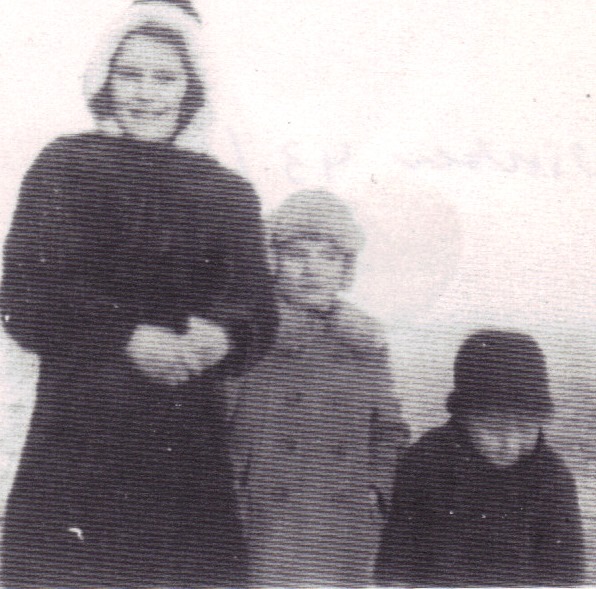
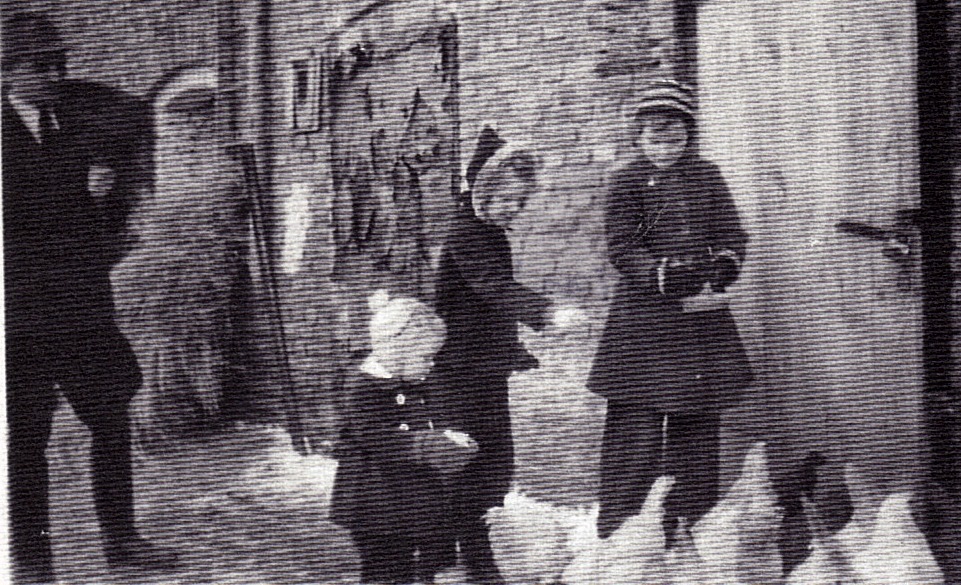
The winter 1943/44 was rather severe especially in the open countryside. We lived there because of air-raid attacks over Berlin. Mum had sewn us warm winter coats and hats to match. In the following picture you can see what we wore to keep out the cold.

2-06-2009 5;00;32 PM

I and my two year old brother with Eva T and  her father looking on.
I and my two year old brother with Eva T in the middle and her father looking on.

Mum did sew the coat I’m wearing, also my little brother’s outfit. Mum also knitted the hats and gloves.

My Education in 1944

The village school in Lichtenow had only one teacher. That was Herr Grosskreuz. His wife, Frau Grosskreuz, came to the school on Wednesday afternoons to teach the girls needlework. Under her guidance I learned to knit socks with five needles. I also learned how to mend socks. Mending socks was called ‘stopfen’. I was taught, how to fill in a hole with a beautiful woven pattern. I probably could still do this kind of work today, only these days one hardly ever finds any holes in socks: It shows how the quality of socks changed over the years!

Every day, including Saturdays, school finished at lunch-time. The only afternoon session for girls was Wednesdays. I did not mind having to go back to school after lunch on that day. I often arrived early in Lichtenow for the afternoon class, stopping at the teacher’s house on the way, where I was always welcomed. I loved to play with daughters Christa and Gerlinde. Christa was the same age as I and had skipped year three together with me. Gerlinde was two years younger. There was another three year old daughter, who was called ‘Püppi’. Püppi and baby-son Hartmut were very sweet. I enjoyed very much visiting the teachers’ family.

The Grosskreuz-family lived in a modern one family home, which stood on a large block of land away from the village. In the village itself were ancient, small farmhouses with huge sloping straw-roofs. People said, the father of Frau Grosskreuz, who was the mayor in a neighbouring small town, had seen to it that the Grosskreuz family could live in style in a modern home.

Why was Herr Grosskreuz not called up to join the army? It seemed to me that he was probably past forty. And besides, he had a slightly crooked leg. It was good, that we were able to have a man-teacher in Lichtenow, so that he could look after all the boys and girls, aged from six to fourteen, which meant that eight different school-years were given lessons in the one class-room!

Later on when I attended school in Herzfelde, I found out that the whole school was run by women. Presumably all male teachers had been called up to fight in the war, the same as had been the case in my school in Berlin.

Aunty Ilse often invited me to sit with her in her cosy living-room, which had extremely comfortable seats upholstered in an expensive velvety red material. Aunty kept an eye on my attempts at knitting and darning of socks. This is how I received a great deal of practice and encouragement. (When I was still very young, Aunty always praised me for doing little pieces of cross-stitch embroidering for her birthday. I felt very proud then that I could give her something I had made.)

When Aunty Ilse started doing office work for Werner M, she sometimes let me help with checking additions of huge columns of numbers. From then on I always found additions easy to do. Aunty must have thought that I was good at checking additions because she asked me again and again to do it with her. I willingly obliged. I loved to do things together with her for I felt very peaceful in her presence.

Mum and Grandma (Omi) and later on also Uncle Peter pointed out that Ilse was a bit of a scatter brain. Once Uncle Peter remarked, that he did not know, how his wife ever was able to get a driver’s license. To me Aunty Ilse seemed rather calm as compared to my nervous and highly strung mother. Mum’s nervousness constantly upset me, even though I usually tried not to show it. As far as I know, I always tried very hard, not to lose control of myself —

Mum had a large roll of hair across her forehead and two more rolls parallel behind it on top of her head. She made me wear one huge roll of hair right on top of my head, which would constantly slip unto my forehead and annoyed me a great deal. One of the first verses, when I started learning English, was:

‘There was a little girl,

who had a little curl,

right in the middle of her forehead.

When it was good,

she was very, very good.

But when it was bad,

she was horrid.’

I imagined, I was very much like this girl!

On my tenth birthday I was finally allowed to discard the nasty roll. It made me feel really grown- up. Best of all was, that I never again had to wear this terrible roll!

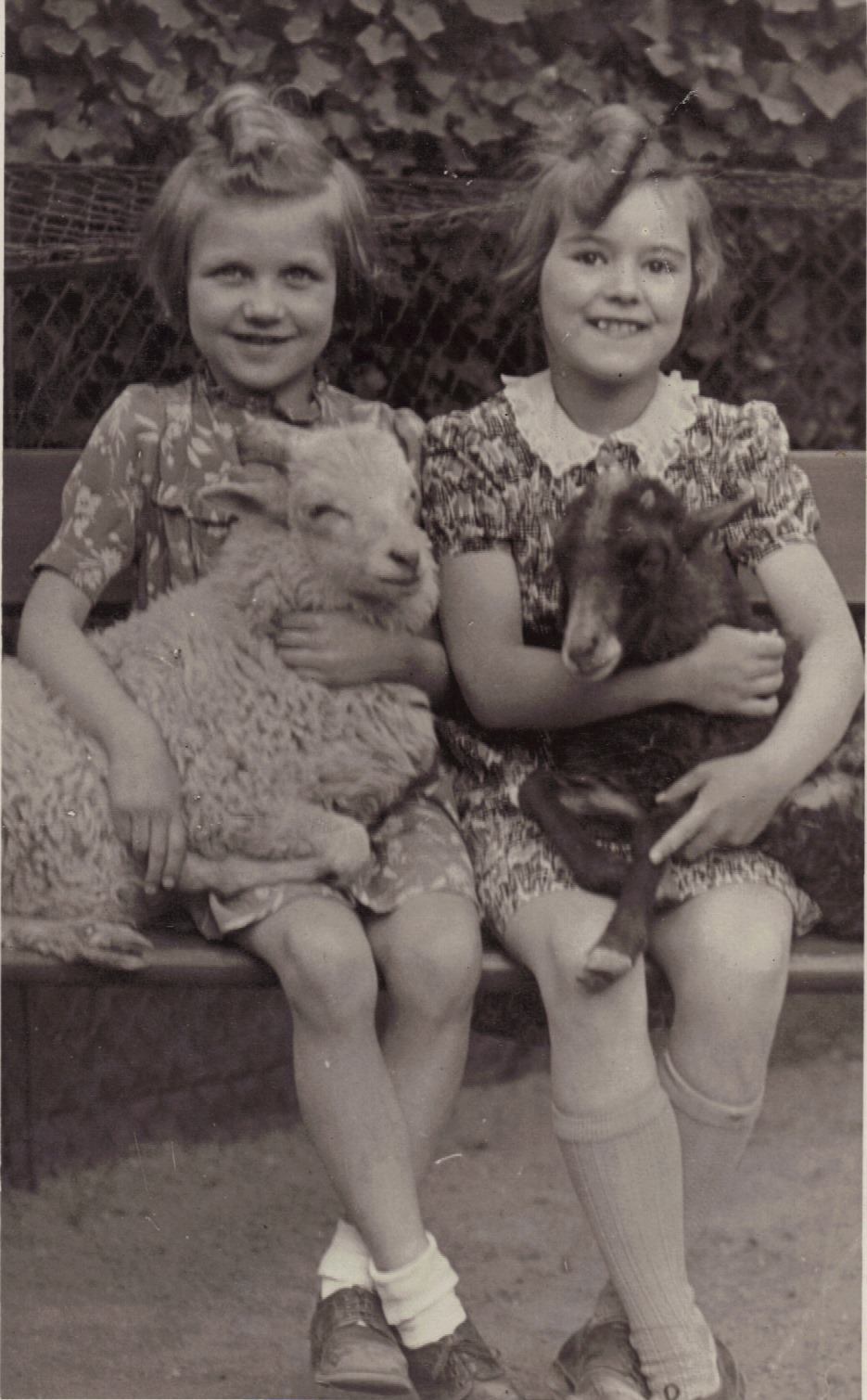
Here I am with Eva T in the Zoo Gardens of Berlin in 1942
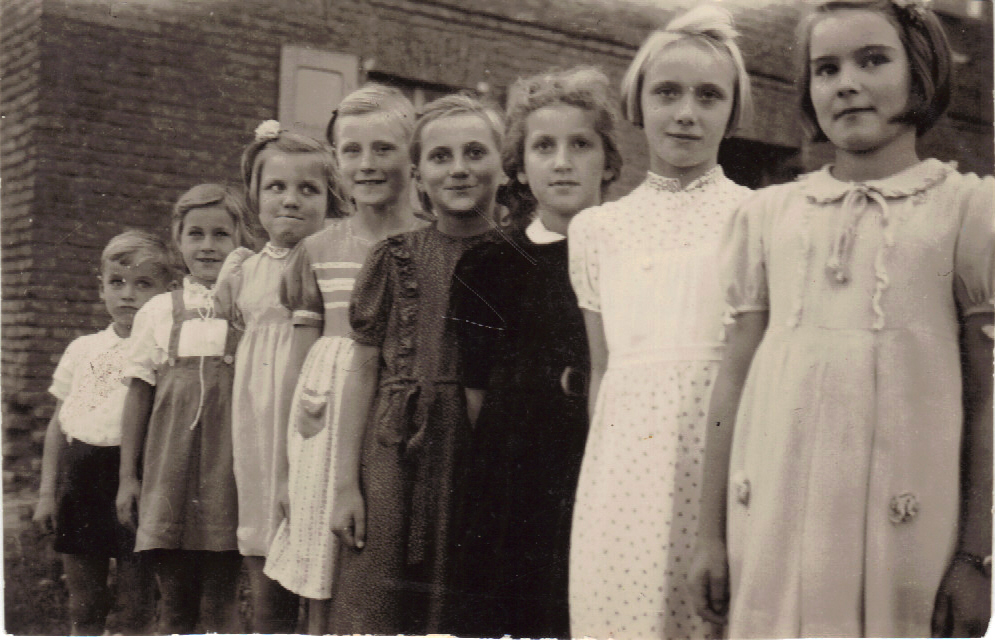
21st September 1944, my guests on my tenth birthday.

I, the birthday girl, at the front, the following three girls are my school-friends from Herzfelde, the next girl is Christa Grosskreuz, then follow Eva T and Gerlinde Grosskreuz, and last but not least my six year old brother Bodo.

Eva had a ‘Poesy-Album’. I thought it was a great idea to get family and friends to write a little verse in such a book and possibly add a photo as well. Mrs T found out that I would very much like to have a ‘Poesy-Album’. She said: ‘I believe I still have a spare album amongst my things in Berlin. I’ll ask my mother to look for it. When she finds it, I’ll give it to you.’

Eventually I was given Mrs T’s album. I regarded it as a very special gift. After sixty-five years it is still in my possession. Looking through it, I find that my father wrote something in it for me on the 16th of April 1944. This shows me that he must have been with us on leave at the time. What he wrote, makes a lot of sense. In his writing he points out that in the long run true luck comes only to the efficient person. Therefore he urges me, to be diligent and ambitious. However I should at all times hang unto my peace of mind!

I look at that page which he seems to have written the way it came into his head. One word is crossed out, another word misses several letters. I wonder, whether he made mistakes because it is a first draft or whether he was upset about something when he wrote it . . . .

I like the passport-photo that he stuck next to his writing. This photo was probably taken before he joined the army, well before he turned forty. Oh, my father was still very healthy and good looking then!

MY MOTHER

The following I posted once before. So it may sound familiar to you.

Mum doted on me. I was her first born child. I am sure I got a lot of attention during the first years of my life, and not just from Mum, but also from her sister who had no children of her own. Later on I realised that my mother would very much have loved to have a daughter in her image. What a disappointment it must have been for her that I was in a lot of ways the exact opposite of her! I did not like to be a girl. Oh, I wished so much to have been a boy. Girlish things just did not interest me one bit!

On the ninth of June 1938, when I was not quite four yet, I was very excited about the arrival of a baby brother.  A year and two months after the birth of the baby Mum left us children in the care of our live-in home-help. Why did Mum leave? I remember a call from Mum’s sister who was holidaying in Westerland on the Island of Sylt. I imagine Aunty would have said something like this:

‘Please join me, I am so lonely on that island here, I don’t like to have to spend all the time with that pretentious mother-in-law. She watches me like a hawk! Please, please, come, spend some time with me. It would be so good to have you around here! We can have such a lovely time together. And listen, I’m going to pay for your airfare. You can stay in my room with me. Mother-in-law is in the connecting room.’

Mum promised her sister, she’d fly to Westerland the same day. She was quite excited about this. In her excitement she forgot to ring Dad’s office to let him know about her plans. Or did she deliberately not ring him because she sensed that he would have objections to her leaving us children in the care of our home-help! I remember when Dad came home he was furious when he found out that Mum had taken off to join her sister and left us children in the care of our eighteen year old home-help! I believe Mum stayed in Westerland for a whole week. When she returned, she talked excitedly about how she had been spending time with her sister in Westerland.  Come night-time they waited till Auntie’s mother-in-law was fast asleep, pretending they were going to sleep too. However as soon as they thought the old lady was fast asleep, they escaped through their bedroom window and went dancing. I remember seeing pictures of them that were taken on the dance-floor. They had already acquired a nice brown tan from having spent time on the beach. I remember looking at the photos and seeing how very brown their faces looked in sharp contrast to their white dresses. Two young marine officers, smartly dressed in their uniforms, could be seen with them. Later I found out, that one of the officers was Helmut Lorenz who five years later became Aunty’s second husband after her divorce from the first one. And the other officer was no other than Max Tomscick, who after the war became Mum’s friend and whom she would call ‘Bambie’.  If I’m right that this holidaying on the isle of Sylt took place during the first half of August 1939 this would mean that just a few weeks later, on the first of September, Germany was at war and the above mentioned young navy pilots would immediately have been on call for they were officers in the German Navy.

I cannot recall that having to stay without Mum for a week did cause us any hardship. So the young home-help must have coped quite adequately.  When Baby Brother was nearly a year old he had developed an allergy to cow’s milk. He was not allowed to drink milk then. However when he was a bit older, he could drink milk again.

Mum’s third child, also a boy, was born during the war in 1941. We had a twenty year old Polish maid at the time, who soon cared for the new baby as though he was her own. She became his ‘Dada’. She was the main contact person for the first three years of his life. This second brother became a very happy and contented child, whereas the first brother was always highly sensitive and suffering from asthma through most of his childhood. Dad, when he was around, would pay a lot of attention to us children. But I suspect, this very sensitive brother did not always get sufficient attention. However when he had one of his awful asthma attacks Mum would always be very concerned and tirelessly look after him. Later on in life he failed to establish a long lasting relationship with a woman. The photo shows Mum with us three children in 1948.Charlotte mit ihren drei Kindern 1948

Our Polish maid, Maria, with  the three of us, Summer 1944
Our Polish maid, Maria, with the three of us, Summer 1944
This is a pass-port photo of Maria.

Childhood Memories

I have now two pages about my childhood. One is just “Uta’s Early Childhood”, the other one is “Uta’s Early Childhood, Part II”. In the Part II I inserted today some pictures about my sixth birthday in 1940 plus one picture from summer of 1942. All these pictures were taken during the war, World War II that is, when we lived in Berlin, Germany.

Did we suffer during the first years of war? I don’t think so. Except that my father had moved away from Berlin. He became the manager in grandfather’s furniture factory in Lodz, Poland, which since the German occupation in 1939 was called Litzmannstadt. My father had grown up in Lodz. His family had lived in Lodz since the early 1800s, when this part of Poland belonged to Russia.

My father had studied in Leipzig, Germany. In 1930 he had married my mother in Leipzig. During the early years of their marriage they had for the most part lived in Berlin. Sometime during the early war years my father had some disagreements with some Nazi people he worked with in Berlin. I think he didn’t voice his disagreements publicly. Had he done so, he may have ended up in a concentration camp!

In the end he was allowed to remove himself from Berlin. As I said he became then the manager in grandfather’s factory. My mother typically chose to stay with us children in Berlin. We only went for some visits to “Litzmannstadt”.