OUR LUCKY ESCAPE

Today I remembered again how we escaped all these bomb raids during World War Two. and how we escaped the bombing of grandmother’s place in Leipzig in April 1945. Here I wrote about it:

https://auntyuta.com/2011/12/08/our-lucky-escape/

Some of my children know a bit about our lucky escape in 1945. In case they want to find out a bit more about it, I am now trying to write down whatever I do remember.

During the last war years we had stayed away from Berlin, living east of Berlin in a desolate country area. With the Russians fast approaching at the beginning of 1945, my mother decided, we would move to grandmother’s place in Leipzig, rather than go back to Berlin to our apartment which we still rented. We children were never allowed to visit Berlin during the years of the bomb raids.

From the beginning of February 1945 my mother, my two brothers and I stayed in Leipzig with grandmother and cousin Renata. As I remember it, there were frequent bomb raids. We were used to the sound of the sirens and having to stay in the cellar for hours at a time.

After Christmas, schools had not opened any more. We played a lot in the surrounding streets with other children. But we were never allowed to stroll very far. In case of an alarm , we had to be within the vicinity of our cellar. For us children this was just part of every day life. My brothers were three and six years, I was ten years old. The winter was very cold, but we still had enough to eat, were dressed warmly. In the kitchen there was always a fire going in the oven for cooking and for hot water. In the bedrooms we had enormous feather-beds to keep us warm.

There was talking about that this bloody war was soon to end. We sure were looking forward to this! I cannot remember ever having been scared or thinking that anything bad could happen to me. Or to my family. To us children it seemed rather entertaining to be sitting in the air-raid shelter. Many people congregating as soon as the sirens went off, was extremely exciting! We did get to know everyone, who lived in that tall five story building. The adults would talk to us children, asking us questions, just being friendly.

And we would listen to the adults talking to each other. I remember that I always found it interesting to listen to adult conversations. And sometimes all of us would sing a few songs. I loved the singing of songs! When we could hear bombs hitting somewhere in the neighbourhood, it never seemed very close to us. This meant we were all right. Often my three year old brother entertained everyone by singing solo. They were cute little children’s songs. People always encouraged him to sing more songs because they loved his singing.

In April there was another bomb-raid. We had a relaxing time with everybody in the cellar. It was a long lasting alarm, went on for hours. Since it was in the middle of the night, mum wanted us to go to sleep. We were able to stretch out a bit on our makeshift beds. But I don’t think we were able to go to sleep that night. My brother Peter was still singing his songs when several bombs hit us. This time there could be no doubt that the bombs had fallen right on top of us since the noise was absolutely deafening! My six year old brother Bodo started crying. I felt so sorry for him. It was terrible seeing him being so horribly scared. I said to him he needn’t be afraid. Soon everything would be over.

I was right. It did not take long at all. All of a sudden, it was very quiet. Then some people started moving, investigating, whether we could still get out. Our main exit was full of debris. Impossible to get out there. There was a bricked-in escape to the cellar of the next door building. To make use of this escape, quite a few bricks would have to be dislodged. Then someone shouted that the window, that led from the cellar to the footpath in one of the adjoining cellar-rooms, was not blocked. It was easy, to get out through there!

A sigh of relief went through the crowd. My brother Bodo was not scared any more either. My brother Peter had never been scared at all. People said, this was because he had still been too little to understand. Later on, we found, that the building had been hit by up to five bombs. Right to the ground-floor,  everything had been torn away. Miraculously, a lot of the ground-floor was still standing. This was my grandmother’s apartment! My grandmother was able to save some of her furniture together with all our belongings. A lucky escape indeed.

I published the above in December 2011 and here are some comments to this post:

  1. What a harrowing experience! I hope people are not so quick to forget. There are no real winners in war. There are only casualties. European countries are wise to tread carefully not to disentangle their alliances. No one wants to Europe ripped apart by some lunatic or some crazy ideology.

    1. There have been a lot of changes since the end of World War II. Has the world become more peaceful? Do we all work for peace? When we say we want peace on earth, do we really mean it?
      Let’s count our blessings and be thankful for what has been given to us. But let’s not forget that a lot of people still suffer enormous hardship.
      Thanks for visiting, dear Mary-Ann. Your comments show that you care a lot. Have a very beautiful Advent Season. Best wishes, Uta.

    1. I cannot remember ever having been very scared as a child. But writing about it now makes me shake a bit. After more than 66 years I find it hard to believe that we could have been so lucky to escape unhurt!
      Thanks for your comment, dear Munira.

  2. Oh my goodness. What a vivid account. I know what you mean about being fascinated by adult conversation. I was the same way as a young child. Perhaps that is part of the reason that you had a bit of an adult-like perspective on the events at the time and yet saw it through the eyes of a child as an adventure of sorts. But my goodness–to have experienced so very much so very young. I am grateful that you and your family survived.

    1. You’re spot on with your comments, dear Kate! As you say as children we could see it as an adventure of sorts. Mum was always quick too to make the best of a given situation. We lived in one of the cellar-rooms for the first few days after our building had been destroyed. It was spring already. During the day we had lovely sunshine. Mum and Renata acually anjoyed sitting in the sunshine on mats on the big heap of rubble in front of what used to be our house. They were happily remarking that they had a lovely time sitting there! I am not sure what day the Americans arrived in Leipzig, but I am certain it was while we still lived in the cellar. I was close to Mum and Renata when we noticed some planes flying above us in the clear sky. It happened to be the 20th of April. Mum as well as Renata very happily joked that the planes might be on their way to Berlin to give Hitler a birthday present!.

    1. After the end of W W II we were under the delusion that wars could be prevented forever. We were so much longing for a peaceful world! We were dreaming that peace could last forever. My family was lucky that now for more than 65 years we could live in peace. I wished everyone had the chance to live in peace like this.

Leave a Reply


Sunday, the 1st of September 2019

Today is the official start of spring. It happens also to be Fathers Day because it is the first Sunday in September. And it is the Anniversary of the outbreak of WW II some eighty years ago!

Well, I grew up in Berlin, in Germany. I was born in September 1934. So I do remember that war started on the 1st of September 1939 when I was not quite five years old.

Soon now I am going to be 85. Personally I am happy, that since Germany’s capitulation on the 8th of May 1945 I did not have to experience any more wars.  For sixty years, that is since 1959, I lived with my husband in Australia.

https://en.wikipedia.org/wiki/German_Instrument_of_Surrender

“The German Instrument of Surrender was the legal document which effected the extinction of Nazi Germany and ended World War II in Europe. . . .”


and

A few Questions I asked in a Comment I made a few Days ago

‘. . . . enormous changes are coming, probably for you and definitely for your children and grandchildren.’  This is what Chris Martenson says in his article from January 26,  2019:

By Chris Martenson: Collapse is Already Here

https://auntyuta.com/2019/08/26/enormous-changes-are-coming/

In a comment to my above post I ask the following questions:

A drop in living standards to sustainable levels? It seems to me, hardly anyone is prepared for a drop in their living standards especially if our leaders do not have the guts to insist on it.
What then is most likely to happen in the near future?
Some more far thinking people tell us, something catastrophic may happen, namely the collapse of our natural support systems. . . . The majority of people so far resist believing all this. especially when the leaders give the impression that it is all right to just continue with our way of living the way it is. So, why change anything when we have such a ‘good life’; isn’t this the attitude of most people?

The UK and Germany are miles ahead on climate action

UK and Germany showing Australia what’s possible

13.08.19BY 

It’s easier to imagine a transition to a renewable economy, if we can see what that looks like in action. So we decided to take a select group of journalists to the UK and Germany, to learn from the clean energy revolution already underway, and to bring those stories back home to Australia.

The UK and Germany are miles ahead on climate action

Throughout the trip, the thing that struck the journalists the most was how far ahead the UK and Germany are on climate action and policy compared to Australia. Over the past 10 years, the UK and Germany have made significant progress transitioning away from fossil fuels into renewable energy. While Australia has been an international laggard with no credible climate policy to speak of at present.

Off the coast of England, the journalists saw huge wind turbines embedded in the deep; rode electric black cabs and bright red electric buses through the streets of London, and set foot in German towns that are leading the transition from coal to renewables.

Climate change policies receive bipartisan support in the UK

In the UK, the science of climate change enjoys bipartisan support, which has been brilliant for business and investment, because a change of government doesn’t equate to a rewriting of the rules. This support from both sides of politics has also paved the way for tangible action to tackle the climate crisis.

And recently, Great Britain went two weeks without using coal to generate electricity – the longest period since the 1880s. Records like this are set to become the norm, as it transitions to renewables.

Germany shows us what a just transition away from coal really looks like

While Germany, recognising the need to transition away from fossil fuels, also acknowledges the importance of involving everyone in the process. The last black coal mine closed in December 2018, after a decades-long process. In that time, nobody was made forcibly redundant. Instead, miners were offered generous early retirement packages or the opportunity to re-skill. And this year, Germany committed to closing its brown coal mines by 2038.


If you want an Australia led with imagination, pitch in a tax deductible donation to power our media work creating a vision for our future. And together, we can accelerate that momentum.


Telling positive stories to show Australians what’s possible

It’s real stories like these which can change the course of our future here on home soil. And we need to learn from them, if we’re going to bring everyone along with us in creating an Australia powered by clean energy.

These stories have now been seen by 1.6 million people (and growing), and have been covered by The Australian to the SMH, The Today Show and Radio National.

These stories are already making a local impact

Journalist and trip attendee, Nick O’Malley, recently published a widely read piece in the Sun-Herald and Sunday Age, titled, How Germany closed its coal industry without sacking a single miner. Following its publication, the NSW parliament announced an inquiry aimed at setting a ‘responsible road map’ out of coal and into clean energy. The inquiry will look at the full picture, including NSW’s energy needs, the economic opportunities of renewable energy, and supporting communities to adapt.

It’s clear that momentum is building around the conversation we need to have.

A collage of different media headlines that came out of the Climate Council's media trip to the UK and Germany.
A snapshot of some of the media headlines produced by the journalists that came on the Climate Council’s trip to the UK and Germany. 

This is Australia’s “fork in the road” moment.

Either we plan for the inevitable transformation, like Germany, or we remain in denial until our future is changed for us.

Will you join us in fighting for an Australia with imagination and decisive leadership on climate action?

Elphick, Gladys (1904–1988) by E. M. Fisher

http://adb.anu.edu.au/biography/elphick-gladys-12460

This article was published in Australian Dictionary of Biography, Volume 17, (MUP), 2007

Gladys Elphick (1904-1988), Aboriginal community leader, was born on 27 August 1904 at Wright Court, Adelaide, daughter of John Herbert Walters, gas-meter inspector, and Gertrude Adams. Her maternal great-grandmother was Kudnarto, a woman of Kaurna-Ngadjuri descent, who had married English-born Tom Adams in 1848. At 8 months Gladys Adams was taken to live with relations at Point Pearce Mission Station, Yorke Peninsula. Educated at the local school, as a child she rode horses, swam, played sports and taught herself the organ. Leaving school at 12, she worked at the station dairy. Women Elders trained her as a midwife.

On 13 June 1922 at the Point Pearce Church Gladys married with Methodist forms Walter Stanford Hughes, a shearer. They had two sons. Her husband died in 1937; two years later she moved to Adelaide and found work as a domestic. On 2 December 1940 at St Ignatius’ Catholic Church, Norwood, she married Frederick Joseph Elphick (d.1969), a soldier. They resided first at West Thebarton and later at Ferryden Park. Employed during World War II at the South Australian Railways’ Islington workshops, producing munitions, she won an award for a shop-floor invention.

In the 1940s Mrs Elphick joined the Aborigines Advancement League of South Australia and in the 1960s served on its activities committee, which organised social and sports events. As founding president (1964-73) of the Council of Aboriginal Women of South Australia, she worked to raise the status of Indigenous people in the community. The council employed a social worker, set up various sports clubs and arts and crafts groups, and encouraged women to learn public speaking so that they could confidently express their ideas. Members campaigned for the `Yes’ vote in the 1967 referendum that ensured Federal responsibility for Aborigines, and lobbied for the franchise and Aboriginal rights generally. They established a women’s shelter and health service in Adelaide, and took steps to set up a legal aid service and a kindergarten. In 1973 the women’s council changed its name to the Aboriginal Council of South Australia and included men in the organisation. That year the Aboriginal Community Centre was established to house the various services; Elphick was elected treasurer and was later made a life member of the centre. She was a founder (1977) of the Aboriginal Medical Service.

In 1966-71 Mrs Elphick was a member of the South Australian Aboriginal Affairs Board. She was appointed MBE in 1971. An advocate of adult education courses for Aborigines, in the 1960s she had helped to arrange evening art classes, conducted at Challa Gardens primary school by John Morley. These and other programs led to the establishment in 1973 of the College of Aboriginal Education, as part of the Underdale campus of the South Australian College of Advanced Education.

Known as `Aunty Glad’, Elphick, according to Kevin Gilbert, possessed a `lively sense of humour’ and `a shrewd personality’ that pierced through `humbug’. A highly respected elder, in 1984 she was named South Australian Aborigine of the Year. She died on 19 January 1988 at Daw Park, Adelaide, and was buried in Centennial Park cemetery. Her elder son, Timothy Hughes , had predeceased her; her son Alfred survived her. In 2003 the Aboriginal women’s group advising the International Women’s Day Committee (South Australia) presented the inaugural Gladys Elphick award.


Berlin in Petrenko fever: His inaugural concert with the Berlin Philharmonic

https://www.dw.com/en/berlin-in-petrenko-fever-his-inaugural-concert-with-the-berlin-philharmonic/a-50153214

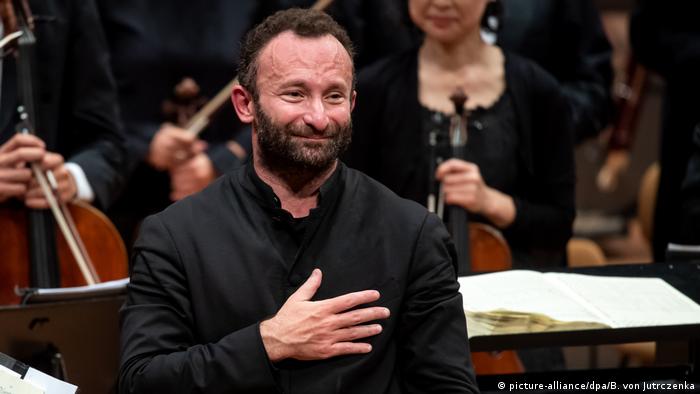
“Four years ago, Kirill Petrenko was elected principal conductor of the orchestra, one steeped in tradition. At his first official concert in that function, the Russian-born maestro gave a sample of what is in store.

    
Kirill Petrenko with orchestra members seen in background (picture-alliance/dpa/B. von Jutrczenka)

What’s the secret of a conductor’s success? His aura? Charisma? Stage presence? Authority? Technical ability? Hard work?

Those questions came to mind while experiencing Kirill Petrenko’s first appearance as principal conductor of the Berlin Philharmonic. And were answered.

Read more: Back to the basics with Petrenko

The iconic Berlin Philharmonie shook to the performance of Beethoven’s Ninth Symphony, and one could feel the tremors in far-off Bonn, where this author watched the transmission in a movie theater. Getting a ticket for the concert in Berlin was impossible, but that was a blessing in disguise: In the theater, one could watch the musical process up close.

Rare appearances

Back to the beginning: In 2015, the Berlin Philharmonic — one musician, one vote — elected the now 47-year-old Austrian, born in Siberia, to be the seventh principal conductor in the orchestra’s 137-year history. Only seven principals in 137 years points to a long history for each individual one.

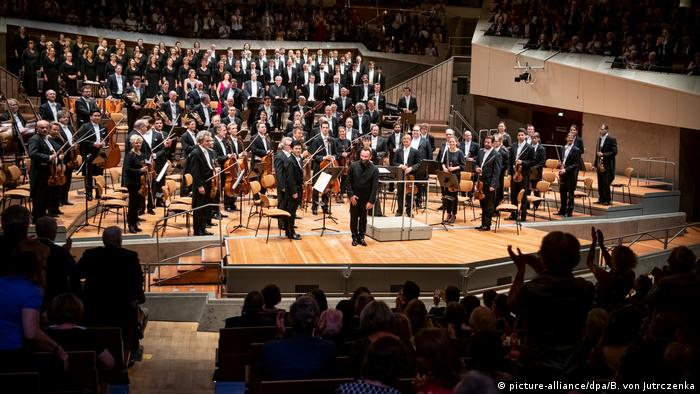
Orchestra members, choristers and conductor onstage in the Berlin Philharmonie (picture-alliance/dpa/B. von Jutrczenka)All dressed in black, except for the mezzo-soprano — she wore red

Pre-election, the Berliners had experienced Petrenko only a few times, and post-election there were only four joint performances. In the season to come, Petrenko graces the playbills only six times — in contrast to his omnipresent predecessor, Simon Rattle. The reason? Until the end of 2020, Petrenko remains under contract with the Bavarian State Opera and will commute from Munich to Berlin and back.

So his inaugural performance was all the more hotly anticipated. It began with Symphonic Pieces from the opera “Lulu” by Alban Berg. A riddle of a work from the year 1934: highly modern, atonal.

With 100 energetic musicians onstage, one had the impression that the conductor was working harder than the rest together. Veins pulsed in his forehead, and long before the main work of the evening, he was working up a sweat.

Making music with modest means

Petrenko’s philosophy? “We have to see what we can achieve with our modest means,” said the maestro in a pre-concert interview. Modest means? The Berlin Philharmonic is considered one of the world’s most-renowned orchestras. Some even say: the most-renowned.

Was the conductor playing down the group or its members’ abilities? Hardly. “There are not just 130 musicians sitting there,” says cello chair Olaf Maninger. “The orchestra’s whole history is sitting there. And he brings along the respect for that into his official function.”

The remark about “modest means” can have been made by Petrenko only in relation to something much greater: a work of music, something that can be only approached and never fully revealed.

Conductor applauds musicians and directs them to stand up (picture-alliance/dpa/B. von Jutrczenka)A conductor who wants to insure that every one of his musicians gets fair credit

Beethoven’s Ninth sounding new

All the more so with a often-heard piece like Beethoven’s Symphony No. 9, which had also been important to his predecessors Hans von Bülow, Artur Nikisch, Wilhelm Furtwängler, Herbert von Karajan, Claudio Abbado and Simon Rattle. When conducting it, every nerve, ever fiber in in Kirill Petrenko’s body seems infused with music. He drives the musicians with expansive, energetic gestures, yet seems to conduct most of all with his eyes. In close-ups, those expressions are intriguing, ranging from desperation to jubilation, from wild to crazy — and culminating again and again in an ecstatic grin.

Read more: all about Deutsche Grammophon

Sometimes Petrenko seems to beseech, to implore his musicians with his body language. He often even seems to stand at the edge of a precipice, as though only his last reserves of energy and those of his fellow musicians could prevent the fall.

The exertion is echoed in the faces of the instrumentalists. They, too, play as though their lives depend on it.

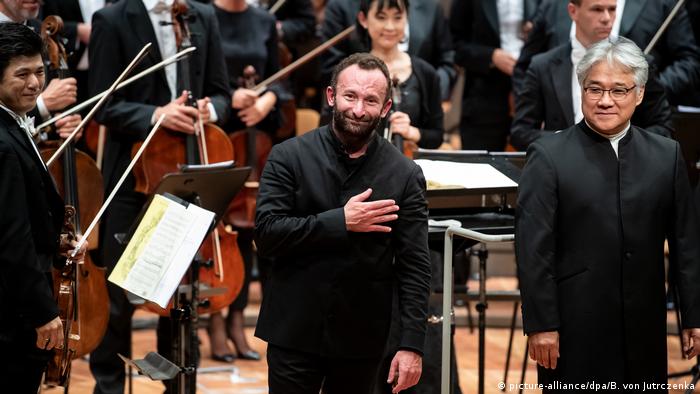
Conductor, soloist and orchestra taking ovations (picture-alliance/dpa/B. von Jutrczenka)Moved and exhausted: Petrenko and baritone Kwangchul Youn

Passion and humility

Orchestra members confirm that wild, uncompromising demeanor. “He went absolutely berserk,” says horn player Sarah Willis, describing Petrenko’s passion. “He struck like a meteor,” agrees violist Matthew Hunter. “It was an explosive experience.”

Yet in conversation, the conductor seems quiet and modest, anything but a commanding presence. In an interview with cellist Olaf Maninger, he mostly avoids eye contact and speaks in a quiet tenor and with a thick Russian accent, as though embarrassed to be speaking at all. One understands why Petrenko rarely gives interviews. But the message is clear: “A concert like this comes only once in a lifetime. Yet the pressure is incredible. I couldn’t wait for the day to pass. I wanted it to be evening right away.”

And about the point of departure for the new relationship: “I had the feeling that the musicians are ready to honestly follow my intention. And so I want to give them some kind of confirmation, to say: ‘Yes, I’m the one!'”

No megalomaniac at the podium

The American Matthew Hunter, a member of the Berlin Philharmonic since 1996, explains what Petrenko’s modesty means in terms of music-making: “You don’t have to have a big ego onstage. In fact, it probably gets in the way of achieving musical aims. So you can be modest and still have the maximum musical authority.”

And the results? Beethoven’s Ninth was rendered with momentum, passion — and meaning. A work that has to withstand performances at every kind of official celebration sounded fresh, as though heard for the first or only time. Timpani player Rainer Seegers describes the experience, saying: “You take the maximum risk. But then you have the chance that something comes about that can never be repeated.”

Gazing into the crystal ball

What’s to be expected in the Petrenko era of the Berlin Philharmonic Orchestra? Matthew Hunter gives a hint: “I can’t predict how Kirill Petrenko will develop our sound in the next five or 10 years. But I would say we’re returning to something in our sound. The sound is in us, and it will be in the air.”

Rainer Seegers adds, “Something is returning, something that was there ages ago with Karajan. Restoring the unmistakable sound of the Berlin Philharmonic: I think that’s his secret goal or wish.”

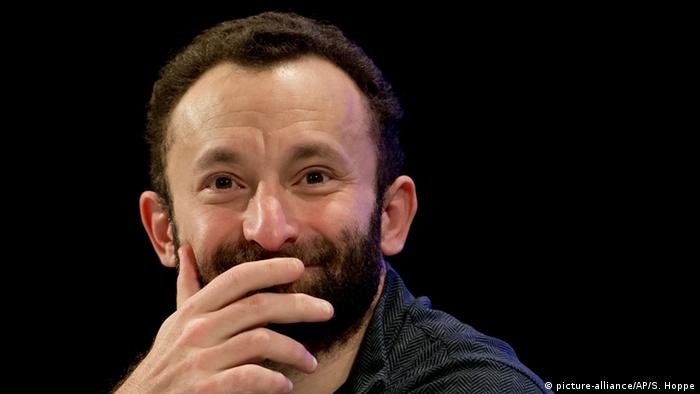
Kirill Petrenko smiling broadly, partially covering his face with his hand (picture-alliance/AP/S. Hoppe)Just what does he have in mind?

For the moment, it’s more of a honeymoon feeling between maestro and orchestra. The program is to be repeated outdoors on August 24 in front of the Brandenburg Gate for an audience of up to 32,000, with transmission onto an LED screen, to television and to the Berlin Philharmonic’s Digital Concert Hall. The program begins at 8:00 p.m. CET.

But what was the last thing heard the night before? Ovations, curtain calls, flowers, bows, hugs: the usual ritual — but the ovations wouldn’t subside. One felt the applause could have gone on for half an hour, had the chorus and orchestra not stood up and walked out. Then the auditorium thinned out, too, but the clapping and cheering continued until Kirill Petrenko appeared again on the now empty stage and bowed to the remaining audience members as though to say, “Yes, I’m the one!”

Every evening at 1830 UTC, DW’s editors send out a selection of the day’s hard news and quality feature journalism. You can sign up to receive it directly here.

DW RECOMMENDS

WWW LINKS

RELATED CONTENT

Johannes Brahms / Foto 1864 - -

Symphony for the piano 15.08.2019

Johannes Brahms began with a sonata for two pianos, which morphed into a symphony and later into his first piano concerto. The result is so perfect, you’d think he’d planned it that way from the start.

Komponist Mieczysław Weinberg

Rediscovering Weinberg15.08.2019

Why are some composers popular, then forgotten? Or ignored during their lifetime and later treasured? Such is the case with the Polish-born Soviet composer Mieczyslaw Weinberg, whose centennial falls in 2019.

Das Jugendorchester der EU beim Young Euro Classic 2019

Young Euro Classic launches a new season19.07.2019

Celebrating its 20th anniversary, the world’s largest parade of youth orchestras has music by Beethoven in its sights – but audiences can also expect surprises.

  • Date 24.08.2019
  • Author Rick Fulke


Kirill Petrenko startet bei den Berliner Philharmonikern

https://www.dw.com/de/kirill-petrenko-startet-bei-den-berliner-philharmonikern/a-18532207

“Er ist heiß begehrt: Kirill Petrenko, der in Russland geborene Dirigent, übernimmt Simon Rattles Nachfolge bei den Berliner Philharmonikern. Mit Beethovens “Neunter” legt er los.

    
Dirigent Kirill Petrenko (Foto: Sven Hoppe/dpa via AP,file)

Vor 13 Jahren, im Frühling 2006, spazierte ich mit Kirill Petrenko durch Berlin, nach einem “Don Giovanni” an der Komischen Oper. Wir waren beide gleich alt und beide in Russland geboren. Es war spät, aber mein Gesprächspartner hatte ausreichend Zeit für ein Interview, obwohl er kurz zuvor einen fulminanten Mozartabend dirigiert hatte. Wir sprachen Russisch. “Musik ist nicht zum Spaß da”, sagte er unter anderem, “sondern dazu, dass wir ständig an uns arbeiten, auch das Tragische am Leben erkennen und dadurch womöglich bessere Menschen werden.” Die Musik sei schlussendlich die höchste Form der Menschlichkeit, so Petrenko. . . . ”


“Dass ein Musiker mit russisch-ukrainisch-jüdischen Wurzeln zum Nachfolger nicht nur von Simon Rattle, sondern auch von Wilhelm Furtwängler und Herbert von Karajan wird, ist ebenso symbolisch wie historisch gerecht.”

https://www.dw.com/de/kirill-petrenko-gab-seinen-einstand-mit-den-berliner-philharmonikern/a-50151396

Autor Rick Fulker

Beethovens Neunte ganz neu

. . . . . .

Ein Blick in die Zukunft

Was kann man in der Petrenko-Ära der Berliner Philharmoniker erwarten? Matthew Hunter deutet es an: “Ich kann nicht voraussagen, wie Petrenko unseren Klang in den kommenden fünf bis zehn Jahren entwickeln wird. Aber ich würde sagen, wir kehren zu etwas zurück.”

“Rainer Seegers wird da deutlicher: “Da kommt wieder so was, was vor urlanger Zeit mit Karajan auch war. Der Klang der Berliner Philharmoniker, den es mal gab, wiederherzustellen: Ich glaube, das ist sein geheimes Ziel.”

Petrenko und sein Orchester auf der Bühne (picture-alliance/dpa/B. von Jutrczenka)Zum Schluss lässt Petrenko die Orchestergruppen aufstehen

Zum jetzigen Augenblick steht aber erstmal die frisch gebackene Partnerschaft im Vordergrund, die von einer Art Flitterwochen-Gefühl überlagert wird. Am 24. August wird das Programm wiederholt – am Brandenburger Tor vor einem Publikum von bis zu 32.000 Menschen samt Übertragung auf eine LED-Wand, ins Fernsehen und zur Digital Concert Hall der Berliner Philharmoniker. Um 20 Uhr mitteleuropäischer Zeit geht es los.

Und wie ging die Aufführung am 23. August zu Ende? Mit nicht enden wollenden Ovationen, etlichen Vorhängen und den üblichen Ritualen: Einzelne Instrumentengruppen nahmen den Applaus entgegen, Chor, Vokalsolisten – und immer wieder erschien der Maestro, der glücklich und erlöst wirkte. Das hätte vermutlich eine gute halbe Stunde so weiter gehen können. Irgendwann standen jedoch Orchester- und Chormitglieder auf und gingen. Dann lichteten sich auch im Auditorium die Reihen etwas. Es ging aber mit dem Applaus immer noch weiter. Endlich kam dann Kirill Petrenko alleine heraus, ein letztes Mal, und verbeugte sich vor dem Rest-Publikum. So als wollte der bescheidene Maestro nochmal sagen: “Ja, ich bin es!”

Our Brunch on a Sunday in August 2018


IMG_1837.JPG

>


DSCN4693DSCN4694

DSCN4697


DSCN4699
I copy here what I wrote in last year’s blog including the comments to that post:

Sunday, 12th of August 2018

The soft boiled eggs that Peter cooked for breakfast were perfect. I ate my warmed up crispy bread-roll with the egg, I also had some fresh strawberries with strawberry jam on one half of the bread-roll. And I took all my vitamins. We both also had a great cup of coffee for our breakfast.

At nine o’clock we started watching the Insiders’ program on ABC TV. The politics that were discussed upset me a great deal. I mean I should be used to this sort of political talk  by now where everything gets blamed on labor. But somehow it got to me today more than usual. I just could not keep my cool. Maybe I should stop watching these interviews where no question gets answered properly and were outrages lies are repeated ad  nauseam. Soon Peter handed me a bit of brandy to calm my upset stomach. This bit of brandy that I sipped very slowly, actually made me feel a whole lot better.

Later on for  brunch we had baked camenbert cheese with some bread and a glass of red wine. We also had a bit of vanilla ice-cream with apple sauce. Luckily my stomach had settled sufficiently, and I could enjoy this excellent meal. I enjoyed it very much indeed!

7 thoughts on “Sunday, 12th of August 2018”

  1. We forgot the ABC Insiders which is unusual. Just as well by the sound of it. Glad you made up for it by having such a lovely breakfast. We are finding that the ABC is so keen to remain neutral that it is now dribbling a lot of nonsense in its commentary, frightened to give an opinion, any opinion.

    1. Here you can watch the whole program, Gerard, in case you and Helvi are interested.

      http://www.abc.net.au/insiders/sunday-12-august-full-program/10111188

      “Barrie Cassidy interviews Energy Minister Josh Frydenberg, and Fiona Katauskas talks pictures with The Feed’s Jan Fran. On the panel are The Australian’s Niki Savva, Guardian Australia’s Lenore Taylor and The Saturday Paper’s Mike Seccombe.”

      Barrie Cassidy and also the panel did not upset me. The Energy Minister chose not to answer certain questions. Do you expect anything else from politicians? Sometimes I just cannot listen to them anymore! But I understand that the person who is interviewing has to remain polite. I went out for a while to calm down. But I did watch the hilarious talking pictures. A bit of fun and laughing is definitely preferable!

      What do you think of the “National Energy Guarantee” program?

      http://www.abc.net.au/insiders/balancing-act/10111158

      https://www.energy.gov.au/government-priorities/better-energy-future-australia

  2. Thank you Uta for the links.

    Helvi watched the whole episode on my computer. She thought Frydenberg was weak. We feel that renewables are the only way to get cheap energy that will also guarantee lower emissions. It is ironic that Australia with its overabundance of resources now has some of the highest energy prices in the world.
    Sadly the word ‘renewables’ has become a dirty word in our Government. Those without solar and batteries will increasingly carry the burden of coal fired energy and its maintenance.
    What do you think will give us energy at a price that is affordable? I just had my electricity bill which was $410.- for three months. The last gas bill was about the same.

    1. Our recent electricity bill was a bit over 600 Dollars for three months, Gerard. But we use no gas. You’re right, only people who have solar and batteries can expect to pay less for power in the long run. Why does the government not want some of the old power stations to close? And why, oh why, do they even think of allowing new coal power stations to open? Surely no investor would want to invest in new coal fired power stations? Who owns the coal? Is it the government or some companies?
      Surely, we have enough sun and wind in Australia for all our energy needs. We have sun and wind for free, whereas someone has a vested interest in all the coal reserves and wants to get some adequate profit from whatever their investments were.
      I hate it that there are so many different energy companies now. The supply of energy and water should be in government’s hands only. The government should also have strict rules that our air and environment does not get polluted. But instead of looking after the needs of the total population in the first place, they are more interested in looking after vested interests and companies above all. Anyhow, this is the way I see this, and I am just an ordinary citizen without special knowledge.
      You say that renewables are the only way to get cheap energy that will also guarantee lower emissions. I could not agree more!

  3. Your Sunday meals sound beautiful and yummy! Especially the eggs Peter made for you with love! 🙂

    I try not to watch news or politics TV shows. But maybe I should. Usually they upset me too much. 😦
    HUGS!!! 🙂

Diary about a blog by Keith Davis published by the AIM Network on August 17, 2019

Women

This is a blog by Keith Davis published by the AIM Network on August 17, 2019. I read it today, and I also read the 32 replies that were published by the AIM Network.

Keith Davis wants “equality, and an end to violence against women in our society!”

Among other things Keith asks: “Who, on average, kills one Australian woman each and every week of each and every year of each and every decade?”

These killings of course are a terrible crime. So, we know, these killings are mostly done by men. But what actually drives some men to commit murder? Is it a power game? Do they want to show that they have more power than a woman by resorting to killing or to some kind of abuse? In what cases do women have the power to defend themselves?

Is it a matter of feelings, of not being able to cope with angry feelings? But then, what makes such men feel so much anger?

Do men in general feel a need to show dominance over a woman? In our day and age, where women rightly strive for equality between the sexes, can some men just find it too hard to grant a woman ‘equal’ rights?

Many different circumstances may result in violance against women in our society. Apart from violent behaviour, which on the whole might be the exception, I ask myself, where, oh where, do we find an understanding between men and women? My experience tells me, it does exist. In some cases maybe it does not exist permanently. Divorces in our society are quite common, aren’t they? I reckon a vast number of reasons may lead to divorce. On top of it maybe a significant number of women these days do not want to commit themselves to marriage because they aim for absolute indepedence.

This gender equality thing, does it lead some women to want to be so independent that any relationship apart from a ‘platonic’ relationship is out of the question? Maybre some of these women prefer to become lesbians? But even in a lesbian relationship one of the partners would have to become more or less dominant, or not?

Maybe a sexual relationship can be over-valued. I mean it is beautiful when it happens and when it is mutually satifying. But for people with this strive for independence and no inclination to want to raise children, maybe they are better off without a sexual relationship or possibly a very casual relationship if you can rely on the partner to be right with this. If not, it may lead to a lot of complications or a break-up of a great friendship!

“A Ukulele Opera…” by Joe Carli


A Ukulele Opera…Act #3.

Image result for Two lovers embracing.


Enrico and Rosaline.

Joe, the narrator tells of Enrico’s story..:

“You see, he had only just landed at Outer Harbour in the year of 1939 when he was immediately informed that being an “enemy alien”, of Italian extraction he would be interned…but the company he gained work with as a stone-mason/bricklayer gave him a choice..; He could be interned with the rest of the Italians in the Riverland, or he could go to Darwin to do work that the company had contracts for there on the hospital and the wharfs…He chose the latter…but then when he was working there, Darwin got bombed by the Japanese and he had to make his way back down the centre to here with us other Italians.. as fate would have it…

“Guiseppi!…how would your luck be” Enrico exclaimed to me when he got here, “ I leave Italy to get away from Mussolini, and then I come here to get bombed out by Tojo!….where does one go for a bit of peace in this world?”

Anyway…here he was and here he would stay….at least for the duration…and ..like the rest of us, he wasn’t very happy with the option.”

Joe, the narrator continues..He reads from a sheet of paper….

“Now at last I am free!

Off through the scrub I run

Where sheep tracks only are seen

Nothing but bush and sun

Till all of a sudden I come

Out where an axe swings free.

Cutting, for love and money

The axe bites deep in a tree…”

“A passing moment does not a lifetime make, but a moment’s passion can be a lifetime’s mistake….or..good fortune.  A life brought into being by the strangest union in the most unusual chances and circumstances one could imagine. He from the north of Italy, in the Dolomites, she from the ‘heartbreak country’ of the Murray Mallee in Australia..

They met on the banks of the Murray River, Enrico and Rosaline. He there to collect a truck-load of water for the camp, she on an evening ambulation from Portee Station where she worked as a servant girl.

He being able to speak barely a word of English, she not being able to understand a single word of Italian..But they met and exchanged pleasantries as only such ethnically diverse  strangers could.”

He asked (in Italian) if they ate well at the big house…;

“Mangiano bene nella grande casa?”

She replied ( in English)..:

“ The evening light falling on the river spreads a certain calm over the waters…don’t you think?”

He was a stone-mason by trade.

She desired to be a poet.

They got on well, and in the intervening months, while Enrico’s English improved immensely, so did their congenial meetings..by now a regular, mutually agreeable thing. As the Spring weather became more and more pleasant and the days longer, Enrico would linger at his duties of pumping water into the tanker longer than was allocated by his roster and he was questioned by Joe on his arrival back at the camp..

“What do you get up to there by the riverside to be away for so long?” Joe asked.

“ I listen to the birds sing and observe the calming light on the waters”..Enrico answered.

“And this singing birdy you listen to..what is her name?” Joe cynically responded..

“Rosaline.” Enrico smiled.

Indeed, They did eventually wed..the youthful composer of the above doggerel ; Rosaline Thomas and the refugee Italian ; Enrico Corradini (whom she would call; “Ricky”). And as she describes her running through the scrub to meet with her lover, I can now ask, knowing the ending of her story ; Was she running to embrace life, or running from a desolate lifestyle?..And Enrico, the refugee , HE we know was running from hunger and war, but did he realise then as he surely did later, what and where was he running to?”

Enrico arrived at the Charcoal camp a week after Artini’s attemped escape and drowning in the Murray River. So the whole camp was in the doldrums over that affair. There was little appetite for getting to know any new arrivals at the moment..the whole camp ran on “automatic pilot” and Enrico was given the easy job of just going to the river twice a week to get a tanker full of water. It was on one of these trips that he met Rosaline.

The “unofficial” story surrounding their meeting and courtship is recorded in the family circle..It seems the erstwhile Enrico was out trapping rabbits one day and he got lost..only to stumble onto the dusty bush camp where, coincidently, the young Rosaline was in attendance to her mother ; Grace Thomas, who was expecting her fifth child. Rosaline’s father, having difficulty understanding the gesticulating “eyetalian”, instructed Rose to show him the track leading to the presumed wood-cutters camp from whence he came.

In truth, the information on the whereabouts of that family’s camp-site away in the bush from another charcoal-burning camp a couple of kilometres from Fox’s camp, and the fact that Rosaline would be at that camp-site on such a time of the month was passed to Enrico on one of their “accidental meetings” at the river’s edge..the trapping of rabbits was Enrico’s own innovation.

A week or so later, Enrico turned up again, rabbit traps in hand and lost again..the same procedure as last time was followed and that was that, until again..another week later Enrico shows up again, lost while trapping rabbits…this time, as Rosaline is leading the gentleman away, Richard Thomas scratched the back of his head in thought…he turned to his wife..:

“You know..that eyetie must be the worst trapper in the world…he’s never got one single bunny!”

Joe continues…;

“The camp that Rosaline’s parents were at was a couple of kilometres from our camp and it was run by a Slavic man named Jack…It was a rough camp of desperates and opportunists, with many accidents at the charcoal pit heads..for if those burns were not attended to or done right, they could suddenly explode into a shower of flame and sparks and set the whole camp aflame…Here, I will let Rosaline explain it from this poem she wrote of everyday life there..

“Also down in the camp,

The man are up and about,

Somebody waves a flagon,’

And another raises a shout!

Then a glass of wine is downed,

To help one through the day . . .”

So you can see, there was not much disciplined routine over in that camp and that is why Richard Thomas moved his family away into the scrub and pitched tent away from the men, as Mrs. Thomas and the young girls were the only women and children in the camp…So when Rosaline told Enrico she was going to stay with her mother because of the mother’s pregnancy, that developed into the occurrence of her mother having a miscarriage and Rosaline had to stay longer to both help with her mother’s recuperation and the schooling of the younger ones..so Enrico got to know Rosa and her family quite well over that time, with the family sometimes coming to play cards at the Italian camp..and then when Rosaline went back to work at Portee station, he resumed his job of going to the river to get water..and there he continued his courtship of Rosaline.”

Joe continues..:

“Now, the war is coming to an end..it won’t be long before the camp will be broken up and all these men will be able to go back to their dreams…but I wonder if those dreams will now become something different?….”

One afternoon, on the banks of the Murray River, Enrico and Rosaline sit talking of the future…The war is near an end and the Camp is due to be broken up…The Italians will be able to go back to their former plans and dreams…Enrico says to Rosaline:

“Rosa..what are we to do?…I will soon be sent back to the city..what will you do?”

Rosaline sat quietly looking over the river waters…then she spoke..not exactly TO Enrico, but to the quiet atmosphere around them both..:

“There’s an old German hand there at Portee who, whenever he has to cross the river on the punt to go to work on the other side, would pick up a small stone, a pebble, carry it across and place it on the other side….I once asked him why he did it….he was at first reluctant to tell me..but I persisted…

“Well, girlie”…( that’s what they all call young women out here)….”it is my own little thing…I think of the small stone as my soul,…you see, I cannot swim..and so I take the stone, carry it, and if or when I reach safely the solid ground on the other side, I leave it dzair….when I come back, I do the same”

“What happens if the punt starts to sink?” I asked.

“Dzen I will try to throw it with all my might, to the other side….and I think if it reaches there , then  I feel I too will reach there…”

“And if it doesn’t?”

“Dzen, I think I vill be lost in the waters of the river…” Rosaline stopped abruptly and looked to Enrico with a sadness in her eyes..“Will I too be lost in the waters of the river, Enrico?” she asked. “Will my life’s hope be as desperate as that little pebble..nothing but a hope of something better?”

Enrico took her hands and looked deep into her eyes…he then asked the question he had been wanting to ask for a long time….

“Will you come to the city to be with me, Rosa?…Come to the city and we can soon be married…if you will have me.”

“O’, Ricky..how can we marry?…you see where my family lives..how my family lives…in a bag tent in the Mallee..I have nothing, you have little as you have said yourself..How can we start a life together?”

Enrico clasps her hands tight..

“But, my love..soon I will be back in the city..I have a job promised to me by Joe..he is a builder there..I will make my money..if you can find work there, we can both start a new life together..”

Rosaline brightens up at the new prospect, this new hope…

“Dr. Hackendorf and his wife are good friends of the owners of Portee Station and the Doctor has said many times that I could work and board with them if I ever decide to come to the city to live…I’ll see if that offer still stands”…

Enrico moves to kneel in front of the sitting Rosaline takes hold of her hands and sings this song to her..:

“El canto della sposa”..:

“The house of my darling,

Is all made of bags,

But for me who wishes to go there ,

It is a palace of silk..”  (etc.see : https://www.youtube.com/watch?v=r-KqXtc0CFo )

Afterwards, they both go back to the camp, where they find the men there in an uproar at the news that Gemano’s fiancé has survived the war and has written a letter to Gemano…He rushes toward Enrico when he sees he and Rosaline arrive back from the river in the water truck…The opening music of Verdi’s “Requiem Dies Irae “  strikes up in the background ; https://www.youtube.com/watch?v=79tAD1UZ7m0

Gemano is waving a letter and crying out to the sky..

“She lives!!…she lives!!…my love is alive!…ahh, ha ha! ..she lives..” he drops to his knees and sobs.. “We have won, Enrico..we have both beaten death…for now…my love lives..she lives”

And he holds the letter up to Enrico who takes it gently and reads it..:

“Oh Gemano…truly you are fortunate…yes…she lives..” Enrico pauses, his brow furrows as he reads on..” She says here she now has a child…born during the war…”

“Yes, yes..I saw that..and she says she will only come to me if I accept the child as well.. what say you, Enrico…what do you think..”

“Do you still love her, Gemano?”

“Truly…more than I could say…so much more than I could say..”

“Then you must accept them both, Gemano…for they are both needing you as well..and who can say what has happened to those we left behind in that war…both you and I remember the last great war…so much killing of the young and old and raping of the women…the armies went up and down those valleys taking and using everything in their path so that none were spared..or none would survive..”…and he hands the letter back to Gemano…who takes it tenderly, folds it away into the envelope and places it into a top pocket…he then stands and takes out the old photograph he has of her..the stage darkens with a spotlight only on Gemano…he sings his song to the tune once again of ; “O’ mio babbino caro”…(I would also like to hear the soft strains of the ukulele mixed in tune with the symphonic music) https://www.youtube.com/watch?v=f59v8r1CBIo&list=PLabSmKXr9e_dZYdM61YNlQ40pRjjBPjYR&index=2&t=0s

“Now I will see my Sophia, (he holds her picture in front)

I still hold her picture so dear..

We will kiss at the station once more,

And I’ll put a white rose in her hair.

Just like this one I see here, (touches photo)

Now she is back I will kiss her,

Now she is back I shan’t miss her,

Once I see my Sophia,

I can’t believe she will be here,

I so want her to call my name,

Now I will see my Sophia,

Now I will hold my Fidanza,

We will kiss once more at the station,

I will put a rose in her hair, (Gemano strokes the picture lovingly)

I can hardly believe she will be here,

I so want her near me,

I will soon see my Sophia,

My love, My darling, my dear.”

I will soon see my Sophia,

My love, my darling, my dear.”

The music continues as the light slowly dims on Gemano, standing with his head bowed …

Joe the Narrator takes up the story…

“Ah…Gemano and Sophia…they did get married…by proxy..he here, she there in the old country and they finally joined together later when the ship brought her and her child to a new life here in Australia…and they had more children.

The camp was broken up not long after, and the men went back to their trades and work in the city and elsewhere…and look (Joe points to a heap of sacks left in a jumble at the back of the stage set ) there..in amongst the left over rubbish and sacks on their old life here..(He bends to pick up Gemano’s ukulele..it is battered and damaged and a couple of strings are broken) and see here..Gemano’s ukulele…what brought so much song and joy to so many nights in the camp..left to decay away with their memories…(he tosses it onto the heap of sacks) ..oh well..perhaps best it be so…so many dark days to walk away from…best it be so…”

Joe walks briskly off stage, whistling as he does so to the background music of “O’ mio babbino caro”…..


Share this:

5 thoughts on “A Ukulele Opera…Act #3.”

  1. Thanks for this link, Joe:

    I like this music very much. And my intention is now to study all three parts of your Ukelele Opera. Some of it I read already and it makes me want to read and understand more! And there seem to be lots of refernces to great music . . . .

    Like

    1. Hello, Uta….it was late last night when I saw your comment..now I have time to answer better…Yes, the music is the thing..I wanted to orignally join in with someone who could read and write music to do a real opera rather than a “reading opera”…but coming from the trades, I had no reliable contacts to work with…so I had to borrow music and songs where I could and re-write words for them…But the story of those people is the thing, as it happened to some of my relatives in that very camp I write about..indeed, some of the “players” in the opera are my rlatives…It is a tale that had to be put down for posterity…good or bad, it had to be put on paper…Thanks for yours and Peter’s support, Uta..it is much appreciated

      Like

  2. Thank you so much for this answer, Joe. Yes, I thought that the story is based on some of your relatives experiences. My impression is, that Australia does produce a great number of very talented people in the arts. Joe, that you put your story not just on paper but also on the internet, may inspire some people to use it in a creative way as for instance in a ‘real’ opera! You did well, to try to put this story down for posterity. 🙂

    Like

  3. That generation were tenacious buggers…but I suppose coming from a great depression and two WWars, they had been through so much that a little more was not going to break them all…The ‘Gemano” in the story lamenting for his fiance back in Italy was a true event…where he came tto Aust’ with my father to get established but with the war, he didn’t hear anything of her for the duration..he didn’t know if she was alive or dead..so you can imagine the relief at the news…ah…I wonder if this new generation coming on has the “dig in and hold ground” tenacity of those of the past…I think there are going to be a lot of very lonely people around in the years to come…