
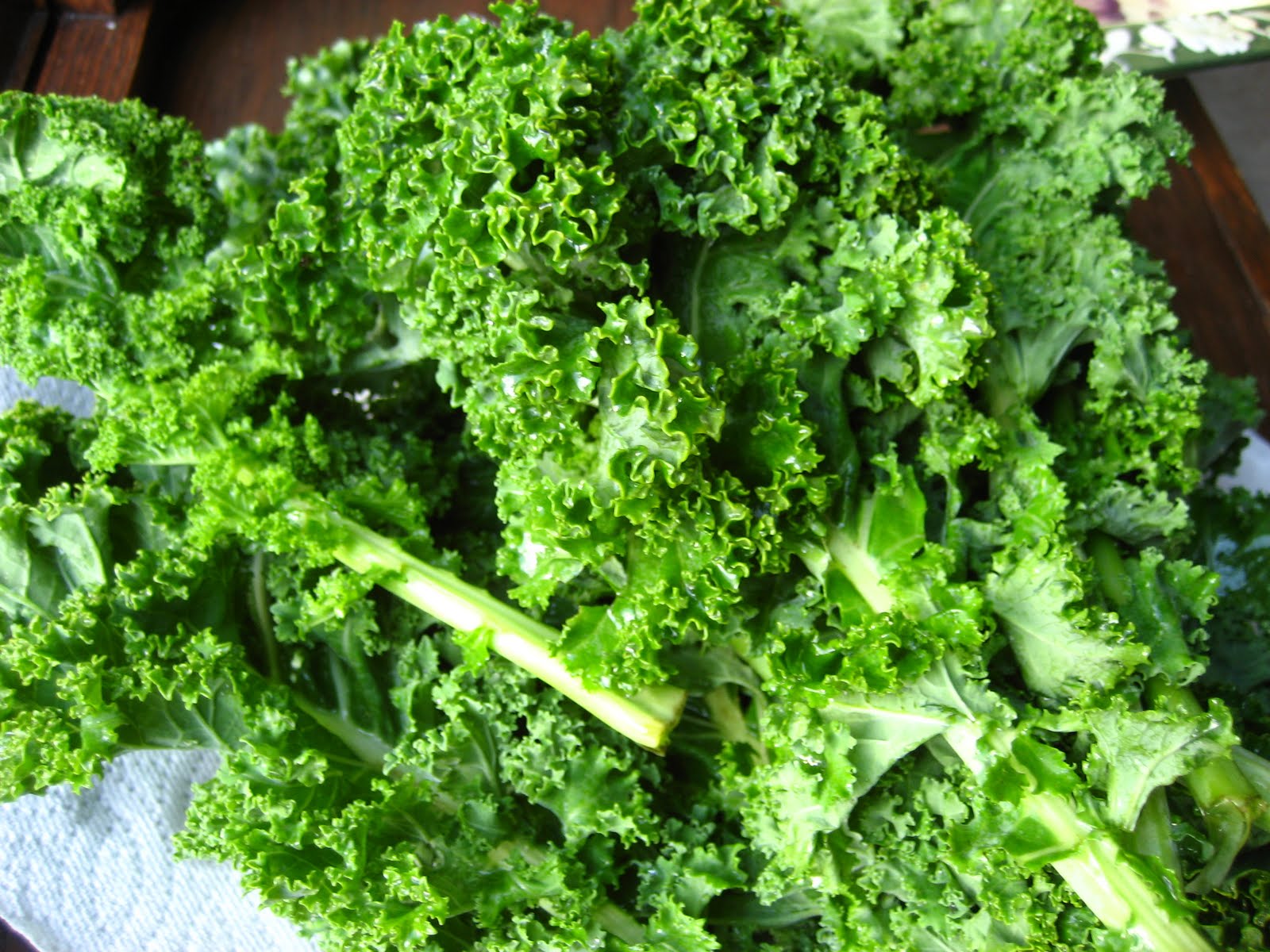

The pictures are from Wikipedia
Kale or borecole is a vegetable with green or purple leaves, in which the central leaves do not form a head. It is considered to be closer to wild cabbage than most domesticated forms. Wikipedia
I copied underneath some pages about kale for your perusal. First I want to relate now some of my recent experiences with kale:
After having had a look at the above you are probably convinced that kale is very good for you. Apparently kale is getting more and more popular in Australia. We did buy a bunch of it the other day at a greengrocer’s in Thirroul. It was only three Dollars, which we thought was a very good buy. Today we bought another bunch here in Dapto, costing us five Dollars.
Today’s bunch was a Hydro Produce. Does it mean it is free of pesticides? I hope so. When Caroline gave us a bunch of kale the other day, this was probably organically grown kale. Caroline usually buys organically grown vegies. Out of Caroline’s kale I made a meal for breakfast. I had a few boiled potatoes which I cut into small pieces. Then I hacked the kale leaves into tiny pieces. I also cut some fresh red capsicums into pieces. I used two frying pans: One for the potatoes with the kale pieces, the other one for the capsicum. I sauteed everything in organic butter. I transferred the cooked capsicum to the big frying pan. Then I used this smaller frying pan to do some scrambled eggs in. Once everything was served onto plates these looked rather colourful: Sauted potato pieces, tiny green kale pieces and pieces of red capsicum on one side and beautiful yellow scrambled eggs on the other side. I like to eat food that looks colourful like this! 🙂 When I cooked this breakfast we still had Caroline and Matthew with us. They praised my cooking which made me very happy.
Today we had another sunny but very cold and windy day. Exactly the sort of winter day where some hot comfort food is very much appreciated. We still had some slices of kassler (smoked pork). Normally I do not like to cook any meat together with my vegies. However Peter wanted the kale cooked together with the kassler. And he wanted it cooked a long time (the German way) so it would be quite soft. So the kale with slices of kassler in it was cooked for a long time. In the meantime I also boiled some potatoes to go with the meal. I added some butter and pepper to the kale. My slice of meat I did not eat for lunch. I left it on the side for eating it another time. Peter did eat two slices of kassler with kale and potatoes. I could see that he loved it a lot. We each had a can of beer to go with this very enjoyable meal. For desert we had some preserved sour cherries topped with a bit of organic yogurt and some custard. After lunch Peter served some espresso coffee with a piece of chocolate. Delicious! 🙂
Isn’t it amazing that we, being ‘poor’ pensioners, can afford great meals like these? As far as income is concerned we really do belong to the people with the least money. Still, we think our lifestyle is not poor at all, in fact we always are grateful how well we can live with our bit of money. Plus we have on top of the Australian pension a tiny German pension. This extra tiny pension helps us to do occasionally a bit of extra travelling. Our government thinks, it is about time we all learned to get by with less money. But I think most pensioners would find it very hard to make ends meet if the pension was to be adjusted to a lower level.
Here now is a link to the following page: http://www.whfoods.com/genpage.php?tname=foodspice&dbid=38
I copied only some sections of it!
” What’s New and Beneficial About Kale
Cholesterol-lowering benefits
Risk-lowering benefits for cancer
Providing comprehensive support for the body’s detoxification system
Researchers can now identify over 45 different flavonoids in kale.
WHFoods Recommendations: . . . . At a minimum, include cruciferous vegetables as part of your diet 2-3 times per week, and make the serving size at least 1-1/2 cups. Even better from a health standpoint, enjoy kale and other vegetables from the cruciferous vegetable group 4-5 times per week, and increase your serving size to 2 cups.
Kale is one of the healthiest vegetables around and one way to be sure to enjoy the maximum nutrition and flavor from kale is to cook it properly. We recommend Healthy Steaming kale for 5 minutes. To ensure quick and even cooking cut the leaves into 1/2″ slices and the stems into 1/4″ lengths. Let them sit for at least 5 minutes to enhance their health-promoting qualities before steaming.
……..
Kale and Pesticide Residues:
According to the Environmental Working Group (EWG) in their 2014 report, Shopper’s Guide to Pesticides in Produce, conventionally grown kale are contaminated with concentrations of organophosphate insecticides, which are considered to be highly toxic to the nervous system. While they were not among the 12 varieties of produce most concentrated in overall pesticide residues (and therefore not part of the EWG’s traditional “Dirty Dozen”), the EWG felt that this organophosphate concentration was relevant enough to bring attention to kale. They actually renamed their produce category of concern from “Dirty Dozen” to “Dirty Dozen Plus” with kale, collard greens, and hot peppers being the “Plus” conventionally grown produce. Therefore, individuals wanting to avoid pesticide-associated health risks may want to avoid consumption of kale unless it is grown organically.
………
Apparently all this is in kale in good, very good or excellent amounts:
vitamin K, vitamin A, vitamin C , manganese, copper, vitamin B6,
fiber, calcium, potassium, vitamin E, vitamin B2, iron magnesium, vitamin B1. omega-3 fats, phosphorus, protein, folate, vitamin B3″
Please go to the link if you want to find out more about the exact amounts.
Originally I copied nearly everything but then I shortened it quite a bit so the post won’t be so very long any more.
Isn’t kale a marvellous food? What do you think?









 AuntyUta
July 22, 2013 at 5:08 am | Why? Is it because we feel our way of life being threatened?
Do we not spend billions to ‘protect’ our borders? What if this money or at least part of it could be spent to provide some simple housing for asylum seekers. What if we let these people work to build houses, infrastructure and to produce nourishing food, as well as build schools and do training of teachers for children as well as adults to learn English? Does anyone think these people are not capable of doing a day’s work? Why let them rot in camps without being able to work? It doesn’t make sense to me.
There are many jobs in Australia that are nearly exclusively done by recent migrants from Asia and Africa. They are willingly and gladly doing these jobs for little pay which other Australians are not willing to do anymore!
How much do people pay these so called people smugglers? Why don’t we go to Indonesia and tell these people instead of giving this money to people smugglers they can deposit it with an Australian Bank. Then they only have to apply for residence in Australia and in due time the Australian government is going to transport them to this country of their choice at no cost to them? If the application is not successful for some reason (maybe because they cannot provide sufficient papers?) then they can withdraw their saved money at any time. At least the the people smugglers would not get the money and these people would not risk being drowned at sea or their application not being successful after a hazardous journey. When Peter and I applied for migration to Australia from Germany in 1959 we were asked to come for an interview to the Australian embassy in Cologne. We had to bring our two babies along too when we talked to the Australian officer.
Why cannot the same thing be done with prospective migrants in Indonesia?
Like
July 22, 2013 at 6:32 am | Of course many could be settled here very comfortably. The political parties just use the boat people for political ends, whipping up xenophobia.
Anyway, it seems the liberals have been snookered by the ALP in their own game. I think your idea to advice people to invest the money going to smugglers into an Australian Bank instead an excellent idea. It take an (ex) German to come up with practical workable solutions! 🙂
Like
July 22, 2013 at 7:12 amHe, he, Gerard, this remains to be seen if anything like this would meet any government’s criteria!
I just read what barrister and human rights advocate Julian Burnside has to say. He says boat arrivals are less than 0,7% of all yearly arrivals. To keep one person in detention for one year costs 200,000 $ in our cities and more then twice this in outback centres or off shore places. (I reckon Papua New Guinea might be a lot cheaper!)
Burnside says after one month for security and health checks asylum seekers should be released into the community allowing them to work or to receive Centrelink benefits, settling them in regional centres who would gladly welcome the influx of people to these reginal towns who struggle to survive.
Like
July 22, 2013 at 7:22 am | Yes, that would be common sense. But common sense seems to be in short supply. The difficulty seems to be to turn around peoples perception that the boat people numbers are not large, they are miniscule. It is not a real problem for such a country of ‘boundless plains’.
Like
July 22, 2013 at 6:09 am | Can’t believe the white Australia policy is still going on. Amazing. I remember it from years back when my uncle was a ten pound pom and my partner and some of his mates from South Wales went in the late 70s. Then, to be fair, it did change and Redfern became full of Vietnamese.It’s one of the ironies of life that big countries are invariably underpopulated and small ones overpopulated. A generalisation, but living in the fifth most densely populated territory in the world, one that applies to me. If you look at Europe, Belgium, Netherlands, and to a lesser extent, the UK, are all relatively high up the list. Spain less so, like Australia, it has vast areas of country that have no people.
When you start to look at bigger countries with a high population density, Bangla Desh comes first, followed by India, and then China. Bangla Desh isn’t that big, just the biggest that hits six figures in sq kms in the top 20. India makes top 50, and China is 83 in the rankings. The rest of the big countries are way down the list.
Having said all that PNG is pretty low on the list 209, compared with Australia at 233.
http://en.wikipedia.org/wiki/List_of_sovereign_states_and_dependent_territories_by_population_density.
Like
July 22, 2013 at 6:40 am | The original White Australian Policy was abandoned officially in the seventies. The population now is very mixed and from just about all over the world, that’s why it is so ludicrous to be so worried about boat people in desperation trying to come here. We should be worried about their drowning but this is not the main concern which is a way over the top whipping up of xenophobia, being overrun by hordes of Afghans or Iranians, etc.
We went to those countries waging dubious wars that made millions of refugees. When some in desperation try and come to Australia risking their lives, we make out as if they have evil intentions for Australia
. Terrible.
Like
July 22, 2013 at 11:21 amI should have added that every year there is an influx of raft people from Africa trying to get to Spain and thence to northern Europe for a better life. Or just anywhere really.What so-called developed countries (ie greedy capitalist ones) should do, is put some reasonable infrastructure in instead of going to war for oil, leaving the place a dog’s breakfast, and consider more environmental moves. In my dreams.
Like
July 22, 2013 at 6:47 am | Gerard, you are painting a good picture of the history of post-war immigration into Australia and the present sad state of affairs.Even the language they are using explaining the new measurements are offensive, like “this country has enough”. What about PNG? They soon will have enough of the asylum seekers.
The “boat people” will get a culture shock. Perhaps this is intended. You are right, it can’t be the number of people that come. There is plenty of land that can be populated.
You say, Australia is a huge country and “small” parts of it are as big as European countries. The problem with Australians is they have no idea how huge Australia is. When they go to school and they see a map of Australia the map is the same size as the map of any other country. Since we have no neighbours here we have no way comparing our country with another.
The numbers in boat arrivals are minuscule. If we are worried about the drowning, as they say, they should go to Indonesia and pick the recognised refugees up and bring them here. I wrote to PM Gillard but got no response.
When we came to Australia they came and picked us up (assisted migrants) and we were economic migrants. We all want a better life, what is wrong with that? Didn’t the Angle-Saxon go to Britain for a better life?
Contracting out the asylum seekers is cheaper. To hell with the consequences for them and the people of PNG. The shock of the new measure “might” do the trick and it will reduce the boat arrivals.
And you asked, why? Because we stole the country in the first place and we don’t want to share it with others. The population has increased despite ourselves. We are racist, but we will not admit it.
Like
July 22, 2013 at 8:23 am | Yes Berlioz 1935.
Back in those days the Australian Government were advertising overseas to try and entice people to migrate. Now many are coming out of a much greater need. The need to survive and escape terrible wars.
I can’t believe some of the dreadful comments in the media. Many boat people have drowned and are still drowning and it is made out as if this is some ploy by them to gain a better outcome or more sympathy.