
Leon Panetta, 76, served under former US President Bill Clinton as White House chief of staff. He later served as defense secretary and the head of the CIA under President Barack Obama. He retired during the spring of 2013 and Penguin Press published his memoir, “Worthy Fights,” in October 2014.
Category: Documentary
What the Obama Administration issued
By Patrick Martin
7 February 2015
The Obama administration issued its National Security Strategy document Friday, ostensibly laying out the principles on which its foreign policy will be based for the final two years that Obama occupies the White House.
The document was presented by National Security Adviser Susan Rice at the Brookings Institution on Friday afternoon, no doubt aimed at focusing attention on US threats against Russia over Ukraine. The Obama administration is currently considering providing direct arms to the US-backed regime in Kiev, a move that could lead very quickly to a direct war with Russia, a nuclear-armed power.
‘ ‘ ‘ ‘ ‘
To read more please go to:
Excerpts from a Guantanamo Prison Diary
What is going to happen now? Are the great majority of Americans going to say they did not know about it?
What Gorbachev says about Putin
http://rt.com/news/217931-gorbachev-putin-saved-russia/
I read this with great interest.
Public Services International
The report on TISA was prepared for Public Services International, written by Scott Sinclair, Canadian Centre for Policy Alternatives, and Hadrian Mertins-Kirkwood, Institute of Political Economy, Carleton University.
Also see PSI and OWINF’s special report The Really Good Friends of Transnational Corporations
The above refers to:
PSI Special Report: TISA versus Public Services
from
28 April, 2014
Source:
PSI
I published the above report some ten days ago, actually on the 20th of January 2015. I want to copy it here again and stress some of what it says.
So here is the copy:
“A new report by Public Services International (PSI) warns that governments are planning to take the world on a liberalisation spree on a scale never seen before. According to the report, this massive trade deal will put public healthcare, broadcasting, water, transport and other services at risk. The proposed deal could make it impossible for future governments to restore public services to public control, even in cases where private service delivery has failed. It would also restrict a government’s ability to regulate key sectors including financial, energy, telecommunications and cross-border data flows.
Treating public services as commodities for trade creates a fundamental misconception of public services. The Trades in Services Agreement (TISA), currently being negotiated in secret and outside of World Trade Organization rules, is a deliberate attempt to privilege the profits of the richest corporations and countries in the world over those who have the greatest needs.
Public services are designed to provide vital social and economic necessities – such as health care and education – affordably, universally and on the basis of need. Public services exist because markets will not produce these outcomes. Further, public services are fundamental to ensure fair competition for business, and effective regulation to avoid environmental, social and economic disasters – such as the global financial crisis and global warming. Trade agreements consciously promote commercialisation and define goods and services in terms of their ability to be exploited for profit by global corporations. Even the most ardent supporters of trade agreements admit that there are winners and losers in this rigged game.
The winners are usually powerful countries who are able to assert their power, multinational corporations who are best placed to exploit new access to markets, and wealthy consumers who can afford expensive foreign imports. The losers tend to be workers who face job losses and downward pressure on wages, users of public services and local small businesses which cannot compete with multinational corporations.”
I ask myself why do I bother reading such stuff? I am just one of the masses. I have no special education, I cannot compete with the power of governments or multinational corporations or any of the very rich people. I am very near the end of my life. Why is it not enough for me to just concentrate on having as good a life as possible for the last days of my existence here on earth?
A Conversation with Paul Craig Roberts

Transitions; Morals; Alliances and Dissolutions
A Conversation with Paul Craig Roberts
“This old anvil laughs at many broken hammers.
There are men who can’t be bought.
The fireborn are at home in fire.”
–Carl Sandburg
GC: I’ve been reading your work fairly regularly over the past 4 years. Within this year, I’ve reviewed your two most recent books: The Failure of Laissez-Faire Capitalism and How America Was Lost. I know something about your background as Assistant Treasury Secretary during the Reagan Administration, and as a former associate editor and columnist for the Wall Street Journal, etc. You and I have corresponded a little, mostly about setting up this interview. I’m glad to meet you in person.
At one point in LOST you relate the story of a friend who had lunch with former colleagues of yours who lamented your shift in politics from a conservative “Reaganite” to someone now writing radical articles (posted, I’ll add, at some of the best websites in the world!). These former colleagues took the attitude of “Poor Paul! He could have been really rich, with a sinecure at a prestigious university—probably a named chair for him–giving talks at Foundation events, getting cut in on special deals—as rich a sell-out as Tony Blair is now! He just had to play along… he just had to tone it down!”
So, my first question is: What’s the matter with you? Why didn’t you take the easy path? What kind of credo drives you?
PCR: Well, you know, being a prostitute is not an easy path! It’s not a role that anybody really wants… and it’s just people who don’t have alternatives who get stuck in that. . Of course, I did have a prestigious university chair…. When I went to Treasury, I had been occupying the William E. Simon Chair in Political Economy at Georgetown University for 12 years. I think that what some of my former colleagues were saying is that they had gotten rich by selling out. That was their claim to fame—that they were now rich. [He laughs here. He has a good!] So, I felt sorry for them. My friend who related the story told me that he stood up and told them that he didn’t know he was having lunch with a bunch of whores… and he left! [More laughter….]
GC: I like to read history—to get a grip on where we are now, to see the great continuum. You often write about the generation of our Founding Fathers; their intentions in our Constitution, our Declaration of Independence. One of the pictures on your Web articles shows you standing in front of a painting of what looks like a Revolutionary War leader—I think he’s Alexander Hamilton. Can you tell me who is in the painting and how do you identify with him? What values do you share?
PCR: That’s Alexander Hamilton, the first Secretary of the Treasury. It’s a copy of the original. It was given to me when I was appointed Assistant Secretary of the Treasury. It hasn’t any other kind of meaning…. A lot of people think it implies that I’m a Mason, because the person in the portrait has his hand in his waistcoat—like Napoleon. But, of course, Napoleon wasn’t a Mason! It has been explained to me that the reason for this is that it’s very difficult to paint the human hand, and that the “charge” for a picture with the human hand was much greater, so at the time it was the convention to get the human hand out of the picture! I don’t know if that’s true or not….
GC: It sounds apocryphal!
PCR: That could be….
GC: The reason I mention it… many of my “progressive” friends are critical of Hamilton as the founder of the Central Bank, and so forth…. Do you have any feelings about that?
PCR: When you’re forming a new country, no one really knows exactly what to do, and there were differences among these Founding Fathers… and I am not really the kind of historian to handle this issue. He was right and he was wrong. I think everybody was trying to do what they thought was right, and, on the whole, they succeeded. But… the troubles since then are not entirely due to their inability to anticipate….
GC: Everything changes….
PCR: Well, they knew that power would accrue to Government. That’s why they tried to break it up into 3 coequal branches, hoping that the jealousies between the branches would keep the overall power low. Unfortunately, they did not anticipate the War Against Southern Secession, which destroyed States’ Rights and elevated the power of the Central Government…. Since then, we’ve had other interest groups step forward: the Bankers who wanted the Federal Reserve so that they would have a way of endlessly expanding credit; and, of course, we’ve had the so-called “War on Terror,” which is a way to get rid of the Constitution itself! We can’t really say that the Founding Fathers should have anticipated all of this….
GC: I’m going to ask you a question that most journalists will never ask you. Because you do touch on these matters in your books and in your articles…. You talk about the Arts… You mention in LOST that we need a new Orwell…. I think we need a new Shakespeare as well–someone to help us define our language better, to use it as a cutting tool. So, let me ask you: What is the role of the Arts in creating a new political culture?
PCR: Well, ah, you’re getting over my head here, Gary. I’m not… I don’t have the kind of background to answer that question in any satisfactory way.
GC: Okay… this is somewhat related….In the 60s and early 70s, there was a flourishing of political and cultural energies. Is anything like that happening now? How can we help it along?
PCR: Well, I think there was some output with the Occupy Movement. It was put down with force and intimidation…. In a very real sense, those forces in the 60s and 70s have been bought off…. You don’t see [for example] the kind of Black leadership that you had in the days of Martin Luther King…. Just think about the Rappers—when they came on the scene they were socially conscious, the songs were challenging. Now, some of them are billionaires! I saw the other day that someone was selling out and, ah… Apple… Apple was going to buy his company and the guy’s going to end up a billionaire! So… where are these energetic forces going to come from? That has been the success of the elites! They just co-opt whatever movement comes along.
GC: Okay… thanks for indulging me in my particular field…. Back to your expertise now…. You make a strong case that it wasn’t “supply side” economics that screwed up our economy and destroyed our middle class; rather, that had more to do with the Clinton Administration’s de-regulation and off-shoring of jobs…. Now, one definition of “government” is “to regulate.” When we accepted “deregulation” weren’t we basically “de-governing” ourselves—giving up the protections of government, oversight functions, etc.? And when that happened, didn’t we turn into one big neo-con/neo-liberal hairball—liberalism and conservatism blurred into a crazed Godzilla whose main “business” is war?” How can we get back to better, sensible, more humane regulation and governance?
PCR: I’ve always regarded regulation as a factor of production. If you have too much, you’re in trouble; and if you don’t have enough, you’re in trouble. The judgment of getting the right amount is open to debate. But, certainly, financial deregulation was irresponsible… because we had had the experience of a deregulated financial system [during the Great Depression] and we saw what an unsatisfactory outcome that was! So, repealing safeguards against repeating those mistakes was a great error. And, it was done by the Banks, which essentially purchased enough “Think Tanks” with grants and donations, and enough university faculty—with grants and donations and speaking opportunities–, and purchased enough senators and Congressmen to get the Glass-Steagall Act repealed—and this was a fundamental error! Among other serious mistakes: the position limits on speculators was removed… and now they can control the markets; they no longer provide a positive function, they basically loot! They use their power for their own profits…. Also, allowing the kinds of financial concentration, where you have the banks “too big to fail.” Whoever heard of such a thing? If banks are too big to fail, you don’t have Capitalism! The justification for Capitalism is that it eliminates those corporations that don’t make efficient use of resources. Those are the ones that fail! If you don’t let them fail, then you have a subsidized system that makes inefficient use of resources! All of this was a disaster.
GC: And this all happened under Clinton, basically….
PCR: The repeal of Glass-Steagall happened under Clinton. The subsequent deregulations happened under George W. Bush. For example, when Brooksley Born, the head of the Commodities Futures Trading Corporation, tried to perform her federal duty and regulate over-the-counter derivatives, she was blocked by the Chairman of the Federal Reserve, the Secretary of the Treasury and the head of the Securities and Exchange Commission! They took this to Congress and shouted her down and forced her out of office. The position they had was an ideological position for which I know of no evidence: that markets are “self-regulating”… and, therefore, that markets are better regulated without regulators! This is absolute nonsense! And, it’s hard to believe that people in Congress didn’t know it was nonsense! I attribute it to the influence of the Banks—the money…. And, lo and behold, the senator who led the deregulation was very quickly rewarded—he was made Vice-Chairman of one of the “too big to fail” banks; somebody who’s paid millions of dollars to go around giving speeches! This is the way this System works when private interests become too powerful. In the United States today, the public and private sectors have merged–because the powerful private sectors essentially determine the policy of the government. There isn’t really a government independent of Wall Street, the military-security complex, the Israel Lobby, the mining, energy and timber business, agribusiness—these groups write the laws that Congress passes and the President signs…. And, the Supreme Court has made it even easier for them because it has ruled that it’s legitimate for corporations to purchase the government—
GC: “Citizens United” and—
PCR: That was the first one… and then the most recent one—
GC: Made it even easier—
PCR: In other words, there are no limits for wealthy corporations to elect the government they want! It’s like former President Jimmy Carter said a short time ago: At this time, the United States does not have a “functioning democracy.” Well, he’s right! We have an oligarchy. And the oligarchy rules, and the government is some sort of cloak for the rulers. You never see anything happen against the oligarchs! For example, one of the senior prosecutors for the Securities and Exchange Commission retired recently; and, he gave a speech and said that his most important cases had been blocked by the “higher-ups” who hoped to get good jobs with the banks that they were protecting! This is the way the government works today. When you try to say, we need more regulation—you can’t! The regulators are “captured” by private interests. It was about 30 years ago, that economist George Stigler said that regulatory agencies invariably wind up “captured” by the industries they’re supposed to regulate.
GC: What was his name?
PCR: Stigler…. He won the Nobel Prize… not for that observation. He was a colleague of Milton Freedman… and was quite jealous of Freedman’s renown among ordinary people. Whereas, Stigler had renown only among academics! [Laughter….] At any rate, I don’t think you can simply say that we’ll restore regulation… because the regulations that are on the books can’t be enforced; the higher-ups are protecting those they’re supposed to regulate—so they can get major jobs when they leave government service.
GC: The “revolving door”!
PCR: It’s a sea change. And I think the only way you recover from something like this is through a catastrophe—something comparable to the Great Depression. But even that might not do it, because the way the forces are arrayed now it seems that the so-called forces of “Law and Order” are in behalf of the private interest groups. Look at who busted up the Occupy Movement! And we now have all this information of all the federal agencies being armed to the teeth. I mean, even things like the Social Security Administration, and the Post Office! The other day, I read where the Department of Agriculture has put in a purchase order for submachine guns! So… what is all this about if not to suppress any sort of popular resistance to an economic collapse or catastrophe? And, it may be that even a catastrophe won’t let the United States recover.
GC: Are we past the point of no return?
PCR: Who knows? But, I gave you the reasons that could be the case….
GC: I do think we are in a great transitional period. I’m pessimistic, as you are. I think a lot of people admire your work because you made a transition, a transformation in your life—from being a conservative, Reaganite type to a radical who now writes against the system—
PCR: Well, Gary, let me interrupt you here…. Actually, that’s a mistaken perception of me…. Because, they think if you work in a Democratic Administration it means you’re a liberal or a Leftie; if you work in a Republican, it means you’re a conservative or a Right Winger. But, actually, I was writing against the Establishment of the time! The supply-side movement was an attack on the Keynesian movement. The Keynesians were the Establishment! I wasn’t attacking them for any ideological reasons; I was attacking them because their policies had ceased to work, and we were confronted with stagflation—which meant worsening inflation and worsening of unemployment; and they had no solution except to freeze everybody’s wages, salaries and prices—which was an absurd solution; it wouldn’t have worked! I was as much “on the outs” at that time as I am now. I haven’t made any transition. I just see mistakes and speak against them.
GC: You’re against rigidity. You want to be flexible; apply the best solution for the time….
PCR: I’m against ideological thinking. I’m against unrealistic thinking. I’m against the brutality of corruption! Because it endangers the country. We’ve already lost the Constitution because of this. I’m not a radical when I defend the Constitution! Today, it’s becoming “anti-American” to defend the Constitution! Not even the Supreme Court will defend it! So, it’s not a transition I made from being a conservative to a radical. I’ve always been challenging the Establishment—whether it’s Left Wing or Right Wing. When I began as an Economist in Washington, the Keynesian Establishment was essentially a Democratic Establishment. Today, the Establishment is the “exceptional, indispensable Americans”—which is a self-definition which gives you the notion that you are superior to others. It’s like Putin said a year or so ago in one of his speeches: Americans can say that they are exceptional; but, in fact, God created us all equal!
GC: That was in his New York Times op-ed piece.
PCR: Wherever it was… when you start making these claims that you are some sort of ubermensch, you start sounding like the Nazis. And you then start acting like you have the right to run over other people, other countries… because History chose you to be the hegemon! Well, this is extremely dangerous—not just to others, but it’s dangerous to Americans; because the next step is, you lose your civil liberties. And you’re faced with indefinite detention… or you may be murdered! Simply because somebody in the Executive Branch suspects you might be a terrorist! So, it’s not radical to complain against the loss of the Constitution. That’s a very conservative position—historically.
GC: I think it’s fair to say you’re a moralist—
PCR: I’m not an immoralist, I hope!
GC: I’m wondering about your background…. You mention God, not thinking of ourselves, and so forth… What about your upbringing? Can you tell us how these values were inculcated?
PCR: You know…, it was a different world…. People had to be able to look themselves in the mirror—and that meant you had to have behaved correctly. Today, it has almost turned around! The only way you can look yourself in the mirror is if you got the better of someone else. It’s like the Wall Street culture has taken over…. And, if we look at American foreign policy—what it’s about is prevailing! It’s not about diplomacy; it’s about the application of force. Our diplomacy is: If you don’t do as we say, we’re going to bomb you into the Stone Age. This is not the country I grew up in!
GC: What country did you grow up in? Did you go to Church every week…?
PCR: I grew up in the United States! And the people I grew up with—their values, their way of life—were formed in earlier times; their behavior, their appearance, their way of thinking reflected the kinds of values that were the basis of the country—when such values were still effective… or somewhat effective. It was before those values had been worn out and discarded. So, in that sense, I’m a remnant of when we were finer than we are today…. And the kinds of things that happen today simply couldn’t have happened earlier. I think that a great deal has been lost….
GC: Staying with this theme of things lost; values worth retaining and reclaiming…. You bring up Revolution in some of your recent work, and even in your book, LOST…. Other writers I respect talk openly now about Revolution—Chris Hedges, for example…. I wonder if it’s possible to organize Global Resistance against what is, in fact, a Global Empire? Is there any chance for us to unite globally… and resist?
PCR: I have no way of knowing…. I suspect it would be very difficult. There’s so much disinformation, misinformation and propaganda. I suspect what will lead to change will simply be failure. The United States is probably in a failing mode; because it has probably overreached; its ambitions are unrealistic; and its economic base is being hollowed out. When you spend 20 years exporting your manufacturing and industrial jobs, and all of your tradable professional service jobs—like software engineering, for example—you deprive your own people…. When jobs that American university graduates used to take are now offshored, or filled by H1-B foreign workers who are brought in at much-reduced pay, then you are decimating your own population which is losing its vitality, its ability to rise as all the ladders of mobility are dismantled and there’s no growth in incomes and career prospects become dim. The country that is so foolish as to export its own economy, to give its gross domestic product to other countries—that country hasn’t any prospects. And, if that country’s power also rests heavily on its currency being the “reserve currency”… and the US government erodes confidence in the dollar by incessantly creating new money in order to support new debt—as the Federal Reserve has been doing since the 2007-2008 economic collapse—you undermine the confidence of the world in your currency. And, if they abandon its use as the reserve currency, then your power has gone down the drain…. And we see now, that the Obama regime threatening Russia with sanctions—it shows the complete unawareness of the United States government of its precarious position… because when you threaten a major country with sanctions their alternative is to leave the dollar-paying system, as the Russians are now doing, along with China. So, if you drive them out of the payment system, what happens to your power? And others will follow…. I think the prospect for change will be in some sort of American collapse. It has to be coming because every part of the foundation has been undermined.
GC: Has that been intentional? Some people argue that the globalists actually do want to pauperize the American population, and make it docile, and increase our military strength everywhere while at the same time the people are becoming—
PCR: Gary, that doesn’t make any sense to me…. Because, they’re American-based, and there’s nothing they gain by losing the power base. If Americans are impoverished, certainly the globalists aren’t in control in China. And, they’re not in control of Putin. So…, it can look like that, but I think it’s mainly just hubris and stupidity. What was Hitler thinking when he decided to invade the Soviet Union? He wasn’t!
GC: Well… I don’t think he was positive that Britain would attack him when he did that—when he attacked Poland.
PCR: People make mistakes. And I would never think that, as mistake-prone as people are, that they can organize the world in conspiracies. That implies that people don’t make mistakes—especially these conspiracies that people think have been going on for centuries…. We see every day that people make mistake after mistake… That undermines my calculus that there can be some kind of global conspiracy. Again, what do they gain from undermining their own power-base? Their assets are here….
GC: I do have a question related to this. I’ve been preparing for this, so let me go through it. You can berate me, but l’ll ask it anyway. If you were one of the super-elite and had the power they have, is it not likely that you would conspire with your peers to maintain your power against the masses who opposed you? Like the Titans who would rather eat their children than surrender power to the upstart gods….
PCR: Well, logically, it seems that you would do that. But, what we do know is that most people are so competitive with each other that they can’t get along. I mean, even families can’t hold together! So, when these guys are out competing about who has the biggest yacht… or one’s mad because he’s only got 3 Penthouse playmates, and the other guy’s got half a dozen… and one guy’s mad because he’s only got 10 billion dollars but the other guy’s got 15 billion… and his jet plane is bigger than my jet plane! When you see all this endless competition between individuals among the elite—the notion that they’re somehow going to sit down and agree on how they’re going to do anything…. I mean, nobody can hold together! The Beatles couldn’t hold together! Who had a better thing going than the Beatles? I mean, it’s “first me!” First guy comes along and he says, Okay, I’m going to be the leader of this…. He steps in and soon everybody else is trying to get him out because they want to be the leader! And the policy goes to hell! I mean, in the Reagan Administration—it was all we could do to get the President’s economic program out of his own Administration: it was a drag-out fight! If Treasury had not been willing to take that burden, it wouldn’t have happened. We had to make endless enemies within our own government to do what the President wanted. And there aren’t many people in government who will do that! It just so happened that that particular Treasury had some feisty, fighting people, and they were backed up by the Secretary… That’s rare. Usually, nobody can agree! Or, everybody thinks what he wants was the agreement! And each proceeds on the basis of his own agenda. So, I think that the elites—not all of them… there are some very nice ones—but the politically active ones are mainly concerned with maintaining their wealth and power. As to whether they can form up to something tight that holds a line… like an old-time Mafia group…. See, today the Mafia can’t even hold together! If the Mafia can’t hold together, how can these competitive, rich, educated guys who are jealous of each other?
GC: I’m trying to make a point that… if they can’t hold together against each other… but, against the masses, don’t they hold a solid line?
PCR: I don’t think there’s a “solid line” because I think there are disagreements among elites. Some of them are really nasty, and some of them have a social conscience. I knew Sir James Goldsmith—he was a billionaire; he spent the last years of his life fighting for the people against the E.U.! I knew Roger Milliken. He was a textile magnate, a billionaire. He spent his entire life… not on yachts with Playboy bunnies, but fighting for American jobs—in the Congress! He was totally opposed to all this offshoring of jobs! That doesn’t mean there’s not a whole bunch of bad ones; they do conspire—but they’re conspiring for themselves. Plus, you know, if a group like that was seen as a threat to some particular country—like the United States—the CIA would assassinate them! If the CIA wants to kill every billionaire, they can do it tomorrow. So, it’s really not so much about individuals as it is about corporate interests, or sector interests—agribusiness, Wall Street–those guys seem to fix it somehow so that all of them can gain from it, even though they try to cut each other’s throats! That’s a different kind of maneuvering—and that’s the kind we have to be worried about at this time.
GC: You make some solid, perhaps indisputable points, that there isn’t one unified “elite.” That some of the worst aspects of human nature—our selfishness, greed, hubris, even stupidity—militate against such unity. Still, having no desire to join that group… I wonder about the possibility of alliances among us children of a lesser God? Ralph Nader has a new book, UNSTOPPABLE. He proposes an alliance of Left and Right. I’ve been wondering for a long time: Is there any way we can work together and transcend these political divisions, these ideological divisions, and find common ground?
PCR: I have no idea. I have nothing against it…. You know, I’m not an activist. Nader is. I’m a thinker, I analyze. I can see where explanations or perceptions are wrong, and how wrong explanations, and wrong economic theory, and wrong perceptions–like the “Russian threat”—can lead to total disasters. I try to tell people what really is going on. I think we actually do live in a matrix. And our perceptions are controlled by propaganda: some of it intentional, some unintentional. Some… just because people don’t think things through…. I try to show people what reality is… in so far as I can ascertain it. At least I can show them a different way of seeing what is happening. That doesn’t make me a political activist… because I’m not trying to organize people, I’m trying to wake them up, trying to make them aware. And, what they do with that—I don’t know…. If they organize successfully, and they can find leaders capable of pulling off something like that—that’s great! I don’t really know the answer about forming alliances. I suspect that aspects of the matrix are falling away; people are starting to realize that American propaganda doesn’t make sense; that we destroyed 7 countries in the 21st century—in whole or in part. I don’t think many people are falling for the propaganda that Russia invaded Ukraine and stole Crimea. I don’t think that’s the perception in Europe. It could be that the ability of the formal propaganda—the intentional lies–may be losing its convincing power. If so, it makes it easier for people to escape the unintentional lies, or the misperceived ways of thinking. So, there could be big change…. If the E.U. failed, it would have a huge impact on American power. We would no longer be able to claim that we had a “coalition of the willing” or that we were acting in the name of NATO. The aggressive behavior of the United States would be recognized for what it is—war crimes! If Germany, for example, were to say: Look, we have too many relations with Russia, we see the future here….
GC: So, you must feel heartened by the E.U. parliamentary elections this past week—the rise of the “Euro-skeptics”—
PCR: Those elections were not about “race” and immigrants. They were about dissatisfaction… with the whole concept of the E.U.—the loss of national sovereignty. The Greeks, the Italians, the Portuguese, the Irish—they feel like they’ve lost their sovereignty. The only ones that are “holding on” are the Germans, the French and the British—so it starts to look like the E.U. is some sort of Anglo-German-Franco Empire. And even the Germans, French and Brits have their issues with it! The Germans don’t like it that their government is a puppet state of Washington!
GC: So, this is one positive thing that’s happening now—
PCR: These dissolutions are positive. But, I don’t have a plan on how to bring them about. I think if you organized such a plan, you’d be met with overwhelming opposition…. But, if you haven’t got a plan—it’s more than likely to happen! To wind this up: I think that humans are capable of every kind of error, every kind of stupid mistake. And this means that holding anything together, even a family, is difficult. I mean… half of the marriages end in divorce! So, you’ve got two people in love, two people intimate together, and they can’t hold together. So, somehow you’re going to have a plot that’s going to overwhelm the world? It’s not going to happen! I think you’re going to have continuing errors, crises, and mistakes. And I think the United States has made a massive number of them since the Clinton Administration. All the kinds of restraints that George H. W. Bush had in foreign policy—remember the first Iraq War? That was to get them out of Kuwait! We didn’t go on to attack Iraq! This is the kind of restraint that lets a country continue to exist! But, since that time we’ve seen the most reckless kinds of behavior. I think it’s turning the world against us, and the consequences could be catastrophic. I think we can place our hope in the fact that what’s here today won’t stand… because it’s shaky and the mistakes are multiplying. It’s going to come down. And, when it does–that gives the opportunity to change. And to try to bring that about through some revolutionary movement is not going to succeed. But, it will succeed on its own.
GC: To quote Shakespeare: “the readiness is all.”
PCR: Yeah… right….
Paul Craig Roberts is a former Assistant Secretary of the U.S. Treasury, and a former columnist for Business Week. He held the William E. Simon Chair in Political Economy at Georgetown University for a dozen years. He has authored several books, including, “The Supply-Side Revolution” (translated and published in China in 2013) and “How America Was Lost” (2014). His official home page is: http://www.paulcraigroberts.org/.
Gary Corseri has published novels and poetry collections, and his dramas have been produced on PBS-Atlanta and elsewhere. He has performed his poems at the Carter Presidential Center and has taught in US prisons and public schools, and at US and Japanese universities. Contact: gary_corseri@comcast.net.
Capital in the Twenty-First Century
Piketty’s Capital in the Twenty-First Century is that rare phenomenon, an economics tome that flies off the shelves.
” . . . . .
The gist of Piketty’s book is simple. Returns to capital are rising faster than economies are growing. The wealthy are getting wealthier while everybody else is struggling. Inequality will widen to the point where it becomes unsustainable – both politically and economically – unless action is taken to redistribute income and wealth. Piketty favours a graduated wealth tax and 80% income tax for those on the highest salaries.
Lord (Adair) Turner, the former chairman of the Financial Services Authority, says Capital is “a remarkable piece of work”. Turner, who has name-checked Piketty in his recent lectures, added: “He is saying that we have a set of tendencies at work to which the offset has to be a degree of redistribution. I completely agree with him.”
Krugman, writing in the New York Review of Books, says Piketty’s work will “change both the way we think about society and the way we do economics”.
. . . . “
Outback Choir
http://iview.abc.net.au/programs/outback-choir/
“Follow the heart-warming journey of a regional children’s choir, and its founder Michelle Leonard’s personal mission to bring a desolate musical landscape back to life.”
“Broadcast at 7:40pm on Sun 30 November 2014. Published 5 days ago, available until 8:40pm on 14 December 2014. File size approx. 289 MB”
We watched this broadcast last Sunday. Apparently this video about the Outback Choir is available only up to 14 December 2014. It is heartwarming to see the enthusiasm of these outback children who, if it were not for people like Michelle Leonard, would not get as much of a chance in life.
If you do not have time to watch the whole video, I would recommend you go at least to the last fifteen minutes of it to watch the concert of that choir! This concert is quite an achievement.
11th November, Rememberance Day 2014
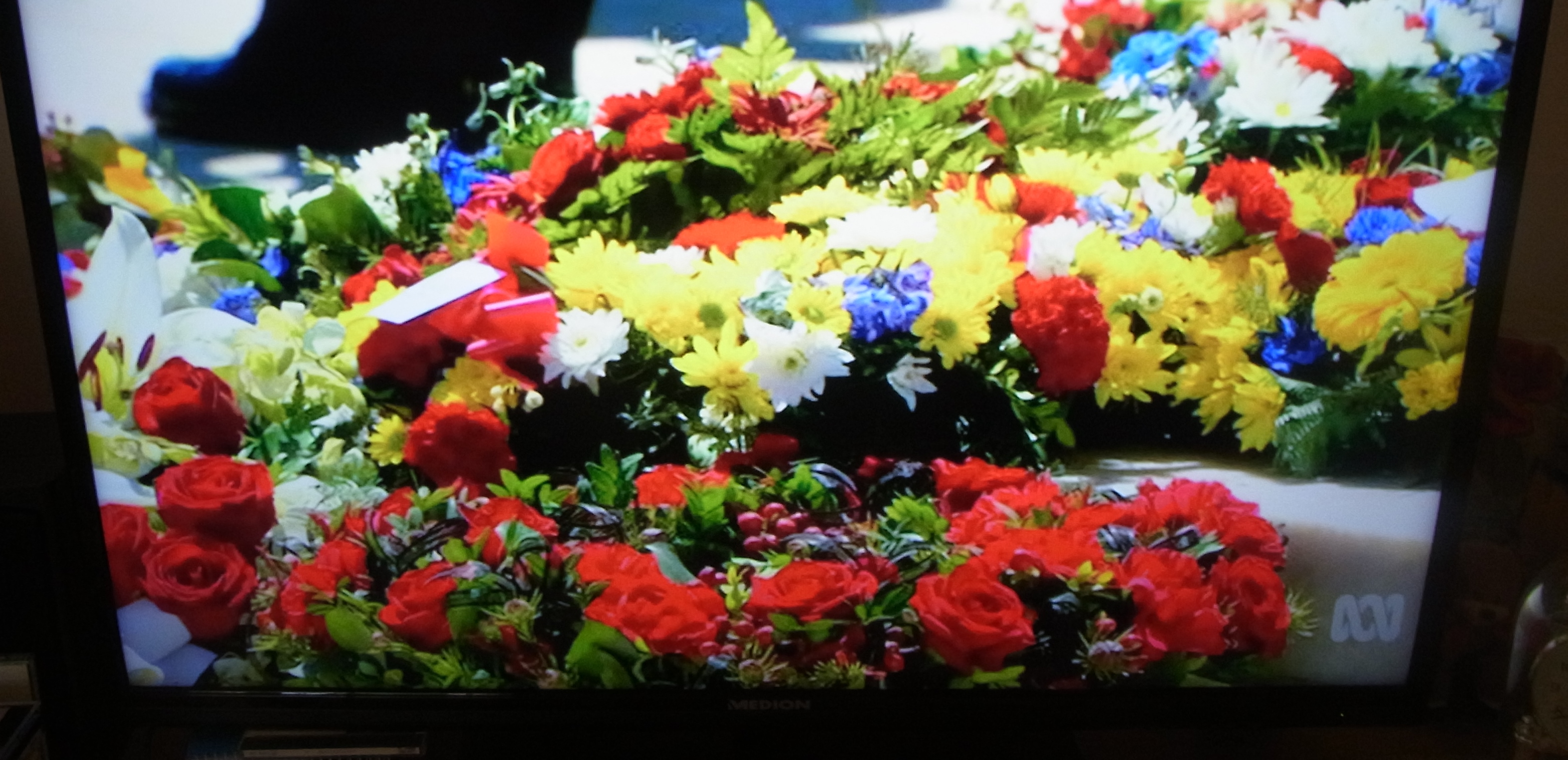
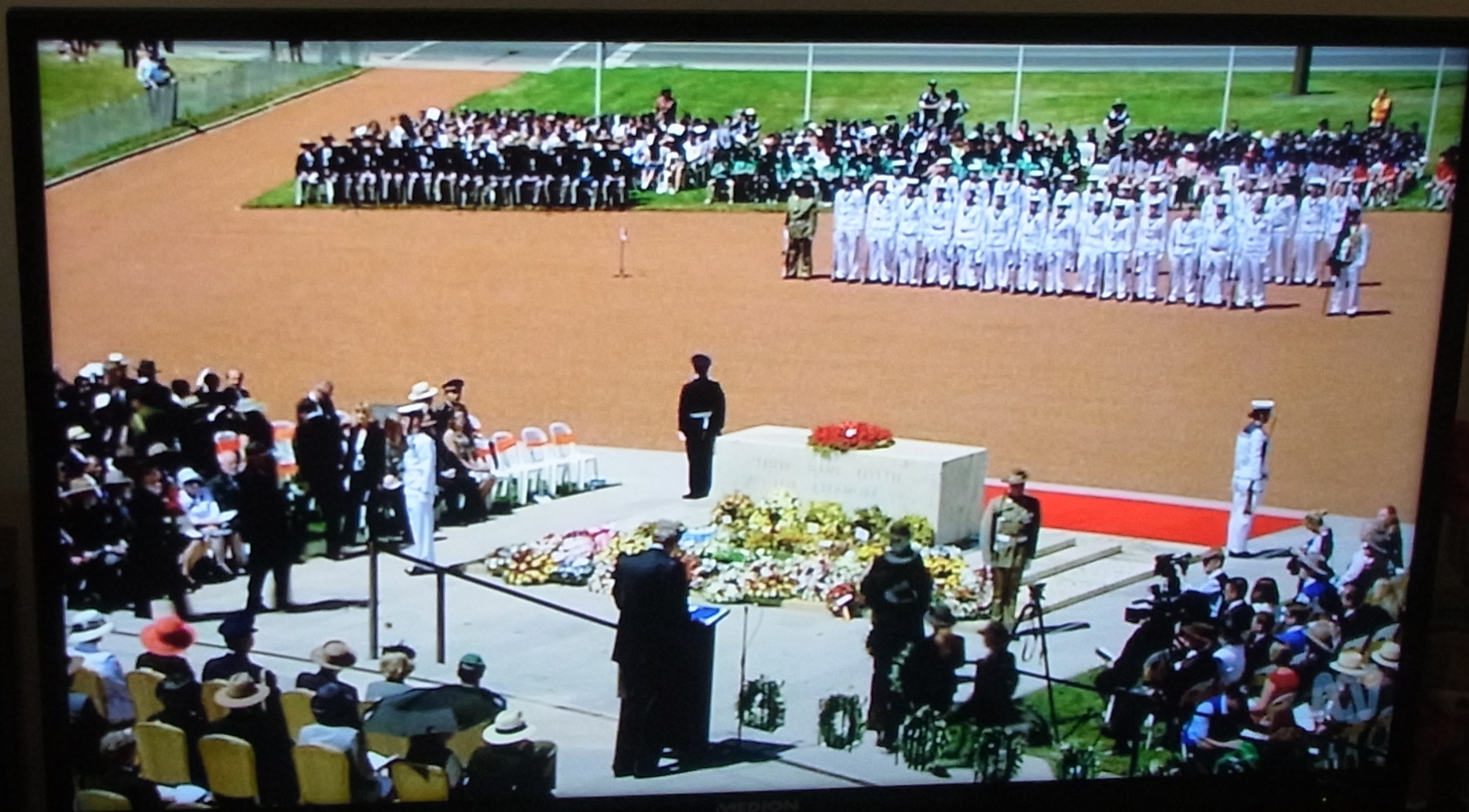
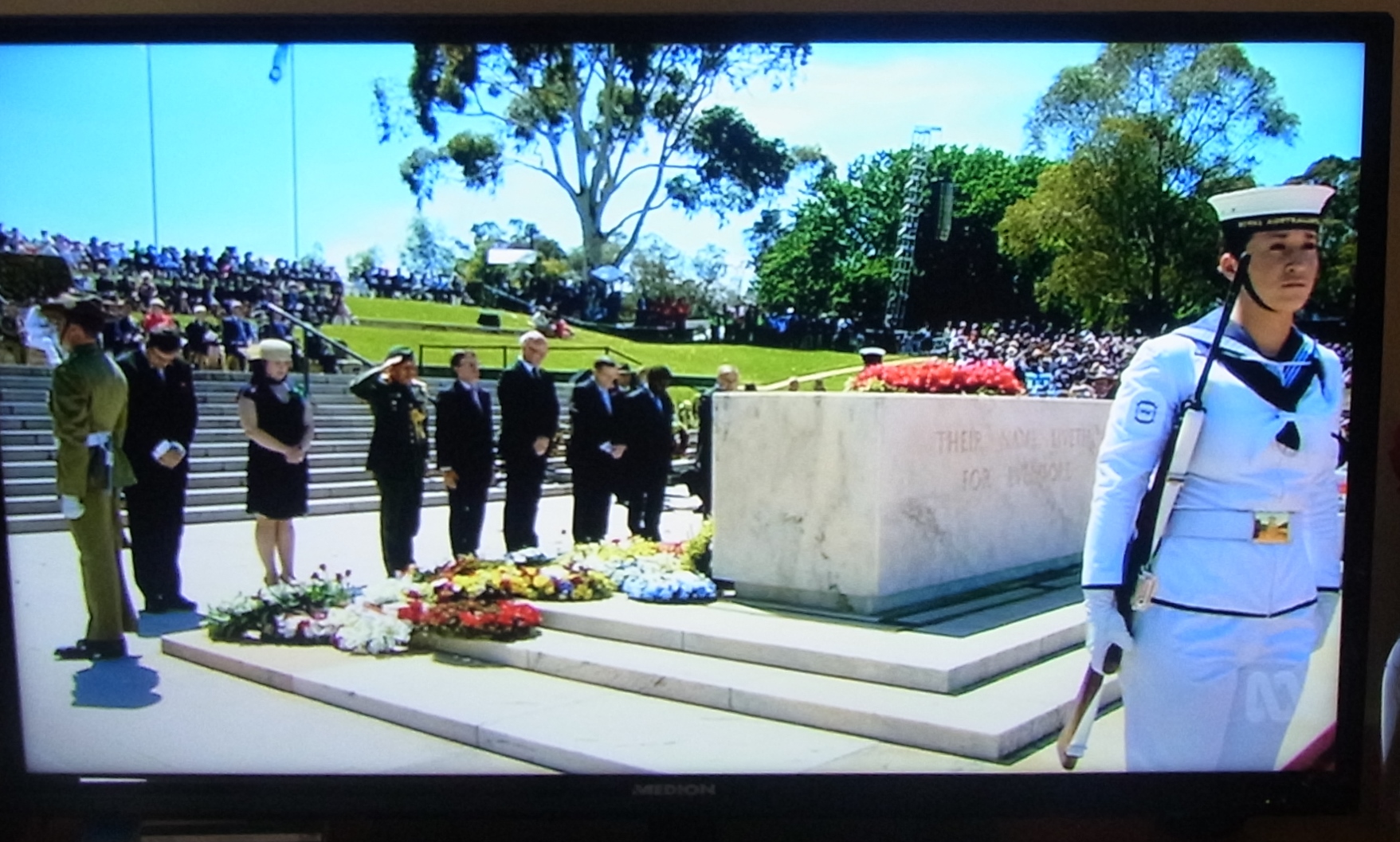
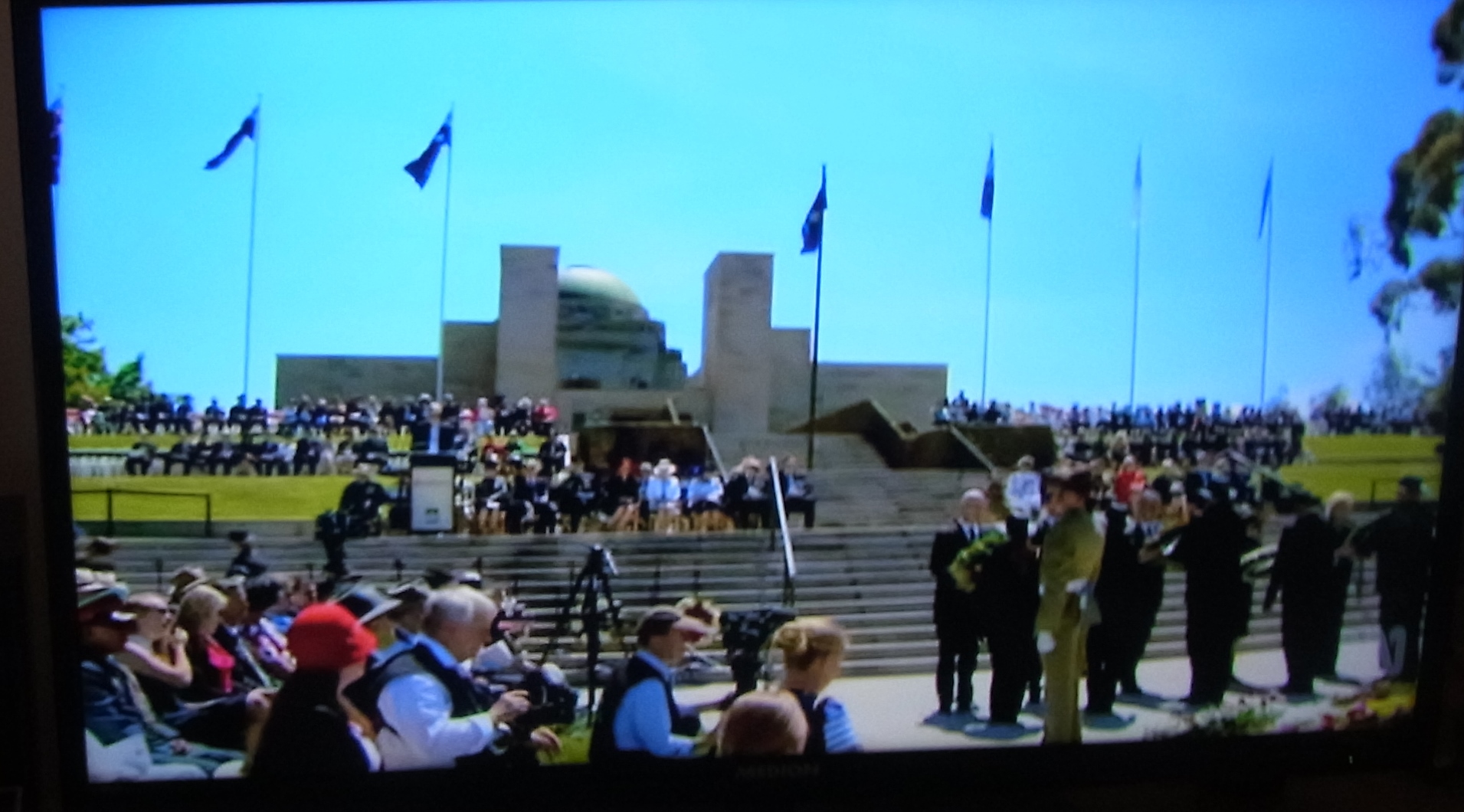

All the above pictures I took from our TV screen this morning during a special ABC broadcast from the Australian War Memorial in Canberra.
http://www.abc.net.au/news/2014-11-11/rememberance-day/5881352
Remembrance Day ceremonies are being held throughout the country to commemorate the Australians who have died serving their country.
Director of the Australian War Memorial Brendan Nelson said it was important to reflect on the lives lost in conflict, particularly those lost during The Great War.
Mr Nelson said the number of Australians killed in World War I and the impact it had on the nation was beyond comprehension.
“Today, I think it shouldn’t be too much to ask every Australian to perhaps set the alarm on your phone for 10:59am AEDT; and what you’re doing at 11:00am AEDT, just stop for a moment and think,” he said.
“You know, we sing our national anthem regularly, ‘Australians all let us rejoice for we are young and free’.
“Just reflect on the fact that we are young and free in no small way because 102,700 Australians have given their lives in our uniform, in our name.”
The Great War was the crucible in which our nation’s identity was forged.
Prime Minister Tony Abbott
In a recorded video message, Prime Minister Tony Abbott called on all Australians to pause and “remember the suffering and loss that’s occurred in all wars”.
“This Remembrance Day marks 96 years since the guns fell silent at the end of The Great War. The Great War was the crucible in which our nation’s identity was forged,” he said.
“From a population of under 5 million, 417,000 enlisted, 332,000 served overseas, 152,000 were wounded and 61,000 never came home.
“Today we will remember the courage, achievements, pain and loss of all who have served in our name and we draw strength from their memory. Lest we forget.”
In Canberra, former prime minister John Howard delivered a commemorative address before a minute’s silence at 11:00am AEDT.
“We honour first and foremost the extraordinary sacrifice of more than 102,000 Australians who have died in the defence of the values of this country and in defence of this country,” he said to the crowd.
“We also gather to honour the spirit of Australia which has moved this nation not to go to war to conquer and subjugate, but rather to go to war and defend the vulnerable, and defend the values of which this nation has always proudly stood.
“The sacrifice of Australians that we honour today is quite remarkable. It is a sacrifice as we contemplate the beginning of World War I, a sacrifice in that war which reached extraordinary proportions.”
In Victoria a $45 million redevelopment of Melbourne’s Shrine of Remembrance will be unveiled as part of that state’s commemorations.
A new gallery and education space will be opened to mark the 80th anniversary of the shrine, and will be officially dedicated after the Remembrance Day ceremony.
The Shrine of Remembrance Foundation’s chief executive Denis Baguley said the Galleries of Remembrance was an important addition.
“It really will ensure that the shrine will remain relevant for future generations. After all, our World War II veterans have passed on. So it’s a very important project in the sense of not only commemoration but education,” he said.
A day to remember returned veterans from recent conflicts
The Returned and Services League of Australia (RSL) urged people to use Remembrance Day to also reflect on those young veterans who have returned from recent conflicts with mental health and substance abuse issues.
President of the Tasmanian RSL, Robert Dick, said almost half of all Tasmanian men fought in the war.
“The Tasmanian presence was very strong, for an area that had a very small population at the time,” he said.
“Of the Tasmanians that actually went and served at the Western Front and at Gallipoli and the Middle East, one in four did not come home, they actually died either of wounds or were killed outright.”
New South Wales RSL president Don Rowe said many young veterans in their 20s and 30s were struggling to return to civilian life after tours of duty in Afghanistan, Iraq and Timor.
He said the sale of red poppies on Remembrance Day was part of an RSL fundraising drive to give returned soldiers the support and services they needed.
“Mental illness obviously is a very large issue. We’re also finding that the homeless issue is another one that’s happening out there to those who’ve served,” he said.
“A number of them just need help and support out there to just get their lives back into order … after serving in our defence forces.”
http://www.abc.net.au/news/2014-11-11/rememberance-day/5881352
This is a link to the above article.
Australians are being asked to pause for a second minute of silence to honour those veterans who have taken their own lives after returning from battle.
“[Australians should pause] to remember those who have come back and unfortunately succumbed to their wounds,” John Bale, a 30-year-old veteran said.
Berlin, a City undivided
http://www.theguardian.com/world/2014/nov/09/berlin-wall-fall-remembered-residents-25-anniversary
A city undivided: the fall of the Berlin Wall commemorated 25 years on
Germans recall the ‘sheer madness’ of the night in 1989 when thousands of East Berliners streamed across the border
Philip Oltermann in Berlin
The Guardian, Monday 10 November 2014 07.56 AEST
Jump to comments (42)
Germany Celebrates 25th Anniversary Of The Fall Of The Berlin Wall
The Brandenburg Gate stands illuminated during celebrations on the 25th anniversary of the fall of the Berlin Wall. Photograph: Sean Gallup/Getty Images
As the long row of helium-filled white balloons lifted off one by one into the night sky over Berlin, Tina Krone managed to gulp down a tear and lit a sparkler. “I haven’t seen that many people on the streets for 25 years,” she said, surveying the crowds at Bernauer Strasse.
On 9 November 1989, when she and thousands of other East Berliners streamed across the border into the west shortly before midnight, only those old enough to remember the building of the wall had cried.
Krone and her friends, on the other hand, had simply been lost for words: “‘Madness, sheer madness’. I know it’s not very original of me, but I must have said that a thousand times that night.”
An active member of the East German dissident movement, she had received a call from a friend in the west at about 10.30pm: “Have you seen the news? They’re saying the wall is open.”
Illuminated balloons, part of the so-called Border of Light, rise into the sky at the Potsdamer Platz in Berlin.
Illuminated balloons, part of the so-called Border of Light, rise into the sky at the Potsdamer Platz in Berlin. Photograph: Soeren Stache/Corbis
Because the closest border crossing to her at Bornholmer Strasse was already crowded, she and her partner jumped into their Trabant car to head to Kreuzberg.
When she had passed through the checkpoint at Heinrich Heine Strasse, a West Berliner thrust a bottle of beer into her hand, but she says she did not need to take a single sip to feel intoxicated.
In a bar, she and her partner met long-lost friends, who gave them a pile of western newspapers and a small colour TV as a welcoming gift. By daybreak, they were back at the checkpoint – there had been rumours that the border would close again at 8am.
Only when the guards waved them through for a second time did the reality sink in. “Then I knew there was no way back for the party bigwigs,” Krone says. “After that, it felt like our Trabi was flying us home.”
Whatever one’s views of the handling of the aftermath of the wall’s fall, memories of 9 November 1989 still have power. And while fall-of-the-wall anniversaries come and go, this year’s art installation, conceived by brothers Christopher and Marc Bauder, managed to create a rare thing: a memorial that felt both poignant and playful, thought-provoking but not maudlin.
People watch balloons marking the former border flying away in front of the Reichstag building.
People watch balloons marking the former border flying away in front of the Reichstag building. Photograph: Steffi Loos/AP
Since Friday morning, a so-called Lichtgrenze or “border of light”, made up of 8,000 balloons, has traced a section of the fallen wall across central Berlin for 15km (nine miles).
On Friday and Saturday night, thousands of Berliners old and young were out on the streets to walk along the old border.
Those who grew up in a divided Berlin are unlikely to ever forget the precise route of the old dividing line.
Krone says she still feels a bit queasy when she passes from east to west and recalls that it “hurt” the first time she passed under the Brandenburg Gate. The driver of the taxi in which she was travelling turned around and did it again, three times in total, “until it stopped hurting”.
But for tourists, it is surprisingly hard to tell these days where West Berlin used to start and East Berlin used to end. On Potsdamer Platz and near the central station, the area where the wall of light ran this weekend has been wholly renovated and is unrecognisable from the wasteland of 1989. In the hipper parts of Kreuzberg, the installation has reminded more recent arrivals that a country used to end right outside their doorstep.
German chancellor Angela Merkel walks along a section of the former Berlin Wall during celebrations for the 25th anniversary of its fall.
German chancellor Angela Merkel walks along a section of the former Berlin Wall during celebrations for the 25th anniversary of its fall. Photograph: Imago / Barcroft Media
At 7.20pm, with a considerable delay, the first balloon floated into the night sky in front of the Brandenburg Gate. The Berlin State Orchestra played Beethoven’s stirring Ninth Symphony and outgoing Berlin mayor, Klaus Wowereit, gave a short speech. “Walls made of concrete and walls in our heads are surmountable when people come together and take their fate into their own hands,” he said.
At Bernauer Strasse, the row of balloons took a sharp left into Mauerpark, once a section of the death strip, now a giant park for residents. Some people had climbed on to the strip of wall in front of the Friedrich-Ludwig-Jahn sports stadium to get a better view, as if in tribute to the pictures that were transmitted around the world in 1989.
Back then it was here, in the Prenzlauer Berg district, that the power of crowds forced the first border point to open. On Sunday, the locals’ famed impatience was once again on display: a number let go of their balloons early.
This year’s commemoration of the fall of the Iron Curtain may also feel more poignant because there is a palpable sense that peace in Europe in 2014 is more fragile than it was at the 20th anniversary in 2009.
People attend a memorial activity to commemorate the 25th anniversary of the fall of the Berlin Wall.
People attend a memorial activity to commemorate the 25th anniversary of the fall of the Berlin Wall. Photograph: Xinhua/Landov/Barcroft Media
In her speech at the wall memorial on Bernauer Strasse on Saturday afternoon, Germany’s chancellor, Angela Merkel, had explicitly emphasised the geopolitical resonances of the event, instead of indulging in personal reminiscences.
“We have the strength to shape things, to turn things from bad to good, that is the message of the fall of the wall,” she said. “These days, that message is directed at Ukraine, Syria, Iraq and many, many other regions in the world.”
Merkel, who on 9 November 1989 had walked over into the west at the Bornholmer Strasse checkpoint on her way back from the sauna, with her wet towel still in her bag, said: “If one thing was wonderful about those days, it was the imagination that was being set free after having been suppressed for so many years.”
Jean-Claude Juncker, the president of the European commission, issued a statement on the anniversary, warning that “Europe must once again become a thing of the heart”. He said: “It was with passion and courage that the people tore down that which divided them, in search of peace, freedom, unity, democracy and prosperity. Two decades later, we must not forget that peace is not a given in Europe. More than ever, Europe must live up to its responsibility to safeguard freedom and peace.”
Hulda, 3, places flowers in between slats of the former Berlin Wall at the Berlin Wall Memorial at Bernauer Strasse.
Hulda, 3, places flowers in between slats of the former Berlin Wall at the Berlin Wall Memorial at Bernauer Strasse. Photograph: Sean Gallup/Getty Images
On Saturday, the former Russian president Mikhail Gorbachev warned of a “new cold war”, brought about by the west’s mishandling of the aftermath of the fall of the wall.
“Instead of building new mechanisms and institutions of European security and pursuing a major demilitarisation of European politics … the west, and particularly the United States, declared victory in the cold war,” said the man behind the Soviet Union’s glasnost and perestroika reforms, speaking at a symposium near the Brandenburg Gate.
“Euphoria and triumphalism went to the heads of western leaders. Taking advantage of Russia’s weakening and the lack of a counterweight, they claimed monopoly leadership and domination in the world.”
The enlargement of Nato, Kosovo, missile defence plans and wars in the Middle East had led to a “collapse of trust”, said Gorbachev, now 83. “To put it metaphorically, a blister has now turned into a bloody, festering wound.”
 AuntyUta