This post of Gerard’s brought on quite a few comments. I think, my first comment to this post of Gerard’s was this one:
“Gerard, your imaginary ‘obituary’ shows your great imagination and humor! It is so humorous, that I made me laugh instantly.
But then I thought a bit more about it, why is it that ‘obituaries’ nearly always deal only with the ‘good’ things a person has done during a life-time?
It leads me to what I call my ‘personal’ belief about ‘Jesus’. I am not sure, whether I am a sort of ‘odd’ Catholic convert. I really do not have a lot of contact to other Catholics. I do not want to go into the reason for that. It is really another subject I would have a lot to say about . . . .
So, at age 40 I became a Catholic convert!
I was attracted by everything that related to what Jesus is supposed to have said.
He said, something like that if a great sinner (for instance someone who did commit murder) if this ‘mortal’ sinner is truly sorry for having done such a horrible sin, Jesus says, In this case a forgiveness of this sin can be granted!
I find the ‘Hail Mary’ Prayer has great faith value!
The first part of the Prayer says how blessed Mary is.
The second part of the Hail Mary goes like this:
Holy Mary,
Mother of God,
Pray for us Sinners,
Save us from the Fires of Hell,
And bring all Souls to
Heaven, especially those
That most need thy mercy. Amen
The Catholic belief, as far as I know, is that every person can become as wholesome as Jesus at death’s door, and then go straight to ‘Heaven’ so to speak. So when a person is dead and has regretted every bit of ‘Wrongdoing (Sin)’ then this person is totally blame-free, meaning nothing bad at all should be said about this deceased person!
Church people, that tend to threaten a mortal Sinner, as for instance
a murderer, with everlasting ‘Hell’ in my view do not act the way the (imaginative) ‘Jesus’ would have acted towards a ‘mortal’ Sinner!
The way, I imagine Jesus, he would have talked gently towards this person who committed a very grave Sin! Probably in most cases, there would not have been an instant forgiveness, but some urging to do a lot of ‘penance’!
When you do ‘penance’, you try extremely hard, to lead a life of a kind of self-sacrifice to make up for the very great wrong of mortal Sin!
Now to Mary, who is called ‘Mother of God’: This, to my mind wholly imaginary ‘Mother of God’, is just someone, that can pray for us so much better than we can ever be praying for ourselves!
In the Hail Mary Prayer, we think especially about those who do need most this special kind of mercy, so are in need of a lot of prayer!
My feeling is, that it is quite alright, ‘to speak only well’ about the deceased.
However, somebody who says on his deathbed that it was right that it was right to murder a person because that person is from a different race, how a person like this can ever be forgiven – – – – Well, I do not have an answer to this.
What I write here, are my personal feelings.
At this stage, I do just express my personal belief!
I do not claim, that my interpretations about ‘Belief’ are of general value: Really, not at all!
I assume, to be able to talk more sufficiently about the subject of belief, would, for sure, require some proper studying!”
Liked by 1 person
My other comments, to what Gerard published, I might publish soon as a follow-up!
It is impossible to read a bad word about those that have gone. All of us, men and women are faultless when in the icy embrace of the dearly departed. Here some examples from the obituary page of the Sydney Morning Herald: “Norman. Devoted father and beloved husband, sadly missed at 98 years old after 68 years of unstinting love to his dear wife Gladys, unselfishly gave to the community. Or Mavis, at 102 years sadly passed surrounded by loving family at Eventide Home, fascinating and loving wife of Geoffrey (who remained, faithful till the bitter end). She pioneered tirelessly for the sport of indoor sword fighting, boxing and gun clubs.”
With all the rain it did make me somewhat melancholic or inward looking and spend the time as usefully as possible and of late have come to peruse the paper’s Deaths and Funerals pages. It is amazing how few…
Today is the4thSunday after Peter died/On th 8th of November, that is just a few weeks ago, when Peter was still alive and able to visit the local doctor (with Olivia’s help that is), yes on the 8th of November I republished one of the posts from November 2011.
Now, I assume that most of my readers would not like to go to the trouble of looking up all these posts. However, for me it was most interesting to read through all of them again. It helps to give some kind of substance to what I do remember about the past nine years or so. These posts show me, that already nine years ago I could not help myself thinking about what would happen when Peter and I would come into our eighties. Well, Peter made it to 85 without any significant changes in our surroundings. I am 86 already. I must admit I am not at all used to organising some trades people to do any necessary repairs. Peter always did this. He always pointed out to me: “You can do it if you like!” But did he really want me to do it? I don’t think so. Whenever he was supposed to show me something, he soon got impatient and took over, doing whatever needed to be done rather himself. I must admit, I am a rather slow learner and always got scared I would not learn fast enough or forget soon again, how to do certain things. This also went very much so with work on the computer too. Whenever something went wrong on the computer he would take over totally, yes, maybe showing me a few things but without making sure that I had understood it properly. And it was very hard for me to ask for repeat instructions. He would just say: “But I showed you already!” and leave it at that.
In a lot of ways I am now totally dependent on the help of my children. I am extremely lucky to have three capable and loving children. But it is difficult for me to accept that I may have to disrupt their lives too much. I would like to have a certain type of independence where I feel that I am still capable of making my own decisions in every way and where I have not to told by anyone how to live my life!
One of my concerns at the moment is the ever increasing need for an overhaul of my backyard. When I look at that post from 22nd of August 2016 about the loss of three of our big trees, I am astounded how this backyard has changed again over the last four years or so!
Often, I like to go back in time by looking at old blogs. The other day, I saw a Diary Post of mine, that I published on the 31st of August 2020. This post says a lot about my odd sleeping patterns!
It is interesting for me, to read about this, and to compare it with what my present waking and sleeping hours are like!
I must say, I still have similar odd sleep habits now. I wonder, what does it mean?
I actually feel rather bad about it, since I do know, that Peter did not like it, when I could not keep myself awake, while we were watching something on television.
Here now is a copy of this afore mentioned post:
“At the start of this writing it is still Sunday, 30th of August 2020, but close to midnight already!
Peter and I, we still enjoy good food and fresh air and sunshine! For lunch I cooked a very likable Vegetarian meal today. (I think, Peter liked it too!) It was lots of different vegies with a cheese sauce. As a desert we had sour cherries (that came in a glass from Poland!) as well as some fresh cream and custard. We also had some chilled Muscat Wine.
And yes, we had a most beautiful sunny day today. So, I spent a lot of time outside. Meaning, for hours, I was just sitting or lying down in the sun! Sometimes, I went to sleep for a bit. In the afternoon Peter joined me in the sun for a while. We each had a glass of chilled ginger beer. This was so good!
Later on we watched a German movie on television. I soon went to sleep. I also went to sleep watching the evening news. Later on I was awake for a while watching ‘Vera’. Before ‘Vera’ was finished, I went to sleep again, probably for hours.
When I woke up around ten o’clock, Peter was still awake. We soon reminded ourselves, that tomorrow is Monday, and we have doctors’ appointments. By 8 o’clock we have to be in the Medical Centre here in Dapto. That means, in order to be getting ready on time, we ought to be up by 6 o’clock!
Reluctantly, we both made an attempt to get ready for bed. I think it was about 11 o’clock when finally we were both lying in bed. Peter was very tired. He soon went to sleep, after having helped me with taking my blood pressure! Taking my blood pressure is always an immense struggle! Just to establish a reading on the monitor, I do find very difficult indeed!
When I realized, that Peter had gone to sleep already, and that I was not quite ready for sleep, I actually decided, it was better for me to get up for a bit of whisky!
Well, I did have this bit of whisky, and now I am glad that I ended up having a bit of time at the computer. In the meantime, it is already a bit past midnight. Time for me to go to bed again! I am sure, I am going to have a wonderful sleep now.”
Yes, Carolyn, Peter is home now! This was so lucky that last week he did not have to stay in hospital any longer. Last Thursday, another procedure was attempted, and that went very well. So he was allowed to go home the following day. They really did take excellent care of him in the hospital. We both get easily tired and rest a lot. There are frequent medical appointments. We are always glad when we are back home again after a few hours out of the house. Peter is doing as well as can be expected. All his sicknesses make him slow down a lot. But part of it, for me too, is of course Old Age! HUGS from both of us!
Oh, I’m so glad he is home now with you!!! And I’m so glad things went while he was there at the hospital! Yes, aging does have that effect on our bodies. I wish you both THE very best and do take rests when you need them! HUGS!!!
Would You Spend $450 to Apologize to Your Best Friend?
And three other ways to resolve conflicts like a Byron Bae.
By Joseph LewMarch 15, 2022
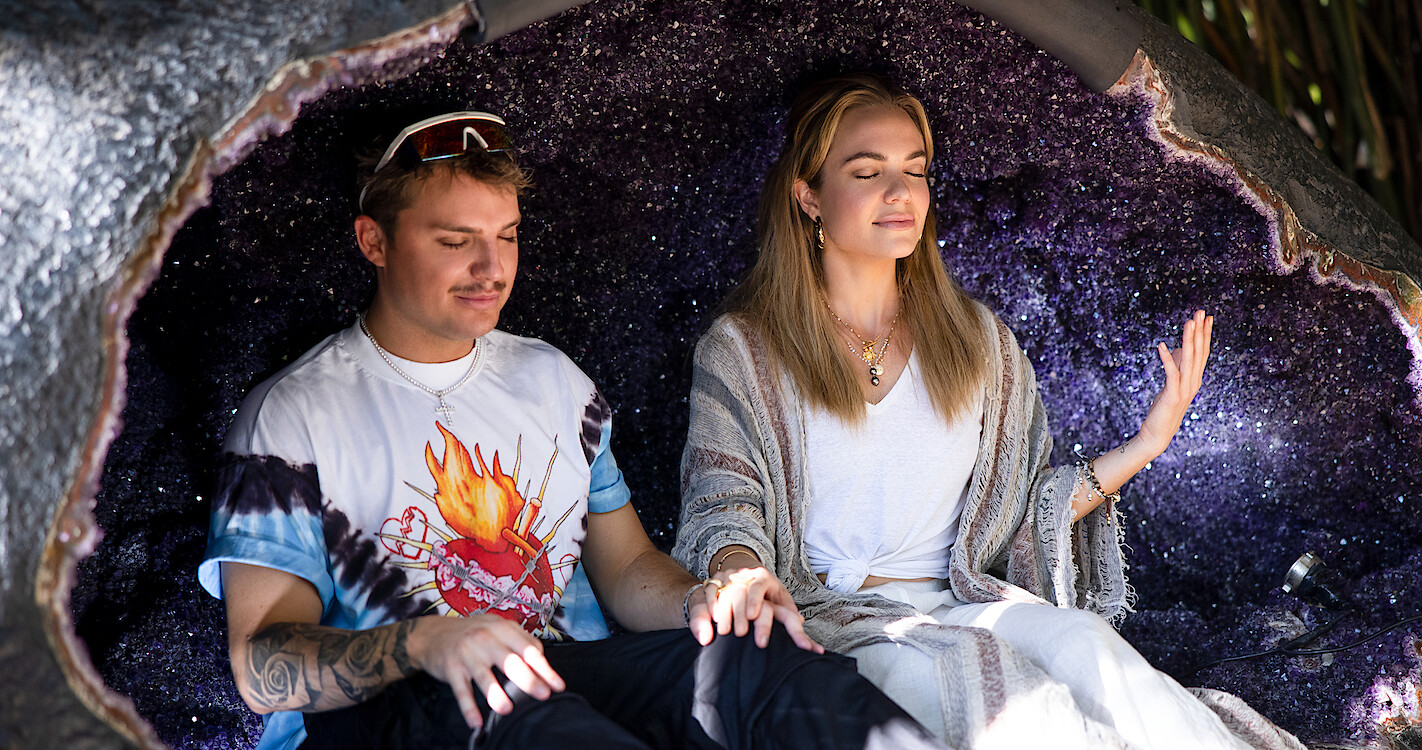
Pristine beaches, linen jumpsuits and sun-soaked drama? That can only mean one thing: Netflix’s first Australian docusoap, Byron Baes, is here, and boy is it wild.
When musician Sarah St. James and social media star Jade Kevin Foster move to the coastal town of Byron Bay, they fall in with a tight-knit group of locals. But not all is as idyllic as it seems, as Sarah quickly finds herself in the middle of a drama-filled love triangle. As the group starts to split down the middle, the alternative-lifestyle-leading locals try to resolve the bubbling tension the best way they know how. Cue outlandish fire-twirling ceremonies, art therapy and shouting matches that belong on Melbourne’s Chapel Street on a Saturday night (“I’m not a fuckboi!” says Nathan for the millionth time).
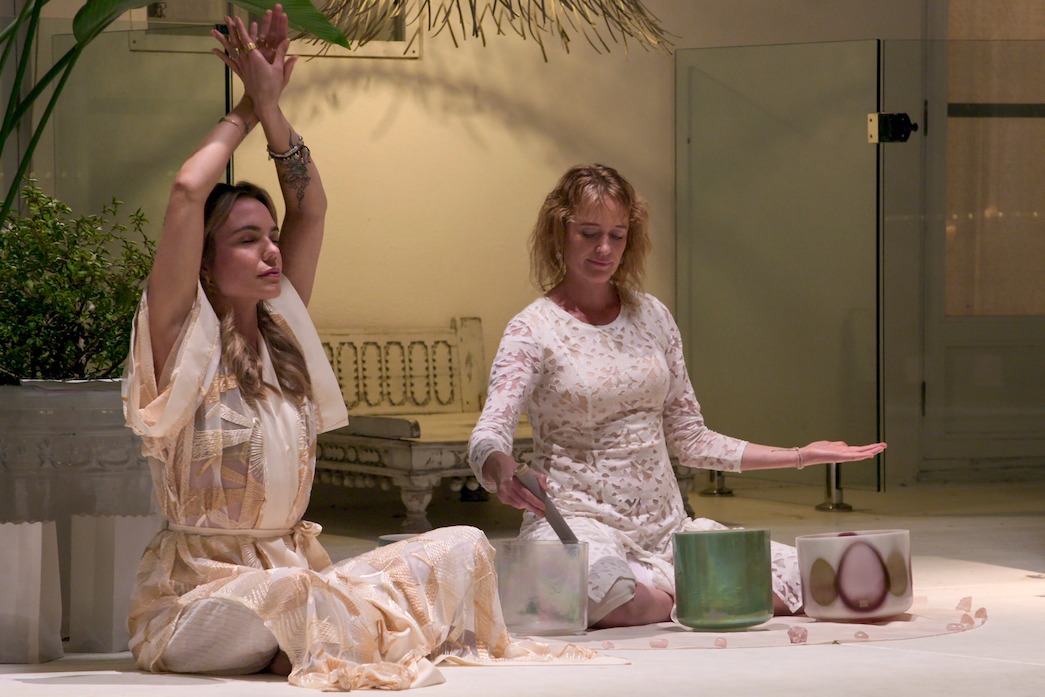
Which has us wondering: Could we resolve, ahem, bad vibez, by bringing all our mates over for a Handmaid’s Tale–esque sound healing? Is it practical to replicate Simba’s fire ceremony every time we end up in a love triangle (which happens more often than we’d hope)?
In our own best interest, we’ve decided to sit down, pour a savvy-b and rank every conflict resolution method the cast uses in Byron Baes by whether we could actually afford them. (Spoiler: No.)
Paul A. Broben/Netflix
4. A good ol’ confrontation
Sometimes people need to be called out on their ish and no one’s kicking that into gear better than Johansen-Bell sister Jessica. You can’t convince us she’s not an Aries because that fire-sign energy literally leaps out when she confronts Hannah in Episode 1.
But while a cheeky confrontation might be free, who wants to just talk things out — boring. After all, when in Byron…
Cost: $0
3. Art therapy
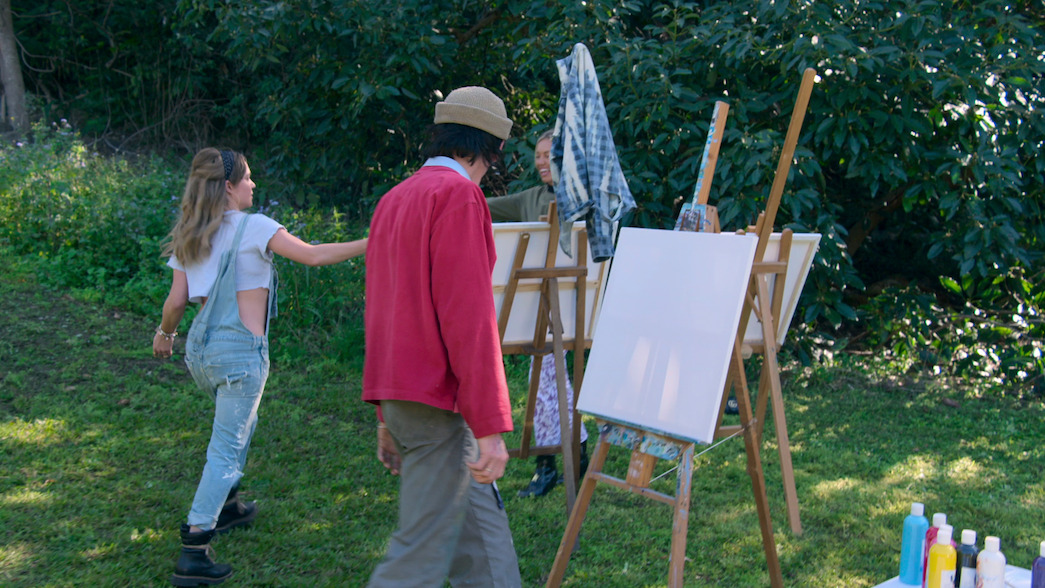
What do you do when you’ve got spare paint, a tension-filled friendship and a couple messy binches? Make even more of a mess and call it, uh, “art therapy.” In Episode 8, Cai leads a workshop to help some of the baes “clear the air,” turn their beef into beauty and answer the age-old question: Can art heal all?
But while something like this might only set us back the cost of some arts supplies, judging from the way Elle flings that paint like a toddler with a brussel sprout (blegh), all the art therapy in the world can’t save you from a Gemini with a vengeance.
Cost: $40
Ben Symons/Netflix
2. Shamanic fire ceremony
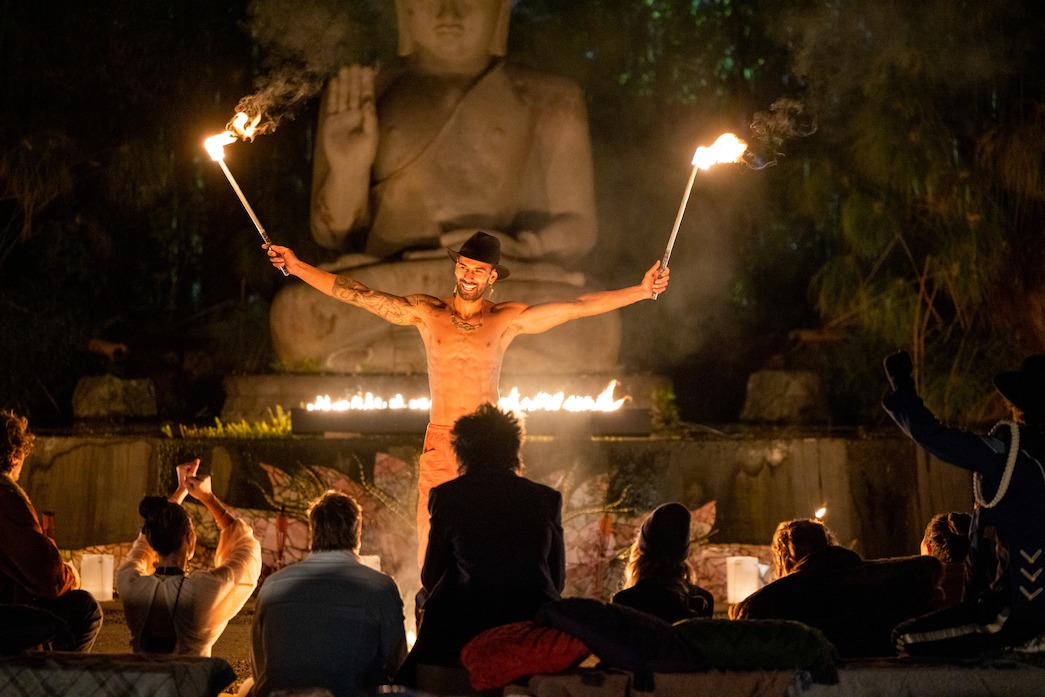
Is it getting hot in here or is Simba on the scene? After toxic energy starts to cloud the Baes, the former finance bro decides to hold a fire ceremony to burn away “internal deadwood” and create space for groundedness and healing. Think: drumming, sage, organic cacao and fire twirling.
After sussing online at how we could burn baby burn some negative vibes of our own, we stumbled upon a couple events that offer exactly the same thing. Better defrost that credit card though, because each ticket will set you back an average of $120. Conclusion? Yeah, nah we’re good — we can get the same experience from a Fitzroy sharehouse.
Cost: $120
1. Sound healing
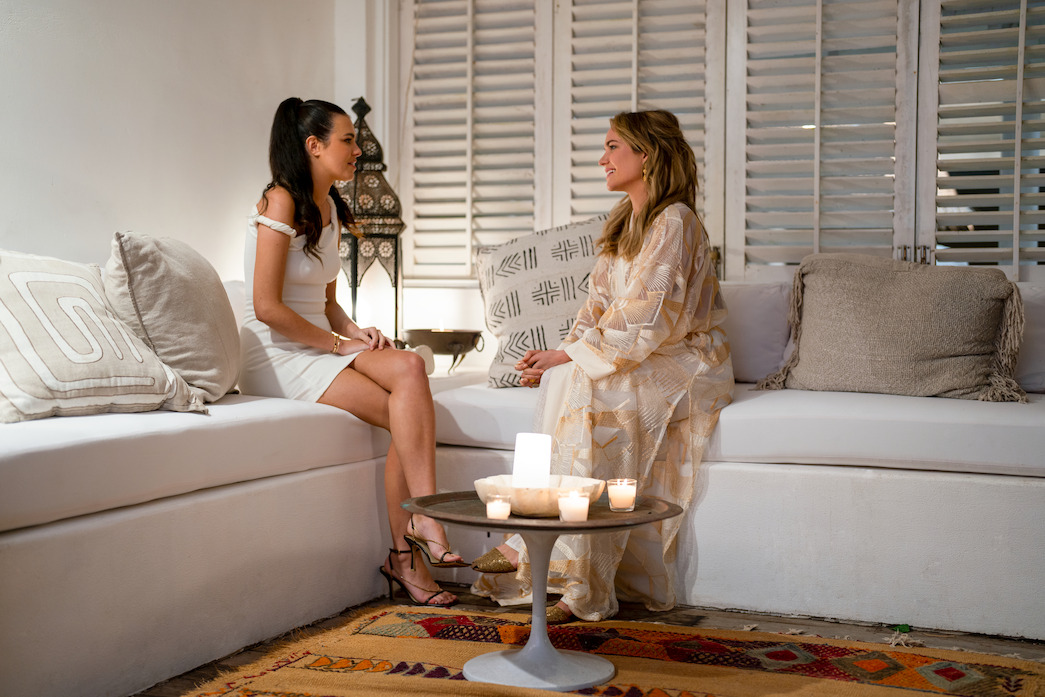
Did enemy No.1 just walk into your party? As Hannah knows all too well, sometimes the only way to rid yourself of some bad juju is with a full-on sound-healing sesh. As sound practitioner Avi Sherbill told Harper’s Bazaar, sound healing uses musical instruments to create meditative vibrations to the equivalent of a “massage on a cellular level.” Clocking in at upwards of $450, depending on how many people are attending, we’d probably rather put on a Youtube video and just pretend it’s the same thing. Close your eyes and you won’t even be able to tell the difference… right? Right? And, in case you missed it, no booze while you sound-heal.
Cost: $450
Ben Symons/Netflix
GUIDE
Would You Spend $450 to Apologize to Your Best Friend?
And three other ways to resolve conflicts like a Byron Bae.
By Joseph LewMarch 15, 2022
Pristine beaches, linen jumpsuits and sun-soaked drama? That can only mean one thing: Netflix’s first Australian docusoap, Byron Baes, is here, and boy is it wild.
When musician Sarah St. James and social media star Jade Kevin Foster move to the coastal town of Byron Bay, they fall in with a tight-knit group of locals. But not all is as idyllic as it seems, as Sarah quickly finds herself in the middle of a drama-filled love triangle. As the group starts to split down the middle, the alternative-lifestyle-leading locals try to resolve the bubbling tension the best way they know how. Cue outlandish fire-twirling ceremonies, art therapy and shouting matches that belong on Melbourne’s Chapel Street on a Saturday night (“I’m not a fuckboi!” says Nathan for the millionth time).
Which has us wondering: Could we resolve, ahem, bad vibez, by bringing all our mates over for a Handmaid’s Tale–esque sound healing? Is it practical to replicate Simba’s fire ceremony every time we end up in a love triangle (which happens more often than we’d hope)?
In our own best interest, we’ve decided to sit down, pour a savvy-b and rank every conflict resolution method the cast uses in Byron Baes by whether we could actually afford them. (Spoiler: No.)
Paul A. Broben/Netflix
4. A good ol’ confrontation
Sometimes people need to be called out on their ish and no one’s kicking that into gear better than Johansen-Bell sister Jessica. You can’t convince us she’s not an Aries because that fire-sign energy literally leaps out when she confronts Hannah in Episode 1.
But while a cheeky confrontation might be free, who wants to just talk things out — boring. After all, when in Byron…
Cost: $0
3. Art therapy
What do you do when you’ve got spare paint, a tension-filled friendship and a couple messy binches? Make even more of a mess and call it, uh, “art therapy.” In Episode 8, Cai leads a workshop to help some of the baes “clear the air,” turn their beef into beauty and answer the age-old question: Can art heal all?
But while something like this might only set us back the cost of some arts supplies, judging from the way Elle flings that paint like a toddler with a brussel sprout (blegh), all the art therapy in the world can’t save you from a Gemini with a vengeance.
Cost: $40
Ben Symons/Netflix
2. Shamanic fire ceremony
Is it getting hot in here or is Simba on the scene? After toxic energy starts to cloud the Baes, the former finance bro decides to hold a fire ceremony to burn away “internal deadwood” and create space for groundedness and healing. Think: drumming, sage, organic cacao and fire twirling.
After sussing online at how we could burn baby burn some negative vibes of our own, we stumbled upon a couple events that offer exactly the same thing. Better defrost that credit card though, because each ticket will set you back an average of $120. Conclusion? Yeah, nah we’re good — we can get the same experience from a Fitzroy sharehouse.
Cost: $120
1. Sound healing
Did enemy No.1 just walk into your party? As Hannah knows all too well, sometimes the only way to rid yourself of some bad juju is with a full-on sound-healing sesh. As sound practitioner Avi Sherbill told Harper’s Bazaar, sound healing uses musical instruments to create meditative vibrations to the equivalent of a “massage on a cellular level.” Clocking in at upwards of $450, depending on how many people are attending, we’d probably rather put on a Youtube video and just pretend it’s the same thing. Close your eyes and you won’t even be able to tell the difference… right? Right? And, in case you missed it, no booze while you sound-heal.
Byron Baes’ Hannah (left) invites Ruby (right) to do some “sound healing” at a party in the show’s first episode.(Supplied: Netflix/ABC Everyday: Luke Tribe)
Share
I’m only a few episodes deep into Byron Baes and I already have so many questions.
For starters, what is a “ceremonial cacao”? And why does everyone hate the Gold Coast so much?
But of all the questions I’m dying to ask Byron Bay’s “tight-knit inspirers”, I’m most curious about the “sound healing” Hannah books for the party at her parents’ bougie house in the first ep.
“I’m having my beautiful sound healing lady play a little,” Hannah announces at the event, trailing off as she gestures into the air.
“It’s about music as it changes the molecular cellular levels.”
A few reality-TV minutes later, Ruby the sound healer arrives.
Then she begins using what look like singing bowls to create “meditative vibrations“.
Some people at the party take it seriously, but there’s also plenty of laughter and shared confused glances. If I were there (a gal can dream) I probably would’ve raised an eyebrow.
Psychologist Mary Hoang tells me sound healing is an ancient practice that uses different instruments including singing bowls and tuning forks to give people “an experience of their mind and body state”.
“Sound healing has been used for quite a long time to help people connect to their emotions, remember past experiences, and it’s an opportunity to just relax and get a sense of wellbeing,” Ms Hoang continues.
“It’s [based on] the idea that the music will have a direct effect on the body and brain and that it will be able to bring about some kind of healing,” adds Professor Katrina McFerran, head of music therapy at the University of Melbourne.
Professor McFerran says this is very different to music therapy, which is a research-based profession that involves music therapists working with people “to achieve their goals using music”.
Some examples of this include using music to help improve pain relief, for help with rehabilitation goals, or to develop insight into personal issues.
This is not to say the contemporary practice of music therapy in Western culture, which sits within a medical model, is “better” than sound healing, or that there’s no point to it.
“There are longstanding cultural traditions of using music within all kinds of rituals which might be described as forms of healing. It’s really important to be respectful of that, and not to disregard what may be thousands of years of beliefs and practices using music,” Professor McFerran adds.
“I don’t know if [sound healing] ‘changes the molecular structure of the cells’ [like Hannah claims], but music can help trigger different emotions and memories and help reduce stress by reducing the heart rate [and] decreasing cortisol in the body,” Ms Hoang says.
And Amanda Krause, a lecturer in psychology at James Cook University, says “there are cognitive, spiritual and physical benefits” to hearing music and sounds, too.
“But it’s really important to note that peoples’ preferences play a role [in the level of benefit that comes from listening to them],” she adds.
If you like what you’re listening to and you’ve chosen to listen to it, she says that’s when you’d start to see some of the positive benefits we just touched on.
But if you don’t respond well to a particular song or sound — say the chiming vibe at Hannah’s party grates on you — you won’t.
Professor McFerran says this is why music therapists and music psychology researchers veer away from “generalisations about the reactions and responses people have to music emotionally, let alone at what you might call a level of ‘healing’.”
I enjoyed this easy to breathe air without any moisture in it! 🙂
A bit before 2 PM a walked over to the Club. I spent there about
an hour sitting in nice surroundings. It was a quiet day at the Club.
Not many people go to the Club on Monday or Tuesday, for these are the days when the Bistro stays closed: So, no food is available on these days.
I liked to sit there for two hours in the afternoon with only a couple of drinks: First I had some cappuccino, and after about one hour I had a glass of chilled Riesling. 🙂
As a member of the Club, I paid only 4 Dollars for each drink! 🙂
While sitting there, I looked into one of my books from the Dapto Library:
A cute little book about Paris with beautiful photos on every page! 🙂
This booklet is called “Quiet Paris” and has 142 pages. 🙂
So that you may get an idea, what these pages are about, I copy, what it says about the content:
(Introduction, with no pictures, starts on page 6)
Museums starts on page 10
Libraries starts on page 22
Parks and Gardens starts on page 32
Places to relax 52
Places of Worship 62
Shops 72
Restaurants 88
Cafes 100
Bookshops 110
Galleries 122
Cultural Centres 130
Places to stay 136
Paris is such a beautiful city! 🙂
I have been there for a week in 1954 as a 19-year-old, and
absolutely loved then my time in Paris! 🤩
I loved it again 36 years later in 1990, when I was there with
Denise Booth tends to her sister’s grave every evening before the sun goes down.
“We miss her,” Denise says quietly.
“Miss her ways. And her smiles and that.”
WARNING: Aboriginal and Torres Strait Islander readers are advised that this article contains images of a person who has died, used with the permission of their family.
So many graves in Doomadgee cemetery belong to young people like Yvette “Betty” Booth.
Just two months before she died, the teenager was diagnosed with an illness that has all but disappeared in most of Australia.
Betty (centre) was just 18 years old when she died.(Supplied/Four Corners: Nick Wiggins)
Denise has the illness too. It’s called rheumatic heart disease (RHD).
Betty was supposed to get weekly check-ups and urgent surgery, but that never happened.
She visited Doomadgee Hospital’s emergency department 12 times in under two months.
On some of those occasions, she was given Panadol through a security grate and sent away.
Her family is heartbroken and angry.
Denise Booth at her sister’s grave.(Four Corners: Louie Eroglu ACS)
“We are human beings, you know?” says Betty’s uncle, Martin Evans.
“We want to get the same treatment as the next person.
“What happened at that hospital — it’s just not right.”
Betty’s death is one of three in the space of a year uncovered by Four Corners in an investigation into health care in this remote town.
Diagnosis
When doctor Bo Remenyi visited Doomadgee in July 2019 to screen children for RHD, she recognised Betty Booth and her family right away.
Dr Remenyi started her medical career in the remote north-west Queensland town and the plight of RHD patients had inspired her to specialise in paediatric cardiology.
She had treated Betty as a baby 18 years earlier and even babysat her.
When she examined Betty, now aged 18, Dr Remenyi quickly realised Betty had severe RHD.
Doctor Bo Remenyi (centre) with Betty and her mother Norma Mick.(Supplied/Four Corners: Nick Wiggins)
Betty needed urgent surgery to repair the valves in her heart.
Dr Remenyi’s team left detailed instructions for her care and multiple health bodies — including Doomadgee Hospital’s doctors and director of nursing — were emailed Betty’s referral to a cardiology service.
Despite this, no record of her illness was kept on Doomadgee Hospital’s file.
Betty was supposed to be reviewed weekly, but that never happened.
‘The shut-up pill’
Betty first went to the hospital four days after her diagnosis, at 11pm with a cough, fever and vomiting.
She was given Panadol and treatment for dehydration and sent home to return in daylight hours.
On that occasion, staff took her temperature and pulse, but that wouldn’t always be the case.
Dr Remenyi says it’s not unusual for patients who go to the hospital on weekends and after hours not to be properly assessed.
“The conversation takes place over a cage, without actually touching the patient or examining the patient or giving that real opportunity to discuss the symptoms,” she says.
Betty would go on to visit the emergency department 12 times, with symptoms including difficulty breathing, fever, an abnormally high heart rate, and coughing up blood.
But she was given paracetamol (and once, antibiotics) – often handed through the locked after-hours security window – and sent away.
Betty went to the hospital several times with symptoms like coughing up blood and difficulty breathing.(Four Corners: Louie Eroglu ACS, Nick Wiggins)
On some of these occasions, hospital staff did not carry out basic vital signs observations that are routine in other hospitals – taking temperature, pulse, oxygen saturations.
“How many times can you present, with the same symptoms, pressing symptoms, coughing up blood, shortness of breath, tachycardia, and each time the outcome is not different?” Dr Remenyi says.
She says Betty’s care represents “clearly, a failure of the health system”.
An independent review of Betty’s care would later say, “generally patients do not present in the middle of the night for no reason, and it is rare for them to present frequently at that time”.
Vicki Wade, director of lobby group RHD Australia, says the use of paracetamol in this way is disappointingly widespread in remote Aboriginal communities.
“We know that it’s not the right treatment, but unfortunately, Panadol’s easy to give out, so you know, people will get the Panadol and we’ll say, ‘oh, that’s the shut-up pill’,” she says.
Four Corners investigates how the health system has failed women like Betty, tonight on ABC TV and iview.
‘They are supposed to be professionals’
After multiple presentations to Doomadgee Hospital in August 2019, Betty went to Townsville, where her mother was having an operation.
Townsville Hospital was also aware of Betty’s diagnosis and while there was toing and froing between medical services and Betty to try to set a date for her surgery, it never happened.
When Betty returned to Doomadgee after three weeks, she fell desperately ill again.
Marilyn Haala, a relative who was staying at Betty’s house that weekend, noticed Betty’s face and neck were “all swollen”. Swelling can be a serious warning sign of heart failure.
“She was sick, she just kept coughing — she didn’t look good,” Ms Haala says.
“She was struggling to breathe.”
Marilyn Haala encouraged Betty to go to the hospital.(Four Corners: Louie Eroglu ACS)
The family decided Betty should go to the hospital, but when Betty’s sister took her to the emergency department, her family says she was again sent home with Panadol.
“An 18-year-old girl should not be sent home with Panadol,” Mr Evans says.
“They are supposed to be the professionals, check her file for goodness sake.”
Weenie George, the mother of Betty’s best friend, says this practice was commonplace at the hospital.
“They don’t treat them and check them,” Ms George says.
“They just send them home. They don’t do their job at night.”
Monday, September 23
Weenie’s husband Terrence and daughter Shakaya both had rheumatic heart disease, so when Betty turned up to their house, they knew the signs of a very unwell patient.
“She was looking a bit puffy in the face. She was breathless talking to me and Terrence,” Weenie George says.
Weenie George says it’s common at night for the hospital to send people home without checking them.(Four Corners: Louie Eroglu ACS)
Terrence George says when Betty sat down on their verandah, he said: “You look sick, Bubba, you better go to the hospital”.
That’s what Betty did. She never came home.
In the afternoon, a nurse recorded Betty had a fever and a fast and irregular heartbeat.
But critically, yet again, there was no alert on the hospital’s online system to show Betty had severe RHD and required urgent surgery.
By 4:45pm, Betty had been waiting for hours, seriously ill, and staff finally decided she should fly out, but she was categorised as “low dependency”, meaning staff had up to six hours to get her on a flight.
An hour later, a plane was ordered from Townsville, 850 kilometres away, instead of the closest big hospital, Mount Isa.
Betty waited for hours before staff decided to fly her out of Doomadgee.(Supplied/Four Corners: Nick Wiggins)
Marilyn Haala and her husband Clennon Bob were pacing around outside the hospital, “stressing out”.
“I wanted to go in to see her,” Mr Bob says.
“No-one would let me go in, even the nurse or the doctors.”
Within an hour, Betty deteriorated badly.
By the time a Royal Flying Doctor Service plane finally landed at Doomadgee, Betty Booth had been dead for almost two hours.
“[The] doctor that was treating her, came out and gave us the bad news: Betty didn’t make it,” Mr Bob says, slowly shaking his head.
“It broke both of our hearts,” Ms Haala says, weeping.
She says it is still painful to talk about Betty, but she hopes it will help other young people in the Doomadgee community with RHD.
“Because what they did there, they just going to keep killing people,” Ms Haala says.
“They going to keep killing them. And get away with it.”
A long wait for answers
Just three months after diagnosing Betty, Dr Remenyi returned to Doomadgee for the teenager’s funeral.
“To see Betty, who was a young, enthusiastic, caring, compassionate young woman with a bright future – to see her in a coffin … devastating,” Dr Remenyi says.
“I felt angry that in 20 years, nothing had changed.
“I became a paediatric cardiologist because I wanted to stop young women, specifically, dying from rheumatic heart disease.
“When I diagnosed Betty with rheumatic heart disease, I felt really positive.
“I felt like I could change the trajectory of her life.
“Now I’m seeing her in a coffin … I felt responsible.”
A community protest followed Betty’s death. Locals were angry and demanded answers.
Locals staged a protest outside the hospital in September 2019.(Supplied: Aiden Green/Four Corners: Nick Wiggins)
The local area health service promised an independent review into what went wrong, but the family heard nothing for almost two years.
In August 2021, shortly after Four Corners began making calls about this story, Betty’s mother Norma Mick suddenly heard from the local area health service, asking her to come for a meeting to discuss a report into Betty’s death.
Ms Mick was shocked to see the report was dated March 2020 – 17 months before.
In all that time, nobody at Doomadgee Hospital or in the health department had thought to share the report with the family.
It catalogued a series of failures that preceded Betty’s death.
Treated ‘like dogs’
The “Betty’s Story” report found Doomadgee Hospital had “clinical risk and poor governance”, low expectations for Aboriginal patients’ health, and an unwelcoming hospital environment.
“[It feels] like they treat us like animals,” Ms Haala says, angrily.
“It’s the truth.”
Other locals cited in the report said the hospital treated them “like dogs”.
Dr Remenyi hoped Betty’s diagnosis would change her life.(Four Corners: Louie Eroglu ACS)
Dr Remenyi says there’s a division between health services and the community.
“It’s racism … one group of people thinking potentially that they are better than the other,” she says.
Pat Turner, who heads the National Aboriginal Community Controlled Health Organisation (NACCHO), the peak body in indigenous community health, says it’s inexcusable for a patient to be repeatedly turned away like Betty was.
“If I present to an emergency department and I’ve got serious symptoms, I don’t want to be handed Panadol through the grate.”
“I want a full triage and I want to have all the work done that any other Australian has a right to expect.
“The racism is absolutely out there, and it has to stop.”
RHD thrives in communities with poor housing and living conditions.(Four Corners: Louie Eroglu ACS, Nick Wiggins)
Despite the high incidence of RHD in Doomadgee for decades, the “Betty’s Story” report found staff at the hospital had “limited understanding of rheumatic heart disease”.
The disease, which had all but disappeared in white Australia by the 1990s, now almost exclusively affects Aboriginal Australians.
What is RHD?
It’s caused when repeated strep A infections in the throat or skin sores are not adequately treated, and they develop rheumatic fever
Getting rheumatic fever repeatedly damages the valves in the heart and leads to RHD, which can cause heart failure, stroke and death
It thrives in poverty – where poor housing and living conditions can allow the strep bug to spread
Rates of RHD have risen from 67 cases in 100,000 in 2014 to 81 cases in 100,000 in 2019.
But the incidence of RHD in Doomadgee’s children is far greater — 4,400 cases in 100,000.
That’s higher than sub-Saharan Africa.
“It is an appalling statistic in a country as capable and competent as Australia,” Pat Turner says.
“We stand back and watch children, time after time again, year after year, decade after decade, having still the same end result,” Dr Remenyi says, “Which is dying far too young.”
Within a year of Betty Booth’s death, two other young women with RHD died after seeking treatment in Doomadgee.
One of them was 17-year old Shakaya George, daughter of Weenie and Terrence George, the other was Shakaya’s aunt, Adele Sandy.
“They’re not helping us,” Ms Haala says of the hospital.
“They’re killing us.”
After being contacted by Four Corners, the Queensland coroner announced on Friday it would hold an inquest into the women’s deaths, including “the adequacy of the care and treatment received”.
Queensland Health Minister Yvette D’Ath told Four Corners in a statement that all three cases were under investigation by North West Hospital and Health Service.
“I would also expect any allegations about the standard of care delivered at Doomadgee Hospital to be investigated,” she said.
Follow the investigation into the deaths of these three women tonight on Four Corners on ABC TV and ABC iview.
NSW flood: Sydney residents in west and north-west evacuate as Warragamba Dam spill
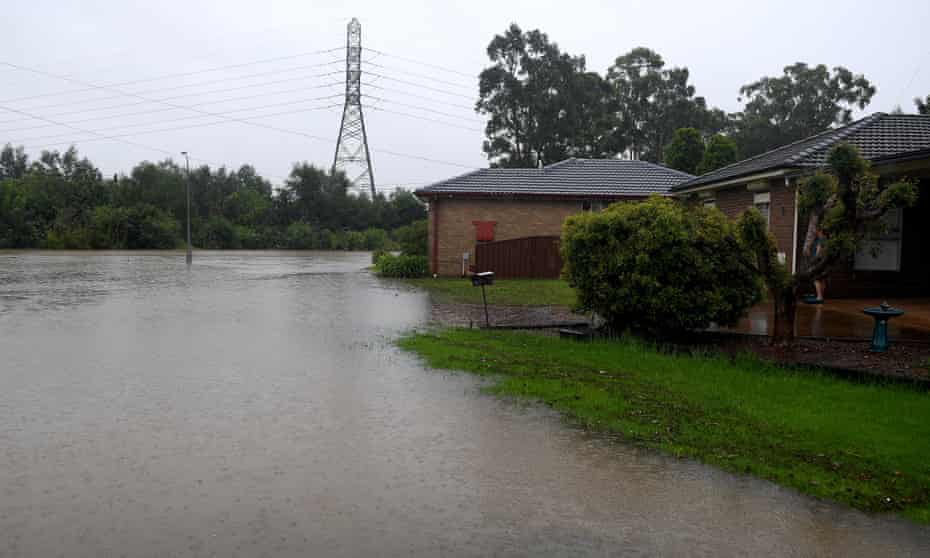
NSW flood: a flooded street in Penrith in Sydney’s west. More severe weather is expected overnight and Thursday, with NSW authorities warning communities at risk to evacuate as Warragamba Dam spills. Photograph: Dan Himbrechts/EPA
New South Wales authorities have warned communities at risk of major flooding in the Sydney region to evacuate or prepare to evacuate as the Hawkesbury, Nepean and Georges rivers continue to rise.
Warragamba Dam, Sydney’s main reservoir, was spilling at a rate in excess of 70 gigalitres a day on Wednesday after torrential rainfall over its catchment exceeded earlier predictions, according to a NSW government official.
The spill, which began at about 3am, was expected to peak on Thursday. The previous expectation of an upper range of the spill at 350GL a day has now been lifted to match or exceed the 440GL/day rate experienced during the March 2021 floods. That event caused widespread damage to areas to Sydney’s north and west.
“Major flooding is occurring in south-west Sydney exceeding March 2021 levels with major flood warnings in place. It’s raining, with some areas hit harder than others and more rain on its way. Keep a serious eye on the warnings and forecasts,” the NSW Bureau of Meteorology tweeted before 9pm.
“This is our worst fear,” the NSW deputy premier, Paul Toole, said earlier on Wednesday evening. “It will get worse before it gets better.”
In a worst-case scenario, Warragamba’s spill rate could peak at 600GL/ day, Toole told a media conference. A potential evacuation could involve “quite a few hundred thousand people”, NSW State Emergency Service commissioner, Carlene York, said.
Sydney Harbour holds roughly 500GL. More flood water, too, is entering the Hawkesbury-Nepean region from other tributaries that enter the flood plain below the dam.
There were also concerns Redbank Dam could fail, prompting the SES to direct people in some parts of North Richmond, north-west of Sydney, to evacuate.
“We just recently issued an evacuation order for the area in North Richmond downstream of the Redbank Dam because it may fail,” York said. “I want all those residents to make sure they do evacuate from that area.”
Residents were told to evacuate in some areas of Agnes Banks, Bligh Park, Camden, Cattai, Chipping Norton, Georges Hall, Lansvale, Leets Vale, Milperra, Moorebank, Sackville, Warwick Farm and other suburbs.
Authorities also told thousands more residents who were affected by Sydney’s 2021 floods to be on standby to leave.
NSW Health told people isolating due to Covid they should still evacuate their home if threatened by rising flood waters.
“If you are told to evacuate, you must evacuate,” NSW acting chief health officer Dr Marianne Gale said. “An emergency evacuation is a valid reason to leave your home.”
The Bureau of Meteorology shifted its forecast for when Sydney’s heaviest falls may land, predicting 120mm to 150mm on Thursday, up from 50 to 70mm. Since 9am on Wednesday, the city had only collected about 10mm, although inland sites were much wetter, with about 84mm up to 5pm at Richmond.
The bureau has also issued a major flood warning for the Nepean and Hawkesbury rivers.
“Significant river level rises have been observed along the Nepean River where major flooding is possible from early Wednesday evening,” the BoM said.
“Along the Hawkesbury and Lower Nepean rivers major flooding is also possible from overnight Wednesday into Thursday at Penrith, North Richmond, Windsor and downstream based on forecast rainfall.”
Sign up to receive an email with the top stories from Guardian Australia every morning
“We are going to be getting massive, like torrential rainfall,” Stephanie Heard, a spokesperson for the NSW SES, said.
“We want the community to start preparing for the potential for evacuation. We really need to make sure that the community listens and will follow our advice. Basically, it’s really quite a dangerous weather system that we’re seeing.”
There had already been 18 flood rescues in the Sydney region by Wednesday afternoon. Rainfall totals could reach 150mm to 200mm over the Hawkesbury region, Heard said.
While Sydney itself had been spared most of the heavy rain from the developing east coast low, inland areas including the Warragamba catchment had been receiving big falls.
Ben Domensino, a senior Weatherzone meteorologist, said the rain gauge at Warragamba had collected almost 100mm from 9am to 3pm. By comparison, Sydney’s Observatory Hill near the CBD had only about 30mm in the 30 hours to 3pm on Wednesday.
“This system has continued to surprise as to the extent of the rainfall,” Domensino said, noting its evolution from a so-called “rain bomb” over south-east Queensland and northern NSW into a low pressure system near the NSW central coast.
“This system at the moment is causing much heavier rain on the ranges than it is near the coast. There’s likely to be some heavy rain near the coast especially as the low pressure system comes in overnight into Thursday morning.”
People who may need to be evacuated should prepare an emergency pack and gather pets, which evacuation centres will be able to accommodate, the SES’s Heard said. The kit should include key valuables but also Medicare and other ID. More details can be found here.
Not surprisingly given the spill from Warragamba, the dam is 100% full, WaterNSW said. The entire dam network is sitting at 99.2% and it’s likely they will all be spilling by the end of this rain event.
Along with the warnings about floods and heavy rain, there are strong wind gusts and dangerous surf forecast, the latter up and down the NSW coast, the BoM said.
The truth, they say, is the first casualty of war, more so at a time when misinformation spreads so rapidly. But with correspondents on the ground on both sides of the Ukraine-Russia border, in Kyiv, Moscow, Brussels and other European capitals, the Guardian is well placed to provide the honest, factual reporting that readers will need to understand this perilous moment for Europe and the former Soviet Union.
The Guardian has an illustrious history of persistent, independent reporting in the region. We know there is no substitute for being there, and were on the ground at all the critical moments – from the 1917 revolution and the Ukrainian famine of the 1930s, to the collapse of 1991 and the first Russo-Ukrainian conflict in 2014. And we will stay on the ground through this frightening period as well.
As a Guardian supporter, you will know that since we started publishing 200 years ago, tens of millions have placed their trust in the Guardian’s fearless journalism, turning to us in moments of crisis, uncertainty, solidarity and hope. More than 1.5 million supporters, including you, from 180 countries, now power us financially – keeping us open to all, and fiercely independent.
And thanks to your support, we are able to provide all of this for free, for everyone. We do this because we believe in information equality. Greater numbers of people can keep track of the global events shaping our world, understand their impact on people and communities, and become inspired to take meaningful action. Millions can benefit from open access to quality, truthful news, regardless of their ability to pay for it.
If you can, we hope you’ll consider making an extra contribution to the Guardian today – you can do so from just $1. Every contribution, however big or small, sustains our future. You’re helping to power independent Guardian journalism that everyone can rely on.Thank you.
There is a lot to get your head around with the weather at the moment.
But here are the answers to five quick questions about the floods.
1. How unusual is this rain?
Very unusual.
The rainfall totals from this event have been staggering.
From 9am Thursday to 9am Monday three stations recorded over a metre of rain:
– 1637mm at Mount Glorious, QLD – 1180mm at Pomona, QLD – 1094mm at Bracken Ridge
Brisbane has absolutely smashed its three-day rainfall record with 677mm, by recording over 200mm each day for three days in a row.
Before this week it had never even had two consecutive days over 200mm and had only ever recorded eight in total.
The mean annual rainfall for Brisbane is 1011.5mm and it recorded 741mm in just the four days from 9am Thursday and 9am Monday.
Speaking of records, Weatherzone is reporting Dunoon in NSW recorded the second-highest daily rainfall total in NSW when 775mm fell in just the 24 hours to 9am Monday.
If you are not sick of stats yet, Doon Doon in NSW picked up a whopping 1040mm of rain in just the 48 hours to 9am Tuesday. That is over a metre of rain in just two days.
But it is not just the big totals that have made this rainfall event unusual.
Bofu Yu of Griffith University’s School of Engineering and Built Environment and Australian Rivers Institute observed that while the rainfall amount over south-east Queensland from Thursday to Sunday was huge and widespread, the intensity of rain was moderate at around 50mm per hour.
“This is distinct from the 2011 event when rainfall was concentrated in the western part of the Brisbane River Basin with a much higher peak rainfall intensity,” Dr Yu said.
The result is the rainfall has been spread far more liberally around the catchment this time and more water is flowing down the small creeks and tributaries, which has a flow-on effect further downstream.
Skinner and Lowes Heritage Wharf, Murwillumbah, Tweed River.(Supplied: Fran Silk)
“The peak discharge may not be as high compared to the 2011 flood, but high flows will persist over a much longer period of time,” Dr Yu explained.
South-east Queensland and northern NSW are historically flood prone and have certainly flooded before but this event is definitely different from those we have seen in the past.
2. Is climate change involved?
Attributing any one event to climate change is tricky, especially in the case of rain, which has many contributing factors.
But there is a clear link between a warming atmosphere and its ability to hold more moisture and deliver that moisture in the form of heavy rain.
“With each degree increase in the atmospheric temperatures, air can hold roughly 7 per cent more water vapour that is eventually available to fall as rain,” as Nina Ridder, research associate in the UNSW Climate Change Research Centre, explained.
“This means that under future conditions which are likely to be higher than what we have seen in the past.
“Over the past decades we have already seen an increase in the number and intensity of extreme rainfall events and we are expecting this trend to continue into the future.”
Another major climatic factor at play at the moment is the La Niña, which the BOM declared last year. It has been busy enhancing the rainfall over Australia all summer.
When La Niña conditions are in place warm tropical waters in the north and strong trade winds from the east encourage moisture onto Australia.
So, when individual weather systems come through it gives them another moisture kick.
David Karoly, Honorary Professor in the University of Melbourne School of Geography, Earth and Atmospheric Sciences, concludes that both climate change and the occurrence of La Niña are likely to have contributed to the increased risk of heavy rainfall in south-east Queensland in the current event.
“The difficult part is to precisely quantify the increase in risk or the contribution to the amount of rainfall, both of which are uncertain,” he said.
Brisbane has experienced an extraordinary amount of rain over the past few days.(ABC News: Michael Rennie)
3. What is a rain bomb?
This event has been commonly referred to as a “rain bomb” over the past few days.
But while it may have felt like the rain has been bombing down, a “rain bomb” is not a meteorological term.
There is a thing called “bomb cyclogenesis”, which is when a low pressure system develops unusually quickly, but that is not what happened this week.
Likewise there is another phenomena called a “wet microburst”, which is when a huge amount of rain drops suddenly from a storm, but that is generally over a small area.
What has been going on over the past week has been a surface trough, with upper atmosphere enhancement funnelling tropical moisture off the Coral Sea onto the coast which was blocked from moving off.
This created a large area of prolonged heavy rain.
Flooded canals at the Gold Coast.(Supplied: Reign Scott Drone Imagery)
4. What’s to come?
More extreme weather is forecast over the coming days as an east coast low develops off the NSW coast.
Severe thunderstorm warnings are in place for large parts of New South Wales this evening and flood watches are in place for parts of the NSW coast from Newcastle to Bega, pushing down into Victoria.
Wind gusts are forecast to be up around 90kph and could uproot trees and powerlines.
Where exactly the worst of the impacts will be felt in the coming days will largely depend on where the low moves to.
But heavy rainfall is expected on the southern side of the low, and Sydney residents have been urged to brace for flooding.
Impacts along the NSW coast are expected to linger until Thursday.
Back up in northern NSW and south-east Queensland it looks like showers and storms could return as soon as Wednesday afternoon.
The BOM is saying there is the potential for severe thunderstorms, heavy rainfall, damaging winds and large hail.
With catchments already on the edge, it is a worrying time for low lying areas
Longer term, summer may be over but there are still two months left of the tropical wet season.
The autumn outlook suggests wetter-than-average conditions are likely to remain across much of the country.
BOM’s autumn outlook indicates above median rainfall is likely for much of the county while fairly average conditions are likely elsewhere. (Supplied: Bureau of Meteorology)
There is still plenty of time for more tropical moisture to make its way south, bringing more heavy rain with it.
With the catchments so sodden, it won’t take much now to trigger more flooding.
If you are in a potential risk zone and have not yet thought about what you would do in a flood situation, this would be the time.
5. Where can I find the latest information?
ABC Emergency is the go-to place for up-to-date local emergency warnings.
The website also has a number of resources on how to prepare for and protect yourself from different disasters and emergencies.
It also release near daily severe weather updates during big events on its YouTube page.
If you would like the latest updates on rainfall numbers and where all the river levels are sitting across the country that can also be accessed through the BOM website here: http://www.bom.gov.au/australia/flood/?ref=ftr
Flood maps for your local area should be available on your local council website.





 AuntyUta