
Category: Reblog
Last day of the Year
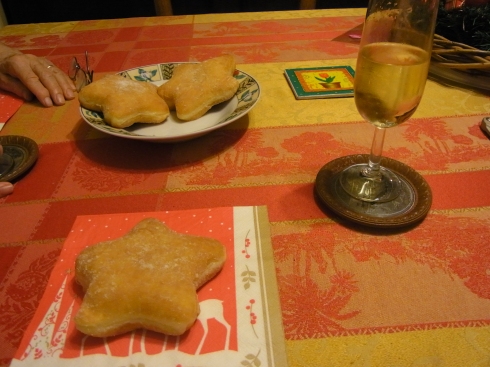
I’m a bit late with this post. More than three weeks have already gone into the New Year 2013. Here now I want to document what we did on the last day of 2012! Our day started with a trip to Bondi Junction, where we met our daughter. We had a cup of coffee with Caroline (sorry no photo). Then Caroline had to go shopping. We strolled back to the station. This time to a different entrance to the station, one that we weren’t familiar with yet. A beautiful large rest asrea opened up in front of us. Lots of different food and drinks were on offer at different outlets. In the middle of the plaza some delicious looking (homemade) ice-cream caught our eye. Peter and I each had a cup full of this very refreshing treat. It wasn’t expensive but tasted wonderful. There were plenty of seats everywhere to have a rest. We took the lift down to the platform. Only a few minutes and our train departed. We got off at Town Hall Station.  Later on we looked at the displays of some cake-shops. We were hoping we would find some Berliners. It is our tradition to eat Berliners on New Year’s Eve. We had no luck. We couldn’t find any. We went back to Town Hall Station to catch our train to Dapto. While we were waiting for the train we took some photos. The trip to Dapto took nearly two hours. Some shops in Dapto Shopping Center were already about to close when we arrived there. We knew we had a bottle of Bubbly at home in the fridge for our end of year celebrations. But we were still without any Berliners. I felt a bit tired and was sitting down for a while. In the meantime Peter rushed into another shop that was still open. Surprise, surprise, he came out with some delicious looking Berliners in the form of stars! He got them at half price for they were the last ones that were left! At home we watched “Dinner for One”, which is a tradition with us to watch on New Year’s Eve. It is a sketch about Miss Sophie’s 90th Birthday. Very, very funny! We’ve seen it so often and every time we laugh our heads off again. Peter tried out to take a few pictures from the TV showing Sydney Harbour. At midnight he took also some pictures of the fireworks. Soon after we went to bed. But of course we did have our Bubbly and did eat the heated up little stars with it. They tasted delicious, just as good as the balls, called Berliners, do taste. Of course we did get messages and phone calls from our children before we went to bed, wishing us a HAPPY NEW YEAR.


 Sorry,


Last Day of the Year
 HAPPY NEW YEAR!


How we settled in Australia
How we settled in Australia
We disembarked in Port Melbourne on the 31st of May, 1959. The same day a train took us from Melbourne to the Bonegilla Hostel (near Albury/Wodonga). The train was a special train for us migrants who had come on the S.S. STRAITHAIRD to Port Melbourne.
Around lunch-time we stopped in what seemed to be the middle of nowhere. There were two long huts. Some Australian volunteer ladies were about to serve us a warm meal in these huts. One hut was designated for women and children, the other for men. Each hut was equipped with long tables and benches.
It was lunch-time. The meal for us consisted of meat with three vegies: Potatoes, carrots and peas. The peas were straight away called ‘Kuller-Erbsen’ by some German migrants for they thought the peas weren’t soft enough. They kept joking they were just good enough to be ‘kullert’ (rolled around)!
Peter was most upset that he wasn’t allowed to sit with me and the children. ‘I could’ve helped you with the feeding of the babies,’ he said. ‘Why on earth wouldn’t they let me sit with you?’ Yes, I would have loved Peter to be with us for the meal. Nonetheless, I felt that the feeding of the newcomers was well organised. I thought we ought to be thankful that they went to a lot of trouble to provide a warm meal for all of us. Strangely enough, I even liked the ‘Kuller-Erbsen’. The meat-rissoles were tasty and suitable to be fed to the babies. Besides, they had allowed us enough time for our lunch; we did not feel rushed at all. — And there were special chairs for all the babies! That gave me the feeling that Australians liked children. In Germany we had never seen a baby-chair in any public place!
In the evening our train stopped at a siding close to the Bonegilla Migrant Hostel. It was still early evening, but already pitch dark. And we could immediately feel that it was going to be a very cold night.
At the Hostel we were assigned two rooms in one of the huts. One room contained two single beds with two sheets and four Army blankets on each bed. In the other room were two baby cots, also with sheets and warm baby blankets. Both rooms were freezing cold. An electric radiator was in each room. We decided we would use only one room to sleep in, and use the other room as a store-room for our luggage and for one of the cots. One of the cots fitted into our bedroom. So we let our twenty-one months old baby sleep in it. Our six months old baby was to sleep in her pram, of course also in the same room with us. We pushed the two single beds together to make one big bed. One of the Army blankets we hung over the window as an extra buffer against the cold. Using both radiators for the one room it was soon pleasantly warm.
Before bedtime we were given another hot meal in the huge dining hall. We were told every day we would get breakfast, lunch and dinner in the dining hall. The meals were served from a counter. And again there was no shortage of baby-chairs for all the little ones!
For breakfast there was always semolina available, which was cooked in creamy milk. Our babies liked to eat it and so did I. Most German grown-ups didn’t like it at all and would complain that this sort of food was served every morning.
Nonetheless, this was not the only breakfast food. There was always toast and butter and jams as well as other hot cooked food; for instance baked beans, scrambled or boiled eggs or fried eggs with bacon. I think there was also fruit-juice on offer and of course hot tea as well as coffee. The coffee would not have been made the way Germans liked it, but I’m sure I thought by myself, we had really nothing to complain about!
We had severely cold nights during the month of June and wonderful sunshine during the day. We could use an outside laundry free of charge. There were a number of huge kettles and laundry tubs. Most mornings we boiled nappies in one of the kettles. After having rinsed those nappies in one of the laundry tubs, they were hung outside on one of the long clothes-lines. The sun quickly dried them. Taking the dry nappies of the line, they smelled wonderfully fresh! Some of the women made some rather sly remarks about how Peter was always around to help me with the babies as well as all the daily washing. They were probably envious that their husbands didn’t help them as much!
We soon made friends with another German couple who had two babies of about the same age as our babies. During the day we often went for walks with them. The fresh air was good for all of us, especially for the babies, two of them being pushed around in their prams, while the other two could already walk a bit and when they got tired they could sit on a little seat which was fastened to the front of the pram.
This other German family had been neighbours of ours on the S.S. Straithaird. The voyage on that P & O ocean-liner had been absolutely first class: Families with very small children had been accommodated on C-Deck with private cabins for each family! The cabins were large enough for double bunks for the parents as well as room for two cots. Right next to our cabin we had our own private bathroom, where the steward would fill the bathtub for us with hot seawater. He did this twice daily. Next to the bathtub was a dish which was filled with hot softwater for soaping ourselves.
Every morning our steward collected our baby nappies to take them to the laundry-service, for which we had to pay some money. We were not allowed to wash nappies in the communal laundry, which people could use for free. Our voyage lasted for five weeks. For a five weeks nappy-service we had sufficient money, only just. Naturally we could not buy anything in the shops on board the ship. This did not in the least matter to us. All the meals on board for the passengers were absolutely first class! We regarded this sea-voyage as the best holiday we ever had.
In Bonegilla we were immediatly given ‘dole’-money, since nobody had started work yet. The migrant workers were given a choice to look around themselves for a job or to start working in the Port Kembla Steelworks in Wollongong. Peter chose to go to Wollongong, a pleasant town at the Pacific Ocean. (We still live in the area!) Most migrants chose to start in the Steelworks. For a number of years Peter worked in the Steelworks with a gang of brush-handpainter climbing onto very high chimneys in order to paint these chimneys.
Over the years Peter has had lots of different jobs. He was never out of work. It was like that in the sixties: There were always jobs available for everyone. People did not have to be afraid of losing their job. In the seventies Peter joined the railways and eventually was an ASM (Assistant Station Master). He worked then for the railways until his retirement.
We raised four children in Australia. We are debtfree and own our own home. We never regretted that we left Germany to live in Australia. However we like to go back to Germany for visits. We’ve done so a number of times.
I really like this Blog
Cristiane von Goethe
I find my comment ftom Dec 2017 rather interesting. What do you think?
I had read the original German version of this article. I published here the automatic translation into English. I noticed now that some of the English writing sounds rather obscure. For instance in the last paragraph it is being referred to ‘her’ health, so it should say as ‘she’ grew older . . . .
My apologies for taking the easy way out by publishing this ‘automatic’ translation. Tell me please, if you find more obscure sections in this article.
However, some sections seem to come out well in translation. For instance this paragraph:
“Even after her marriage Christiane was accepted as a “Geheimrätin von Goethe” by the Weimar society only reluctantly and hesitantly. To change the social rejection of his wife, Goethe asked the wealthy widow Johanna Schopenhauer , mother of the philosopher Arthur Schopenhauer , to break the barrier with an official invitation to tea. She did it with the remark: “If Goethe gives her his name, we will be able to give her a cup of tea.”
(„Wenn Goethe ihr seinen Namen gibt, werden wir ihr wohl eine Tasse Tee geben können.“)
This remark by Johanna Schopenhauer does sound quite sarcastic, don’t you think?
THE CHICKENS – SCENE FROM BERLIN OF THE WEIMAR REPUBLIC
COUNTING THE CHICKENS – SCENE FROM BERLIN OF THE WEIMAR REPUBLIC
I like this post by Berlin companion and reblogged it in 2021. I came across it today and would like to copy it to post it again!
I hope this is okay that I copy it!

Here is a typical Berlin Balkonia, little man’s and woman’s green paradise, in its rooftop edition: as a small garden and a chicken-pen.
This model example of self-sufficiency was necessary to survive dire food-shortages of the First World War – shortages which were particularly acute in the capital and led to long periods of starvation not only among the poorest. Many Berlin children did not survive those and if they did, they often suffered their consequences – mentally and health-wise – for the rest of their lives.
This idyllic image is a witness to a very bitter truth: that unless you were able to provide your own food yourself, your family was in danger. And that in 99% of the cases this responsibility had to be shouldered by women – whose children were at great risk.
MORE IN AUNTYUTA
Online Verification?
All about Christmastime two Years ago
Esther Perel about Relationships
Premiered Jul 1, 2020 Feel Better Live More podcastAs human beings, relationships are fundamental to who we are. We know that relationships can be a big source of happiness and fulfillment in our lives but they can also be one of the major sources of stress. So, why is it that we often find relationships so hard? In this conversation, I speak to arguably one of the world’s leading and most original thinkers on modern relationships, the wonderful, Esther Perel, who has long been on my dream guest list. We talk about the many differences between relationships of the past and the relationships of now. How we are now all under pressure not only to have the perfect relationship, but also to portray this illusion to others as well. Esther believes that it’s the quality of our relationships that determines the quality of our lives. And who we are is actually a combination of how we see ourselves and how others see us. We only really get to know ourselves through our interactions with others. We talk about the idea that we are not one person but different with each person – and rather than being one-way, all interactions are reciprocal. We discuss the value of couples’ counselling and whether it’s something all relationships, healthy or otherwise, need. Reassuringly, we learn that there’s no such thing as a perfect relationship, they all follow a rhythm of harmony, disharmony and repair. Esther and I touch and expand on our own situations and how the family history and values you bring to a relationship or marriage impacts the dynamic between you. She talks us through how much the concept of marriage has changed over the past century, and how it’s a tall order to ask just one person in our lives to meet all of our needs – needs which once would have been shared across our extended families and communities. This episode is a joyous celebration of all the relationships in our lives. It’s challenging, poignant but ultimately hugely practical. Esther offers some wonderful examples of practices we can all start implementing today, from rituals to build strength in our intimate relationships, to advice on reframing criticism or starting difficult conversations at work. The upshot? Rather than hoping others will change, we can be the change ourselves. It was a great pleasure to speak with such an incredible lady and I know that you will get a lot of value from hearing what she has to say. Show notes available at https://drchatterjee.com/119 Connect with Esther: Website https://www.estherperel.com Instagram / estherperelofficial Facebook / esther.perel Twitter / estherperel YouTube @estherperel Esther’s podcasts: Where should we begin? https://whereshouldwebegin.estherpere… How’s work? https://howswork.estherperel.com Esther’s books: Mating in Captivity – https://amzn.to/3eN0qVK The State of Affairs – https://amzn.to/2YIqL1A Esther’s TED talks: The secret to desire in a long-term relationship https://www.ted.com/talks/esther_pere… Rethinking fidelity….a talk for anyone who has ever loved https://www.ted.com/talks/esther_pere… Related FBLM podcasts: #37 How Our Childhood Shapes Every Aspect of Our Health with Dr. Gabor Maté • How Our Childhood Shapes Every Aspect… #75 What Every Parent Should Know with Philippa Perry • What Every Parent Should Know with Ph… #feelbetterlivemore#estherperel#relationships ——–
Dr Rangan Chatterjee
Premiered Jul 1, 2020 Feel Better Live More podcastAs human beings, relationships are fundamental to who we are. We know that relationships can be a big source of happiness and fulfillment in our lives but they can also be one of the major sources of stress. So, why is it that we often find relationships so hard?
Eleven Years ago
This year, 8 months ago, I wrote in a comment the following: Eleven years ago I did not expect to live much longer. . . .
And now, at age 89, I am still kicking and enjoying life!
 AuntyUta