Before and after the War

Before and After the War

Extracts from my Memories

In 1942/1943 my friends in Berlin and I had often contemplated what life might be like, once we had peace again. Our dreams for the future were very basic. We all wanted to get married and have children. We all wanted our husbands to have occupations that would enable us to live in comfortable houses. My friend Siglinde and I were for ever drawing house-plans. There would be at least three bed-rooms: one for the parents, one for two boys and another one for two girls. Yes, to have two boys as well as two girls, that was our ideal.

Before we married, we would finish school and go to university and our husbands would of course be university educated. In peace-time we would be able to buy all the things we had been able to buy before the war started: Bananas, pineapples, oranges and lemons; all this would be available again! Somehow we knew, we were only dreaming about all this. We had no idea, what would really happen, once the war ended.

I turned eight in September of 1942. Most of my friends were around the same age. My friend Siglinde however was four years my senior, the same as my cousin Sigrid.

After I started high-school, some time after the war had finished, Cousin Sigrid made a remark, that put a damper on my wishful thinking. Sigrid had noticed, that I got very good marks in high-school. So she said in a quite friendly way: ‘I see, you’ll probably end up becoming a Fräulein Doctor!’ This remark made me furious inside. It sounded to me, that once I embarked on becoming a ‘Fräulein Doctor’ I would have no hope in the world of acquiring a husband and children. ‘Who in their right mind would study to achieve a doctorate and miss out on having a husband and children?’ I thought to myself.

Mum, Tante Ilse and Uncle Peter loved to read romance and crime fiction. Most of the books they read were translations from English. Mum and Tante Ilse loved Courts-Mahler, Uncle Peter liked Scotland Yard stories best. They all had read ‘Gone with the Wind’. Even my father, who boasted, he never read any novels, read this one.

I read ‘Gone with the Wind’, when I was fourteen. My father’s sister Elisabeth, on hearing this, was shocked, that my mother let me read this novel. According to Tante Lisa, I was much too young to read something like this. However some of my girl-friends read this book too. They all loved Rhett Butler. About Scarlett the opinions were divided. Personally I did not care for the way she treated Melanie. I thought by constantly making passionate advances towards Ashley, she showed total disregard for Melanie’s feelings. Rhett adored Melanie. He showed her great respect as a person with a noble character. In contrast, he was well aware that Scarlet was anything but noble. Often he found Scarlett’s irrational behaviour highly amusing. Ashley treated Scarlett in a very gentleman like way. Not so Rhett. This impressed my friends. They all admired Rhett! I think, I admired Ashley more. –

Mum and Tante Ilse borrowed books from a lending library. A middle-sized novel cost one Deutsche Mark to borrow for one week, a real big novel cost two Marks. In secret I once read a translation of ‘Amber’. Fascinating stuff this was.

When I read ‘Amber’, I was probably thirteen. I read it only, when I was by myself in the apartment, which happened often enough. I was able to consume the whole big novel without anybody noticing it. I knew, Mum and Tante Ilse had read the book already, because they often talked about it, how good it was. But the book was still lying around at our place. There were a few more days before it had to be returned to the library. I found out, that Amber was a fifteen year old country-girl, who went to London. The time was the seventeen hundreds. Because of her beauty, Amber was able to make it in the world. She had lots of lovers. She always made sure, that her next lover was of a higher ranking than the previous one. That made it possible for her, to climb up the social ladder. – Well, this is about as much as I still remember from that novel.

During the first years after the war we lived like paupers. Still, I realized – maybe a bit to my regret – that there was a big difference between a desperately poor girl from the country and me, desperately poor city girl from a ‘good’ family. I knew then, whether I wanted it or not, I had to put up with an extremely low standard of living for some time yet. And I mean by ‘low standard’ not the low standard that everyone went through during the adjustments after the war, but a standard, where it was necessary for us to get social services payments!

Was I out to enhance my appearance in order to catch a prosperous male as an escort to take me out to fun-parties and adult entertainment? No way! Something like that was just not for me. I felt I was plain Uta who was never invited to go out anywhere with anyone.

Was I really that plain? I wonder. Up to age fourteen I may have had some chances with the opposite sex, given the opportunity. However by age fifteen I had put on so much weight, that I felt to be totally unattractive. I was right, because no attractive male ever made an attempt to woo for my attention, not until I was about seventeen and a half that is. But even then things didn’t change much for me. I honestly felt like some kind of a social freak during most of my teenage years.

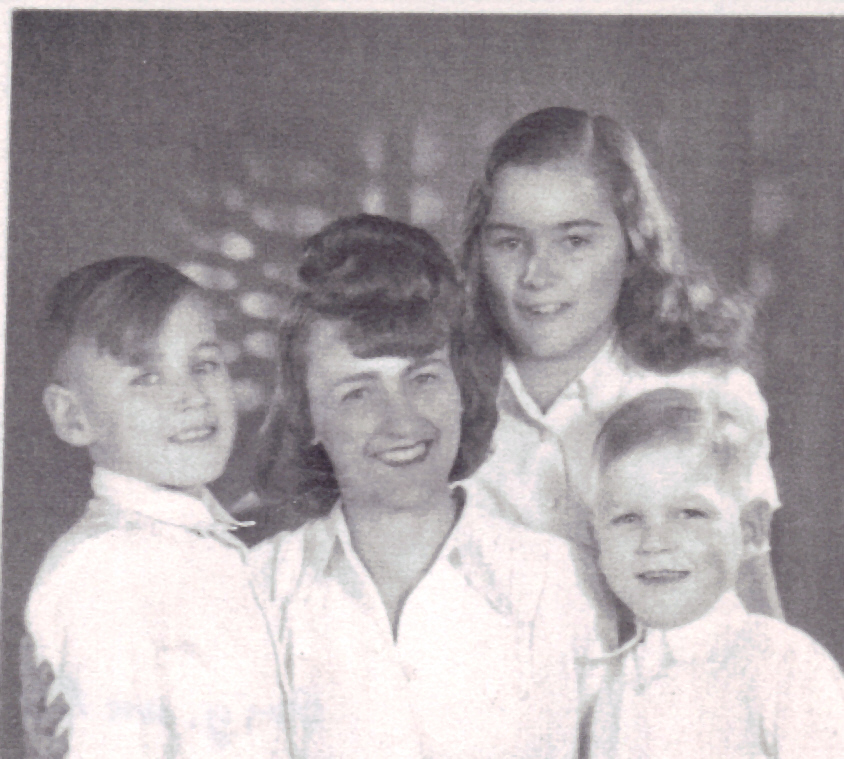
Here is a photo which was taken in 1948 with Mum

and my brothers, who were 7 and 10 years and I was 14.
The Beach at Graal/Müritz

During the summer of 1940 we were on holidays at the Baltic Sea. We had rented a small cottage. Auntie Ilse was staying with Mum, little Bodo and me most of the time. Our maid Gertrud was with us too. Dad worked during the week in Berlin and came to Graal only on weekends.

Two year old Bodo must have already been quite a walker. I remember that Dad took us for walks in the nearby forest where we would be looking for blueberries. These berries were quite delicious. We would eat them for supper with some sugar and milk.

The beach was not far from our cottage. We went there every day. A photographer had a shop close by. During the day he often took pictures of people on the beach. The following day he displayed the pictures in front of his shop ready for sale. I think people did not order to have their pictures taken. They bought them only if they happened to like them.

In my files I have two of these pictures. They are more than seventy years old now. I was reminded of these pictures when we went to an Australian beach the other day. In one of these old pictures you can see my father with my mother and Auntie Ilse. The women sit in their ‘Strandkorb’. These ‘Strandkörbe’ are very popular on all German beaches. They are popular still to this day. They are a good wind shelter. I think people usually place them in such a way that they can catch the sun. Mum and Auntie Ilse were always proud of their suntan.

Ute mit Bodo Graal Mueritz Sommer 1940

The other photo shows me with Bodo,  my little brother.

In Love with Leipzig

I found an interesting contribution about the German city of Leipzig.

http://blog.goethe.de/meet-the-germans/archives/179-In-Love-with-Leipzig.html

As a ten and eleven year old in 1945/46 I did get to know a bit about this city. Sure, when we first moved there to stay at grandmother’s place, the war hadn’t finished yet and we experienced quite a few bomb raids.

As I told in another blog, one bomb raid in April 1945 turned out to be disastrous for us. This was probably the very last bomb raid that Leipzig had to endure, because soon after the American troops together with some Canadians occupied the city. When the Canadians moved through neighbouring streets to lay out some cables, we kids were watching them. We were impressed by their appearance. They were all very young looking, tall and lean in immaculate uniforms. We welcomed the foreign troops.Them being with us meant, we wouldn’t be bombed any more. From now on we could sleep in peace!

We were a family of six. Having lost our home in the bomb raid, we applied for accomodation for our family. We were given a flat in an area where the buildings weren’t damaged at all. Our flat had three rooms plus kitchen and bathroom. Had grandmother been just with Renata, the two of them had not been able to get a flat of this size. Only families of five or more were assigned accomodation with so many rooms! So we were lucky again.

About Leipzig I remember the ‘Ratskeller’, where we had a few times a lovely meal. I always thought it was something special to eat out somewhere. But I loved Grandma’s cooking too. She always like magic produced excellent meals even when there was not much food available. She was a great one for improvising. And never ever was any bit of food thrown out. She always pointed out to us, to throw away good food, was a sin. This kind of thinking still sticks with me today!

I also  remember the Thomaner Church in Leipzig and the Thomaner Choir. I believe the journalist who wrote the blog about present day Leipzig is from England and lives in Berlin now. He went for a visit to Leipzig and ended up loving this city. If ever I have a chance to visit Germany again, I plan on paying Leipzig a visit together with Peter, my husband, and Peter, my brother. If you are interested in finding out more about Leipzig, please look up the above link.

OUR LUCKY ESCAPE


Some of my children know a bit about our lucky escape in 1945. In case they want to find out a bit more about it, I am now trying to write down whatever I do remember.

During the last war years we had stayed away from Berlin, living east of Berlin in a desolate country area. With the Russians fast approaching at the beginning of 1945, my mother decided, we would move to grandmother’s place in Leipzig, rather than go back to Berlin to our apartment which we still rented. We children were never allowed to visit Berlin during the years of the bomb raids.

From the beginning of February 1945 my mother, my two brothers and I stayed in Leipzig with grandmother and cousin Renata. As I remember it, there were frequent bomb raids. We were used to the sound of the sirens and having to stay in the cellar for hours at a time.

After Christmas, schools had not opened any more. We played a lot in the surrounding streets with other children. But we were never allowed to stroll very far. In case of an alarm , we had to be within the vicinity of our cellar. For us children this was just part of every day life. My brothers were three and six years, I was ten years old. The winter was very cold, but we still had enough to eat, were dressed warmly. In the kitchen there was always a fire going in the oven for cooking and for hot water. In the bedrooms we had enormous feather-beds to keep us warm.

There was talking about that this bloody war was soon to end. We sure were looking forward to this! I cannot remember ever having been scared or thinking that anything bad could happen to me. Or to my family. To us children it seemed rather entertaining to be sitting in the air-raid shelter. Many people congregating as soon as the sirens went off, was extremely exciting! We did get to know everyone, who lived in that tall five story building. The adults would talk to us children, asking us questions, just being friendly.

And we would listen to the adults talking to each other. I remember that I always found it interesting to listen to adult conversations. And sometimes all of us would sing a few songs. I loved the singing of songs! When we could hear bombs hitting somewhere in the neighbourhood, it never seemed very close to us. This meant we were all right. Often my three year old brother entertained everyone by singing solo. They were cute little children’s songs. People always encouraged him to sing more songs because they loved his singing.

In April there was another bomb-raid. We had a relaxing time with everybody in the cellar. It was a long lasting alarm, went on for hours. Since it was in the middle of the night, mum wanted us to go to sleep. We were able to stretch out a bit on our makeshift beds. But I don’t think we were able to go to sleep that night. My brother Peter was still singing his songs when several bombs hit us. This time there could be no doubt that the bombs had fallen right on top of us since the noise was absolutely deafening! My six year old brother Bodo started crying. I felt so sorry for him. It was terrible seeing him being so horribly scared. I said to him he needn’t be afraid. Soon everything would be over.

I was right. It did not take long at all. All of a sudden, it was very quiet. Then some people started moving, investigating, whether we could still get out. Our main exit was full of debris. Impossible to get out there. There was a bricked-in escape to the cellar of the next door building. To make use of this escape, quite a few bricks would have to be dislodged. Then someone shouted that the window, that led from the cellar to the footpath in one of the adjoining cellar-rooms, was not blocked. It was easy, to get out through there!

A sigh of relief went through the crowd. My brother Bodo was not scared any more either. My brother Peter had never been scared at all. People said, this was because he had still been too little to understand. Later on, we found, that the building had been hit by up to five bombs. Right to the ground-floor,  everything had been torn away. Miraculously, a lot of the ground-floor was still standing. This was my grandmother’s apartment! My grandmother was able to save some of her furniture together with all our belongings. A lucky escape indeed.


Childhood Memories

              The Spickermann Family and Uncle Alfred

Mum used to say: ‘Everyone in the Spickermann Family is useless except for one, and that is Grandfather. He is the only one who works hard and has achieved something. Everyone else in the family just likes to laze about, talking stupid things and not doing any work.’

I also remember Grandfather Joseph saying of my mother: ‘Lotte is a very good worker. Oleg should be very grateful for having such a good looking and hard working, smart wife.’

For Grandmother Hilda my Mum had absolutely no kind word. She thought that Grandmother should make a bit of an effort to keep up with Grandfather. And why could she not look after her appearance a bit better? Surely with the position that Grandfather held, she should attempt to be a bit more representative looking! Instead she let herself go and was just a housewife and mother. And why for heaven’s sake did she have to spend all morning in the kitchen when she had two maids to do the cooking for her!

I cannot remember whether Mum ever commented on the competency of Dad’s younger sister Lies, who single handedly would manage a large estate when her husband Alfred had had once again too much to drink and needed some time off for recovery. I seem to remember that in a way she admired Alfred for always being able to recover after some extensive drinking bouts. He was a very tall, strong man. Mum said: ‘He could drink a real lot before adverse health effects were noticeable. Then, when he felt he could not go on any longer, he stopped drinking altogether and lived for a while just on milk until he felt all right again.’

I remember several Spickermanns debating the tough fate their sister Lies had to suffer. How Alfred’s drinking habits effected the children, especially the eldest son Horst. All this happened when the Spickermann Family still lived in Lodz, which was called Litzmannstadt at the time. Horst would have been less than nine years old then.

As far as I know, Alfred ended up in the army before the end of the war. After the war he often talked about it how well he had been treated as a prisoner on the Island of Guernsey. He kept saying what a good life he had had on this island. It sticks in my memory that the family used to say of him being somewhat ‘anglophil’. When I heard this, I was wondering why on earth they called him this. I think I had enquired about the meaning of the word ‘anglophil’. I thought by myself why anyone could imply there might be something wrong with liking the English ways. I think I always was interested in the way other people lived. I am sure I could very well empathise with someone believing that the German way was not the only way worth living! Why shouldn’t you be able to like aspects of some other culture? It seems to me that this kind of thinking I must have developed rather early.

When Peter and I went on our first visit back to Germany, we saw Auntie Lies and Uncle Alfred, who were both in good health. Alfred died one year later at the age of ninety! Having cut down on his drinking in his later years, he none the less still enjoyed drinking a bottle of wine each day right to the end of his life.

CHILDHOOD MEMORIES

                     CHILDHOOD MEMORIES

I remember vaguely a conversation which took place on our balcony in Berlin soon after Easter 1946. I know for certain that at the time Dad was still with us and that Mum had made friends with a lady from the neighbourhood who had established herself as a manicurist. The name ‘Julia Gratz’ is my invention.

The following conversation is more or less made up by me. I only remember for sure that this lady talked to Mum about ‘Gone with the Wind’. I am also pretty sure that this lady was very courteous to Dad and treated him with much respect. It is also true that I had just returned from Leipzig and was about to start school in Berlin. It is also true that I had to catch up in English and that an older school-girl volunteered to give me private lessons. I also distinctly remember that all of us were sitting on the balcony and that it was balmy spring weather.

As a writing exercise I tried to write the following in the third person.

                            BERLIN, SPRING 1946

Eleven year old Uta has just returned from her grandmother’s place in Leipzig. Her parents, Charlotte and Alexander, sit with her on the sunlit balcony.

Also on the balcony is a voluptuous blond woman. Her permed hair is well set. Her fingernails are excellently shaped. Her nail polish is of a pink colour. Her name is Julia Gratz. She has just finished doing Charlotte’s fingernails. This is how she earns a living in this black-market time. She is well spoken. She likes to talk to Alexander, trying to flatter him with ‘intelligent’ questions.

Julia: ‘What do you think, Herr Doctor, is there any chance at all that we get our proper jobs back? How long is it going to take before we recover from Germany’s disastrous downfall?’

Alexander: ‘I am sure it is going to take several years. I only hope that Germany is not going to be made to pay enormous amounts in reparation as was the case after World War I. But since we have been totally defeated, we basically have to accept, that the other countries can do with us as they like.’

Julia (turning to Charlotte): ‘I’ve just been reading GONE WITH THE WIND. I have enormous admiration for Scarlet O’Hara, how in the midst of having lost everything due to the war, she shows courage by sewing herself a dress out of some curtains. She does not want to look poor, when she goes to see Rhet Butler, who profited from the war and is very well of.’

Charlotte: ‘Yes indeed, this shows enormous courage. It reminds me, that I dismantled our old flag and used the material for sewing a colourful blouse. In times like this, you have to use whatever you can, to get by.’

Julia (talks to Uta, who had been listening intensely):

‘Uta, how do you like it to be back in Berlin? You must have missed your mum, when your mum was already in Berlin while you were still staying with your grandmother in Leipzig. Tell me, for how long did you go to school in Leipzig?’

Uta: ‘Actually between January and October schools had been closed in Leipzig, which means I’ve been in high-school since October last year. Cousin Renate gave me and Bob a few lessons at home while the schools were still closed. In October I was then straight away admitted to second year of high-school.’

Julia: ‘So now that you’re back in Berlin you start school here after the Easter break?

Uta: ‘That’s right. However I found out that I’ll have to catch up in English. It seems, here in Berlin they are much further ahead in English. I have been enrolled for the second year of high-school. They said, they want to give me a try and see whether I can keep up with that year.’

Julia: ‘I’m sure you’ll be able to make it. Maybe some-one can give you some private lessons to catch up in English?’

Uta: ‘Yes, I was told, that a girl, who is three years ahead of me, is willing to give me some lessons at her home.’

Julia: ‘It sounds like this may be the perfect solution for you. I wish you good luck!

Uta: ‘Thank you very much, Frau Gratz.’

Childhood Memories 1943/44 continued

Since Tante Ilse was a single person, she was supposed to have a regular job. Everyone who was capable to work, had to work for the war effort! That meant Ilse had to prove that she had a proper job. Naturally Werner M came to the rescue again. ‘You can work for me in the office,’ he said. And office work she did, however not in the office, but at home. She did not even have to collect the work!

One of the workers, who lived in our complex, was given the task of handing over the sheets of paper to Frau Ilse Schlinke on his way home from work. When the paper-work was finished by Tante Ilse, he took the sheets of paper back to the office on the way to his work-place. How did he transport the papers? He simply fastened the bundles unto the back of his bike. This worker was Herr Fritz. He was a smith and worked for Werner Mann. A smith was always needed in a huge estate with lots of horses and farm equipment. Even though Herr Fritz was a qualified trades-man, he and his family lived extremely simple lives; indeed, he did not seem to live any better than an unqualified worker.

Herr und Frau Fritz had two sons; one was ten, the other one fourteen. The older one was quite talented. He built complicated mechanical things out of odd bits and pieces. I admired him very much. The younger son told Eva and me stories about the ‘Lamp Angel’ (Lampen-Engel) who was supposed to have kerosine-lamps in a straight line out in the country away from any built-up areas to distract bombers, who might accidentally have come to our countryside.

A few times I went with Eva and Bodo in search of those lamps. Yet we never could find any of them. Unfortunately the neighbour’s son, who had told us the story, was not willing to come along with us to show us where the lamps were. To this day, I really do not know, whether there ever had been any lamps!

Both sons of the neighbours went to Lichtenow village primary school, the same school that Eva and I went to. There was only one teacher for the whole school. The school had eight school-years. After year eight you had to leave and start work or learn a trade. Students who wanted to go to high-school, were supposed to enroll at high-school after finishing year four of primary school. By September 1944 I should have started high-school. However I had no chance to travel to high-school from where we lived. Mum said: ‘Since you skipped year three, it does not matter, if you repeat year four. Next year the war will be over anyway, and then we do not have to live here anymore and you can be enrolled in high-school. But I want you to go to a different village-school now and start again with year four. I made enquiries in Herzfelde. The primary school in Herzfelde is much larger then the one in Lichtenow. So this is why I’ve enrolled you in Herzfelde.’

I went to Herzfelde Primary for three months only. By the end of January 1945 we had moved to Leipzig to stay with Grandma. All schooling had stopped by then. We felt more and more, that it was very close to the end of the war.

During the warmer months of 1944 we did a lot of athletics at the Lichtenow school. There was running, high-jump and long-jump. There was also an athletics’ carnival in which only students who were ten years or older were allowed to participate. I was not quite ten yet, but they let me join anyway. I was good at running for my age. In all the jumps I was just average.

I had plenty of opportunity to practise high-jump at home. Herr Todtenhausen and his brother, who was at the Ausbau for a visit, set up two poles with a line to jump over. The line could be set higher or lower. It was set very low for Eva Todtenhausen and for my brother Bodo. The Todtenhausen brothers were both quite good sportsmen and could still jump astonishingly high, even though they were both well over forty.

I often thought that the afternoons at the Ausbau were boring. What was there to do for me? Not much. When the weather was fine, I liked to go for walks, always wishing, that the landscape were not as dreary. I longed for a variety of trees and the view of a lake or a river.

During the colder season we had sometimes real terrible winds. On the way to the outside toilets we had to turn around the corner of the house to walk to the shedlike building at the back. You had to be quite brave to turn the corner, when that gusty wind was blowing, blowing, blowing. Winds like that were unknown to us in the city. Well, the Ausbau was in open country area after all.

We had a warm lunch when I came home from school at about one. And after that in the afternoon there was nothing to do! Maybe a bit of home-work here and there. But this certainly did not take all afternoon. When we had to stay in the playroom because of bad weather, I usually read a book. I loved reading. I was glad I could borrow books from Frau Todtenhausen. She had dozens of books for girls, which she had kept from her own childhood and which eight year old Eva was not able to read yet.

Naturally my two younger brothers and Eva and I sometimes played together as well as talking to each other. Still I missed all my friends from Berlin. In Berlin I was always surrounded by many different children. We all lived in the same street; it was easy to see each other on a daily basis.

One Thursday during the summer school-holidays Mum came home from Berlin with excellent news. ‘Guess what?’ she said ‘I saw Rosemarie today! She is going to stay in Berlin for a few weeks, and I asked her, would she like to come and stay with you at the Ausbau for one week. I could pick her up next Thursday and take her back to Berlin the following Thursday.’

I cried with delight: ‘Oh, Mum, that’s excellent! I love to have Rosemarie here for a visit!’

The visit took place as Mum had planned. Rosemarie and I went for lots of walks . We had so much to talk about that we hardly noticed, how dreary the landscape looked. Once we went into the direction where the lamps of the ‘Lampen-Engel’ were supposed to be. However we never saw any lamps.

I felt a bit jealous, that Rosemarie was allowed to stay in Berlin for a little while during school-holidays. I could never talk Mum into letting me stay in Berlin, not even for a day. Mum always said, that it was too dangerous since there could be bomb raids day-time or night-time. I was not to be put into danger. And that was it.

During that summer of 1944 I learned to swim. We had summer holidays. On a hot day Bodo and I went on our bikes some distance past the Lichtenow school to an artificial lake, which people called ‘Bruch’. It was possible to swim in it. Dozens of people were stretched out on some grass near the lake or frolicked in the water. I went in up to where the water reached my chest. Then I tried to lie on my tummy reaching out my hands to touch the ground. After a while, I noticed my hands had left the ground and I was swimming in the water! What a thrill that was! Being nearly ten I was finally able to swim. What an achievement! Bodo had stayed obediently in shallow water. I could not wait to go to him to share the great news with him.

I remember I had to wear an old two-piece swimsuit of my mother’s which she had sewn together for me. Later on in the year Mum found in a shop in Berlin a proper swimming costume for me which she was able to buy with some coupons. I was given that swimsuit for Christmas. It looked lovely. There were some little orange pictures of girls with bath-caps all over the costume.

The swimming costume was a perfect fit and I was fantasising how I would wear it the following summer. Unfortunately I was never able to wear it since it got lost during the upheaval of moving to Leipzig. —

Towards the end of January 1945, when we were about to leave the Ausbau, Mum, Tante Ilse, Frau Todtenhausen, as well as Katja and Maria were busy all night killing all our rabbits and chooks and preserving the whole lot in glasses. We ended up taking quite a few of those glasses to Leipzig, where miraculously they survived the total distruction of our house during a bomb raid in the pantry next to a very strong wall. Not one glass was shattered! I myself though was not able to eat any of the rabbit- or chicken-meat, since from early childhood on I’ve never been able to eat this kind of meat. …

Before we left the Ausbau, all the furniture in the house was pushed together as much as possible. Some beds had been dismantled already. But we children were meant to get some sleep in spite of all the commotion. I was put with Eva in one room. The two of us were much too excited to sleep. We kept ourselves awake for hours singing all the songs we knew. Eva taught me a few new songs which I had not known until then. Yet I still know them now. One song was a song from Tirol about some young men who go looking over the fence to see a girl, the one who looks after the cows.

Ja wenn wir schaun, schaun, schaun

übern Zaun, Zaun, Zaun,

in das schöne Land Tirol –

Ja dann freuet sich die Sennerin,

ja wenn wir schaun, schaun, schaun übern Zaun.

Ja wenn wir gucken, gucken, gucken

durch die Lucken, Lucken, Lucken,

in das schöne Land Tirol –

Ja dann freuet sich die Sennerin,

ja wenn wir gucken, gucken, durch die Lucken, Lucken, Lucken …

Childhood Memories

‘Your father has always been a selfish person. He doesn’t send any money for you but I bet he sits down for breakfast with a soft boiled egg in front of him. He knows how to look after himself and doesn’t care whether his children have anything to eat.’

The voice of my mother still rings in my ears. When years later I talked to my father about his so called selfishness, he justified himself with a lot of words and by producing the Post Office receipts which proved that he had constantly sent money for us children. True, he never could send much, however Mum’s claim that he didn’t send any money at all was totally wrong, according to Dad. He made sure that I looked at all the relevant slips. It seemed very important to him that I should believe him.

I felt sorry for Dad and I felt sorry for Mum. I used to feel that I could not take sides for either of them: I was totally torn between them. My loyalty belonged to both in equal proportions, that means, I could never decide on who’s side I should be. Mum of course accused me constantly of siding with my father and rejecting her. She probably did not feel supported by me. She just could not stand it when I tried to defend Dad.

Dad was the opposite. No matter how much he complained about Mum and let it be known how frustated he was about Mum’s behaviour, he was never angry with me when I tried to defend Mum. He always listened patiently to what I had to say. On the contrary, he liked it when I pointed out how much Mum meant to me and the boys.

‘You are right, Uta,’ he would say, ‘it is very important for you and the boys that you have a good relationship with your Mum. After all she is your Mum. I certainly would not like you rejecting her. In her own way she loves all three of you. You should never forget this.’ Then he would continue to complain about it that Mum was not willing to leave Berlin and live with him and us children as one family. He also had some gripes about Tante Ilse. According to him it was she who had wrecked their marriage.

I loved this aunt. For me it was very hard to listen to Dad’s accusations about her. Dad claimed in a very angry voice that Ilse had lived a ‘Lotter-Leben’ (bad life) when she was younger. He said that she had now a very good marriage. He was of the opinion that marrying HL was the best thing that could have happened to her. Dad regarded HL as being of very good character. I could only agree. In my experience, this Uncle spoke of Dad always in a respectful way, that is, I never heard him say anything bad about Dad. Come to think of it, neither did Tante Ilse. The way I saw it, only Mum would talk about Dad in a very nasty kind of way. It shows that to her mind he must have been a great disappointment to her. Even as a child I tried to see both sides. This was mind boggling for me. A lot of the issues were about what normally only grown-ups would be concerned about. On the other hand – even though I had no way of being able to tell what for instance the sexual difficulties may have been – I none the less felt those vibes which told me, my parents had those very strong love/hate feelings towards each other. I also sensed Mum’s absolute disgust about the way Dad’s life had turned out to be. Yes, I can imagine what immense disappointment this was for her!

Some time after Dad had managed to set himself up in a secure position again he talked to me about how it would be best for all of us if he remarried Mum. I told him that I could not imagine this happening. And sure enough, when he asked Mum to live with him again, she refused.

In 1959 Peter and I migrated to Australia with our two baby-girls. The following year Dad married Gertrud. Peter and I were under the impression that the new wife was right for Dad in every way, I am sure, Dad had a very good marriage with G. They had only a short time to

gether: At age sixty-two Dad died of prostate cancer. After having stayed in hospital for a while Dad pleaded with G to take him home. She did this and nursed him for the last six months of his life. It so happened, that G received Dad’s pension after he died. This upset my Mum and my brothers immensely! They thought, G had no right to receive all the benefits. They told me that the first wife should get more consideration for having had a much longer marriage as well as children. I felt awful when my family talked badly about G. I know that she had always been very welcoming, kind and supportive towards my brothers.

G is ninety-two now. Over the distance I still have some occasional contact with her. I am never going to forget, how, during the last years of his life, she gave Dad so much of herself. When I received her letter six months before he died, telling me about the seriousness of Dad’s illness, I cried and cried.

PS on the 14th of October 2017:

My step-mother, Gertrud Spickermann, died recently aged 98. Her 99th birthday would have been on the 23rd of November 2017. Not so long ago she skyped with Peter and me. She was always keen to keep in touch with family.

My Education in 1944

The village school in Lichtenow had only one teacher. That was Herr Grosskreuz. His wife, Frau Grosskreuz, came to the school on Wednesday afternoons to teach the girls needlework. Under her guidance I learned to knit socks with five needles. I also learned how to mend socks. Mending socks was called ‘stopfen’. I was taught, how to fill in a hole with a beautiful woven pattern. I probably could still do this kind of work today, only these days one hardly ever finds any holes in socks: It shows how the quality of socks changed over the years!

Every day, including Saturdays, school finished at lunch-time. The only afternoon session for girls was Wednesdays. I did not mind having to go back to school after lunch on that day. I often arrived early in Lichtenow for the afternoon class, stopping at the teacher’s house on the way, where I was always welcomed. I loved to play with daughters Christa and Gerlinde. Christa was the same age as I and had skipped year three together with me. Gerlinde was two years younger. There was another three year old daughter, who was called ‘Puppi’. Puppi and baby-son Hartmut were very sweet. I enjoyed very much visiting the teachers’ family.

The Grosskreuz-family lived in a modern one family home, which stood on a large block of land away from the village. In the village itself were ancient, small farmhouses with huge sloping straw-roofs. People said, the father of Frau Grosskreuz, who was the mayor in a neighbouring small town, had seen to it that the Grosskreuz family could live in style in a modern home.

Why was Herr Grosskreuz not called up to join the army? It seemed to me that he was probably past forty. And besides, he had a slightly crooked leg. It was good, that we were able to have a man-teacher in Lichtenow, so that he could look after all the boys and girls, aged from six to fourteen, which meant that eight different school-years were given lessons in the one class-room!

Later on when I attended school in Herzfelde, I found out that the whole school was run by women. Presumably all male teachers had been called up to fight in the war, the same as had been the case in my school in Berlin.

Aunty Ilse often invited me to sit with her in her cosy living-room, which had extremely comfortable seats upholstered in an expensive velvety red material. Aunty kept an eye on my attempts at knitting and darning of socks. This is how I received a great deal of practise and encouragement. Earlier on, when I was only about four,  Aunty would praise me for doing little pieces of cross-stitch embroidering for her for her birthday. I felt very proud then that I could give her something I had made.

When Aunty Ilse started doing office work for Werner Mann, she sometimes let me help with checking additions of huge columns of numbers. From then on I always found additions easy to do. Aunty must have thought that I was good at checking additions because she asked me again and again to do it with her. I willingly obliged. I loved to do things together with her for I felt very peaceful in her presence.

Mum and Grandma (Omi) and later on also Uncle Peter pointed out that Ilse was a bit of a scatter brain. Once Uncle Peter remarked, that he did not know, how his wife ever was able to get a driver’s license. To me Aunty Ilse seemed rather calm as compared to my nervous and highly strung mother. Mum’s nervousness constantly upset me, even though I usually tried not to show it. As far as I know, I always tried very hard, not to lose control of myself —

Mum had a large roll of hair across her forehead and two more rolls parallel behind it on top of her head. She made me wear one huge roll of hair right on top of my head, which would constantly slip unto my forehead and annoyed me a great deal. One of the first verses, when I started learning English, was:

‘There was a little girl,

who had a little curl,

right in the middle of her forehead.

When it was good,

she was very, very good.

But when it was bad,

she was horrid.’


I imagined, I was very much like this girl!

On my tenth birthday I was finally allowed to discard the nasty roll. It made me feel really grown- up.  It was bliss that never again I had to wear this terrible roll!

Eva Todtenhausen had a ‘Poesy-Album’. I thought it was a great idea to get family and friends to write a little verse in such a book and possibly add a photo as well. Mrs Tostenhausen found out that I would very much like to have a ‘Poesy-Album’. She said: ‘I believe I still have a spare album amongst my things in Berlin. I’ll ask my mother to look for it. When she finds it, I’ll give it to you.’

Eventually I was given Mrs T’s album. I regarded it as a very special gift. After sixty-five years it is still in my possession. Looking through it, I find that my father wrote something in it for me on the 16th of April 1944. This shows me that he must have been with us on leave at the time. What he wrote, makes a lot of sense. In his writing he points out that in the long run true luck comes only to the efficient person. Therefore, he urges me, to be diligent and ambitious. However I should at all times hang unto my peace of mind!

I look at that page which he seems to have written the way it came into his head. One word is crossed out, another word misses several letters. I wonder, whether he made mistakes because it is a first draft or whether he was upset about something when he wrote it . . . .

I like the passport-photo that he stuck next to his writing. This photo was probably taken before he joined the army, well before he turned forty. Oh, my father was still very healthy and good looking then!