David died in August 2013. On the 22nd of August 2013 I wrote about David’s passing. Here is a copy of the post I published in 2013:
“Some bloggers may not want to read any more about the lives of Gaby and David. However I am still at this stage where I keep thinking about it a lot. Recently I wrote two long replies to comments from ‘Words fall from my Eyes’ and ‘Island Traveler’. Just for recollection I want to publish these two replies here. They only touch on the lives of Gaby and David. But anyhow here is what I wrote:
Wow, Noeleen, there’s so much to remember. Both had kind, big hearts. But Gaby was very demanding. It did get too much for David over the years. He just wanted to be left alone. He led a very unhealthy life over many years and often drove Gaby’s carers round the bend with little bursts of energy, screaming, yelling. this sort of thing. But most of the time he would stay semi conscious in his room. A nursing sister who would come to see him after he had been in hospital for a while he would chase away. He would not visit his siblings any more. They just could not cope with him. The only person who could always cope best with him was his long time friend Steve. But even he could not do much for him after Gaby had died and it was apparent David could not cope on his own. However he strictly refused to make any changes in his living arrangements. until he collapsed last Christmas. Sheila, his neighbour, noticed and called an ambulance.
It’s very sad when someone ends like this. But I think he went peacefully. And this is a comfort. We do remember a lot of good things about David. He was the only person who would take on the challenging task of taking on a life together with Gaby, and he did so out of his big good heart. He stuck with Gaby right to the end. I think he had the feeling that he could not desert her. Yes, great honour to him! Dear, dear David and wonderful life loving and caring Gaby!
—–
You are right, IT. It was quite amazing how Gaby always tried to be there for David. It must have been very difficult for her at times. Everyone kept telling her that David was too sick to stay at her place. He should be in a nursing home where he’d be given proper care. When Gaby died last year David refused to move to a different place. Any attempts by his siblings to help him were in vain. David just did not want to be helped!
For as long as Gaby was alive, the house got cleaned by Gaby’s carers. The carers often had a hard time when David was in a bad mood. If something displeased him, he would shout at them. We often wondered how Gaby and the carers could cope with all this.
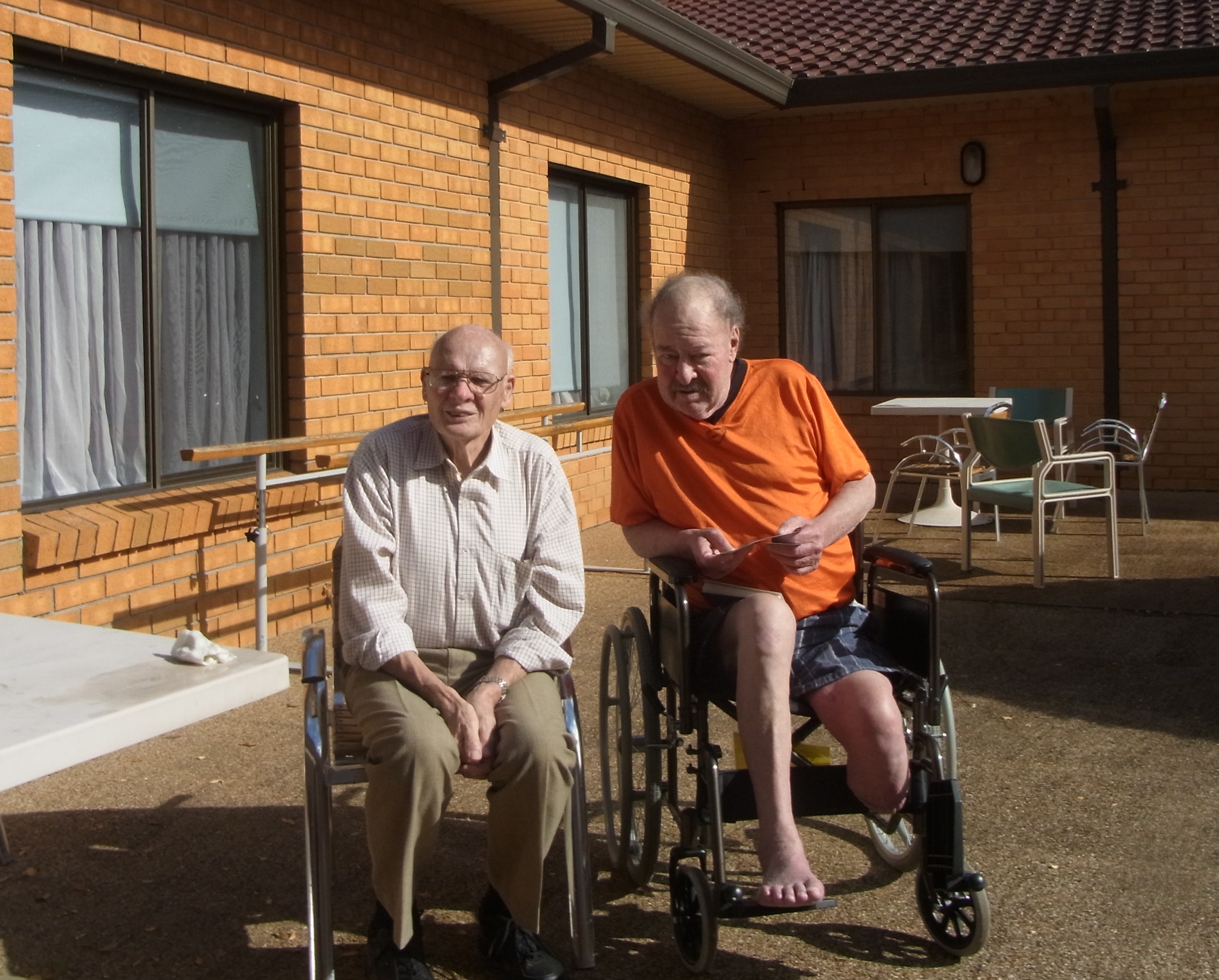
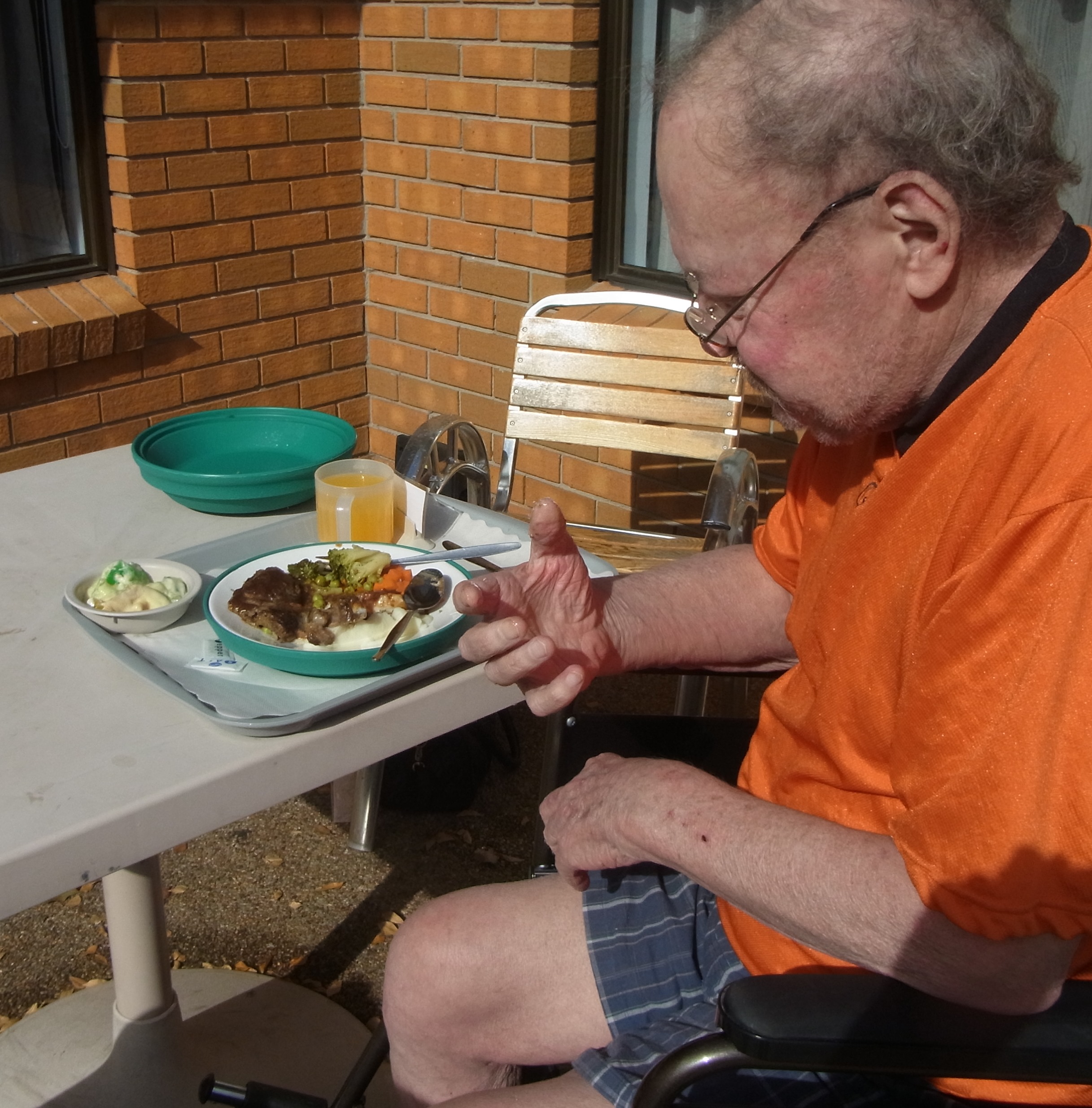
The last few months of his life David received very good care in Parramatta Nursing Home.. He was not allowed alcohol; and cigarettes he could afford only very few and had to smoke them in some outside area, wheeling himself out there a few times every day. He could not eat very well any more. It turned out there was something wrong with his gall bladder apart from many other things. But he was not an angry man any more. He didn’t give the staff any trouble. I think they liked looking after him.
For years David had always told me: Don’t worry, Mama! I could not make him change his mind about anything.
The youngest brother of David, Anthony, took very good care of David after he collapsed last Christmas and ended up in hospital again. During the two months in hospital they had to amputate his left leg below the knee. After this he spent the last months of his life in Parramatta Nursing Home. It’s good to know that he did get proper care there and was able to die peacefully.
– – – – –
Gabriele (Gaby) was Peter’s and my first born daughter, an extremely lively child who was struck down by poliomyelitis on her fourth birthday. She ended up being a quadriplegic. She also had breathing difficulties and needed to sleep in an Iron Lung. Towards the end of 1989, when Gaby was 32 and David 40, they moved in together into a house provided by the Department of Housing. David became Gaby’s main carer at this stage. But David was never Gaby’s only carer. At that stage Gaby was always provided extra outside help. And when David needed a break, there was always one carer who could sleep in Gaby’s house overnight so she wouldn’t be alone in the house. When we were much younger Peter and I would sometimes stay together with our youngest daughter Caroline in the house for a few nights so that David could have a break. When David was supposed to go on holidays for five nights, he often would return already after three nights. That would then mean we, Peter, myself, and Caroline, would be able to drive back home after three nights already.
Well, this is just a bit about the lives of Gaby and David.
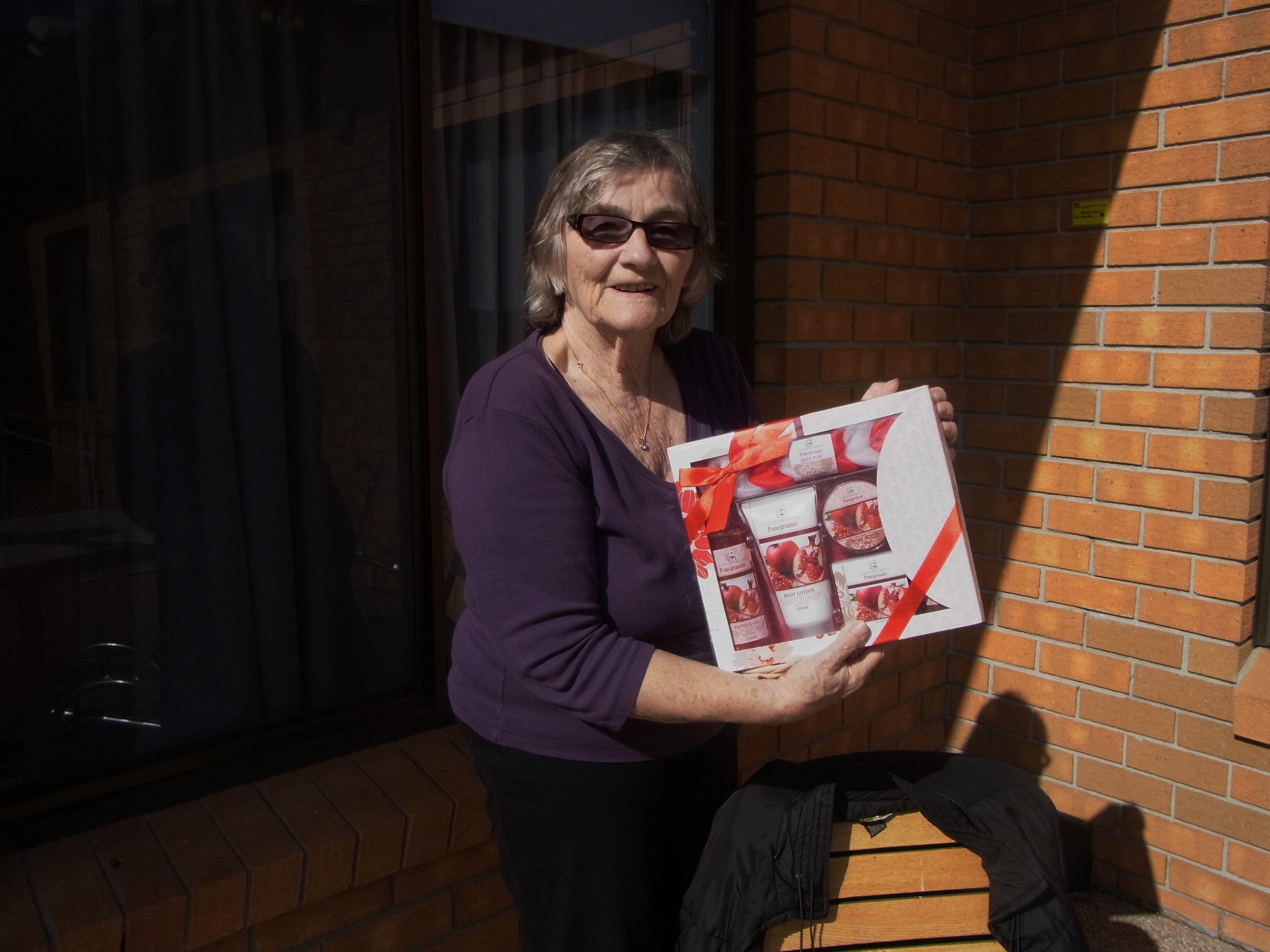
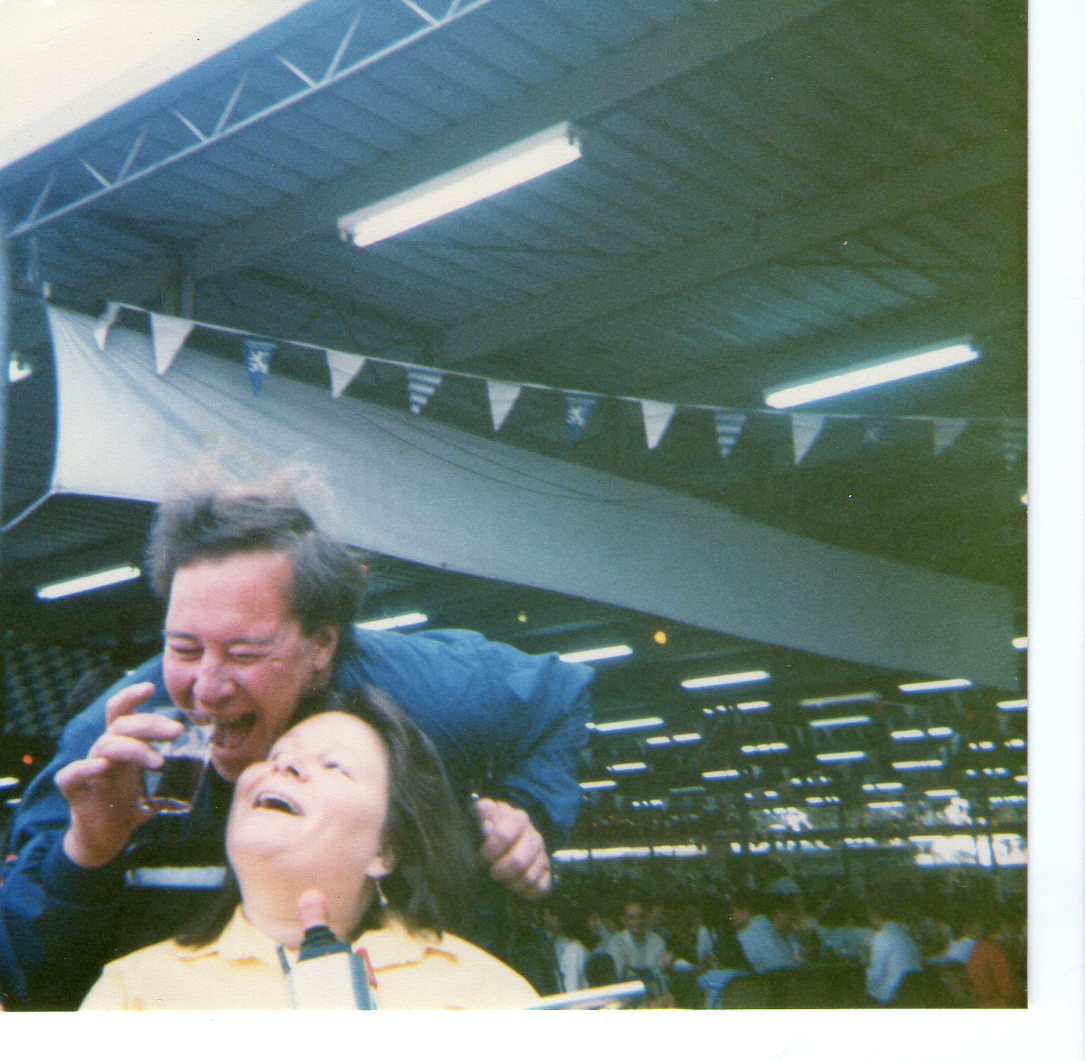
Peter and David in an outside area of the Nursing Home David was allowed to have his lunch outside. But he hardly touched it. David gave me this Mother’s Day gift on the day Peter and I visited him. He said he had bought raffle tickets to win this to give it to me. I was very touched by this.
Here is another recollection I want to add:
With some departed loved ones you get the feeling that it was time for them to leave. You are grateful for the times they could be in your lives. But when the time runs out you have to accept that they really want to be somewhere else. In my family’s case I think they are at peace and with God, which is a great comfort. I am very touched by what both families did to give them the last rest. Both our daughter Gaby and her long time carer David led rather difficult lives. But there were times when they could greatly enjoy each other. And Gaby was always very life confirming and always found ways overcoming some of her disabilities. Last year Gaby died rather suddenly but knowing her disabilities not all that unexpectedly. She died when she was the most happy. David survived her by a bit over a year even though he had been in extremely bad health for many years. David’s family gave him a very good funeral and I was very touched by this.
When our daughter died so suddenly last year it was our family who put together to give her a good parting. Sadly David had neglected to inform his family. So they weren’t part of the celebration of Gaby’s life. Yes, I feel very sad about this. We shouldn’t have left it up to David to inform them. Somehow we thought because he had informed us about Gaby’s passing he would be able to ring someone in his family too. But he didn’t.
Last Mondays celebration of David’s life somehow made up for it now. We were able to talk to David’s four brothers and three sisters
I published the following photos on the 31st of July 2012 after Gaby had passed on the 15th of July 2012. I wanted David to have the original photos. I thought at the time it was a good idea to have these photo scanned before I gave them away. The result of the scanning is this post which I did copy for today’s post since I was reminded today how much David had been a part in Gaby’s life.
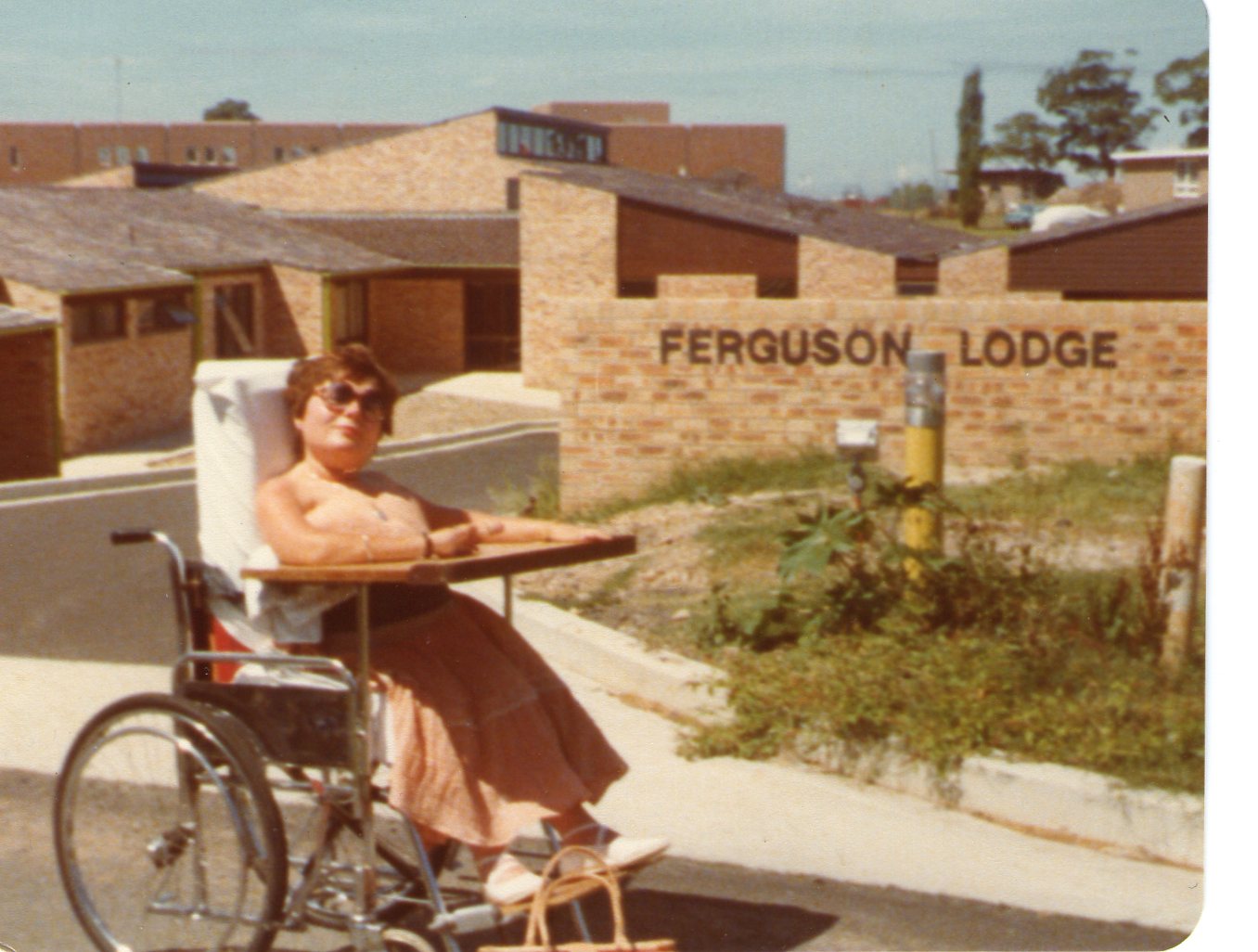
David did get to know Gaby while she lived in Ferguson Lodge which is a place for disabled people in a wheelchair. In this place people were well looked after. However it was institutionalized care. Gaby was very happy when in 1989 David made it possible for her to move into her own home. She was 32 at the time and David was 40.
The picture of Peter holding baby Caroline was taken ca. March 1979, visiting Gaby at Ferguson Lodge with friend Ron Bates.
Next to Gaby is David’s father, on the left David’s mother, on the right friend Coral
Gaby has a birthday cake in front of her, David is on the right, David’s mother left
David and Gaby
ca. 1973 when Gaby still lived with us: Mum, Dad, brother Martin, sister Monika
David and Gaby came to visit for Christmas celebrations. David is Father Christmas and Caroline, who just turned 6, and the twins (5 1/2) have fun. Behind Gaby is Monika, the twins’ Mum.
The day on which we came out of the dark world of the air raid shelter and back into daylight was Wednesday, the 9th of May 1945. As I mentioned before, after living in the cellar for days on end, the days of the week had no meaning at all. Nobody would give a fig of what day of the week it was. Abnormality had become the norm.
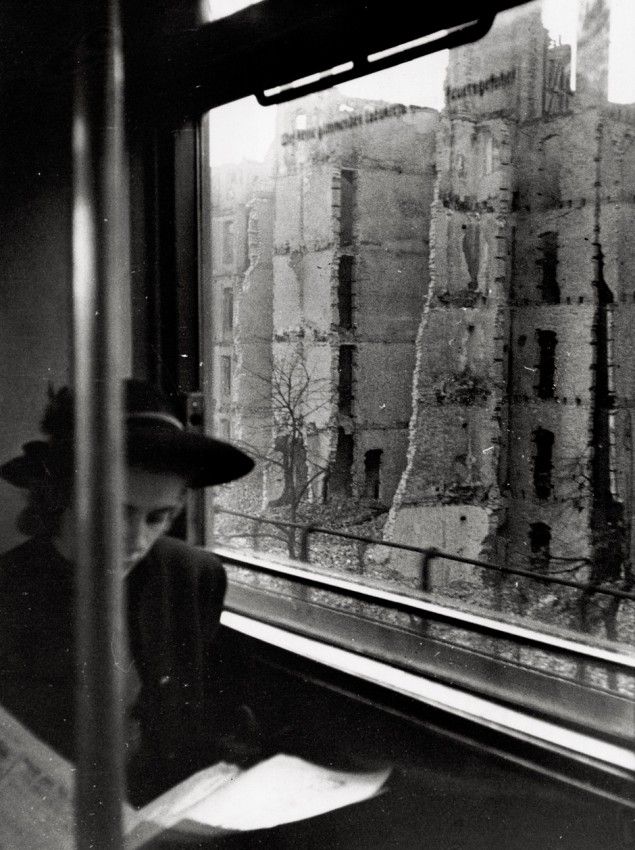
Bombed out people in the streets of Berlin
It was more important to us, that the fighting was finally over and we were allowed to be on the streets of Berlin for an extended time. There was still a night curfew in place, but we could, if even only for a short time, resume life. The most important question was, where would the next meal come from?
Most of the women were with their children on their own unless, of course…
This longer version is even more sensational. July would have been the middle of summer. People were actually going to Strandbad Wannsee and enjoying themselves on the beach and in the water.
“With complicated move and countermove, the four occupying powers settled down last week to the task of ruling conquered Germany. A few picked units of British and U.S. troops packed their gear and took off for Berlin, where they would help the Russians garrison the city.
Bulldozers and sweating U.S. engineers finished a bridge across the Mulde. Over it rumbled the Berlin-bound U.S. troops. Soon Russians would cross it in the other direction to take over territory vacated by the Americans. On the Autobahnen of Saxony and Thuringia U.S. vehicles rumbled west and south,…”
And here I want to comment a bit on the above video:
I was at the time in Leipzig, Saxony. I remember how American/Canadian troops occupied Leipzig in the middle of April 1945. Some two months later these troops were replaced by Russian troops. Saxony belonged from then on to the Russian occupied zone,
In the above video you see how Americans look around in Berlin and Potsdam.Berlin was initially taken by Russian forces. Fighting in Berlin stopped on the 7th of May 1945.
However the Western Allies, namely British, American and French forces, eventually did go to Berlin and apart from the Eastern Sector the three Western Sectors of Berlin were established, This would have been in the beginning of July 1945.
In the video a bit of Potsdam is shown, which is a town outside of Berlin in the land of Brandenburg which belonged to the Russian occupied Zone of Germany and remained Russian occupied for a good many years. (Russian troops left Germany soon after the Fall of the Wall in 1989).
In the video American military personal is seen. This was filmed only a few days after they had come to Berlin. Pictures of the Olympic Pool are shown. There is water in the pool and we can see people enjoying themselves around the pool. My guess is that these people maybe are Americans who took over the pool for themselves. Also the people at Strandbad Wannsee are probably Americans. Both the Olympic Stadium as well as Strandbad Wannsee would have been in the American Sector of Berlin.
After on April 25th, 1945 the whole public transportation system in Berlin came to a halt and the city went up in flames, it was indeed short of a miracle that the first trams, buses and trains could take up their service less than a week after Germany´s surrender.
On May 13th, the same day Berlin´s first Soviet Commander, General Nikolai Bersarin signed an order (Order No. 6) to re-establish the S-Bahn and U-Bahn traffic in Germany´s capital, the first passengers used the bus line – “Linie T” – from Onkel Toms Hüte to Schönow.
The first U-Bahn trains set off on May 14th, 1945 in Neukölln: along one section of the future U7 (then still known as Linie C I) with the service running between the stations Hermannplatz and Bergstrasse. Another fast resurrected line was part of the future U8 (Linie D) from Boddinstrasse to Schönleinstrasse. Due to the…
The following is taken from an online debate Above is a link to it.
” . . . .. Not even being the ‘First Consul for Life’ satisfied him. No, he had to become ‘An enlightened despot’ *** He became Emperor of the French and his satellite nations. He aspired to style himself as the famed Roman emperor Augustus Caesar (who, I may also add, initiated many conflicts).
“Why were the conscripts actually eager to sign up? Why, in 1815, when he returned to France, not a single soldier fired on him and joined him instead? He was immensely popular with the army and continued to be until the very end.”
this, in itself, is a peculiar statement. Conscripts eager to sign up? Isn’t that oxymoronic? Conscripts are forced to sign up; there may be a few who do so willingly, but the majority of them do it so that their families do not get persecuted. Let us compare it to Hitler’s armies. He utilize conscription and thousands and millions signed up for the ‘Fuhrer’ and the ‘Reich’. Everybody was pleased to be a German soldier in 1939, 1940 and 1941, when Hitler owned Europe, the Allies torn, Russia invaded and England besieged. It is a like manner that men conditioned by propaganda would sign in Napoleon’s armies – for their nation. While the nation expands and is victorious, they can earn medals, eat well, receive payment and treat life as plentiful. When the fighting gets grim, do you really think that these conscripts and soldiers were happy, as you proclaim? Of course not! As I have also mentioned, these men were carefully conditioned by propaganda. They were soldiers of the ‘greatest’ and most victorious nation of Europe. Why not fight? To their doom.
I have never denied that he was very considerate in his political, administrative and religious achievements. This is true, but it is also irrelevant as to whether or not he was a warmonger. He precipitated and began several conflicts. He ruthlessly consolidated power and manipulated leaders until he controlled a vast portion of Europe – of which very little naturally belonged to him.
“vassal states”, as my opponent agrees, are too true. Napoleon created many of which were subjugated by him.
Here are some quotations that the reader may find interesting from the book, “The Art of Warfare in the Age of Napoleon.”
“But it was Napoleon, however, and not the Russian ruler who actively prepared for aggression.” *
Thus, I have clearly demonstrated that Napoleon, by definition in Round 1, was a warmonger. He certainly advocated every war that he fought in. He endorsed them all and precipitated most of them (such as mobilizing and attacking before Austria even realized that war had been declared in England and France, or marching on Russia while Russia was astonished), even if he only actually declared war for a few of them. I proved that Napoleon grasped power and always attempted to consolidate more of it; such was his greed. He also was paranoid to lose it, as many other famed warmongers have been – Hitler and Stalin foremost among them.
Thanks for a wonderful Debate, Nazgul. I think I’ll take you up on that offer. this has been most interesting!
Readers, since I have clearly shown that Napoleon was, no matter how many civil achievements, a warmonger. Vote Con!”
auntyuta
June 26, 2014 at 3:14 pm Edit #
“Napoleon Bonaparte Was Not a Warmongering Conquerer”
This is what the debate was about. The above excerpt is taken from the concluding statement of the person who debated against the above statement.
I cannot agree with the people who say Napoleon was not a warmonger.
“I proved that Napoleon grasped power and always attempted to consolidate more of it; such was his greed. He also was paranoid to lose it, as many other famed warmongers have been – Hitler and Stalin foremost among them.”
This is what the Con debater says. It looks to me that he is right. I am sorry, but to me a warmonger is not a great person, definitely not. Even in my teens I hated it when certain people admired Napoleon. How can I admire a warmonger? I just can’t!
Warmongering literally means, “The activities of a Warmonger.”
Warmonger means, “A person who advocates, endorses, or tries to precipitate war.” (Dictionary definition)
REPLY
berlioz1935
June 26, 2014 at 5:43 pm Edit #
History doesn’t start with one person. It can be carried by one person. But that one person is born out of a conflict that is already present.
The French Revolution put the fear into the ruling classes all over Europe. As a result of that fear they started the “War of the First Coalition (1792–1797)”
From then on the Coalition would not stop and France had to wage war whether they liked it or not. The French noticed very quickly the Napoleon Bonaparte was the only one who would be able to contain the other European powers.
There was no other way, according to them, than to continue the war until the Coalition powers were defeated.
There were Pan-European efforts to contain Napoleon and Coalition after Coalition was formed. Of course, France was on a continued war footing they could not stop as the other powers would have marched into France and restored the Monarchy. The revolution had to be saved, they felt.
Of course, the victors write the history.
REPLY
auntyuta
June 26, 2014 at 6:02 pm Edit #
Berlioz, you say: “The revolution had to be saved, they felt.”
“He became Emperor of the French and his satellite nations. He aspired to style himself as the famed Roman emperor Augustus Caesar . . . ”
He must have thought calling himself “Emperor” is one better from calling himself “King”. His idea of “saving the revolution” seems rather strange to me!
In the end Napoleon was not the victor, was he? And many historians claim he was a great man and not a warmonger. How come?
Peter and I just finished our morning tea. We were enjoying sitting outside in the warm winter-sun, watching a wild dove, who seemed to watch us, while she looked again and again towards a large bush. Was she thinking of building a nest there? We had found birds’ nests in the past in bushes near the front of our house. It was not like this with this bird. She just took off to look around elsewhere.
Our thoughts went to our neighbours, J. and S., who had left early in the morning to go on a holiday to Queensland. J. sometimes comes to talk to us when we’re sitting outside having our cup of tea. Peter says that J. won’t be around today.
So, why do we suddenly talk about the games we played as children? I think we were comparing our different attitudes to being left alone. I say…
This post goes back to my earliest blogging days. I tried to find whether I reblogged it before, but could not find it anywhere. It might be of interest to some of my followers. This is, why I reblog it now.
Towards the end of September 1943 we left Berlin to live in the country. We moved to a place called the ‘Ausbau’, which meant that eventually ‘more’ was to be added to the building.. It was a simple rectangular red brick complex with several entrances around the building. There was no plumbing or electricity. The entrance for us ‘Berliners’ was on the left side at the front of the building. We had a cellar, a groundfloor and two upper floors.
Mum, my two younger brothers and I, shared a bedroom on the first upper floor. We also had a small kitchen and a living-room. I would sleep in the living-room when my dad came home on leave. Two maids, one Polish, the other Russian, shared two rooms on the top floor. All the rooms on the top floor had sloping ceilings. Our Polish maid was in her…
THIS IS A REBLOG OF SOMETHING THAT I PUBLISHED IN MAY 2013. BITS AND PIECES MAY INTEREST SOME OF MY FOLLOWERRS, ESPECIALLY THE COMMENTS TO THIS BLOG I FIND VERY INTERESTING TO READ ONCE MORE.
On a sunny morning in August 2011 Peter and I had morning tea in front of our house. We were watching a wild dove, who seemed to watch us, while she looked again and again towards a large bush. Was she thinking of building a nest there? We had found birds’ nests in the past in bushes near the front of our house. It was not like this with this bird. She soon took off to look around elsewhere.
Suddenly we talked about the games we played as children. We were comparing our different attitudes to being left alone. I mentioned that I cannot remember ever having been distressed when I was left to do something by myself. I had my ‘Kinderzimmer’, where I was often supposed to play on my own. When I was all by myself, I liked to invent people who would talk to me. I totally accepted that not all the time someone could be with me no matter how much I loved to be surrounded by people.
‘Yes’, Peter said, ‘I played with my toys all by myself too. I can imagine your Mum would have been home with you more often than mine because your Mum did not have to go to work, whereas my Mum always went away, and I hated it, when she went away. I did not want her to go away.’
I said: ‘I don’t think, it bothered me, when Mum had to go somewhere without me. However, I was very happy when I was allowed go on an outing somewhere with someone. And I certainly loved it, when I was allowed to play with other children.’
Many children my age and older lived in our street, the Bozener Strasse in Berlin-Schöneberg. The buildings in our street were five stories high. We all lived in rented apartments. Our street was very secluded with no traffic to speak of. We would play ball-games in the street. We also played singing games or games where we had to recite certain verses. I can still remember a lot of the songs or verses that went with our games!
This is an edited version of what I published on the 10th of August 2011. This was one of the first things I published. Noeleen sometimes liked to look up some earlier blogs. She happened to come across this piece on the 26th of March 2012. Here are her comments and my replies:
Noeleen: “This is lovely to imagine, Aunty Uta – playing ball in a good secure street. But being left alone – wow, you didn’t mind? It’s funny how as an adult, we’d be thought crazy if we made up people to talk to, but I can see your imagination was very alive, and kept you company. How funny to imagine that both your husband and you played with your toys alone. Similar as children, and not even knowing it…”
My Reply: “Thank you very much for visiting, Noeleen, and commenting. Making up people to talk to, isn’t that what we do when we write fiction? When real people talk to me, or I listen to others talking, certain conversations just stick to my mind and I reflect on them over and over again.
When I was about five and we were celebrating grandfather’s 70th birthday, there was music and dancing. I happened to be outside in the entrance hall listening to the music and trying out a bit of dancing on my own. Uncle Edmund noticed me. He asked me what dance I was doing. I said: ‘Swing. I’m dancing swing. This is what Mum and Aunty Ilse are always dancing.’ Uncle E was rather amused. His face definitely showed great amusement! I felt embarrassed by his amusement. This is why I never forgot this incident.
Mum always told me I was not a very good dancer, same as my father. She called it ‘stiff’ dancing. I admired Mum and Aunty for being such good dancers. I longed so much to be able to dance like this!
I think Uncle repeated the word ‘Swing’ in a mocking way as though it was funny I should be using such an English sounding word for my little dance.”
Noeleen: “Ah, memories. We just can’t escape them.”
My Reply: “This reminds me that we all seem to remember different things. I think you said your sisters remember not the same things that you remember. Peter remembers a real lot about his childhood but his sisters don’t. I would certainly remember not the same things my brothers remember. My children probably all remember quite different things too. I mean they don’t necessarily all have the same memories. I think it’s great when you are able to write down some of your memories. And so we’re really lucky that we are helped along with this by having the opportunity to do it in the form of blogging. I find blogging is great fun! And to see how so many different people go about blogging all over the world, this is something truly amazing.”
Childhood Memories about World War Two
This is what I published in May 2013:
‘I have now two pages about my childhood. One is just “Uta’s Early Childhood”, the other one is “Uta’s Early Childhood, Part II”. In the Part II I inserted today some pictures about my sixth birthday in 1940 plus one picture from summer of 1942. All these pictures were taken during the war, World War II that is, when we lived in Berlin, Germany.
Did we suffer during the first years of war? I don’t think so. Except that my father had moved away from Berlin. He became the manager in grandfather’s furniture factory in Lodz, Poland, which since the German occupation in 1939 was called Litzmannstadt. My father had grown up in Lodz. His family had lived in Lodz since the early 1800s, when this part of Poland belonged to Russia.
My father had studied in Leipzig, Germany. In 1930 he had married my mother in Leipzig. During the early years of their marriage they had for the most part lived in Berlin. Sometime during the early war years my father had some disagreements with some Nazi people he worked with in Berlin. I think he didn’t voice his disagreements publicly. Had he done so, he may have ended up in a concentration camp!
In the end he was allowed to remove himself from Berlin. As I said he became then the manager in grandfather’s factory. My mother typically chose to stay with us children in Berlin. We only went for some visits to “Litzmannstadt”.’
Submitted on 2014/10/15 at 9:49 am | In reply to auntyuta.
Just now I did re-read this whole post and all the comments. As Peter says, between “Will” and “Reason”, “Will” will always win. I think this is because most people will their emotions let their thinking rule. Well, this is the way it is, this is what humans are like.
To come back to how children experienced the Nazi area in Germany, one book, that deals with this, comes to mind. I read it only recently. It is set in a small place near Munich in southern Germany. I lived near Berlin and in Leipzig during the last years of the war. So I have no experience what life was like for children in Bavaria during these war years in Nazi time. However what Markus Zusak tells us in his historical novel THE BOOK THIEF sounds absolutely believable to me.
In the next comment section I post some details about the book from Wikipedia.
auntyuta
auntyuta.wordpress.com
utahannemann@hotmail.com
14.200.207.145
Submitted on 2014/10/15 at 9:30 am
THE BOOK THIEF
From Wikipedia, the free encyclopedia
This article is about the novel. For the film adaptation, see The Book Thief (film).
The Book Thief
The Book Thief by Markus Zusak book cover.jpg
1st Edition front cover
Illustrator Trudy White
Cover artist Colin Anderson/Brand X Pictures/Getty Images
Country Germany
Language English, German
Genre Novel-Historical Fiction
Publisher Picador, Australia; Knopf, US
Publication date
2005(Australia); 14 March 2006 (worldwide)
Media type Print (Hardback & Paperback)
Pages 550
The Book Thief is a novel by Australian author Markus Zusak.[1] Narrated by Death, the book is set in Nazi Germany, a place and time when the narrator notes he was extremely busy. It describes a young girl’s relationship with her foster parents, the other residents of their neighborhood, and a young Jewish man who hides in her home during the escalation of World War II. First published in 2005, the book has won numerous awards and was listed on The New York Times Best Seller list for over 230 weeks.[2]
berlioz1935
berlioz1935.wordpress.com
berlioz1935@gmail.com
14.200.207.145
Submitted on 2013/05/21 at 11:05 am | In reply to Robert M. Weiss.
Robert, you are spot on with your overall view of history. I always say, that the 2. WW was a continuation of WW I as it was finished in an unsatisfactory way. Meaning, nobody was thinking about the future. Versailles was a disaster. A much better solution was found at the end of WW II. The Germans, at the end of WW I, were hoping that Wilson’s 14 Points would be adhered to.
As a result “The humiliation of the Treaty of Versailles”, as you say, let to the rise of Hitler.
You say further “By borrowing heavily from German mythology, Wagner, the concept of the ubermensch, Hitler instilled in the young a burning pride in Germany’s future. Hitler was also influenced by Schopenhauer’s “Will to Power”. This idea is the subject of a book. “The Jew of Linz” by Australian writer Kimberly Cornish
Cornish has been criticised too, but I found it an interesting read on a certain view point of history. Schopenhauer stipulates, that in a contest between “Will” and “Reason”, “Will” will always win.
berlioz1935
berlioz1935.wordpress.com
berlioz1935@gmail.com
14.200.207.145
Submitted on 2013/05/21 at 10:27 am | In reply to The Emu.
The disagreement with the Nazis was on two levels: personal and about the conduct of war.
Personal: When Hitler came to power he joined the party as a “good” public servant would. Later the life style of his wife could have headed for divorce. This was intolerable for the Nazis and they asked him to discipline his wife or he could not remain a member of the party.
in which Goebels called for “Total War” to be waged. Uta’s father was of the opinion that it was pure propaganda. As an economist he could see that many mistakes were made and the German industry and population were not put on a war footing. He criticised the use of forced labour and called for the utilisation of German women in industry. Only 33% of women were working. Working women was an anathema for Hitler.
He wrote a Memorandum to Hitler and for his effort was hauled in front of Martin Bormann, secretary of Hitler, who advised him not to insist on sending the Memorandum to Hitler. Instead they sent him to the “Ostfront” because he was a Russian speaker.
This is the stuff novels are written about. A lot of what we know is only bits and pieces. Adults did not talk to children about it. Later, yes, but not all came to light.
auntyuta
auntyuta.wordpress.com
utahannemann@hotmail.com
14.200.207.145
Submitted on 2013/05/21 at 7:59 am
Thanks for this very insightful reply, Robert.
” . . . . nationalism has been responsible for many wars.” This is a known fact. Still, leaders don’t want to learn from this and continue to promote it.
Will there ever be a time when mankind can live in peace without any wars?
Maybe if there’s an outside threat we’ll then be acknowledging our common humanity.
So he marched to the death camp with his children . . . . . I wonder how many children were with him.
Is it that the Nazis rigorously went to eliminate everything that seemed foreign to them?Do a lot of people to this day have an innate fear about this what doesn’t fit into their view of the world?
I think not many people are interested in understanding the historical process. They are just interested in how they see their own little world, which is an island surrounded by things that frighten them. Does this lead to fundamentalism? Can fundamentalists live peacefully together with non-fundamentalists or other fundamentalists? If they don’t want peace, what do you do? Eliminate them? Every religion teaches you not to kill unless you are attacked. So for instance Talibans want to kill us. So we are allowed to kill them. Aren’t we? No objections to killing Talibans. Too bad if a few other people get killed along the way. And so it goes. No wonder I need prayers to stay sane. Because the historical process goes on whether I like it or not.
Robert M. Weiss
river4827.wordpress.com
forestbreeze40@earthlink.net
70.197.68.149
Submitted on 2013/05/21 at 3:00 am
Janusz Korczak was offered an opportunity to escape from Poland, but he did not take it. Instead, in 1942, he marched with his orphan children to the death camp of Treblinka…. No doubt people in great psychological need follow cults, and often utilize unhealthy coping mechanisms. What happens with countries brings matters to a larger scale, and nationalism has been responsible for many wars. The humiliation of the Treaty of Versailles, the rampant unemployment, and other factors went into the cauldron of Nazi Germany. Hitler’s genius was to work with the young people, and gain their support in actively supporting the Third Reich and its goals. By borrowing heavily from German mythology, Wagner, the concept of the ubermensch, Hitler instilled in the young a burning pride in Germany’s future. Hitler was also influenced by Schopenhauer’s “Will to Power”, the incendiary speeches of Bismarck, and the methods of American advertising… History is composed of a series of reactions and counter reactions. Perhaps one day we will succeed in isolating the variables responsible for the vagaries of history, and gain a more precise understanding of the historical process.
catterel
catterel.wordpress.com
catherine.sommer@bluewin.ch
86.168.203.38
Submitted on 2013/05/20 at 9:02 pm | In reply to auntyuta.
HiI Uta – yes, no, yes. I’m writing a memoir that gets added to sporadically, but haven’t published many old photos from that time. Maybe I should!
auntyuta
auntyuta.wordpress.com
utahannemann@hotmail.com
14.200.207.145
Submitted on 2013/05/20 at 3:10 pm | In reply to The Emu.
“The Marshall Plan (officially the European Recovery Program, ERP) was the American program to aid Europe, in which the United States gave economic support to help rebuild European economies after the end of World War II in order to prevent the spread of Soviet Communism. . . .”
Ian, this recovery program helped Germany enormously after WW II. Whereas what happened after WW I was a terrible disaster for Germany. The result was that the Nazis came to power!
The disagreements my father had with the Nazis had to do with the war. But sorry, I cannot recall properly what my father said about it. Anyhow the way I remember it, my father was objecting to the way the war was conducted. I think he moved to “Litzmannstadt” towards the end of 1940. This for instance would have been long before Pearl Harbour!
For a great part of 1941 we stayed with the grandparents in Poland.
By August 1941 we were back in our apartment in Berlin (without my father of course). In September 1941 I started school. I was then aged seven already! My second brother was born in October 1941.
My first school reports say my father’s occupation was “Betriebsführer” (Manager).
He was born in 1904. During the first war years he was regarded as being too old to be conscripted. But by 1943 his year, that is men having been born in 1904, were being called up for military duties. After some training my father was made straight away to be an officer. He was sent to the Eastern front.
He came back from the war with his health ruined. For many years after the war he suffered from these health problems without getting any support from my mother I might say. But his sisters and the sisters families as well as his mother who were all refugees from Poland, well everyone in his extended family supported him to the best of their ability. Eventually he did recover and was able to get full employment. At about 1949 my mother got a divorce from him. In the 1950s when he was gainfully employed again and his health had improved a lot, he asked my mother to marry him again. She refused.
He married his secretary in 1959. In 1966 he died of prostate cancer.
The Emu
aussieemu.wordpress.com
ian.anafelton@gmail.com
121.219.179.19
Submitted on 2013/05/20 at 11:37 am
Very interesting Auntyuta, to read of your background in those years, virtually a first hand account and must be recorded and handed down into your family and put into book form.
It intrigues me as to the disagreement your father had with the Nazi;s, maybe you could elaborate on this Auntyuta.
A great historical reading.
Emu aka Ian
auntyuta
auntyuta.wordpress.com
utahannemann@hotmail.com
14.200.207.145
Submitted on 2013/05/20 at 7:58 am | In reply to catterel.
Hi Cat, do you write a lot about your early childhood and do you have pictures of that time published? Do you find you cannot disclose too much about people who are still alive? It’s great for your kids to be told by you what life was like in the 1940’s and 50’s.
auntyuta
auntyuta.wordpress.com
utahannemann@hotmail.com
14.200.207.145
Submitted on 2013/05/20 at 7:46 am | In reply to Robert M. Weiss.
Hi, Robert, I have the feeling what you say about Hitler may be absolutely right. My generation (after all I was only a child during the Hitler years) on the whole has learned not to trust people like this.
Aren’t there certain people around in certain countries who somehow are able to get followers when clearly if they only started thinking a bit for themselves maybe they couldn’t be followers? Sadly people in general go more by their feelings and what’s in it for them rather than thinking about the consequences of their support. Aren’t most people selfish? If something is promised that advances them they go for it, don’t they?
I guess Janusz Korczak was a remarkable educator, right? I think you mentioned him in one of your blogs. But I can’t recall any details. Did he for instance survive the war years? Did he have family? It is of course admirable if people stand up for what they believe in.
The best example where protests by a lot of people resulted in an immense change happened in the Eastern part of Germany. The fall of the Iron Curtain, which for years and years looked rather impossible, all of a sudden was possible in a rather peaceful way. That it went ahead peacefully was thanks to some noble people who restrained themselves from interfering.
War and Peace, War and Peace, maybe this is the fate of mankind for ever and ever. Didn’t Orwell say, some people when they say peace mean war? Our previous Primeminister Keating here in Australia used to fight a lot in parliament. His attitude was it was better to fight in parliament rather than attack each other in the street.
Robert M. Weiss
river4827.wordpress.com
forestbreeze40@earthlink.net
70.197.70.2
Submitted on 2013/05/20 at 2:24 am
Many people at that time didn’t voice their opinions openly. Janusz Korczak, the Polish educator, did. He walked through the streets of Warsaw wearing his Polish army uniform, and was put in jail for his efforts… I continue to be amazed how the Germans could have supported such a madman as Adolf Hitler, which he clearly was. He misused Darwinism, Nietzsche, and never followed his main tenet: to produce children for the Fatherland. Perhaps he knew that that he was the most misbegotten cross and handicapped person of them all.
catterel
catterel.wordpress.com
catherine.sommer@bluewin.ch
86.166.198.202
Submitted on 2013/05/20 at 12:10 am
Yes, do please write about your childhood. It was so different then, and personal memories make it come alive for our children and grandchildren. My early life in England (1940’s and 50’s) seems like tales from a distant planet when I reminisce to the kids!
auntyuta
auntyuta.wordpress.com
utahannemann@hotmail.com
14.200.207.145
Submitted on 2013/05/19 at 4:36 pm
Hi Diana, thanks for the comment and welcome to my blogging. I read your about page and am interested in what happened to you when you turned forty. I remember, a long time ago when I turned forty my life seems to have undergone some kind of a change.
A lot of the subjects you write about look very interesting to me. I want to do some reading of your blogs pretty soon.
Cheerio, Aunty Uta.
Holistic Wayfarer
aholisticjourney.wordpress.com
dipumpkin@gmail.com
76.232.196.192
Submitted on 2013/05/19 at 1:51 pm
Keep writing. That was a fascinating era — and we are just so comfortable these days. We don’t appreciate what our parents and grandparents endured to sustain the basic things we take for granted
Response by Emu 18th Oct 2014:
You got a lot of interesting comments on this article Uta, I do recall this post, the comments illustrate the interest in this part of your life and this part of history in general.
These memorys must be recorded while you can, as overtime history does get altered to suit the imaginations of the reader in recorded history.
Emu
REPLY
auntyuta
October 18, 2014 at 3:38 pm Edit #
Thank you so much for coming back to this story, Ian, and commenting on it again. At the moment my head is full of reviews to the book “Before I go to Sleep”. I googled all these reviews and spent quite some time reading them. At the moment I took a break from reading. Having seen the movie today with Peter we did discuss the story quite bit. The acting was superb: Colin Firth and Nicole Kidman at their best! If the story is supposed to be a real life story, there were a few things that did not make real sense to us. We happened to mention it to the cinema owner and he suggested that maybe in the book there would be some more clues. Not having read the book yet but having looked up a number of reviews about it I am more or less informed now about a few more details. However it makes me wonder how often in the real world people are being lied to and don’t know whom to trust, and how often it is easy for criminals to escape prosecution because the police or the medical profession do not follow up on any given clues?
To me the whole thing is a human relationship story. How people relate to each other I always find most interesting.
I hope you, dear Ian and Ana, you both have a good weekend. When are the two of you going on another trip? 🙂
Cheers
Uta
MY PARENTS
May 1935 in Berlin Baby Uta with her Dad
This is a reflectionon my parents. Their marriage their frequent separations, their divorce, how they related to us children, their interests, their friends or partners, Dad’s second marriage.
When I was about fifteen, Mum introduced ‘Bambi’ into our lives. ‘Bambi’ was Herr Burghoff aka Tomscick. Of course only Mum called him ‘Bambi’. To us children he was ‘Herr Burghoff’. We did not have any problem with this. Later on I found out that Dad had a problem with calling him by his adopted new name. Dad insisted on calling him ‘Tomscick’.
Here is a conversation I had with Dad when I was about eighteen:
It was June 1953. I was on a one week leave from FLEUROP and had used this, my very first vacation, to visit Dad in Düsseldorf.
‘The boys told me that Tomscik never shared his supper with you children,’ said Dad.
‘Don’t worry, Dad,’ was my response. ‘We never wanted Herr Burghoff to act as our Dad. I thought it was perfectly all right that he bought “Abendbrot” only for himself and Mum. At the time he was still studying and didn’t have much money. Maybe it would have been different had he already been employed in the Public Service.’
‘And what is this, that he wants to marry Mum?’ asked Dad.
‘Well, it’s true, he wanted to marry her. You know, that as a Catholic he was not allowed to marry a divorced woman. That’s why they asked the Pope for special permission. It took a while, but they did get it in the end.’
‘Yea, by declaring the marriage invalid and my children bastards,’ screamed Dad.
‘I know, they established that she married under pressure of her mother and sister Ilse. They claim, she didn’t really know what she was getting into when she married you.’
Dad looked extremely upset. ‘That’s absolute nonsense!’ he shouted.
I felt very sorry for Dad. ‘Anyway, Dad, it seems Mum’s not going to marry him after all. Tante Ilse says so.’
‘And why would that be? What could possibly be a reason for not marrying him now?’
‘The reason? According to Tante Ilse there are several reasons. You know, Herr Burghoff is now employed here in a town in the Rheinland. That is Mum would have to move away from Berlin, if she wanted to live with him. And you know what Mum’s like: She just does not want to leave Berlin!’
Dad nodded. He knew all about this: Mum had always refused to leave Berlin to live with him.
‘ And Tante Ilse told me something else. She said when Mum went to his new place for a visit, she noticed him praying a lot. At least twice a day he would fall on his knees praying in front of a statue. It was kind of acceptable for Mum to go with him to Sunday Mass in Berlin. But apparently she can’t stand all this praying at home. Tante Ilse thinks it was just too much for her to see him do this. Indeed, it must have been the straw that broke the camel’s back!’
Mum actually never re-married. An acquaintance of Mum’s helped her to acquire a permanent job in the Berlin Rathaus (Council Building). She worked there till she turned 65. She could have stopped working earlier, however she knew her pension would increase if she worked to age 65. She lived for her twice yearly vacations. She always saved up for these vacations to go on wonderful holiday trips. On one of these trips she met a widower who was keen on marrying her. Years later she once told me, she chose not to marry him. He was elderly and she was too scared he might eventually need nursing care. The thought of having to nurse someone in old age just didn’t appeal to her. She thought she deserved to have the opportunity to still have a bit of fun in life. On each holiday she took lots of photos and meticulously preserved them in photo albums. She also wrote a few comments for every trip. There are some records in her recollections about two very elegant men who invited her for dinner. These men turned out to be homosexuals who greatly enjoyed the company of a well groomed presentable lady. And apparently she enjoyed being invited and appreciated. She told me she was glad that none of them expected any sexual favours from her.
Dad was actually thinking of re-marrying Mum once he was back in secure employment. As far as I know he did ask her and she refused. Apparently she had no desire at all to get back together with him. I remember Dad did ask me at the time whether I thought it would be better for us children if he re-married our mother. Well, I must admit, I did not think so at the time. I just could not imagine the two of them being civil to each other after all the hostilities that had been going on between them for many years. I think I was eighteen when this question came up. When I was younger I would so much have loved to be living with two parents under the one roof. At eighteen I had overcome these feelings of deprivation of not having two parents around all the time. Should I have thought more about my two younger brothers? Maybe Mum would have mellowed and been able to put up with Dad for the sake of the boys who definitely would have needed a father – – – –
Mum with her three children: Uta, Bodo and Peter-Uwe. 1948 in Berlin
I don’t know whether Mum would have paid any attention to what I could have been saying. I always had the feeling I could not talk to Mum about these feelings. It was very different with Dad. He always wanted to hear my opinion on everything.
Anyhow as it turned out I left old Germany a few years later with my husband and two young children. Dad was quite devastated to see us leaving. He had become so attached to his first born granddaughter Gaby. She gave him such great joy! We were soon well and truly settled in Australia. We felt Australia was for our young family much better than Germany. We never regretted having left Germany behind.
Dad’s secretary, Frau Kusche, was a war-widow. She came from Lodz in Poland the same as my Dad. She had raised a son and a daughter as a war-widow. I had seen Frau Kusche only once briefly at the office. I later heard her 28 year old son who was married and also had a little son, this 28 year old was suffering from terminal cancer. Before he died he was witness at the marriage of his sister who had been an air-hostess and was marrying an American. My father, who had married Frau Kusche in the meantime, was also present at the wedding, together with his new wife of course.
Frau Kusche’s first name starts with G. Dad had a few good years with her towards the end of his life. He too, sadly died of cancer when he was only 62. He and G made a few visits to America to see G’s daughter there. They had also planned to come and visit us in Australia. Sadly, this never eventuated. G. was looking after Dad when he was terminally ill. It took a lot out of her. But she recovered eventually. She’s still alive and well now, being in her nineties, her daughter-in-law keeping an eye on her.
10 Responses to “My Parents”
berlioz1935
September 7, 2013 at 3:20 pm Edit #
Your parents were victims of the political reality and the war in Germany. It is hard to say what would have happened to them without the war interfering in their lives. Having known both of them I venture to say they were not suited to each other in any case.
REPLY
auntyuta
September 7, 2013 at 3:44 pm Edit #
You may be right there, Berlioz. Thanks for commenting.
REPLY
elizabeth2560
September 7, 2013 at 3:34 pm Edit #
It is amazing that Frau G is still alive so there is someone who you may share memories of your father with. It is sad about your parents separation. However, you have weathered the storms well and set your own firm roots with your own family tree growing strongly here in Australia.
REPLY
auntyuta
September 7, 2013 at 4:07 pm Edit #
Our family tree is indeed growing strongly here in Australia, Elizabeth. Of course, I do like this very much.
I saw my mother in 1994 shortly before she died.
With G I have some contact per e-mail and photos. We saw her in Duesseldorf in 1986. I would have liked to see her again last year when Peter and I were visiting Berlin. We also stayed for a while with my brother Peter Uwe in Meck/Pom (north of Berlin). Other than that we went to my cousin’s funeral in Munich. But sadly we were not able to travel to Duesseldorf as well. It would have been lovely to see G again. However it was good to see her in 1986. She told us a lot about her life with my father.
REPLY
chrisstov
September 7, 2013 at 5:07 pm Edit #
Telling that story must have brought back many memories. Thank you for sharing it with us.
REPLY
auntyuta
September 7, 2013 at 5:19 pm Edit #
It does bring back memories,Chris. Hopefully my descendants may be interested to read about it! 🙂
REPLY
WordsFallFromMyEyes
September 7, 2013 at 9:26 pm Edit #
Your memory is alive & well, Aunty Uta. There is heaps of detail here. How interesting your dad was so open to your opinions – I like that.
REPLY
auntyuta
September 7, 2013 at 10:02 pm Edit #
Thanks, Noeleen. 🙂
REPLY
rangewriter
September 12, 2013 at 2:35 pm Edit #
As I grow up (;-) I discover that families the world over and through the centuries have been weird. Just plain weird! It’s a good thing to know. More kids should recognize this fact so they wouldn’t feel so isolated by the facts of their families.
REPLY
auntyuta
September 12, 2013 at 4:39 pm Edit #
Quite amazing, Linda, isn’t it? What exactly do you mean by ‘weird’? Families that are somehow ‘dysfunctional’? What about divorce? Hasn’t this been on the increase in our time? Maybe it has partly to do with the increase in life expectation? In any case I believe it is important for children to know who their parents are. Whether they stay through all their growing up years with one, two or none of their parents this is a different matter. Some parents might not be the best option for a child, but the same goes for some institutions. It all depends. I did get to know during my growing up years some very well functioning families. I am talking about our extended family and about the families of some of my friends. I also saw examples of desperately struggling war widows with for instance four children and a bone breaking job with very little money. When I was a child a lot of people seemed to blame WW II for the increase in dysfunctional families.

 Peter and David in an outside area of the Nursing Home
 David was allowed to have his lunch outside. But he hardly touched it.
 David gave me this Mother’s Day gift on the day Peter and I visited him. He said he had bought raffle tickets to win this to give it to me. I was very touched by this.








 AuntyUta