
Here are some more pictures that were taken with Peter’s camera. (The previous pictures were taken with my camera.)


Here are some more pictures that were taken with Peter’s camera. (The previous pictures were taken with my camera.)
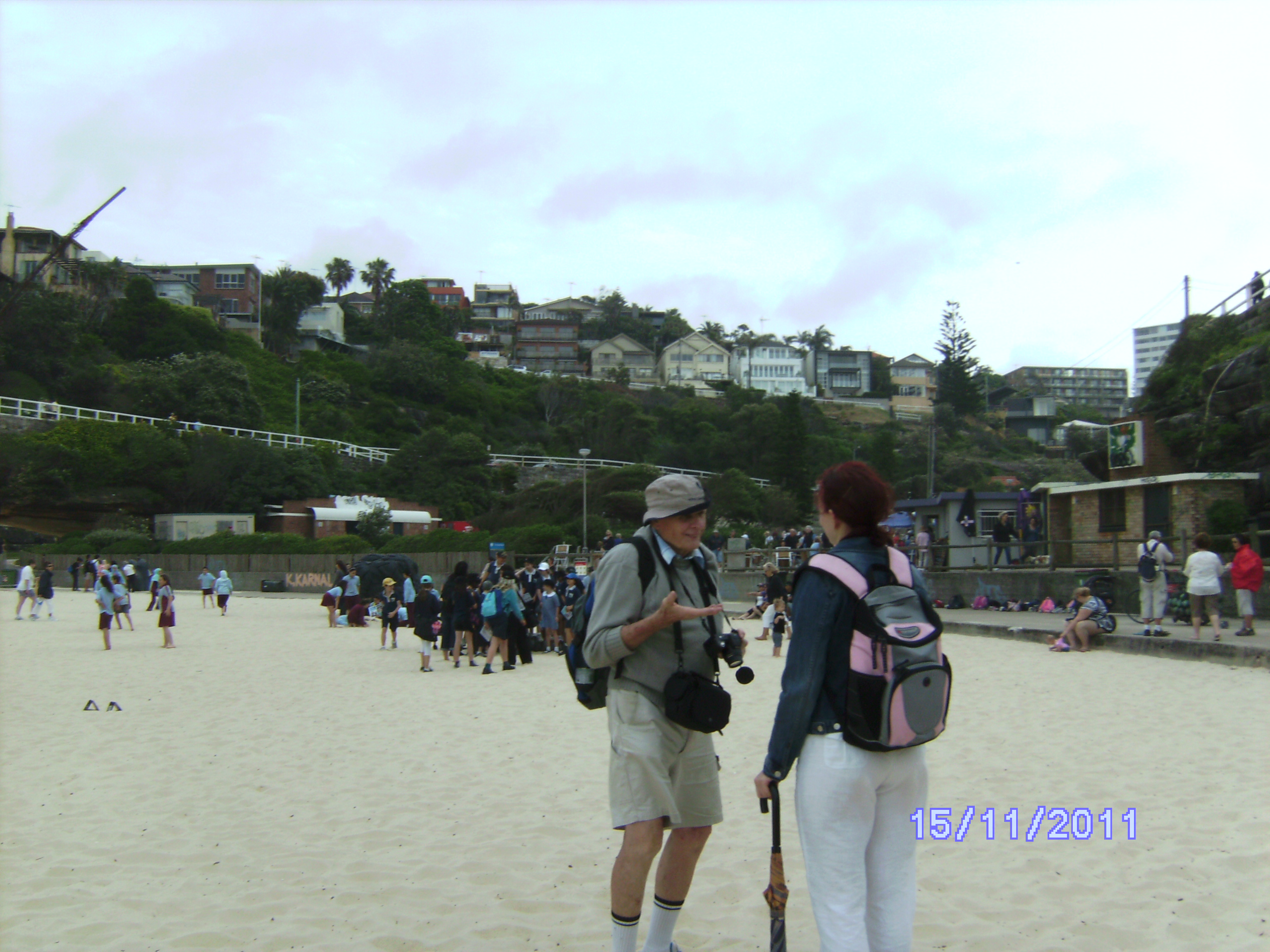
Every year at around this time you can view on the walk from Bondi Beach to Tamarama Beach an exhibition of ‘sculptures by the sea’.
We went by train from Dapto to Bondi Junction, where we met our daughter. From Bondi Junction going on the bus it wasn’t far to Bondi Beach, where we started our walk.




We discovered this place in February 2011 on a bus tour from Forster, NSW.
The Spickermann Family and Uncle Alfred
Mum used to say: ‘Everyone in the Spickermann Family is useless except for one, and that is Grandfather. He is the only one who works hard and has achieved something. Everyone else in the family just likes to laze about, talking stupid things and not doing any work.’
I also remember Grandfather Joseph saying of my mother: ‘Lotte is a very good worker. Oleg should be very grateful for having such a good looking and hard working, smart wife.’
For Grandmother Hilda my Mum had absolutely no kind word. She thought that Grandmother should make a bit of an effort to keep up with Grandfather. And why could she not look after her appearance a bit better? Surely with the position that Grandfather held, she should attempt to be a bit more representative looking! Instead she let herself go and was just a housewife and mother. And why for heaven’s sake did she have to spend all morning in the kitchen when she had two maids to do the cooking for her!
I cannot remember whether Mum ever commented on the competency of Dad’s younger sister Lies, who single handedly would manage a large estate when her husband Alfred had had once again too much to drink and needed some time off for recovery. I seem to remember that in a way she admired Alfred for always being able to recover after some extensive drinking bouts. He was a very tall, strong man. Mum said: ‘He could drink a real lot before adverse health effects were noticeable. Then, when he felt he could not go on any longer, he stopped drinking altogether and lived for a while just on milk until he felt all right again.’
I remember several Spickermanns debating the tough fate their sister Lies had to suffer. How Alfred’s drinking habits effected the children, especially the eldest son Horst. All this happened when the Spickermann Family still lived in Lodz, which was called Litzmannstadt at the time. Horst would have been less than nine years old then.
As far as I know, Alfred ended up in the army before the end of the war. After the war he often talked about it how well he had been treated as a prisoner on the Island of Guernsey. He kept saying what a good life he had had on this island. It sticks in my memory that the family used to say of him being somewhat ‘anglophil’. When I heard this, I was wondering why on earth they called him this. I think I had enquired about the meaning of the word ‘anglophil’. I thought by myself why anyone could imply there might be something wrong with liking the English ways. I think I always was interested in the way other people lived. I am sure I could very well empathise with someone believing that the German way was not the only way worth living! Why shouldn’t you be able to like aspects of some other culture? It seems to me that this kind of thinking I must have developed rather early.
When Peter and I went on our first visit back to Germany, we saw Auntie Lies and Uncle Alfred, who were both in good health. Alfred died one year later at the age of ninety! Having cut down on his drinking in his later years, he none the less still enjoyed drinking a bottle of wine each day right to the end of his life.
The other week we saw a terrific theatre production of
Summer of the Seventeenth Doll
at the Belvoir Theatre in Sydney. This Australian play was first produced in November 1955 in Melbourne and made its way from Australia to London and New York under the direction of John Sumner. The play was written by Ray Lawler and was very successful over the years.It was also made into a movie.
The play is set in 1953 in Melbourne. One gets reminded what life was like in Australia in the 1950s. I think it shows especially what women’s life was like in those days. Women should never appear to be too easy going. This was what was expected of them. Unless a woman could get married, she really had no security at all.
The two women in the play had their men only for the five summer months during wich time they aimed at enjoying themselves to the utmost. The rest of the year their men worked as cane-cutters in Queensland. That went on for seventeen years. They never married. Then in the seventeenth year one of the women had just gone off to marry someone else.
So a new woman, a widow in her fortieth, comes into the game. They want to see whether she fits in so they can keep on playing the game of being absolutely happy during the summer months. Somehow it doesn’t work out because the people involved haven’t learned to take on responsibility. They just do not want to grow up. Maybe they think they can enjoy themselves like that for ever and ever. They never seem to want to grow older. The five months spent together have just become a habit. They are under the delusion that this makes them happy.
Stressful situations like this still exist if partners have to work in different occupations in different countries for part of the year. So I think the play has still relevance today!
We were lucky enough to be at a debriefing last Sunday with the playwright Ray Lawler. He is in his nineties now and a dear old gentleman. He told us much about his life. He started work in a factory at age fourteen. He did the factory work for eleven years. When he started writing, he went to the Melbourne Public Library which opened at 10 in the morning and closed at 10 o’clock at night. It was quiet there, in winter warm and cool enough in summer. He counted himself to be very fortunate that he was able to write in a place like that.
For the said production Belvoir Theatre Company cut a window into the outside wall of the theatre so that proper lighting could fall onto the stage through this window. That gave the audience the illusion that it was outside either daytime or night-time.
In the photo the two lamps are covered. The lamps are being used for lighting effects durings evening performances.


PLANS for December
Martin and Kristen invited us to stay with them in their rented cottage at the Great Ocean Road in Victoria. Kristen booked the cottage already at the beginning of the year. It has three bedrooms, that is two with double beds and one with two double bunks. The booking is for one week.
Martin says he’s going to rent a car to take us all to the Great Ocean Road. Kristen wants to drive her own car, a station- wagon, to take her big dog along and possibly her Mum as well. We are going to leave Melbourne on Monday, the 26th of December. Before we leave Melbourne, we pick Martin’s daughter Lauren up from the air-port.
Spending time with our son Martin and Kristen and Lauren close to the beach will be very good for us. I am also looking forward to meeting Margaret (Kristen’s Mum) again. I hope she’s going to be all right because she’s had an operation not so long ago. Kristen had the idea to book this cottage because it is where she often used to spend summer holidays as a child. Peter and I have actually never been driving along the Great Ocean Road, even though we’ve been travelling to Melbourne lots of times. We always had wished to find time to go along the Great Ocean Road and see the Twelve Apostles, a collections of huge stones standing right in the ocean. I believe there are only eleven apostles left since one got tipped over in a storm.
Lauren, our granddaughter, we haven’t seen for one whole year! It will be great to finally see her again. This holiday will be so good for all of us. We plan to leave home on Friday, the 23rd of December and spend Christmas in Melbourne. Our family back home is going to be disappointed that there won’t be any Christmas Eve celebrations at our house this year. We’re inviting them instead to a Pre-Christmas Lunch on Sunday, the 18th of December. But the lunch is going to be at a restaurant, not at our home.
Unfortunately I did not have the opportunity to grow up in Australia. However, all my children grew up here and are very happy to live here. I ask myself, do people always love the place they grow up in? No, I do not think that is necessarily so. I for one was not happy with the educational opportunities that were open to me in postwar Germany. I was glad to leave Germany behind in 1959. I felt I did owe Germany no loyalty. In those postwar years a lot of Germans longed to live in America, the free country! I thought the next best thing would be to live in Australia.
These days I am glad that we were given the chance to migrate to Australia rather than to America. In Australia we felt straight away freer than in Germany. Peter started in a very low paid job. That meant, we were on an extremely low budget. Still we found life in Australia easy going. It took us only a couple of years to pay off a block of land! Somehow we managed the payments for the land by strictly buying only the most basic things. We spent little on clothes. Home cooked meals were not expensive. About once a week we could even afford to buy take-away fish and chips or a yummy take-away hamburger!
After the land had been paid for, a building society gave us a loan for a small house. We could never have achieved that in Germany! Our two babies were regarded as something precious in Australia. Whereas in Germany people’s attitude was something like: We young people with hardly any prospects for the future should not have any children. The question at the top of their minds was, how on earth could we dare to have children when we had no means to adequately provide for them?!
Over the years we raised four children in Australia. We soon owned our own home. I never had to go to work. Peter always earned sufficient to provide for his family. I chose to stay home with the children. Sure, our children were not spoiled with a lot of the things that todays children take for granted. But there was always a roof over their head, someone to look after them, enough food and clothes as well as the chance for a good education. I reckon Australia was the best place for children to grow up in. University education was free in those days. Even when the parents were on a low income level their children were given good opportunities to better themselves.
We came to Australia in 1959. A lot of things have changed since then. Maybe I feel a bit nostalgic as far as the 60s and 70s are concerned. Sure, a lot of progress has been made since then. Some technical progress has been enormous; e.g. with computers, mobile phones, digital TV etc. However, I reckon the growing gap between rich and poor has not been good. To my mind the difference between poor people and rich people has been growing to an unacceptable level. How can an enormously huge gap in assets and income level be good for society? I wonder whether any reforms are possible and whether the very rich could ever accept a somewhat lower standard of living so that the gap would not be quite as enormous?
I wrote the above about a year ago and came across it today in my files. Somehow it still makes sense to me today. How on earth can the excessive widening of the gap ever be stopped? Is it right for me to worry about it? I live in one of the richest countries in the world and personally I don’t suffer any hardship. Being seventy-seven years of age my life is nearing its end. Is it right for me to worry about what comes after me? Shouldn’t I just count my blessings? Justice for all and the abolishment of poverty: It’s just a dream, isn’t it? Or maybe, just maybe it might become true one day!
Charlotte tells her story to her niece Renata. Daughter Uta is listening in the background.
Charlotte: ‘You have no idea, what things I had to do to find our furniture!’
Renata: ‘I’ve heard, there was a Russian soldier who wanted to kidnap you.’
Charlotte: ‘Too right. This Russian, who came along in a jeep, saw me walking along the Chaussee. He stopped and pointed to the seat beside him and then pointed straight ahead. He looked friendly enough. I felt very tired after a long day trying to find out, where all our furniture had ended up. I thought this Russian was just a guy, who wanted to help out a tired looking woman. So as naive as I was, I hopped into his car. Before I got in, I pointed into the direction of the next village and asked him, whether he was going to Herzfelde. – H e r z f e l d e? I said repeatedly. The Russian nodded his head. He was very young and friendly looking. When he took off with me, his face broke out into a big smile. It did not take long, when he slowed down a bit. I looked to the side and then it dawned on me, he wanted to turn off into a side-road, more like a track really. I could see a lot of trees in the distance. So I thought, that this was, where he wanted to take me. In a split second I made a decision. He had just turned the corner, when I jumped out of the moving jeep and ran back to the Chaussee as quickly as possible. Then I was walking along the Chaussee, where quite a few cars were going in both directions. My friendly Russian came back to the Chaussee, yet he did not bother to invite me into his jeep again!’
Renata: ‘An amazing story. You are so brave, Tante Lotte!’
POSTSCRIPT: I cannot remember the exact circumstances when and how Mum told this story. My cousin Renata is a few years my senior. That Mum told her niece Renata the story in this way is my invention. However it could have happened this way. That Mum was nearly kidnapped by a young Russian soldier, this is definitely true. Herzfelde is a small town east of Berlin. Our furniture had been stored at a place called ‘Ausbau’ as I had told in earlier blogs. Some of the neighbours had helped themselves to some of our furniture after the war and had taken it to different places in the area. I have no idea, how Mum managed to recover most of it and get it transported back to Berlin.
I just found last year’s Christmas pictures which we took in Wollongong, NSW. I can’t believe, another Christmas is approaching soon. The year went so quickly.


CHILDHOOD MEMORIES
I remember vaguely a conversation which took place on our balcony in Berlin soon after Easter 1946. I know for certain that at the time Dad was still with us and that Mum had made friends with a lady from the neighbourhood who had established herself as a manicurist. The name ‘Julia Gratz’ is my invention.
The following conversation is more or less made up by me. I only remember for sure that this lady talked to Mum about ‘Gone with the Wind’. I am also pretty sure that this lady was very courteous to Dad and treated him with much respect. It is also true that I had just returned from Leipzig and was about to start school in Berlin. It is also true that I had to catch up in English and that an older school-girl volunteered to give me private lessons. I also distinctly remember that all of us were sitting on the balcony and that it was balmy spring weather.
As a writing exercise I tried to write the following in the third person.
BERLIN, SPRING 1946
Eleven year old Uta has just returned from her grandmother’s place in Leipzig. Her parents, Charlotte and Alexander, sit with her on the sunlit balcony.
Also on the balcony is a voluptuous blond woman. Her permed hair is well set. Her fingernails are excellently shaped. Her nail polish is of a pink colour. Her name is Julia Gratz. She has just finished doing Charlotte’s fingernails. This is how she earns a living in this black-market time. She is well spoken. She likes to talk to Alexander, trying to flatter him with ‘intelligent’ questions.
Julia: ‘What do you think, Herr Doctor, is there any chance at all that we get our proper jobs back? How long is it going to take before we recover from Germany’s disastrous downfall?’
Alexander: ‘I am sure it is going to take several years. I only hope that Germany is not going to be made to pay enormous amounts in reparation as was the case after World War I. But since we have been totally defeated, we basically have to accept, that the other countries can do with us as they like.’
Julia (turning to Charlotte): ‘I’ve just been reading GONE WITH THE WIND. I have enormous admiration for Scarlet O’Hara, how in the midst of having lost everything due to the war, she shows courage by sewing herself a dress out of some curtains. She does not want to look poor, when she goes to see Rhet Butler, who profited from the war and is very well of.’
Charlotte: ‘Yes indeed, this shows enormous courage. It reminds me, that I dismantled our old flag and used the material for sewing a colourful blouse. In times like this, you have to use whatever you can, to get by.’
Julia (talks to Uta, who had been listening intensely):
‘Uta, how do you like it to be back in Berlin? You must have missed your mum, when your mum was already in Berlin while you were still staying with your grandmother in Leipzig. Tell me, for how long did you go to school in Leipzig?’
Uta: ‘Actually between January and October schools had been closed in Leipzig, which means I’ve been in high-school since October last year. Cousin Renate gave me and Bob a few lessons at home while the schools were still closed. In October I was then straight away admitted to second year of high-school.’
Julia: ‘So now that you’re back in Berlin you start school here after the Easter break?
Uta: ‘That’s right. However I found out that I’ll have to catch up in English. It seems, here in Berlin they are much further ahead in English. I have been enrolled for the second year of high-school. They said, they want to give me a try and see whether I can keep up with that year.’
Julia: ‘I’m sure you’ll be able to make it. Maybe some-one can give you some private lessons to catch up in English?’
Uta: ‘Yes, I was told, that a girl, who is three years ahead of me, is willing to give me some lessons at her home.’
Julia: ‘It sounds like this may be the perfect solution for you. I wish you good luck!
Uta: ‘Thank you very much, Frau Gratz.’
 AuntyUta