Donald Trump’s administration is after Julian Assange and it serves as a warning to us all

https://www.abc.net.au/news/2019-07-29/trump-administration-after-assange-and-it-serves-as-a-warning/11350854

“WikiLeaks founder Julian Assange is being aggressively pursued by the Trump administration, despite Donald Trump’s enthusiastic embrace during the 2016 election campaign.

Mr Trump famously declared “I love WikiLeaks” during the campaign as WikiLeaks began rolling out a series of leaks damaging to Hillary Clinton.

Mr Assange — an Australian citizen — is now charged with 17 counts of espionage and one count of hacking and faces a possible 175 years in jail if he is eventually extradited to the United States and found guilty.

The Obama administration also looked at the possibility of charging Mr Assange with espionage but eventually decided that a prosecution under the espionage act would be too problematic.

They concluded that if the US courts could charge WikiLeaks with publishing the classified information, they could also charge The New York Times.

The Trump administration obviously doesn’t feel The New York Times problem is so acute.  .  .  . ”


Aged Diablo Canyon Nuclear Power Plant

We have all the information about nuclear plants. What I know about them, especially those that are not well maintained, really scares the shits out of me. Well, there are obviously other people that are as scared and concerned as I am. To what avail? Why isn’t the shutting down of these dangerous plants a priority?

http://solartopia.org/

Hollywood Stars, Grassroots Activists, State Senator, Mayor & Major Organizations Ask Gov. Newsom to Fully Inspect Aged Diablo Canyon Nuclear Unit One Before it Re-Fuels


High Speed Rail?

https://en.wikipedia.org/wiki/Sydney%E2%80%93Melbourne_rail_corridor

The following I found in Wikipedia. So, to this day ‘High Speed Rail’ does not exist yet in Australia!

High-speed rail[edit]

Based on the definition of a minimum top speed of 200 km/h in passenger service, High-speed rail in Australia does not yet exist, but there are proposals for high-speed rail (HSR) infrastructure in Australia (also known as very fast train projects) – several proposals have been investigated since the early 1980s.[7]

Various combinations of the route between MelbourneCanberraGoulburnSydneyNewcastleCoffs HarbourGold Coastand Brisbane have been the subject of detailed investigation by prospective operators, government departments and advocacy groups.

Phase 1 of the A$20m HSR study was released on 4 August 2011.[8] It proposed a corridor similar to the 2001 study, with prospective stations located in Melbourne, Tullamarine, Albury, Canberra, Goulburn, Sydney, Newcastle, the Mid—North Coast, Gold Coast and Brisbane. The cost for this route was estimated at A$61 billion, but the adoption of more difficult alignments or cost blowouts could raise the cost to over A$100 billion.[8] The report urged the authorities to acquire land on the corridor now to avoid further price escalations.[8]

Work on phase 2 of the study started in late 2011 and culminated in the release of the High speed rail study phase 2 report[9]on 11 April 2013. Building on the work of phase 1, it was more comprehensive in objectives and scope, and refined many of the phase 1 estimates, particularly demand and cost estimates.

Other proposals[edit]

Less ambitious proposals have included a minor 9.2-kilometre (5.7 mi) Jindalee Deviation mentioned in a 2006 Ernst and Young Report. Naturally a slow evolution consisting of many short deviations which can provide benefits sooner will not be equivalent to a few large deviations which could provide bigger bypasses and greater benefit. However more ambitious proposals come with greater risk of projects being delayed or cancelled.

Over the years a number of deviations have been proposed for the track between Junee and Sydney, including between Glenlee and Aylmerton (known as the Wentworth Deviation), Werai and Penrose, Goulburn and Yass (Centennial Deviation), Bowning and Frampton including a bypass of Cootamundra (Hoare Deviation), and Frampton and Bethungra (removal of the Bethungra Spiral).[10] The proposals would replace 260 kilometres (160 mi) of winding track with 200 kilometres (120 mi) of straighter, higher-speed track, saving travel time, fuel, brake wear and track maintenance. However the Australian Rail Track Corporation have only documented plans for a handful of minor deviations to be completed by 2014.[11]

Bob Brown: Hawke was our environmental prime minister

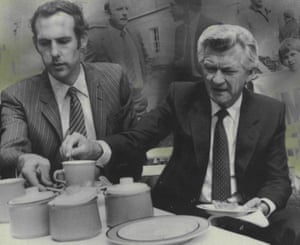
Bob Brown with Bob Hawke in February 1983
 Tea for two in one of Hobart’s parks: Bob Brown with Bob Hawke in February 1983, the month Hawke became Australia’s 23rd prime minister. Photograph: Fairfax Media via Getty Images

Bob Hawke was the environmental prime minister of Australia. His legacy includes Landcare and the listing of the Queensland’s Daintree wet tropics, Shark Bay in Western Australia, Uluru-Kata Tjuta in the Northern Territory, the Gondwana rainforests of the New South Wales-Queensland border region and large extensions to both the Northern Territory’s Kakadu and the Tasmanian wilderness world heritage areas.

The latter was in contention in 1989 after the “Whispering Bulldozer”, the Tasmanian Liberal premier Robin Gray, lost office to Labor’s Michael Field and myself, leading the five Greens holding the balance of power. We Greens negotiated the expansion of the Tasmanian wilderness world heritage area by more than 600,000 hectares to include such iconic wilderness as the Walls of Jerusalem, Central Plateau, Denison River Valley. At the end, Field had had enough and called a press conference to announce the outcome. I did not go.

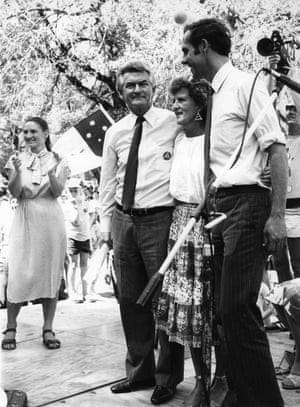
Bob and Hazel Hawke with Karen Alexander and Bob Hawke at the Franklin River protest in Melbourne
Pinterest
 Bob and Hazel Hawke with Karen Alexander and Bob Hawke at the Franklin River protest in Melbourne. Photograph: Ross Scott

Instead, I was on the phone to Hawke’s office arguing that the eastern end of Macquarie Harbour – some 40,000 hectares – should also be included. Hawke agreed so that most magnificent part of the harbour, including Kellys Basin, the mouth of the Gordon River and the convict ruins on Sarah Island, is, these days, a natural delight free of otherwise inevitable industrial fish farming, for hundreds of thousands of people catching cruises out of Strahan.

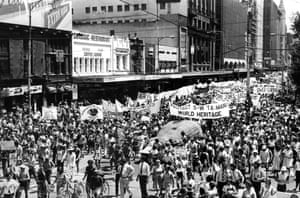
After taking over leadership of the Labor party before the election in 1983, Hawke committed to saving the Franklin River. The Wilderness Society’s peaceful blockade of Gray’s dam works threatening the river had seen thousands of people come to Strahan and more than 500 go to Risdon jail. In Melbourne, at a rally of 15,000 people, Hazel Hawke famously put on “No Dams” earrings and Bob made an ironclad commitment to stop the dam. On election night, 5 March, he made just one specific commitment: the dam would not go ahead but those affected would be duly compensated. He carried through on both promises.

One US outdoors company recently put the Franklin at the top of the world’s 10 most desirable whitewater rafting adventures. Had Hawke and Labor not won that election the river would now, instead, be a series of dead impoundments.

Hawke’s next masterstroke for the environment was to replace Barry Cohen, his first minister for the environment, with Graham Richardson. Never before or since has such a powerful figure on Australia’s political landscape held this portfolio. There could not be a greater contrast with the present minister, who has been absent from the 2019 election campaign.

The Melbourne rally
Pinterest
 ‘Hear the crowd roar’: the Melbourne rally. Photograph: Ross Scott

Richardson told environmentalists that if he was going to take action he needed to “hear the crowd roar”. So the late 1980s and early 1990s were perhaps the greatest period of public involvement and environmental advance in Australia. This was not without contention. Richardson faced a jeering anti-environmental mob at Ravenshoe in northern Queensland on the way to the Hawke government having the rainforests given world heritage status and protection.

In Tasmania, Richardson, working with Hawke’s office, made repeated visits to back that 1989 extension of the Tasmania wilderness world heritage area against mounting opposition from loggers and miners and the state government. They stopped the polluting Wesley Vale pulp mill project after a huge campaign led by a farmers’ daughter, Christine Milne.

Of course, Hawke did not please us all the time. He backed uranium mining and flirted with Ronald Reagan’s proposal to test MX missiles over the Pacific Ocean. He backed off on a treaty with Australia’s First Nations when the proposal came under fire from the Western Australia Labor premier Brian Burke.

A Hawke masterstroke was to accept the proposal of the Australian Conservation Foundation’s Phillip Toyne and the National Farmers’ Federation’s Rick Farley to set up Landcare. This became a beacon of global interest in government-funded repair of rural lands and rivers. That Landcare and general environment spending has been gutted in recent years highlights the loss of vision in Canberra since the great environmental innovation era Hawke ushered in.

Key to Hawke’s environmental success was his listening ear. He knew the Australian public was keen on protecting nature and he made himself open to direct liaison with environmental leaders. He was a tough negotiator but he and his staff opened an ear to the environment, which has been finally closed altogether by the Morrison government.

Richardson was the first environment minister to alert cabinet to the onrush of climate change. Decades later, at the 25th anniversary of the saving of the Franklin in Hobart in 2008, Hawke lambasted the Coalition’s lack of concern for the heating planet:

And as you look at the arguments and the positions of political parties today you see a complete replication of what we experienced back there in 1983. The conservatives: they never change, they never learn. What was their argument back then? You can’t do this, it will cost jobs. It will cost economic growth. You can’t do it, you mustn’t do it.

Hawke did it and, were he prime minster in 2019, I reckon the very unpopular Adani coalmine proposal would be headed for the bin.

With Paul Keating in the fray, Hawke joined the French government in leading the world – against Bush administration misgivings – to formulating the Madrid protocol which protects Antarctica from mining industrialisation.

Perhaps Thursday night’s Southern Aurora, visible across southern Tasmania, was nature’s accolade for the life of a natural champion.

 Our wide brown land: ‘We’ve hit rock bottom’ – video
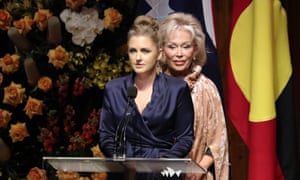
Sophie Taylor-Price and Blanche d’Alpuget

 Bob Hawke’s granddaughter Sophie Taylor-Price and his widow, Blanche d’Alpuget, at his memorial service in Sydney. Photograph: Mike Bowers/The Guardian

And this is what Sophie Taylor-Price had to say:

“I grew up in the shadow of a giant. All the reflections shared today reinforce that his greatness was one of a kind. However, his blood is my blood and his story has become part of my story. When I was four years old, I sat by my grandfather’s knee in 1989 when he addressed the nation on climate change. It is actually one of my first memories. Having spent my entire professional career working in climate change and sustainability, you could say that that night rubbed off on me.

However, it is only in recent years, with the passing of my nan and pop, that I’ve truly reflected on just how their values have shaped mine and what I carry forward.

Of all the things said about Bob these past weeks, there is one story that, to me, speaks to the legacy that is most relevant to the future of Australia. For both what was achieved and what is possible, in 1989, Bob was handed some cabinet papers, requesting Australia’s support to open Antarctica to mining. He was horrified. But he was told that years of international negotiations could not be unwound. It was a done deal. “Bugger that” he said.

Refusing to sign, Bob courted the world with an ideal for something greater, better and fairer. Enlisting global eco champion Jacques Cousteau, the Hawke/Keating government determined to set about changing the world’s mind, and they did.

In 1991 the Madrid protocol was executed, making the last great wilderness on earth a place devoted to peace and to science, protected from exploitation. Now, that is legacy.

To me, this tells the greatest of stories. It speaks of pop’s values of fairness and equality, and his love and his faith in the brotherhood of mankind. It speaks of true leadership and his willingness to be unpopular and to listen to unpopular truths. Thirty years ago I sat by his knee and he implored us to take action on climate.

These past months, he expressed such great sadness that we have failed to do so. He saw it as a collective failure of our nation that we have traded short-term interests over intergenerational equality.

He would say that the foundations of excuses we cling to are fragile and will inevitably collapse. We must stop delaying the cost of change now, for all we do is load our future citizens with a debt that they cannot repay. Let us listen to the children and young people who parade their courage and conviction, because their tomorrows will be affected by our actions today.

Many tributes have been shared today, but truly honouring my grandfather means reflecting on his achievements and applying his values to the future choices we make.

Let us take to heart his courage, borrow his optimism and mirror his love for the brotherhood of human kind.

In his twilight years, pop was a gruff old bugger at times. I imagine that if he were here today, he would look at me with love and with fierce pride and with a twinkle in his eye, say in his grumpy old man voice, ‘Well, get on with it then.’

So, that is my path. It was both his gift to me and my enduring tribute to his legacy.”


https://www.canberratimes.com.au/story/6218558/bob-hawkes-sadness-on-climate-failure/?cs=14231

 Bob Hawke’s granddaughter Sophie Taylor-Price says Australia has failed his environmental legacy.

Bob Hawke’s granddaughter has delivered a searing critique of Australia’s progress on tackling climate change while praising the former prime minister for his visionary work.

The former Labor leader’s many achievements were highlighted at a state memorial service in Sydney on Friday where granddaughter Sophie Taylor-Price argued his most relevant legacy was protecting the environment in the face of resistance.

Ms Taylor-Price said one of her earliest memories was when, as a four-year-old, she sat by her grandfather’s knee in 1989 as he addressed the nation on climate change.

“Having spent my entire professional career working in climate change and sustainability, you could say that that night rubbed off on me,” she told the Sydney Opera House audience.

That year, Mr Hawke was handed cabinet papers requesting support for opening up Antarctica to mining.

“He was horrified,” Ms Taylor-Price said on Friday.

“Bob courted the world with an ideal for something greater, better and fairer.”

Instead of signing off on the plan, the then prime minister set about changing the world’s mind, and in 1991 the Madrid protocol was executed and Antarctica was protected.

“Now, that is legacy,” his granddaughter said.

In contrast, current Australian leaders have failed to take action on climate change and Mr Hawke expressed disappointment regarding that fact before his death.

“He saw it as a collective failure of our nation that we have traded short-term interests over intergenerational equality,” Ms Taylor-Price said.

“He would say that the foundations of excuses we cling to are fragile and will inevitably collapse.”

To truly honour Mr Hawke would mean applying his values to “future choices”, she said.

Australian Associated Press

THE CUPBOARD WAS BARE!

Here is a copy of ‘THE CUPBOARD WAS BARE’ from the Political Sword. I really like to copy it for it speaks the truth about all the lies, the truth that I reckon was and is very easy to detect; instead a majority of voters could not help themselves but decided to believe all the lies. Did their instincts tell them that it was important to believe all these lies?  

Here is a comment by ‘DoodlePoodle’ to this ad astra blog. This comment was written on the day of the election: 

DoodlePoodle

18/05/2019

“You can fool all the people some of the time, and some of the people all the time, but you cannot fool all the people all the time. Abraham Lincoln”

“So many gullible people but hopefully enough not so gullible people who will vote for Labor and change the government.”

Election Day was on the 18th of May. By the end of the day we knew already that a majority of voters had been voting for the Coalition, not for Labor and Bill Shorten. So our hope is now that you cannot fool all the people all the time. I wonder, is it going to show by the next election that you cannot fool the majority of people all the time? In the meantime we have to cope with a very right leaning government. I fear there may be quite scary times ahead. I hope, the opposition in parliament will do their utmost to preserve some kind of democracy.

Now, here you can get into the ‘nerve centre of the LNP’:

http://www.thepoliticalsword.com/posts.aspx?postid=30087b68-c709-4e14-90ad-cd2f606f0049

It wasn’t easy getting into the nerve centre of the LNP – the secret place where talking points, election strategies and day to day tactics are brainstormed by the Coalition’s eggheads in the dead of night – but eventually, more by good luck than good management, I found myself in the inner sanctum.

The secrets of the LNP were stored there, not in neatly labeled fling cabinets, or cleverly organized computer files, such as would befit a modern, forward-looking political party. Instead, they were stored in a wooden cupboard, like those that once graced the kitchens of our grandmothers. Its surface bore that worn, ‘distressed’ look that now appeals to upmarket millennials. It was surrounded by an untidy mess: kitchen paraphernalia, a few bottles of wine in a basket and a tatty rack, and a couple of barrels, presumably left over from a late night drinking session.

Surprised as I was, I reasoned that such an ancient cupboard at least did capture the image of a well-established organisation with a rich history extending back many decades. But it did seem strange that such an old-fashioned object could be the repository for the Coalition’s visions, secrets, plans, and tactics. But who was I to judge?

Intrigued, I began exploring, pulling out drawers and opening doors via knobs worn smooth by continual use. I was surprised there were no visible labels, but soon discovered that they were inside, scribbled on bits of paper browning around the edges with the telling signs of age.

In a top drawer, written with blue Texta on half a page of yellowing newspaper, I found a telling label: ‘Good Slogans’. Underneath I found a rich lode. Scribbled with crayon on a large piece of Butchers Paper, I found:

In another corner of this drawer I found a battered Bushells Tea Tin. On the lid, scrawled in red Texta, I read: ‘Great Anti-Shorten Slogans’.

Inside were scraps of paper, a motley collection of what the Coalition regards as telling zingers, recognizable to us all through repeated use:

I marvelled at how much effort had been put into these anti-Labor and anti-Shorten slogans. They looked like a schoolchild’s first project, with words scratched out and over-written. Many hours of thought must have gone into refining them. No doubt the authors were proud of their efforts.

I looked for, and eventually found a tin labeled: ‘Pro-Coalition Slogans’, but was surprised how small it was. I looked inside and was even more surprised at how few slogans promoted the virtues of a Coalition government. Apart from the boast of its economic superiority and its sterling record of managing the economy and creating jobs, there was little else. I though that surely there must be more to crow about after all the years the Coalition has been in power?

What about an energy policy? In one compartment, I was excited to find a piece of paper with ‘Energy’ scribbled on it. Alongside it there were several scraps of paper. Filled with expectation I looked though them. All had been screwed up, all had different dates, all had the same word scrawled on them: NEG. I looked around for one with a recent date, but all the dates were old.

With more hope than expectation, I looked in the next compartment eager to find something on climate policy. I was astonished. In a large rusting biscuit tin I found a collection of what looked like climate change notes. They were in Tony Abbott’s handwriting: “Climate science is crap.”, “Climate change is a relatively new political issue, but it’s been happening since the earth’s beginning.”, “I am hugely unconvinced by the so-called settled science on climate change. I just think that the science is highly contentious, to say the least.”, “The climate has changed over the eons and we know from history, at the time of Julius Caesar and Jesus of Nazareth the climate was considerably warmer than it is now.”, “Are we proposing to put at risk our manufacturing industry, to penalise struggling families, to make a tough situation worse for millions of households right around Australia. And for what? To make not a scrap of difference to the environment any time in the next 1000 years.”, “Climate change happens all the time and it is not man that drives those climate changes back in history. It is an open question how much the climate changes today and what role man plays.” The notes were well fingered. No doubt they had been a rich source of inspiration and quotable quotes for his climate denier mates.

Since it has become such a hot political issue, made all the more so since the election was called, with urgent action on climate change now supported by a majority of electors and most stridently by young people, who see their planetary home disintegrating before their eyes, I looked through the other scraps of paper for the Coalition’s thoughts on climate change. There were a few scrawled in what looked like Morrison’s hand: “We’re taking positive action on climate change through Direct Action”, “We’ll meet our emissions targets in a canter”, “We’ll meet our Kyoto 20 and 30 targets”. “Emissions are falling”. I looked then for the newspaper clipping of his recent concession that emissions in fact are not falling, searching for his actual words: that emissions ‘had lifted’. I couldn’t find it.

Climate change action seemed a low priority. There were though bits of paper with “Coal will be a part of our energy mix for many years”. “Coal will remain a major export commodity”. There was even a photo of our PM fondling a piece of coal in parliament telling us not to be afraid of it!

I got the impression that there was nothing more to find about climate change action.

Tiring, I looked around for a compartment that might give me a picture of what the Coalition thought about this nation’s future, apart from its mantras about a strong economy, and more jobs and growth. How did they see our nation developing? What future did they envisage for our people. What could they promise our young folk? Surely any plans the Coalition had must be based on its vision of our future.

I was becoming desperate. I looked and looked for a compartment labelled ‘Vision’. There must be one somewhere. Eventually, I found a small door, stuck closed and festooned with cobwebs. I managed to prise it open with a screwdriver that I found in the cutlery drawer. Inside, I was delighted to find a faded, dog-eared label: ‘Vision’.

I fossicked around expectantly looking for the Coalition’s Vision for our Nation. I explored every nook and cranny. Surely there must be something that would reveal its shining dream!

The compartment was empty.

If the Coalition hadn’t got a vision, surely they must have some plans, some new policies for the next three years. Having listened to the Coalition launch, where Morrison boasted that he had ‘a plan’ for everything, I expected to find a bundle of plans stashed away somewhere. So I looked for a receptacle labelled ‘Policies and Plans’. Eventually I found a small tin. In it there were a few dog-eared bits of paper. On them were written “economy strong”, “jobs growing”, “revenue solid”, “sponsors happy”, “everything’s fine”, and a fresh piece with “surplus coming” on it.” Then on a large piece initialled ‘SM” was written in capitals: “IF YOU HAVE A GO, YOU’LL GET A GO”, “BUILDING OUR ECONOMY, SECURING OUR FUTURE”, “WE BROUGHT THE BUDGET BACK TO SURPLUS NEXT YEAR”, “THERE’S MORE TO DO. NOW IS NOT THE TIME TO TURN BACK”, “YOU CAN’T TRUST BILL SHORTEN”, “LABOR CAN’T MANAGE MONEY”, “THIS ELECTION IS NOT A HOOPLA EVENT”, “I DO NOT BELIEVE THAT GAY PEOPLE GO TO HELL”, “I’M NOT RUNNING FOR THE POPE, I’M RUNNING FOR PRIME MINISTER”, “I WILL CONTROL COALITION POLICY DIRECTION”, and last of all, his coup de grâce: “IT IS MY VISON FOR THIS COUNTRY AS YOUR PRIME MINISTER TO KEEP THE PROMISE OF AUSTRALIA TO ALL AUSTRALIANS”.

Was that all the Coalition has planned for the years ahead?

Frustrated, I looked again for clues, any clues, that might spell out the Coalition’s story, its vision and its intentions for the next three years. I ransacked the entire cupboard looking for more than the few scraps of paper that I had already found.

The cupboard was bare!


Cape Preston

What do Australians know about Cape Preston? Honestly what do we know about it? I googled it and found this:

https://en.wikipedia.org/wiki/Cape_Preston

.  .  .  .

During the mid-late 1960s, Cape Preston was considered as a possible location for an iron ore outport.[7][8][9] A similar plan was ultimately realised in 2012, and iron ore exports commenced in 2013.

Sino Iron Project

Resources company Austeel was granted permission to build an iron ore operation in the area in 2003 following environmental approval being given by then minister Judy Edwards. Construction of the operation was to commence in late 2004.[10]

A contract was awarded to develop the mine to a Chinese company, China Metallurgical Group Corp, in 2007. The project was estimated to cost $1.98 billion, including a magnetite mine, a seawater desalination plant, a thermal power plant and port facilities.[11]

.  .  .  .

As of 2016, the project is owned by Hong Kong-based CITIC Limited and according to the company represents “one of China’s largest investments into the Australian resources sector”.  .  .  .

<!–more–>

The tiny Town behind a heartwarming 9/11 Tale

https://www.smh.com.au/world/north-america/the-tiny-town-behind-a-heartwarming-9-11-tale-20190326-p517pe.html

This is a real feel good story!!

“The tiny town behind a heartwarming 9/11 tale When dozens of planes were forced to land in a tiny Canadian town after the 9/11 attacks, locals billeted thousands of stranded travellers.”

https://www.usatoday.com/story/news/nation/2017/09/08/gander-newfoundland-september-11-terror-attacks-kindess-come-from-away/631329001/

https://www.northjersey.com/videos/news/new-jersey/2018/09/06/documentary-story-gander-newfoundland-9-11/1210974002/


Fibershed

https://www.fibershed.com/about/

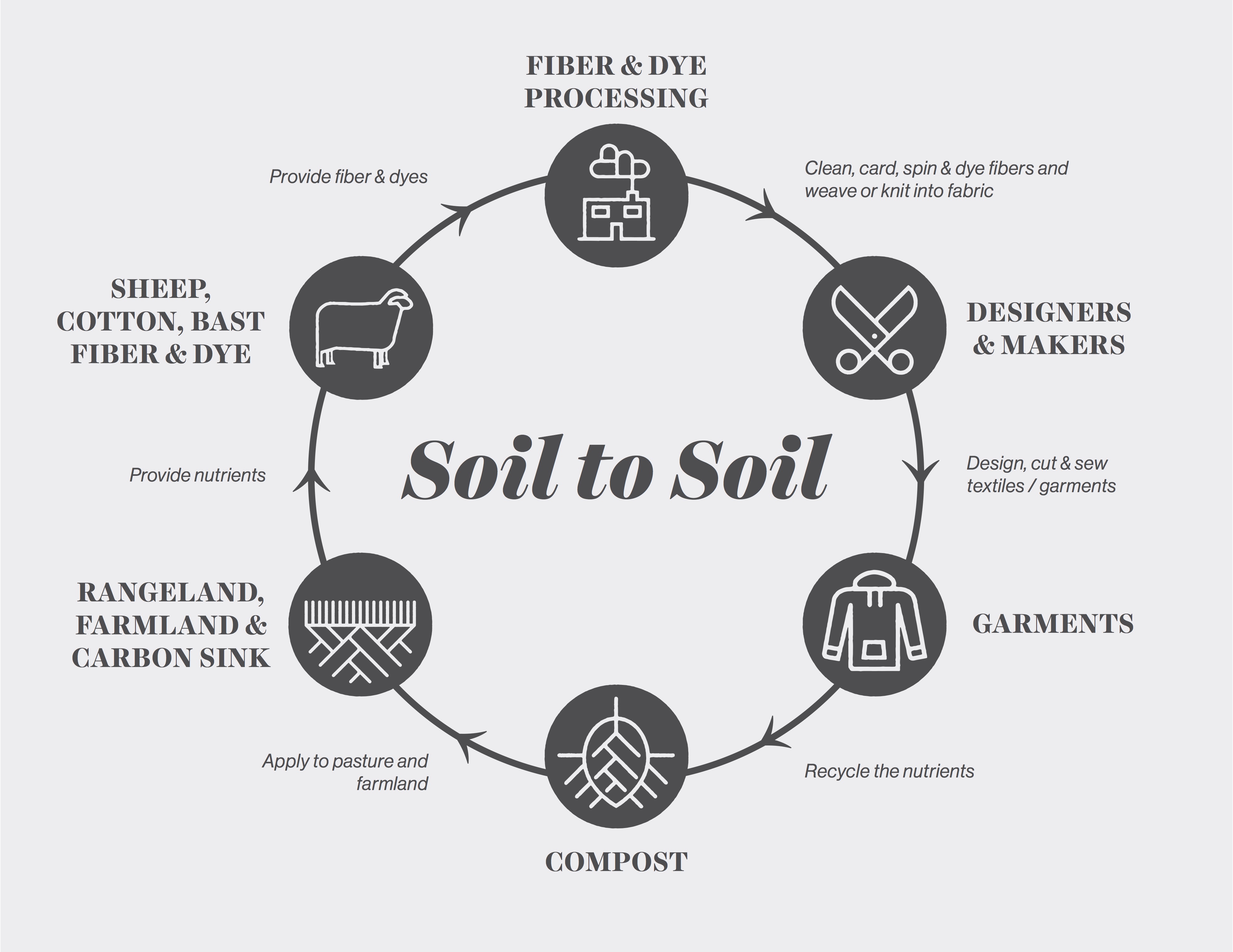
Fibershed develops regional and regenerative fiber systems on behalf of independent working producers, by expanding opportunities to implement carbon farming, forming catalytic foundations to rebuild regional manufacturing, and through connecting end-users to farms and ranches through public education.

We envision the emergence of an international system of regional textile communities that enliven connection and ownership of ‘soil-to-soil’ textile processes. These diverse textile cultures are designed to build soil carbon stocks on the working landscapes on which they depend, while directly enhancing the strength of regional economies. Both fiber and food systems now face a drastically changing climate, and must utilize the best of time-honored knowledge and available science for their long-term ability to thrive.

As each Fibershed community manages their resources to create permanent and lasting systems of production, these efforts to take full responsibility for a garment’s lifecycle will diminish pressure on highly polluted and ecologically undermined areas of the world. (China produces 52% of the world’s textiles. The industry is the third largest fresh water polluter in the country.) Future Fibershed communities will rely upon renewable energy powered mills that will exist in close proximity to where the fibers are grown. Through strategic grazing, conservation tillage, and a host of scientifically vetted soil carbon enhancing practices, our supply chains will create ‘climate beneficial’ clothing that will become the new standard in a world looking to rapidly mitigate the effects of climate change. We see a nourishing tradition emerging that connects the wearer to the local field where the clothes were grown, building a system that can last for countless generations into the future.

How did the Fibershed project start?

The project began in 2010 with a commitment by its founder, Rebecca Burgess, to develop and wear a prototype wardrobe whose dyes, fibers and labor were sourced from a region no larger than 150 miles from the project’s headquarters. Burgess had no expected outcomes from the personal challenge other than to reduce her own ecological footprint and maybe inspire a few others.

Burgess teamed up with a talented group of farmers and artisans to build the wardrobe by hand, as manufacturing equipment had all been lost from the landscape more than 20 years ago. The goal was to illuminate that regionally grown fibers, natural dyes, and local talent was still in great enough existence to provide this most basic human necessity—our clothes.  Within months, the project became a movement, and the word Fibershed and the working concept behind it spread to regions across the globe. Burgess founded Fibershed’s 501c3 to address and educate the public on the environmental, economic and social benefits of de-centralizing the textile supply chain.