What’s the Biggest Determinant for Living a Long and Healthy Life?
Centenarian Secrets on Longevity
Aug 11, 2022 The Rich Roll PodcastMike Fremont is a 100-year-old who holds many world records, including the fastest recorded marathon for a 91-year-old; at 96, he set the American one-mile record for his age group, and at 99, he raced the Canoe National USCA Championships. Now 100, he has no intention of stopping. I’m proud to share his story with you. For more on Mike, go here👉🏾http://bit.ly/richroll697 ✌🏼🌱 – Rich
Most of the time I am in love with myself now. To embrace myself, I do cross my arms in front of me!
I feel, right now this is for me a pretty good state to be in. 🙂
The Excitement of falling in Love:
I do have good memories how exciting it is to fall in love with another person! Even platonic love can at times be emotionally very exciting and beautiful! It may come to an end and require an acceptence of the ending without regret! For nothing stays the same forever. We change, life changes us. However, when you have a love that lasts throughout your life despite all the changes, that is bliss! 🙂
There were a few years when my husband and I had major difficulties in our sexual relationship, and in communicating about it in a satisfactory way. So, we lived very much apart but under the same roof! Despite these marriage problems, we were always able to remain friends. Whenever I was inclined to fall in love with another desirable man, of course this relationship had to stay absolutely platonic. And my husband knew, that he could trust me and never acted jealous, except that with a few remarks he would show me sometimes, that he did not like me to become too close to a certain attractive person I felt drawn to. I feel, he did stay friendly with anyone who became my close friend. Really, it so happened, that I never did fall in love with a complete stranger, that is, it was always someone who was known to the whole family! 🙂
Also, I was very familiar with the women that Peter liked to be with. He usually liked the company of women, or some mixed company. However, I think he was a bit unsure of himself, and did not feel like he wanted to try out whether another woman loved him as a sex partner. So, as far as I am concerned, we never became a so called ‘open’ marriage in a sexual sense.
As far as our children are concerned, I often marvelled at the close relationship Peter had with all our children. That means, he had a very good relationship with our three daughters as well as our son! – A few years after all our children had left home, Peter and I became very close partners again. We had many good years of retirement together with lots of travelling. Life was so good! 🙂
Nearly two years ago, Peter died of bone cancer. I thought, I had been well prepared for his departure. But not so. You can never be prepared for the departure of someone you have known for more than 65 years and lived with for close to 64 years! I never imagined that missing Peter could become worse and worse with time, and kind of all consuming. So it was really important, that I started somehow to fall in love with myself! Now life, whatever is left of it, is getting better and better again . . .
auntyutafreefall852Here, Joe, is what I wrote as a comment to that post of yours:May 25, 2022 at 8:55 pm I cannot imagine how I could still feel alive if I didn’t still have a desire for the opposite sex. Whether I act on it or have an opportunity to act on it, that is another matter. If I cannot act on it for whatever reason, I can still keep the desire going, just by imagining it and maybe write about it, whereas artful people would express it in their art. There are paintings, there is music, there are books to keep the desire alive. I cannot imagine not being touched anymore by a special kind of music for as long as I am alive!Reply2
The Real-Life Philomena: ‘You See So Much Hurt Caused by Anger’
Forced to give up her child for adoption as a teenager, the woman who inspired the Oscar-nominated film starring Judi Dench talks about forgiveness and keeping her faith.By Nolan Feeney
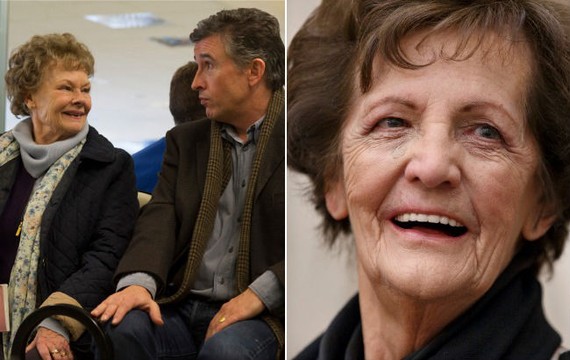
Left: Judi Dench and Steve Coogan in Philomena. Right: Philomena Lee. (The Weinstein Company; AP)
For decades, Philomena Lee didn’t think there was anything interesting about her life story.
After becoming pregnant out of wedlock in Ireland in 1951, a teenage Lee was disowned by her father and sent to live and work in a convent alongside other unmarried mothers. When her son Anthony was three years old, the convent’s nuns, in exchange for a generous donation, gave him up for adoption to Americans, who were told he was an orphan. A distraught Lee watched from an upstairs window as strangers drove off with her child.
For the next 50 years, Lee told nobody about Anthony. That’s just how life went for sinners in the Catholic Church, she thought.
But one day, she told her secret to her daughter, Jane Libberton, who quickly began the search for Lee’s long-lost child. It wasn’t easy: Irish law makes it extremely difficult for adopted children to learn about their parents and birth records, and the nuns at the convent where Lee lived stonewalled her requests for information. Eventually, Libberton pieced together the identity of Anthony: Renamed Michael Hess by his American parents, he’d grown up to be a top attorney for the Republican National Committee.
By the time Lee and Libberton solved the mystery, however, they were too late: Hess had died of AIDS in 1995. His ashes had been buried at the the convent at Hess’s request—he hoped that his mother would return and find him. Just as the nuns wouldn’t give Lee and Libberton any answers about what happened to Anthony, Hess himself had journeyed to Ireland to ask about his mother—with no luck.
Acclaim and Oscar nominations for Philomena, based off journalist Martin Sixsmith’s book, The Lost Child of Philomena Lee, have brought international attention to the stories of Lee and the thousands of women just like her. Last month, Lee partnered with the Adoption Rights Alliance to launch The Philomena Project, which will advocate for changes to Ireland’s adoption-records policies and help connect mothers and children separated by the country’s history of forced adoptions. In late January, Lee, Libberton, and Mari Steed, U.S. coordinator of the ARA, traveled to Washington D.C. to meet with senators and diplomats about the project, and they spoke to The Atlantic about the film, faith, and forgiveness.
When you started your journey a decade ago, did you ever think it would bring you to Washington?
Philomena: No way whatsoever.
Jane: When mom first met Martin, she didn’t even really want it to be a book, did you? You didn’t really want the story.
Philomena: Oh no. When I told my daughter after 50 years, I said, “No, I can’t.” Because I kept it a secret so long. No way. So then I just decided, well, look, if it can help a lot of mothers my age, I’m nearly 80—
Jane: You are 80!
Philomena: We were ostracized in them days because we had babies out of wedlock, because that was a very awful thing to do. Women my age kept it a secret and wouldn’t tell their families. A lot of the babies born, their offspring, they’re now looking for them. A lot of ladies my age still haven’t come out to say it. So many people responded to the film, and a lot of them actually were women like me coming out. People like Mari and her colleagues have been trying for years to get the government in Ireland to give people rights to their records.
Is the project more about helping adopted children here connect with parents in Ireland, or about putting pressure on Ireland to change its policies?
Mari: Both. Some of the senators and congressmen we met are from the states where a lot of the babies were placed to—in Anthony’s case, Missouri—so we met with Senators Roy Blunt and Claire McCaskill. Somebody might go to their local representatives and say, “I was born in Ireland and am a citizen here, what do I do?”
Likewise, we met the Irish ambassador [Anne Anderson] and it’s the same thing. “If one of our citizens should happen to come to the Irish Embassy or call one of the consulates, would you be able to give them these resources and point us in the right direction?” We don’t want to do any hard-hitting political lobbying, but we would like them to lend their voices and their support if at all possible. I think the response was very positive.
Jane: It was very positive! Obviously my mom and I have no experience of being here in Washington and meeting senators, that’s like—
Philomena: Wow-wee!
Jane: We had no idea what to expect. Each and every one was different, but very positive. We felt like we were following in Anthony’s footsteps because he worked in these buildings.
That must have been special.
Philomena: Very much so. This was his world.
Activists have said you’d need to drag Ireland to the United Nations to see these changes happen. Have you had more success going the political route than through the Church?“We’re just telling the truth of what happened. It was never, ever from the start meant to be an attack on the Church.”
Mari: Absolutely. With the Church, you really will get nowhere. I’m not saying that’s a negative or a positive. That’s simply what it is. They’re not going to change their mind or suddenly change their policies. And not only that, but all of the records, as of this year, have finally been transferred out from under the ownership of Church agents and are now under the government’s Health Service Executive in Ireland, so we’ve almost removed the Church from the picture, at least as far as the records are concerned. But I think eventually it may take a UN case similar to the Magdalenes cause in Ireland. We’ve got the right players, we’ve got people affiliated with the project. If we have to go that route, we will.
Have the ways the Catholic Church has changed in the past several decades made it any easier?
Mari: Yeah, not really. Their attitudes really haven’t changed.
Jane: In Ireland.
Mari: Yeah, absolutely not in Ireland. Here in the States, we tend to get a lot more encouragement and sympathy. In Ireland, it’s still this stubborn willfulness. They’d rather stay silent and take the bad press than issue apologies, because they know that will open them up to legal liabilities.
Jane: My mom still very much has her faith and is still quite protective of the Church, so you find it a bit awkward sometimes.
Philomena: Sometimes. You just believed everything you were told. You didn’t query it, you just didn’t query it. People would say, “Are you against the Catholic Church?” No, I’m not. At the time they did it, they took me in, they gave me a home for my baby. They gave us a home. It was the Church that caused all the problems because the Church made a baby out of wedlock a mortal sin. So we firmly believed we were sinners. That’s the teaching of the Church.
Were you worried people would take an anti-Catholic message away from the movie?
Jane: I don’t think we even thought about the Catholic stance at all, this is just my mom’s story and what happened to her. Obviously people have come out and said, “This is an anti-Catholic film.” It was never intended to be. This is what happened.”People can’t understand how I could have been so forgiving.”
Philomena: No! It’s my story.
Jane: There are other Catholic groups that are in support of it, [saying] that it isn’t an anti-Catholic film because she retains her faith all the way through it. We’re just telling the truth of what happened. It was never, ever from the start meant to be an attack on the Church. Steve Coogan [who plays Martin Sixsmith] says the same thing. He’s from an Irish-Catholic family. He spent a lot of time with women my mom’s age when he was a child. He never set out at all to make an anti-Catholic film. It’s just different people who have different views. As mom said, yes, they did take her in. Where else would she have gone? But they kind of caused the problem in the first place. They were part of the solution, but they were part of the problem.
Did you feel surprised that so many people found your commitment to your faith inspiring?
Philomena: We did, actually. People can’t understand how I could have been so forgiving. But I mean, Anthony would have been 61 last year. When he was adopted and taken away, I went to Liverpool, two years I stayed there, and then I went down and did psychiatric nursing for 30 years. Now, you don’t work in a psychiatric hospital and not see some awful, sad faces. You see so much hurt and pain caused by anger. I was angry in the beginning, and I used to think, why did this happen to me? And then nursing the patients, sitting down and talking with them, helping them with their problems—it made my own slide into the background. I’ve seen so much hurt caused through anger. And I thought, “I couldn’t go through my whole life being angry.” It’s just not in my nature to be angry. I was upset and very sad and very hurt. But I just went on with life and got married and had children. Working with psychiatric patients, it helped me to heal a lot of the pain I had.
One of the most powerful scenes in the movie is the moment of forgiveness near the end. Steve Coogan, as Martin, seems confused by it, asking, “Just like that?” But Judi Dench, as you, says it actually takes everything inside you to forgive.
Philomena: When my daughter first found out about this story, she was very angry, and I think Steve Coogan took on her anger.
Jane: Martin was a political journalist, and he wasn’t particularly angry. He’s seen all sort of things in his career. Steve asked a particular question of whether you forgive the nuns, and you did. I said, “I don’t,” so he took the anger and put it in his character. Martin wasn’t an angry character, he was a journalist.
Were the nuns as big of an obstacle in learning about Anthony as they appeared in the movie?
Jane: When we went the first time, they didn’t help. They were very pleasant very nice.
Philomena: Lovely.
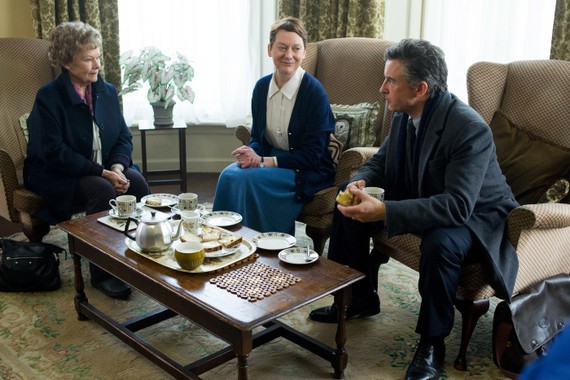
Jane: We sat down to tea like this. We knew Anthony’s grave was there. But they didn’t give us any information about the American side of things. When we went back the second year, I’d said we found Anthony’s partner and we found Mary, who was adopted with Anthony, and then they went to the cupboard and gave me papers they could have given me before. Without those papers, there never would have been a book. They just weren’t helpful.”We were ostracized so much. We had to lose our identities. I wasn’t Philomena Lee anymore. I got a name called Marcella. For three and a half years, I was Marcella.”
Did they not fully understand?
Jane: Oh, they understood. [The character] Sister Margaret was [based off] the present-day nun we met with Martin. She was delightful. She’s English like I am, so she knew where I was coming from, because in the United Kingdom, at 18 years old, you can find out your history if you’re adopted. In Ireland, you can’t. I didn’t get angry with her. I was angry, but I didn’t shout out her like Steve Coogan shouts at Sister Hildegard [in the movie]. She knew exactly what I meant when I said, “To me, what you’re doing is completely wrong.” She did sit there kind of stony-faced. She was in the position where she felt she couldn’t give me the information because that’s what she’d been taught by the Church. And we’re only talking about seven years ago. It wasn’t a long time ago.
The Weinstein Company
Did you have a sense of how widespread this was?
Philomena: You mean everybody having babies? Women having babies?
The forced adoptions across the country, I mean.
Philomena: I was a teenager at the time. I didn’t know anything about that. I didn’t know about babies being gone abroad and getting donations for them. I didn’t know the first thing about that. How would we know? The nuns wouldn’t tell you. We were Catholic, we went to church, we went to mass, that’s all we did. I worked in the laundry for three and a half years.
Mari: There were many Irish families who might have had a mother and baby home just up the road and didn’t even know it. They just knew it was the nuns who ran their business. Nobody really knew what went on behind the walls or dared ask. I think they had an inkling, it just wasn’t discussed.
Philomena: And often the mother’s parents were glad to get rid of you, because it was such a shame on them. We were ostracized so much. We had to lose our identities. I wasn’t Philomena Lee anymore. I got a name called Marcella. For three and a half years, I was Marcella. Some of the women now come forward and say, “Did you remember me when I was there?” I wouldn’t have remembered them because they’d have another name. From the day I went in till the day I came out I was Marcella, not Philomena Lee.”And the whole of my life, all I wanted was to find him. Finding out he was dead was very hard, but at least I found him.”
Tell me about the first time you told Jane about Anthony.
Philomena: I go home to Ireland every year. I call it home still even though I’ve lived 56 years in England. My brother, he was a young lad. He was 18 months older than me when I went to the home. He drove me when they discovered I was pregnant. He bounced him on his knees and hugged him and loved him. My father was out signing papers with the nuns—in them days you didn’t query what they were doing—and my brother was out with me in the halls. For years he felt so guilty. “I should have run away with him.” But with the police, the guards, we call them guards in Ireland, [he] wouldn’t have gotten away with it. I went home in 2003, was it? He said, “For goodness’ sake, go back home and tell them.” My son is older than Jane. I went home and sat them down and told them.
Jane: Well, you told me. You came out to see me. I’d just moved house and renovated it. And my mom, you’d [just] been to Ireland, and you said, “Oh, I’ll pop around and see you.” It was slightly unusual because we normally meet in the day, and you were feigning interest in my decor. I just had some new light switches. I remember it very clearly. You looked at them said, “They’re very nice.” You’re not really into that kind of thing.
Philomena: Not decorating, no.
Jane: So she sat down, and we did open a bottle of wine, and she just came out with it. “I had a baby in Ireland,” I think is what you said. But immediately I knew who this child was because we always had his photograph in with all the other family photos. He always looked like he was in an odd place because he’s got nuns with him, or he looks like he’s in a hospital. I had asked you once when I was a child, and you said it was a cousin’s son, and I didn’t think anything more of that. But I felt immediately sorry for her, because I’ve got children, and he was three and a half when he was adopted. I couldn’t imagine having to give a child away at that age. It would just be awful.
Philomena: Awful, awful.
Jane: Clearly you would have bonded with him because they’re little people at that age.
Philomena: He was a lovely, lovely little boy.
What was it like seeing the movie for the first time?
Philomena: We didn’t know what to make of it, did we? We saw it together.
Jane: It was very hard to judge whether it was good or not because we’d been so involved in it. We met the next day at lunch and I said, “I think it’s okay? I think we’ll be alright with this film.” But we couldn’t tell. People asked me if it was good and I said, “I don’t know. I couldn’t tell you if it was good.”
Philomena: We couldn’t!
Jane: It took a couple viewings. Then it went to the Venice Film Festival and received such fantastic reviews. I started reading the reviews to mom, and we could see why people liked it. But it took other people to point us in the right direction.
But you’ve come to enjoy it?
Jane: Yes, we certainly laughed.
Philomena: Oh yes, it’s very funny.
Jane: Life’s not all doom and gloom.
It was already such a tough, emotional movie to watch, it would have been a lot harder without those funnier moments.
Philomena: The thing is, I found him. And the whole of my life, all I wanted was to find him. Finding out he was dead was very hard, but at least I found him. I used to think over the years he could be in Vietnam, he could be on Skid Row. It’s the not knowing. But once I found out how successful he was, then I was able to put my heart to rest and my mind to rest. At least he had a very good life and a wonderful partner. And I’m sure, up there, he helped me to start this 10 years ago. I believe that.
Mari: He’d be so pleased.
Jane: I think he’d be pleased, being a political man.
Philomena: I’m sure he is. The thing is, I’m sure because about one year [before finding him], maybe less than that, I started going back to mass. I had given up going to mass and communion and confession. Somehow or another I said, “I think I’ll start going back.” I went to mass at the beautiful abbey near where we lived. They had a Catholic mass every Friday morning. I joined that and got back in there, and I’d go down and light my candle in this beautiful place. Somehow after this, my brother said to me, “Will you go back home and tell your daughter?” after I started [getting that] feeling. I’m sure Anthony was up there.
Nolan Feeney is a former producer for TheAtlantic.com.
It is our tradition, to celebrate Christmas with all the family on Christmas Eve! So, all my family want to come this year to my place again! We are usually more than 16 people for this kind of get-togethers! This is including four of my great-grandchildren aged 2, 5, 7 and 9! I have two more great-grandchildren in Victoria. Unfortunately I have not seen these for quite a while. – – – Sadly, it is going to be the second Christmas without Peter. – – –
Secret Santa will be coming again this year. So, everyone gets only one present! However, I am sure there is going to be some very special nice food provided once more due to the combined effort of several women. I am probably going to make some potato salad again. A lot of people do like my salad! I sometimes used to add some herring to the salad! 🙂
And of course people bring along beer, wine and maybe some liquor as well as a variety of soft drinks. (Mark is in the habit of drinking only Coca Cola when he knows, that he has to be driving home again.)
Our other custom at Christmas time is to make ‘Bunte Teller’ with Pfefferkuchen (gingerbread), nuts, special fruit and some sweets like for instance marzipan sweets and chocolates.
I hope the weather is going to be fine, so that we can stay outside a lot and make good use of the new deck and to be outside in the open a lot of the time.
Maybe some people are going to stay overnight again, that would mean, we could be able to cheer with plenty of nice drinks!
All the outside area on the three different sections of the house have been made usable recently. So there is plenty of room for people to spread out a bit. There are even two ramps for my rollator! Colourful electric lights have been installed, and there are also about half a dozen solar lights spread out over the ground as well as some new electric flash lights!
I hope, my son Martin will be able to come from Victoria, and that this time the borders are going to stay open. Martin told me, that he can stay only for a couple of nights, but that I am welcome to go back with him and his dog Millie to his place in Benalla.
I am looking forward to spend some great holidays in Benalla!
Auntie, Sister. Grandmother, Great-Grandmother, Mother and Wife of German Descent I’ve lived in Australia since 1959 together with my husband Peter. We have four children, eight grandchildren and two great-grandchildren. I started blogging because I wanted to publish some of my childhood memories. I am blogging now also some of my other memories. I like to publish some photos too as well as a little bit of a diary from the present time. Occasionally I publish a story with a bit of fiction in it. Peter, my husband, is publishing some of his stories under berlioz1935.wordpress.com View all posts by auntyuta
YAY! This all sounds wonderful, SweetUta! Enjoy your family, the celebrations, especially the love. I know Peter will be with you in thought, spirit, and heart. He will be smiling. I’d love to know your potato salad recipe if you care to share it. I make a good potato salad but I’m always open to learning a new way. (((HUGS))) Reply
Carolyn, I think it is a good idea to make the potato salad a day before you want to use it. Before I serve it the next day, I make sure to taste it first to find out whether it needs some extra ingredients. For instance, it is possible that it does need a bit of extra salt and also some extra vinegar. People usually like it, when it is sufficiently sour! When I make the salad, I like to add a lot of finely diced onions to the potato pieces, as well as small pieces of pickled or sour cucumbers. And I find, if I happen to have some nice sweet apples, it improves the salad to add finely cut apple pieces! Also a little bit of mustard can make the salad a bit more spicy. Of course, I start making the salad with a large amount of boiled and sliced, cooled down pieces of potato. (I take the skin off after I boiled the potatoes!) As soon as all the potatoes are diced, I add pepper, salt and olive oil plus the mayonnaise and also a bit of vinegar. All the other things that I mentioned are optional. Peter always liked my potato salad too. Stay safe, dear Carolyn, Hugs from Uta
Yes, that makes sense. Potato Salad is great day of, but, also, tastes even better in the days after…the leftovers. (If there are any! Ha!) I add all of the things you do…but I’ve never thought of apples! I love this idea! I shall try it! Thank you for sharing this idea! I appreciate it! (((HUGS)))
And you can add herring!! Ha
DebraEditI do hope the travel restrictions will be very light, and that you will have your wonderful family tradition on the 24th. God bless you, Uta.Reply
auntyutaEditYes, dear Debra, we all hope there won’t be any travel restrictions. And I am so happy, that this time we will be able to mainly celebrate outside. This should make it much safer to have so many people around. We still don’t know, how this new variant of the Coronavirus might effect us. So, I send you hugs from the Australian summer! Stay safe, Debra, and enjoy your Christmas as much as possible. Love, Uta
ABC’s Classic Choir premieres “Oh Christmas Tree (Yerrbill with Clarence)” with lyrics by Gardening Australia’s Clarence Slockee and orchestrated by Joseph Twist, a new song commissioned especially for ABC Classic’s virtual choir.
ABC Classic Choir with Gardening Australia Oh Christmas Tree (Yerrbill with Clarence) Lyrics: Clarence Slockee Arrangement: Joe Twist Welcome – Jingi Walla Jingi Walla Kgarool Banaam Welcome/Hello All Together Brother(s) Bundjalung Jingi Walla Kgarool Nanung Welcome/Hello All Together Sister(s) Jingi Walla Bugalweena Welcome/Hello Good Health Bundjalung Burrinah Born of → Bundjalung VERSE 1 Bundjalung Yerrbilehla Yerrbilehla Singing Singing Minyunbal Nganduwal Minyunbal Nganduwal language Yerrbill Bundjalung Yerrbill Bundjalung Sing Bundjalung Sing Bundjalung Minyunbal Nganduwal Minyunbal Nganduwal language Bidjung Wudjung Nanung Baanam Father Mother Sister Brother Kgarool Bugalweena All together Good Health Junguli Jala Jala Eat Food – lots of different food Bunbar Waywani Beach Waywani VERSE 2 Bundjalung Let’s sing as one, in Bundjalung Bundjalung – mob and language from Northern coastal NSW Language Minyunbal Nganduwal Minyunbal Nganduwal – Clarence’s dialect of Bundjalung Yerrbilehla, we are singing Yerrbilehla – singing In one of our first languages So many words for family Good health to all from you and me All together, eat different food Swim at the beach, love all we see VERSE 3 Larrakia and Kuku Yalanji At Christmas time, across the land It’s heating up it’s summer time The seasons that have linked us all For so long are so much more Larrakia Country in the Northern Territory In Larrakia, it’s Balnba Balnba – Rainy season in Larrakia Country It’s time to pick the Moerrma Moerrma – black plum in the Larrakia language For Kuku Yalanji it’s Jarramali time Kuku Yalanji – mob from an area of FNQ When banday fruit is ripe Jarramali – rainy season in Kuku Yalanji Banday – green plum in the Kuku Yalanji Language VERSE 4 Turrbal, Dharawal and Wurundjeri Woi Wurrung Red Kamala, red and green Fruits in Meanjin Meanjin – the Brisbane area in the Turrbal Language And further south in Dharawal Dharawal Country – coastal area of the Sydney basin The Gurrengutch begins his call Gurrengutch – the Great Giant Eel in Dharawal Yam daisy in the highlands Flowers everywhere you stand The Garrawang in Narrm brings Garrawang – summer season in Woi Wurrung Language Kangaroo apple flowers Narrm – Melbourne in the Woi Wurrung Language VERSE 5 Noongar, palawa kani and Kaurna For the Noongar mob across the west Noongar – mob from southwest corner of WA The Birak breezes will refresh Birak – rainy season in Noongar language The Moojar flowers, bright and gold Moojar – the WA “Christmas tree” in Noongar Language There’s still more stories to be told Lutruwita, Kaluyna-ti “Tasmania in summertime” in palawa kani Praympi, muta mapali “The common heath, birds of all kinds” in palawa kani Warltati in Kaurna “In Kaurna it’s summer” in Kaurna Language Christmas Bush tirntungka “Christmas bush in the sun” in Kaurna Language INSTRUMENTAL VERSE REPEAT VERSE 1 Bundjalung Yerrbilehla Yerrbilehla Singing Singing Minyunbal Nganduwal Minyunbal Nganduwal language Yerrbill Bundjalung Yerrbill Bundjalung Sing Bundjalung Sing Bundjalung Minyunbal Nganduwal Minyunbal Nganduwal language Bidjung Wudjung Nanung Baanam Father Mother Sister Brother Kgarool Bugalweena All together Good Health Junguli Jala Jala Eat Food – lots of
O du fröhliche This very popular German Christmas carol has Italian origins. In 1788 the German philosopher, theologian, and poet Johann Gottfried von Herder (1744-1803) brought the melody to Germany after a trip to Italy. Originally a Sicilian fisherman’s song, the melody was used for the Latin hymn “O Sanctissima.” Around 1816 Johannes Daniel Falk (1768-1826) wrote the German lyrics for what soon became one of the most popular German Weihnachtslieder. The English version is known as “O How Joyfully.”
O du fröhliche O You Merry (Christmastide)
MELODIE: Sizilianisches Fischerlied – Johann Gottfried von Herder (1788) TEXT: Johannes Daniel Falk (1816)
DEUTSCH Johannes Daniel Falk, 1816O du fröhliche, o du selige, Gnadenbringende Weihnachtszeit! Welt ging verloren, Christ ist geboren, Freue, freue dich, o Christenheit! O du fröhliche, o du selige, Gnadenbringende Weihnachtszeit! Christ ist erschienen, Uns zu versöhnen, Freue, freue dich, o Christenheit!O du fröhliche, o du selige, Gnadenbringende Weihnachtszeit! Himmlische Heere Jauchzen dir Ehre, Freue, freue dich, o Christenheit!
ENGLISH (lit. prose) See poetic version belowO you merry, o you blessed, Merciful Christmastide! The world was lost, Christ was born, Rejoice, rejoice o Christendom! O you merry, o you blessed, Merciful Christmastide! Christ appeared, To reconcile us, Rejoice, rejoice o Christendom!O you merry, o you blessed, Merciful Christmastide! Heavenly hosts, Exult your honor, Rejoice, rejoice o Christendom!
English poetic version, author unknown O How Joyfully (O du fröhliche)
O how joyfully, o how blessedly, Comes the glory of Christmastime! To a world so lost in sin, Christ the Savior, enters in: Praise Him, praise Him Christians, evermore!
O how joyfully, o how blessedly, Comes the glory of Christmastime! Jesus, born in lowly stall, With His grace redeems us all: Praise Him, praise Him Christians, evermore!
O how joyfully, o how blessedly, Comes the glory of Christmastime! Hosts of angels from on high, Sing, rejoicing, in the sky: Praise Him, praise Him Christians, evermore!
Auntie, Sister. Grandmother, Great-Grandmother, Mother and Wife of German Descent I’ve lived in Australia since 1959 together with my husband Peter. We have four children, eight grandchildren and two great-grandchildren. I started blogging because I wanted to publish some of my childhood memories. I am blogging now also some of my other memories. I like to publish some photos too as well as a little bit of a diary from the present time. Occasionally I publish a story with a bit of fiction in it. Peter, my husband, is publishing some of his stories under berlioz1935.wordpress.com View all posts by auntyuta
2 thoughts on “Christmas Songs and some German Christmas Customs”
catterelEditI have to agree with you, dear Uta, that Advent and Christmas in German-speaking countries is so much more enjoyable than in Engliash-speaking lands, even in these over-commercialised days. I don’t know a good English word for ‘besinnlich’ – but it’s that element that makes the difference. I have been fortunate to spend many Advents and Christmases in snowy mountain settings, and there is nothing to compare with trudging through the snow to midnight mass (even though I’m not a Catholic!)Reply
auntyutaEditThank you so much, dear Cat, for commenting. Snowy settings of course tend to have a very calming influence. I think this is why it is extra special to have snow around Christmastime. Here in Australia we have in December a great summer holiday season. Christmas is very different from what it used to be for us in Germany. However we do stick to some traditions. For instance listening to certain Christmas songs brings back memories of a time long gone!
Lyrics: Come over to the window, my little darling I’d like to try to read your palm I used to think I was some kind of Gypsy boy Before I let you take me home Now so long, Marianne, it’s time that we began To laugh and cry and cry and laugh about it all again Well you know that I love to live with you But you make me forget so very much I forget to pray for the angels And then the angels forget to pray for us Now so long, Marianne, it’s time that we began To laugh and cry and cry and laugh about it all again We met when we were almost young Deep in the green lilac park You held on to me like I was a crucifix As we went kneeling through the dark Now so long, Marianne, it’s time that we began To laugh and cry and cry and laugh about it all again Your letters they all say that you’re beside me now Then why do I feel alone? I’m standing on a ledge and your fine spider web Is fastening my ankle to a stone Now so long, Marianne, it’s time that we began To laugh and cry and cry and laugh about it all again For now I need your hidden love I’m cold as a new razor blade You left when I told you I was curious I never said that I was brave Now so long, Marianne, it’s time that we began To laugh and cry and cry and laugh about it all again Oh, you are really such a pretty one I see you’ve gone and changed your name again And just when I climbed this whole mountainside To wash my eyelids in the rain! Now so long, Marianne, it’s time that we began To laugh and cry and cry and laugh about it all again
Premiered Oct 9, 2022►Speech is completely original and produced exclusively by Grace Digital Network ►Music licensed through Artlist.io ►Footage licensed through Filmpac.com and Storyblocks ►Animation: Tina Davidson ►Writer: David Kolawole All scripture animations are derived from the King James Bible (KJB) or simply the Authorized Version (AV) Our purpose, when making these videos, is to make quality educational motivational videos and share these with our viewers. Note: We own copyright to the footages and background music used in this video. ——————————————————–




 AuntyUta