1st of May 2019 in Australia

DSCN5325

DSCN5324

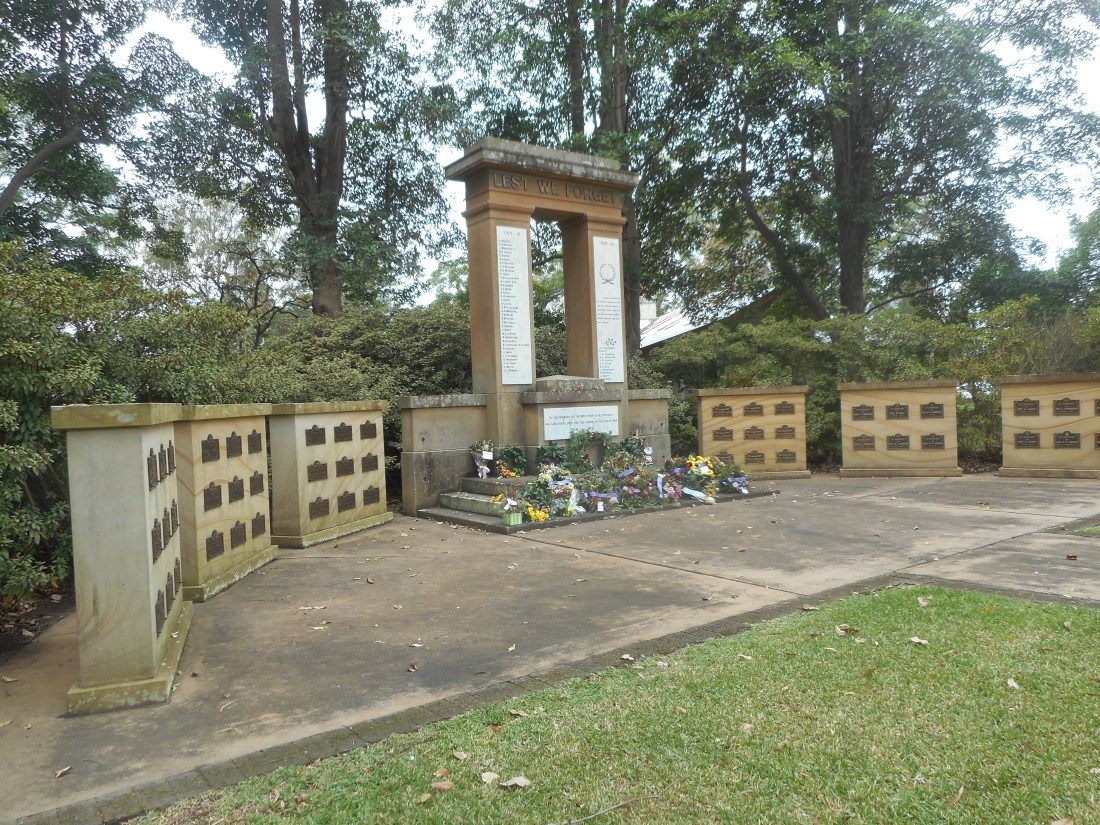
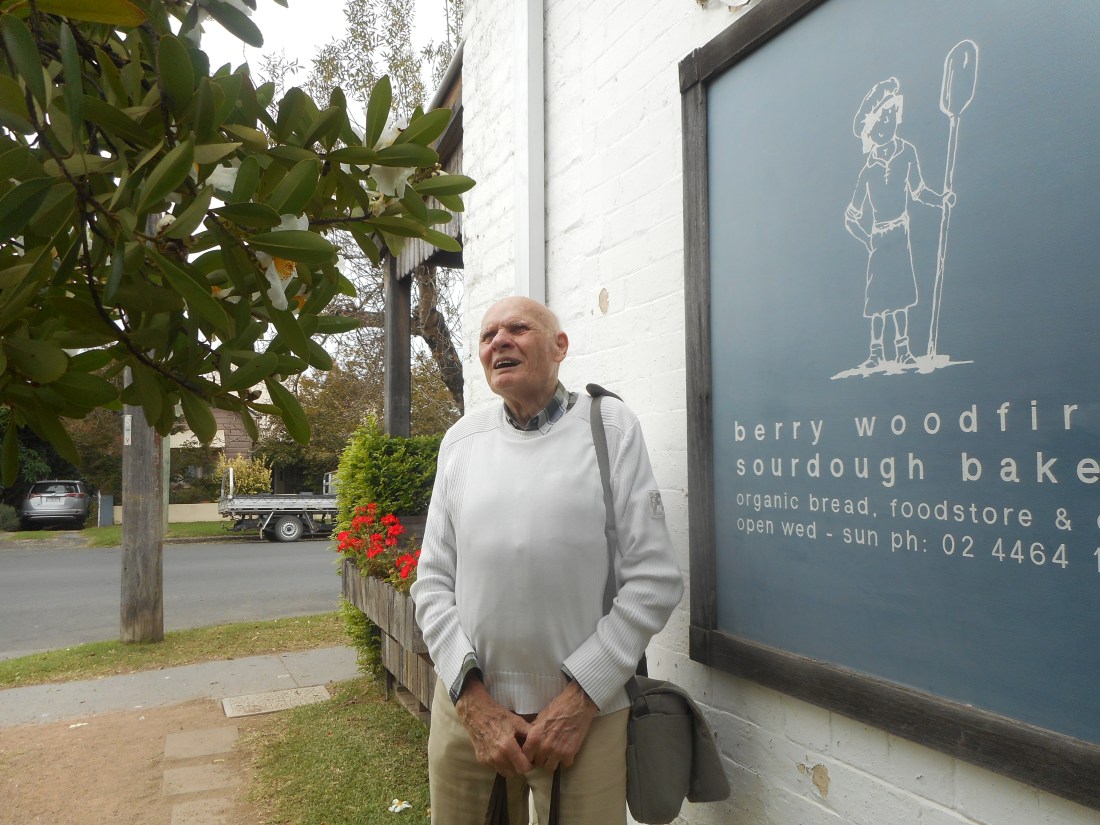
We were lucky the cafe was open today, Wednesday, the first of May. We had some good breakfast there and ‘bowls’ of excellent coffee. Then we drove a bit around the backroads of this small town called Berry. Our first stop was here:

DSCN5342
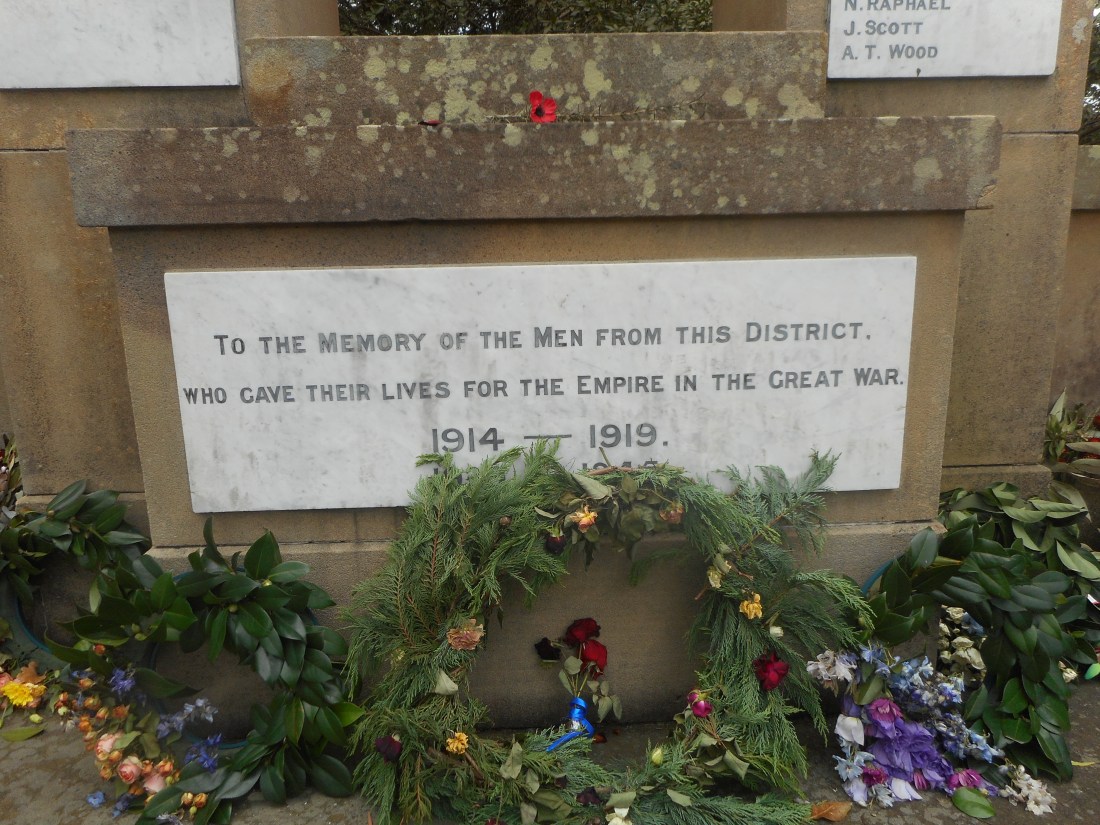
There were still a lot of wreaths and flowers from Anzac Day.

From Wikipedia:

“Anzac Day (/ˈænzæk/) is a national day of remembrance in Australia and New Zealand that broadly commemorates all Australians and New Zealanders “who served and died in all wars, conflicts, and peacekeeping operations” and “the contribution and suffering of all those who have served”.[1][2] Observed on 25 April each year, Anzac Day was originally devised to honour the members of the Australian and New Zealand Army Corps (ANZAC) who served in the Gallipoli Campaign, their first engagement in the First World War (1914–1918).”
DSCN5341

DSCN5338

DSCN5337

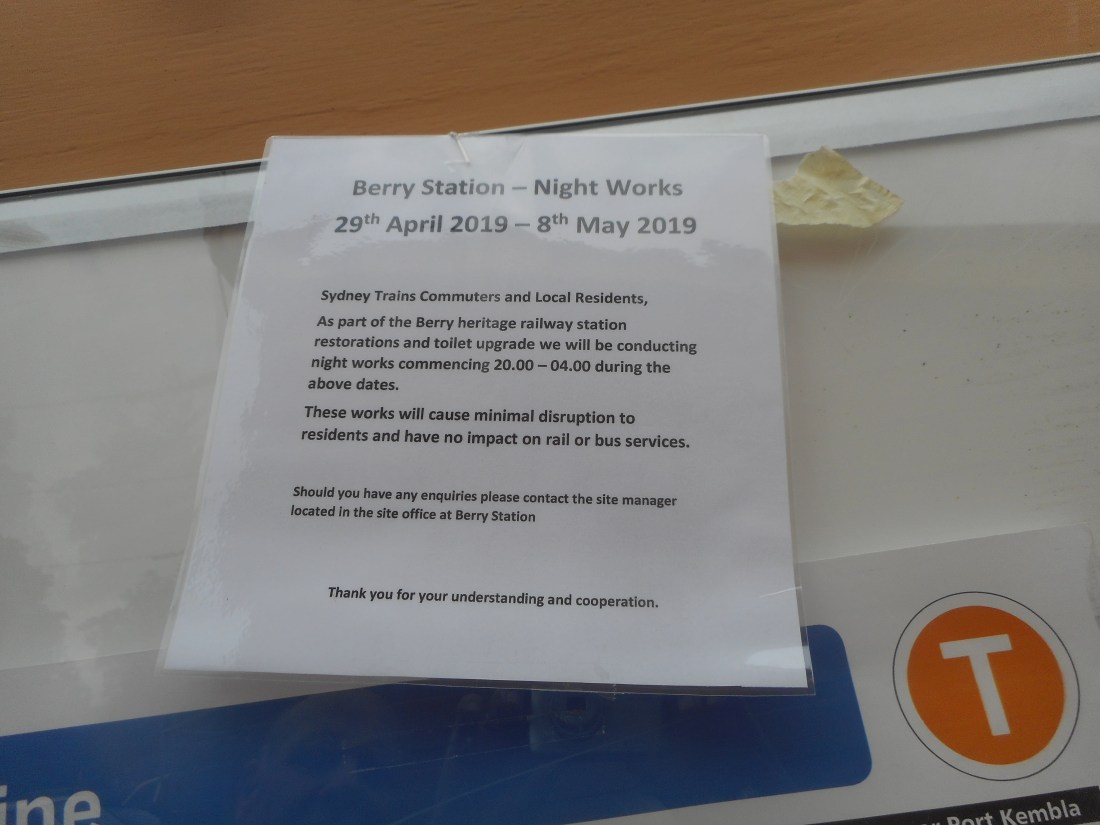
Berry Station is just down this road!

DSCN5356


DSCN5357

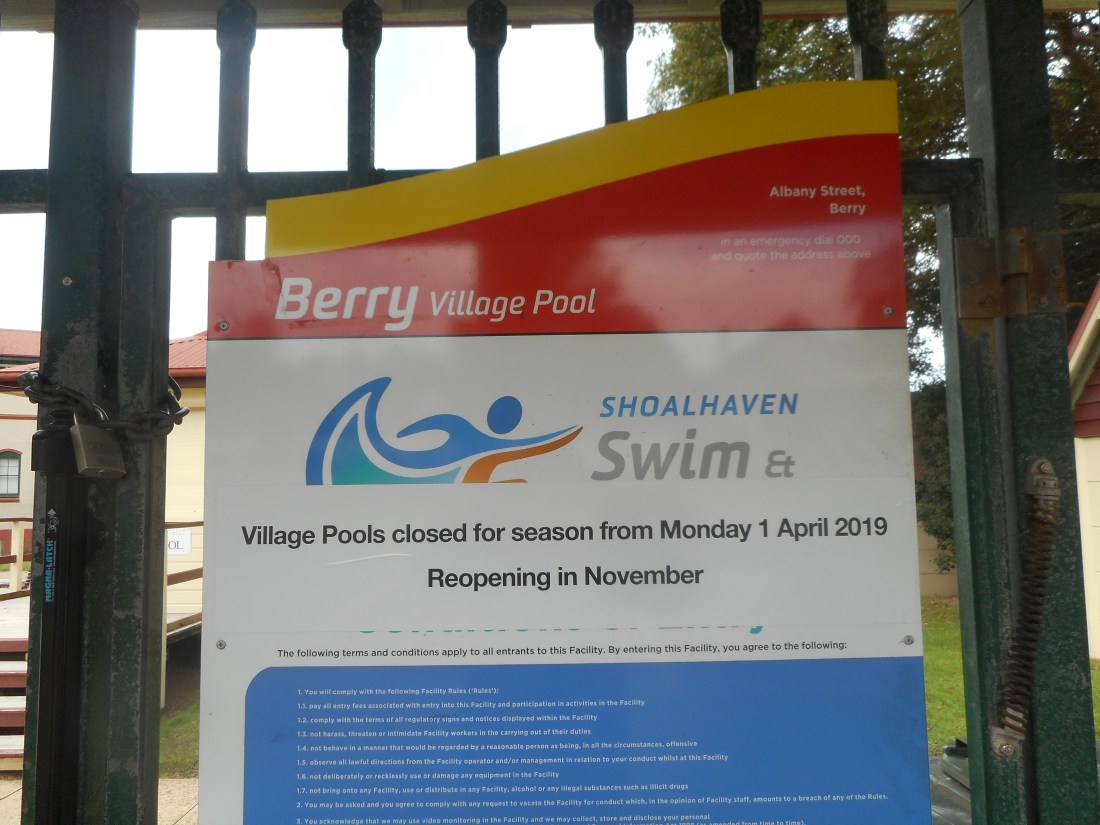
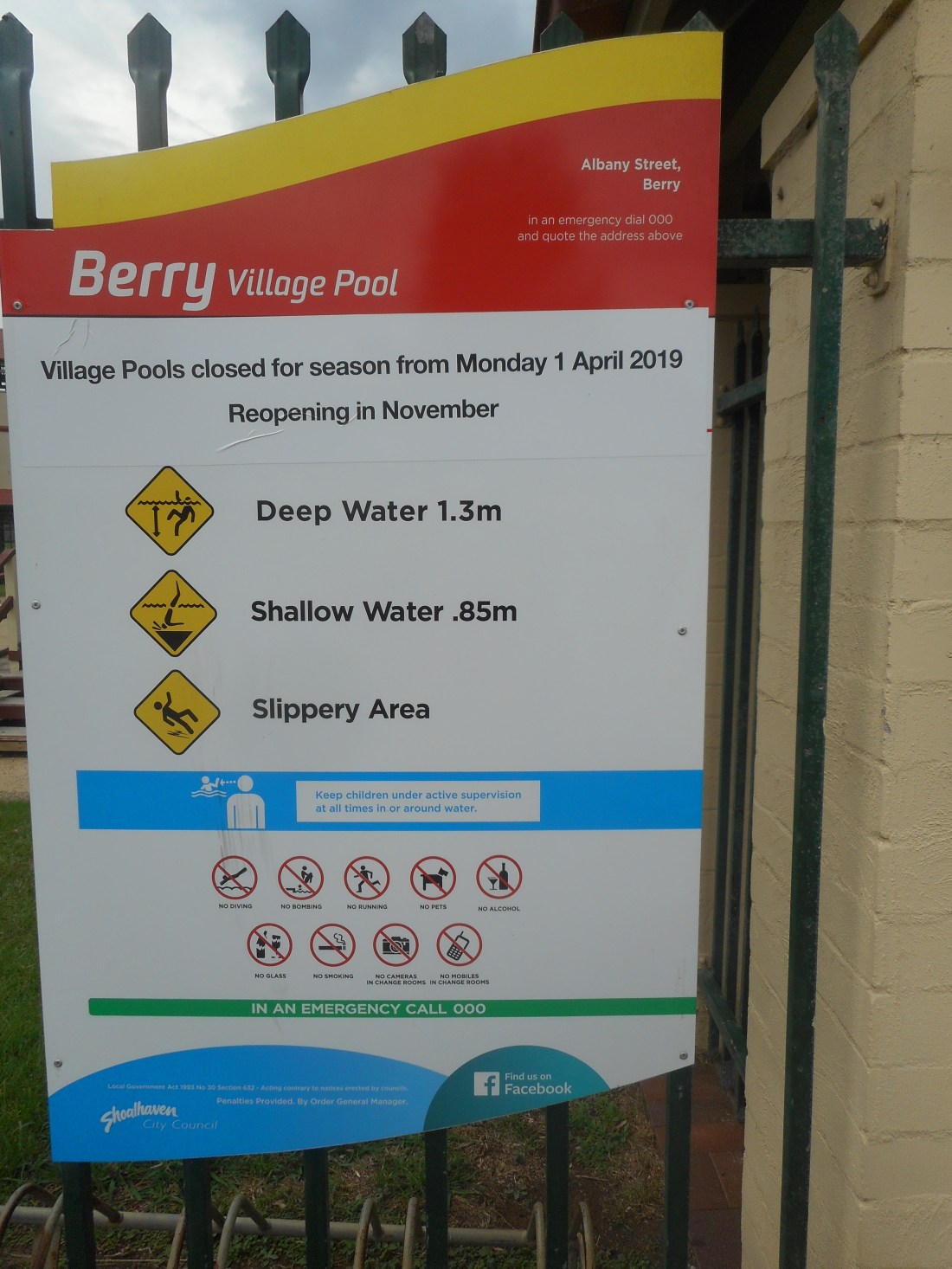
Our next stop was the Berry Swimming Pool that was closed for the winter months from April to November.
 

DSCN5359

DSCN5361

DSCN5360

DSCN5363

Berry

We passed this retirement village. We thought it looked quite interesting.


We took a few more street pictures in Berry and then drove on through Kangaroo Valley to the small town by that name.

https://en.wikipedia.org/wiki/Kangaroo_Valley,_New_South_Wales

Here is some Wikipedia information about this town :

“As of 2013, the small town has a variety of arts and craft shops, restaurants and cafes, a hotel, club, post office, supermarket and other businesses, including an ambulance station, general practitioner and a chemist.

Kangaroo Valley has a bus service to Nowra and Moss Vale. Priors Scenic Express also provides a long-distance coach service to BowralMittagong, and Sydney as well as to the Shoalhaven and South Coast, as far as Narooma.”

We stopped at a very nice cafe in the main street.

DSCN5379

Oh yes, we had not great difficulty pretending it was 1995!!

DSCN5381

On the way home we stopped at the Robertson Pie Shop for a cup of refreshing tea and some delicious fruit pie.


Here is a link to a post Peter (Berlioz) wrote seven years ago:

https://berlioz1935.wordpress.com/2012/05/03/the-old-and-the-new-australia/

Among other things you find the following in Peter’s post:

“The other day, on the First of May actually, we were enticed by the beautiful sunshine to drive into the country site. Not far from where we live, about 70 km is Kangaroo Valley. On the way there and back we passed through Berry, a town on the Princes Highway. It is “old charm” town where on weekends well to do people from Sydney come to visit and do some shopping for things that do not come from China, like craft work etc. . . .”

https://www.warmemorialsregister.nsw.gov.au/content/berry-war-memorial

This is mentioned about the war memorial:

“When the Cenotaph was unveiled in 1921, a tree was planted for each of the dead along Alexandra Street, at the base of each of these trees a bronze plaque was set recalling the soldier to whom the tree was originally dedicated. . . .”

Peter also did mention in his post from 2012 the Cenotaph in Berry that we visited again today:

“We drove a bit further and suddenly saw the town’s Cenotaph erected for the fallen of the two World Wars. The floral tributes from the recent ANZAC Day were still to be seen. I realised then, that perhaps Berry represents, in equal parts, the modern and the old Australia, and the fallen soldiers are the connecting element of this duality. Without knowing it they gave their lives for just the Australia we have become. Migrants of the countries that were fighting in the Great War of 1914/18 are now here. . . .”

In my post from seven years ago I mentioned the Berry Sourdough Cafe in Prince Alfred Street:

” . . . we drove on to Berry where we had some pies for lunch. We also bought some cake at the Milkwood Bakery. This is a newly opened bakery in Queen Street. They are a branch of the Berry Sourdough Cafe in Prince Alfred Street, which is famous for very good breakfasts.”  So today, seven years later but also on the first of May, we did actually have breakfast at the cafe in Prince Alfred Street.

https://www.google.com/search?q=berry+sourdough+cafe&tbm=isch&source=univ&sa=X&ved=2ahUKEwjf_87u7fnhAhWaV30KHeXJCOMQsAR6BAgGEAE&biw=1229&bih=603

The above link is to a real lot of fantastic images to what is available at the Berry Sourdough Cafe!!

“QUALITY FIRST: Artisan baker Jelle Hilkemeijer of Berry Sourdough Cafe says small bakeries enjoy strong loyalty from customers.”

https://www.southcoastregister.com.au/story/2604353/small-bakers-focus-on-quality/?cs=4158

And now here is the link to another post Peter wrote seven years ago about our outing on the first of May:

https://berlioz1935.wordpress.com/2012/05/02/1-may-2012/

This blog he started with these words:

“Early in the morning we heard a song about the Hampden Bridge and we thought why not go there today? It seems to be the right thing to do. First of May is not a holiday in Australia. But what the heck, our life is a constant holiday and we can go to the Kangaroo Valley, that is where the bridge is, any time we want. So off we went. The Illawarra is a beautiful part of NSW and we are proud to live here. . . . ”

Today we passed Hampden Bridge again, but did not stop there but drove on to the village of Kangaroo Valley.


A Copy of a Blog of mine from September 2014

Today, 28th of April 2019, I had a look at several blogs of mine from a few years ago. Among others, I found a blog from the day after Alexander was born. I like this blog so much, that I cannot resist copying it and publishing it again. I hope some of my readers are going to like having a look at it too, even if they have seen it before! I think it is interesting, to compare the pictures of Lucas and Alex with their very recent pictures, and to also see Carter, their two year old cousin, who came to visit them the other week. What the boys look like now, can be seen in this recent blog of mine:

https://auntyuta.com/2019/04/21/easter-sunday-2019/

And here now is what I wrote on Sunday, 28th of September 2014: 

Yesterday, on the 27th of September 2014, Baby Alexander Robert, a brother for two year old Lucas, was born in Wollongong Hospital. Ryan and Ebony made it to the hospital barely an hour before little Alex was born. Twelve hours later they were already on their way back home, where the first family visits soon arrived.

Today, on Sunday, Caroline came from Sydney to see the new baby. Peter and I picked her up from Dapto Station. Caroline arrived on a rail bus. There were no trains today because of track work. Towards 3 o’clock in the afternoon Peter, Caroline and I could see  the new baby for the first time. He is such a sweetie! The baby had been born soon after midnight on Saturday. So this afternoon he would have been going towards forty hours, that means he is still less than two days old! It was great that Ebony was allowed to go home already.

RIMG0226

RIMG0227

RIMG0225

RIMG0225 (2)

RIMG0240

RIMG0241

RIMG0242

RIMG0243

RIMG0244

RIMG0245

RIMG0248

RIMG0249

RIMG0223

RIMG0231

IMG_0435

IMG_0437

IMG_0441

IMG_0442

IMG_0444

RIMG0219RIMG0224

IMG_0448

Grandmother Monika, Great-Grandparents Uta and Peter with Baby Alex

RIMG0236

Lucas has a look at the cheese-cake.
Soon there were cups of coffee and cheese-cake for everyone.

In the morning I had been going to church. I noticed some beautiful yellow roses and took some pictures of them after Mass.

RIMG0217

RIMG0218

RIMG0217 (2)

It was a lovely, balmy sunny morning. In the afternoon the temperature reached 28 Degrees Celsius. We felt that this was a bit like a summer day already. I have not been to the swimming pool for a while. If we have some more weather like we had today, I might have the courage to go for a swim some time soon. So far we had either clouds and a bit of rain or very strong winds. But maybe the next few days are going to be very pleasant. I hope so! 🙂

A Copy of a Blog I published in May 2012

I wrote to Berlioz (Peter) in May 2012:

Hi Peter! I am sure this day and the two posts you wrote about it are going to stay in my memory. I had a lovely day. It was such a good idea to go for this drive, wasn’t it? Love, Uta

Now, seven years have passed and today Peter sent me an answer with the following invitation:

Hi Uta, it was indeed a lovely day and I invite you to do same drive on the 1, May this year. Love Peter

I just answered: Yes, Peter, sure I’ll love to do the same drive with you on the 1st of May this year. So, this is coming up in three days!! Very much looking forward to this. Love, Uta 🙂

The following two links are to Peter’s two posts about our outing seven years ago:

https://berlioz1935.wordpress.com/2012/05/03/the-old-and-the-new-australia/#comment-3299

https://berlioz1935.wordpress.com/2012/05/02/1-may-2012/

And here is the link to my post from May 2012:

What does God want me to do?

I copy my post from sevrn years ago here:

What does God want me to do?

Last Sunday at Mass I was confronted with the above question. As it happened it was a day when I was in quite a bit of physical pain. The pain didn’t start out to be really bad. I would be all right walking to church, so I thought. But far from it. After walking the distance, which took about twenty-five minutes, the pain was getting quite considerable. I arrived at the church at the last minute. But Father was still standing there shaking hands. He shook my hand too.

I happened to find a seat beside Sister Kevin. I greeted her and sat down. I told myself if I could just rest my knee and concentrate on my breathing, the pain would be bearable. I started reflecting on how God probably wanted to tell me something. Maybe God wanted me to make changes to my life as to correspond better with my aging body. What changes to my life should I make? What sort of changes did God actually want me to do?

I was very moved by the beautiful singing in the church. Both Fr Francis Tran and the Seminarian, Mr Stephen Varney, were singing Mass. Both have such beautiful voices! The church choir sang very well too. Stephen was given the homily that morning. He pointed out that for some people the Priesthood can offer a fulfilling way of life. They may think that it might be too hard to stick to being a priest. Even though for most people it is right to get married, you may think about it that it is also often not easy to stick to being husband and wife. It all depends on what God wants you to do, doesn’t it?

Monday has come and gone, so has Tuesday. Today is Wednesday and the pain is still there. I can cope with it as long as I don’t do too much! I cancelled the walks with my neighbour, Irene. I didn’t even go to the pool on Monday or to the Thai Yoga class on Tuesday. Peter could have driven me to the pool. But I declined.

When Peter suggested on Tuesday, the first of May, we could drive to Berry and then further on to Hampden Bridge, I joyfully agreed to this. We had a lovely day out. The weather was perfect for an outing. The good thing was, I didn’t have to walk much. Peter took lots of pictures. I took quite a few pictures too, some of them out of the window from the car.

This leads to Peter’s blog about our outing and another blog about his thoughts to the 1st of May:

https://berlioz1935.wordpress.com/2012/05/03/the-old-and-the-new-australia/

At the moment I do not want to think about seeing the doctor or the dentist or the optometrist. Within the next couple of months I ought to see all these people. Just now I only want to rest and get better.

Peter looks over the coast south of Kiama

From there we drove on to Berry where we had some pies for lunch. We also bought some cake at the Milkwood Bakery. This is a newly opened bakery in Queen Street. They are a branch of the Berry Sourdough Cafe in Prince Alfred Street, which is famous for very good breakfasts.


These are some autumn leaves in Berry and the following picture shows a tree with autumn leaves in this particular street in Berry


This is where we turned off from Berry taking the Tourist Drive to Hampden Bridge


We saw some unusual cloud formations on the way. This was one of them.


This is part of the Kangaroo Valley Road


Further along the Tourist Road


A gate to a property along the Road

Nearly there at the Bridge
This sign tells us that there are wombats in the area
And this sign tells us our way back home

Tagged: Autumn, Autumn Leaves, Berry, choir, Hampden Bridge, Mass, Priesthood

20 thoughts on “What does God want me to do?”

Hello, Aunty Uta. Sad to hear you are in pain. Do you have arthritis? Or is this an old injury? I hope it’s been looked at and you are getting the right treatment for it.

Thanks for your concern, dear Mary-Ann. It’s not an old injury. It’s probably old age, don’t you think:

Some mild discomfort and initial stiffness that gradually alleviates with increased movement is natural in aging but not the pain you described. I would recommend that you have it examined if it recurs or persists. It may be something that’s easily treated. The last thing you want is something that will restrict your mobility. This would be very detrimental to your continued well-being.
You’re right, Mary-Ann. What you say makes a lot of sense to me. Actually Peter has to see his doctor for his annual check-up so he can keep his drivers’ license. In the past he liked to see his doctor at the Medical Centre Wednesday nights, when he was on night duty and there wasn’t a very long waiting time. We both tried to see this doctor last night. There were already ten people signed in waiting to see him. This would have meant a waiting time of more than two hours for us. After consultation with the receptionist we decided we would see the doctor early Friday morning, because on Thursday he’s not available. So I hope for the best now, that it can be easily treated.
From Berlioz (Peter):

“What does God wants you to do?” How can an atheist, like me, answer this question? Philosophers, sages and other wise people have thought about this important question for centuries. It is practical the same as asking, “What is the meaning of (my) life?”

Let’s assume that your implied assumption is right and there is a God. I think he does not want you to do anything other than to be. His purpose for you falls under the inscrutable. Who knows what God wants you to do? Even bad people have a mission given to them by God. Think of Judas. Without him Jesus could have escaped capture or not? Even Jesus wasn’t sure what was happening when he asked, “Why have you forsaken me?” He of all people should have known that was his purpose.

To say your cross is your hurting knee, might be a bit harsh, but it is a reminder that our bodies are subject to decay and sickness; two other aspects of God’s plans for you.

And what if we assume there is no God? You have to take responsible action and be happy with what you done. Try to be sure within yourself. Every action is the basis for the next action – cause and effect. Resting in the church was the right thing to do. Seeing a doctor will be the next right thing to do.

Thanks, Berlioz, for this comment. Of course I realise that seeing the doctor is going to be the next right thing to do. It looks I won’t be able to avoid it!

Having the outing with you was the right thing to do. It was a beautiful day. The sun was shining and the clouds in the sky were performing in an artful way.

The bakery in Berry is a French bakery and it felt like a trip to the “Provence” in the Autumn.
The cake was delicious and the bread wholesome.

The bit of “Provence” in Berry was indeed very welcome. I loved the whole outing. We are very blessed to live in such a beautiful area.

Hi Uta,

I am sorry to hear that you are experiencing some pain and I hope that you find some comfort soon.

However, it would appear that, in spite of your pain, you still managed to find some enjoyment. Perhaps there is a lesson for us in that ie even in our most difficult moments, we can still find joy in our lives.

Get better soon,

Carthage

Hi Carthage, Oh yes, there’s a lot of enjoyment in life even in old age. Pain just tells me I have to change something. Maybe just slow down a bit more?
Thank you very much for your good wishes. Uta

LOVED LOVED LOVED your pictures, and very much envy you! An excellent blog, & very interesting. I am sorry you appear to be n pain & I hope things even out, work out. Sincerely, Noeleen

Thanks, Noeleen.

Aunty Uta, I meant also to say that I think it’s great you do thai yoga & swimming. I think these things are perfect. I am genuinely sorry about your pain & I just don’t know what you can actually do, because I truly would have thought the swimming would do it. I truly hope you’re better at least today… And the pictures, sigh. Great camera! 🙂

You are right, Noeleen, thai yoga and swimming are perfect exercises for me or have been for as long as this arthritic pain didn’t overwhelm me. Yes, I found out now from the doctor that it has to do with arthritis. My knee was xrayed. So now I am on anti-imflammatory tablets.
The doctor didn’t mention diet. Personally I think I ought to do some changes to my eating habits. Wish me luck with this, Noeleen!
Thank you so much for thinking of me. I keep thinking about you a lot too!

By the way, Noeleen, if you would like to see some more of those pictures we took last Tuesday, please go to Peter’s blog. If you go to the end of my writing (before the pictures start) you’re going to find the link. I think you’ll be interested in browsing through Peter’s blog!

Actually Peter wrote about our excursion to Hampden Bridge in two parts. Both parts have some good photos in it.

I do wish you luck, Aunty Uta, all all luck! YOU CAN DO IT!!
Yes, thank you, Noeleen

Sending you healing light and love… the answers will come. 😉

Thanks for that, Eliz.

The tiny Town behind a heartwarming 9/11 Tale

https://www.smh.com.au/world/north-america/the-tiny-town-behind-a-heartwarming-9-11-tale-20190326-p517pe.html

This is a real feel good story!!

“The tiny town behind a heartwarming 9/11 tale When dozens of planes were forced to land in a tiny Canadian town after the 9/11 attacks, locals billeted thousands of stranded travellers.”

https://www.usatoday.com/story/news/nation/2017/09/08/gander-newfoundland-september-11-terror-attacks-kindess-come-from-away/631329001/

https://www.northjersey.com/videos/news/new-jersey/2018/09/06/documentary-story-gander-newfoundland-9-11/1210974002/


Fibershed

https://www.fibershed.com/about/

Fibershed develops regional and regenerative fiber systems on behalf of independent working producers, by expanding opportunities to implement carbon farming, forming catalytic foundations to rebuild regional manufacturing, and through connecting end-users to farms and ranches through public education.

We envision the emergence of an international system of regional textile communities that enliven connection and ownership of ‘soil-to-soil’ textile processes. These diverse textile cultures are designed to build soil carbon stocks on the working landscapes on which they depend, while directly enhancing the strength of regional economies. Both fiber and food systems now face a drastically changing climate, and must utilize the best of time-honored knowledge and available science for their long-term ability to thrive.

As each Fibershed community manages their resources to create permanent and lasting systems of production, these efforts to take full responsibility for a garment’s lifecycle will diminish pressure on highly polluted and ecologically undermined areas of the world. (China produces 52% of the world’s textiles. The industry is the third largest fresh water polluter in the country.) Future Fibershed communities will rely upon renewable energy powered mills that will exist in close proximity to where the fibers are grown. Through strategic grazing, conservation tillage, and a host of scientifically vetted soil carbon enhancing practices, our supply chains will create ‘climate beneficial’ clothing that will become the new standard in a world looking to rapidly mitigate the effects of climate change. We see a nourishing tradition emerging that connects the wearer to the local field where the clothes were grown, building a system that can last for countless generations into the future.

How did the Fibershed project start?

The project began in 2010 with a commitment by its founder, Rebecca Burgess, to develop and wear a prototype wardrobe whose dyes, fibers and labor were sourced from a region no larger than 150 miles from the project’s headquarters. Burgess had no expected outcomes from the personal challenge other than to reduce her own ecological footprint and maybe inspire a few others.

Burgess teamed up with a talented group of farmers and artisans to build the wardrobe by hand, as manufacturing equipment had all been lost from the landscape more than 20 years ago. The goal was to illuminate that regionally grown fibers, natural dyes, and local talent was still in great enough existence to provide this most basic human necessity—our clothes.  Within months, the project became a movement, and the word Fibershed and the working concept behind it spread to regions across the globe. Burgess founded Fibershed’s 501c3 to address and educate the public on the environmental, economic and social benefits of de-centralizing the textile supply chain.


Rebecca calls her experiment the Fibershed Project


Published on Sep 20, 2011 by Kirsten Dirksen
Except for notions (buttons, zippers, etc), everything in Rebecca Burgess’ wardrobe has been grown and designed within 150 miles of her home. But until putting her closet on a diet one year ago, nearly all her clothing was produced far from home, and that made her a very typical American. Over the past half century the U.S. textile industry has been decimated. “In 1965, 95% of the clothing in a typical American’s closet was made in America,” Burgess writes on her blog, “today less than 5% of our clothes are made here.” Upset by the outsourcing of the American wardrobe, as well as the disconnect this by the waste produced by the textile industry worldwide (it’s the #1 polluter of fresh water on the planet and America’s 5th largest polluting industry), Burgess decided she needed to focus public attention on local fabric, in the same way the food movement had done with local food. Inspired by the success of challenges like the 100 Mile Diet, Burgess decided to put her closet on a diet. For six weeks she wore one outfit (created from local rancher Sally Fox’s color-grown cotton that Fox had milled back in 1983 before the area lost all of its mills), but then local designers, in collaboration with local farmers, began creating more hand spun/knitted/dyed pieces until her wardrobe had become so complete she even had a naturally-wicking alpaca raincoat. Rebecca calls her experiment the Fibershed Project, because like a foodshed or watershed, her fibershed- the 150 mile radius of her home- is big enough to provide for all the fibers and dyes necessary to create a diverse wardrobe. She admits she’s lucky to be in Northern California where there are plenty of ranchers raising even alpacas, angoras and mohair goats and where there’s an ideal climate for growing a variety of color-grown cottons. In this video, we visit Burgess at her dye farm in Lagunitas, California and her home nearby where she shows us her 150-mile wardrobe, including a bicycle-felted vest and a sweater made from the wool of the oldest rancher in the fibershed (a 96-year-old sheep rancher) and the youngest designer (an 18-year-old knitter).

Some very interesting Statistics!

Published on Nov 15, 2007
Waking Up to the Century of Declines. One of the world’s foremost Peak Oil educators gives us his insight into the coming century. Recorded in Orewa on Tuesday 9th October 2007.
Even though this video (several more parts following directly after Part 1) was published some time ago,  it shows nonetheless very impressive charts about the huge amounts of energy we produce now comparing the increase in energy use since the time humans evolved! The increase during the last few years is absolutely frightening . . . .
Richard Heinberg
American journalist

Wikipedia Description

Richard William Heinberg is an American journalist and educator who has written extensively on energy, economic, and ecological issues, including oil depletion. He is the author of 13 books, and presently serves as the senior fellow at the Post Carbon Institute. Wikipedia

Born21 October 1950 (age 68 years)
The End of Growth: Adapting to Our New Economic Reality (2011)
The End of Growth: Adapting…
2011
The Party's Over: Oil, War, and the Fate of Industrial Societies (2003)
The Party’s Over: Oil, War, and…
2003
Peak Everything (2007)
Peak Everything
2007
Power Down: Options and Actions for a Post-Carbon World (2004)
Power Down: Options a…
2004
And here is another very interesting video:

Why end of growth can mean more happiness (Richard Heinberg)

Published on Sep 26, 2011 by Kirsten Dirksen:
Richard Heinberg- whose latest book describes The End of Growth- isn’t looking for when the recession will end and we’ll get back to “normal”. He believes our decades-long era of growth was based on aberrant set of conditions- namely cheap oil, but also cheap minerals, cheap food, etc- and that looking ahead, we need to prepare for a “new normal”. The problem, according to Heinberg, is our natural resources just aren’t so cheap and plentiful anymore, and he’s not just talking about Peak Oil, Heinberg believes in Peak Everything (also the title of one of his books). Heinberg thinks for many, adjusting to a life where everything costs a bit more, could be very hard, but he also thinks the transition to a new normal might actually make life better. “Particularly in the Western industrialized countries we’ve gotten used to levels of consumption that are not only environmentally unsustainable, they also don’t make us happy. They’ve in fact hollowed out our lives. We’ve given up things that actually do give us satisfaction and pleasure so that we can work more and more hours to get more and more money with which to buy more and more stuff- more flatscreen tvs, bigger SUVs, bigger houses and it’s not making us happier. Well, guess what, it’s possible to downsize, it’s possible to use less, become more self sufficient, grow more of your own food, have chickens in your backyard and be a happier person.” This is not all theoretical. In the backyard of the home Heinberg shares with his wife, Janet Barocco, the couple grow most of their food during the summer months (i.e. 25 fruit & nut trees, veggies, potatoes.. they’re just lack grains), raise chickens for eggs, capture rainwater, bake with solar cookers and a solar food drier and secure energy with photovoltaic and solar hot water panels. Their backyard reflects Heinberg’s vision for our “new normal” and it’s full of experiments, like the slightly less than 120-square-foot cottage that was inspired by the Small Home Movement. It was built with the help of some of Heinberg’s college students (in one of the nation’s first sustainability classes) using recycled and natural materials (like lime plaster). Heinberg admits it’s not a real tiny house experiment since they don’t actually live in it- his wife uses it as a massage studio, he meditates there and sometimes it’s used as a guest house (though that’s hush hush due to permitting issues). But their tiny cottage points to the bigger point behind why a transition to a less resource intensive future could equal greater happiness. “Simplify. Pay less attention to all of the stuff in your life and pay more attention to what’s really important. Maybe for you it’s gardening, maybe for you it’s painting or music. You know we all have stuff that gives us real pleasure and most of us find we have less and less time for that because we have to devote so much time to shopping, paying bills and driving from here to there and so on. Well, how about if we cut out some of that stuff and spend more time doing what really feeds us emotionally and spiritually and in some cases even nutritionally.”

https://www.climatecouncil.org.au/about/


A Tune based on a Swiss folk song

Wednesday 27th March
In the morning we always like to listen to ABC Classic with Russel Torrance.
At 8:30 this morning we listened on ABC Classic to this:


Mozart, Wolfgang Amadeus, Concerto in A Major for Basset Clarinet K. 622: II. Adagio

Craig Hill (clarinet) + Australian Brandenburg Orchestra

Both Peter and I staight away did think of the lyrics of  -Ich hatt’ einen Kameraden – –

It is a catching melody with catching lyrics. We both remembered having known the lyrics when we were children. We thought about how it would be interesting to find out how Mozart did incorporate the melody in his concerto. Sure enough now we know that the music is based on the tune of a Swiss folk song and the lyrics, written by Ludwig Uhland in 1809 are inspired by what happened during the Tyrolean Rebellion of 1809!
Following is some information I took from Google, and the videos are on YouTube. I like to brouse like this on the internet. It is truly amazing that so much information can be found there.

Published on Mar 26, 201

“Der gute Kamerad” (“The good Comrade”), also known by its incipit as Ich hatt’ einen Kameraden (“I had a comrade”) is a traditional lament of the German Armed Forces.The text was written by German poet Ludwig Uhland in 1809. Its immediate inspiration was the deployment of Badener troops against the Tyrolean Rebellion. In 1825, the composer Friedrich Silcher set it to music, based on the tune of a Swiss folk song.”
Lyrics
Ich hatt’ einen Kameraden,
Einen bessern findst du nicht.
Die Trommel schlug zum Streite,
Er ging an meiner Seite
In gleichem Schritt und Tritt.
Eine Kugel kam geflogen,
Gilt’s mir oder gilt es dir?
Ihn hat es weggerissen,
Er liegt vor meinen Füßen
Als wär’s ein Stück von mir.
Will mir die Hand noch reichen,
Derweil ich eben lad’.
“Kann dir die Hand nicht geben,
Bleib du im ew’gen Leben
Mein guter Kamerad!”

The Clarinet Concerto in A, K622, completed in 1791, the year of Mozart’s death, marked his farewell to instrumental music. It was also the first clarinet concerto to be written by a major composer – except that Mozart did not write it for the clarinet at all.

In fact, it is rare that we ever hear this most famous of wind concertos played on the instrument Mozart intended – the basset clarinet, a clarinet that has four semitones added to its lower range.

The inventor of the basset clarinet, and its leading virtuoso, was Mozart’s friend and fellow Mason, Anton Stadler, for whom Mozart had written the Clarinet Quintet in A, in 1789. “Never,” wrote  Mozart to Stadler, “would I have thought that a clarinet could be capable of imitating the human voice as deceptively as it is imitated by you. Truly your instrument has so soft and lovely a tone that nobody with a heart could resist it.”

Far from being entirely the product of Mozart’s miraculously inspired final year, the first 199 bars of the clarinet concerto are identical to an abandoned concerto for basset horn (an instrument Stadler also played) that he began as early as 1787. By looking at this fragment (preserved at Winterthur, Switzerland) we can see, from the scribbles and erasures, that Mozart was uncharacteristically lacking in decision, often changing his mind and obviously under stress.

What may have stimulated Mozart into completing the abandoned basset horn concerto for Stadler and his basset clarinet, was his journey to Prague for the premiere of La Clemenza di Tito. One of his travelling companions was his pupil Süssmayr, who revealed that he was writing a basset clarinet concerto for Stadler. Mozart could not allow himself to be outdone. The concerto was written in Vienna some time between the end of September and the beginning of October 1791. The completed score was sent off to Stadler in Bohemia and it received its first performance at Stadler’s benefit concert in the Prague Theatre on October 16, 1791. Seven weeks later, Mozart was dead.

The concerto was not published until 1802, with the solo part adapted for the clarinet rather than the obsolete basset clarinet. The whereabouts of the original manuscript are unknown.

In Wikipedia you can find a number of interesting facts about the TYROLEAN REBELLION of 1809.

Is the Extinction Rebellion Movement our last Chance?

https://theconversation.com/extinction-rebellion-im-an-academic-embracing-direct-action-to-stop-climate-change-107037

Rupert Read is affiliated with Extinction Rebellion and the Green Party.

Rupert Read says:

“I’m a Reader in Philosophy at the University of East Anglia and I have thrown myself headfirst into this movement. Our long-term aim is to create a situation where the government can no longer ignore the determination of an increasingly large number of people to shift the world from what appears to be a direct course towards climate calamity. Who knows, the government could even end up having to negotiate with the rebels.”

Further on he says:

“The Extinction Rebellion challenges oligarchy and neoliberal capitalism for their rank excess and the political class for its deep lack of seriousness. But the changes that will be needed to arrest the collapse of our climate and biodiversity are now so huge that this movement is concerned with changing our whole way of life. Changing our dietsignificantly. Changing our transport systems drastically. Changing the way our economies work to radically relocalise them. The list goes on.

This runs up against powerful vested interests – but also places considerable demands upon ordinary citizens, especially in “developed” countries such as the UK. It is therefore a much harder ask. This means that the chances of the Extinction Rebellion succeeding are relatively slim. But this doesn’t prove it’s a mistaken enterprise – on the contrary, it looks like our last chance.”

So he admits that the chances of the Extinction Rebellion succeeding are relatively slim. Still, I think we should want it to succeed, because it looks like this maybe our last chance!!

When I looked up the above link to ‘changing our diets’ I found this article in The Guardian:

Huge reduction in meat-eating ‘essential’ to avoid climate breakdown

https://www.theguardian.com/environment/2018/oct/10/huge-reduction-in-meat-eating-essential-to-avoid-climate-breakdown

What do you think, does it look like that a huge reduction in meat-eating should be achievable? I think we would have to get governments to agree to want to be working towards achieving such a reduction. If governments had the will to introduce certain policies, policies that would for instance be necessary in war-time, then a real lot could be achieved.

To use our cars less, is another thing that we could all keep in mind!

“Changing the way our economies work to radically relocalise them”: Do you have any ideas how this could work?

A Week away from Home in November 2018 and another Trip to Benalla coming up

https://auntyuta.com/2018/11/15/nearly-one-week-away-from-home-in-november-2018/

This is what I wrote on the 15th of November 2018:

“We have just come back from a great few days away from home. I found our trip was very relaxing, and we did quite a few things that are worth remembering. It is always good to be able to go away for a little while. This creates memories.

Both Peter and I are in our eighties. That we still enjoy doing a bit of travelling, I find remarkable. Peter is battling to maintain some normality to his life while old age and sickness diminish his fitness. The one thing he is still pretty good at, is driving a car. He says driving a car on good roads for certain distances he finds relaxing. Our old Audi goes well on highways. In towns where there are a lot of traffic lights, Peter has to stop the car too often. This is when the car uses a lot of petrol pro km. However on freeways and highways the car uses much, much less petrol, and it makes Peter very happy and joyful to not have to stop all the time. However, Peter being 83 and having a few health issues that can make him feel perhaps too tired after a longer drive, he agreed not to drive the 650 km to Benalla in one day, but rather to stay overnight somewhere, that is  at about the halfway point. This time we came up with the idea to stop at Gundagai for our overnight stays. This worked  out very well. I wrote here that we stayed at the “Gundagai Motel”:

https://auntielive.wordpress.com/

http://gundagaimotel.com.au/

After our one night’s stay at Gundagai we stayed at our son’s place at Benalla for three nights. And on the way back we stayed again for one night at Gundagai. This means we left home on a Friday morning and arrived back home on a Wednesday afternoon. So this makes it close to one week! I reckon we did very well, considering our age and Peter’s health problems. And of course I too have sometimes a few minor health problems related to old age!

Peter is booked in for some more treatment in the hospital. We hope the result of these treatments is going to be as good as possible so that perhaps in future we are still going to be able to do similar beautiful trips!”

Today is the 25th of March 2019 and write here a little P.S.:

In less than two weeks we are going for another trip to Benalla. Peter’s treatment in the hospital has been delayed. We don’t know yet, whether he can get some treatment soon. This may be a good thing, for Peter has not symptoms that he is unduly concerned about. So we booked a few stays at the Gundagai Motel again. And Martin knows already that we want to be with him for his birthday on the 8th of April.