
UNSER KIND’ – OUR CHILD , this is the title of a book Mum used for recording notes about my development. Here are some of the notes:
“Uta was born on Friday, 21st September 1934, at 19 hrs and 55 min. in Berlin-Schöneberg. Her birth weight was 3200 g, she was 51 cm in length.
Friday, 5th October 1934, Uta 14 days old. This is the day when she was outside for the first time. She had her first solid food on the 23rd December. She enjoyed eating biscuit with orange juice. On 2nd April 1935 she drank out of a small cup all by herself.
On 27th February 1935, Tante Ilse’s birthday, she wore a dress for the first time. She congratulated Aunty with some violets in her hand. When Uta was four months old she raised herself up into a sitting position for the first time. She could already stand quite well when she was six months. She was ten months and two days old when she took the first two steps all by herself. She could climb one step by herself at twelve months without holding onto anything.
Her first tooth appeared when she wasn’t quite seven months old yet. At twelve months she had six teeth at the top and two at the bottom. These teeth appeared one after another without any problems. On the 20th of March Uta wore ‘Schuhchen’ (little shoes) for the first time.
On the 24th of March 1935, a Sunday, she was baptised in the ‘Kirche zum Heilbronn’ by Pfarrer Wiligmann. Uta’s first words were “wau, wau”. Later she said “Mama” and then “Papa” and “Buh”. With “Buh” she meant ball.
She had three small pox vaccinations, because the first two weren’t successful. (Unsuccessful on 12.5.36 and 24.10.36. Successful vaccination on 13.4.37.)”
Here now is what Mum wrote on the 26th of September 1935: “Uta likes children a real lot. She wants to play with every one. She loves to play in the sand. – When I take her out she always likes to stand up in her pram and she smiles at every one. People always take notice of her. When Uta was ten months old I took her on a bike-tour. She was placed in a basket-seat which was fastened to my handle-bar. We went along the Promenade of Münster. It started raining a bit. Because of this she ended up with a bit of a cold.
She was eleven months when she was for the first time in an outside water, the Aasee of Münster. The temperature was 24 degrees (Celsius). Uta went across the German border into Poland when she was nine months. This was her first major trip. Destination Lodz.
For Uta’s first birthday we were still in Münster. Sissi and Teo were our guests. Uta loved all the presents. All day long she played with her toys.”
And there’s a list of all the presents I received, from Aunty in Berlin, from Grandma in Leipzig and also from the grandparents in Lodz.

These are pictures from Lodz in June 1935. I’m in the pictures with my cousin Horst who was born in February 1935.

These are pictures of me from July 1935 in Münster/Westphalia


These are two more pictures from September 1935

Mum wrote I loved to play with sand. Here I’m sitting at one of the sand-boxes (Buddelkasten) with my ‘boy-friend’. I think I was fond of boys at a young age!


The last two pictures are taken in my ‘Kinderzimmer’. I have great fun sitting in the little bed which is for dolls and teddies. There’s one of the chairs which was a gift all the way from Lodz for my first birthday.
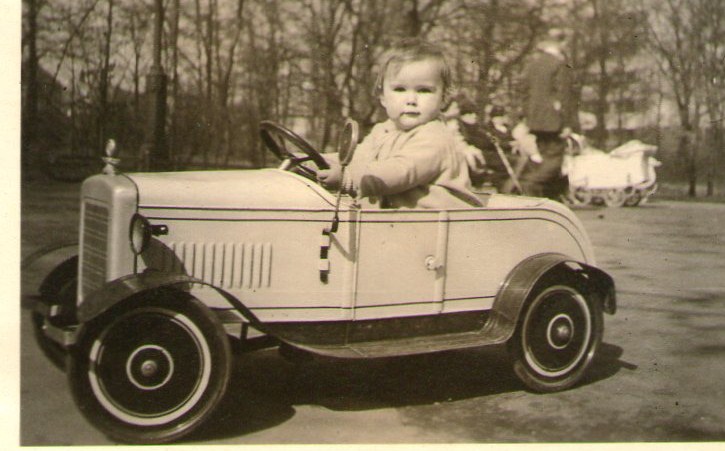
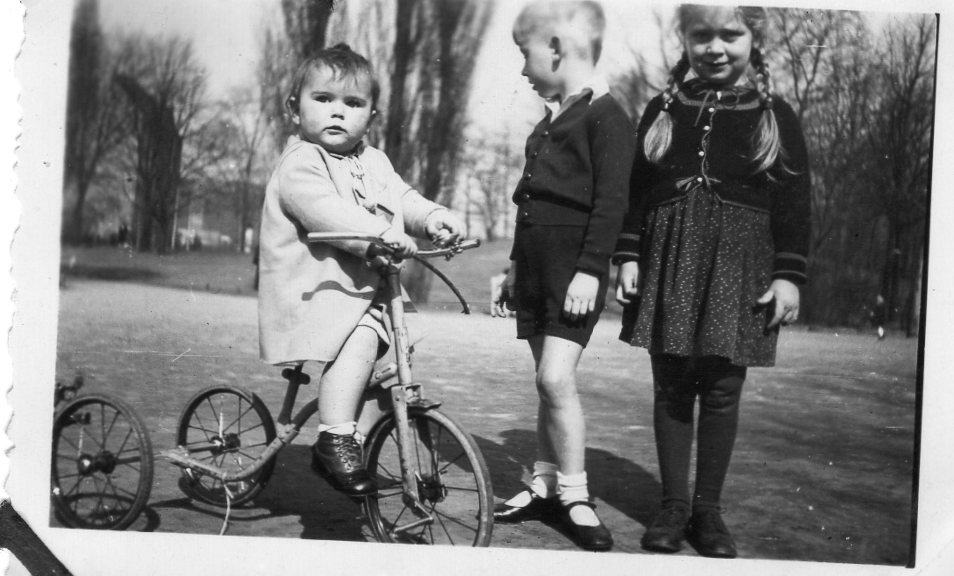
I have here a few more pictures Mum took of me as a toddler. Apparently I wanted to try out whatever other children had, be it a toy car, a doll’s pram or a big tricycle. I didn’t own any of these things, but gee I was keen on trying them out!
How on earth did Mum convince the children to let me try out their things so she could take these photos?

 .
.
On my fourth birthday Tante Ilse gave me a ‘Puppenwagen’, a pram for my
dolls.


Mum kept a big photo album with pictures of me. Growing up, I always liked to look at all these pictures. However, I remember distinctly that the following pictures annoyed me quite a bit. I felt awful that the pictures showed me being so very plump! When I was told I looked ‘cute’ I tended not to believe it. I was self conscious at an early age and mostly didn’t feel ‘cute’ at all. I still often don’t like my picture taken because I think I might look awful! The adults in the pictures are my Mum, Tante Ilse and Onkel Addi. I wonder who took the pictures with all three adults in it. Was it perhaps my father? Pussi was Tante Ilse’s dog. Apparently I loved carrying this dog.


For good measure I want to include here another blog with my father and mother in it and some of the extended family.
My father, Alexander Spickermann, was born in Lodz on the 13th of May 1904. The following picture of him was taken in about 1916. This is the earliest picture I have of him.
Alexander’s brother Edmund Spickermann, was born in 1902. Both brothers studied in Leipzig, Germany. The following pictures are from 1925 in the city of Leipzig. There is first Alexander and then Edmund. Both brothers are in their student outfits. And then there is a picture of both of them in front of the Völkerschlacht-Denkmal in Leipzig.


Alexander and Charlotte are my parents. They were married on the 25th of September 1930. Earlier that year, that is in 1930, Alexander promoted to Dr. phil and Edmund, I think, to Dr. rer.pol. The above picture is from 1925 when Alexander and Edmund first met Charlotte and Ilse. Charlotte was only fourteen years old at the time. Her sister Ilse was eighteen. Below is my parents’ wedding photo from the 25th of September 1930. (Charlotte was born on the 23rd of March 1911 and Ilse on the 27th of February 1907).


Above is another photo of Dad from 1930. The next photo was taken around Easter of 1935.
Dad is holding me. I had been born on the 21st of September 1934. So I am about six months in that picture.

In the above picture Dad is probably not quite forty yet. And then there is the photo of the Grandparents’ Golden Wedding Anniversary in Litzmannstadt (Lodz) in November of 1943. On the left is my sixteen year old cousin Ursula; next are Dad and Mum and I am in front beside Grossmutter (Grandma). I am nine years old.

Below now is the picture that was taken in June of 1938 soon after the home-birth of my brother Bodo. Since February of 1930 Ilse had been married to Adolf Schlinke (Onkel Addi). They owned this beautiful car, called ‘Wanderer’.
Grossvater Josef Spickermann (Granddad) was in Berlin for a visit. Presumably to see Bodo, his new grandson. The Schlinkes took Granddad, Dad and me for an outing in their car. The picture was taken in Berlin at the Reichssportfeld. Dad is in the picture on the left.
The next picture is taken at the Baltic seaside resort of Graal/Müritz in 1940. In the ‘Strandkorb’ are Mum and Tante Ilse, Dad is standing next to them.


I copied three more photos, probably all from the 1950s. The first one is Dad in his office, the two others are party photos with Dad and his family. In the last photo are Dad and his three sisters and two brothers. They were probably celebrating someone’s birthday. The Spickermanns liked to come together as a family.


 AuntyUta
catterelAugust 10, 2015 at 7:53 pm Edit #
Fascinating! I’ve always wanted to visit Augsburg properly (I changed trains a few times there but never got beyond the station) – maybe one day I’ll make it.
berlioz1935August 10, 2015 at 8:13 pm Edit #
It is a great place. The main street has buildings reflecting the wealth of the former trading post.
auntyutaAugust 11, 2015 at 8:03 am Edit #
We have some lovely memories of the place, Cat, spending the day with Uncle and Flora. Gee, this goes back to 1977!
berlioz1935August 10, 2015 at 8:26 pm Edit #
I remember the day well. Flora, a Berliner speaking with the out of place accent, was a retired GP who did some work for the Army checking up new recruits. She was a no-nonsense person who liked to be in charge. In the restaurant, she was the queen.
She had ordered a huge platter laden with cheeses and cold cuts. We could not eat all and she ordered all the left-overs being packed up to take home.
The building in the main street seemed to be covered in gold and great churches could be seen. The Fuggers of the 16th century financed half of the known world.
auntyutaAugust 11, 2015 at 8:06 am Edit #
It is quite impressive how rich the Fuggers were. Their housing project is a good example of what can be done for needy people.
auntyutaAugust 11, 2015 at 8:21 am Edit #
Yes, Flora was quite a character. Both she and Uncle were marvellous hosts to us. They walked with us showing us very interesting places around the city centre. After lunch back it was back to their luxurious apartment for coffee and yummy cakes.
Uncle was overjoyed when he could hand us a minuscule grandfather clock to take home as a gift. We loved this little clock because it was given with so much joy and reminded us of that beautiful day we had spent in Augsburg. Alas, sadly in Australia it soon broke to pieces! 🙂
gerard oostermanAugust 11, 2015 at 11:27 am Edit #
Yes, the idea of ‘owning’ own place is fairly new. We had no idea of that concept before we came to Australia. We always rented in Holland and it was as secure as owning.
Social housing has a lot going for it. Just look at what the Fuggerei achieved and it is still going.
Something like that in Australia would now be a shopping mall or a McDonalds.
auntyutaAugust 11, 2015 at 3:31 pm Edit #
This uncle Edmund and his wife lived in a patrician. very spacious apartment. And I am sure they did not own it but paid rent, which they presumably could very well afford. I assume each one would have had a very good pension. As Peter mentioned, Flora substituted her income by doing some casual medical work.
Edmund as well as Flora were widowed when they decided to get married. Edmund seemed to be quite content to have resolute Flora for company in his old age.
stuartbramhallAugust 12, 2015 at 9:32 am Edit #
Very interesting background. Excellent example of German determination to retain the commons. As I understand, resistance to enclosure was strongest in Germany. It was only under the Third Reich that customary rights were abolished in many regions. It’s good to see this institution survived the Nazi regime.
auntyutaAugust 12, 2015 at 4:02 pm Edit #
Yes, it is quite amazing, Stuart, that the institution survived over such a long time. However it says In the Wikipedia that the Fuggerei was heavily damaged by the bombings of Augsburg during World War II, but has been rebuilt in its original style. I am glad that it was rebuilt in its original style! 🙂