Uta’s Diary April/May 2017

The last few weeks passed very, very quickly! So that, really I do have a lot to catch up on as far as some writing is concerned.

I think I already started on writing about some of the things we did with my brother Peter Uwe and sister-in-law Astrid. While Peter and Astrid were here the days were filled to the brim. Now, five days have passed already since they left to fly back to Germany. And still I did not get much of a chance to write anything!

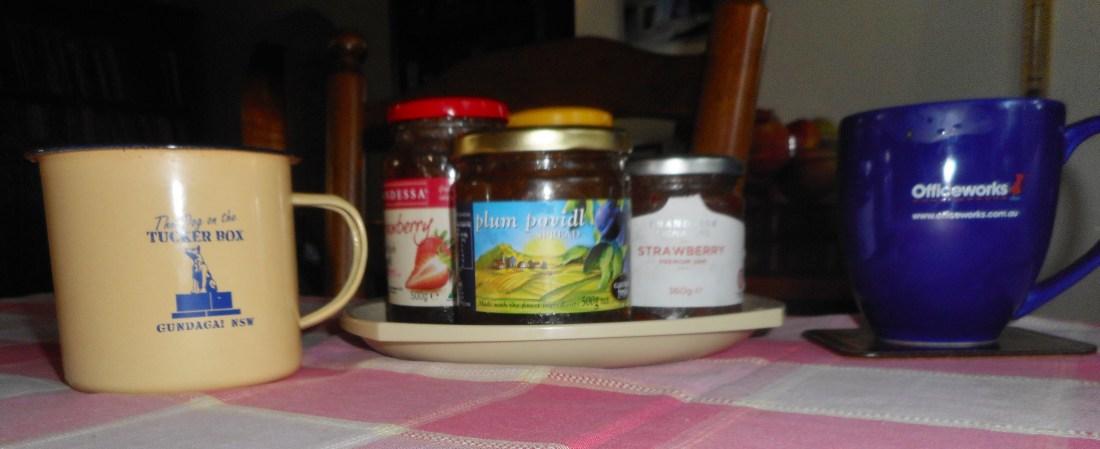
I just want to start with a picture I took the other day of our ‘tray of happiness’. It is really Peter’s ‘tray of happiness’ for I do not think I depend on it for happiness. If I remember correctly, Matthew used to give Peter’s tray with all the different jams on it the above name. This name shows indeed how important for Peter is this tray. There need to be five different jars of jam on it. If only four jars are left. it is time to go shopping for another jar. It is very, very important for Peter that at all times there is an adequate selection of jams on that tray!
DSCN2806
Only four jars of jam left? Well, it must be time to buy a bit more jam!

To the left of the tray is Peter’s mug that he likes to drink his water from. He needs to drink at least two litres of water every day. So every morning a big two litre glass jug is filled with water. That means Peter’s mug to drink out of has to be refilled on a regular basis. The large blue cup on the right side in the picture is Peter’s coffee cup for breakfast.

For old people that we are, it is good to have a daily routine. The difficulty only is that my routine overall is often slightly different from Peter’s. For instance instead of buttered toast with four or five different jams, I prefer to have a cooked breakfast. A good breakfast for me is vegetables and an egg sauted in some butter and served with some green salad leaves. But I usually have for breakfast the same sort of coffee that Peter has. I do not always manage to do some cooking for breakfast. Then I might just have a slice of buttered toast with vegemite and maybe some yoghurt.

In conversation with family we often mention Peter’s ‘tray of happiness’. I think this is why I just did find it easy to write about it. I actually enjoy writing best when I can do it in a conversational way.

The last few weeks were filled with German talk in our house, for Astrid has a very limited knowledge of English. Peter Uwe understands written and spoken English somewhat better and can say something in English if he has to. However he prefers to say everything in German. When I talked to Peter Uwe and Astrid I tried to speak strictly German without any English words added to it. This was at times rather difficult. Sometimes I was lost for the exactly right German word. When I asked Peter to help me out, he often could not find the right German word straight away either!

Yesterday afternoon I joined four other ladies for our Friday games which I had missed while our visitors were around. One of the ladies asked me, whether our German visitors had liked it here in Australia. And I said, that they had enjoyed their stay in Australia very much, and that we had done a real lot of things with them. And we had very much loved to have them here.

Yes, it was a terrific time with them here. When we have visitors from overseas they are always astonished how beautiful the area is we live in. For us it is marvellous too, when we can go to all the different places that we did get to know and love over many years.

Some bloggers that looked at some of my previous posts might remember perhaps a bit about the Illawarra area and beyond. To mention all the interesting places makes really a long list. Even though we could take our visitors to a lot of places, there was in the end not enough time to take them to the Blue Mountains, or to Berry on the South Coast. Also a trip to Canberra or Melbourne could not be fitted in. Peter Uwe had Queensland in good memory from a previous stay in Australia some eighteen years ago. Astrid had never been to Australia. Peter Uwe and Astrid decided to book a one week holiday up in Cairns, Queensland. They did fly to Cairns and stayed in a hotel there. They were lucky with the weather. It was good for swimming and snorkeling.

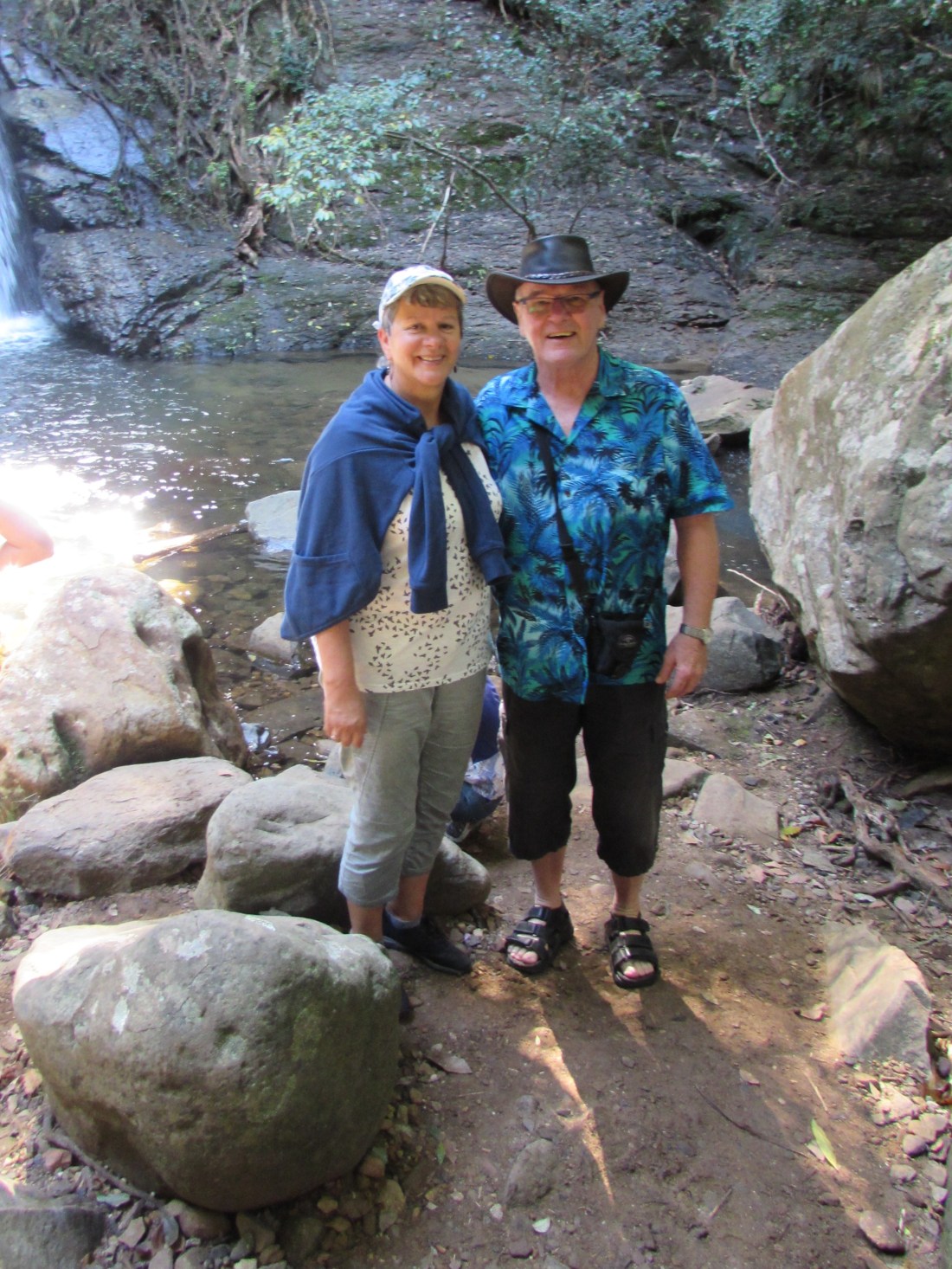
They also loved our solar heated swimming pool in Dapto and went there twice in a row. They were also happy to meet our extended family several times.



17862451_10212975592930124_2699164778960520883_n

IMG_1701 (2)

Plain Packaging of McDonalds and Coke!

I enjoyed reading this post, Gerard, and am going to reblog it. I reckon it is well worth reading. Thank you!

gerard oosterman's avatarOosterman Treats Blog

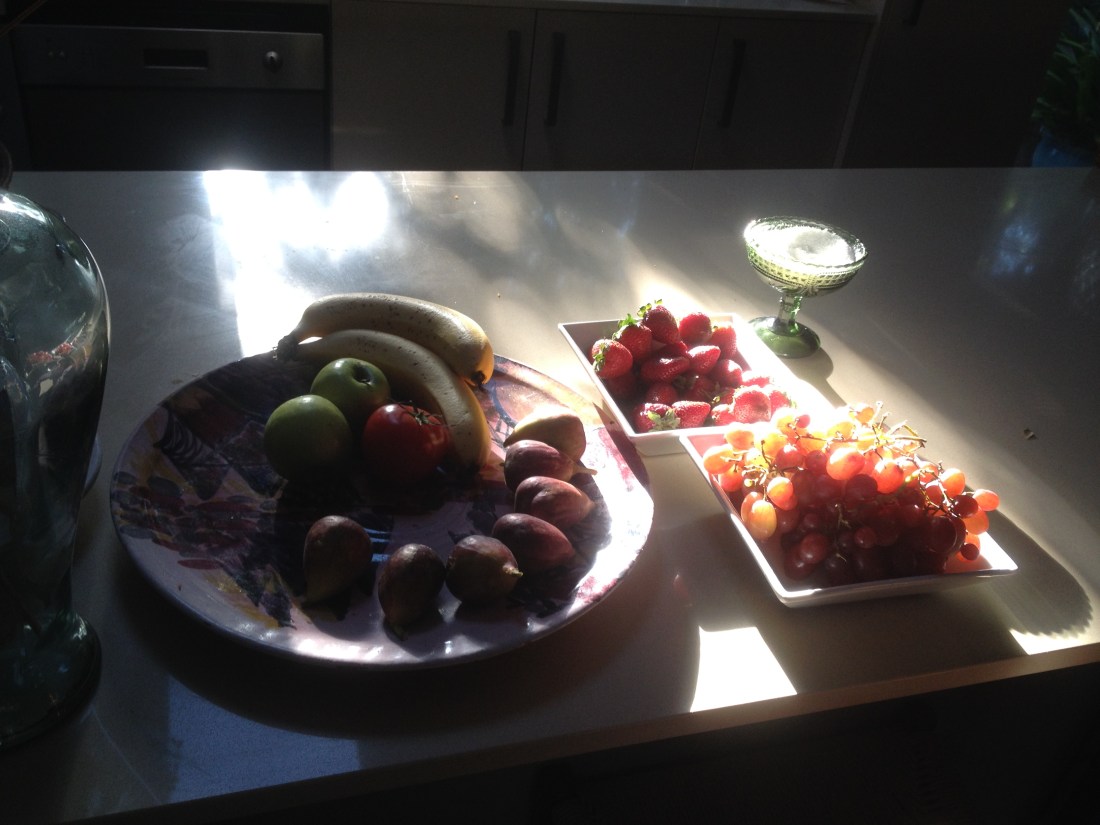
IMG_0815 Grapes, strawberries and figs.

It’s not often that good news greets one on awakening. I was still rubbing my eyes expecting the usual diet of slaughter of innocents or Trump tweets news on my IPhone when I read this article;http://www.abc.net.au/news/2017-05-05/australia-wins-landmark-wto-tobacco-packaging-case/8498750

I nearly broke out in a celebratory waltz. Sorry for the link but let me give you the more salient bits saving you to click on the link.

“Australia’s tobacco plain packaging laws are a legitimate public health measure, according to a World Trade Organisation dispute panel ruling reported by Bloomberg.It cited two people close to the situation as saying the panel had rejected a case made by Cuba, Honduras, Dominican Republic and Indonesia, which argued the laws constituted illegal barriers to trade.Such a ruling from the WTO has been widely anticipated as giving a green light for other countries to roll out similar laws, not only on tobacco but also…

View original post 419 more words

Work! Do you like it or hate it?

Very interesting subject. What sort of life is a healthy life. Does more work make us more healthy?

|||'s avatarsynthetic zerØ

James Livingston says “fuck work”! That was the original title of the book that now appears as No More Work: Why Full Employment Is A Bad Idea (2016).

 For centuries we have believed that work is where we build character, and that the labor market allocates incomes more or less rationally. These beliefs have become delusions. What then? Why do we hold fast to full employment as the cure for what ails us, and retain faith in the labor market’s efficiencies?

Livingston is Professor of History at Rutgers., and delivered this lecture at the University of Pittsburgh on March 18, 2017 as part of boundary 2’s conference, “Neoliberalism, Its Ontology and Genealogy”:

View original post

The 1972 US Coup Against Australia

stuartbramhall's avatarThe Most Revolutionary Act

Hot Money and the Politics of Debt

RT Naylor

McGill-Queens University Press (2004)

Book Review

Hot Money is about the trillions of dollars of global financial activity that is never recorded in official economic statistics. Corporate money laundering of illegal narcotics profits is the form of “hot money” that gets the most publicity. However according to Naylor, it accounts for a relatively small proportion of “hot money” percolating through offshore banks and dummy corporations.

Most “hot money” starts out as funds generated via “legitimate” business which rich elites sebd offshore to avoid taxes or in anticipation of economic calamity or regime change. All the world’s most ruthless dictators stashed funds in Swiss banks or similar financial havens prior to being deposed.

A sizeable chunk of hot money is generated from other illegal enterprises, such as gun running, illegal arms deals, prostitution, phony charities and religious groups (eg Reverend Moon’s Unification…

View original post 250 more words

One Week after Easter 2017


Yesterday, Monday, we did some shopping at the newly refurbished Warrawong Shopping Centre. The above pictures show a quiet corner where we could have a well deserved rest from shopping. We also treated ourselves to some coffee at a newly opened EMPORIUM Coffee shop:


DSCN2709


DSCN2719
During the Easter school holidays the shopping centre provides a lot of entertainment for the children.

Today was a public holiday in Australia. I watched a lot of TV programs for Anzac Day on National Television. Anzac Day is always celebrated on the 25th of April. In a few minutes Peter and I will go to the Dapto Station to pick up my brother Peter-Uwe and Astrid who are coming back from a week’s holiday in Cairns, Queensland. We are looking forward to spending some more days with them before they return to Germany.

Yesterday afternoon was also end of the month residents meeting. This time the meeting was at Aileen’s place. I arrived late at the meeting. The other women, six in all, were already there. Everyone had brought some snacks for afternoon tea/coffee:

Some Figures from the Australian Taxation Office

This is what Michael Lacey says today in a comment:

michael laceyApril 23, 2017 at 8:39 am

Recent figures from the Australian Taxation Office show that in the 2014-15 tax year, 48 millionaires paid no Australian tax at all on earnings of $110 million, but paid accountants and tax advisers over $20 million.

I found the following in Google:

https://www.ato.gov.au/…ATO/…statistics/…/Taxation-statistics/Taxation-statistics-201…
3 days ago – These statistics look at the tax returns and related schedules for the 2014–15 income year for individuals, companies, superannuation (super) …

http://www.ato.gov.au/

But always get this:

This site can’t be reached

Insiders

Insiders - Insiders - Episode 10

Insiders

Series 2017 | Episode 10CCCURRENT AFFAIRS58 mins

Barrie Cassidy interviews the Immigration Minister, Peter Dutton. On the panel: Phil Coorey, Katharine Murphy & Niki Savva plus Mike Bowers talks pictures with blogger Jack the Insider. #Insiders

Barrie Cassidy presents Australia’s most popular political program. Insiders speaks with the key players, providing analysis, opinion & robust debate from the country’s leading political commentators. #Insiders

https://www.theguardian.com/australia-news/2017/apr/21/png-police-reject-peter-dutton-account-manus-shooting

I publish here part of what Helen Davidson says in The Guardian:

Helen Davidson is a re oporter for Guardipublisan Australia, based in Darwin.

The top police officer on Manus Island has flatly rejected the Australian immigration minister’s claim that a shooting last Friday was sparked by detainees taking a five-year-old boy into the detention centre.

The regional police commander, David Yapu, told Guardian Australia Peter Dutton’s comments were completely wrong, and maintained that the shooting began when an altercation between navy personnel and asylum seekers escalated.

“It’s a total separate incident altogether,” he said. “The incident that transpired on Friday was because a duty soldier was being assaulted by one of the asylum seekers or refugees.”

Yapu said a young boy had gone to the centre to ask for food about two weeks ago, but he was not led there and was 10, not five. The boy’s parents had not made a complaint, and police were not investigating any link between his visit and the shooting.

Last Friday evening multiple shots were fired at and around the immigration detention centre. Asylum seekers, refugees and centre staff cowered in rooms or ran into the jungle to escape the rampage, which Yapu blamed on “drunken soldiers”.

The navy and Yapu said detainees had refused to leave a soccer field on the naval base and accused an asylum seeker of assaulting a soldier – which detainees who spoke to the Guardian denied. The situation then escalated and at least two people were injured. The navy said asylum seekers had thrown rocks and all parties acknowledged soldiers were shooting.

But on Thursday, Dutton alleged the shooting occurred after local people witnessed asylum seekers leading a five-year-old boy towards the centre.

“I think there was concern about why the boy was being led, or for what purpose he was being led, away back into the regional processing centre,” he told Sky News.

“I think it’s fair to say that the mood had elevated quite quickly. I think some of the local residents were quite angry about this particular incident and another alleged sexual assault,” he said, while conceding he did not have “full details”.

The comments formed Dutton’s only public statement on the shooting since it happened a week ago.

Dutton’s account, which mirrored a witness’s statement to News Corp last week, was wrong, Yapu said.

On social media detainees also disputed Dutton’s statement, saying the allegation related to an incident two weeks ago when a young boy asked for some food and detainees told him to stay at the doorway while they gathered some up. Benham Satah said several CCTV cameras would have captured the visit and called for Dutton to release the footage.

“Security came to them later that night and asked what [the] child was doing and they explained and security left,” he said.

“My friends who were there say we are ready to testify and request for camera records of this false accusations.”

The Greens senator Nick McKim told Guardian Australia Dutton had been caught telling an “outrageous lie” and should either “resign or be sacked”.

“This is on top of consistent failures to protect vulnerable people to whom he owes a duty of care,” McKim said.

“If he won’t go the PM ought to sack him. This has disturbing echoes of the children overboard lies.”

Just now, in Insiders’ interview with Immigtation Minister Peter Dutton, Barrie Cassidy refers to the incident on Manus Island from 21st April 2017.  . . . . “

When Cassidy refers to certain facts from the above incident on Manus Island, Dutton says: “I give you the Facts!”

Interesting facts, indeed!

A Vision for the Future?

http://rightnow.org.au/opinion-3/a-brief-history-of-villawood-and-a-vision-for-the-future/

A brief history of Villawood and a vision for the future

BY SADIE GRANT BUTLER

Villawood

Villawood Migrant Hostel was established shortly after the end of World War II in order to accommodate assisted migrants from Britain and Europe, including those displaced by the war. The grounds formerly comprised the Leightonfield Munitions Factory, which was replaced by a sea of pre-fabricated, corrugated iron dome structures called “Nissen huts”, with the establishment of the hostel. These basic little structures, each taking about four hours to erect, were the homes of many new migrants who arrived in Australia from 1949 onwards.

Although the huts were located within a compound, the residents were permitted to come and go freely. Children attended the local schools and their parents worked in local businesses, saving their money to leave the hostel and establish new lives, usually within the local community where they were already immersed. The hostel itself was a community, complete with a post office, linen store and childcare centres.

Photographs from that period show children playing cricket, posing in their school uniforms and stringing Christmas decorations from the curved roofs of their huts. A resident of the area at that time recalls strolling into Villawood regularly to play table tennis and visit mates, and another describes Villawood fondly as “a great place to arrive at in 1960”. In 1964 the hostel was home to 1425 residents and it was around this time that The Easybeats were established, which, for those too young to remember, was the Australian “It” band of their day formed by five new migrants from three different countries who called Villawood home.

But of course, photographs do not tell the entire story, and there is a tendency to imbue old times with a warm nostalgic glow that belies the severe realities of life. For those migrating from cold European climes, the Western Sydney sun beating down on those sheds was unbearably hot and humid at times. The conditions were cramped, with multiple, large families sharing small quarters, described by some former residents as putrid and shocking. Hostel resident Patricia Donnelly put it bluntly, “Nothing in the hostels, where most people went, was as it was shown in the brochures. Hostel life was terrible.”

Asylum seekers who arrived by boat from Vietnam in the 1970s were housed with refugees who had already been granted visas. These asylum seekers were not allowed to leave the hostel while they were being processed, but processing was swift and there was no moral question hanging over their heads. There was no suspicion about whether they were “real refugees”. The Government understood why the Vietnamese boat people were fleeing, and why they were doing so as quickly as they could.

In 1992, mandatory detention was introduced. The 1958 Migration Act had allowed for discretionary detention of those who arrived without a visa, and the government had been exploiting this discretion to detain the increasing number of Cambodian refugees arriving since 1989. In 1992 a number of detainees applied for judicial review of the decision to detain them. Pre-empting the result of the case, the Keating Government, with the support of the Coalition, amended the Migration Act to undercut future applications for judicial review on the same grounds.

According to then-immigration minister Gerry Hand, the amendment was intended “only as an interim measure” to contain the number of Vietnamese, Cambodian and Chinese boat arrivals – yet it remains in force more than 23 years later. Hand’s fierce declaration that “a clear signal be sent that migration to Australia may not be achieved by simply arriving in this country and expecting to be allowed into the community” represents the beginning of the misguided conflation of the term “asylum seeker” with the umbrella term “migrant”, which remains to this day in the Australian dialogue. Al Jazeera has recently announced that they will no longer use the term “migrant” where “asylum seeker” or “refugee” is appropriate  we can only hope to see the media take a similar stance here.

“Australia, with its boundless plains to share,
could become a country renowned for its
compassion instead of its cruelty.”

People seem to have trouble imagining an Australia without mandatory detention for boat people, but mandatory detention is relatively new. It is not difficult to imagine a future policy that acknowledges the right of a person to ask for our help, a policy that does not completely strip a human being of their freedom, dignity and hope. Malcolm Fraser’s Coalition Government dealt with Vietnamese boat people by accepting, housing and processing those who made the journey, whilst simultaneously increasing humanitarian intake in an effort to reduce the numbers making the inarguably dangerous journey.

Australia’s relative geographical isolation means that we are unlikely to ever be at risk of a constant stream of boats, but the number of refugees in the world – 19.5 million at last count and ever increasing – will not decrease simply because we turn our back on them. Increasing humanitarian intake, and directing funds into rescue measures rather than punitive measures, is the way to stop deaths at sea.

For better or for worse, modern Australia is a country founded on immigration of many kinds. Apart from our Indigenous population, the rest of us are descended from persons from elsewhere – convicts, refugees, those seeking employment, better living conditions, sun and sea.

If we strain our imaginations, with the aid of a few sepia photographs, perhaps we can imagine creating the conditions under which human beings who have suffered incredible trauma are be able to recover and flourish. Perhaps we can imagine ridding our country of immigration detention centres and recreating, and improving upon, hostels like the old Villawood Migrant Hostel. Australia, with its boundless plains to share, could become a country renowned for its compassion instead of its cruelty.

Sadie Grant Butler is a philosophy student, writer and activist from Sydney. She tweets sporadically @spadiegb

Feature image: Kate Ausburn/Flickr