The Innovation Australia website has another cracking story. What’s the reward for the government’s vaccine rollout failure? A million dollars a month.
Over to InnovationAus:
The federal government is paying global consulting giant PwC nearly $1 million per month across 2021 to assist with its troubled COVID-19 vaccine rollout, under a previously secret contract released publicly nine months after it was signed and nearly eight months after government was obliged to make it public.
The Department of Health entered into a contract with PwC worth $11.4 million on 14 December last year, running until 14 December 2021, for “COVID-19 vaccination program management support”…
PwC’s role in the work was announced by Health Minister Greg Hunt on Christmas Eve, but no contract was posted to AusTender and further details on its work have been significantly restricted, and no information has been provided on what has been delivered by PwC.
The contract, which will see PwC paid $950,000 per month for all of 2021, was issued following a closed tender process, with the Department using an exemption due to its necessity to “protect human health”.
PwC is acting as the federal government’s “program delivery partner for the vaccine rollout”.
And how did this scandalous “previously secret contract” get made public. That’s a second scandal of its own:
Despite signing the contract nearly nine months ago, it was only made public last week, on the same day InnovationAus published a story on the lack of a contract with PwC for its vaccine rollout work, and after questions were put to the Department on this issue.
The Department said the contract was kept secret due to it being “incorrectly registered” as being exempt from reporting. The exemption does not, however, apply to consultancy services, and the error was picked up by “routine assirance activities” with a correction made “as quickly as practicably”, a department spokesperson told InnovationAus.
The government can’t manage its own programs, can’t provide fundamental accountability — but is going to keep us safe from the virus.
Yeah. Right.Got something to add? Join the discussion and comment below.
“Interestingly, when the researchers separated the individuals who had severe enough illness to require hospitalization, the results were the same as for those who had experienced milder COVID-19. That is, people who had been infected with COVID-19 showed a loss of brain volume even when the disease was not severe enough to require hospitalization.”
With more than 18 months of the pandemic in the rearview mirror, researchers have been steadily gathering new and important insights into the effects of COVID-19 on the body and brain. These findings are raising concerns about the long-term impacts that the coronavirus might have on biological processes such as aging.
As a cognitive neuroscientist, my past research has focused on understanding how normal brain changes related to aging affect people’s ability to think and move – particularly in middle age and beyond. But as more evidence came in showing that COVID-19 could affect the body and brain for months or longer following infection, my research team became interested in exploring how it might also impact the natural process of aging.
Peering in at the brain’s response to COVID-19
In August 2021, a preliminary but large-scale study investigating brain changes in people who had experienced COVID-19 drew a great deal of attention within the neuroscience community.
In that study, researchers relied on an existing database called the UK Biobank, which contains brain imaging data from over 45,000 people in the U.K. going back to 2014. This means – crucially – that there was baseline data and brain imaging of all of those people from before the pandemic.
Get news that’s free, independent and based on evidence.
Get newsletter
The research team analyzed the brain imaging data and then brought back those who had been diagnosed with COVID-19 for additional brain scans. They compared people who had experienced COVID-19 to participants who had not, carefully matching the groups based on age, sex, baseline test date and study location, as well as common risk factors for disease, such as health variables and socioeconomic status.
The team found marked differences in gray matter – which is made up of the cell bodies of neurons that process information in the brain – between those who had been infected with COVID-19 and those who had not. Specifically, the thickness of the gray matter tissue in brain regions known as the frontal and temporal lobes was reduced in the COVID-19 group, differing from the typical patterns seen in the group that hadn’t experienced COVID-19.
In the general population, it is normal to see some change in gray matter volume or thickness over time as people age, but the changes were larger than normal in those who had been infected with COVID-19.
Interestingly, when the researchers separated the individuals who had severe enough illness to require hospitalization, the results were the same as for those who had experienced milder COVID-19. That is, people who had been infected with COVID-19 showed a loss of brain volume even when the disease was not severe enough to require hospitalization.
Finally, researchers also investigated changes in performance on cognitive tasks and found that those who had contracted COVID-19 were slower in processing information, relative to those who had not.
While we have to be careful interpreting these findings as they await formal peer review, the large sample, pre- and post-illness data in the same people and careful matching with people who had not had COVID-19 have made this preliminary work particularly valuable.
What do these changes in brain volume mean?
Early on in the pandemic, one of the most common reports from those infected with COVID-19 was the loss of sense of taste and smell.
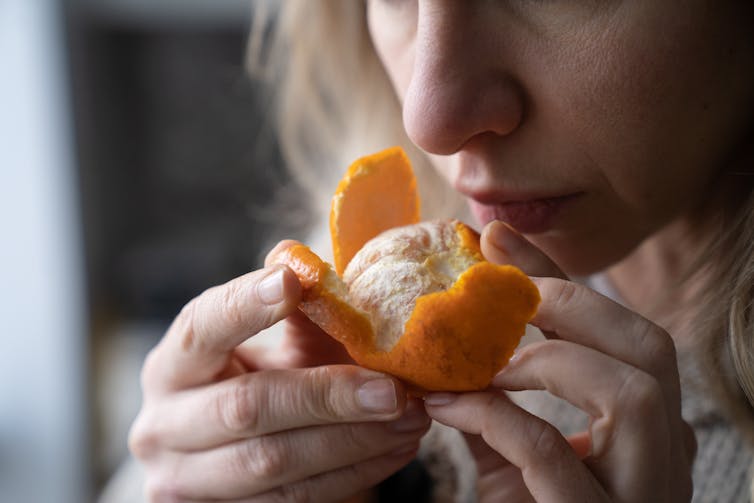
Some COVID-19 patients have experienced either the loss of, or a reduction in, their sense of smell. Dima Berlin via Getty Images
Strikingly, the brain regions that the U.K. researchers found to be impacted by COVID-19 are all linked to the olfactory bulb, a structure near the front of the brain that passes signals about smells from the nose to other brain regions. The olfactory bulb has connections to regions of the temporal lobe. We often talk about the temporal lobe in the context of aging and Alzheimer’s disease because it is where the hippocampus is located. The hippocampus is likely to play a key role in aging, given its involvement in memory and cognitive processes.
The sense of smell is also important to Alzheimer’s research, as some data has suggested that those at risk for the disease have a reduced sense of smell. While it is far too early to draw any conclusions about the long-term impacts of these COVID-related changes, investigating possible connections between COVID-19-related brain changes and memory is of great interest – particularly given the regions implicated and their importance in memory and Alzheimer’s disease.
Looking ahead
These new findings bring about important yet unanswered questions: What do these brain changes following COVID-19 mean for the process and pace of aging? And, over time does the brain recover to some extent from viral infection?
These are active and open areas of research, some of which we are beginning to do in my own laboratory in conjunction with our ongoing work investigating brain aging.
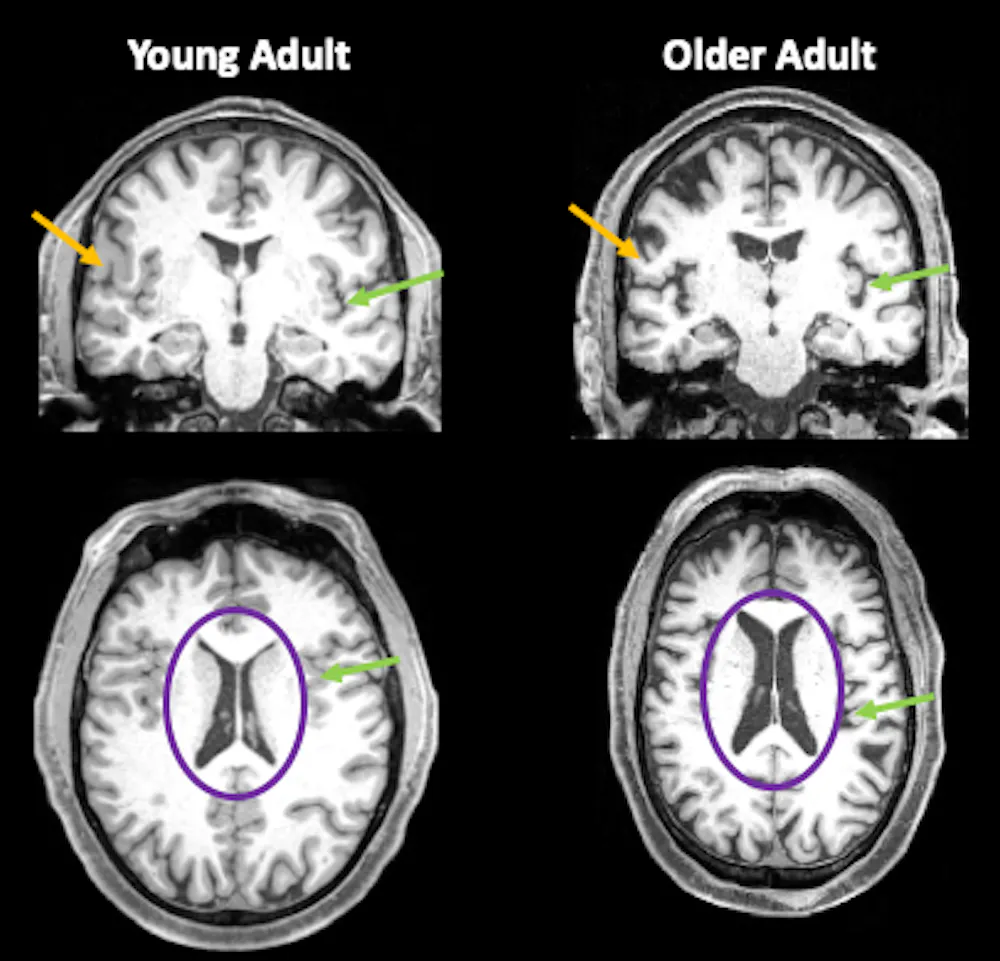
Brain images from a 35-year-old and an 85-year-old. Orange arrows show the thinner gray matter in the older individual. Green arrows point to areas where there is more space filled with cerebrospinal fluid (CSF) due to reduced brain volume. The purple circles highlight the brains’ ventricles, which are filled with CSF. In older adults, these fluid-filled areas are much larger. Jessica Bernard, CC BY-ND
Our lab’s work demonstrates that as people age, the brain thinks and processes information differently. In addition, we’ve observed changes over time in how peoples’ bodies move and how people learn new motor skills. Several decades of work have demonstrated that older adults have a harder time processing and manipulating information – such as updating a mental grocery list – but they typically maintain their knowledge of facts and vocabulary. With respect to motor skills, we know that older adults still learn, but they do so more slowly then young adults.
When it comes to brain structure, we typically see a decrease in the size of the brain in adults over age 65. This decrease is not just localized to one area. Differences can be seen across many regions of the brain. There is also typically an increase in cerebrospinal fluid that fills space due to the loss of brain tissue. In addition, white matter, the insulation on axons – long cables that carry electrical impulses between nerve cells – is also less intact in older adults.
As life expectancy has increased in the past decades, more individuals are reaching older age. While the goal is for all to live long and healthy lives, even in the best-case scenario where one ages without disease or disability, older adulthood brings on changes in how we think and move.
Learning how all of these puzzle pieces fit together will help us unravel the mysteries of aging so that we can help improve quality of life and function for aging individuals. And now, in the context of COVID-19, it will help us understand the degree to which the brain may recover after illness as well.
Producing evidence-based journalism comes at a cost. At a time when Australian media is in crisis, The Conversation produces trusted news coverage written by experts and we rely on donors to keep our lights on. If you value us, please show us by becoming a monthly donor.
Cameron Stewart says: “The vaccinated feel they need protection from the unvaccinated — but if the vaccinated are somewhat protected and can spread the disease, isn’t it the other way around? It is the unvaccinated who need protection from the vaccinated.”
I think he has a point there. However, I would say, even if I am fully vaccinated, I am in danger of being infected by someone who may be fully vaccinated too, for I do not want to end up with Covid even if it is in a mild form; for living on my own, I think I may be in danger of being admitted to a Covid ward, even with a mild form of the disease, since I might not be able to look after myself and be needing some sort of full time care.
It is true, I might have a good chance of recovering from the disease if I am being treated in a Covid ward. But being treated in a Covid ward, do I have the guarantee that they let me die a natural death if my condition worsens? And are they willing to let my children see me before I die?
Speaking about costs. This is what Cameron Stewart says: “Australia’s new two-tier vaccination society is almost certainly going to be a temporary one. The costs on businesses and governments of enforcing the rules indefinitely would be exorbitant.”
So, enforcing the rule is going to be too costly? He may be right, for we have to look only at overseas experiences in some other countries. I reckon, we should really learn something from these experiences in some other countries! 🙂
Thirty-four are from the Wollongong local government area (LGA), 20 are from Shellharbour, five are from the Kiama LGA and three are in the Shoalhaven.
Only 24 are linked to previously reported cases.
Dr Chant urged residents in the region to book in for a vaccination and get tested.
“I want to highlight that we are seeing increasing cases in the Illawarra area, in the Wollongong, Shellharbour and Kiama area,” she said.
“Please come forward and get vaccinated.”
A woman in her 80s and a man in his 70s died in Wollongong Hospital on Tuesday.(Supplied: ISLHD)
‘High risk’ premises
There were three new cases recorded in the Wingecarribee Shire, bringing the total cases confirmed in the LGA since the beginning of the Delta outbreak to 32.
There were no new cases reported from two apartment buildings under lockdown in Wollongong, but NSW Health officially declared the 35-room Piccadilly Motor Inn on Crown Street a “high risk” premises.
Tuesday was the 21st of September, my birthday. I did not only have a Great Day, but also a great week. It reminded me of my 80th birthday in 2014, when I was celebrating for days on end.
The following link leads to my posts from September 2014:
After the card games we asked everyone over to our unit for some drinks of sparkling wine. We had a few bottles of this and Caroline poured the sparkling wine into these blue wine glasses. We were able to use the glasses from all the different units. I mentioned that I was looking forward to my approaching birthday. I actually sang a song about my approaching birthday which may have impressed a few people!! Ha,ha. Anyhow, I was in a cheerful mood.
Here is the song (the German version);
Ich freue mich, dass ich geboren bin und hab Geburtstag bald. Man hat mich lieb und schenkt mir viel, zum Essen, Trinken und zum Spiel. Ich freue mich, dass ich geboren bin und hab Geburtstag bald.
The following day, Sunday, after lunch all the units had to be cleaned before we could leave. Some people were still cleaning while others were waiting outside. Here I am with the group of people who were waiting.
Ryan had come with a van and could take in it all of our stuff that did not fit into our car.
We drove back along this road. 40 means 40 kilometres.
Abbas Nazari’s memoir couldn’t have come at a more poignant time as he watches his country fall to the same forces his family escaped from 20 years ago.
In After the Tampa: From Afghanistan to New Zealand, Nazari recounts a harrowing journey to leave Afghanistan at the age of 7 and being rescued by the MV Tampa, which resulted in an international diplomatic rift.
Graduating from the University of Canterbury, pictured with his mother and father.
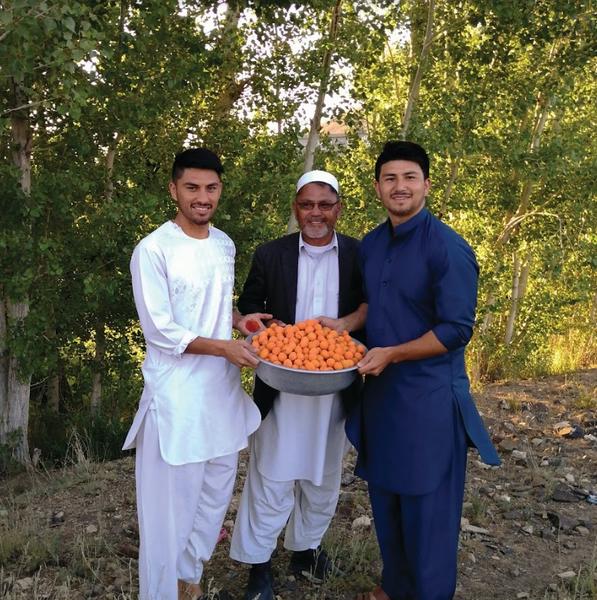
Ali (left), his father (middle) and Abbas helping a Sungjoy family with their apricot harvest in 2017.
First day of school in Pakistan.
Talking to NZ with Mike McRoberts one week after 15th March.
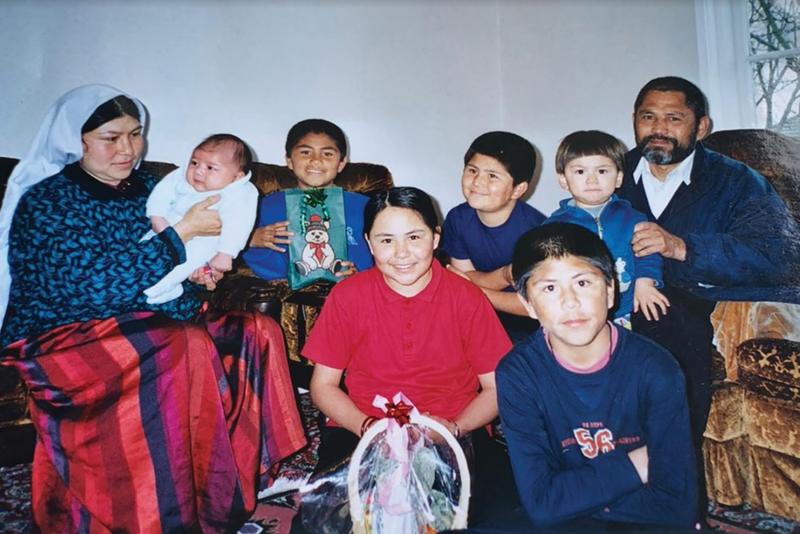
The Nazari clan one year into their lives in Christchurch.
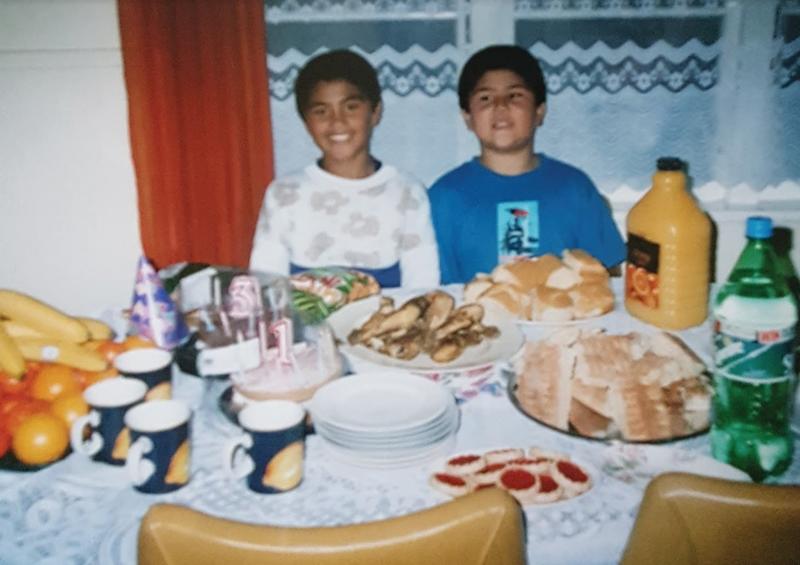
Ali and Abbas learnt about birthdays at school and convinced their mum to throw a joint party.
Nazari’s story echoes the agonising decisions some in Afghanistan are having to make at every turn.
“The war is coming in and it’s getting more dangerous by the day and so [my parents] had a choice, do we stay and face persecution or potential killing by the Taliban? Or do we pack up our things and seek security elsewhere? And for my parents back then, that was across the border in Pakistan,” Nazari tells Jim Mora.
“There’s so many points along the way where they had to make a decision, to stay or to go into the unknown.”
With the persecution of the Hazaras ethnic minority in Afghanistan, his family became fearful. Having Central Asian genes, speaking a different language, and with most belonging to the Shia’a sect of Islam, they were a visible target, Nazari says.
“Over centuries, that has meant we are an ‘other’, a minority group that is unwanted in the land of the majority.
“In the book, I detail countless instances of massacres, of genocidal acts, culminating with the Taliban takeover and the many massacres and atrocities they committed against the Hazaras Afghans. That is a genuine fear, that now with the Taliban back in power, that they’ll continue what they started in the ’90s.
“Right now when viewers and readers are tuning in to the harrowing images of what’s happening in Afghanistan … we see statistics and crowds of people, but each person there is an individual story, where they’ve either had to say goodbye to their families, where they’ve had their families killed, or whether they’ve had absolute fear of staying because they might be an ethnic minority, a translator, or a woman.
“All that is lost when we talk about what’s happening in Afghanistan.”
The Taliban have claimed that their rule will be different to last time, while Nazari hopes that will be true, he says “their actions speak louder than words”.
“Keep in mind, they’re incredibly tech-savvy now. They have biometric data from all the technology they’ve seized, so they know exactly who has worked with the foreign troops, they know exactly who the journalists are, who the critical thinkers are, and they know exactly where people live.”
Now there’s a sea of people surrounding Kabul Airport, and Nazari says even though they probably have tickets to get out, militants are controlling the checkpoints and have been firing bullets over the crowds to make them withdraw.
His own journey to cross the border was troublesome, he says, when “every second feels like an eternity.”
Barely getting through there to Pakistan and finally Indonesia, they get on a rickety fishing boat with more than 400 asylum seekers, heading to Australia.
“That chapter describes the rollercoaster of emotions we went through. We were in the belly in the hull of the ship that was being torn apart by the wave, I remember the decking falling apart, holes in the sides, the beams are splitting and people are sliding across those decks … and it was the most horrendous experience I’ve ever been through … that particular night is installed in high definition in my memory.
“I remember one of the parents next to me, gripping on to his child, and his prayer he uttered was something along the lines of ‘oh God, if we were to die tonight then let our bodies wash ashore so we can be buried on land’. What more do you need to show how desperate and fearful people were about their circumstances.”
They were rescued by cargo ship Tampa, which was refused entry by Australia and spent 35 days at sea before New Zealand struck a deal to take in 150 people, among them Nazari’s family.
“That was one of the happiest times of my life … I learned my ABCs at Mangere, I remember eating all the mounds of food we were given.
“And how starkly different my life was to the 300-odd men and single dads and elder sons who had ventured alone, who were sent to Nauru, some who would spend three years there before they were given resettlement elsewhere.”
While the story of escaping the violence can be quite grim and dark, Nazari also hopes to show through his book that Afghanistan has known peace before and believes it can be accomplished again.
Nazari is now a Fulbright scholar, and recently came back to Aotearoa from his studies in the United States at Georgetown University. He was due to appear alongside former prime minister Helen Clark at a WORD event – which has now been cancelled due to the Covid-19 outbreak.
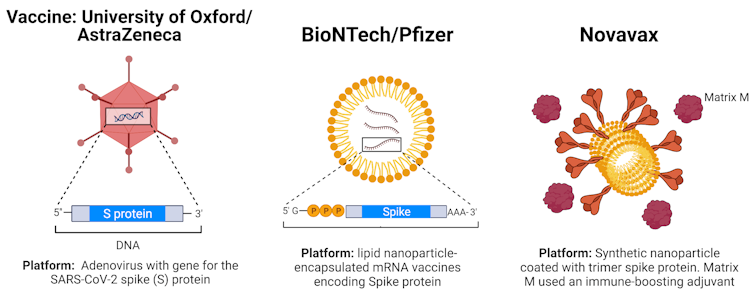
The Novavax vaccine uses a version of the spike protein made in the lab. The spike proteins are assembled into tiny particles called “nanoparticles” which aim to resemble the structure of the coronavirus, however they cannot replicate once injected and the vaccine cannot cause you to get COVID-19.
In order for these subunit vaccines to generate strong protective responses, they need to include molecules that boost your immune system, called “adjuvants”. The goal of these adjuvants is to mimic the way the real virus would activate the immune system, to generate maximum protective immunity.
COVID Vaccine Rollout: Anthony Albanese has slammed Prime Minister Scott Morrison for the delay in Australia’s Novavax vaccines. 51 million doses expected to arrive later this year will now only be available from 2022, which the Opposition Leader says is a “further setback” on Australia’s road to recovery from COVID-19.
“Scott Morrison had two big jobs this year – the rollout of the vaccine and effective national quarantine – and unfortunately, both of them have been botched.” Share this:
How does the Novavax vaccine work?
The Novavax vaccine is given as two doses, similar to the Pfizer and AstraZeneca shots already being used in Australia.
It can be stored for up to three months at fridge temperature, which differs from the Pfizer mRNA vaccine which needs to be kept at ultra-low temperatures. In saying that, the TGA said last week the Pfizer vaccine can be stored at normal freezer temperatures for two weeks during transport, and at fridge temperatures for five days — though must still be kept ultra-cold after transport and in the long-term.
Comparing Australia’s three COVID-19 vaccine options. Jamie Triccas, made with BioRender, CC BY-ND
The vaccine also uses a different technology to the Pfizer and AstraZeneca vaccines. It’s a “protein subunit” vaccine; these are vaccines that introduce a part of the virus to the immune system, but don’t contain any live components of the virus.
The protein part of the vaccine is the coronavirus’ “spike protein”. This is part of the other COVID-19 vaccines in use but in a different form.
The Novavax vaccine uses a version of the spike protein made in the lab. The spike proteins are assembled into tiny particles called “nanoparticles” which aim to resemble the structure of the coronavirus, however they cannot replicate once injected and the vaccine cannot cause you to get COVID-19.
In order for these subunit vaccines to generate strong protective responses, they need to include molecules that boost your immune system, called “adjuvants”. The goal of these adjuvants is to mimic the way the real virus would activate the immune system, to generate maximum protective immunity.
How effective is the vaccine compared to those already in use in Australia?
The interim data from phase 3 testing, released in March, was very encouraging. When tested in the UK in a clinical trial including more that 15,000 people, the vaccine was 96% effective at preventing COVID-19 disease for those infected with the original strain of the coronavirus.
This compares well to the Pfizer vaccine, with an efficacy of 95%, and recent data from AstraZeneca demonstrating 76% efficacy against COVID-19.
The Novavax vaccine is also safe. In early clinical testing the vaccine caused mainly mild adverse events such as pain and tenderness at the injection site, and no serious adverse reactions were recorded. In the larger trials, adverse events occurred at low levels and were similar between the vaccine and placebo groups.
In a statement on Friday morning, the company said it expects “to initiate [a] Phase 1 clinical trial in Australia later this year”.
Australia has already been key to Novavax’s development of its standalone COVID-19 vaccine, with an ongoing US-Australian study applying the initial two doses to local volunteers and then giving certain participants boosters
gerard oostermanEditHappy Birthday Uta from us at Bowral. Gerard & Helvi.“Lang zal ze leven” Hiep Hiep Hoera!Reply
berlioz1935EditI think you had a really great day. Here is a little musical treat from Indiahttps://www.youtube.com/embed/FWbRuUE5E9M?version=3&rel=1&showsearch=0&showinfo=1&iv_load_policy=1&fs=1&hl=en&autohide=2&wmode=transparentReply
auntyutaEditI love this musical treat from India. Thank you for this, Peter. Yes, I had a really great day and I thank everyone for their good wishes to my 80th birthday. Thank you very much for all your comments!Reply
The EmuEditMy apologies for a very late acknowledgement of a great milestone in your life May your birthday year bring you much happiness, and beautiful recollections of the love of your family, and all those who have been privileged to be a part of your life. Kindest regards Ian and AnaReply
auntyutaEditThank you so much, Ian and Ana, for your lovely wishes . Yes, I regard this birthday as a great milestone! Have a great week! Love, UtaReply
Holistic WayfarerEditPhotos are simply beautiful. I trust it was a special day with loved ones. I am so happy to see more comments on your blog.Love, DianaReply
auntyutaEditIt was for me a very special day indeed, Diana. Thank you so much for commenting. Love, Uta
Well it seems as if the new boogeyman of the 21st century is fully established. Instead of drumming up fear and paranoia at the idea of ‘Reds Under the Bed‘ as was done in the past our governments have now determined that all our fear focused hate should be turned in the direction of those who follow the Muslim faith. In short we should all fear the ‘Burqa Under the Bed‘ [courtesy of Yvette Scholtmeyer].
Regardless of the political tap dancing our world leaders use to present the idea that they are only interested in those who are extremist in their faith to the point of violence against others the facts are that they have stirred up a mighty brew of xenophobic fear and hatred. How easy it is to cast stones at those whose beliefs differ to ours especially when we do little…
Well it seems as if the new boogeyman of the 21st century is fully established. Instead of drumming up fear and paranoia at the idea of ‘Reds Under the Bed‘ as was done in the past our governments have now determined that all our fear focused hate should be turned in the direction of those who follow the Muslim faith. In short we should all fear the ‘Burqa Under the Bed‘ [courtesy of Yvette Scholtmeyer].
Regardless of the political tap dancing our world leaders use to present the idea that they are only interested in those who are extremist in their faith to the point of violence against others the facts are that they have stirred up a mighty brew of xenophobic fear and hatred. How easy it is to cast stones at those whose beliefs differ to ours especially when we do little…
15 thoughts on “Burqas Under the Bed – Fabricated Fear for the New Millennium”
Jenni Thanks for the re-blog – it’s good to see that people understand how badly we are being manipulated.Reply
auntyuta Since I just turned 80. Jenni, I can remember what it was like in Germany under the Nazi regime. How relieved we were when there was peace and freedom after World War Two!Reply
JenniEditIt’s too easy to forget just how much things can go wrong when people don’t speak out and just let things go until it reaches a point when it is no longer possible to speak out. History paints a very clear picture of what such actions bring but humanity just can’t seem to learn from the past. Frustrating is too mild a word for it but fortunately due to the internet those who want to speak out have a voice those in the past didn’t have access to. Although I’m pretty sure the Abbott government is taking steps to tighten control over social media.
auntyutaEditMy goodness, Jenni, you seem to think on much the same wave length. – Yes, luckily the internet can be used to make our views known – Well, so far it is possible. Thanks for that.
likeitizEditThis is very sad to read about, Aunty Uta.By the way, my nephew, who went to live in Sydney for a year of training for his company, is back here on vacation. He says he’s enjoying his life in Sydney.Reply
auntyutaEditSydney has become very expensive but we love to go there for a visit. You can find some very enjoyable places in Sydney. Thanks for commenting, dear Mary-Ann. Who knows where we are going in future?Reply
likeitizEditBTW, my daughter just got engaged. Her boyfriend of 7 years has proposed. I feel that they are still young, but what the heck! It’s not my life. Guess what! He was born in Washington D.C. but when he was barely 2 years old, his parents moved to Sydney. He came back to study at Stanford University for college and that’s where he met my daughter! Small world, Aunty!And yes, he has an Australian accent.
auntyutaEditAmazing, Mary-Ann. Such a small world!
gerard oosterman Australia would be better of looking at our rate of youth unemployment which is almost 15%. They are spending 500.000.000.- a year on exercising their pyrotechnical toys bombing far away sandy countries. On top of that billions on keeping a few boat people away by the Australian defence Force and keeping them locked up in detention/jails. With that money they could have kept our manufacturing motor industry and other large employers of people. It is no wonder the young are disillusioned and seek adventure and excitement elsewhere.Reply
auntyuta I totally agree, Gerard, the money is not spent the way it should be spent. I say, this is very sad state of affairs. It shows that our so called democracy is not working very well. So far it does not effect me personally. I have a good life and nothing to complain about. Still, this does not make me happy go lucky. It is so terrible to think about how more and more people in our own society have no prospects, absolutely none. What causes are the young ones going to fight for? I don’t like it.I am officially old now for I am 80; but all this makes me frightened for future generations. Even for well off people there is eventually going to be less and less security in this kind of a world. As Jenni says: ” . . . . humanity just can’t seem to learn from the past.”The years when government did not seem to do too much wrong, are long gone. Now they are making more and more mistakes, the same mistakes that had been done by other generations in other countries. Do they learn from the mistakes of the past? Of course not. All their actions are being rationalised to make people believe they do the right thing. And so it goes. . . . .Reply
stuartbramhall Great find. Thanks for sharing. I see Abbott is copying Obama’s and Bush’s old trick of scaring people to death to keep them from seeing how incompetent he is.Reply
Team OyeniyiThank you for the introduction to Jenni! Love her work!Reply
auntyutaEditI love it too, Robyn. Yes, she does good work.I am glad that you love it.












 cardamone5


 AuntyUta