In my memory sticks a meeting with a woman on a small farm outside Lodz, which was called ‘Litzmannstadt’ at the time. One day Grandmother wanted to buy eggs from the farm where she had been buying eggs for years. She took me along for the ride in the Pferde-Droschke (horse drawn taxicab). I cannot remember any other time, when I was allowed to go out with her. So this was really something very special for me. I was thrilled, that Grandmother had chosen me to accompany her!
Grandmother greeted the farm-woman in a very friendly manner and proudly introduced me, saying: ‘This is my grand-daughter, She is here for a visit from Berlin.’ The woman seemed very happy to see my grandmother. With a big smile she greeted both of us. Grandmother did not enter the small farmhouse, but handed the woman her very large basket asking her to fill it up please. The woman left and soon returned with the basket full of lovely large hen-eggs, about thirty of them. Then the women talked a bit more.
The farm-woman enquired about Grandmother’s family. She seemed to know, that Grandmother had many children. ‘Did you receive the Silver Cross for having had six children?’ she wanted to know. And Grandmother replied:’I did indeed receive a Cross, but it is the Golden Cross for eight children. My first two children, that were twins,died in infancy. All my other six children are alive and well..’ At that the farm-woman looked admiringly at my Grandmother and uttered a few words of congratulations for having received the Golden Cross.
Come to think of it, this conversation must have happened in German, otherwise I could not have understood a word of it. To me this woman probably seemed just like any other German woman living in Poland.
The eggs were beautiful. One morning we had some of those large, fresh eggs as soft boiled eggs for breakfast. Grandfather was there and two of his sons, one of them being my father. Someone made a comment how good tasting those eggs were. This did it. Fresh good tasting eggs like this, they had to be from a farm, and probably from that farm, where Grandmother always used to buy her eggs.
My uncle put his napkin down. Then the inquisition started. ‘Mother, where did you get these eggs? Did you get them from those Jewish people on the farm, where you always used to buy your eggs?’
Grandmother answered defiantly: ‘Yes, this is where I bought them.’
Uncle looked around, first at Grandfather, then at my Father. ‘Help me out here,’ he said. ‘Am I hearing this right? Mother had no scruples whatsoever hiring a Pferde-Droschke to go out to that farm and buying produce from a Jewish woman? And the Polish coachman very likely bearing witness to all this! My goodness, Mother, don’t you realise, this could put you into jail? Your whole family could suffer because of this. Our factory might be taken away from us. Think about it, Mother! Just think about it for one moment. Do you want to jeopardise our whole future for a few eggs?’
Grandmother looked very upset. I had the feeling, she could not understand, how buying a few eggs from a farm was supposed to effect the future of the whole family in an adverse way. Then my Father started to speak up. ‘Look, Mother,’ he said, ‘You have to understand, we do not make the rules. The authorities do. Since there is this rule, that Germans are not allowed to buy anything from Jewish people, we better live up to this rule, because if we ignore it, it might cost us dearly. You do not want your own family to suffer hardship now, do you?’
Grandmother was shaking her head, being close to tears of frustration. Her eyes often looked a bit teary anyway. Then Father said: ‘All we want, is, that you promise us, that you will not under any circumstances go out to that farm again. Will you promise us that?’ Grandmother nodded. And that was that.
Grandfather, who normally was very talkative, had not said a word through all this.
GRANDMOTHER’S QUERY
Weeping softly, she says defiantly:
‘I bought the eggs from a Jewish woman.
So what? Are you going to kill me for it?
Aren’t I free to buy my eggs from whomever
I want to buy them from? What does it matter to you,
whether the eggs come from Jewish, Polish, Russian
or German hens? Tell me, what does it matter to you?’
( This is, what Grandmother actually never said, but what she may have felt like.)
6 thoughts on “Grandmother Hulda buys Eggs”
catterelEditThank you for this, Uta – so many people outside Germany could never understand how or why the ordinary folk often went along with the anti-semitic laws of the Third Reich. It’s easy to stand outside and criticise,,and say “they should have resisted”, but as your Uncle pointed out, when your livelihood is at stake, you think of yourself and your own family first. I’m not condoning this – just aware that “He who is without sin should throw the first stone.” It was one of the lessons I learnt from living in Germany.Reply
auntyutaEditThank you so much for commenting, Cat. Peter and I just finished watching a TV Movie from Germany. It shows the life of one (fictional) person from 1904 to 1997. This woman, Sonja, who was born in 1904, had family connections with the famous Hotel Adlon in Berlin. Her life was very much shaped by what went on in this hotel because for a great part of her life she was employed there. Because of Nazi interference she lost her daughter and the Jewish father of her daughter. The way the Nazis are depicted is truly mind boggling. I reckon there’s no excuse for behaviour like this. It’s good when people are made to think about this.Reply
aussieian2011EditThanks for sharing that rather sad yet interesting story, I think there must have been many such incidents back in those dark days. IanReply
auntyutaEditI saw a Jewish friend of mine being taken away in a truck. He was about ten and I was a few years younger. I cannot recall any other incidents. But you are right, Ian, there must have been many incidents. There was a synagogue not far from where we lived. I think it got burned in 1936 when I was only two. I cannot say for sure that I saw it burning. But I have this feeling I may have seen the flames from where I was sitting in my stroller!
I thought today about my grandmother’s life. She was German but lived for her whole life in Poland, up to January 1945 that is when she had to flee with her whole family to Germany In 1945 she would have turned 73. When she bought these eggs, that would probably have been in 1940 when I was not quite 6 yet and grandmother would have been close to 68. Oh, she seemed to be so very old to me!
At the time grandmother was still doing a lot of cooking for her whole extended family. As I remember it, she would spend a real lot of time in the kitchen where she was being helped by two young Polish girls. This brings me to the subject of home help. I want to write about this another time. Actually, I think about this constantly, why on earth the average elderly woman in our society is these days not in a position to have some home help, usually not until she is very feeble and can hardly do anything herself anyway.
In Grandmother’s family everybody spoke only German to each other. But everybody was also fluent in Polish, and some could also speak Russian. I remember Grandmother would speak to the Polish girls Polish, not German. This is why I could understand hardly anything!
When you go to this post that I republished today. you find that I wrote something about how Maria, our home help did learn German very well:
It says in the second last paragraph: “When Maria first came to live with us, she knew very little German. However she was determined to learn German quickly. She liked to ask Bodo and me how to pronounce certain words. She also asked me how to write those words in German. . . .”
“Statins are the most profitable drugs in the history of Big Pharma. Statins fail to prevent or treat heart disease for almost everyone who takes them and they are causing more harm than any other class of medications. In fact, statins are effective for approximately 1% who take them. In other words, statins fail 99% who take them.
Cholesterol is not a harmful substance. In fact, it is an essential substance that is needed by every cell in the body. We cannot live without adequate amounts of cholesterol. You will learn what steps you can take to prevent becoming a heart patient and how to holistically treat heart disease. Dr. Brownstein will show you why the cholesterol = heart disease hypothesis is a failed paradigm. . . .”
Dear CHM Patients-I want to let you know that we have been ordered by the Federal Trade Commission (FTC) to stop making any statements about our treatment protocols of Vitamins A, C and D as well as nutritional IV’s, iodine, ozone and nebulization to support the immune system with respect to Coronavirus Diseases 2019 (COVID-19).
According to this letter:
“It is unlawful under the FTC Act, 15 U.S.C Sec. 41 et seq. to advertise that a product or service can prevent, treat, or cure human disease unless you possess competent and reliable scientific evidence, including, when appropriate, well-controlled human clinical studies, substantiating that the claims are true at the time they are made. For COVID-19, no such study is currently known to exist for the products or services identified above. Thus, any Coronavirus-related prevention or treatment claims regarding such products or services are not supported by competent and reliable scientific evidence. You must immediately cease making all such claims.”
Have you had a wake-up birthday? Can you barely believe you’re a certain age and dread what lies ahead? Is your future self a blurry screen or a stereotyped cartoon? Are you frozen even though you know exactly what to do? Do you think it’s too late or too soon?
Now’s the perfect time to face the facts and get a grip and get control of your precious life not because you ought to but because you can. Tweak your life and make the best of your bonus years and here’s the bottom line: you’re not dead!
—Rachel McAlpine 2020
. . . . .
Thoughts about aging (positive and negative) flourish in lockdown
Lockdown is like a wake-up birthday: time to choose your own old age
I would strongly recommend to go to this post by Rachel McAlpine. It shows that old age can be a beautiful time. How do we prepare for it? How do we live it? Rachel McAlpine has some great thought about what we can do to make good use of old age to the benefit of all society!
I’m indebted to my colleague Josta Heylingers for pointing me at the literature on functional linguistics. Josta uses this literature to teach people how to write discussion chapters at Auckland University of Technology. To do this, she uses the work of John Swales, and his method of ‘move step analysis’. I touched on this method in my own PhD, and of my PhD students is using move step analysis in her work, so I’ve had to become passingly familiar with the method.
Swales starts by assuming that texts are social things: every reader has been ‘trained’ on what to expect from different kinds of texts. Job applications ‘sound’ different from grant applications, which sound different than a journal article. So readers are familiar with the linguistic ‘moves’ to expect. These linguistic moves are sort of like dance steps that build together to make a socially recognisable text.
Swales’ move step analysis is a way of breaking down the text dance so you can understand which bits go where and how to put them together in an accomplished performance. Think of any dance craze you can name. When I was a teenager, in the 1980s (!) it was ‘The Nutbush‘; by the 1990s it was The Macarena. In case you weren’t there, or don’t remember, here’s a helpful video. It’s worth watching, because it’s delightful, and a good way to understand what move step analysis is:
I’m indebted to my colleague Josta Heylingers for pointing me at the literature on functional linguistics. Josta uses this literature to teach people how to write discussion chapters at Auckland University of Technology. To do this, she uses the work of John Swales, and his method of ‘move step analysis’. I touched on this method in my own PhD, and of my PhD students is using move step analysis in her work, so I’ve had to become passingly familiar with the method.
Swales starts by assuming that texts are social things: every reader has been ‘trained’ on what to expect from different kinds of texts. Job applications ‘sound’ different from grant applications, which sound different than a journal article. So readers are familiar with the linguistic ‘moves’ to expect. These linguistic moves are sort of like dance steps that build together to make a socially recognisable text.
Swales’ move step analysis is a way of breaking down the text dance so you can understand which bits go where and how to put them together in an accomplished performance. Think of any dance craze you can name. When I was a teenager, in the 1980s (!) it was ‘The Nutbush‘; by the 1990s it was The Macarena. In case you weren’t there, or don’t remember, here’s a helpful video. It’s worth watching, because it’s delightful, and a good way to understand what move step analysis is:
I’m indebted to my colleague Josta Heylingers for pointing me at the literature on functional linguistics. Josta uses this literature to teach people how to write discussion chapters at Auckland University of Technology. To do this, she uses the work of John Swales, and his method of ‘move step analysis’. I touched on this method in my own PhD, and of my PhD students is using move step analysis in her work, so I’ve had to become passingly familiar with the method.
Swales starts by assuming that texts are social things: every reader has been ‘trained’ on what to expect from different kinds of texts. Job applications ‘sound’ different from grant applications, which sound different than a journal article. So readers are familiar with the linguistic ‘moves’ to expect. These linguistic moves are sort of like dance steps that build together to make a socially recognisable text.
Swales’ move step analysis is a way of breaking down the text dance so you can understand which bits go where and how to put them together in an accomplished performance. Think of any dance craze you can name. When I was a teenager, in the 1980s (!) it was ‘The Nutbush‘; by the 1990s it was The Macarena. In case you weren’t there, or don’t remember, here’s a helpful video. It’s worth watching, because it’s delightful, and a good way to understand what move step analysis is:
David McGuire (left) runs a care home for the elderly and those with special needs in Kent, and managed to protect all his residents from COVID-19.(Supplied: David McGuire)
Share
As coronavirus ripped through care homes in the UK, one provider decided to go its own way and ended up saving residents from catastrophe.
Key points:
About 20,000 UK care residents died from COVID-19 between March and June
One provider locked down homes and refused to take in hospital patients
Their homes have not experienced a single case of COVID-19
David McGuire runs the Diagrama Foundation, which cares for elderly and special needs residents in Kent in southern England.
Despite claims from health officials in February that it was “very unlikely” people in care could be infected, Mr McGuire defied the government’s guidelines and locked down his facilities.
It paid off.
While about 20,000 care residents have died with COVID-19 in the UK, none of Mr McGuire’s residents has tested positive.
“Don’t wait for anyone to tell you what to do,” he told the ABC.
The UK care home boss says Australian facilities shouldn’t be afraid to impose lockdowns, even if it seems excessive.
“Act quickly. Follow your gut. If you think what you’re doing is ‘over the top,’ keep doing it.”
How David avoided a coronavirus outbreak
In late February, when there were only a few cases of COVID-19 in the UK, the Government agency Public Health England told care homes not to worry.
“Currently there is no evidence of transmission of COVID-19 in the United Kingdom. There is no need to do anything differently in any care setting at present,” it said.
The advice was updated on March 13, but even then they failed to comprehend the risk.
Homes were simply advised to encourage good hygiene, whilst discouraging visits from guests who were unwell.
David McGuire locked down his care homes in March, despite some residents being distressed about not seeing their families.(Supplied: David McGuire)
“The message was ‘wash your hands’. That was it. We were in limbo,” David McGuire said.
But Mr McGuire had been speaking regularly with colleagues in Spain, where the virus had already taken hold in care homes.
He couldn’t comprehend the UK’s approach, and so decided to take decisive action.
Mr McGuire banned all non-essential visits, meaning his residents could not see their friends and family. Video calls were their only social contact with the outside world.
“I remember some residents crying. It was a difficult decision,” he said.
The government did not order a general lockdown until 11 days later. By that time, the virus was already embedding itself in the nation’s care homes.
Over the weeks that followed, thousands of vulnerable people would die, many without their families by their sides.
Hospitals needed to free up beds for an influx of COVID-19 patients, and in early April official guidance stated that negative tests were not required before a patient could be transferred to a care home.
But Mr McGuire stood his ground, and said he would only accept patients who had tested negative.
“I think that has proved to be right, because some of the people who we stopped … a couple of days later, they [tested] positive,” he said.
There is no way of knowing how many infectious patients were discharged into care homes.
However, figures show that 25,000 patients were transferred from hospitals into English care homes before a routine testing program began on April 16.
Nadra Ahmed, Chair of the National Care Association, said the test results did not come fast enough to prevent contagion.
“There were assurances that [patients] were fit for discharge. So tests were taken, but results weren’t necessarily available before the move was made,” she told the ABC.
She said staff felt “scared” and “anxious” that the hospital system was being prioritised over care homes.
“There was a feeling of being abandoned and thrown the wolves. They were expected to run mini-hospitals all of a sudden,” she said.
The UK Government denies there was any systematic discharge of infectious patients.
Earlier this month, Prime Minister Boris Johnson even appeared to blame care home staff, saying many “didn’t really follow the procedures”.
“The one thing that nobody knew early on during this pandemic was that the virus was being passed asymptomatically from person to person in the way that it is,” he said.
Regardless of how the virus arrived in care homes, it wreaked havoc once inside.
Between early March and mid June, 66,112 people died in care home deaths in England and Wales. Nearly 30 per cent of those deaths “involved” COVID-19, according to the UK Office of National Statistics.
It accounted for one in three male deaths in care homes. For women, the figure was one in four.
Staff wore the ‘same mask for five shifts’
Australia has been building up its stocks of personal protective equipment (PPE) for several months, although some shortages have still been reported in Victoria, where aged care staff are now required to wear them.
Some care homes say they had to compete with hospitals for personal protective equipment at the height of Britain’s outbreak.(Reuters: Eddie Keogh)
In the UK, care homes had to compete for supplies with better resourced hospitals, including several temporary ‘Nightingale’ clinics set up specifically to treat COVID-19 patients.
“Some consignments were coming into the UK docks and being diverted straight to the [new] Nightingale hospitals,” Ms Ahmed said.
Like many other care providers in the UK, Mr McGuire was not able to secure enough PPE, so staff had to reuse their masks for up to five shifts.
“It was better to reuse them than to not wear anything,” he said.
He said he hopes Australian aged care staff use everything at their disposal, even if it seems like overkill.
“Masks should be worn by everyone at all times,” he said.
While Australia’s rising infection numbers are still low compared to what occurred in the UK, Mr McGuire has warned that complacency can lead to catastrophe.
“You’re seeing what’s happening in other countries. You could face the same problem.”
IDN21037 Australian Government Bureau of Meteorology
TOP PRIORITY FOR IMMEDIATE BROADCAST
Severe Weather Warning
for DAMAGING WINDS and DAMAGING SURF
For people in Illawarra, South Coast, Snowy Mountains and parts of Metropolitan, Central Tablelands, Southern Tablelands and Australian Capital Territory Forecast Districts.
Issued at 4:43 pm Monday, 27 July 2020.
COASTAL LOW BRINGS DAMAGING WINDS AND SURF TO CENTRAL AND SOUTHERN PARTS OF COAST TODAY
A deep low pressure system lies off the Illawarra coast and is expected to remain slow moving, bringing damaging winds, rain and large wind-driven waves along southern parts of the coast. Conditions are forecast to ease overnight or during Tuesday morning as the low weakens and moves east.
DAMAGING WINDS, averaging 60 to 70 km/h with peak gusts in excess of 90 km/h are expected along the parts of the Illawarra and the South Coast districts, possibly reaching the far southeast of Sydney this evening.
DAMAGING WINDS are also possible for parts of the Snowy Mountains, Southern Tablelands, ACT, Southern Highlands and the coastal ranges of South Coast this evening. For Alpine areas above 1900 metres, winds may average 80 to 90 km/h with peak gusts in excess of 120 km/h.
Winds are expected to gradually ease overnight or on Tuesday morning, as the low gradually weakens and moves east.
VERY HEAVY SURF which may lead to localised damage and coastal erosion with wind-driven large sea waves is likely for coastal areas south of Sydney, especially in the south-facing surf zones.
Beach conditions in these areas could be dangerous and people should stay well away from the surf and surf exposed areas.
Although rainfall rates have eased across the southern coast, steady rain is continuing in the region tonight. A Flood Warning is current for the Deua River and St Georges Basin on the South Coast. A Flood Watch is also current for the South Coast river catchments.
Locations which may be affected include Wollongong, Nowra, Bowral, Batemans Bay, Eden, Cooma, Mount Ginini, Perisher Valley and Sydney.
Bellambi AWS recorded 91 km/h wind gust at 12:58 am Monday.
Kiama AWS recorded 96 km/h wind gust at 1:51pm Monday.
Ulladulla recorded a 113 km/h wind gust at 10:22 am Monday
Moruya Airport AWS recorded a 91 km/h wind gust at 9:24am Monday.
Montague Island recorded a 117 km/h wind gust at 1:46pm Monday.
Point Perpendicular AWS recorded a 98 km/h wind gust at 3:37pm Monday
Wollongong Airport AWS recorded a 98 km/h wind gust at 2:05pm
Jervis Bay Airfield, High Range (Wanganderry) and Mount Ginini have also recorded 89 km/h gusts today.
The Batemans Bay wave rider buoy has recorded significant wave heights of 5-6m today, with a maximum wave height of 11.6m earlier this afternoon.
Many locations through the Hunter, Sydney Metropolitan, Illawarra and South Coast districts have recorded in excess of 100 mm of rainfall in the past 24 hours.
The State Emergency Service advises that people should: * Move vehicles under cover or away from trees. * Secure or put away loose items around your house, yard and balcony. * Keep at least 8 metres away from fallen power lines or objects that may be energised, such as fences. * Trees that have been damaged by fire are likely to be more unstable and more likely to fall. * Report fallen power lines to either Ausgrid (131 388), Endeavour Energy (131 003), Essential Energy (132 080) or Evoenergy (131 093) as shown on your power bill. * Stay vigilant and monitor conditions. Note that the landscape may have changed following bushfires. * For emergency help in floods and storms, ring your local SES Unit on 132 500.
The next Severe Weather Warning will be issued by 11:00 pm AEST Monday.
Warnings are also available through TV and Radio broadcasts, the Bureau’s website at http://www.bom.gov.au or call 1300 659 210. The Bureau and State Emergency Service would appreciate warnings being broadcast regularly.
It burned for 79 days and remains seared in the memory of all who feared and fought it.
The statistics are staggering. Over a million hectares burned; a hundred homes destroyed on Sydney’s doorstep.
Gospers Mountain became famous as Australia’s first “mega-blaze”.
But behind the smoke, flames and evacuations, there is still much to learn about the monster.
The ABC has pieced together data, imagery and interviews to form a new narrative of the fire.
The NSW Rural Fire Service (RFS) and National Parks and Wildlife Service (NPWS) contributed information and access to operational commanders, some speaking for the first time.
We can reveal the fire’s starting point, and how close Sydney’s suburbs came to disaster.
Firefighters tell of raised hopes as the flames faltered, and despair as backburns backfired.
Mein Urenkel, Lucas, wurde in diesem Juli acht Jahre alt. Er ist ein stattlicher Bursche, der uns viel Freude bereitet. Er und sein Bruder wachsen in einer Zeit und in einem Land auf, dass nicht unterschiedlicher sein kann von der Zeit und Umgebung in der ich als Achtjähriger aufwuchs.
Lucas an einem Strand von NSW, Australien
Und als ich ihn während der Woche sah, machte ich mir Gedanken darüber wie es war als ich acht Jahre alt war.
Ich lebte damals in Berlin und der Krieg war allgegenwärtig. Die Zeitungen und die Wochenschauen berichteten ständig über das Geschehen an den Fronten. In den Nächten raubte die RAF uns mit ihren Luftangriffen um unseren Schlaf.
Ich laß damals täglich zwei Zeitungen. Morgens die Berliner Morgenpost und Nachmittags die BZ am Mittag. Letztere wurde im Februar eingestellt. Die Radio Nachrichten wurden vom Wehrmachtsbericht des OKW beherrscht. Ich konnte mir damals nicht vorstellen, was es wohl in Friedenszeiten zu berichten gab. Wir hörten oder lasen nie einen Wetterbericht, denn das war ein Kriegsgeheimnis.
Wir Kinder wurden angehalten, Lumpen und Altpapier zu sammel um unsere Soldaten an den Fronten, überall in Europa, zu unterstützen. Dazu sangen wir: „Lumpen, Knochen, Eisen und Papier, ja, ja, ja das sammeln wir…“ . Hier muss ich ein Geständnis machen. Unter dem gesammelten Papier befanden sich viele Bücher. Wir, meine Schwestern und ich, schauten uns die Bücher genau an und so manche behielten wir zum Lesen. So wurde ich zum Wehrkaftzerzetzer ohne es zu ahnen.
Das Jahr fing für uns Deutsche mit der militärischen Katastrophe von Stalingrad an. Die sechste Armee hatte eine Stärke die größer war als die heutige gesamte Bundeswehr. 150,000 Soldaten „starben durch Kampfhandlungen, verhungerten oder erfroren. 108,000 gingen in die Gefangenschaft, Von ihnen kehrten nur 6,000 nach dem Krieg zurück (Wikipedia)“. Am 18. Februar ruft dann Joseph Goebbels im Sportpalast den „Totalen Krieg“ aus.
Mein Geburtstag fiel 1943 auf einen Sonntag, aber schon am Samstag davor lud mich meine Mutter ein, nach der Schule zu ihrer Arbeitsstelle, in der Hedemannstraße, zu kommen um mir ein Geburtstagsgeschenk abzuholen. Es war nicht ungewöhnlich das ich allein mit der U-Bahn zu ihr ins Büro fuhr. Bei ihr angekommen überraschte sie mich mit einem Modell eines Rennautos. Es war blau und etwa 30cm lang. Wie freute ich mich! Als der Zug auf der Rückfahrt ankam, öffnete ich die Wagentür schon vor dem Halt und sprang aus dem noch fahrenden Zug. Ich hatte das schon öfters getan aber diesmal hatte ich die Geschwindigkeit des Zuges unterschätzt. Ich fiel auf die Platform und der Rennwagen befreite sich von meinem Griff und raste von mir fort. Er knallte mit voller Wucht an die erste Stufe der Treppe zum Ausgang. Außer ein paar Schrammen am Knie war mir nichts passiert.
Die Verhältnismäßige Ruhe in 1942 ging dann mit der Verschärfung des Luftkrieges im Juli 1943 zu Ende. Zuerst kam es zu einem verheerenden Angriff auf Hamburg (24. und 25 Juli). Ich kann mich noch gut an die Bilder aus Hamburg erinnern. Es war grauenvoll.
Das ließ nichts Gutes ahnen. Die Evakuierung von Schulen mit Kindern und Lehrern wurde für Berlin angeordnet. Frauen die nicht arbeiteten sollten auch die Stadt verlassen.
Am 10. Juli landeten die ersten Truppen der westlichen Alliierten auf Sizilien. In der Wochenschau zeigten sie uns wie die Luftlandetruppen massenweise aus den Flugzeugen sprangen. Mein Vater, der bisher in Lodz war, wurde nach Italien versetzt und dort al LKW Fahrer eingesetzt.
Am 23. August wurden meine beiden Schwestern nach Ostpreußen verschickt. In der folgenden Nacht gab es den bisher schwersten Luftangriff.
Die Luftangriffe bestimmten den Rhythmus unseres Lebens. Kaum eine Nacht konnten wir durchschlafen. Am 22. November, am Abend bis in die Nacht, kam dann der schwerste Angriff. Meine Mutter war ins Theater gegangen. Meine Tante weigerte sich mit mir in den Keller zu gehen. Ich machte mir große Sorgen um meine Mutter. Die Bomben fielen ohne Unterbrechung. Bevor sie explodierten konnte man das Heulen hören, dann Stille und dann ein gewaltiger Knall. Die Erschütterungen ließen das ganze Haus wackeln. Das elektrische Licht flackerte, aber es hielt. Später hörten wir, dass der Zoo schwer getroffen wurde und das viele Tiere, soweit sie nicht getötet wurden, entkommen waren. Es war genau die Gegend wo meine Mutter war. Auch sie überlebte. Ein neues Wort wurde 1943 geprägt, „Heimatfront“. So fühlte es sich auch an. Uns allen war klar, jeder Tag konnte der letzte Tag unseres Lebens sein. Nach den Angriffen brannte es überall in der Stadt und der Himmel färbte sich blutrot.
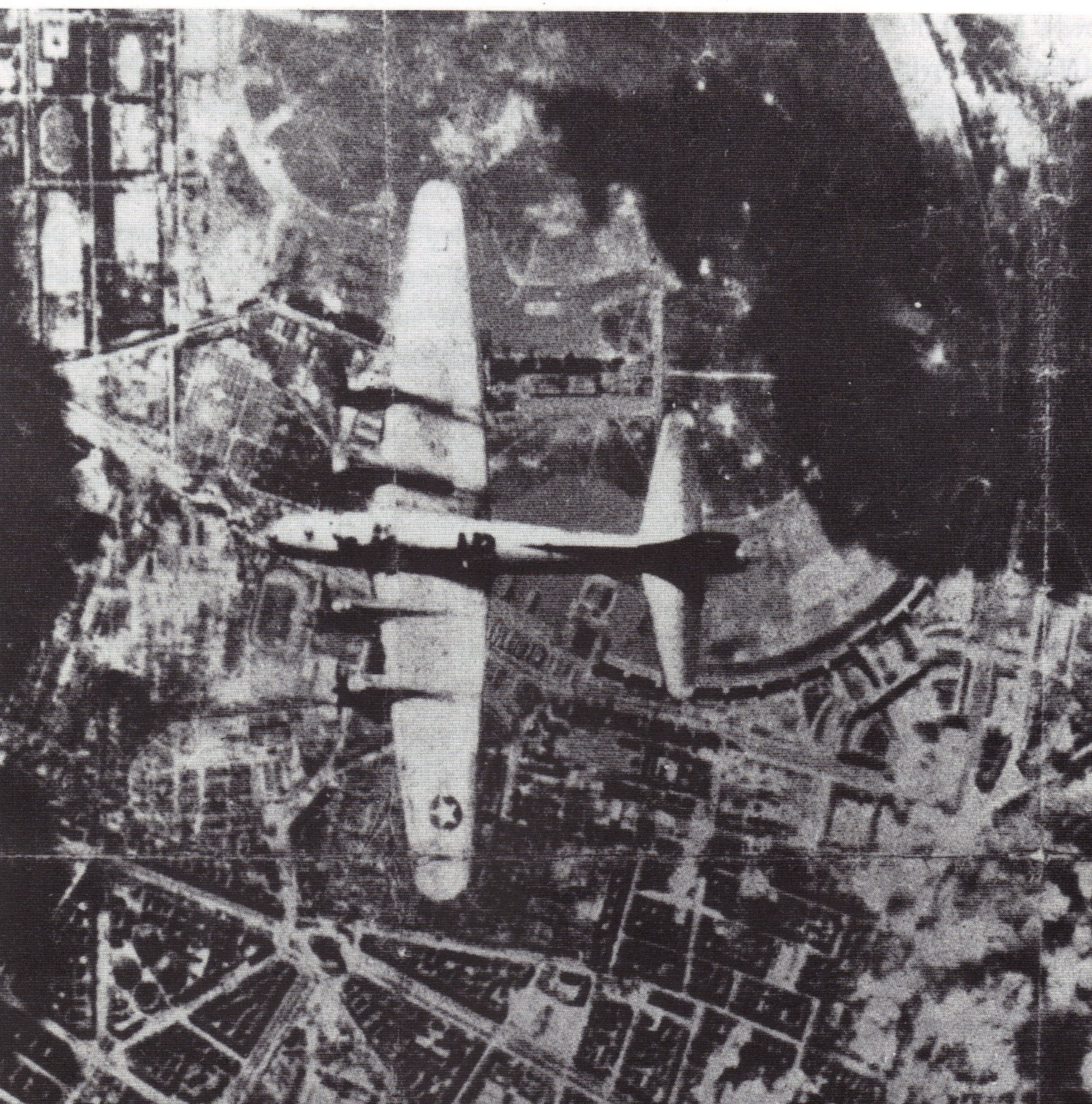
Eine amerikanische B 17, Super Festung über unserer Wohngegend. An der Spitze des linken Tragflügels ist der Südstern zu erkennen.
Etwa zwei Wochen später kam mein Vater plötzlich auf Heimaturlaub. Am Abend zuvor schickte mich meine Mutter zum Gemüseladen um Senf für ihn zu kaufen. Ich rannte vor Freude und Erwartung und stolperte dann an der Eingangsstufe zum Geschäft und fiel zu Boden. Das leere Glas, das ich trug, zerschellte und ein Splitter durchschnitt eine Ader an meinem rechten Handgelenk. Es blutete sehr, es war aber nicht die Pulsader. Meine Mutter brachte mich sofort zu unserem Hausarzt der dann die Wunde nähte. Am nächsten Tag konnte ich dann den Verband stolz meinem Vater zeigen.
Er blieb nicht lange da meine Eltern zu Weihnachten nach Ostpreußen fuhren um dort meine Schwestern zu besuchen. Am Heiligen Abend blieb ich bei meiner Tante die in der Wohnung über uns wohnte. Es war ein sehr einsamer Heilig Abend, kein gemütliches Beisammensein mit der Familie und auch kein Weihnachtsbaum. Es war schon spät als die Tante mich dann in unsere Wohnung brachte und siehe da, in der Stube auf dem Tisch standen etwa ein Dutzend Spielzeugsoldaten in der Uniform aus den Zeiten Friedrich des Großen. Der Weihnachtsmann hatte mich also nicht vergessen.
Noch vor dem Neuen Jahr kehrte meine Mutter zurück und brachte einen Topf voll Königsberger Klopse mit. Meinen Vater habe ich erst nach dem Krieg im Mai 1946 wieder gesehen. So ging das fünfte Kriegsjahr zu Ende. Es hatte große Veränderungen gebracht. Die Krieg war näher gekommen und niemand war mehr siegessicher.
PS. In der ersten Woche im Januar 1944 wurde auch ich verschickt und trat meine Reise nach Oberschlesien an. Für Berlin wurde es ein schlimmes Jahr mit Tages- und Nachtangriffen.
Towards the end of September 1943 we left Berlin to live in the country. We moved to a place called the ‘Ausbau’, which meant that eventually ‘more’ was to be added to the building.. It was a simple rectangular red brick complex with several entrances around the building. There was no plumbing or electricity. The entrance for us ‘Berliners’ was on the left side at the front of the building. We had a cellar, a groundfloor and two upper floors.
Mum, my two younger brothers and I, shared a bedroom on the first upper floor. We also had a small kitchen and a living-room. I would sleep in the living-room when my dad came home on leave. Two maids, one Polish, the other Russian, shared two rooms on the top floor. All the rooms on the top floor had sloping ceilings. Our Polish maid was in her early twenties. Her name was Maria. She was very efficient and always rather serious.. The Todtenhausen Family, who lived on the groundfloor, employed Katja, the Russian maid, who was only eighteen and extremely fun loving.
My mum’s sister, Aunty Ilse, also had her rooms on the first upper floor. She had a bedroom and a living-room. On the groundfloor, right underneath her upper rooms, she had a kitchen and a dining-room. She hardly ever used those downstairs rooms. Our friends from Berlin, the T. Family, occupied three rooms downstairs, namely a kitchen, a living-room and a bedroom, the same arrangement of rooms that we had on the upper floor.
There was an additional larger room for storage under the sloping roof. T. Family and my Family stored in that room additional larger furniture which we wanted to save from the bombs in Berlin. — In that room Mum stored a lot of Boskop-apples during the cold season. They were neatly spread out on some straw. Come Christmas-time, other delicious food was also hidden somewhere amongst our stored furniture. It was very tempting for me to go exploring in that room! Mum noticed sometimes, that some food was missing. And I admitted, when questioned, that I had helped myself to some of the goodies. However I was never punished for doing such a thing. That shows, that Mum must have been quite tolerant. —
On the same upper floor right under the roof was a playroom, which my brothers and I shared with eight year old Edith T. There was another room next to the playroom where Mrs. T.’s parents had stored some bedroom furniture. The parents were Mr. and Mrs. Braun. They had a business in Berlin. (They sometimes stayed at the ‘Ausbau’ in that bedroom in order to be with their family away from the bombs in Berlin.)
Our toilets were “plumps-closets” some distance away from the house. Water for cooking and washing had to be fetched from a pump in the backyard. Fetching water from the pump kept both maids very busy indeed. For lights we had kerosine-lamps, for heating there were coal-fired stoves which could also be used for cooking. Everything was very basic.
Gradually some changes were being made. The first big change was that our landlord had electricity laid on. All the workers who lived with their families in the other part of the building, received the benefit of electricity at the same time. This certainly was a very welcome improvement for them.
The ‘Ausbau’ was built close to a dirt-track which meandered through wide open barley-, oat- and potato-fields. On the track it was a good half hour to walk to the next village. Bike-riding however made it a bit quicker.
Werner Mann, the owner of all those fields that went on for miles and miles, was an acquaintance of Tante Ilse. He was apparently quite rich. He also owned extensive brick-works (Ziegeleien). It was said of him that he was a millionaire. He was our landlord, and he liked to spoil us. With no strings attached! Tante Ilse only had to voice a wish and Werner M. immediately did whatever he could to fulfill her wish. He spoilt us by constantly getting produce delivered to us: Potatoes, cabbage for making sauerkraut, wonderful treacle made of sweet-beets, and coal for our stoves.
Even I, as a nine year old, could see that sixty year old Werner M. was hopelessly in love with Ilse. I also was quite aware, that she always kept him at a distance. He was happy to just be invited for ”Kaffee und Kuchen’ on weekends and to spend some time with all of us. He always came to visit on his bike. On his daily inspection tours of the workers in the fields he also went around on his bike. He owned coaches with horses, but hardly ever used those to go anywhere.
When we were invited to his place (which people called ‘Schloss’), he would send the coach with a coachman to pick us up. Once in winter when there was plenty of snow, Werner M. sent a ‘Pferde-Schlitten’ (horse-drawn sledge). On this sledge we were wrapped up in blankets under a clear night-sky with the moon and lots of stars shining on us. It was unforgettable and one of the rare highlights in our otherwise pretty dreary country-life existence.
The place where Werner M. lived, did not look like a castle at all, even though people called it ‘Schloss’. It was not even a mansion but a rather large, but fairly plain house. There was a huge, fenced in veggie garden next to the house. I have seen the veggie garden only once. However I was very impressed by it, because it seemed to be so very large.
When we moved to the ‘Ausbau’, Ilse had already been divorced from Adolf Schlinke. It was obvious that Werner M. would have liked to marry Ilse. However, it never came to that. Ilse married Helmut Lorenz on July 20th, 1944.
CHILDHOOD MEMORIES CONTINUED
It was a big thrill for me to go exploring amongst the furniture in that big storage-room: and especially in the weeks before Christmas!
Mum used to store lot of goodies for the Christmas season. It was very exciting for me to find out what new things had been stored in that big room. I remember seeing huge chunks of nougat (a yummy hazelnut-paste) as well as heart-shaped marzipan-pieces. There was a pot with sweetened thick milk. Sometimes I dipped my finger into it to lick this wonderful sweet stuff! I also liked to eat a few of the stored raisins and prunes! Smells of ginger bread and apples: It made me feel that Christmas was something to be looking forward to.
Where on earth did Mum get all those things from? It was war-time, wasn’t it? We were in the midst of war! I knew very well where all this came from. The parents of Mrs.Todtenhausen had a distributing business. It was called ‘Backbedarf en Gros’. That meant they delivered goods to bakeries and cake-shops. Even in the midst of war deliveries of the above mentioned goods still took place! Of course there were shortages, but basically most things were still available.
Mr.T. and Mrs.T., as well as Tante Ilse and Mum were all good friends. Every Saturday night they came together for some card games. Eight year old daughter Edith and I were allowed to stay up late on those nights. For hours we were watching the adults playing cards and at the same time entertaining ourselves with doodling on bits of paper. At around ten o’clock some cake and hot chocolate as well as coffee would be served. But the maids did not have to do the serving, They were already in their rooms at this hour. The cake was usually freshly baked, very fluffy yeast cake topped with delicious butter-crumbs and filled with a thick custard. Hmm yummy!
Mr.T. would stay in Berlin during the week, where he was employed by his parents-in-law. Being over forty, he was not required to join the German army. Mr.T. always brought some sweet goodies along when he came home from Berlin for the weekend.
During the summer of 1944 Mr.T. and Mum liked to go on their bikes to a neighbouring Nursery where they were able to trade sweets for fresh produce. Edith and I were often allowed to go along with them on our bikes. The sweets were traded for strawberries or cherries or gooseberries as well as peaches and apricots, and later on in the year for pears and apples. I remember the Boskop apples were still in season in late autumn. The owner of the nursery was a well-off looking middle-aged woman who was very fond of sweets and loved to trade her produce. At one time we found out that she thought Mr.T. and Mum were a couple and we girls were sisters. Laughing joyfully, Mum and Mr.T. explained, that this was not so.
Only once as far as I remember were we shown into the lady’s home. Mr.T. made complimentary remarks about the interior of the house. He said it showed off the owner’s good taste. I liked the lady’s house a real lot too. Our families used to have well furnished apartments in Berlin. But this modern looking villa in the midst of the nursery really was something else. My feelings were I would very much like to live in a place like that. However we had to be happy with our accomodation in the Ausbau. To us children it was always pointed out, to be happy that we did not have to live amongst the bomb raids in Berlin. I’m pretty sure that by myself I felt that I’d rather live in Berlin, bomb-raids or not. I think to children bomb-raids usually didn’t seem as scary as to the adults. At the time we children had had no experience yet how absolutely horrible those bomb-raids could become.
In 1990, soon after the Fall of the Wall, I went with my family to have a look at the area where we used to be hidden away from the bomb-raids. We discovered that the nursery as well as the lady’s house had completely vanished. There was nothing left of the ‘Ausbau’ either!
In 1943, when we had lived at he ‘Ausbau’ for a couple of months, Mrs. T. delivered a healthy daughter in a regional hospital. The day after the baby was born, it may perhaps have been a Saturday or Sunday, Mr. T. and Edith went for the forty-five minute bike-ride to the Hospital. I was thrilled that I was allowed to go with them! The baby was on the tiny side and soon called Krümel (tiny crumb). Edith had a pet-name too. She was often called Honkepong.
As soon as Mrs.T. came home from hospital, there was a nurse waiting for her to take charge of the baby. Mr.T. said something like: “Katja is a very nice girl, but I would not trust her with our new born baby. I am glad that Nurse is here to help my wife to look after our Krümel.”
Nurse used for herself the bedroom next to our playroom. Sometimes she sat with us children in the playroom. Since Christmas was approaching, she taught us how to make some Christmas decorations. I was very impressed, because I was nine years old and nobody had ever taught me anything like it! Nurse also made sure, we learned our Christmas poems. We had to be prepared to recite them to Santa on Christmas Eve!
Maria, our Polish maid, had been with us since before my little brother was born. He regarded Maria as his ‘Dah-dah’, that is he always called her ‘Dah-dah’. By the end of January 1945 we had to flee from the ‘Ausbau’ as the Russians were approaching fast. We went to Berlin first and then by train to Leipzig to stay at Grandmother’s place. Maria remained in Berlin with her Polish fiancee, who was a butcher.
When we parted from Maria, little brother Peter-Uwe had just turned three. Yet he must have missed her for quite a while since she had always looked after him and I am sure, he loved her very much and she loved him. Mum always trusted Maria, who was in every way caring and efficient at the same time. Mum was always impressed how quickly Maria did all the house-work. Any dirty dishes were washed immediately. She was indeed capable of doing all the housework and Mum was happy to let her do just about everything. An exception was the baking of a large cake on Saturdays, which Mum loved to do herself.
Maria always made some potato-salad for the weekend. I watched how she did it. To the peeled and sliced potatoes she added finely cut onion, some oil, pepper and salt. Then she poured hot vinegar-water over the potatoes as a finishing touch. The huge salad-bowl was placed outside on a shelf near the stairway so the salad could cool down. I often helped myself to some of the warm salad when nobody was looking, because I loved to eat the salad when it was still a little bit warm. It was the same every Saturday. I watched Maria preparing the salad and placing it on the shelf outside. Then it did not take long before I had a good taste of it!
Friday night was the night for our bath. Maria placed a small tin-tub on the kitchen-floor. She carried several buckets of water from the outside pump to the kitchen. Some of the water she heated on the kitchen-stove in an especially huge pot. I was always the first one to use the bath-water, then it was brother Bodo’s turn. Little brother Peter-Uwe was always the last one. Some hot water was added for everyone, but still the water must have been quite dirty for little Peter after Bodo and I had had our baths!
When Maria first came to live with us, she knew very little German. However she was determined to learn German quickly. She liked to ask Bodo and me how to pronounce certain words. She also asked me how to write those words in German. Mum often praised Maria, that she was willing and able to learn quickly. This applied to everything she did. She was an amazingly efficient person. A ‘pearl of a maid’ people would say of her. Maria was a city girl. She came from Lodz, which was called ‘Litzmannstadt’ at the time. We had spent the summer-months of 1941 at Zokolniki (near Lodz) and that was when Maria was assigned to us as a help. Mum liked Maria and wanted her to come with us when we went back to Berlin. Maria told me later that she did not want to leave Poland. But she had not been given the choice to stay in her own country.
When Katja arrived, we could see that she was very different from Maria. She was a country-girl from Russia. She never learned German as well as Maria did. She could never be trusted to do all the house-work by herself. Mrs.Todtenhausen always had to supervise her and do certain things herself because Katja took too long to learn to do it properly. But we all loved Katja. She was always cheerful and full of beans. As a country-girl she did not know certain things that a city-girl had been brought up with. Maria took to instructing Kartja about certain things. I think they communicated in German. After they finished work in the evening, they had plenty of time to stay in their rooms together and keep each other company. Both girls always had to get up early. During summer, school-classes in the village started as early as seven o’clock. That meant, I had to get up at six o’clock to get ready for school. Mum never got up that early. But Maria always came down at six o’clock to start working for us. She often had to do Peter’s linen early in the morning, which I am sure was not one of her favourite tasks.
Auntie, Sister. Grandmother, Great-Grandmother, Mother and Wife of German Descent I’ve lived in Australia since 1959 together with my husband Peter. We have four children, eight grandchildren and two great-grandchildren. I started blogging because I wanted to publish some of my childhood memories. I am blogging now also some of my other memories. I like to publish some photos too as well as a little bit of a diary from the present time. Occasionally I publish a story with a bit of fiction in it. Peter, my husband, is publishing some of his stories under berlioz1935.wordpress.com View all posts by auntyutaPublishedJuly 10, 2011
auntyutaEditWith hubby’s help I managed last night to add some of the continuation of my memories 1943/1944. Over the past five years or so I saved quite a few pages of memory writing in Open Office. So far my writing is not very well organised and needs more editing. When I started with memory writing I did it hoping that maybe some of my grand-children and great-grand-children might be interested in reading it later on.Hubby and I joined a writers’ group for a number of years. When this stopped, I stopped writing since nobody seemed to be interested to read any new writing of mine on a regular basis. In the writers’ class we were given lots of encouragement by a qualified tutor! Recently I always found excuses why it wasn’t important to keep writing. Somehow there were constantly other things that took priority.I’m glad now that my niece encouraged me to try blogging.Reply
muniraEditWhat an incredible story Aunty Uta. I loved reading every word. Somehow, listening to or reading someone’s stories of the past is so much better and that much more evocative compared to a history book. I felt transported to a different world as I read this post. I’m glad you started blogging. It’s very commendable and your memories are amazingly vivid.Reply
auntyutaEditThank you very much, dear Munira. Your reply made my day. I started reading some of your blogs and enjoyed them very much. Blogging for sure opens different worlds for us, doesn’t it? I try to read as much as possible. I loved it that you included old family pictures. I hope that some day in the not so distant future I may manage to add some of my old family pictures. I’m going on 77 and there’s still so much to learn. Yet I have to try to take it easy. I have to accept that certain things take longer as you get older. When I change trains at Central Station in Sydney for instance it takes me much longer to proceed along the stairways than most other people. I JUST HAVE TO TAKE IT A BIT SLOWER THAN ALL THE YOUNGER PEOPLE: And that’s it. As long as I can manage a little bit, it’s better than nothing.I enjoy my life.I can honestly say I am grateful for every day that’s still given to me.Reply
WordsFallFromMyEyesEditSending a coach to pick you up! Makes you sound so old, but you’re not that old…. the world’s progressing so FAST, really.Great memories, Aunty Uta. Precious, really. I feel without memory, well, I would feel I had not even existed, I imagine.Reply
auntyutaEditHi Noeleen, I love it when you go to my earlier writings. It’s a great thrill for me that you like to look these things up. Well, in the 1940s, when I was a kid, there weren’t many cars around yet. In the country we had no public transport. Usually we went on our bikes or walked. Werner M was a very rich man in his sixties. He didn’t own a car and thought nothing of it to use his bike to get from A to B same as any other ordinary citizen. As I remember it, horses were still being used for different sorts of transport and for farmwork. I imagine in the 1940s you weren’t born yet, dear Noeleen. True, what I write about my childhood goes a long way back. I wonder whether any of my descendants are ever going to read some of my stuff that I’ve written!Reply
WordsFallFromMyEyesEditI wish your descendants would read you, Aunty Uta, as I strongly believe knowing where people “came from” (circumstances, life, family, and physical) is really valuable in our understanding of now today. Also our appreciation of today, mind.I bet having a bike was special 🙂
auntyutaEditI am amazed how self sufficient we were as kids. We were able to do maintenance to our bikes like fixing holes in the tubes! 🙂Reply
auntyutaEditReblogged this on auntyuta and commented:This post goes back to my earliest blogging days. I tried to find whether I reblogged it before, but could not find it anywhere. It might be of interest to some of my followers. This is, why I reblog it now.
We arrived at 10,30 am at Martin Place station to meet Angie and Roy at 11 am. We walked along Macquarie Street to their hotel and Peter took some pictures along the way. When we arrived at the hotel they offered us refreshments straightaway. And we soon got into talking amiably.
Later on we had Japanese lunch with them at the Opera House. The sky had cleared for the day. In beautiful sunshine we walked up to the Opera House. Peter took some pictures. When my lunch arrived Peter took a picture of that too. I had ordered a vegetarian roll. It looked beautiful with the avocado on top and cut up in small pieces. Somehow I managed to eat all this with chopsticks! I spiced every piece with soy sauce, horseradish and ginger. Delicious! The others had ordered something with fish. They all commented that my dish looked much more colourful.
After lunch we walked through the Botanical Gardens and Peter took some more pictures. By 2 pm we were back in Macquarie Street where Angie and Roy were staying at the InterContinental.They had tickets for a concert for later in the afternoon at the Opera House. So it worked out well that they could have a little rest before going out again. Peter and I wanted to catch our train back home from Martin Place. We had had a lovely day with two people we had never met before. But some of Angie’s family are known to us. They all were emailed some photos of yesterday’s meeting. One of Angie’s sisters, who lives in England, already emailed back saying she and her husband were planning to travel to Melbourne next year to see their two sons there and meet other family members. It’s such a small world! Peter worked out that a lot of the descendents of his paternal grandparents already live in Australia.
Angie and Roy travel today, Monday, to South Australia and to the Barossa Valley. They stay in Australia for two weeks only. During this time they also plan to fly to Alice Springs (to see ULURU), as well as to Cairns and from there back home to America. I think in Sydney they had had only three days.

catterelEditThank you for this, Uta – so many people outside Germany could never understand how or why the ordinary folk often went along with the anti-semitic laws of the Third Reich. It’s easy to stand outside and criticise,,and say “they should have resisted”, but as your Uncle pointed out, when your livelihood is at stake, you think of yourself and your own family first. I’m not condoning this – just aware that “He who is without sin should throw the first stone.” It was one of the lessons I learnt from living in Germany.Reply
auntyutaEditThank you so much for commenting, Cat. Peter and I just finished watching a TV Movie from Germany. It shows the life of one (fictional) person from 1904 to 1997. This woman, Sonja, who was born in 1904, had family connections with the famous Hotel Adlon in Berlin. Her life was very much shaped by what went on in this hotel because for a great part of her life she was employed there. Because of Nazi interference she lost her daughter and the Jewish father of her daughter. The way the Nazis are depicted is truly mind boggling. I reckon there’s no excuse for behaviour like this. It’s good when people are made to think about this.Reply
backonmyownEditA very poignant story indeed. Thank you for sharing it.Reply
aussieian2011EditThanks for sharing that rather sad yet interesting story, I think there must have been many such incidents back in those dark days.




 WordsFallFromMyEyes


 AuntyUta