People’s Assembly Statement on The Coronavirus Crisis

https://www.thepeoplesassembly.org.uk/index.php/news/16-people-s-assembly-statement-on-the-coronavirus-crisis

THIS IS THE COPY OF AN ARTICLE THAT MAKES GREAT SENSE TO ME, UTA:

“The people are ahead of the government in making serious moves to combat the spread of the coronavirus. It is clear the government were pushed by organisations already taking action to close down large events, a move we very much welcome. Where government refuses to act civil society institutions, trade unions, and ordinary citizens are taking matters into their own hands. We reject the ‘herd immunity’ theory that coronavirus can simply be left to rip through society until enough people develop immunity. Not only is there no proof this will happen with this virus, it is the most deadly and careless approach the government could take. The government should be acting on World Health Organisation guidance and learning from those countries it commends for swift and decisive action. Older and vulnerable people matter as much as everyone else. We insist the government alter course immediately and implement the following measures:

1. Close all schools, universities and colleges. Government and Local Authorities to work with schools to develop plans to get food to children who would have been entitled to free school meals.

2. Mass testing and tracing, which World Health Organisation experts have suggested is more effective in the early stages.

3. Workers should be allowed to work from home where possible. Introduce a mortgage and rent freeze for the duration of the crisis for those workers denied their full pay.

4. Extend statutory sick pay to all workers. Following successful pressure on the government to give sick pay from day one for those affected by the virus. Statutory sick pay should be uplifted to a living wage.

5. Pensioners on low-incomes, low income workers and disabled people to be eligible for one-off grants to cover food, fuel and travel costs.

6. Scrap the assessment period for Universal Credit and make payments immediately. Sanctions for benefit claimants who don’t attend appointments should be scrapped. Universal Credit payments should be topped up to account for extra costs of preparing for virus and moving to shut down.

7. Price controls to be introduced on essential medical equipment and drugs. There must be no hiking of prices on masks, ventilators, isolation units, beds, basic supplies like soap and hand towels, as well as drugs to combat bacterial complications etc.

8. Private hospitals to be put under the management of the NHS. Essential equipment owned by private companies should be pooled as part of the overall effort; private hospital beds should be treated as public.

9. Cleaners are a vital frontline, as are NHS staff. They should both be given an immediate pay boost to attract more cleaners, nurses, hospital porters and administrators. All workers should have the protective clothing necessary in line with TUC guidelines.

10. No scapegoating of Chinese people, Italians, immigrants or anyone else. An emergency programme of aid and refugee resettlement should be initiated across Europe.

11. The outbreak must not be used as a pretext for clamping down on civil liberties. Frontline public sector workers, especially health workers, should be brought in at the highest level of decision making. The trade unions should be part of the conversation with civil servants and senior NHS staff.”

Thunberg: ‘Indigenous Peoples Lead the Fight Against Crisis’

By teleSUR

07 February 20

Meanwhile, Brazil’s Bolsonaro facilitates business activities in the Indigenous Peoples’ Amazonian lands.


he Fridays For Future (FFF) movement activist Greta Thunberg praised the role of Indigenous peoples in the fight against global climate change during a demonstration in Jokkmokk, Sweden, on Friday.

“We must give voice to Indigenous peoples around the world because we depend on them, even if we don’t want to accept it,” Thunberg said.

The organization Saminourra reported how the effects of climate change affect the Lapps’ daily lives, especially reindeer herding, a fundamental activity in the culture of the Sami, an Arctic Indigenous people of about 80,000 persons who are spread across Norway, Russia, Finland, and Sweden.

“We are in a serious climate crisis and the Indigenous people are the ones who are first and most affected,” Thunberg stressed.

“They lead the fight and are the ones who resist the most. They are the front line. We support them.”

The founder of the FFF movement also recalled that solutions to climate-related environmental problems should include the knowledge of Indigenous peoples “who live from and with nature.”

Licypriya Kangujam

@LicypriyaK

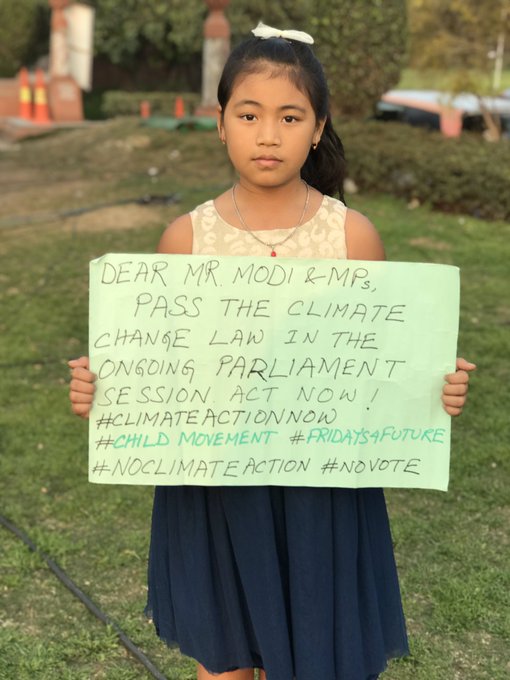
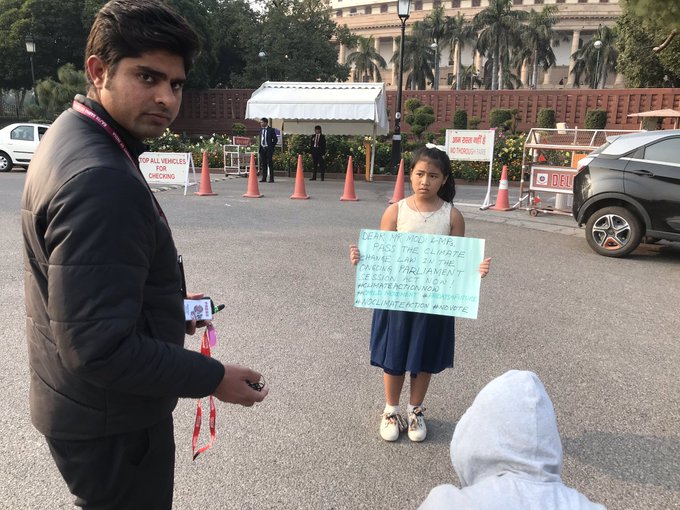
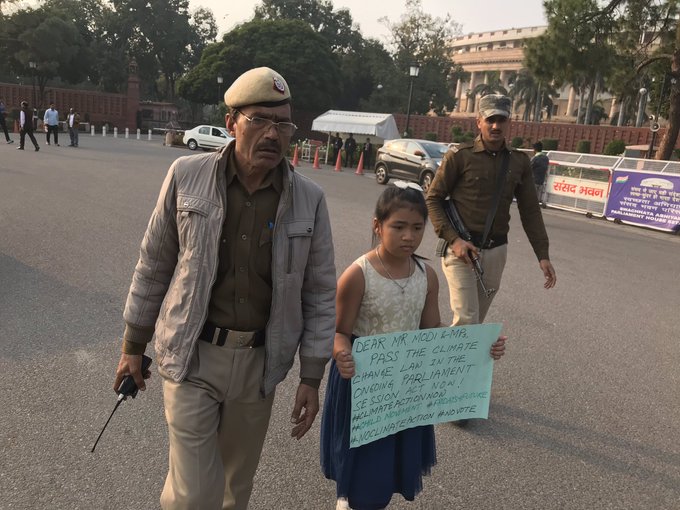
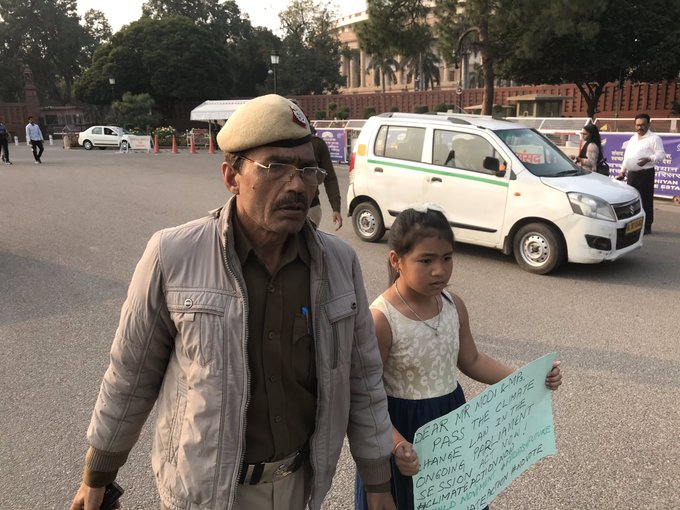
Today completed my 1 year of protests in front of the Parliament House of India to pass a climate change law in India. Delhi Police & other securities threatened me to detain / arrest if not leaving the place. But I did it. I told them, “Arrest me if you can!”

View image on TwitterView image on TwitterView image on TwitterView image on Twitter
1,576 people are talking about this

Thunberg’s positive appreciation for indigenous traditional knowledge, however, is not shared by those who work in favor of transnational corporations.

On Thursday, Brazil’s far-right President Jair Bolsonaro presented a bill to facilitate agribusiness, mining activities, oil extraction, and hydroelectric construction in Indigenous peoples’ territories located in the Amazon, the world’s largest rainforest.

In response to the harsh criticism that his bill is receiving, the former captain said that he would like to lock environmental activists in the Amazon, which meant an ironic allusion to what South American dictatorships used to do with leftist political prisoners who were sent to prisons in the jungle.

“Are we going to suffer pressure from environmentalists? Someday, if I can, I confine them to the Amazon because they like nature very much. Stop bothering here in the cities,” Bolsonaro said, as reported by local outlet Petroleo E Gas.

Climate Change Response

https://readersupportednews.org/opinion2/277-75/53671-rsn-climate-change-response-pits-trump-against-us-government

Climate Change Response Pits Trump Against US Government

By William Boardman, Reader Supported News

01 December 18

I don’t believe it.

– Donald Trump, November 26th, referring to the 1596-page Fourth National Climate Assessment, released by the White House at 2 p.m. on Black Friday, November 23rd, the day after Thanksgiving.


 don’t believe it” is not, by definition, a rational argument supported by evidence. It’s a statement of faith, not susceptible of proof or rebuttal, and as such is useless to effective governance. “I don’t believe it” is the empty opposite of the Fourth National Climate Assessment that is part of a continuing, multi-disciplinary, real-world examination of climate change that began in 1990 (more on this under-publicized report later). Produced by the 13 government agencies that comprise the U.S. Global Change Research Program, the Assessment is the latest report in a thirty-year climate watch that has seen steady, unchanging trends toward catastrophic global impact. Climate change is a dynamic process, driven by human activity that humans have done little to mitigate for a generation. Climate change is happening, it is irreversible, but there is still time to mitigate its worst effects, to save lives, to preserve habitat, to adjust economies, to sustain a somewhat civilized world.

“I don’t believe it” is Donald Trump’s response to all of this. Researchers in the Trump administration are forbidden – forbidden! – from even mentioning climate change, never mind developing strategies to cope with its varied impacts. Sorry about that, Puerto Rico. Sorry about that, Houston and North Carolina. Sorry about that, California. Sorry about that, everyone.

“I don’t believe it” has a corollary in White House practice: “I don’t want you to believe it.” The White House considered suppressing the report, but that would require overt law-breaking, since the National Climate Assessment is mandated by Congress. The White House reportedly considered editing or censoring the report, but feared that would make things worse (as it had when a Bush administration oil executive falsified an earlier climate report). So the White House went with a traditional subterfuge, releasing the Assessment when it would be least likely to get significant news coverage – at 2 p.m. on a Friday, not only a traditional black hole for bad news but super-shopper Black Friday after Thanksgiving as well. For a report that signaled the inevitably of an uninhabitable planet within decades, unless the U.S. and others make major changes of public policy, the story has received rather muted attention.

As one Trump advisor summed up the dishonest White House approach, adding a touch of conspiratorial paranoia:

We don’t care. In our view, this is made-up hysteria anyway…. Trying to stop the deep state from doing this in the first place, or trying to alter the document, and then creating a whole new narrative — it’s better to just have it come out and get it over with. But do it on a day when nobody cares, and hope it gets swept away by the next day’s news.

To reinforce distraction from news that affects every American for generations, the White House also chose to lie about it. The White House issued a statement on November 23rd that falsely claimed that “the report is largely based on the most extreme scenario.” The report included a range of scenarios. White House spokesperson Sarah Huckabee Sanders repeated this lie on November 27th, falsely claiming the official U.S. government position on climate was “not based on facts.” Sanders also lied when she claimed that the National Climate Assessment process was not transparent. Sanders also made false environmental claims that are irrelevant to and a distraction from climate questions.

In a sense, it’s not news when Donald Trump and his followers double down on climate denial. These are veteran birthers, after all. But the scale of climate change is vast and daunting. The stakes in dealing with climate change are intimidatingly high: millions of lives, billions of acres, trillions of dollars. It’s enough to give the most careful, rational leader pause.

“I don’t believe it” is not an answer. It’s not a policy. It’s cowardice or worse.

At this point, the world is past the point of preventing climate change from doing serious damage. That damage is already happening. Bigger and more powerful storms, coastal and inland flooding, larger and more intense forest fires, water scarcity, lethal heat waves and more, all exacerbated by climate change, take more lives and property every year. The problem is global; political dithering is pandemic, reinforced by political corruption. We’ve known – or should have known – for at least thirty years that we have a problem we need to face. Exxon and other oil companies have known for fifty years or more that their profitability came at the cost of putting the planet at risk. Coal companies have always known that coal was unhealthy for people, if not the globe.

“I don’t believe it” is an abdication of leadership. “I don’t know” is what you say, whether you believe it or not, when your goal is to put a prohibitive tariff on solar panels, to slow the rush away from fossil fuels.

We didn’t have to get to this place, where our choices are all stark. In 1989, President George H.W. Bush initiated the U.S. Global Change Research Program. In 1990, Congress passed the Global Change Research Act, designed to develop and coordinate “a comprehensive and integrated United States research program which will assist the Nation and the world to understand, assess, predict, and respond to human-induced and natural processes of global change.” From that rational beginning of intellectual integrity, we have drifted through one feckless presidency and Congress after another, squandering thirty years of opportunity to save ourselves from ourselves.

“I don’t believe it” seems to have become the national motto, sometimes expressed as “In God We Trust,” long since replacing e pluribus unum or any other aspirational goal. The reigning cultural stupidity of the United States, its suicidal cultural stupidity, was neatly encapsulated by Utah Republican senator Mike Lee on November 25th, when he expressed the widely shared mindlessness that passes for conventional wisdom on addressing climate change:

All the proposals I’ve seen so far that would address any of these issues would devastate the U.S. economy and have little or no benefit that is demonstrable from our standpoint. And so I have yet to see a proposal that would bring this about. I think if we’re going to move away from fossil fuels, it’s got to be done through innovation. And innovation can be choked out through excessive government regulation.

He doesn’t mention regulation like a tariff on solar panels. He has no proposal of his own. He’s not even sure fossil fuels are bad (“if we’re going to move away from fossil fuels”). For the foreseeable future the Mike Lees of the world, who hold positions of power everywhere, are content to let the planet creep toward further catastrophe rather than disturb the profit centers of their patrons. He may as well as have said, “I don’t believe it.”

While it is true that climate change is a global problem that needs a global solution, it is also true that the U.S. is the single largest contributor of greenhouse gases driving the problem. And the U.S. is led by people committed to creating ever more greenhouse gases until some uncertain future date when something unspecified will change their course. In February, the U.S. Energy Department reported that there was likely to be no decrease in U.S. carbon emissions for more than 30 years. That would mean the rest of the world would have to achieve zero carbon emissions, immediately, just to maintain the already damaging status quo.

Thirty years ago, Bill McKibben published “The End of Nature,” an early warning about what was then called “the greenhouse effect.” McKibben’s recent piece in the New Yorker of November 26th is a long, angry, despairing piece about our collective path to self-destruction:

The extra heat that we trap near the planet every day is equivalent to the heat from four hundred thousand [400,000] bombs the size of the one that was dropped on Hiroshima.

As a result, in the past thirty years we’ve seen all twenty of the hottest years ever recorded. The melting of ice caps and glaciers and the rising levels of our oceans and seas, initially predicted for the end of the century, have occurred decades early. “I’ve never been at … a climate conference where people say ‘that happened slower than I thought it would,’ ” Christina Hulbe, a New Zealand climatologist, told a reporter for Grist last year…. 

All this has played out more or less as scientists warned, albeit faster. What has defied expectations is the slowness of the response. The climatologist James Hansen testified before Congress about the dangers of human-caused climate change thirty years ago. 

The cultural vacuity of American leadership is as stunning as is it self-willed. Confronted with an official U.S. government report, American leadership chooses to ignore three decades of conscientious, consistent, accumulating research that a real problem is getting steadily worse, choosing instead to ignore, deny, lie, and maintain the policy that feeds the crisis. This is beyond rearranging deck chairs on the Titanic. This is maintaining full speed ahead while betting that there are no icebergs.

No matter what happens next, the failed American leadership of the past thirty years has assured that we, and the rest of the world, will go on suffering unnecessary losses for a long time into the future. Perhaps the new Democrats in Congress will force the failed party leadership to adopt a “Green New Deal” and perhaps, in time, that can make some difference, though it’s too late to make much difference in time. But that’s one of the two grim choices we face: do something to reduce carbon emissions as quickly as possible and risk the possibly severe economic consequences.

The other choice is to follow current policy and risk almost certain, severe economic consequence – as well as severe ecological consequences – as well as severe consequences to human well being, health, and life. This is the path of Trump’s climate leadership, and it is fraudulent, irresponsible, and criminal.

Criminal? We have seen the carnage caused by climate change already. We know there will be more and worse to come unless we take efforts to mitigate the consequences. Trump shows no evidence that he knows the risk or cares about it, so how is that not criminal negligence on a global scale? Lock him up.

William M. Boardman has over 40 years experience in theatre, radio, TV, print journalism, and non-fiction, including 20 years in the Vermont judiciary. He has received honors from Writers Guild of America, Corporation for Public Broadcasting, Vermont Life magazine, and an Emmy Award nomination from the Academy of Television Arts and Sciences.

Reader Supported News is the Publication of Origin for this work. Permission to republish is freely granted with credit and a link back to Reader Supported News.

Using less power, eating less meat, avoid flying, reduce water consumption

https://www.abc.net.au/news/2020-01-28/climate-researcher-says-australians-need-to-take/11892966

Professor Palutikof says, people have to be prepared ‘for the changes that they are going to have to make’, meaning for instance using less power, eating less meat, avoid flying, reduce water consumption.

https://www.abc.net.au/news/2020-01-28/climate-change-bushfires-and-cutting-my-carbon-emissions/11892230

ABC News Breakfast By Madeleine Morris:

“We would need 3.4 Earths if everyone had my lifestyle. . . .”

“I always thought I was environmentally responsible. But when I calculated my family’s carbon emissions I was shocked by the result,” writes Madeleine Morris.

In this article by Madeleine Morris it says that the average Australian footprint is 15.37 tonnes of CO2 and vastly above the EU average of 6.4 tonnes.

It also says that Jean Palutikof from the Climate Change Adaptation Research Facility says about the impacts of climate change that we need to do to reduce them while we still can.

“People are going to have to change their way of life,” she said.

“There is this rhetoric about the Government taking action, but actually what that means is that people will themselves have to take action.”

Madeleine Morris is News Breakfast’s finance presenter. Previously she was a Melbourne-based reporter for 7.30, and worked for the BBC in London for 11 years as an international reporter and presenter.
Madeleine Morris says: “I calculated my carbon footprint and now my family will try to cut our emissions by 7.6 per cent”

FUTURE DEVELOPMENT Stakeholder capitalism arrives at Davos Addisu LashitewTuesday, January 21, 2020

Stakeholder capitalism arrives at Davos

“The 2020 annual meeting of the World Economic Forum opens this week with the theme of “Stakeholders for a Cohesive and Sustainable World.” More than 3,000 global leaders, including 53 heads of state, will convene in the resort town of Davos on the Swiss Alpine to deliberate on pathways to “stakeholder capitalism.”

Some Childhood Memories about my School Years in the 1940s

I just looked at this earlier post of mine, made a few changes and am going to republish it!

I also copy here the comments from the comment section:

likeitiz

Feb 2, 2012·

likeitiz.wordpress.com

There is something so precious about childhood memories. It makes us go back to a time when our lives were much simpler but fun and enjoyable, not fraught with stress and worry. Is your life back to a similar atmosphere? I wonder if we need to work hard to make sure our twilight years would be fun to live through.

My answer:

You’re right, Mary-Ann, cutting back on work and leading a much simpler life is possible in old age and can be enjoyable and less stressful. All the people I know in my age-group admit they tend to gradually do a bit less but enjoy doing the things they are still able to do. This applies to me too! Thinking back to what I was like before puberty set in I find that this was probably a relatively stressfree time.The atmosphere I grew up in was probably a healthy one even though there was a war going on. I was always healthy despite certain shortages due to the war.

As far as old age is concerned, yes, life is simpler. You learn to accept limitations like not being able to walk as fast as younger people, your eyesight and hearing isn’t as good as it used to be, your bones are shrinking and sometimes aching etc. Well, as a young child you also have some limitations. However, as a child you know that as you grow older you’ll get better in a lot of things. So you’re looking forward to the future. You want to grow up quickly to do this and do that!

As an older person you just hope that the young ones are going to have a good future! It’s bliss to see the young ones grow up and develop their skills.

Eliz asked:

Why the roll on top of your head? Just curious. Thankfully some of the teaching approaches have changed.


  • auntyuta

    auntyuta
    eof737

    I guess the roll on top of the head was fashionable and my mother liked it. Some girls seemed to cope rather well with it. Since I have extremely soft hair the roll just wouldn’t stay on top of my head but hover over my forehead which annoyed me no end.
    Teaching methods would probably have changed quite a bit over the years. After all, these were the 1940s!


Here now is a copy of my post I published Feb 2012:

Towards the End of Worldwar II and after the War

During my year at the village school in Lichtenow, I had become used to a very individual teaching style. This changed however, when after the summer holidays of 1944 I was enrolled in year four of the Herzfelde Primary School, and I found myself there in a class of about thirty girls.

In this class we spent most of the time doing reading, writing and arithmetic. We also learnt a few songs, especially ‘marching songs’. We had to know these songs because they came in handy, when we marched through town, which happened about once a week. We thought, it was great fun, when all the girls of our class marched along in rows of two, singing all the marching songs, which we knew so well. I believe this marching business came about, because we were supposed to have a bit of exercise to keep us healthy and fit. We did not have a sports’ teacher at the time, which meant, that sport as such was not on the curriculum. Of course we had our class-teacher accompanying us on our marching sessions through town and surroundings.

Once a week we were given dictation. Every spelling mistake was marked by the teacher, counting one bad point for every mistake and half a bad point for a punctuation mistake. The student with the least mistakes was seated at the top of the class. All students were seated according to the number of mistakes they made in dictation. The students who made the most mistakes were seated at the bottom of the class right in front of the teacher.

Thanks to the good schooling I had received in Lichtenow, I was able to spell quite well and usually ended up among the top three students in the class. I felt lucky in that regard. My handwriting however was terrible. Handwriting had always been my worst subject. Luckily for me, it was a separate subject and did not influence the marking of any other subject!

That the teacher praised students with the better marks, was nothing new to me. It was also generally accepted, that the teacher let the other students know, who was in the lower range in any subject. For instance, when we were writing a composition on a given theme, the teacher would collect the finished compositions and take them home to mark them. Once the marked compositions were handed back to us, the teacher discussed in front of the whole class, who had written a good composition; also whose composition was satisfactory, just satisfactory or unsatisfactory.

I went to the school in Herzfelde for about three months only. From that time on I had a preference for sitting in the back rather than the front of the class. When I went to high-school in Berlin later on, I always tried to get a seat in one of the back-rows. I was rather glad, that In high-school we were allowed to choose ourselves, where to sit. I used to pity the girls in the front-rows, who often had to suffer a lot of spitting out of the mouth of this very old German teacher, Dr. Petzel. The standard joke after an enormous spitting session was, that the girls in the front rows should put up umbrellas, when Dr. Petzel was talking!

Right through my childhood I was made to wear a roll of hair on top of my head, which hovered over the midst of my forehead. On my tenth birthday I was finally allowed to comb my hair to the side. Because of this, I felt, I was on the way to becoming a grown-up person.

Here’s a picture from my tenth birthday as well as a picture that was taken a bit after my 10th birthday. Then there is a picture that was taken at a zoo when I was only about 8 and my friend Eva was 7.

2-06-2009 5;02;05 PM

Guests I had on my 10th Birthday: Next to me three schoolfriends from my school in Herzfelde, then Christa Grosskreuz, Eva Todtenhausen, Gerlinde Grosskreuz, and  my brother Bodo.

2-06-2009 5;02;01 PM2-06-2009 4;31;52 PM


auntyuta's avatarAuntyUta

Towards the End of Worldwar II and after the War

During my year at the village school in Lichtenow, I had become used to a very individual teaching style. This changed however, when after the summer holidays of 1944 I was enrolled in year four of the Herzfelde Primary School, and I found myself there in a class of about thirty girls.

In this class we spent most of the time doing reading, writing and arithmetic. We also learnt a few songs, especially ‘marching songs’. We had to know these songs because they came in handy, when we marched through town, which happened about once a week. We thought, it was great fun, when all the girls of our class marched along in rows of two, singing all the marching songs, which we knew so well. I believe this marching business came about, because we were supposed to have a…

View original post 503 more words

GLOBAL RISKS REPORT 2020

https://www.oliverwyman.com/our-expertise/insights/2020/jan/globalrisks2020.html?utm_source=exacttarget&utm_medium=email&utm_campaign=risk-report

“Economic and political polarization will intensify, as collaboration is needed more than ever to respond to severe threats to climate, public health, and technology systems.”

“The Global Risks Report 2020 presents the major risks the world will be facing in the coming year. It stresses the need for a multistakeholder approach to addressing the world’s greatest challenges, and comes ahead of the World Economic Forum’s 50th Annual Meeting in Davos-Klosters, where the focus is Stakeholders for a Cohesive and Sustainable World.

Speakers: Borge Brende, President, World Economic Forum Mirek Dusek, Deputy Head of the Centre for Geopolitical & Regional Affairs, World Economic Forum John Drzik, President, Global Risk and Digital, Marsh Peter Giger, Group Chief Risk Officer,

Zurich Insurance Group Emily Farnwoth, Head of Climate Change Initiatives,

World Economic Forum Moderated by: Adrian Monck, Managing Director, Head of Public Engagement The World Economic Forum is the International Organization for Public-Private Cooperation. The Forum engages the foremost political, business, cultural and other leaders of society to shape global, regional and industry agendas. We believe that progress happens by bringing together people from all walks of life who have the drive and the influence to make positive change.”

Memories from Mecklenburg-Vorpommern in 2010 as well as some other Memories from 2010

We had been away from Australia from the end of of May 2010 to the beginning of July 2010. I started publishing in WordPress in 2011. On the 11th of February 2012 I then published in WordPress what I had written on Sunday, 1stAugust 2010. Here is a copy of what I had written then:

Sunday, 1stAugust 2010

Today I had the feeling that spring was just around the corner. I walked to church and enjoyed the warmth of the sun. Soon I took off my cardigan and let the sunshine touch my bare arms. This is good for replenishing Vitamin D and for absorbing more Calcium, I told myself.

I was amazed how healthy I felt on a day like today. Last month I had persevered with several more tooth-extractions, There were five teeth that did have very old and quite large amalgam-fillings. I had made up my mind that it was time to get rid off these teeth. So now there aren’t anymore amalgam fillings left in my mouth. I wonder whether this is why I feel much healthier? Soon after all those extractions I had started a detoxing program. Kate, the naturopath at the Dental Centre, gave me four different supplements, which I keep taking as prescribed. In about six weeks I’ll go for another check-up to find out whether the detoxing of the various metals in my blood has been successful.

Most days I feel that walking for thirty minutes or so is no problem. I usually don’t get pains anymore and I hardly ever seem to run out of breath while walking. Besides, I used to wobble a bit to one side quite frequently. This seems to be better now. Come to think of it, I have been keeping quite well over the last few months. Didn’t I undertake an exhausting overseas trip from the end of May to the beginning of July this year, and didn’t I cope with the stress of travelling remarkably well? Who would have thought that I was capable of travelling for so long without a problem?

The last time I had travelled overseas had been in 1994. That year I had gone with Peter and daughter Caroline to Berlin. In 1997 and 2004 Peter travelled to Berlin by himself. So I had not been to Berlin for a long time. I felt very much like a stranger there during our recent visit in contrast to Peter who straight away felt at home again. He’s extremely familiar with this city. I think the biggest difference, compared to my previous visits, was the experience of feeling so much more elderly. I was for instance always grateful when younger people offered me their seat on the underground train or on the bus. Being elderly gave me the feeling that I could go slowly. I did not have to hurry as the younger people did. Whenever I felt a bit tired I could sit down and rest for a while.

We arrived in Berlin on the 31st of May. We had expected warm weather, but it was still very, very chilly and often extremely windy. Consequently I soon developed a terrible cold. However with adequate rest I quickly recovered from this attack of flu. When it had become a bit warmer, Peter and I enjoyed what nature had to offer, especially further up north in Mecklenburg/Vorpommern where we stayed for ten days with my brother Peter and his wife Astrid.

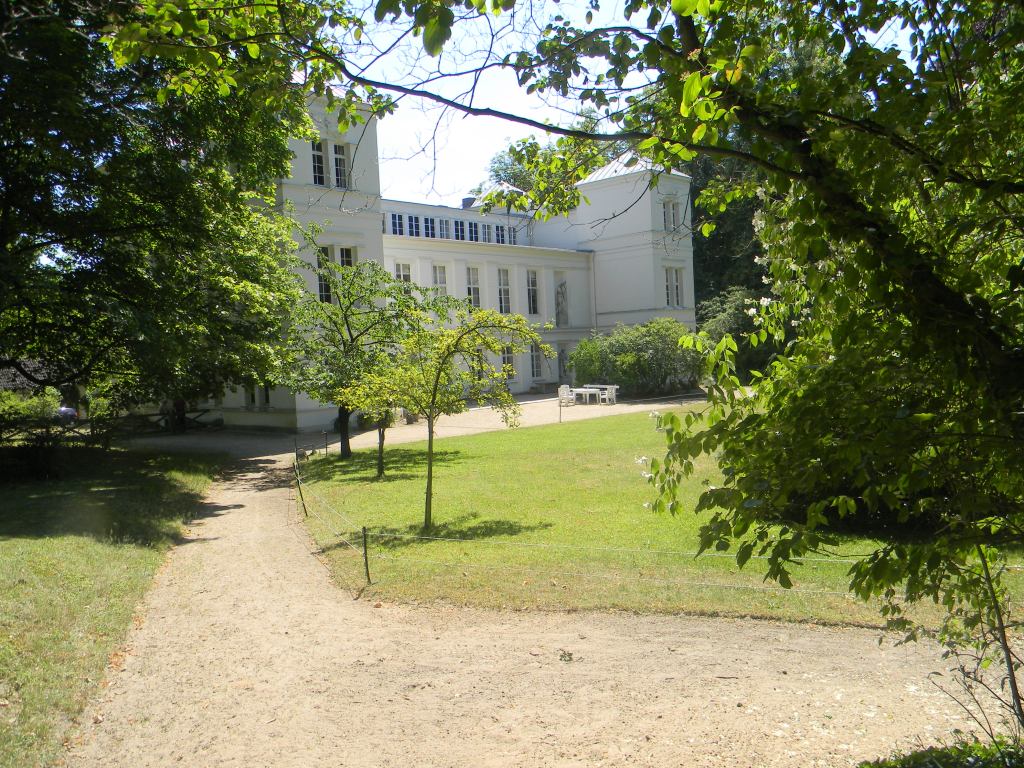
Mecklenburg/Vorpommern has forests and many, many lakes as well as canals connecting these lakes. The small towns in the area all cater for tourists. Very old houses have been lovingly restored. Some new developments include expensive marinas. Peter and Astrid showed us historical sites and castles where previously kings and queens liked to relax with their families, away from the hussle and bussle of Berlin.

The last few days of our stay in Germany we were back in Berlin. Day-temperatures had risen to well above thirty degrees by then. It did not cool down very much during the nights either. Daylight lasted till about ten at night. At four in the morning it was quite light again. Sometimes it seemed to be a bit light the whole night through!

Peter’s sister, who lives in Berlin, went on a lot of outings with us. Sometimes we were driven around in a car by friends or family members. However most of the time we used public transport – and very efficient transport at that. When you want to catch an underground train, you hardly ever have to wait for more than five minutes for the train to arrive!

Most people probably do not know that Berlin has many lakes, rivers and canals with hundreds of bridges. I do not know the exact number of bridges, however, I was told Berlin has more bridges than Venice! We saw quite a few of these Berlin waterways. Once we were taken on a boat- excursion that took us right through the city centre! On the boat we were served beer. frankfurts and potato salad. A few times we went on ‘book hunting’ excursions. Visiting friends and family in different parts of the city kept us busy as well.

On Friday, 2nd of July, was departure day. We left from Tegel Airport . This Airport is rather small and totally inadequate for a city like Berlin. Because of a lack of space very few big machines can fly in or out of Berlin. However, a much larger airport is to be opened in Berlin in about two years. If all goes well, Peter and I may then be able to go on a direct flight from Sydney to Berlin which would probably cut travelling time by a few hours.

We had a return flight from Sydney to Berlin via Kuala Lumpur and Amsterdam. We travelled KLM. To our great relief our luggage could be booked through to Berlin and later back to Sydney.

I was a bit apprehensive about our return flight since the schedule included a five hour stay at Kuala Lumpur. To my surprise I rather liked this stay at Kuala Lumpur Airport. The airport is huge. Internet connections are provided without charge. There is also no charge for drinking water! In the midst of the airport is a rainforest enclosure for travellers to enjoy. And of course there are shops, shops, shops! Also facilities for showers, massages, reflexology treatments and more. In the sitting area you can find stretch-out seats for tired travellers!

We did not want to go for dinner at one of the restaurants. We rightly assumed we would get dinner on the flight from Kuala Lumpur to Sydney. However we decided to go for coffee and cake at the Airport’s Deli France. And we enjoyed this! For a little while I also made use of one of the stretch-out seats. Why doesn’t every airport have those seats for sleepy travellers?

https://auntyuta.com/2012/02/19/mecklenburg-vorpommern-2010/

On the 19th of February 2012 I published the following:

Peter and I are looking forward to visit Mecklenburg-Vorpommern again this year. Last time we were there in 2010 we took lots of pictures. It is an area a bit north of Berlin and stretches right to the Baltic Sea. Not many people live there. There’s a lot of wooded area, lakes, creeks and canals. On these waterways you can travel to Berlin or up north to the open sea.

My brother lives in this area with his wife. So during our trip later in the year we’re going to visit them again. I’m sure we going to love it the same as last time. Most of the time we’ll be staying in Berlin though. I’m sure I’ll be able to blog many interesting pictures from Berlin as well.

Today I just want to blog a few of our landscape pictures.

a lake in the country

DSCN0472

DSCN0475

DSCN0477

DSCN0534

DSCN0786

DSCN0787

DSCN0789

DSCN0790

DSCN0791

DSCN0522

DSCN0996
On the Pfaueninsel, Berlin, 2010