“I’ve always been interested in Exilliteratur– books by or about writers and artists forced to flee Germany during the Nazi era. Much, of course, has been written about the exile community in Southern California – including Michael Lentz’s terrific Pazific Exil (2007). Anna Seghers wrote about her exile in Mexico in Ausflug der toten Mädchen, and many of Hilde Domin’s poems deal with her exile years in the Dominican Republic. But very little has been written about the German exile experience in Cuba – which is one reason I was keen on reading Ursula Krechel’s Landgericht (literally “District Court”), which won the German Book Prize in 2012. The central figure in the novel, the Jewish barrister Richard Kornitzer, is forced to flee the Nazis and finds sanctuary in Havana for ten years.
But Landgericht is also about homecoming – returning to the “scene of the crime”, to the country that cast Kornitzer out and wrecked his family forever.
Life was good for Kornitzer and his wife Claire in the Weimar Republic. He was a talented young lawyer and judge with a brilliant career ahead of him, while Claire was a successful businesswoman, with her own advertising agency that created and placed ads in the booming German cinema. Together they lived in a chic apartment in central Berlin and had two children. But things quickly went downhill once the Nazi’s came to power: Kornitzer was forced out of his job and could no longer practice law, Claire, although of Aryan background, had her business stolen from her because of her marriage to a Jew (which she refused to renounce). Soon it was clear that Richard and the children (Halbjuden) were in mortal danger. The children were sent to England via the Kindertransport while Richard was able to secure safe passage to Cuba – without his wife Claire.
Ursula Krechel takes the reader back and forth in time. The book opens with Kornitzer’s return to a ruined Germany after 10 years in exile, hoping to resume his career where it had been suspended by the Nazis. He is given a post in the provincial civil court in Mainz – a city that had been 95% destroyed by the allied firebombing. And the descriptions of the deprivations of those early postwar years are well done. Kornitzer quickly learns that the Third Reich never really ended: his colleagues on the bench in Mainz are all either former members of the NSDAP or Mitläufer. Kornitzer is treated as an outsider – both as a Jew and because of his special status an Opfer des Faschismus. And he is not alone as an outsider in new “democratic” West Germany. Krechel often brings real historical events and figures into the novel. Such as Philipp Auerbach, a Jew and former chemist who survived Auschwitz and who after the war worked tirelessly for restitution to the victims of Nazi crimes. Kornitzer watches with great interest as Auerbach is persecuted by former Nazis in Bavaria. Eventually he is unjustly convicted and imprisoned by a court comprised of ex-Nazis, and commits suicide. Kornitzer cynically sees what is necessary to succeed as a Jew in postwar Germany:
“Am besten war es, man verhielt sich mucksmäuschenstill. man tut seine Arbeit, man fiel nicht auf, gab sich nicht als ehemaliges Mitglied einer Spruchkammer, als Jude, als Trauernder um Philipp Auerbach zu erkennen, gab keinen Anlass, antisemitische Äusserungen, Taktlosigkeiten, Nadelstiche auf sich zu ziehen. Am besten, man war wortkarg, sah nicht nach links und nicht nach rechts und tat seine Arbeit. Am besten, man war tot.”
I very much enjoyed the middle part of Landgericht, which deals with Kornitzer’s exile in Havana. Life for the German/Austrian exiles in Cuba was hardly a tropical vacation. Many ended up in a jungle detention camp where conditions were deplorable. Kornitzer is able to find work as a secretary for a corrupt attorney and fares somewhat better than his compatriots. Ursula Krechel obviously conducted quite a bit of research on Cuba in the 1940s and its treatment of European refugees. Eventually Kornitzer meets and falls in love with a young school teacher. The affair produces a daughter – Amanda – who Kornitzer never has a chance to see before the war ends he returns to Germany.
Kornitzer becomes frustrated and embittered by his inability to get ahead in the “new” postwar order. His children are now more English than German and are estranged from their parents. Claire’s health was ruined after her business was confiscated and she was forced to work in a dairy during the war. Kornitzer pursues every legal and bureaucratic channel to recover the life that was stolen from him – the back and forth with the various courts and agencies becomes somewhat tiresome to the reader. But Ursula Krechel makes one brilliant move towards the end of the novel: Kornitzer is bitter that he was passed over for a promotion and in a public court hearing reads out Article 3 of the German constitution (Grundgesetz):
Niemand darf wegen seines Geschlechtes, seiner Abstammung, seiner Rasse, seiner Sprache, seiner Heimat und Herkunft, seines Glaubens, seiner religiösen oder politischen Anschauungen benachteiligt oder bevorzugt werden.
(No person shall be favoured or disfavoured because of sex, parentage, race, language, homeland and origin, faith, or religious or political opinions.)
That simple act of reading out loud a passage from the constitution is viewed as scandalous, and Kornitzer is forced into early retirement. He spends his retirement relentlessly seeking restitution and – despite an appearance by Amanda – dies embittered man.
This novel would have benefited from a good editor – it is about 150 pages too long. Nevertheless, Landgericht is an important novel and deserves an English translation. Landgericht was a recently made into a two-part film for television, which hopefully will be available to American audiences at some point.”
2 thoughts on “Ursula Knechel’s ‘Landgericht’, review by David Vickrey”
Thanks for the review of this very interesting story. I was quite interested in the book after watching the two-part (3-hour) video entitled ‘Redemption Road’ via streaming on MHZ Networks in German with English subtitles.
It says: “Redemption Road, a two-episode limited series based on the novel Landgericht by Ursula Krechel (which was translated into English as State Justice, so as not to be confused with Redemption Road, a 2016 thriller novel by John Hart, nor with Redemption Road, a 2010 limited release feature film …The two episodes are beautifully directed by Matthias Glasner (Blochin), and star German fave Ronald Zehrfeld (The Weissensee Saga, In the Face of Crime) and the fantastic Johanna Wokalek as a married German couple, Richard and Claire, dealing with the trauma and subsequent fallout of Nazi persecution. He’s Jewish, she’s not, and – good news! – neither of them die in the war! Neither do their children! No one ends up in a concentration camp! Sounds great, except… well, agony is relative, but it’s still agony.”
In the review something interesting is mentioned about the German constitution!
Article 3 of the German constitution (Grundgesetz) says:
“No person shall be favoured or disfavoured because of sex, parentage, race, language, homeland and origin, faith, or religious or political opinions.”
Vickrey says: “The central figure in the novel, the Jewish barrister Richard Kornitzer, is forced to flee the Nazis and finds sanctuary in Havana for ten years. . . .”
After his return during the postwar years “Kornitzer is treated as an outsider – both as a Jew and because of his special status an Opfer des Faschismus. And he is not alone as an outsider in new “democratic” West Germany . . .”
“That simple act of reading out loud a passage from the constitution is viewed as scandalous, and Kornitzer is forced into early retirement. . .”
Yes, so much about how people may be treated in the new “democratic” West Germany!
This is what it says further on about the movie:
“Redemption Road presents something of a unique perspective of the life of German Jews in WWII. By now, we’ve absorbed accounts of the Holocaust, historical and fictional, delving into Nazi atrocities of imprisonment, starvation, unfathomable physical abuse, and murder in the camps. Less often told are the stories of the people who, through foresight or luck, managed to get out, to escape their homeland as their citizenship was revoked, and their livelihoods taken away. Richard, a district judge who has devoted his life to the rule of law, sees the writing on the wall and, just in time, sends his little children to England as part of the kindertransport.
With subtle horror, the show captures the utter nightmare and surreality of what it must be like for a parent to see their children taken from them, not knowing what will happen to them, not knowing if they’ll ever be together again. How could anyone survive the distress? For a person such as Richard, devoted to logic and order, the lost decade and mental toll in the face of the injustice of it all, is severe. His family stays alive, but at what cost? If you were obsessed with A French Village, here’s a look at the war’s aftermath from another angle.
The road back Having outlasted the war, Richard makes a return to Germany that was just as painful as his exit, and is reunited with Claire. Will putting the pieces back together prove futile? Is there any hope that justice will be served for the millions of fortunes destroyed, families torn apart and innocent lives lost in the name of war? Is there any point in seeking acknowledgment of the decimation done to so many? What does it take to make a life worth living after you have merely survived evil inflicted on you by your own country? These are but a few of the questions asked by Redemption Road as its characters go on with their lives, separately and together, seeking answers.”
Before I was three we lived in Taunus Strasse, Berlin- Friedenau. Some time during 1937 we moved to Bozener Strasse in Berlin-Schöneberg. This is where Tante Ilse and Onkel Addi lived as well and also my friend Cordula and her parents. Later on we did get to know Family T. who lived in the house opposite our apartment building.
During my early childhood Bozener Strasse was a very quiet street. There were no cars parked in the street.
Tante Ilse had this narrow but very long balcony with a lot of plants to water. As a two year old I loved to help with watering some of the plants!
Uta loves to water the plants. Mum is looking on.
Here Mum still has this “Bubikopf” which I believe became fashionable already in the 1920s.
In the next picture, which was taken in Bozener Strasse on 21st September 1947, my brother Peter is nearly six. I stand behind Peter. I turned thirteen on this day. My brother Bodo is on the left. He is nine. Beside him Eva Todtenhausen, who is going on twelve and beside Eva is Cordula who is twelve. Today I found out that Cordula died in July 2011, aged 76. This was very sad news for me. 😦
The above picture is from my birthday in 1940. We stand under the huge chestnut tree. Cordula spent part of the war outside of Berlin. She is not in the 1940 picture.
We took the following picture of Bozener Strasse during our Berlin visit in September 2012. It is still the same chestnut tree. But look at all the cars now!
Our apartment was on the third floor, Tante Ilse lived two floors further up. Mum quite often went up with me to visit Tante Ilse. One of my early memories is that Tante Ilse and Mum were lying under the bright lights of some tanning lamps (Höhensonne). They used some oil on their skin which smelled beautiful and made their skin look shiny. Their skin usually had quite a bit of a tan. They wore some protective dark glasses. Sometimes they made me lie under the lamp for a little while. I liked it when some of this nice smelling oil was rubbed all over my body. I too had to wear these dark glasses. I liked to wear them for a little while. But I was required to lie totally still. Very soon I did get sick of it, not wanting to lie still any more under the hot tanning lamp. I was then always glad when I was allowed to get up again.
I remember thinking that Auntie was a very beautiful looking woman with her very long curly hair. In the three way mirrors of her dressing table I remember watching how Auntie brushed her hair. It was very strong and long chestnut-coloured hair. Auntie usually brushed it slightly back so it stayed behind her ears. She often wore very long blue earrings. Oh, I loved the look of these blue earrings. They looked beautiful hanging down from Auntie’s ears! I think Mum did not wear any earrings, because her ears were covered by her hair. Mum’s brown hair was very fine and much shorter than Auntie’s. My hair was rather fine too. Mum always cut it quite short. I often wished that I could wear my hair longer but Mum would not let me grow it longer.
Both Auntie Ilse and Mum wore identical three big rolls of hair horizontally on top of their heads. The front rolls covered the top of their foreheads, the other two rolls were rolled behind the front roll. They often wore identical clothes, for instance light pink angora wool tops with identical grey suits.
1948: Mum 37, Uta 14, Bodo 10 and Peter 7.
Mum features her three big rolls of hair, I am already allowed to wear my hair long!
———-
Mum often called me ‘MAUSEL’ or ‘Mauselchen’, whereas Auntie liked to call me ‘HERZCHEN’ or ‘LIEBLING’. Dad sometimes said ‘HERZEL’ to me, but he usually called me by my name. Mausel is derived from Maus (mouse), Herzchen means ‘little heart’, Liebling means ‘darling’.
Cordula’s mum once told me, that her name meant ‘heart’ in the Latin language, but not to tell anyone otherwise some children would make fun of the name. I did not want anyone to make fun of Cordula. So I promised myself to keep the meaning of the name to myself.
My brother Bodo was born in June 1938. I think Cordula’s brother Tilwin was born a few months after that. Mum said that Tilwin was an extremely odd name. It turned out he grew up with very bright red hair. The children in the street teased him about his hair. As much as possible Cordula always stood up for her brother. I think for the most part Tilwin avoided playing with other children.
The Lepsius apartment was on the same side as our apartment, just two floors further up. (Auntie Ilse’s apartment was on the other side of the fifth floor). I often went up to the Lepsius apartment all by myself to play with Cordula. They had a ‘roof-garden’ (Dachgarten) above their apartment. It was the size of a big room and had no roof above it. I remember the sun shining right into it. The floor was concrete and along the walls were garden-beds . Cordula was allowed to look after her own little garden-bed.. Once Cordula’s Mum let me have a portion of a little garden-bed too! Cordula’s Mum and Dad were always kind to me. They made me feel welcome and included.
Cordula’s family had food that I had never seen before.. For snacks we children were often given some kind of brown flakes and raisins. Sometimes we were given dates or figs. I loved this food! My Mum thought it was strange to eat something like that. In Mum’s opinion this family was rather odd because they had lived in the Middle East for a while. Cordula’s father was an architect. My Mum called him ‘the Hunger-Architect’ (Hungerleider) since he seemed to get hardly any work in his profession.
Mum must have seen their apartment once for I remember her remarking how sparsely furnished it was. Mum found their choice of furniture quite odd. There were a great number of shelves stacked full with books. These shelves went from floor to ceiling. Herr Lepsius sometimes showed us children books with colourful illustrations. He also told us stories. We loved one story in particular which had a funny ending. We demanded to be told that story again and again. Each time we laughed our heads off and Herr L laughed with us. The story was about a beggar who knocked at the door of an apartment. A beautiful maid opened the door. Some time later the beggar knocked at another door of an apartment in the neighbouring building. And the same beautiful maid opened the door! We found the astonishment of the beggar very funny! Herr L explained to us, that a wall had been broken through to connect the apartments on that floor. This was actually where the family of Herr L had lived, when he was a boy.
Herr L was old and bald. He was about twenty years older than his wife. Quite a few years later Cordula and I went to the same high-school. We walked there together every morning. One morning I climbed up the stairs to Cordula’s apartment to find out why she had not come down yet to go to school with me. I rang the bell. Frau L opened the door. She was in tears. She did not let me come in but went with me to the top of the stairs. She said: “Our father just died; I haven’t even told Cordula yet.” She looked at me with despair in her face. I did not know what to say. She hugged me and then she disappeared in her apartment.
12 Responses to “Early Memories”
berlioz1935
June 3, 2013 at 10:54 am Edit #
The last paragraph is very interesting as you must have rang the door bell at a moment of great turmoil and grief for the L. family.
That gave me an idea and I Googled her and I must say I’m very sorry to say I have learnt that your friend Cordula has passed away in the European summer of 2011.
I will send you the notification by email.
REPLY
auntyuta
June 3, 2013 at 12:15 pm Edit #
Thanks for that, Berlioz.
REPLY
giselzitrone
June 3, 2013 at 7:08 pm Edit #
Hallo liebe Freundin wünsche dir auch einen schönen Tag wieder so schön geschrieben ja die gute alte Zeit man hat gute und schlechte Erinnerung daran,und alles liegt schon so weit zurück.hatte heute mal keine Lust viel zu schreiben,naher kommt jemand raus um den P.C. anzusehen manches mal stimmt was nicht ist immer was ärgerlich.Ich wünsche dir eine glückliche schöne Woche bei euch scheint sicher die Sonne bei uns ist Regen.Lieber Gruß von mir.Gislinde
REPLY
auntyuta
June 3, 2013 at 9:14 pm Edit #
Ja, hoffentlich hört der Regen bei euch bald auf. In vielen Teilen Deutsclands sind ja zur Zeit Überschwemmungen. Wir sahen es in den Nachrichten. Wir hatten auch wieder etwas Regen. Dieser wurde bei uns gebraucht, denn es fing schon an etwas auszutrocknen.
Na, dann lass mal deinen PC recht schön auf Schwung bringen!
Dann macht das Schreiben wieder Spass. Viele liebe Grüsse von Uta.
REPLY
likeitiz
June 4, 2013 at 4:34 pm Edit #
Lovely photos, Aunty. I guess back in those days the adverse effects of tanning salons was not known yet. You had gorgeous hair at 14 years in one of the pictures. Do you know where your friend Cordula is nowadays?
REPLY
auntyuta
June 4, 2013 at 4:59 pm Edit #
My husband Peter aka Berlioz made a comment to the last paragraph of this blog. It gave him the idea to research on Google where Cordula is nowadays. He found out the sad news that Cordula died in the European summer or autumn of 2011, aged 76. Sad news: 😦
Thanks for commenting, Mary-Ann.
I feel sorry that I had lost contact with Cordula over the years. The last time I had seen her was in 1986. I probably could have done more to keep in touch with her. All I know is that at the time her priorities were to give her two children the best possible start in life and to establish a business with her older and already retired husband.
The death notice the computer found for Peter in a church bulletin from October 2011. This was definitely a death notice for Cordula. It showed the correct spelling of her first name and double surname.
REPLY
WordsFallFromMyEyes
June 5, 2013 at 10:16 pm Edit #
You at 14 is wow. And your mother looks so lovely. I can’t imagine handling that many kids!
Re the oil over your body – I agree. I would have loved that 🙂
REPLY
auntyuta
June 5, 2013 at 10:31 pm Edit #
Funny you should think three kids is too many. Actually Tante Ilse thought so too. She thought two children would have been plenty, especially during times of war.
The oil, yes Noeleen, I really loved the smell. I can still imagine all the beautiful smells in Auntie’s bedroom. I am still very sensitive to smell. Some smells I love, others I detest.
REPLY
The Emu
June 5, 2013 at 11:07 pm Edit #
Beautiful yet sad memories Auntyuta, I see by one of the other comments that your friend Cordula passed away in 2011, a beautiful friendship spanning many years.
Emu
REPLY
auntyuta
June 6, 2013 at 12:18 am Edit #
Emu, thanks very much for your comment. I have so many memories about Cordula going as far back as 1937 I believe. It’s kind of strange that there are big gaps when she wasn’t around because of the war. There were some beautiful years of friendship after the war. However she was in a different school year and had not the same friends that I had. Maybe Lieselotte who was in my class, was the only mutual friend we had. Then her Mum died and she moved away to live with her aunts. Later on she lived in the Middle East. She wrote me beautiful letters. She had a good job. She married late in life. Had two children, sent me lovely photos of her family. She moved with her husband back to Germany. I only saw her once again for an afternoon visit. This was in 1986, such a long time ago! There’s so much I don’t know. Maybe there’s a chance to find out where Tilwin, her brother, is. The last we heard from him, he lived with his wife and two children in Düsseldorf. But this goes back maybe fifty years. Such gaps in time.
I can only say that I always thought that Cordula was a very special person. Maybe I’m imagining things, but I think she was filled with inner beauty. No, I’m not imagining this. This is how she was. I am sure she led a good life. You’re right, Emu, beautiful yet sad memories.
REPLY
DevonTexas
June 6, 2013 at 1:41 am Edit #
mein Mitgefühl für die Freundin. I’m pleased, however, that you are sharing these memories with us. I feel like I was there. Gute Woche!
The train was a special train for us migrants who had come on the S.S. STRAITHAIRD to Port Melbourne.
Around lunch-time we stopped in what seemed to be the middle of nowhere. There were two long huts. Some Australian volunteer ladies were about to serve us a warm meal in these huts. One hut was designated for women and children, the other for men. Each hut was equipped with long tables and benches.
It was lunch-time. The meal for us consisted of meat with three vegies: Potatoes, carrots and peas. The peas were straight away called ‘Kuller-Erbsen’ by some German migrants for they thought the peas weren’t soft enough. They kept joking they were just good enough to be ‘kullert’ (rolled around)!
Peter was most upset that he wasn’t allowed to sit with me and the children. ‘I could’ve helped you with the feeding of the babies,’ he said. ‘Why on earth wouldn’t they let me sit with you?’ Yes, I would have loved Peter to be with us for the meal. Nonetheless, I felt that the feeding of the newcomers was well organised. I thought we ought to be thankful that they went to a lot of trouble to provide a warm meal for all of us. Strangely enough, I even liked the ‘Kuller-Erbsen’. The meat-rissoles were tasty and suitable to be fed to the babies. Besides, they had allowed us enough time for our lunch; we did not feel rushed at all. — And there were special chairs for all the babies! That gave me the feeling that Australians liked children. In Germany we had never seen a baby-chair in any public place!
In the evening our train stopped at a siding close to the Bonegilla Migrant Hostel. It was still early evening, but already pitch dark. And we could immediately feel that it was going to be a very cold night.
At the Hostel we were assigned two rooms in one of the huts. One room contained two single beds with two sheets and four Army blankets on each bed. In the other room were two baby cots, also with sheets and warm baby blankets. Both rooms were freezing cold. An electric radiator was in each room. We decided we would use only one room to sleep in, and use the other room as a store-room for our luggage and for one of the cots. One of the cots fitted into our bedroom. So we let our twenty-one months old baby sleep in it. Our six months old baby was to sleep in her pram, of course also in the same room with us. We pushed the two single beds together to make one big bed. One of the Army blankets we hung over the window as an extra buffer against the cold. Using both radiators for the one room it was soon pleasantly warm.
Before bedtime we were given another hot meal in the huge dining hall. We were told every day we would get breakfast, lunch and dinner in the dining hall. The meals were served from a counter. And again there was no shortage of baby-chairs for all the little ones!
For breakfast there was always semolina available, which was cooked in creamy milk. Our babies liked to eat it and so did I. Most German grown-ups didn’t like it at all and would complain that this sort of food was served every morning.
Nonetheless, this was not the only breakfast food. There was always toast and butter and jams as well as other hot cooked food; for instance baked beans, scrambled or boiled eggs or fried eggs with bacon. I think there was also fruit-juice on offer and of course hot tea as well as coffee. The coffee would not have been made the way Germans liked it, but I’m sure I thought by myself, we had really nothing to complain about!
We had severely cold nights during the month of June and wonderful sunshine during the day. We could use an outside laundry free of charge. There were a number of huge kettles and laundry tubs. Most mornings we boiled nappies in one of the kettles. After having rinsed those nappies in one of the laundry tubs, they were hung outside on one of the long clothes-lines. The sun quickly dried them. Taking the dry nappies of the line, they smelled wonderfully fresh! Some of the women made some rather sly remarks about how Peter was always around to help me with the babies as well as all the daily washing. They were probably envious that their husbands didn’t help them as much!
We soon made friends with another German couple who had two babies of about the same age as our babies. During the day we often went for walks with them. The fresh air was good for all of us, especially for the babies, two of them being pushed around in their prams, while the other two could already walk a bit and when they got tired they could sit on a little seat which was fastened to the front of the pram.
This other German family had been neighbours of ours on the S.S. Straithaird. The voyage on that P & O ocean-liner had been absolutely first class: Families with very small children had been accommodated on C-Deck with private cabins for each family! The cabins were large enough for double bunks for the parents as well as room for two cots. Right next to our cabin we had our own private bathroom, where the steward would fill the bathtub for us with hot seawater. He did this twice daily. Next to the bathtub was a dish which was filled with hot softwater for soaping ourselves.
Every morning our steward collected our baby nappies to take them to the laundry-service, for which we had to pay some money. We were not allowed to wash nappies in the communal laundry, which people could use for free. Our voyage lasted for five weeks. For a five weeks nappy-service we had sufficient money, only just. Naturally we could not buy anything in the shops on board the ship. This did not in the least matter to us. All the meals on board for the passengers were absolutely first class! We regarded this sea-voyage as the best holiday we ever had.
In Bonegilla we were immediatly given ‘dole’-money, since nobody had started work yet. The migrant workers were given a choice to look around themselves for a job or to start working in the Port Kembla Steelworks in Wollongong. Peter chose to go to Wollongong, a pleasant town at the Pacific Ocean. (We still live in the area!) Most migrants chose to start in the Steelworks. For a number of years Peter worked in the Steelworks with a gang of brush-handpainter climbing onto very high chimneys in order to paint these chimneys.
Over the years Peter has had lots of different jobs. He was never out of work. It was like that in the sixties: There were always jobs available for everyone. People did not have to be afraid of losing their job. In the seventies Peter joined the railways and eventually was an ASM (Assistant Station Master). He worked then for the railways until his retirement.
We raised four children in Australia. We are debtfree and own our own home. We never regretted that we left Germany to live in Australia. However we like to go back to Germany for visits. We’ve done so a number of times.
I don’t think it’s your brain that is responsible, but a tireless ego, a strong will to live that dismisses the fact of aging. I can surely see this with my Dad. As we age, the brain does not accept information as rapidly as in our youth, but I find that I’m able to think on a much deeper level as I grow older and have stronger powers of concentration.
Thanks for commenting. You are probably right. My post is more tongue in cheek than anything else. But there seems to be a disconnect of what we want and of what we can achieve. At times, it is frustrating. Generally, I’m happy with my age and with my ability to manage my life.
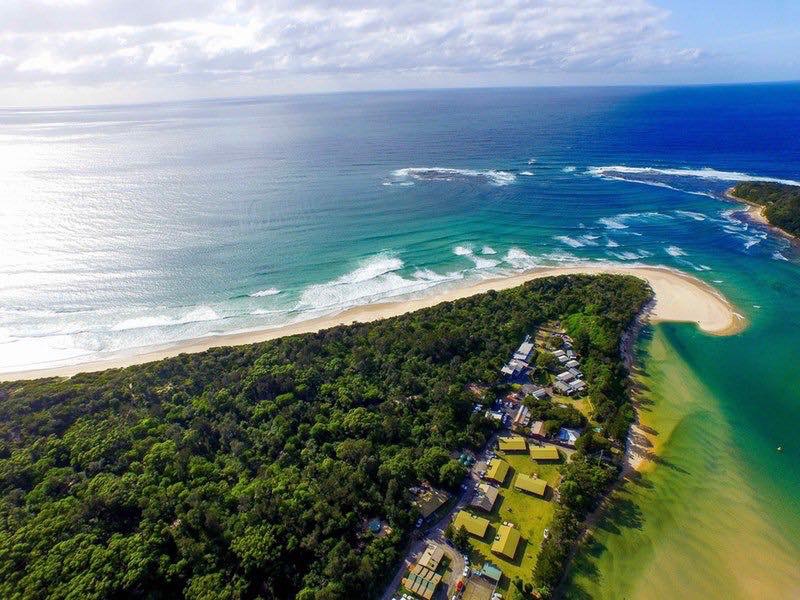
In 1989 my brother Peter Uwe came to visit us. He stayed with us for a few weeks. Unfortunately it rained most of the time while he stayed with us at Oak Flats. Only during our one weeks stay with him at Sussex Inlet we had beautiful sunshine. Looking at this blog about Sussex Inlet brings back memories. Here is the link to the blog about Sussex Inlet in April of 1989:
Soon after waking up in the morning Caroline, Troy and Ryan go outside to greet a kangaroo.
Caroline with her Dad
Ryan and his boat
SIXTY YEARS AGO WE ARRIVED IN AUSTRALIA:
On the 31st of May 1959 Peter and I arrived with the P&O liner “STRAITHAIRD” in Port Melbourne. Six months old Monika and twenty months old Gabriele were with us. We can hardly believe it, that this was sixty years ago!
ANNIVERSARY CELEBRATIONS on the 31st of May 2019:
Celebrations on that sixty year anniversary are coming up! We are going to meet with the whole extended family for these celebrations. We decided we are going to celebrate at this beautiful Holiday Park at Sussex Inlet.
Above the house of Josef and Hulda Spickermann in Lodz during the years before the end of World War Two.
Josef Alexander and Hulda celebrated their 50th Wedding Anniversary in November 1943. All their children with all their spouses and most of the grandchildren were present. Josef and Hulda had three daughters and three sons: Olga, Jenny, Elisabeth (Lies) and Edmund (E), Alexander (Oleg) and Ludwig (Luttek). I have a picture of the Golden Wedding with everyone in it. Here it is:
1927 in Lodz: This is a picture of Dad’s sisters Olga, Jenny and Elisabeth.
My father was the second son of Josef and Hulda. He married my mother, Irma Charlotte Summerer, on the 30th of September 1930. My mother was only nineteen at the time. Four years later, on the 21st of September 1934, I was born. In June of 1935 my parents travelled with me to Lodz (Poland) to visit Dad’s family there. My mother and I, we did not have our own passports. We were included in Dad’s passport as can be seen in the following picture.
As far as I know we stayed in Lodz with Tante Lies (Elisabeth) and Onkel Alfred. I have several pictures that show me with their son Horst who was born on the 7th of February 1935. Tante Lies was about the same age as my mother. Whereas Onkel Alred was twenty years older than his wife. He owned huge properties. We always thought they were rich.
In the above picture I am in the pram with my cousin Horst. There are also cousins George and Gerd, the sons of Tante Olga as well as cousin Ursula, the daughter of Tante Jenny. (Olga and Jenny were of course the older sisters of my father.) The picture is taken in the park of the Häuslers, Horst’s parents.
When I was six weeks old the grandparents, Hulda and Josef, came to Berlin for a visit, where they saw me for the first time. They were proud to have a grandchild by one of their sons. (Their other two sons did not have any children yet at the time). I think my twenty-three year old mother looks very pretty in that picture.
On the 9th of June 1938 my brother Bodo Alexander was born. He was born at home in our apartment in Berlin, Bozener Strasse. Here in this picture he is only a few hours old. I was thrilled to have a baby brother! I believed the ‘Klapperstorch’ had brought him. Mum’s sister Ilse was very excited about this addition to the family as well. Later on I always heard stories about how this home delivery took place. And I did sleep through all of it. When I woke up in the morning, Tante Ilse led me to the cot in the parent’s bedroom. And surprise, surprise, der Klapperstorch had brought a beautiful baby boy. There he was lying in the cot!
Here I am with Opa Spickermann at the ‘Reichssportfeld’ in June 1938 soon after the birth of brother Bodo. It was a time when Mum still had to stay in bed. Tante Ilse and her husband Adolf Schlinke owned a ‘Wanderer’ car. In that they drove Dad, Opa and me to the Reichssportfeld for an outing. Probably so Opa could see a bit of Berlin. Presumably he had come all the way from Lodz to Berlin to see his first born grandson by the name of Spickermann.
Dad, Granddad, Tante Ilse and little Uta,
(I guess, Onkel Addi took the picture.)
UNSER KIND’ – OUR CHILD , this is the title of a book Mum used for recording notes about my development. Here are some of the notes:
“Uta was born on Friday, 21st September 1934, at 19 hrs and 55 min. in Berlin-Schöneberg. Her birth weight was 3200 g, she was 51 cm in length.
Friday, 5th October 1934, Uta 14 days old. This is the day when she was outside for the first time. She had her first solid food on the 23rd December. She enjoyed eating biscuit with orange juice. On 2nd April 1935 she drank out of a small cup all by herself.
On 27th February 1935, Tante Ilse’s birthday, she wore a dress for the first time. She congratulated Aunty with some violets in her hand. When Uta was four months old she raised herself up into a sitting position for the first time. She could already stand quite well when she was six months. She was ten months and two days old when she took the first two steps all by herself. She could climb one step by herself at twelve months without holding onto anything.
Her first tooth appeared when she wasn’t quite seven months old yet. At twelve months she had six teeth at the top and two at the bottom. These teeth appeared one after another without any problems. On the 20th of March Uta wore ‘Schuhchen’ (little shoes) for the first time.
On the 24th of March 1935, a Sunday, she was baptised in the ‘Kirche zum Heilbronn’ by Pfarrer Wiligmann. Uta’s first words were “wau, wau”. Later she said “Mama” and then “Papa” and “Buh”. With “Buh” she meant ball.
She had three small pox vaccinations, because the first two weren’t successful. (Unsuccessful on 12.5.36 and 24.10.36. Successful vaccination on 13.4.37.)”
Here now is what Mum wrote on the 26th of September 1935: “Uta likes children a real lot. She wants to play with every one. She loves to play in the sand. – When I take her out she always likes to stand up in her pram and she smiles at every one. People always take notice of her. When Uta was ten months old I took her on a bike-tour. She was placed in a basket-seat which was fastened to my handle-bar. We went along the Promenade of Münster. It started raining a bit. Because of this she ended up with a bit of a cold.
She was eleven months when she was for the first time in an outside water, the Aasee of Münster. The temperature was 24 degrees (Celsius). Uta went across the German border into Poland when she was nine months. This was her first major trip. Destination Lodz.
For Uta’s first birthday we were still in Münster. Sissi and Teo were our guests. Uta loved all the presents. All day long she played with her toys.”
And there’s a list of all the presents I received, from Aunty in Berlin, from Grandma in Leipzig and also from the grandparents in Lodz.
These are pictures from Lodz in June 1935. I’m in the pictures with my cousin Horst who was born in February 1935.
These are pictures of me from July 1935 in Münster/Westphalia
These are two more pictures from September 1935
Mum wrote I loved to play with sand. Here I’m sitting at one of the sand-boxes (Buddelkasten) with my ‘boy-friend’. I think I was fond of boys at a young age!
The last two pictures are taken in my ‘Kinderzimmer’. I have great fun sitting in the little bed which is for dolls and teddies. There’s one of the chairs which was a gift all the way from Lodz for my first birthday.
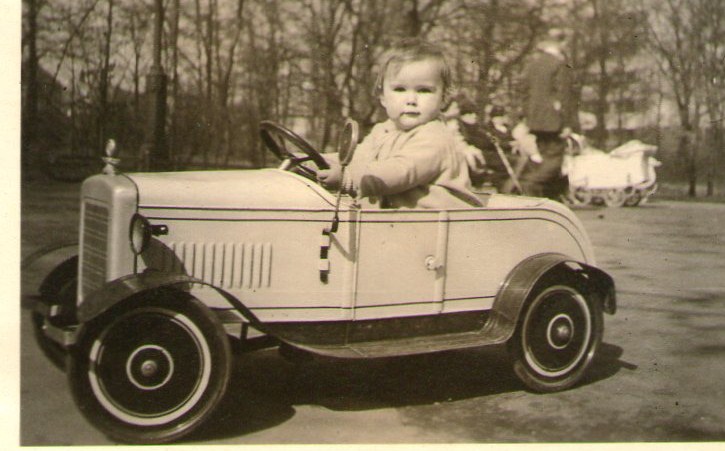
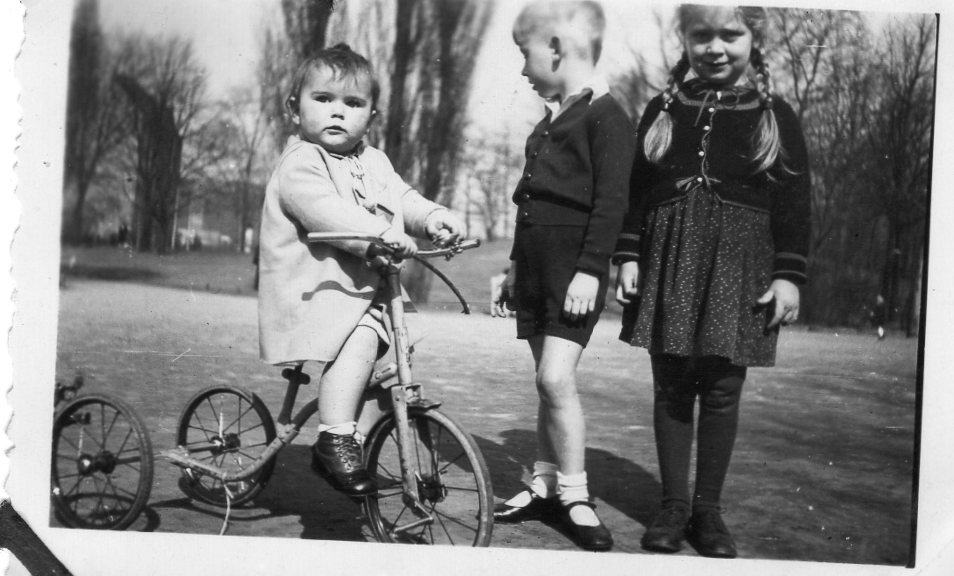
I have here a few more pictures Mum took of me as a toddler. Apparently I wanted to try out whatever other children had, be it a toy car, a doll’s pram or a big tricycle. I didn’t own any of these things, but gee I was keen on trying them out!
How on earth did Mum convince the children to let me try out their things so she could take these photos?
.
On my fourth birthday Tante Ilse gave me a ‘Puppenwagen’, a pram for my
dolls.
Mum kept a big photo album with pictures of me. Growing up, I always liked to look at all these pictures. However, I remember distinctly that the following pictures annoyed me quite a bit. I felt awful that the pictures showed me being so very plump! When I was told I looked ‘cute’ I tended not to believe it. I was self conscious at an early age and mostly didn’t feel ‘cute’ at all. I still often don’t like my picture taken because I think I might look awful! The adults in the pictures are my Mum, Tante Ilse and Onkel Addi. I wonder who took the pictures with all three adults in it. Was it perhaps my father? Pussi was Tante Ilse’s dog. Apparently I loved carrying this dog.
For good measure I want to include here another blog with my father and mother in it and some of the extended family.
My father, Alexander Spickermann, was born in Lodz on the 13th of May 1904. The following picture of him was taken in about 1916. This is the earliest picture I have of him.
Alexander’s brother Edmund Spickermann, was born in 1902. Both brothers studied in Leipzig, Germany. The following pictures are from 1925 in the city of Leipzig. There is first Alexander and then Edmund. Both brothers are in their student outfits. And then there is a picture of both of them in front of the Völkerschlacht-Denkmal in Leipzig.
Alexander and Charlotte are my parents. They were married on the 25th of September 1930. Earlier that year, that is in 1930, Alexander promoted to Dr. phil and Edmund, I think, to Dr. rer.pol. The above picture is from 1925 when Alexander and Edmund first met Charlotte and Ilse. Charlotte was only fourteen years old at the time. Her sister Ilse was eighteen. Below is my parents’ wedding photo from the 25th of September 1930. (Charlotte was born on the 23rd of March 1911 and Ilse on the 27th of February 1907).
Above is another photo of Dad from 1930. The next photo was taken around Easter of 1935.
Dad is holding me. I had been born on the 21st of September 1934. So I am about six months in that picture.
In the above picture Dad is probably not quite forty yet. And then there is the photo of the Grandparents’ Golden Wedding Anniversary in Litzmannstadt (Lodz) in November of 1943. On the left is my sixteen year old cousin Ursula; next are Dad and Mum and I am in front beside Grossmutter (Grandma). I am nine years old.
Below now is the picture that was taken in June of 1938 soon after the home-birth of my brother Bodo. Since February of 1930 Ilse had been married to Adolf Schlinke (Onkel Addi). They owned this beautiful car, called ‘Wanderer’.
Grossvater Josef Spickermann (Granddad) was in Berlin for a visit. Presumably to see Bodo, his new grandson. The Schlinkes took Granddad, Dad and me for an outing in their car. The picture was taken in Berlin at the Reichssportfeld. Dad is in the picture on the left.
The next picture is taken at the Baltic seaside resort of Graal/Müritz in 1940. In the ‘Strandkorb’ are Mum and Tante Ilse, Dad is standing next to them.
I copied three more photos, probably all from the 1950s. The first one is Dad in his office, the two others are party photos with Dad and his family. In the last photo are Dad and his three sisters and two brothers. They were probably celebrating someone’s birthday. The Spickermanns liked to come together as a family.
” . . . . The ”Bayerischer Platz” is the center of the ”Bayerisches Viertel”, (Bavarian district), with many streets named after Bavarian cities, which was destroyed a lot [more] during World War II (about 60%). . . . . ”
I just had a look at my post from January 2015 about Bayerishces Viertel. We used to live in Bozener Strasse. I always assumed that the town of “Bozen” was in Bavaria. I know now that is not the case.
Bolzano (Bozen) is in Southern Tyrol and belongs now to Italy.
“During the gradual decline of the Romans’ influence in the 7th century, Bavarian immigration took place and the first mention of a Bavarian ruler in Bolzano dates from 679.[5] At that time, the Bavarians named the nearby villages around Bolzano Bauzanum or Bauzana.[6]Germanpopulations have been present in the region of Tyrol since this time.”
It seems, even though it belongs to Italy, the German population in Southern Tyrol is predominant. Here is what I found in wikipedia about the modern-day South Tyrol:
This post brings back memories about Bozener Strasse. This is the street where I lived during most of my childhood and early adulthood years. Some of the buildings look a lot more colourful now than they used to. I like some of the very bright colours. During the 1930s and 1940s we children would use Bozener Strasse as our playground because there were usually no cars parked there. Our street was very out of the way and had no through traffic. Tante Ilse and Onkel Addi for instance parked their car in a nearby garage. I think to that garage it was a five minute walk!
I sometimes like to just browse through some older posts of mine. Being able to ‘search’ for certain subjects, often helps to find some posts that I am specially looking for. Today for instance I wanted to find a picture from my first birthday. I assumed that at some time I had published this picture that was taken on my first birthday. Inserting “first Birthday” in the search space, resulted in the following:
Alas, nothing came up about my first birthday, but on the other hand quite a few posts that I enjoyed having another look at. Feel welcome, to browse through some of my posts too. I hope you find some of the posts interesting.
Peter’s mother, Frieda Hannemann, nee Müller, was born on the 16th of November 1900.
“She was always a rather physically weak child, did not like any strenuous activity. On Sundays her father liked to walk with the family across the Tempelhofer Field (later Airport Tempelhof) where the walk over the sandy ground drove her to tears. But her father wanted to have his beer on the other side of the large field.
After school and training to be an “early childhood carer” she worked for a little while as a nanny, but later, during the Big War, she joined the Post Office and became a telephone operator in the new technology of telephony. She had a beautiful, clear voice right to the end of her life. In old age she still sounded like a forty year old on the phone.
Peter’s parents got engaged in 1922
and married in 1929.
This blog is about Peter’s grandfather, Otto Hannemann, father of Richard Hannemann.
“Otto Hannemann, was a carpenter foreman in the growing city of Berlin. Born in the small town of Lukenwalde, south of Berlin, he looked for work in the big city to support his growing family.
When the war started he was not called up straight away. Only later, in the beginning of 1916, he was called upon as he was a reservist (Landjäger).
It seems he had his training in Schwerin, the capital of Mecklenburg
He was sent to the Western Front. (Perhaps he was even opposite Australian forces.) We know from the war reports and history books that it was hell. On the 2. 12. 1916 he fell. Some reports tell of cold and frosty days. He is buried in a war cemetery just outside Lille: https://en.wikipedia.org/wiki/Lille”
Last year I published this blog about the Wedding Reception of Ebony and Ryan. I probably never published the photos that were taken in Wollongongs’s Botanical Gardens on the morning of the wedding on 31st of October 2015. I found in my drop-box three of these photos and publish them here now.
Bride and Groom have already two sons: Lucas (3) and Alexander (1)







 AuntyUta
Thanks for the review of this very interesting story. I was quite interested in the book after watching the two-part (3-hour) video entitled ‘Redemption Road’ via streaming on MHZ Networks in German with English subtitles.
Like
Hi Bill, I thank you for mentioning this video. I found it here:
https://mhzchoiceblog.com/first-look-redemption-road/
Now Streaming
It says: “Redemption Road, a two-episode limited series based on the novel Landgericht by Ursula Krechel (which was translated into English as State Justice, so as not to be confused with Redemption Road, a 2016 thriller novel by John Hart, nor with Redemption Road, a 2010 limited release feature film …The two episodes are beautifully directed by Matthias Glasner (Blochin), and star German fave Ronald Zehrfeld (The Weissensee Saga, In the Face of Crime) and the fantastic Johanna Wokalek as a married German couple, Richard and Claire, dealing with the trauma and subsequent fallout of Nazi persecution. He’s Jewish, she’s not, and – good news! – neither of them die in the war! Neither do their children! No one ends up in a concentration camp! Sounds great, except… well, agony is relative, but it’s still agony.”
In the review something interesting is mentioned about the German constitution!
Article 3 of the German constitution (Grundgesetz) says:
“No person shall be favoured or disfavoured because of sex, parentage, race, language, homeland and origin, faith, or religious or political opinions.”
Vickrey says: “The central figure in the novel, the Jewish barrister Richard Kornitzer, is forced to flee the Nazis and finds sanctuary in Havana for ten years. . . .”
After his return during the postwar years “Kornitzer is treated as an outsider – both as a Jew and because of his special status an Opfer des Faschismus. And he is not alone as an outsider in new “democratic” West Germany . . .”
“That simple act of reading out loud a passage from the constitution is viewed as scandalous, and Kornitzer is forced into early retirement. . .”
Yes, so much about how people may be treated in the new “democratic” West Germany!
This is what it says further on about the movie:
“Redemption Road presents something of a unique perspective of the life of German Jews in WWII. By now, we’ve absorbed accounts of the Holocaust, historical and fictional, delving into Nazi atrocities of imprisonment, starvation, unfathomable physical abuse, and murder in the camps. Less often told are the stories of the people who, through foresight or luck, managed to get out, to escape their homeland as their citizenship was revoked, and their livelihoods taken away. Richard, a district judge who has devoted his life to the rule of law, sees the writing on the wall and, just in time, sends his little children to England as part of the kindertransport.
With subtle horror, the show captures the utter nightmare and surreality of what it must be like for a parent to see their children taken from them, not knowing what will happen to them, not knowing if they’ll ever be together again. How could anyone survive the distress? For a person such as Richard, devoted to logic and order, the lost decade and mental toll in the face of the injustice of it all, is severe. His family stays alive, but at what cost? If you were obsessed with A French Village, here’s a look at the war’s aftermath from another angle.
The road back
Having outlasted the war, Richard makes a return to Germany that was just as painful as his exit, and is reunited with Claire. Will putting the pieces back together prove futile? Is there any hope that justice will be served for the millions of fortunes destroyed, families torn apart and innocent lives lost in the name of war? Is there any point in seeking acknowledgment of the decimation done to so many? What does it take to make a life worth living after you have merely survived evil inflicted on you by your own country? These are but a few of the questions asked by Redemption Road as its characters go on with their lives, separately and together, seeking answers.”