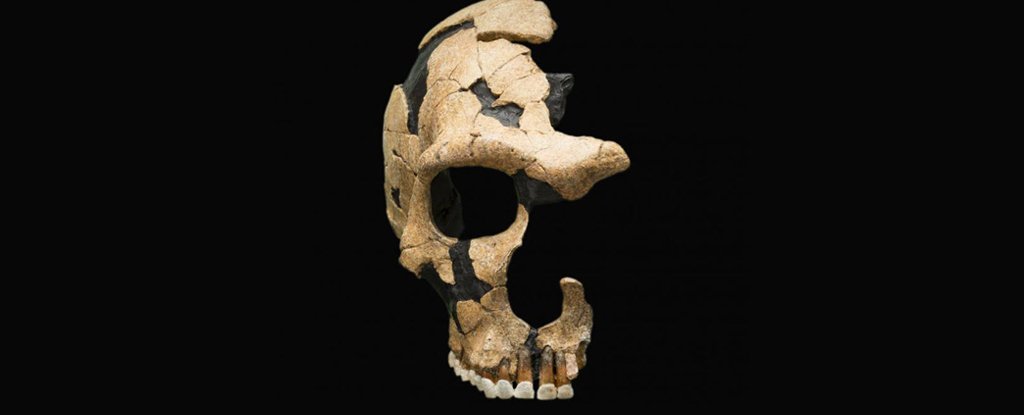
Neanderthals And Humans Were at War For Over 100,000 Years, Evidence Shows

Reblogged this on auntyuta and commented:
“Behaviourally, Neanderthals were astonishingly like us. They made fireburied their dead, fashioned jewellery from seashells and animal teethmade artwork and stone shrines. If Neanderthals shared so many of our creative instincts, they probably shared many of our destructive instincts, too.!

Violent lives

Exposing the Big Game's avatarThe Extinction Chronicles

main article image

The Saint-Césaire Neanderthal skull suffered a blow that split the skull. (Smithsonian Institution)HUMANS

NICHOLAS R. LONGRICH, THE CONVERSATION3 NOVEMBER 2020

Around 600,000 years ago, humanity split in two. One group stayed in Africa, evolving into us. The other struck out overland, into Asia, then Europe, becomingHomo neanderthalensis– theNeanderthals. They weren’t our ancestors, but a sister species, evolving in parallel.

Neanderthals fascinate us because of what they tell us about ourselves – who we were, and who we might have become. It’s tempting to see them in idyllic terms, living peacefully with nature andeach other, like Adam and Eve in the Garden.

If so, maybe humanity’s ills – especially our territoriality, violence, wars – aren’t innate, but modern inventions.

Biology and palaeontology paint a darker picture. Far from peaceful, Neanderthals were likely skilled fighters and dangerous warriors, rivalled only by modern humans.

Top predators

View original post 845 more words

Gore Vidal: The United States of Amnesia

I am looking forward to watching this film!

stuartbramhall's avatarThe Most Revolutionary Act

Gore Vidal: The United States of Amnesia

Directed by Nicholas Wrathall (2013)

Film Review

This film is dedicated to the memory of US dissident and iconoclast Gore Vidal, who died at 87 in 2012. Born to privilege, Vidal was one of the few Eastern- Washington DC elite to turn against his class. His maternal great-grandfather Thomas Pryor Gore was a long serving US Senator and his mother married into the Auchincloss* family, resulting in close ties to the Kennedy family.

Vidal spent three years in the Pacific during World War II before being invalided out for rheumatoid arthritis. He published his first novel at 19.

After Vidal was blackballed by the mainstream media (the New York Times and Washington Post refused to review his books) for publishing the first American novel explaining the mechanics of gay sex, he moved to Hollywood to write TV and movie scripts. He would receive…

View original post 304 more words

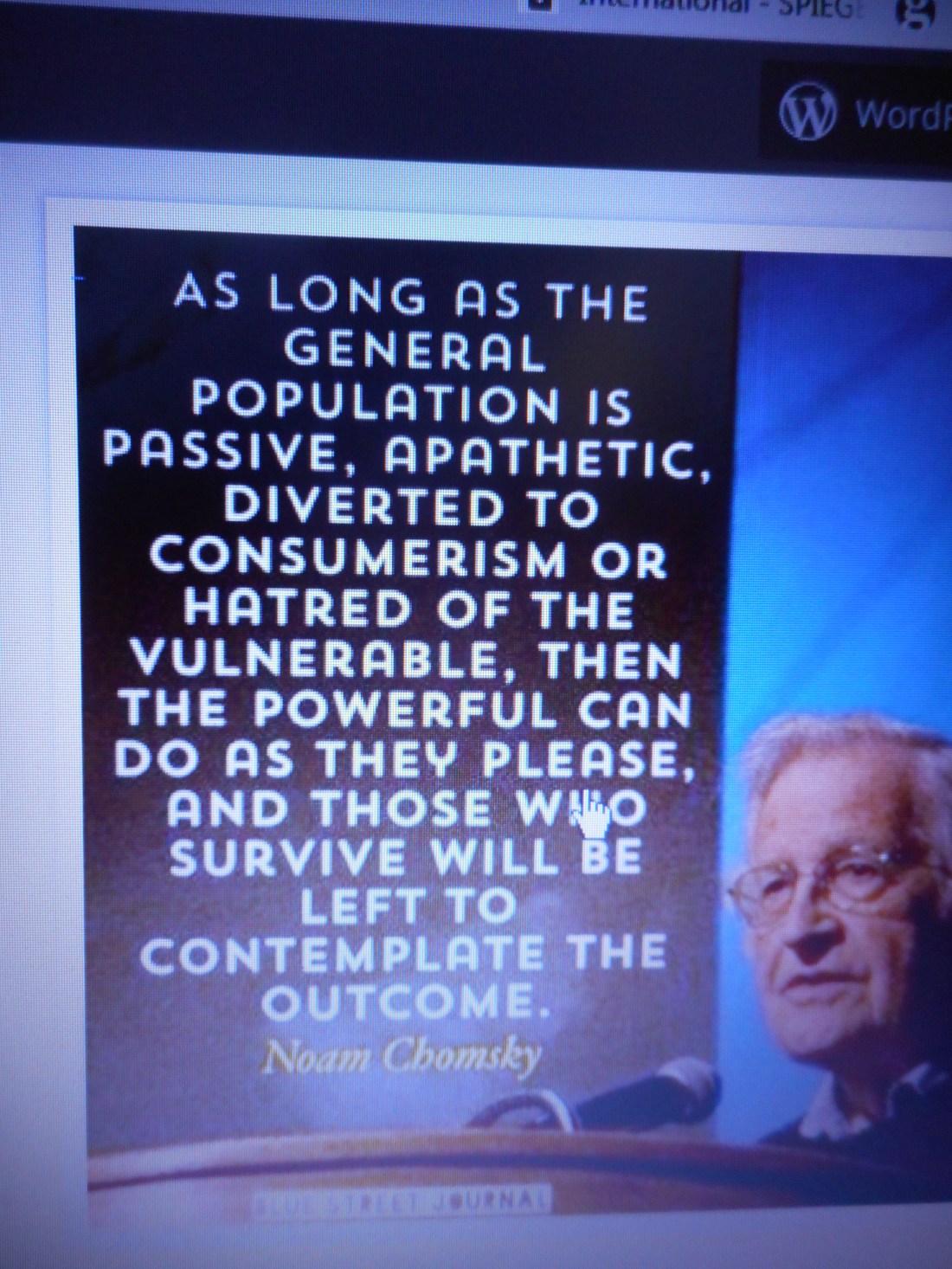
Reflection on a quote by Noam Chomsky

It would be great to have a conversation on this subject!

auntyuta's avatarAuntyUta

Here is the link and what I wrote yesterday after reflecting on a quote by  Noam Chomsky.

https://auntyuta.com/2017/12/07/december-diary-2017/

. . . .  the expression “diverted to consumerism or hatred of the vulnerable” demands my attention. As a pensioner in Australia without major assets (except for owning own house), I would have to count myself to the bottom half in the population. And yet I must say I lead a comfortable life with most medical expenses covered by Medicare. Is it because the general population in Australia is “diverted to consumerism”? Or is it “hatred of the vulnerable” especially hatred of so called illegal migrants that makes us prosper in Australia? Well, this is something to contemplate. If we stop being “apathetic and passive” does our good life end then? How important is it to have a “good ” life at the expense of the vulnerable? Would the vulnerable have a…

View original post 137 more words

December Diary 2017

In 2017 I asked myself: ‘How important is it to have a “good ” life at the expense of the vulnerable? Would the vulnerable have a better life if we stopped consuming so much? . . . ‘

auntyuta's avatarAuntyUta

DSCN3541

Well, so far I survived for eighty-three years. So what is there to contemplate? The answer: There is a whole lot to contemplate!

I looked this up in Wikipedia:

Avram Noam Chomsky(US: /ævˈrɑːm ˈnm ˈɒmski/ (About this sound listen) av-RAHMNOHM CHOM-skee; born December 7, 1928) is an American linguistphilosophercognitive scientisthistoriansocial critic, and political activist. Sometimes described as “the father of modern linguistics,” Chomsky is also a major figure in analytic philosophy and one of the founders of the field of cognitive science. He is the author of over 100 books on topics such as linguistics, war, politics, and mass media. Ideologically, he aligns with anarcho-syndicalism and libertarian socialism

View original post 303 more words

Deutscher Liebesfilm nach einem Roman von Utta Danella

auntyuta's avatarAuntyUta

Ja, dies ist ein Liebesfilm der ‘Grosse Gefühle’ zeigt. Ich finde die Liebes-Beziehungen die die unterschiedlichsten Menschen eingehen, sehr interessant. Dies ist wahrscheinlich ein Film der nicht mehr so gut in unsere Zeit hineinpasst. Mir gefällt der Film sehr, und er hätte mir sicher auch gefallen, als ich jünger war. Vielleicht kann sich die heutige jüngere Generation in das Leben von damals nicht so richtig hineindenken und findet die Handlung zum Teil etwas langweilig und unverständlich, während ich als ältere Person den Film äusserst spannend finde, besonders den 2. Teil!!

Hier ist der 2. Teil:

View original post

Peter

Some followers keep asking, how is Peter. I am afraid to say, that Peter is very disabled now in that most days he can hardly move at all. Today, he is about to undergo some bone scans. It is very difficult for Peter to move in a way that it does not hurt too much. The painkilling tablets that he has been given so far, do not seem to help much at all. Peter has a lot of kidney trouble. A lot of water stays in the body and causes much swelling, especially in the feet and legs.

[241] What a Year – 2020

“And as COVID has shown, if we face an emergency, we are prepared to fight for our lives; let’s fight for climate change as hard, since that will be what’s going to determine our lives from now on.”

We faced an emergency with COVID, Bu climate change is an increasing emergency. There is no doubt about it!

finfin777's avatarFin fin news

It isn’t over yet, it might never be over; and when it’s over, the next challenge awaits us. The next challenge has already started however, it’s the biggest challenge humanity has ever faced, and therefore I’ll continue focussing on it: I’m talking about climate change and the energy transition of course, and other related environmental problems, which obviously haven’t stopped during COVID.

Some got worsened, such as single used plastics, take-away containers, mouth masks, and worse of all the sanitary tissues – which don’t only clog the sewage systems. Others on the other hand got a glimpse of perfection, such as the Himalaya that became visible after years having been covered in smog, and in other cities air pollution dropped to historically low levels – or at least in the history of the industrialised world.

In the meantime, California’s bush fires keep ravaging the USA, while the amazon keeps burning…

View original post 197 more words

The Psychology of Political Helplessness

This looks to me like a very interesting blog!

https://en.wikipedia.org/wiki/Martin_Seligman#Learned_helplessness

Learned helplessness

From Wikipedia, the free encyclopedia

Jump to navigationJump to search

Learned helplessness is behavior exhibited by a subject after enduring repeated aversive stimuli beyond their control. It was initially thought to be caused from the subject’s acceptance of their powerlessness: discontinuing attempts to escape or avoid the aversive stimulus, even when such alternatives are unambiguously presented. Upon exhibiting such behavior, the subject was said to have acquired learned helplessness.[1][2] Over the past few decades, neuroscience has provided insight into learned helplessness and shown that the original theory actually had it backwards: the brain’s default state is to assume that control is not present, and the presence of “helpfulness” is what is actually learned.[3]

In humans, learned helplessness is related to the concept of self-efficacy; the individual’s belief in their innate ability to achieve goals. Learned helplessness theory is the view that clinical depression and related mental illnesses may result from such real or perceived absence of control over the outcome of a situation.[4]