This is a presentation Oscar Mayer heir Chuck Collins, author of Born on Third Base, gave on November 9th. At age 26, Collins made the brave decision to give his fortune away. He currently works as a senior scholar at the Institute for Policy Studies in Washington DC. In his leisure time, he works to educate 1%ers about inequality and their ethical obligations to society. He has campaigned heavily with Bill Gates senior and other billionaires to retain the estate tax and to oppose tax cuts for the wealthy.
Most of the presentation concerns his efforts to challenge the views of other 1%ers on privilege and the grave threat inequality poses to American democracy and the planet.
The Q&As, in which he talks about Donald Trump’s election upset are the best part of the talk. Collins credits Trump’s victory to the dismissive way Democrats view and talk about the…
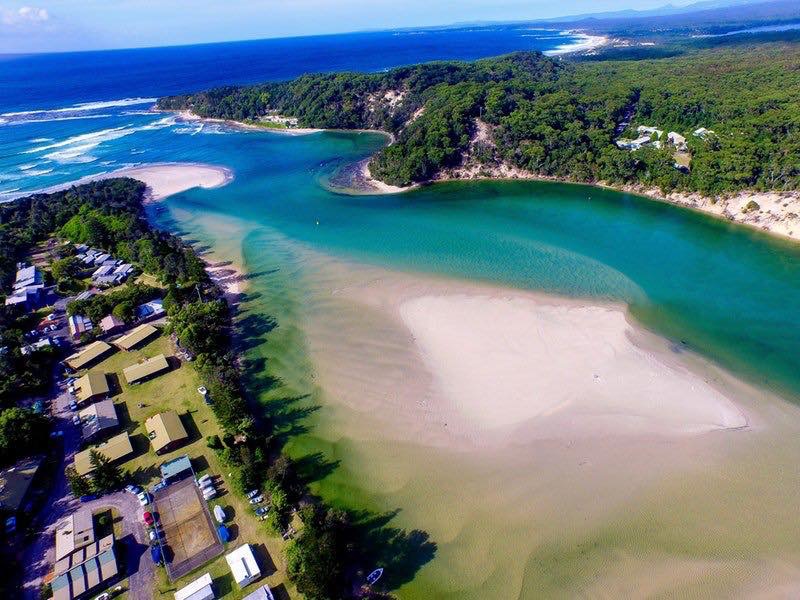
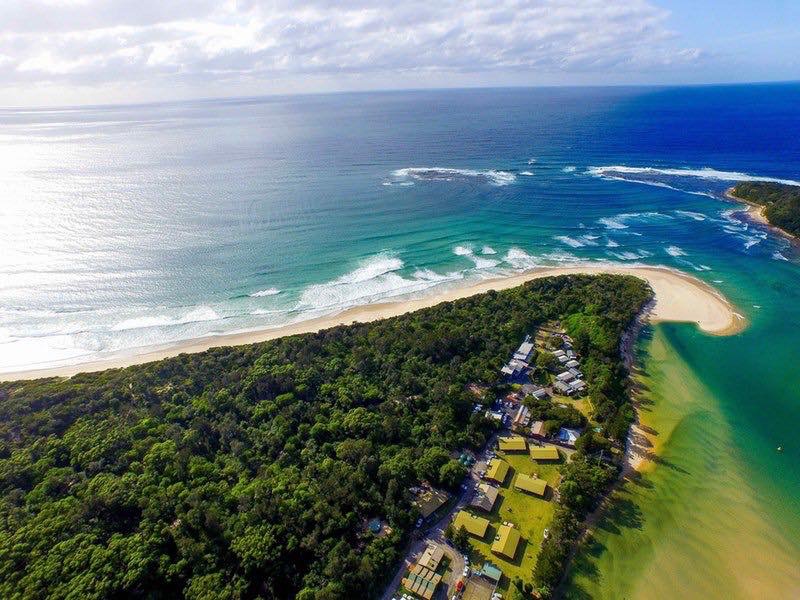
The above pictures I took early on Saturday morning on the 1st of June 2019.
On that weekend at Sussex Inlet, Peter and I as well as our daughter Monika remembered our arrival in Australia 60 years ago, that is we arrived at Port Melbourne on the 31st of May 1959 when Monika was barely 6 months old!
Monika’s partner, her two sons and three daughters (one daughter pregnant with her second child!) and also their partners and Monika’s 3 grandchildren and our 59 year old son Martin (Monika’s brother) were all cebrating with us. Still, there were a few other family members that could not come to Sussex Inlet on that weekend. But some we had been seeing earlier on in May. On the last weekend of June, that is this month, we are going to be in Newcastle to celebrate the 21st birthday of Martin’s younger daughter Lauren.
This is what I wrote in May after we had had quite a few visitors on Mothers Day:
“We had quite a few visitors yesterday for Mothers Day. Come to think of it, all the mothers that were visiting, were already grandmothers. And I am even a great-grandmother! I was so happy, that great-grandons Lucas and Alexander were visiting too yesterday! And Peter actually did hand out roses yesterday to all the visiting mothers. I think they liked this very much.
So, for about three hours in the afternoon we had a large crowd in our house. Daughters Monika and Caroline did most of the catering. This was very relaxing for me.
Monika had come with her daughter Natasha and her son Troy had come with his fiancee Antonina. Troy’s twin-brother Ryan and wife Ebony spent the afternoon with Ebony’s family, but Troy and Nina had brought their nephews Lucas and Alexander along to our plae. Caroline’s husband Matthew and Monika’s partner Mark had come too, and Mark had brought his mother Merl along.”
As far as the 1st of June is concerned, I reflected that on the 1st of June 1959 we had already settled into our accommodation at Bonegilla, Victoria. I wrote about it here:
The Strathaird had come from England with a lot of British migrants and stopped at Cuxhaven to pick up more migrants from Germany. So, Peter, myself and our two baby daghters were among all of those German migrants. We had stayed at Bremen-Lesum overnight. From Bremen-Lesum goes a direct train-line to Cuxhaven. All the migrants, that had stayed together with us at Bremen-Lesum, were taken by train to our destination at Cuxhaven where the Strathaird was already waiting for us.
The Strathaird took five weeks to reach Port Melbourne. It was the most terrific cruise we had on that ocean liner! We were treated like first class passengers. We could not believe how lucky we were. So, this was 60 years ago in 1959!!!
This year we drove to Sussex Inlet on Friday, 31st of May, to celebrate this 60 year Anniversary with our extended Australian family. Most of them also arrived on Friday; some more people actually did arrive on Saturday, the 1st of June. Saturday night we had a great barbecue that was enjoyed by all.
All of us left our beautiful holiday place early on Sunday. Some of us stopped at the Lone Pine on our way home. I did like this very much!
The train was a special train for us migrants who had come on the S.S. STRAITHAIRD to Port Melbourne.
Around lunch-time we stopped in what seemed to be the middle of nowhere. There were two long huts. Some Australian volunteer ladies were about to serve us a warm meal in these huts. One hut was designated for women and children, the other for men. Each hut was equipped with long tables and benches.
It was lunch-time. The meal for us consisted of meat with three vegies: Potatoes, carrots and peas. The peas were straight away called ‘Kuller-Erbsen’ by some German migrants for they thought the peas weren’t soft enough. They kept joking they were just good enough to be ‘kullert’ (rolled around)!
Peter was most upset that he wasn’t allowed to sit with me and the children. ‘I could’ve helped you with the feeding of the babies,’ he said. ‘Why on earth wouldn’t they let me sit with you?’ Yes, I would have loved Peter to be with us for the meal. Nonetheless, I felt that the feeding of the newcomers was well organised. I thought we ought to be thankful that they went to a lot of trouble to provide a warm meal for all of us. Strangely enough, I even liked the ‘Kuller-Erbsen’. The meat-rissoles were tasty and suitable to be fed to the babies. Besides, they had allowed us enough time for our lunch; we did not feel rushed at all. — And there were special chairs for all the babies! That gave me the feeling that Australians liked children. In Germany we had never seen a baby-chair in any public place!
In the evening our train stopped at a siding close to the Bonegilla Migrant Hostel. It was still early evening, but already pitch dark. And we could immediately feel that it was going to be a very cold night.
At the Hostel we were assigned two rooms in one of the huts. One room contained two single beds with two sheets and four Army blankets on each bed. In the other room were two baby cots, also with sheets and warm baby blankets. Both rooms were freezing cold. An electric radiator was in each room. We decided we would use only one room to sleep in, and use the other room as a store-room for our luggage and for one of the cots. One of the cots fitted into our bedroom. So we let our twenty-one months old baby sleep in it. Our six months old baby was to sleep in her pram, of course also in the same room with us. We pushed the two single beds together to make one big bed. One of the Army blankets we hung over the window as an extra buffer against the cold. Using both radiators for the one room it was soon pleasantly warm.
Before bedtime we were given another hot meal in the huge dining hall. We were told every day we would get breakfast, lunch and dinner in the dining hall. The meals were served from a counter. And again there was no shortage of baby-chairs for all the little ones!
For breakfast there was always semolina available, which was cooked in creamy milk. Our babies liked to eat it and so did I. Most German grown-ups didn’t like it at all and would complain that this sort of food was served every morning.
Nonetheless, this was not the only breakfast food. There was always toast and butter and jams as well as other hot cooked food; for instance baked beans, scrambled or boiled eggs or fried eggs with bacon. I think there was also fruit-juice on offer and of course hot tea as well as coffee. The coffee would not have been made the way Germans liked it, but I’m sure I thought by myself, we had really nothing to complain about!
We had severely cold nights during the month of June and wonderful sunshine during the day. We could use an outside laundry free of charge. There were a number of huge kettles and laundry tubs. Most mornings we boiled nappies in one of the kettles. After having rinsed those nappies in one of the laundry tubs, they were hung outside on one of the long clothes-lines. The sun quickly dried them. Taking the dry nappies of the line, they smelled wonderfully fresh! Some of the women made some rather sly remarks about how Peter was always around to help me with the babies as well as all the daily washing. They were probably envious that their husbands didn’t help them as much!
We soon made friends with another German couple who had two babies of about the same age as our babies. During the day we often went for walks with them. The fresh air was good for all of us, especially for the babies, two of them being pushed around in their prams, while the other two could already walk a bit and when they got tired they could sit on a little seat which was fastened to the front of the pram.
This other German family had been neighbours of ours on the S.S. Straithaird. The voyage on that P & O ocean-liner had been absolutely first class: Families with very small children had been accommodated on C-Deck with private cabins for each family! The cabins were large enough for double bunks for the parents as well as room for two cots. Right next to our cabin we had our own private bathroom, where the steward would fill the bathtub for us with hot seawater. He did this twice daily. Next to the bathtub was a dish which was filled with hot softwater for soaping ourselves.
Every morning our steward collected our baby nappies to take them to the laundry-service, for which we had to pay some money. We were not allowed to wash nappies in the communal laundry, which people could use for free. Our voyage lasted for five weeks. For a five weeks nappy-service we had sufficient money, only just. Naturally we could not buy anything in the shops on board the ship. This did not in the least matter to us. All the meals on board for the passengers were absolutely first class! We regarded this sea-voyage as the best holiday we ever had.
In Bonegilla we were immediatly given ‘dole’-money, since nobody had started work yet. The migrant workers were given a choice to look around themselves for a job or to start working in the Port Kembla Steelworks in Wollongong. Peter chose to go to Wollongong, a pleasant town at the Pacific Ocean. (We still live in the area!) Most migrants chose to start in the Steelworks. For a number of years Peter worked in the Steelworks with a gang of brush-handpainter climbing onto very high chimneys in order to paint these chimneys.
Over the years Peter has had lots of different jobs. He was never out of work. It was like that in the sixties: There were always jobs available for everyone. People did not have to be afraid of losing their job. In the seventies Peter joined the railways and eventually was an ASM (Assistant Station Master). He worked then for the railways until his retirement.
We raised four children in Australia. We are debtfree and own our own home. We never regretted that we left Germany to live in Australia. However we like to go back to Germany for visits. We’ve done so a number of times.
Tante Mietze was born on the 17th of June 1873. On the day of the Uprising in East Berlin she turned 80. She was an aunt of Peter’s mother. Peter’s mum was a working mother. So it was great to have Tante Mietze around at all times. Peter and his sisters remember Tante Mietze fondly. She lived with them and cared for the family all the time. Peter remembers that his father had not liked Tante Mietze living with them. He would have preferred his wife staying at home and giving up her job.
Every year on the 17th of June Peter remembers Tante Mietze, setting up a picture of her with some flowers and a candle. This year he also baked a cake in memory of her. He reckons it is the sort of cake Tante Mietze often did bake for the family.
This year the 17th of June was a Sunday and some of our family came to visit. Some family is soon going on an overseas trip, and some others are about to go on a cruise. Peter and I would have loved to join them on the cruise. However we did not want to book it because Peter off and on still needed some treatment at the hospital.
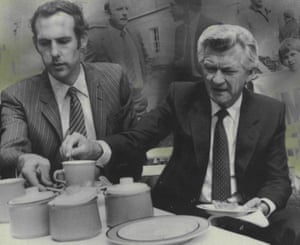
Tea for two in one of Hobart’s parks: Bob Brown with Bob Hawke in February 1983, the month Hawke became Australia’s 23rd prime minister. Photograph: Fairfax Media via Getty Images
Bob Hawke was the environmental prime minister of Australia. His legacy includes Landcare and the listing of the Queensland’s Daintree wet tropics, Shark Bay in Western Australia, Uluru-Kata Tjuta in the Northern Territory, the Gondwana rainforests of the New South Wales-Queensland border region and large extensions to both the Northern Territory’s Kakadu and the Tasmanian wilderness world heritage areas.
The latter was in contention in 1989 after the “Whispering Bulldozer”, the Tasmanian Liberal premier Robin Gray, lost office to Labor’s Michael Field and myself, leading the five Greens holding the balance of power. We Greens negotiated the expansion of the Tasmanian wilderness world heritage area by more than 600,000 hectares to include such iconic wilderness as the Walls of Jerusalem, Central Plateau, Denison River Valley. At the end, Field had had enough and called a press conference to announce the outcome. I did not go.
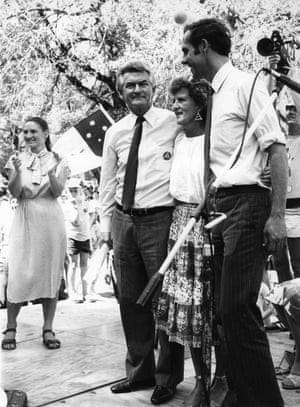
Bob and Hazel Hawke with Karen Alexander and Bob Hawke at the Franklin River protest in Melbourne. Photograph: Ross Scott
Instead, I was on the phone to Hawke’s office arguing that the eastern end of Macquarie Harbour – some 40,000 hectares – should also be included. Hawke agreed so that most magnificent part of the harbour, including Kellys Basin, the mouth of the Gordon River and the convict ruins on Sarah Island, is, these days, a natural delight free of otherwise inevitable industrial fish farming, for hundreds of thousands of people catching cruises out of Strahan.
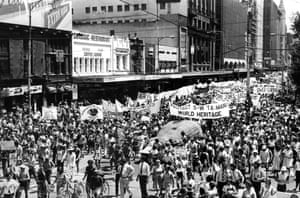
After taking over leadership of the Labor party before the election in 1983, Hawke committed to saving the Franklin River. The Wilderness Society’s peaceful blockade of Gray’s dam works threatening the river had seen thousands of people come to Strahan and more than 500 go to Risdon jail. In Melbourne, at a rally of 15,000 people, Hazel Hawke famously put on “No Dams” earrings and Bob made an ironclad commitment to stop the dam. On election night, 5 March, he made just one specific commitment: the dam would not go ahead but those affected would be duly compensated. He carried through on both promises.
One US outdoors company recently put the Franklin at the top of the world’s 10 most desirable whitewater rafting adventures. Had Hawke and Labor not won that election the river would now, instead, be a series of dead impoundments.
Hawke’s next masterstroke for the environment was to replace Barry Cohen, his first minister for the environment, with Graham Richardson. Never before or since has such a powerful figure on Australia’s political landscape held this portfolio. There could not be a greater contrast with the present minister, who has been absent from the 2019 election campaign.
‘Hear the crowd roar’: the Melbourne rally. Photograph: Ross Scott
Richardson told environmentalists that if he was going to take action he needed to “hear the crowd roar”. So the late 1980s and early 1990s were perhaps the greatest period of public involvement and environmental advance in Australia. This was not without contention. Richardson faced a jeering anti-environmental mob at Ravenshoe in northern Queensland on the way to the Hawke government having the rainforests given world heritage status and protection.
In Tasmania, Richardson, working with Hawke’s office, made repeated visits to back that 1989 extension of the Tasmania wilderness world heritage area against mounting opposition from loggers and miners and the state government. They stopped the polluting Wesley Vale pulp mill project after a huge campaign led by a farmers’ daughter, Christine Milne.
Of course, Hawke did not please us all the time. He backed uranium mining and flirted with Ronald Reagan’s proposal to test MX missiles over the Pacific Ocean. He backed off on a treaty with Australia’s First Nations when the proposal came under fire from the Western Australia Labor premier Brian Burke.
A Hawke masterstroke was to accept the proposal of the Australian Conservation Foundation’s Phillip Toyne and the National Farmers’ Federation’s Rick Farley to set up Landcare. This became a beacon of global interest in government-funded repair of rural lands and rivers. That Landcare and general environment spending has been gutted in recent years highlights the loss of vision in Canberra since the great environmental innovation era Hawke ushered in.
Key to Hawke’s environmental success was his listening ear. He knew the Australian public was keen on protecting nature and he made himself open to direct liaison with environmental leaders. He was a tough negotiator but he and his staff opened an ear to the environment, which has been finally closed altogether by the Morrison government.
Richardson was the first environment minister to alert cabinet to the onrush of climate change. Decades later, at the 25th anniversary of the saving of the Franklin in Hobart in 2008, Hawke lambasted the Coalition’s lack of concern for the heating planet:
And as you look at the arguments and the positions of political parties today you see a complete replication of what we experienced back there in 1983. The conservatives: they never change, they never learn. What was their argument back then? You can’t do this, it will cost jobs. It will cost economic growth. You can’t do it, you mustn’t do it.
Hawke did it and, were he prime minster in 2019, I reckon the very unpopular Adani coalmine proposal would be headed for the bin.
With Paul Keating in the fray, Hawke joined the French government in leading the world – against Bush administration misgivings – to formulating the Madrid protocol which protects Antarctica from mining industrialisation.
Perhaps Thursday night’s Southern Aurora, visible across southern Tasmania, was nature’s accolade for the life of a natural champion.
Our wide brown land: ‘We’ve hit rock bottom’ – video
“Global warming cannot be dismissed as just another environmental problem.”
This video of Bob Hawke speaking about climate change with his granddaughter was played at his memorial today,
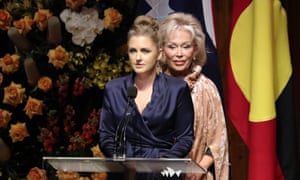
Bob Hawke’s granddaughter Sophie Taylor-Price and his widow, Blanche d’Alpuget, at his memorial service in Sydney. Photograph: Mike Bowers/The Guardian
And this is what Sophie Taylor-Price had to say:
“I grew up in the shadow of a giant. All the reflections shared today reinforce that his greatness was one of a kind. However, his blood is my blood and his story has become part of my story. When I was four years old, I sat by my grandfather’s knee in 1989 when he addressed the nation on climate change. It is actually one of my first memories. Having spent my entire professional career working in climate change and sustainability, you could say that that night rubbed off on me.
However, it is only in recent years, with the passing of my nan and pop, that I’ve truly reflected on just how their values have shaped mine and what I carry forward.
Of all the things said about Bob these past weeks, there is one story that, to me, speaks to the legacy that is most relevant to the future of Australia. For both what was achieved and what is possible, in 1989, Bob was handed some cabinet papers, requesting Australia’s support to open Antarctica to mining. He was horrified. But he was told that years of international negotiations could not be unwound. It was a done deal. “Bugger that” he said.
Refusing to sign, Bob courted the world with an ideal for something greater, better and fairer. Enlisting global eco champion Jacques Cousteau, the Hawke/Keating government determined to set about changing the world’s mind, and they did.
In 1991 the Madrid protocol was executed, making the last great wilderness on earth a place devoted to peace and to science, protected from exploitation. Now, that is legacy.
To me, this tells the greatest of stories. It speaks of pop’s values of fairness and equality, and his love and his faith in the brotherhood of mankind. It speaks of true leadership and his willingness to be unpopular and to listen to unpopular truths. Thirty years ago I sat by his knee and he implored us to take action on climate.
These past months, he expressed such great sadness that we have failed to do so. He saw it as a collective failure of our nation that we have traded short-term interests over intergenerational equality.
He would say that the foundations of excuses we cling to are fragile and will inevitably collapse. We must stop delaying the cost of change now, for all we do is load our future citizens with a debt that they cannot repay. Let us listen to the children and young people who parade their courage and conviction, because their tomorrows will be affected by our actions today.
Many tributes have been shared today, but truly honouring my grandfather means reflecting on his achievements and applying his values to the future choices we make.
Let us take to heart his courage, borrow his optimism and mirror his love for the brotherhood of human kind.
In his twilight years, pop was a gruff old bugger at times. I imagine that if he were here today, he would look at me with love and with fierce pride and with a twinkle in his eye, say in his grumpy old man voice, ‘Well, get on with it then.’
So, that is my path. It was both his gift to me and my enduring tribute to his legacy.”
Bob Hawke’s granddaughter Sophie Taylor-Price says Australia has failed his environmental legacy.
Bob Hawke’s granddaughter has delivered a searing critique of Australia’s progress on tackling climate change while praising the former prime minister for his visionary work.
The former Labor leader’s many achievements were highlighted at a state memorial service in Sydney on Friday where granddaughter Sophie Taylor-Price argued his most relevant legacy was protecting the environment in the face of resistance.
Ms Taylor-Price said one of her earliest memories was when, as a four-year-old, she sat by her grandfather’s knee in 1989 as he addressed the nation on climate change.
“Having spent my entire professional career working in climate change and sustainability, you could say that that night rubbed off on me,” she told the Sydney Opera House audience.
That year, Mr Hawke was handed cabinet papers requesting support for opening up Antarctica to mining.
“He was horrified,” Ms Taylor-Price said on Friday.
“Bob courted the world with an ideal for something greater, better and fairer.”
Instead of signing off on the plan, the then prime minister set about changing the world’s mind, and in 1991 the Madrid protocol was executed and Antarctica was protected.
“Now, that is legacy,” his granddaughter said.
In contrast, current Australian leaders have failed to take action on climate change and Mr Hawke expressed disappointment regarding that fact before his death.
“He saw it as a collective failure of our nation that we have traded short-term interests over intergenerational equality,” Ms Taylor-Price said.
“He would say that the foundations of excuses we cling to are fragile and will inevitably collapse.”
To truly honour Mr Hawke would mean applying his values to “future choices”, she said.
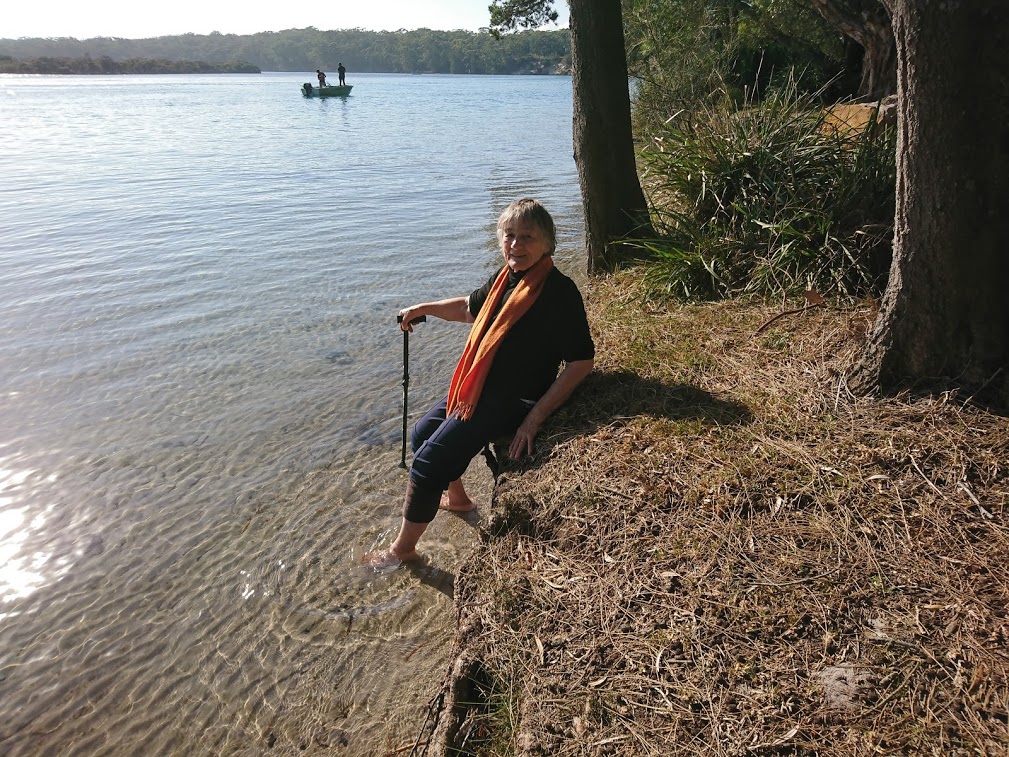
These pictures are published by the RTBU. We stayed in the RTBU Holiday Park from May 31st to June 2nd. On the way home we stopped at the Lone Pine, where I took the chance to dip my feet into the water for a while!!
“Holiday accommodation within Booderee National Park (Ellmoos Road Jervis Bay).
There are 14 self contained cabins which each sleep six. You must supply own linen.
Facilities include an undercover barbecue area, tennis court and the property is readily accessible to the inlet and beach. Cabins contain queen size bed, two single beds and bunk beds in sleep out, fridge, cooking and eating utensils, oven, microwave, cooktop and television.
Owned and operated by the Rail Tram and Bus Union, discount rates apply for union members. General public bookings welcome.
To book or check availability, please contact the RTBU head office on the number provided.”
In the following pictures you can see the Sussex Inlet in the background:
These pictures were taken on the twins birthday in June of 2011.
Two months ago I published the above pics and in one reply to a comment I said these grandsons looked like little angels when they were kids. And Munira said that she can’t imagine them as kids. Ha, ha! So I replied:
“All right, Munira, as soon as I can scan pics again, I’ll show you how they looked when they were little! The twin’s birthday pics were taken just a few days before I started blogging. My profile pic that I still use, was cropped from that birthday pic where you can see me with Troy.”
Well, their birthday is coming up next week. So here I am publishing what they looked like as kids. I went through all our photo albums this morning and unfortunately I could not find this…
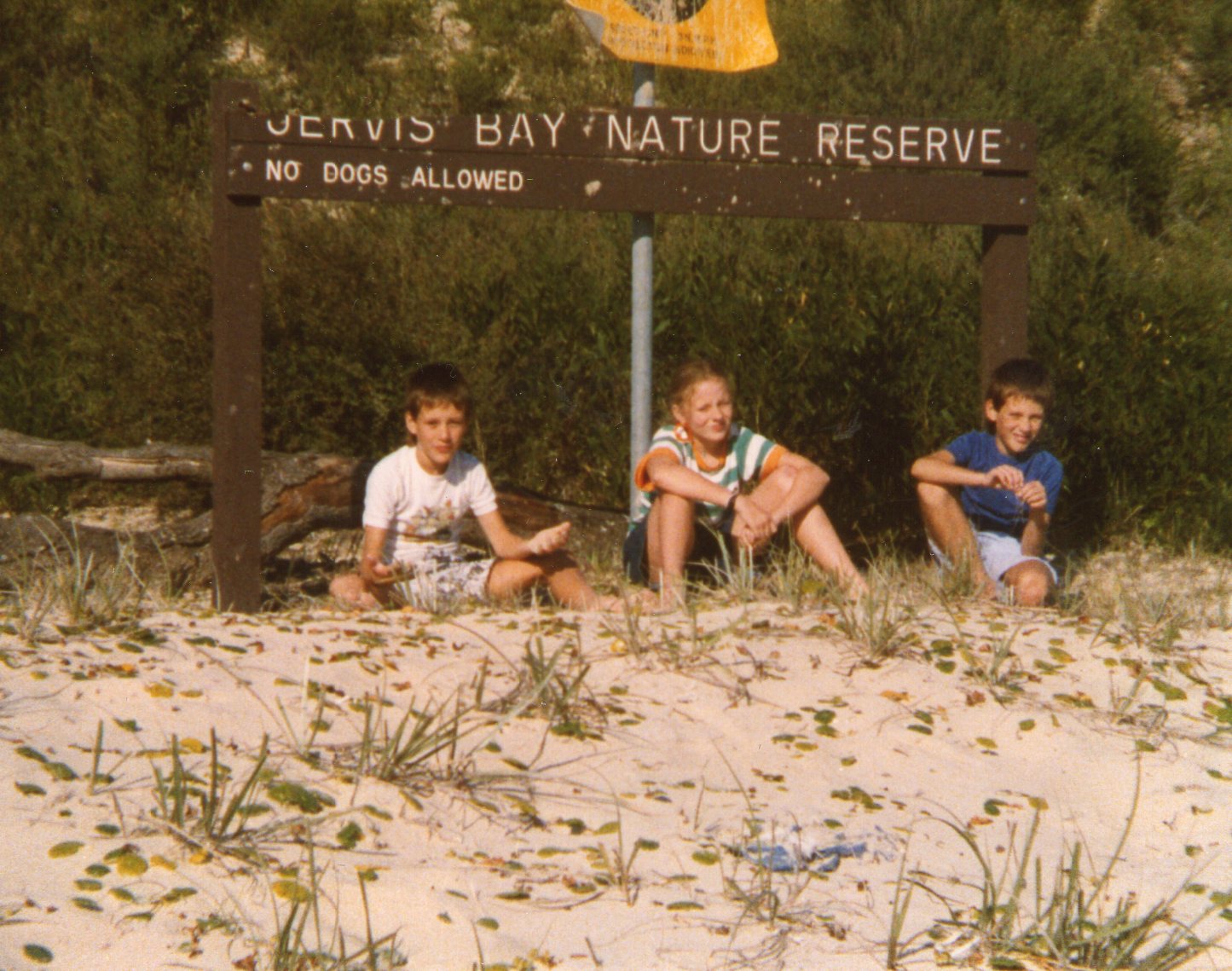
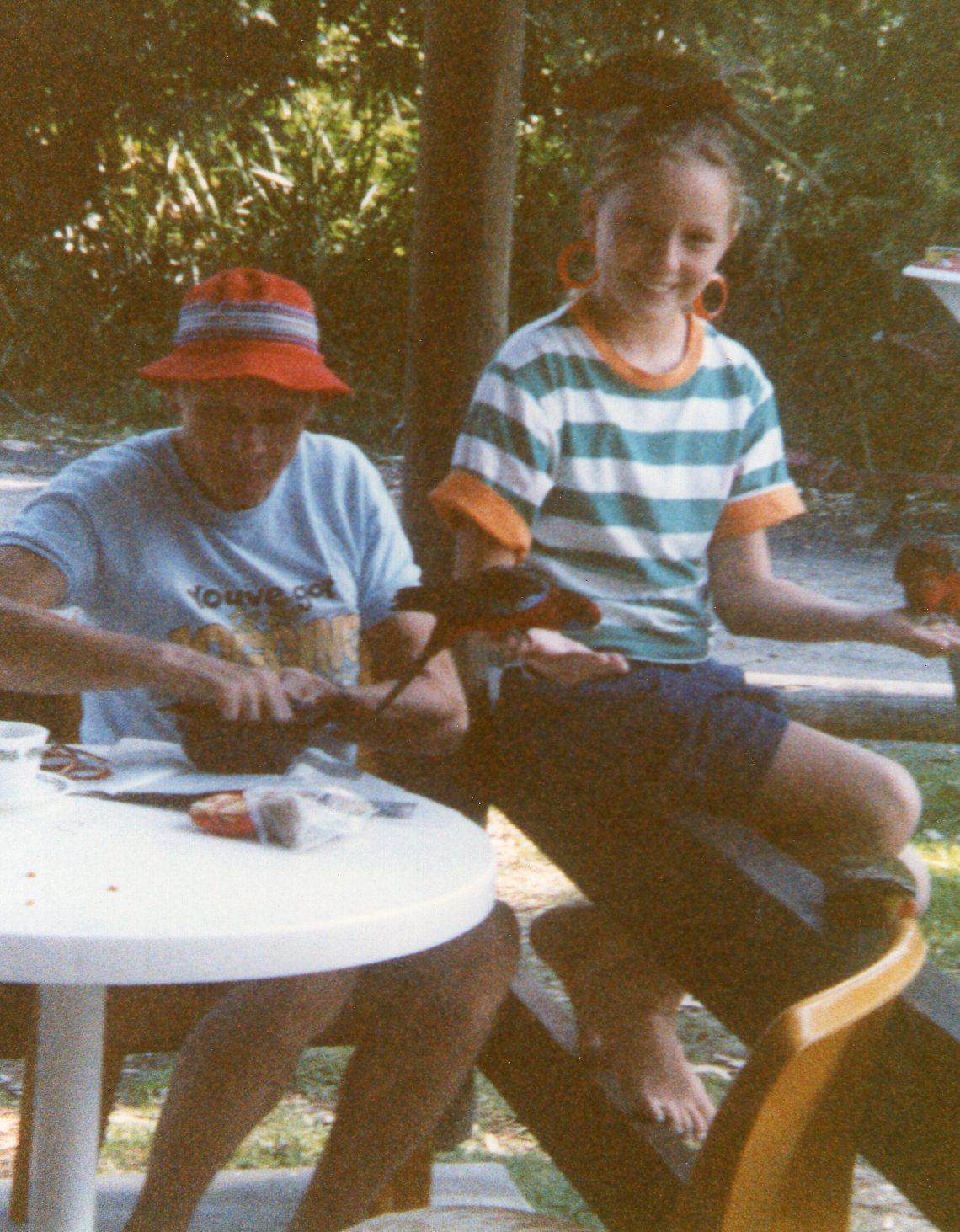
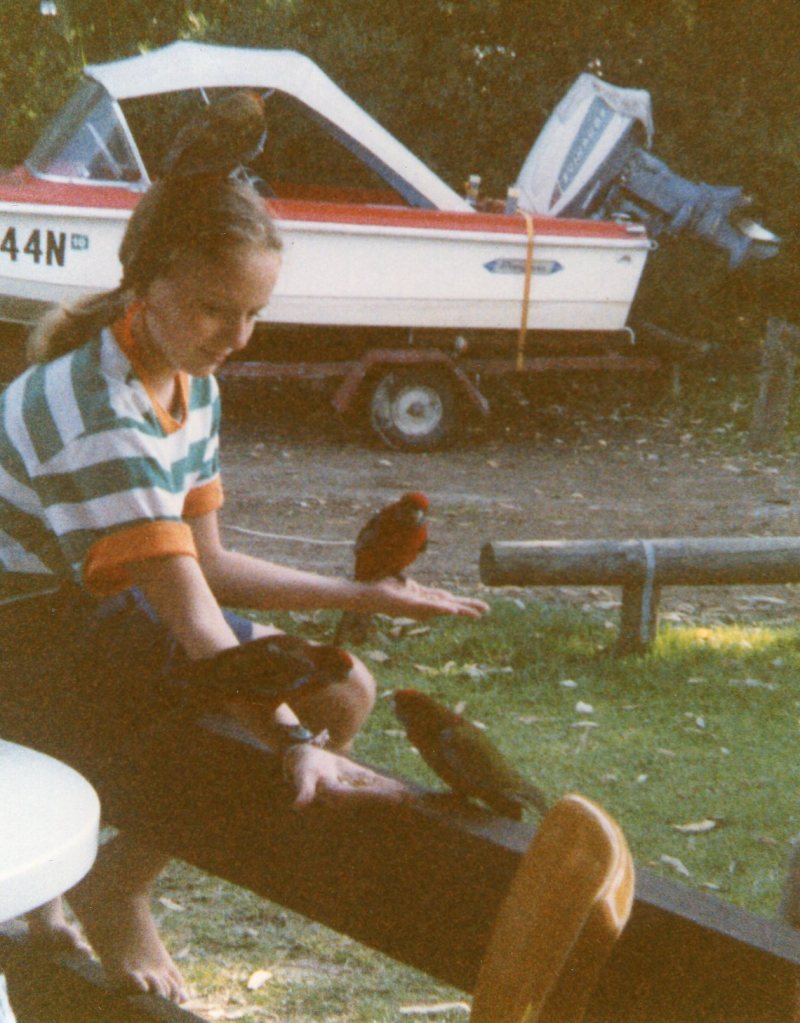
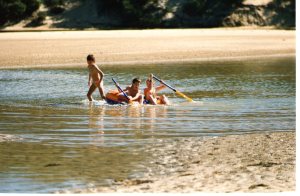
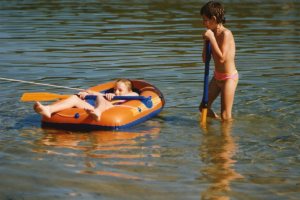
In 1989 my brother Peter Uwe came to visit us. He stayed with us for a few weeks. Unfortunately it rained most of the time while he stayed with us at Oak Flats. Only during our one weeks stay with him at Sussex Inlet we had beautiful sunshine. Looking at this blog about Sussex Inlet brings back memories. Here is the link to the blog about Sussex Inlet in April of 1989:
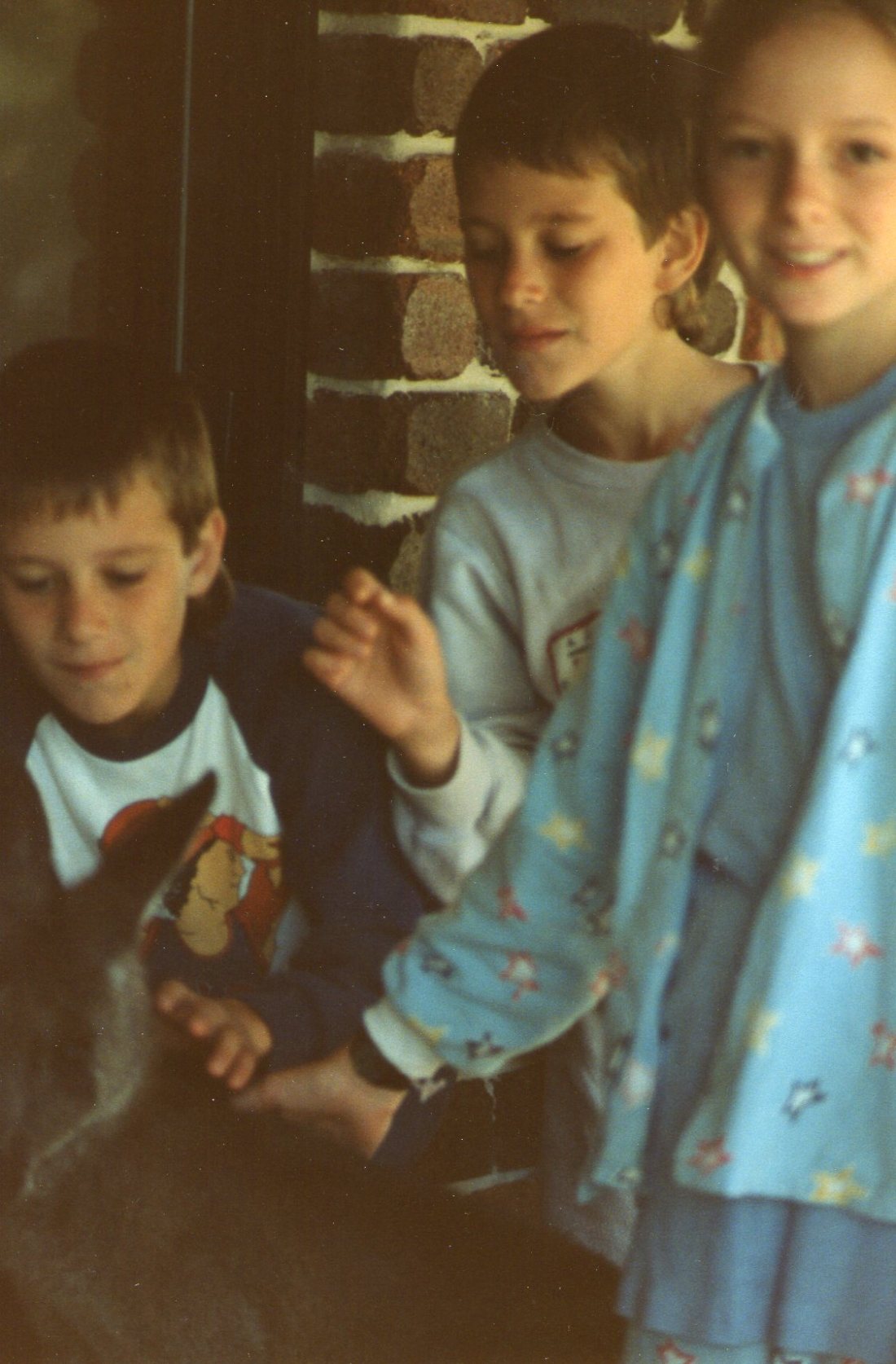
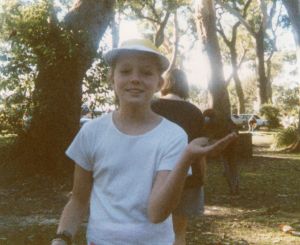
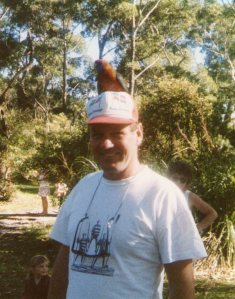
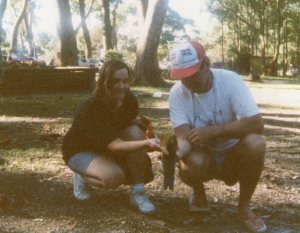
Soon after waking up in the morning Caroline, Troy and Ryan go outside to greet a kangaroo.
Caroline with her Dad
Ryan and his boat
SIXTY YEARS AGO WE ARRIVED IN AUSTRALIA:
On the 31st of May 1959 Peter and I arrived with the P&O liner “STRAITHAIRD” in Port Melbourne. Six months old Monika and twenty months old Gabriele were…





 AuntyUta