Now, that I do have time to write, I find it difficult to settle into a routine. It is for me a rather strange feeling to have any amount of time for writing!
This morning, at the breakfast table, Peter and I were reminiscing about that day when we saw Angie and Roy in Sydney. I found out now, that this was more than eight years ago when we met them in Sydney on that beautiful sunny Sunday!
Angie and Roy just sent the following message:
“Greetings Uta and Peter, From Florida we wish you some peacefulness in the midst of the chaos we are living. We have adjusted to living with the restrictions around us and can only hope that 2021 will be brighter. All the best specially to Peter. Sending light and hugs to you and all your family.”
I wrote back to them the sad news about Peter’s passing. And then they answered:
“Thank you Uta… We are saddened about Peter’s passing and wish you strength in this difficult times. It is your good fortune that you have your family near by. We can all celebrate his life this season and maybe we all meet again. A comforting thought anyway. Fond memories will prevail about our meeting in Sydney and Berlin. All the best and thank you for sharing the links.”
I wrote back to them now:
“Thank you, Angie and Roy! Yes, fond memories. And I do have a large family. This is a blessing, especially now that I am so alone. Peter did not want to leave me. He was always there for me. Our children were always close to both of us. Of course, they want to take care of me now. But they have their own lives too. So, for the time that is left to me now, I may have to cope on my own, as much as possible anyway. I just hope for good health a bit longer, even though the slowing down is already considerable. (You may have noticed I walk with a rollator.) Even though, it would be nice, if all of us could do some more travelling soon! Wishing you all the best for 2021!Love, Uta”
Geraldine Doogue seeks powerful connection with prominent Australians through an investigation of their sacred space. Filmmaker James Ricketson talks about his connection to his home in the northern beaches of Sydney.Share
“Even something as simple as retrofitting homes with heat-reflective roofing and reducing concrete and paving in backyards by increasing grassed areas can reduce what he calls “heat sinks around the home” and lower air temperatures.
When it comes to fighting fires, Gissing advocates investment in technology that can lead us to “the next generation of firefighting”.
“How are we going to be fighting fires in 2040 or 2050 when the frequency of blazes is only going to increase because of climate change?” he says, pointing out that new technology which aims to rapidly detect and suppress fires could prevent catastrophic fire events in the future.
Concrete, tile and paving can increase the way heat is absorbed and raise the temperature of a city.(Supplied: Linking Melbourne Authority)
Survival kit: Things you’ll need in case of an emergency
Share
Emergency agencies recommend having a kit ready with items that will help you survive and recover from a disaster.
The Red Cross talks with hundreds of people each year who are recovering from an emergency including what they wished they’d done to prepare.
Jacqui Pringle from Red Cross Emergency Services says you should ask yourself what are the things that will bring comfort and how will I protect the things that are important.
“Thinking through some of this in advance can make you feel less stressed and give you some control in a situation that is often out-of-control,” said Ms Pringle.
Having an emergency kit is one of the top four survive and recover preparations recommended by the Red Cross, along with knowing your risks, getting connected and getting organised. Find more Red Cross prepare information at redcross.org.au/Prepare or download the Red Cross Get Prepared app.
You should keep your kit in a handy location, in a container or bag that’s big enough to add extra items when you’re responding to a specific disaster.
Some basic items to include:
Radio: battery-powered, wind-up or solar-powered radio. Mark on the dial the frequencies of ABC Radio and other local services.
Light: a waterproof torch is good, and consider a backup windup version that doesn’t need batteries, plus candles with waterproof matches or glow sticks.
Drinking water (consider having 10 litres per person to last three days).
Food: dried and long-life food to last three days, include a can opener and utensils.
Spare batteries for all devices (check batteries every six months).
Toiletries including soap, handwash gels, alcohol wipes, toilet paper, tissues, toothpaste and sanitary items.
Cash: enough to meet basic needs for a few days.
First aid kit and guide book.
Waterproof bags for valuable items and documents
Copies of essential documents such as prescriptions and insurance details. You can also store this on a portable hard drive, give a copy to a trusted person, and/or upload to cloud-based storage.
Your written bushfire, cyclone, flood or emergency survival plan, including contact numbers of family or neighbours.
Protective blankets and clothing suitable for likely emergencies in your area such as long-sleeved natural-fibre shirts for bushfire areas, protective footwear or rubber boots in flood areas. Sunscreen, insect repellent and wide-brimmed hats are also useful.
Set an annual reminder on your phone or calendar to check your emergency kit.
If you need to relocate, include:
Prescription medications
Toiletries and a change of clothes
Mobile phone charger
ATM cards and credit cards
Important documents or valuables including passports, wills, photos, jewellery, insurance papers or mementoes
Don’t forget people with special needs in your family:
Mobility aids
Nappies and supplies for infants
Encourage children to pack familiar things that will bring them comfort in times of stress such as a favourite toy
Items to keep your pets comfortable including a leash, basket, travelling cage and pet food
The following I published exactly nine years ago! We still live in this home that we moved into in 1994. It is 2020 now. So, more than nine years ago we were already contemplating a move to somewhere else. Here is what I published in 2011, November 08:
When we saw the ad in the brochure, we thought immediately, that this could be our dream home. It was rather low priced. It was close to Goulburn Railway Station. It was also near a shopping centre with an ALDI store close by. What more could we want?
This could be our Dream Home! It was as simple as selling our present dwelling, buy the new place and end up with something like fifty thousand Dollars saved in the bank! People told us, but Goulburn, it is a bit out of the way, isn’t it?
No, we said, not at all. There’s the Railway Station close by. We hop on the train and are in Sydney in no time. The pensioner excursion trip to Sydney still costs only two Dollars and fifty cents! We can even go from Goulburn to Newcastle for our two Dollars fifty!
But you cannot do such a long trip that often, was the objection. We were asked, how often we were then going to see our children. How often do we see them now? We asked back. We pointed out, that we more or less only saw them for birthdays and Christmas anyway. We could still see them on those occasions, when we lived in Goulburn.
So we were all set to make the move to Goulburn, when it suddenly dawned on us, that the new place would need some renovations first. Renovations? At our age? Much too difficult! If we paid someone to renovate for us, we’d probably end up with no money left in the bank.
This is the end of the story. We are not going to sell our home and we are not going to move to another place.
POSTSCRIPT
I wrote the above exactly three years ago. In the meantime we’ve become more and more aware that our present home does need renovating. Somehow we just keep putting it off. In another three years we are going to be in our eighties. Maybe if we just put our time and energy into this home we are in now, we can keep living here even in our eighties. If we don’t come up with some major health issues, then maybe we do not need to go to a Retirement Village, even though living in a Retirement Village at an advanced age would make living a lot more comfortable for us.
In our area to buy a place in a Retirement Village costs about twice as much as what we’d be able to pay if we sold our present home, which just isn’t worth that much on the market. So a Retirement place in our area is out of the question.
Then about a year ago we came up with a new idea. That is, we found out that in a place about half way between Sydney and Melbourne we could buy a Retirement place for less than half the price which it would cost here in our coastal area. This place would be further away from Sydney than Goulburn but it would be closer to Melbourne where our son lives. And this place has a railway station, the same as Goulburn! But of course the trips would cost a bit more than two Dollars and fifty cents.
It would be good, if one way or another we could make up our minds about were we want to spend the last years of our lives. It looks to me, we’ll probably leave everything the way it is. For the time being anyway. Maybe we already live in our Dream Home! When we moved in here, the place was brand new and just perfect for us. We’ve been very happy here for the last seventeen years.
Hello, Auntie Uta. How are you? As they always say, “Home is where the heart is.” So true in your situation. As we all get older, familiar surroundings become more and more important. Your home might need some work here and there but I’m sure it’s filled with memories—every inch of space inside and around it. How can one begin to part with such a place? I’m with you there. Now that we’re empty-nesters and our daughter has decided to live in the city, our house seemed too big for us. We thought about moving. We thought about “down-sizing.” We searched for an alternative place to call our own. In the end, we chose to stay. We enjoy our home and our yard. We still like our neighborhood. We like the place where we buy meat, produce, and any comforts. We like going to the farmer’s market once a week. Or even eat at the burgeoning restaurant selection in our little downtown. And so stay we shall!Reply
auntyutaEditHi MOL!I agree with you: Home is where the heart is. As always you make me open my eyes to a lot of things. Your comments are very stimulating. Thank you so much for stopping by!In our case it’s probably time to give away a few things which we collected over the years. We accumulated too much stuff, that’s very obvious. Don’t they say: Less is more?In September 1964 when I had just turned thirty, we moved into our first home. It was a very small cottage, newly built on our block of land. We felt we were in heaven! It was a fantastic experience for us to move into our own brand new home. We stayed in this place for the best part of thirty years. On my sixtieth birthday we moved into our present home. It is a bit larger than our first home was. We love it very much. You’re right: ‘How can one begin to part with such a place?’Now, I ask myself, how on earth can we achieve to live in a less cluttered place? When our youngest daughter has a bit of spare time, she sometimes sets herself the task to unclutter a few cupboards for us. Actually she started on that a few times. Would you believe, it never takes very long for some more clutter to take up all the empty spaces! For instance, we keep most of our old video-tapes, including an old video-player. All this takes up unnecessary room. Why is it so hard to throw the old stuff out? Most of the videos we haven’t watched for ages. Are we ever going to watch them again? Probably not. So why do we keep them?Reply
MuniraEditMay you be followed by good health, wherever you decide to go Reply
Kate KresseEditWe are going through some of the same decision processes…trying to decide whether to get a much smaller house to try to save $$. trying to downsize possessions. also trying to help my mom do the same thing when i go visit her. i can part with things a bit easier than she can. but oh my i find it almost impossible to get rid of books! I use a lot of different books with my tutoring—i have an entire shelf full of math textbooks so that I can show my students various examples and provide them with a lot of quiz and test questions. May you and your husband keep your health so that you can enjoy wherever you live.Reply
auntyutaEditSome of our books are over fifty years old. How often have we said: From now on we’re not going to buy any new books! When we pass a bookshop and there’s a good sale on, we can’t help ourselves, we have to have a look. More likely than not we end up buying some more books. On top of it we have already a collection of E-Books. I find E-Books are a good read on our frequent train-travels to Sydney. Thank you for commenting, dear Kate. Best wishes for you and your family too.Reply
Kate KresseEditAuntyuta—I know what you mean about those book sales!. We have an amazing used book bookstore one town over….about 15 miles from here….oh my son and I could spend an entire day there! And our public library has a little shop set up right off the lobby where they sell books that are excess to them. Those prices are good to begin with and a couple times a year they have big markdowns….and of course there are the Goodwill stores that have books…..sigh. I can’t help it i just love books!!! I have a kindle that has some books on it too….love to you and your hubby today—and the rest of your family too
auntyutaEditThanks. Enjoy the rest of your Sunday!
Just now, Joe Carli from ‘freefall’ gave the above post of mine a ‘like’. I read it again and noticed that I already reblogged it on February 25, 2020 and wrote: “This post from 22 August,2013, was something I just want to have a look at again. I very much like to read some of these old blogs!”
Again I now went back to the post from 22 August, 2013. I did read the whole post again as well as all the comments to it. I very much liked doing this. All these pictures to the post I find interesting too and I want to copy them here now:
(Well, this is just a bit about the lives of Gaby and David.)
Peter and David in an outside area of the Nursing HomeDavid was allowed to have his lunch outside. But he hardly touched it.David gave me this Mother’s Day gift on the day Peter and I visited him. He said he had bought raffle tickets to win this to give it to me. I was very touched by this.
By seven o’clock this morning I was outside in our backyard to take some pictures.
This area on the North side of our house is well shaded by large trees.Some Lavender on the South side ready to be planted.I am happy that some new yellow flowers appeared on the West side of our house.
The East side of our house is Body Corporate area, whereas the three other sides belong to our private area and are fenced in. Yesterday we had our family visiting. The two great-grandsons wanted me to take them to the backyard. They enjoy running around in there from one side of the house, to another one and another one and then back again. Four year old Lucas runs as quickly as he can, and two year old Alexander has fun following his big brother. It gives me great joy to see them running like this.
Caroline and Matthew were staying with us, and we had apart from Lucas and Alexander also four additional adults visiting us for afternoon coffee. Actually, our daughter Caroline had spent the whole weekend with us. Sunday night she had to fly back to Darwin. Mathew drove Caroline to the Airport in Sydney. We went along with them to farewell Caroline.By 9.30 pm we were back home again.
Caroline had purchased for us 15 small lavender plants and did clear the area that was to be planted. While Caroline was busy in the garden, Peter and I took off for a visit to the Temple. Caroline and Matthew had advised us to do this. We gladly followed this advice!
This morning, while I did some washing, Peter took to planting the whole lot along the fence on the South side. He used diluted fertilizer from our worm farm for the plants and then covered them with mulch. It turned out to be beautiful sunny, but early in the morning there was a very cool breeze which I did not like at all!
By the way, today is the wedding anniversary of Ryan and Ebony who are the parents of Lucas and Alexander.
This Camelia kind of survived the slaughter of our trees and is just starting to get some leaves again. Attempting to establish a bit of a veg garden on the West side;
And following are some random pictures near the house on the West side:
Now a few pictures from yesterday (Sunday):
Alexander and Lucas are keeping themselves busy;They loved this cake that Great-Granddad Peter had baked.We had whipped cream with the cake.Here Lucas is having a rest with his Grandma Monika after having been running around for a while.
DinaEditYou are an early riser, Uta! Lovely impressions from garden and weekend. Juicy Marmorkuchen is my alltime favourite. Reply
auntyutaEditI usually rise at about 6 o’clock, Dina. I love to rise early. Yes, this Marmorkuchen turned out well. Peter often volunteers to bake something. He has quite a bit of experience with baking.In the meantime I edited this post a bit. I did add a few more things about last weekend. Actually, I was extremely tired when we came home from the airport last night and went straight to bed.Thanks for commenting, Dina. Hope you and Co had a good weekend too. Cheers, UtaReply
catterelEditLovely! That looks a very authentic Marmorkuchen – do you have real German cake moulds, or can you get the tradition ones in Australia?Reply
auntyutaEditActually, Cat, we’ve had this cake mould (Kuchenform) for a long time. I am not sure where we bought it. Have a great weekend!Reply
auntyutaEditYes, Robert, this is exactly how we feel about it, even though we’re not expert gardeners and too often tend to neglect to work in the garden. But it gives us great joy when finally we have achieved some improvement by just putting a little bit of work into it. Reply
aussieian2011EditA beautiful homely post Uta, and a truly delightful garden, unfortunately Lavender never seems to grow for us, mainly because we can only have them in pots here, their aroma is beautiful, reminds me of my time visiting the Lavender farms in Tasmania. Peter is a great Cake master I think. Cheers.Reply
auntyutaEditWe hope in time their scent is going to dazzle us, Ian. Peter loves baking cake. He hasn’t lost his touch yet! Wishing you and Ana a great weekend. Cheers, Uta
On the 6th of October I published a post with the following message:
“Some followers keep asking, how is Peter. I am afraid to say, that Peter is very disabled now in that most days he can hardly move at all. Today, he is about to undergo some bone scans. It is very difficult for Peter to move in a way that it does not hurt too much. The painkilling tablets that he has been given so far, do not seem to help much at all. Peter has a lot of kidney trouble. A lot of water stays in the body and causes much swelling, especially in the feet and legs.”
The nuclear bone scans showed that Peter’s bone cancer has spread!
Because of some very nasty constipation Peter was admitted to hospital on the following day, Wednesday, 7th of October. On Monday, the 19th of October, he could finally come back home. A lot of alterations were being done to our home to make Peter more comfortable. We are very happy that he did not have to stay in hospital, for now it is possible that a lot of family can visit him. Our son, Martin, who lives in regional Victoria, hopefully may be allowed pretty soon to come to NSW to stay with his Dad. Martin is already extremely distressed that so far he was not allowed to travel to Dapto, not even for compassionate reasons! In a letter written by
Senior Staff Specialist Oncology & Radiotherapy, Wollongong Hospital Senior Lecturer, Graduate School of Medicine, University of Wollongong
the following was stated about Peter’s condition:
Diagnosis: metastatic carcinoma of bladder: hepatic and skeletal metastases
It says: I am writing this letter in support of Mr Hannemann who is a patient of mine suffering from terminal cancer. . . .
Today I republished some pictures that I took exactly six years ago. In 2014 Peter and I had a lovely walk on that 31st of October:
Today is the last day of October – HALLOWEEN! Some years ago there would always some children come to the door to “trick or treat”. They do not come any more. Why? I suppose they did grow up over the years. But why have not any other children taken their place?
These Irises looked beautiful when they were fresh.
The players at Table 25 fought first over the choice of pawns. Doug Herold, a forty-four-year-old real estate appraiser, settled on the car. The player across from him, a shark-eyed IT recruiter named Billy, opted for the ship and took a pull from a can of Coors. The shoe was taken by a goateed toxic-tort litigator named Eric, who periodically distracted himself from the game on a BlackBerry so that he “could get billable hours out of this.” The dog was taken by a doughy computer technician named Trevis, who had driven from Canton, Ohio, as a “good deed” to help the National Kidney Foundation, sponsor of the 25th Annual Corporate Monopoly Tournament, which is held each year in the lobby of the U.S. Steel Tower in downtown Pittsburgh. On hand for the event, which had attracted 112 players, divided into twenty-eight tables of four, were the Pittsburgh Steelers’ mascot, Steely McBeam, who hopped around the lobby grunting and huzzahing with a giant foam I beam under his arm; three referees dressed in stripes, with whistles around their necks; and a sleepy-looking man, attired in a long judges’ robe and carrying a two-foot-long oaken gavel, who was in fact a civil-court judge for Allegheny County donating his time “to make sure these people follow the rules.”
I had spoken the night before with Doug, who won the previous year’s tournament, about his strategy for victory. “Well, last year I managed to get Boardwalk and Park Place, and then everybody landed on them,” he explained, chalking his success up to dumb luck. “What you have to do,” he said, “is get a monopoly, any monopoly, as quickly as you can.” I asked him if he knew the secret history of the game. He confessed that he did not.
The official history of Monopoly, as told by Hasbro, which owns the brand, states that the board game was invented in 1933 by an unemployed steam-radiator repairman and part-time dog walker from Philadelphia named Charles Darrow. Darrow had dreamed up what he described as a real estate trading game whose property names were taken from Atlantic City, the resort town where he’d summered as a child. Patented in 1935 by Darrow and the corporate game maker Parker Brothers, Monopoly sold just over 2 million copies in its first two years of production, making Darrow a rich man and likely saving Parker Brothers from bankruptcy. It would go on to become the world’s best-selling proprietary board game. At least 1 billion people in 111 countries speaking forty-three languages have played it, with an estimated 6 billion little green houses manufactured to date. Monopoly boards have been created using the streets of almost every major American city; they’ve been branded around financiers (Berkshire Hathaway Monopoly), sports teams (Chicago Bears Monopoly), television shows (The Simpsons Monopoly), automobiles (Corvette Monopoly), and farm equipment (John Deere Monopoly).
The game’s true origins, however, go unmentioned in the official literature. Three decades before Darrow’s patent, in 1903, a Maryland actress named Lizzie Magie created a proto-Monopoly as a tool for teaching the philosophy of Henry George, a nineteenth-century writer who had popularized the notion that no single person could claim to “own” land. In his book Progress and Poverty (1879), George called private land ownership an “erroneous and destructive principle” and argued that land should be held in common, with members of society acting collectively as “the general landlord.”
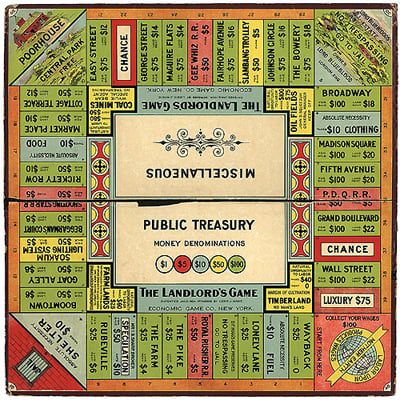
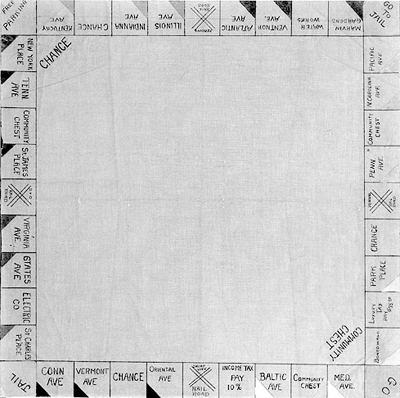
Magie called her invention The Landlord’s Game, and when it was released in 1906 it looked remarkably similar to what we know today as Monopoly. It featured a continuous track along each side of a square board; the track was divided into blocks, each marked with the name of a property, its purchase price, and its rental value. The game was played with dice and scrip cash, and players moved pawns around the track. It had railroads and public utilities—the Soakum Lighting System, the Slambang Trolley—and a “luxury tax” of $75. It also had Chance cards with quotes attributed to Thomas Jefferson (“The earth belongs in usufruct to the living”), John Ruskin (“It begins to be asked on many sides how the possessors of the land became possessed of it”), and Andrew Carnegie (“The greatest astonishment of my life was the discovery that the man who does the work is not the man who gets rich”). The game’s most expensive properties to buy, and those most remunerative to own, were New York City’s Broadway, Fifth Avenue, and Wall Street. In place of Monopoly’s “Go!” was a box marked “Labor Upon Mother Earth Produces Wages.” The Landlord Game’s chief entertainment was the same as in Monopoly: competitors were to be saddled with debt and ultimately reduced to financial ruin, and only one person, the supermonopolist, would stand tall in the end. The players could, however, vote to do something not officially allowed in Monopoly: cooperate. Under this alternative rule set, they would pay land rent not to a property’s title holder but into a common pot—the rent effectively socialized so that, as Magie later wrote, “Prosperity is achieved.”
For close to thirty years after Magie fashioned her first board on an old piece of pressed wood, The Landlord’s Game was played in various forms and under different names—“Monopoly,” “Finance,” “Auction.” It was especially popular among Quaker communities in Atlantic City and Philadelphia, as well as among economics professors and university students who’d taken an interest in socialism. Shared freely as an invention in the public domain, as much a part of the cultural commons as chess or checkers, The Landlord’s Game was, in effect, the property of anyone who learned how to play it.
Thousands of Monopoly tournaments are held in the United States each year: county tournaments, school tournaments, church tournaments, corporate tournaments, tournaments in basements, in boardrooms, in lunchrooms, in public libraries, and online. Every four or five years there are the big officiated tournaments—the U.S. Championship and the World Championship—sponsored by Hasbro, which hands out $20,580 pots to the winners of each. I missed the big tournaments—both were last held in 2009—and instead ended up in the lobby of U.S. Steel. I thought the venue fitting, as the corporation was the brainchild of supermonopolists Andrew Carnegie and J. P. Morgan, the latter being the inspiration for Monopoly’s top-hatted, monocled, tails-wearing mascot, Rich Uncle Pennybags.
The emcee called the lobby to order, shouting into his microphone, “You have ninety minutes. Let’s play Monopoly!” Immediately, the men at Table 25 began rolling dice and frantically buying property as they rounded the board. Doug snagged Pacific Avenue (an expensive investment at $300), two yellow parcels, and several slummier properties. Trevis’s portfolio included two railroads and Marvin Gardens, the most expensive property in the yellow group. Billy held the ultrachic Boardwalk ($400). Eric got Tennessee Avenue and St. James Place ($180 each). These last are among the properties most coveted by competitors, because they are relatively cheap and frequently landed on, along with the other properties that sit directly downboard of the jail, where odds are the players will spend a lot of time.
Sixteen minutes into the game Doug offered Billy a trade. (“The propensity to truck, barter, and exchange one thing for another,” writes Adam Smith in The Wealth of Nations, “is common to all men, and to be found in no other race of animals.”) Land was already growing scarce, and as land becomes scarce in Monopoly—as in the real world—its market value rises, often beyond its nominal value. “This,” said Doug, holding up one of his yellow deeds, “for that,” pointing at one of Billy’s slum deeds, “plus three hundred bucks.”
Billy was unimpressed. “No, you give me three hundred bucks.”
“Give you three hundred bucks?”
“Cash is king!”
This in turn inspired Trevis and Eric to start haggling, with Billy and Doug interjecting to gum up the talks when their own interests were threatened. The table got loud. The parties offered, counteroffered, rejected all offers, sweetened the original offers, rejected the sweetened deals with greater aplomb. Doug heaved a great sigh. “We’re just gonna go around the board and around the board,” he said, “and collect our little money.”
“It’s gotta make sense for me,” said Trevis.
“This guy wants my left testicle,” Doug replied.
In what amounted to open conspiracy, Billy then told Eric that if they made a trade and each received a monopoly as a result, they’d share a “free ride”—no rent would be charged—when they landed on one another’s monopolies: a corrupt duopoly, in effect, targeting Doug and Trevis.
Doug shrugged as Eric pondered the deal, but Trevis was aghast. “You can’t do that—it’s against the rules.”
“Rules!” said Billy. “I’m gonna set my price.”
“Bullshit!”
“Ref!”
A referee, whistle around his neck, hurried over—the judge with the gavel had disappeared—to decide on the matter as the players barked at each other. “You can’t do that,” he said finally.
A few weeks before the tournament, I’d had a conversation with Richard Marinaccio, the 2009 U.S. national Monopoly champion. “Monopoly players around the kitchen table”—which is to say, most people—“think the game is all about accumulation,” he said. “You know, making a lot of money. But the real object is to bankrupt your opponents as quickly as possible. To have just enough so that everybody else has nothing.” In this view, Monopoly is not about unleashing creativity and innovation among many competing parties, nor is it about opening markets and expanding trade or creating wealth through hard work and enlightened self-interest, the virtues Adam Smith thought of as the invisible hands that would produce a dynamic and prosperous society. It’s about shutting down the marketplace. All the players have to do is sit on their land and wait for the suckers to roll the dice.
Smith described such monopolist rent-seekers, who in his day were typified by the landed gentry of England, as the great parasites in the capitalist order. They avoided productive labor, innovated nothing, created nothing—the land was already there—and made a great deal of money while bleeding those who had to pay rent. The initial phase of competition in Monopoly, the free-trade phase that happens to be the most exciting part of the game to watch, is really about ending free trade and nixing competition in order to replace it with rent-seeking.
Henry George was not formally trained in economics. At age sixteen, he shipped out of his native Philadelphia as a mast boy on the freighter Hindoo,bound for Australia and India, where he watched the crew threaten mutiny over their miserable working conditions. By the age of twenty, transplanted to California, he was working as a printer’s apprentice, a rice weigher, and a tramp farmworker. George was soon married and broke, caught up in a wave of unemployment on the West Coast, and by the winter of 1865 his pregnant wife was starving. “Don’t stop to wash the child,” the doctor told George upon the birth of a son that January. “Feed him.” Poverty turned his mind to economics, to the question of why poverty proliferated in a land of plentiful resources. Economics turned him to newspapers, where he imagined he might get paid for his ideas. Eventually, journalism brought him to live in New York City.
What puzzled George was that wherever he saw advanced means of production arise in the United States—wherever industry was built up and capital accumulated—more poor people could be found, and in more desperate conditions. It was for him a stunning paradox. “It is the riddle which the Sphinx of Fate puts to our civilization, and which not to answer is to be destroyed,” wrote George. “So long as all the increased wealth which modern progress brings goes but to build up great fortunes . . . progress is not real and cannot be permanent.” In 1879, he published the book that made him famous, Progress and Poverty: An Inquiry into the Cause of Industrial Depressions and of Increase of Want with Increase of Wealth—The Remedy, which provided a sweeping answer to the riddle: land monopoly was the reason progress brought greater poverty. As American civilization advanced, as populations grew and aggregated in and around cities, land became scarce, prices soared, and the majority who had to live and work on the land paid those prices to the minority who owned it. For the laboring classes, rent slavery was the result. “To see human beings in the most abject, the most helpless and hopeless condition,” George wrote, “you must go, not to the unfenced prairies and the log cabins of new clearings in the backwoods, where man singlehanded is commencing the struggle with nature, and land is yet worth nothing, but to the great cities where the ownership of a little patch of ground is a fortune.”
From those little patches, primarily in New York City, had arisen the dynasties of the American nouveau riche: the Astors, the Beekmans, the Phippses, the Stuyvesants, the Roosevelts, and, later, the Tishmans, the Rudins, the Roses, the Minskoffs, the Dursts, and the Fisher and Tisch brothers. According to George, the sequestering of valuable land assets in private hands was itself the product of a system of property “as artificial and as baseless as the divine right of kings.” “Historically, as ethically,” he wrote, “private property in land is robbery. . . . It has everywhere had its birth in war and conquest.” This was, in fact, the original sin of Western civilization:
In California our land titles go back to the Supreme Government of Mexico, who took from the Spanish King, who took from the Pope, when he by a stroke of the pen divided lands yet to be discovered between the Spanish or Portuguese—or if you please they rest upon conquest. In the eastern states they go back to treaties with Indians and grants from English kings; in Louisiana to the government of France; in Florida to the government of Spain; while in England they go back to the Norman conquerors. Everywhere, not to a right which obliges, but to a force which compels.
George noted that many premodern tribes recognized no right of land ownership; the tribesman’s property was the bow and arrow he built with his hands, not the land he hunted on. Nor was such a right recognized under the laws of the Old Testament, in which land was “treated as the gift of the Creator to his common creatures.” Moses had, after all, instituted the jubilee, under which land was redistributed every fifty years, and the debts incurred against land were canceled—a tradition ended by Roman rule. Everywhere George reviewed the annals of the precapitalist world, he saw the “struggle between this idea of equal rights to the soil and the tendency to monopolize it in individual possession.”
By the nineteenth century, however, the “superstition” of “absolute individual property in land,” represented by the complex array of state-sanctioned deeds and titles, had become fundamental to the American legal system. It could not be crushed—nor should it be, said George. Land seizure and nationalization, he believed, would lead to tyranny. “Let the individuals who now hold it still retain, if they want to, possession of what they are pleased to call their land.” George would not revoke the right to buy and sell property or to will land to one’s descendants. Instead he argued that society might leave landowners “the shell” of their holdings if it could “take the kernel.” As George wrote, “It is not necessary to confiscate land; it is only necessary to confiscate rent. . . . In this way the State may become the universal landlord without calling herself so.”
Rent was the key. In line with classical economics from the time of Adam Smith, George defined rent as the unearned income owners derived from the rising value of land, meaning it was distinct from the labor that went into property in the form of improvements, the construction of homes and offices and factories, and the cultivation of fields. A community’s productivity was the invisible hand that caused land values to increase. The cabin in the woods became a prize when a mine opened up across the field, a road linked the cabin to the mine, a country store opened to supply the miners, more homes were built, a railroad came in, a town was born. The land under the cabin derived its worth from what society built around it. Its increase in value therefore belonged to society, and George said this value was to be assessed and taxed at market rates. This “single tax” on land and natural resources offered a reform of capitalism—whose self-destruction George believed it was his task to prevent—that “open[ed] the way to a realization of the noble dreams of socialism.” [1]
Georgism, as it came to be known, was denounced by wealthy landowners as the most radically lunatic notion of its time, and the single tax as more insidious than all the writings of Karl Marx put together. The Catholic Church ruled George’s thought “worthy of condemnation.” Yet within five years of the publication of Progress and Poverty, hundreds of thousands of Americans would come to believe in the gospel of the single tax. In New York City, the populist priest Father Edward McGlynn referred to George simply as “this prophet . . . this messenger from God.” Mark Twain proselytized as a Georgist, as did the philosopher John Dewey. “It would require less than the fingers of the two hands,” wrote Dewey, “to enumerate those who, from Plato down, rank with Henry George among the world’s social philosophers.”
Leo Tolstoy proclaimed that George would “usher in an epoch.” “The method of solving the land problem has been elaborated by Henry George to such a degree of perfection that, under the existing State organization and compulsory taxation, it is impossible to invent any other better, more just, practical, and peaceful solution,” wrote Tolstoy. “The only thing that would pacify the people now is the introduction of the system of Henry George.”
In 1886, the United Labor Party, fresh from the battles and boycotts of the first May Day, nominated George as its candidate for mayor of New York. His campaign offered a radical vision for the time: wherever railroads, telegraphs, telephones, and gas, water, electric, and heating utilities could be operated more efficiently at scale, as “natural monopolies,” the public would own them; transit in New York would be made free for all; city government would be responsible for social services; he would end child labor and mandate an eight-hour workday. The land-value tax would pay for his programs.
Though not a single major newspaper endorsed him, clubs were founded in George’s name in twenty-four districts across the city. Members financed his campaign, each contributing twenty-five cents, and George, in between sixteen-hour days of speeches and rallies, sat at headquarters rolling coins for distribution to his workers. The coalition he built with the ULP was big-tent, crossing lines of class, ethnicity, and religion that had long divided New York. Three days before the election, his supporters—merchants, lawyers, doctors, tailors, plumbers, cigar makers, brassworkers, Germans, Irish, Russians, Poles, Italians, Jews—gathered by the tens of thousands in lower Manhattan. They carried banners reading HONEST LABOR AGAINST THIEVING LANDLORDS, and at Tompkins Square, in driving rain, they chanted, “Hi! Ho! The leeches must go!” But George was defeated, amid allegations that Tammany Hall had engineered massive voter fraud to ensure his loss.
George returned to journalism, went on the lecture circuit, wrote five more books, and dedicated himself to spreading the word of the single tax. He has been credited with inspiring a generation of progressive reformers. William Jennings Bryan said thatProgress and Poverty “ought to be read by every thinking man and woman.” Samuel Gompers, Jacob Riis, Upton Sinclair, and Ida Tarbell read him and sang his praises. But George showed little interest in reform beyond the single tax. A believer to the end in Adam Smith, he denounced the socialists and labor organizers who were his strongest supporters, and, as one critic wrote, came to lead single-tax supporters “of intolerably dogmatic and doctrinaire spirit.” He refused to accept that unearned income might be gleaned from investments other than land, and thus he was accused of failing to confront the rising power of finance capitalism, which made money off of the socially created value behind stocks and bonds. By the time of his death in 1897, when 100,000 New Yorkers lined up to view his body in state, George’s “great idea” was already, as Tolstoy would lament in 1908, on the long road to being forgotten.
About a month before the Pittsburgh tournament, an amateur Monopoly historian and game collector named Richard Biddle invited me to the village of Arden, Delaware, to have a look at the first Landlord’s Game ever fashioned. Arden had been founded as a Georgist experiment in 1900, four years after a failed attempt to implement the single-tax system across the state. It was envisioned as a self-sufficient utopia on 160 acres of woodland, and it soon attracted artists, poets, actors, anarchists, and freethinkers. Upton Sinclair had a cottage there, dubbed the Jungalow. Ardenites were barred from “owning” their plots, instead purchasing ninety-nine-year leases on cooperatively held land. It didn’t matter whether the residents built mansions or shacks: they were taxed only on the underlying value of the land, often at very high rates. This revenue paid for roads, parks, a commons, playgrounds, and utilities.
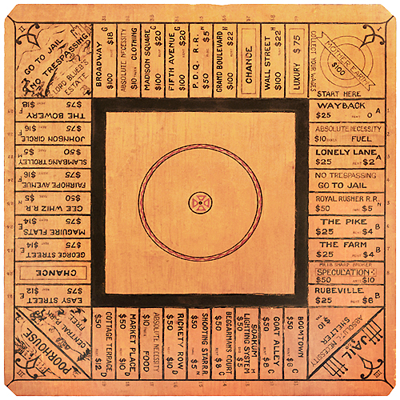
Lizzie Magie visited the village not long after its founding, and brought with her an oilcloth mock-up of her Landlord’s Game, which soon became a pastime among residents. While at Arden, she built a board for the game with the help of a resident carpenter. Biddle spoke solemnly of this alpha board; he estimated that it could be worth a million dollars.
We met at the village green and walked a few blocks, where we found the owner of the board, an eighty-year-old retired autoworker named Ronald Jarrell, standing outside his cottage looking nervous. Apprised of our visit, Jarrell had earlier in the day gone to his safe-deposit box at the local bank to retrieve the board. We entered his living room, where, amid a collection of antique china, jade statues, and old dolls, he laid out the prized artifact on his coffee table. Jarrell’s three yapping poodles made it difficult to talk.
“It was the summer of 1903,” he said. “A woman was down visiting here—”
“Lizzie Magie,” said Biddle.
“I don’t remember the name,” said Jarrell, “but she had an idea for a game.” He told us his stepgrandfather, a Georgist carpenter named Robert Woolery, had grown tired of playing checkers at the general store and needed new entertainment. Woolery looked over the plans drawn up by Magie on the oilcloth and immediately set about making the board.
Biddle held it up and nodded his head approvingly. It was hand-painted and hand-carved out of the backside of a reclaimed pressed-wood crokinole board, and it smelled like an old shoe.
I had earlier looked up Magie’s 1904 rule set, which she produced several months before she and Woolery completed the original board. Oddly, it contained no rule about forming monopolies out of the property groups, nor did it mention charging players higher fees after they’d built houses or hotels (constructions that also didn’t exist in Magie’s original rules). Nor was there anything about Henry George, land-value taxation, or the evil of rent. If the game was designed to teach Georgism, it seemed Magie hadn’t quite thought out the lesson. Two years later, when the game was officially published,the rules had evolved: the business principle of monopoly was fully established, as was the Georgist alternative of cooperation. Theories abound as to how the changes arose; one holds that someone in Arden had pushed The Landlord’s Game in the direction of Henry George, and also in the direction of the Monopoly we know today.
I asked Biddle about the discrepancy. “Ask the Monopoly monopolist,” he said.
“Excuse me?”
“Patrice McFarland. The Monopoly monopolist. She’d have all the answers because she is now the possessor of Lizzie Magie’s diaries. And a lot of other key stuff. But she isn’t talking.”
McFarland, I later learned, was a former exhibit specialist at the New York State Museum who in 1992 had received $25,000 from a Georgist organization, the Robert Schalkenbach Foundation, to produce a biography of Magie. In the ensuing years, Biddle said, she had acquired, along with Magie’s diaries, a trove of early Landlord’s Game prototypes handcrafted by players in Arden and elsewhere. But she had never produced her book, nor, according to Biddle, had she been willing to share the information or documents she’d amassed. “She’s a tough player,” he said. “I once bid against her on eBay for my 1939 Landlord’s Game. Bid almost $10,000.” (I called and emailed McFarland several times to ask about her alleged Monopoly monopolism, but she never responded.)
With us in Jarrell’s cottage was Mike Curtis, an Ardenite who twenty years earlier had played a round of Magie’s original 1906 Landlord’s Game (one of his opponents, as it happened, was Patrice McFarland). The Georgist rules by which Curtis had played were known as the Single Tax set, and they went beyond having players simply pay rent into Magie’s “Public Treasury.” They also aimed to teach the shared ownership of public goods. Under Single Tax rules, when the amount in the treasury reached fifty dollars, the player who owned the lighting utility was forced to sell it, and thereafter the utility cost no money to land on, as it was now publicly owned. This process repeated itself with the Slambang Trolley, then with the railroads, then with the Go to Jail space, which became a public college that, instead of sending players to jail, provided extra wages at the end of the game. After that, each fifty-dollar deposit in the treasury raised players’ wages by ten dollars. A “win” in Single Tax, which Magie later dubbed Prosperity Game, occurred when the player with the least amount of money had doubled his original capital. “The Landlord’s Game,” said Magie, “shows why our national housekeeping has gone wrong and Prosperity Game shows how to start it right and keep it going right.” Curtis admitted that he didn’t think much of the game, pronouncing it “kind of boring after a while.” [2]
In the summer of 1971, Ralph Anspach, a game inventor and retired economics professor who lives in San Francisco, emerged from a crushing Monopoly defeat in his living room—his eight-year-old son had bankrupted him—and found himself considering the salability of a board game that was explicitly antimonopolistic. “My game would have to start,” he wrote in a self-published memoir, The Billion Dollar Monopoly Swindle, “where Monopoly ends, when the board is full of monopolies.” The goal of play would be to break them up, with monopolists fighting off trustbusters. The game Anspach created, Anti-Monopoly, sold 200,000 copies in 1973, its first year of production, and was on pace to top 1 million sales by Christmas of 1974. Parker Brothers, at that time a subsidiary of General Mills, was not pleased. The company threatened to sue Anspach for trademark infringement. Instead, he preemptively sued Parker Brothers—“a sort of buckshot maneuver,” his lawyer called it—on the theory that he could show the company’s Monopoly trademark was invalid.
One of Anspach’s first discoveries as he built his case was the existence of The Landlord’s Game. But he could not explain how Magie’s invention, with its promotion of socialized land and shared wealth, had been transformed into the proprietary commodity that made billions of dollars for Parker Brothers. The key to the mystery, he learned, was a radical socialist professor of economics named Scott Nearing, who taught at the Wharton School of Finance from 1906 to 1915. Anspach spoke to Nearing in 1974, when Nearing was ninety-one years old. The professor said he had learned to play the game around 1910, while living in Arden, then taught it to his students at Wharton in order that they might learn, in his words, “the antisocial nature of monopoly,” and in particular “the wickedness of land monopoly.” The students apparently taught it to their friends. It was around this time that the game became known as “monopoly”—denoted in lowercase, like checkers, chess, or dominoes. The game spread widely over the next several years, to the hometowns of Nearing’s students and to other universities. It would slowly lose its antimonopolistic message, however, as players came to the conclusion that Magie’s vision of Georgist redistribution was not nearly as entertaining as ruining one another.
By 1913, monopoly had made its way to Altoona, Pennsylvania, and four years later it arrived in Philadelphia. The economist Rexford Tugwell, a future member of FDR’s “kitchen cabinet,” remembered having played it in 1915. By the 1920s, camp counselors in the Poconos were playing it, as were students at the University of Pennsylvania, Columbia, Harvard, Haverford, Princeton, and Swarthmore. During the early stages of the Depression, the game reached Indianapolis, where a Quaker schoolteacher-in-training named Ruth Hoskins played it. Hoskins soon traveled to Atlantic City and taught the game to two fellow Quakers, Jesse and Eugene Raiford.
The brothers were so taken with the game that they worked to improve it. Along with other members of the Quaker community, they changed the pawns to household objects: tie clips, hairpins, keys, thimbles. They changed the names and property values to reflect those of Atlantic City. Baltic and Mediterranean Avenues, slums in the Raifords’ hometown, became slums on the board; Boardwalk and Park Place, the carrefour of chic, became the most expensive deeds to purchase. The rules related by Ruth Hoskins stipulated that properties were to be auctioned when players landed on them; Jesse Raiford instead set the prices on the board. (This change later made the game marketable to children, who had difficulty understanding how auctions worked.)
The Raifords taught the game to a friend of theirs, Charles Todd, who taught it to its putative inventor, Charles Darrow. Sometime in 1932, Darrow copied the layout of the board, the rules of play, the property names, the deed values, and the Chance cards, and made his own version of the game. His only innovation seems to have been to claim the mantle of sole inventor. He would soon be assumed into the pantheon of American heroes of commerce.
The irony was not lost on Anspach. Before being monopolized by a single person working in tandem with a corporation, Monopoly had in fact been “invented” by many people—not just Magie and the Raifords but also the unknown player who gave the game its moniker and the unsung Ardenite who had perhaps aided Magie in advancing its rules. The game that today stresses the ruthlessness of the individual and defines victory as the impoverishment of others was the product of communal labor.
None of the information Anspach uncovered helped his case when it went to trial in 1976. The widows of Eugene and Jesse Raiford testified, as did seven other witnesses who claimed to have played monopoly as many as twenty years before Darrow marketed his game. Anspach even put Robert Barton, the former president of Parker Brothers, on the stand. Barton, who was pivotal in helping Darrow secure a patent for his “invention,” admitted under oath that he was fully aware of the game’s history and that he knew Darrow had not in fact invented it. The judge was unmoved. He dismissed Anspach’s complaint, ordering all unsold copies of Anti-Monopoly to be “deliver[ed] up for destruction.” Seven thousand of the games were bulldozed into a garbage dump in rural Minnesota, where officials from Parker Brothers oversaw the interment. [3]
After forty minutes of play, the game at Table 25 had stalled—or, depending on your view, was going along just fine, because no one had a monopoly and no one could raise rents. So Billy paid rent to Eric, who paid about the same rent to Doug, who paid to Billy, who paid to Trevis, who paid to Eric, who made a bad roll and briefly went to jail. Then Doug Herold landed on his third lucrative green property, allowing him to form a monopoly. He had enough cash on hand to build several houses, and one after another the players fell afoul of his outrageous rent hikes. Billy and Trevis handed over several properties in lieu of cash, giving Doug three monopolies. “You see,” he said, turning to me, “I don’t have to deal with these knuckleheads anymore.” There was no further need for trading, no need for the dynamism of the marketplace. He had done the work, built the houses, invested in the properties. Now he did no work, took no risks, made no investments. And yet wealth moved inexorably in his direction. When after ninety minutes time was called, Doug oversaw five monopolies and a wad of $10,293 in cash, more than half the money in the Monopoly bank. He was declared not only the victor at Table 25, but the all-around winner of the U.S. Steel tournament for the second year in a row.
I’d invited Richard Biddle to the tournament, and as Doug had started his run Biddle wandered off to watch the other tables. Every so often I could see him peering over the shoulders of the players, a pinched look on his face. He did not like what had become of Lizzie Magie’s invention. “My brother taught me how to play Monopoly when I was five,” he had told me. “It was pivotal in helping me understand the importance of lying, cheating, and stealing.” I’d asked him to bring along his reproduction of The Landlord’s Game, which he carried in a backpack. Earlier in the evening he had gingerly taken it out to share with whomever he could waylay. “This is the real Monopoly,” Biddle would tell the players, before attempting a sort of CliffsNotes explanation of what Lizzie Magie had in mind. The players nodded politely, their smiles freezing into nervous masks. “That’s very nice, thank you so much,” they said, and then they walked away.
[1] University of Missouri–Kansas City economics professor Michael Hudson has noted that property tax today functions in exactly the opposite fashion from George’s proposed single tax. The Federal Reserve Board is responsible for assessing the total market value of real estate in the United States, Hudson says, yet it routinely produces “nonsensical undervaluations of land.” In fact, the FRB mostly ignores land itself; instead, it considers buildings and capital improvements as the chief markers of value, basing its calculations on the historical cost of original construction and the replacement cost of structures. Land value is an afterthought. The amateur in the real estate marketplace need not read Henry George to know this flies in the face of common sense, the mantra being “location, location, location,” not “replacement cost, replacement cost, replacement cost.” Hudson has conducted some of the few authoritative analyses of the FRB’s sleight of hand, the tax losses that result, and how it benefits the finance, insurance, and real estate sectors, which together have lobbied the FRB to maintain its approach. [2] Curtis also didn’t think much of Arden’s Georgist experiment, saying it had degenerated into something of a failure. The leaseholders, he told me, had learned to game the system by electing land assessors who based their assessments on the town’s budget needs rather than the land’s real market value, and so they avoided paying taxes at appropriate rates. “To be frank,” he said, “the people in Arden today don’t give a damn about Henry George.” [3] Anspach twice appealed the decision, and in 1982 a California appellate court ruled in his favor, concluding that Parker Brothers had in fact committed fraud in the Darrow patent, and was thus under threat of losing its trademark. General Mills Fun Group appealed to the Supreme Court in 1982, backed by amicus briefs from nearly every major American industry group, including the U.S. Chamber of Commerce, the National Association of Manufacturers, the U.S. Trademark Association, the Bar Association of the District of Columbia, and the Committee on Trademarks of the Bar of the City of New York. The Court declined to hear the appeal. Anspach was nearly bankrupted, his house thrice mortgaged, his game business on the edge of ruin, his distributors unwilling to work with him because of a ten-year legal cloud. He was free, however, to continue selling Anti-Monopoly. In the past four years, he has sold 454,000 copies in European markets. Domestic sales, he says, have been comparatively small because Hasbro has used “its monopoly power to monopolize the Monopoly market” in the United States.
One thought on “This was published in HARPERS Magazine in October 2012 about the “Landlord’s Game” versus “Monopoly”:
I loved playing Monopoly as a child. And the article is right. Learning to play monopoly educated me at an early age to the evils of monopoly capitalism.








 AuntyUta